The Origin and Development of the Japanese
Concept of Omotenashi
著者(英)
Toshimi Aishima
学位名
博士(先端マネジメント)
学位授与機関
関西学院大学
学位授与番号
34504甲第697号
URL
http://hdl.handle.net/10236/00029068
Doctoral Dissertation
For Doctoral Degree
Kwansei Gakuin University
The Origin and Development of the Japanese Concept of Omotenashi
Doctoral research advisor: Professor SATO Yoshinobu
December 2018
Graduate Department of Advanced Management (Ph.D)
Institute of Business and Accounting
1
AbstractThe main purpose of this dissertation is to clarify the mechanism of creating customer value in omotenashi, that is the Japanese counterpart to hospitality. Here, the term “omotenashi” is not limited to the hospitality service or industry. Instead, I use the term in a broad sense. To make it more concrete, I start the first chapter with two everyday examples in Japan. First, at a karaoke party, even though there are no clearly specified rules, members all innately obey the unwritten rules, acting as if there are roles allocated to each individual participant based on their age and standing. When selecting a song, rather than a song one can sing well or wants to sing, participants choose songs that will fit the mood and flow of the occasion and venue. Though participants prepare for the occasion, they do not show off their ability. All the participants always “read the air,” and act properly. This is the core of omotenashi, based on sympathy and consideration. Everyone puts the whole value before his/her own interest. In addition, they feel pleasure for making contributions to enhancing the whole value. Indeed, as the party succeeds on the whole, in other words, the values of the occasion (“ba”) increase, each participant can get more value for him/herself. Then, why do they act in that way?
The other example shown to describe the spirit and behavior of omotenashi is a comfortable relationship between employee and customer at a long-established department store. The employees (irrespective of their department) are ready to do anything for the customer (irrespective of the purchase). It is not because they want to sell more or make a good impression on the customer. Rather, the
employees regard omotenashi as a spiritual discipline. And the customers appreciate the consideration. In the department store, employees and customers co-create the value of the department. Again, why do they act in that way?
These questions are important because the spirit of omotenashi links contemporary business practice with ancient tradition handed down carefully to the present. In other words, Japanese business practice has inherited the spirit (and behavior) of omotenashi, not superficially but in a profound sense.
In this dissertation, I go back to the typical scenes of omotenashi in the 7th century, to clarify the core and nature of omotenashi. The unique value creation of renga (chain poems) gathering is also discussed, as the literary genre played a great role to diffuse the spirit (and education) of omotenashi throughout the country. While I deal with historical documents and classical literary works for analysis, this dissertation pursues how the concept of omotenashi has had influence on contemporary business practice. Research
2
of the origin and development of omotenashi give us the key or viewpoint to approach some contemporary misunderstandings that may arise between service providers and customers.
This dissertation deals with three research questions. (1) What, how and why are customer values created in omotenashi? (2) How does the level of education on the part of participants have effects on the individual value in omotenashi? (3) How has the omotenashi spirit or mechanism been inherited by contemporary business practice? An additional question appeared as a result of the research: (4) What is the difference between omotenashi of a high context culture and hospitality of a low context culture?
First, as to the characteristics of customer value created in omotenashi, and the mechanism of creating customer value, analysis of the value of participation in the banquets in the 7th century leads to the findings as follows: in the banquet, the participants prioritized the value of the whole place, or “ba” rather than their own (selfish) purposes related to exhibiting their skill and getting acquainted with influential persons. They voluntarily attempted to enliven the atmosphere and enhance the whole values of “ba.” Participants were required to do these things:(a) to read the consideration of the host, including the intention of omotenashi which was implied in things or decoration, (b) to play their roles (according to implicit rules), make their poems suitable for the occasion, and behave properly. They should make efforts to boost the mood based on “kata” (or a formalized set of behaviors) to respond to the host’s concerns, and (c) to read the air with each other. Participants felt satisfied and pleased when they recognized the enhancement of the value of “ba,” and when the participants thought that they themselves were engaged in, or contributed to, the enhancement of the value of “ba.” Peoples in the Manyo era share the spirit and behavior with us today.
Regarding the second research question, the individual values of participation depend on whether the customer has a high level of education or not. Omotenashi behavior of the provider is often conveyed indirectly and implicitly. In addition, omotenashi is usually carried out by following the "kata”, but the meaning lies in breaking the “kata” a little. The guest is expected to have a certain education to recognize where and why the “kata” has been broken, which is important to understand the host’s feelings.
As to the third question, I introduce the example of Mitsukoshi Department Store, which has the roots of their customer service in the spirit of omotenashi, in the sense that the employees put the value of the whole store (Mitsukoshi) before their own sales. At Mitsukoshi Department Store, customers who experience the omotenashi behavior from the employees often treat other customer in a similar way;
3
Here the omotenashi behavior from the employee to the customer develops into the omotenashi behavior between customers. In this section, Modified Grounded Theory Approach (M-GTA) is applied to analyze the letters of gratitude rom their customers.
Regarding the fourth question which arouse as a result of the research, on the difference between omotenashi of high context cultures and the hospitality of low context cultures, I conducted a comparative analysis between the Imperial Hotel, the Ritz-Carlton Hotel, and Kagaya, a traditional, high class Japanese ryokan or inn. On a superficial level, they have much in common between the Japanese style of omotenashi and the western style of hospitality. However, there is a difference. Hospitality behavior in a low context culture is easy to understand while omotenashi behavior in high context culture is not. In hospitality of a low-context culture, the customer is not expected to have knowledge of the kata or consideration, and thus, the hospitality behavior is understandable for anyone. In contrast, omotenashi depends on the customer’s comprehension, as it is based on the assumption that host and guest share the context. When the behavior is understood properly, it will bring deep emotion. When customers decipher the implied omotenashi and express their feelings (for example, gratitude, joy, etc.), the employees will get a deep pleasure beyond financial rewards. And it will lead to further motivation for the employee, and to further engagement on the part of the customers in turn.
The main practical implications of this research are as follows. it is important for every participant to feel that he/she is contributing to the whole value of “ba.” Thus, it is advisable for the staff and managers that they should introduce some systems in which every participant can make a contribution and feel satisfaction. Regarding rewards, people with an omotenashi spirit are intrinsically motivated to provide excellent service for customers. On this point, it is not preferable that managers put too much emphasis on the financial rewards for the employees. Instead, they should attempt to make effective systems for employees to improve their intrinsic motivation.
As to limitations and future directions, I did not discuss shitsurae, or the space where omotenashi activity is conducted. In this dissertation, it was necessary to focus purely on the relationship between the customer and the provider.
I believe the spirit of omotenashi connects to the very concept of the Japanese language in essence. In the future, I would like to pursue this research on omotenashi together with other scholars of Japanese linguistics and comparative linguistics and compare approaches and findings, especially with a view to improving cross-cultural communication.
Table of Contents
Abstract
Ⅰ Introduction………...….1
1 Purpose of the Study………..…1
2 Structure of this Dissertation with Research Methodology and Theoretical Framework……..…7
Ⅱ Review of Previous Literature………..…...11
Ⅲ Similarities of Omotenashi in the Man-yo-shu Banquet and a Modern Karaoke Party……..….17
1 The Origin of Omotenashi in Man-yo-shu………...17
2 Characteristics of Omotenashi in a Karaoke Party………..…………... 35
Ⅳ Omotenashi in the Heian Period………...46
1 Omotenashi at Court……….…...…46
2 Impression Management Seen in The Tale of Genji………..….……….…....63
3 Comparison of the Banquet of Genji with the Banquet of Jane Austen’s Works…………..…..82
Ⅴ Omotenashi in the Renga Gatherings………..………..….87
1 Omotenashi in the Renga Gatherings in Comparison with the Man-yo Banquets…………... 87
2 Mitate Which Determines Customer Value………...… 101
Ⅵ Chanoyu as Culmination of Omotenashi………..…...117
1 Sen-no-Rikyu as the Innovator of Chanoyu……….………..……..….. 117
2 Sukisha in the Modern Times……….…141
3 The Marketing Strategies of Urasenke……….……..152
Ⅶ The Spirit of Omotenashi Inherited by Contemporary Business Practice………...….….166
1 Omotenashi as Customer Service Provided at Mitsukoshi Department Store……...………. .166
2 Similarities and Differences Between Omotenashi and Hospitality………….…………...…183
Ⅷ Conclusion……….……196
1 Ⅰ Introduction
1-1 Purpose of this Dissertation
The main purpose of this doctoral dissertation is to clarify the mechanism of creating customer value in omotenashi in Japan, while also clarifying the influence of omotenashi on contemporary marketing and business practices in Japan. In the research, another theme will appear and be discussed on the differences between omotenashi in high context culture and hospitality in low context culture.
I would like to start this chapter by introducing the following two scenes.
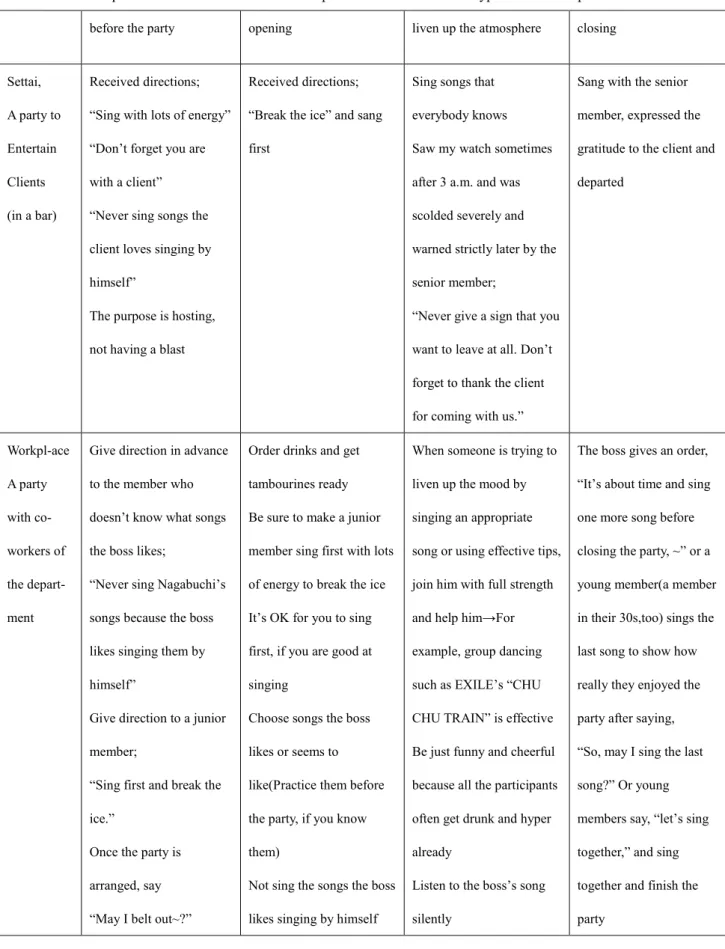
Scene 1. A karaoke booth in a business district. Five or six men and women in their twenties to forties wearing suits are gathered for an uchiage (job-well-done party) for their team. The oldest is in his 40s and appears to be the seniormost person. A young man spontaneously orders food and drink for all the members and another man in his mid-twenties takes the mic first. "Today, can I sing XX!?" It’s a song that everyone knows, with a good tempo. He isn’t a good singer, but he has a powerful voice which suddenly enlivens the place.
More songs are sung one after another with everyone taking turns at the mic. The younger members get excited, sing along and dance to songs by pop groups like AKB48 and EXILE. And then, at just the right time, someone chooses a song and people ask him to sing his specialty song: "Chief, please sing this! It’s the one you always sing!" "Sing it, chief!" All the members know this, so when the seniormost person is there nobody else will ever sing that song. In addition, it is an unwritten rule to sit still and listen attentively when someone sings. However, people may clap to the beat sometimes.
After a while, ballads and slow songs are performed, and people are prompted by those around them to join in singing duets. There are even some songs that people seem to have been practicing for this occasion. At one point, a young member takes out his mobile phone and is disciplined. It is against the rules to look bored at a karaoke party.
Finally, the seniormost person says, "I guess it's time to leave. Okay, let’s sing something and call it a night." He appoints another young man to choose the last song, which has a good rhythm and with which everyone can sing along. Whether or not they can feel satisfied that the entire evening was "fun" rides on this last song. Everyone knows the young man’s intention, so they start humming together. When only men are present, they sometimes choose the kind of song that will have them putting their arms around each other's shoulders and raising their voices. When it is over, they say to each other
2 "good job" and "thank you” as they prepare to return home.
This is a very common scene in Japan. Anyone who has worked at a Japanese company has done this at least once. Pointing out its characteristic elements, we see the following: even though there are no clearly specified rules, the members all innately obey them, acting as if there are roles allocated to them based on their age and standing. When selecting a song, rather than a song one can sing well or wants to sing, they choose songs that will fit the mood and flow of the occasion and the venue. Everyone (with no exceptions) makes an effort to make the occasion exciting (and, moreover, they do it naturally). They make preparations in advance to enliven the event. Despite this, they do not show off their skill. Rather than emphasize themselves, they follow the mood and back one another up.
Scene 2. A long-established department store in Nihombashi, Tokyo. At the sales counter of a watch retailer, a customer is asking questions about repairing his deceased mother's watch. A female clerk is explaining everything to her with a smile and in great detail. She even writes down the things that are difficult to understand and gives these notes to the customer. The customer bows and says, "Thank you," before leaving with a relieved expression. "Please come back if you have any questions," the clerk says with a smile, seeing her off even though the customer did not buy anything.
At a different sales counter, a clerk learns that the product a customer wants to purchase is not in stock, so the clerk without hesitation calls a nearby rival store to inquire. When the clerk learns they have it in stock, she shows the customer a map and explains how to get there. "Route A is shorter, but since it is raining you may want to take route B to avoid getting wet." The customer says with a somewhat apologetic face as he bows and leaves, "That’s a great help. Sorry I couldn't buy it here. I will come again.” The clerk smiles and replies "On the contrary, I apologize for causing you trouble by not having it in stock".
On another floor, a customer says with a smile to the clerk, "I am not in a hurry, so please help that other person first." Whether a customer is buying a 200 yen item or a 20,000 yen item, the clerks still treat them with the same friendly and respectful service.
The clerks smile at everyone and display no sign of "trying to sell things." They are endlessly polite and friendly. They sincerely attempt to meet the customers' desires, their attitudes do not change based on whether or not customers make purchases, and they tell them "please feel free to come again
3
anytime." Customers bow their heads and say "Thank you" to such clerks. The customers are also considerate and thoughtful toward each other. Both the clerks and the customers seem to be satisfied with the store. They really relish such a pleasant atmosphere.
The examples above describe a karaoke party and department store customer service. Although they appear to be unrelated on the surface, the two of them share a common feature, which is deeply related to this research. Let us consider these two scenes once again.
It is the fact that the first scene is not unique to the modern office worker. The Japanese people of 1,200 years ago also participated in the same kind of parties, followed the same unspoken rules, and enlivened the atmosphere together. We can see this in the poems made at banquets of the time, which comprise most of the world’s oldest anthology of verses called Manyo-shu, which was compiled in the Nara period. For the participants, understanding the unspoken rules was a requirement for forging their careers. Because the rules were unspoken, "whether one knew them or not" and "whether one could act appropriately or not" were factors which separated insiders from outsiders.
Looking at the second scene, attentiveness and a subtle consideration of the feelings of customers is related to the spirit of chanoyu, the tea ceremony. At chanoyu gatherings, the host always pays attention to the customers and reads the atmosphere of the room. Additionally, the customers understand and appreciate the attentiveness of the host. In the process of omotenashi, the host and the customers often exchange their roles—the host also receives consideration of omotenashi from the customer, as in the department store described above.
In all these cases, people are not adhering to their own benefits but rather thinking about those of others. Also, the other party understands and reciprocates it. When they behave according to the atmosphere and think about each other, it brings them pleasure as well. I believe that this is the true origin of the Japanese concept of omotenashi, and the key to explaining customer values created in omotenashi.
This research intends to clarify what, how and why customer values are created in omotenashi, while pursuing its essence, transformed and manifested in various ways up to the present through historical changes.
4
Even without mentioning the presentation of Japan’s 2020 Olympic bid, the country has presented omotenashi as a symbol of the Japanese nation. In actuality, Japan is noted for its measures to welcome tourists, and today omotenashi has become a fashionable term in this country. In addition to unique programs being decided upon in local regions, there has also existed since 2016 an "omotenashi standard certifications" system for businesses with outstanding service, as well as many other private sector research and support groups.
On the other hand, there is also an opposing wind beginning to blow against omotenashi, with opinions such as "Omotenashi is a form of coercion,1” “it is a mistaken strategy,2” or that "Omotenashi will not survive on a global stage3."
Examining each of these in turn, we can see that omotenashi has been used to express many different meanings. It can sometimes simply mean outstanding service. It can also mean “Japanese style” service. In a broader sense, it also refers to services in the tourism industry around the world. There are also times when customer service and reception are referred to as omotenashi. Or it may be regarded as synonymous with hospitality. In the average person's home, it is also used to mean inviting guests over for dinner.
Here in this dissertation, omotenashi means “treating others including (but not limited to) customers with respect.” It can be seen both in commercial settings and private circles, as Lashley(2000) suggested in dealing with hospitality.
Basically, omotenashi derives from “motenashi,” a noun form of the verb "motenasu."(“O” in the word is an honorific expression.) The verb "motenasu" is based on the verb "nasu" meaning "to treat as, or to do as," etc., with the prefix "mote" attached to it. According to Nihon Kokugo Daijiten dictionary, the prefix "mote" "gives a subtle nuance to the verb it is attached to, or strengthens the meaning." To translate this, it would mean "take a certain attitude intentionally, do one's best to respond to others, handle something with care." In a dialog with sociologist Tetsuji Yamamoto, The Tale of Genji researcher Sadakazu Fujii focuses on the "mote" in "motenasu," promoting the idea that it has the nuance of “being forced to hold or do something" by someone else. Furthermore, he suggested that the word "motenasu" itself made the relationship between speaker and the other person invisible and creates
1
For example, see Enomoto(2017)
2 http://u-note.me/note/47503562 3
5
a "completely undifferentiated" state with the lines between active and passive blurred. (Fujii, pp. 204-5) Though the word "motenasu" has been used to mean "to receive warmly" since the middle ages, originally it meant behaving intentionally in a certain way when placed in certain occasions or situations, or “ba.”
The vantage point of omotenashi research
Many researchers dealt with omotenashi from aesthetic and emotional standpoints focusing on chanoyu, but after the year 2000, it has been discussed within service and management of restaurants and hotels, as a category of marketing. Sato and Al-alsheikh (2014) showed that hospitality and omotenashi were not the same thing in their research when comparing Kagaya ryokan (one of the oldest Japanese inns famed for omotenashi) and the Ritz-Carlton. Kobayashi, et. al, (2014) adopted a "scientific approach” to classify value co-creation in Japanese style creative service provided at restaurants.
However, omotenashi behavior is not limited to specific places such as ryokan and restaurant--and neither is it fixed by the strict roles of "customer" and "service provider"--but rather observed in everyday settings involving everyone. With a sense of omotenashi, people behave properly with an awareness of "ba" with consideration for one another. The karaoke party mentioned at the beginning of this chapter is a good example. The participants were aware of the setting, obeyed the unspoken rules, and played the roles given to them. They were satisfied by their contribution to the whole atmosphere. Even though it was not overtly taught to them, they somehow know their role. They felt satisfaction to prioritize each other and make the whole “ba” pleasant. How and why did they behave in such an “omotenashi” way? What do they get from such behavior?
From those small questions, three research questions are derived for this doctoral dissertation. The first question is related to the mechanism of creating omotenashi: what, how and why customer values are created in omotenashi. The second one is related to education on the part of customer: how the level of education or knowledge of canonical literature influences the customer value. The third is related to contemporary business in Japan: how Japanese business today, especially the business of retailing as well as hotels, has inherited the omotenashi spirit or mechanism throughout the history.
I would like to deal with these research questions, since there is a dearth of study on the mechanism of creating customer value within a social and cultural context, though Lashley (2000) has pointed out
6
the importance of the viewpoint. When I consider omotenashi within the Japanese cultural context, it is necessary to pay attention to the role of the customer, which has been also omitted from the previous literature.
In this research I will deal with customer value in omotenashi, based on a broader sense of the word as described above, delving down into the culturally shared "spirit" rather than specific, commercial places. During the research, I will take up literary and cultural achievements as cases. Literature is generally seen to be a reflection of eras and societies, and manifests feelings and values among those.
Manyo-shu which I bring up in chapter 3, is the world's oldest anthology of verse, and it describes how Japanese people attended work-related banquets over 1200 years ago where they followed unspoken rules and shared social enjoyment. Renga that I discuss in Chapter 5 is a literary form wherein about ten participants take turns to add to a phrase written by the previous person to create a single poem together. In this case, rather than one person standing out, it is important to increase the value of the overall work, and being able to contribute to that gives one satisfaction. Furthermore, professional renga poets appeared in order to teach a wide social base of learners poem-writing know-how, which spread the literary form of renga from the daimyo to the common people. It is renga gatherings that provided the basis for chanoyu. If we are to say that chanoyu is the spirit of omotenashi, we should also consider the renga gathering, and furthermore banquet songs in Manyo-shu.
Traditionally, this level of attention has not been paid to literature in marketing research. My intention in this research is a multidisciplinary approach covering literature, comparative literature and marketing. I will discover the manifested forms of omotenashi and analyze them within the field of literature, which dynamically changes along with the times and society.
Before explaining the research question and the research methodology of each chapter, I will emphasize three points on the approaches to this doctoral dissertation.
First, although I adopt a literary and cultural viewpoint to my research, this research is not narrowly defined historical or cultural research but rather marketing research. In other words, literary genres and works are used as clues for analyzing how omotenashi manifests and changes within the Japanese cultural context.
Secondly, this dissertation covers history, but rather than focusing on phenomena of the past, it is written with an eye toward modern phenomena and issues of marketing. I believe that the essence of omotenashi, which I clarify in this research, can both directly and indirectly provide suggestions for
7
current problems surrounding omotenashi, as mentioned above. That is not all. Rather than just being superficial behavior, omotenashi as a spirit is still deeply engrained in modern Japanese culture, and it still impacts our form of communication. Omotenashi seems to be an essential element when thinking of corporate culture or value co-creation internally to and externally to a company.
Thirdly, rather than focus on the forms and industry-related omotenashi, I focus on the emotional core spirit which maintains omotenashi, possessed by both the providing and receiving sides. In this research, I focus on how the providing and receiving sides' behavior leads to successful omotenashi, and how to increase the value of an occasion, or “ba”.
1-2 Structure of this Dissertation with Research Methodology and Theoretical Framework
In this research, I apply qualitative research to clarify the characteristics of omotenashi, with a case study method. One of the theoretical frameworks I have based the whole dissertation on is the theory of high context culture/low context culture by Edward Hall (1977). The term high context culture refers to a culture which shares values, experiences, knowledge, etc. at an advanced level, wherein not all aspects of communication are explicitly stated, people understand unspoken subtexts from one another. Implicit meaning is valued, and vague expressions tend to be preferred. People are required to be able to read context. Japan is an example of a high context society. Conversely, a low context society prefers expressions that are explicit and easy for anyone to understand.
The other theoretical frameworks which I have utilized on are Service Dominant Logic by Lusch and Vargo, and Service Logic by Christian Grönroos of the Nordic school. In Service Dominant Logic, Lusch and Vargo introduce the idea of customer as cocreator of value. For them, “value is something that is co-created through the exchange, integration, and use of resources” and “the best that a firm can do is to provide a value proposition” (p.21). Grönroos puts focus on the roles of the customer as value creator, and concludes that “value for customers is created throughout the relationship by the customer, partly in interactions between the customer and the supplier or service provider. The focus is…on the customers’ processes where value creation occurs.” (p.13). It is necessary to examine these two frameworks from the omotenashi point of view.
8
research methodology employed for each chapter. At the same time, I will list first appearances.4
ChapterⅡ overviews the previous literature on hospitality, to show the necessity of dealing with the question of the creation of customer value from a cultural point of view.
In Chapter III, I deal with the banquets described in Manyo-shu, the oldest anthology of verse in Japan, to examine the characteristics of participants, including host and guests, of omotenashi. It is because the origin of the spirit of omotenashi seen in contemporary scenes can be traced back to the Manyo banquet. In other words, it is the prototype for omotenashi in high context culture, wherein people are considerate to one another, read situations, obey protocol and enrich or heighten their shared values at the same occasion. During the research, I clarify how the participants behaved to improve the whole values of “ba.” I also compare the Manyo banquet with a modern karaoke party to show that they share many similarities. Businesspeople today share the spirit of omotenashi with Manyo people, in that people prioritize the value of the whole “ba” over their own interests, and feel pleased to think they have contributed to enlivening the occasion.
The title, “The Origin of Omotenashi in Manyo-shu” is based on the paper, “The Origin of Japanese Omotenashi in Manyo-shu,” published in Business and Accounting Review 16 (2015), coauthored with Professor Yoshinobu Sato. “Characteristics of Omotenashi in a Karaoke Party” is based on a paper “The Characteristics of a Karaoke Party in comparison with the Manyo banquet and the Renga Gathering,” published after the proceedings of the national conference of the Japan Society of Marketing and Distribution (2016), coauthored with Professor Yoshinobu Sato.
Chapter IV deals with omotenashi in the Heian period. First, I analyze the omotenashi behavior of court ladies and the mechanism of elevating the values of their salon, from the B to C point of view. Court ladies waited on their mistress as well as entertaining visitors to the salon. They worked hard to improve their skills of communication and to enhance the values of the salon, or their mistress. Why and how were they able to work for the salon without stress from emotional labor, as Hochschild pointed out in The Managed Heart? Secondly, I deal with the impression management of the characters in The Tale of Genji, which is in considerable contrast to the theory proposed by Gardener III. It is important for this research because in omotenashi, participants are required to read the mood to make the “ba” pleasant, and the ability to read the mood is closely related to the success of impression management in
4
If a chapter is based on a previously published paper, it will include the figures and tables created in that paper unless otherwise noted.
9
the Heian period. This chapter concludes with a comparison of the values of the participants in the banquet in The Tale of Genji and in social events described in the works of Jane Austen.
“Impression Management Seen in The Tale of Genji” is based on a paper “Impression Mechanism for the Contemporary Japanese Based on the Analysis of The Tale of Genji” published in Kwansei Gakuin University Social Sciences Review,21(2017), co-authored with Professor Yoshinobu Sato. “Comparison of the Banquet of Genji with the Banquet of Jane Austen’s Works” is based on a paper presented at the Kansai Division of the Japan Society of Marketing and Distribution (2016).
In Chapter V, I discuss the process of the diffusion of the spirit of omotenashi with the spread of the renga gathering. Renga gatherings are important in three points: (1) The spirit and the essence of omotenashi rapidly prevailed due to the popularity of renga gatherings among commoners as well as the daimyo and noble classes; (2) In the renga gatherings, people should have a certain level of education in classical culture in order to be able to participate. The level of their education determines the values of participation, which is one of the characteristics of omotenashi; and (3) Renga is the predecessor of chanoyu, and masters of chanoyu in those days, including Sen-no-Rikyu, borrowed the philosophy from renga. I also deal with mitate, a rhetoric based on common education and sensibility between the speaker and the listener, because it shows the necessity of having a high level of education to enjoy omotenashi.
“Omotenashi in the Renga Gatherings in Comparison with the Manyo Banquets” is based on an article “Characteristics of Omotenashi in Renga Gatherings in Comparison with Banquets in the Manyo-shu,” published in Kwansei Gakuin University Social Sciences Review,21(2017), co-authored with Professor Yoshinobu Sato. “Mitate which Determines the Customer Value” is based on a paper published in the proceedings of the Marketing Conference of Japan Marketing Academy (2016).
Chapter VI deals with chanoyu as a culmination of omotenashi in high context culture. First, I clarify how Sen-no-Rikyu, the innovator of chanoyu, transformed the style of omotenashi. Sen-no-Rikyu ruled out entertainment at the renga gathering and added spirituality to it. Sen-no-Rikyu also made omotenashi difficult to understand, at least for a novice. Second, I look at the values of participation of chanoyu gathering for sukisha, who enjoyed showing off their collection of arts or chanoyu utensils. Third, I analyze the marketing strategies of Urasenke (the biggest school of chanoyu). Owing to Urasenke, chanoyu added new meanings, such as education in manners for girls, mindfulness, peacefulness, and its role as a symbol of Japanese culture. The ideas of chanoyu, “establishing unity
10
between host and guest(s)” and “frequent exchange of the roles between host and guest(s),” have been passed down to contemporary business practice, which is discussed in the following chapter.
Chapter VII focuses on omotenashi provided at a department and a hotel. First, I explore the mechanism of creating values between customers and employees in their customer service at Mitsukoshi Department Store: what kind of values are provided, how they create the values, and why. At Mitsukoshi Department Store, employees always place the requests of the customers before their own interests, or sales. And the customers appreciate the consideration of the employees. Their customer service leads to long relationships with customers, if not short-term sales. Here I analyze Gifts from Customers, which is a collection of gratitude letters sent by the customers in order to clarify how and why they establish such relationships with their customers, using the Modified Grounded Theory Approach (M-GTA). I interviewed three Mitsukoshi persons: Mr Masahiro Tsuzuki, who is in charge of training course, Mr Akira Ozawa, who is a symbol of the kimono floor, and Ms Kiyoko Kondo, “Okami” of the department store. I also conducted participant observation at Mitsukoshi Department Store: attended a morning assembly, a new staff orientation program, and so on. Then I compare the customer service of Mitsukoshi Department Store with that of Nordstrom which is also known for putting the customer first. What are the similarities and differences between those two department stores? In the final section, I analyze the mechanism of creating value and the system of realizing the value among four organizations: Mitsukoshi Department Store, Nordstrom, Kagaya (ryokan famed for excellent customer service), and the Ritz-Carlton Hotel, with the iceberg model proposed by Sato et. al. (2014), based on the theory of organizational culture by Schein (2010). After that, I focus on the Imperial Hotel, Tokyo, which started as western style in the Meiji era, but now which offers completely Japanese style of omotenashi service. The comparative analysis, with Gouldner's cosmopolitan/local theory, clarifies why and how the employees at the Imperial Hotel continue to improve their abilities as hotel persons, to provide omotenashi.
The structure of the whole dissertation is shown below. (figure1-1)
12
Ⅱ Review of Previous Literature
In this chapter I would review the field of hospitality research. First, I briefly mention the whole trend in research on hospitality marketing. There is a strong focus on a quantitative method research to various kinds of practical problems of hospitality industry. Qualitative method research is less visible in the field of hospitality research.
Second, I draw attention to the directions of the conceptual research in the field of hospitality. I share much in common with the scholars in dealing with the topic, and at the same time, I have found it necessary to work on Japanese concept of omotenashi.
The latter half of this chapter shows a couple of studies of customer value in the late 1990s to clarify the importance of discussing customer value within the cultural context—more specifically, in the context of the high context culture. I also refer to Service Dominant Logic and Service Logic, to which I owe my idea of “exchange,” and “co-creation of value.”
According to Morosan et.al. (2014), hospitality research became popular and increased in remarkably in number around 1990. Morosan et.al. (2014) summarized the major trends of the research in this field in 3 phases; 1989-1998, 1999-2008, and 2009-2013. In the first decade, hospitality scholars dealt with the various topics related to “the specific phenomena characterizing the industry, and “several directions for research began to emerge.” (Mososan et.al. 2014) In the years 1999 to 2008, the research of hospitality had greater degree of diversity. At the same time, more and more hospitality scholars tended to draw on quantitative methods. In the following decade, as the hospitality industry saw some great change in technology and styles, the scholars took interest in the practical problems, such as consumer behavior, using data analysis. (Morosan et.al. 2014) In general, in hospitality research, quantitative method has been popular by far among the scholars. Morosan et.al. (2014) mentioned that only about 10 per cent of the articles they reviewed used qualitative methods.
Yoo et.al. (2011) provided the analysis of hospitality research with classification of the topical areas according to the diversity of journals. Form the analysis, hospitality marketing research has been for most part empirical, and the majority of the researchers used a quantitative research design. Yoo et.al. (2011) pointed out that there were scarce attempts to “implement more conceptual rigor and central theories in general” and continued as follows: “the number of conceptual papers and researches that implemented
13
qualitative study designs decreased to a quite large extent…Overall, studies have progressed in practical research where researchers attempted to utilize various resources and challenged to test the existing subjects in diverse industries. Many researchers realized the importance and need of more theoretical applications and made efforts to replicate existing study topics in different service industries.” (Yoo et.al, 2011, p.529)
In sum, there has been a strong focus on a quantitative method research to various kinds of practical problems of hospitality industry. Qualitative method research is less popular, and conceptual research is even less popular. Then, has the necessity of conceptual research been left behind in obscurity?
Far from it, there are scholars shedding light on the concept and definition of hospitality in UK. Brotherton (1999) began his article named “Towards a Definitive View of the Nature of Hospitality and Hospitality Management” with the question; “what are hospitality and hospitality management?” and reviewed the hospitality literature, with a focus on definition of the word hospitality.
In the introduction to In Search of Hospitality, Lashley stated that “current interest in defining hospitality as an academic subject outlined in this book stems form a meeting held in Nottingham in April 1997. The meeting aimed to explore subjects of common interest amongst some of the leading researchers and writers in hospitality subjects within the UK.” (Lashley, 2000, xv-xvi) The book covered various topics, including domains of hospitality, structures and functions of hospitality from a social anthropological view, the hospitality trades, gender and hospitality, hospitality management, and education for hospitality. In his own article, Lashley also raised an interesting question about the definition of hospitality. He argued that the definitions of hospitality stated by the major organizations in UK are rather economic activity-based, and that we should consider hospitality in the wider contexts. Then, Lashley (2000) proposed three domains of hospitality; social, private, and commercial. They were independent of each other but somewhat overlapped. Especially, he put focus on the social domain and explained the necessity of study of hospitality in social domain in detail. According to Lashley, with some exceptions, “few hospitality academics…considered hospitality from historical, cultural or anthropological perspectives.” (Lashley, 2000, p.5) Here he specified the importance of study of hospitality from historical and cultural context.
Regarding “anthropological view of hospitality,” Selwyn (2000) defined the basic function of hospitality as “ to establish a relationship or to promote an already established relationship,” and acts of
14
hospitality as “[to] achieve this in the course of exchange of goods and services, both material and symbolic, between those who give hospitality (hosts) and those who receive it (guests). (Selwyn, 2000, p.19) He pointed out that in hospitality hosts and guests already “share[d] the same moral universe”, but at the same time, he clearly stated that “hospitality proceed[ed] by giving and receiving.” (Selwyn, 2000, p.27) For Selwyn, host and guests shared the same moral, but their roles were fixed. They were not exchangeable.
Another article in the same book is also worth mentioning. Telfer (2000) dealt with “being a good host” and discussed the role and motives of the host in detail, though she mentioned neither “being a good guest” nor the role of the guest. It is needless to say, the role of the guest, as well as that of the host is important in omotenashi. It made me reaffirm that importance of discussing the idea of “being a good guest” in the field of hospitality.
In an article titled “Discovering hospitality: observations from recent research” including the response to his earlier book published in 20001 , Lashley (2007b) put much emphasis on the concept of “the relationship between hosts and guests” in the study of hospitality. He wrote as follows: “at s social and cultural level, different societies require varying degree of obligation to be hospitable with duties and obligations on both guests and hosts. Importantly, these obligations do change over time as a result of a “modernity” or increased contact with tourists.” (Lashley, 2007b, p.215, emphasis in original.)
As seen above, I have found some perspectives in common with the scholars who work on the conceptual research of hospitality. First, I agree to their focus on the relationship between host and guest, as it is one of the most decisive elements of omotenashi. Second, I share the interest in the hospitality in the social, cultural context. I believe the research of the other concept of hospitality, or Japanese concept of omotenashi, will make a contribution to the field. Third, I agree with them in the attempt to utilize various kinds of literature, including literary works. Morrison and O’Goman (2008) implied that there could be various disciplinary approaches to the subject of hospitality. It is desirable that we should make the most of the results of other academic field to explore the subject in marketing. Fourth, I found the term of “being good host” much intriguing. In omotenashi, it is not only host but also guest that has responsibility. Thus, guests are also required to be good guests, to realize the value of “ba” of omotenashi. In addition, the roles or requisite qualifications of hosts and guests are not fixed. Host is required to be
1 Lashley admitted the book was met with a mixed reception. Some academics showed somewhat “hostile”
15
good host and good guest in a sense, while guests are required to be good guests and good hosts, as stated by tea masters. The unity of host and guests improves the values of omotenashi.
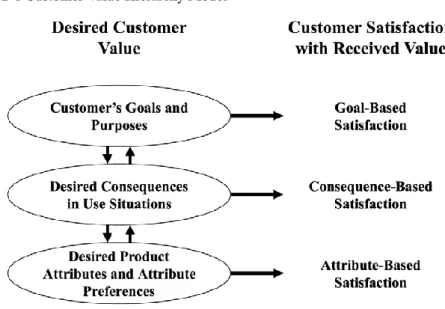
Then, it is time to look at the previous literature dealing with the concept of value especially of customers. Two scholars discussed customer value respectively. Woodruff (1997) shows customer value hierarchy model (Figure2- 1).
Figure 2-1 Customer Value Hierarchy Model
(adapted from Woodruff,1997, p.142)
According to the customer value hierarchy, the value of customer depends on whether and how his /her own purposes are fulfilled. In contrast, in the scenes of omotenashi, there are few people who have clear purposes to achieve, and even fewer who stick to realize them. Participants of omotenashi enjoy cooperating with each other to enliven the “ba”, as seen in the karaoke party described in Chapter1. It is also important to remember here the typology of Holbrook (1999). In introduction to Consumer Value, Holbrook classified the consumer value into 8 types as below. (Table 2-2)
16
In the typology of consumer value, there were listed efficiency, play, excellence, aesthetics, status, ethics, esteem, and spirituality for each category. Here again, I had an impression that some adjustment would be needed to apply the typology to Japanese customer. For example, for Japanese customer, the axis of “self- oriented vs other-oriented” seemed rather stiff. Remembering the scene of karaoke party, participants felt pleasure when they succeeded in enlivening the occasion tighter with other participants. They enjoyed themselves, and at the same time, they enjoyed contributing to the whole “ba”. The typology of Holbrook could not explain it. Thus, there is a necessity to explore another typology of consumer value suitable for high context culture.
After 5 years from those discussions of customer value, a radically new concept of customer value emerged, changing completely the environment among the concept of value.
Vargo and Lusch (2004) introduced the idea of value as something collaboratively created through the exchange among the multiple parties. In Service Dominant Logic, the focus was put on the process of co-creation of values with the customer as a beneficial actor. Then, it seemed to be unavoidable for us to clarify which kind of value was created and how. Thus, this dissertation discusses the mechanism of creating customer value, starting with clarifying the contents of customer value as well as the process of creating values on the part of customers.
17
a service provider, is or feels better off than before.”(p.12) In this sense, he focused on “value for customers and the service provider’s capability to support its customers’ process in a way that enables the customers to create value and achieve their goals.”(p.13) In other words, he cast a spotlight on the relationship between the customer and the service provider as the place of customer value creation. Grönroos also applied the term of “sphere,” that is, sphere of customer, provider, and both (joint sphere) to explain the value generation. The ideas of process, relationship, and place would be of a great use to examine the customer value in omotenashi. It is also worth mentioning that Grönroos (2015) referred to the “role of customers,” though in this context, the term of “the role of customers” rather meant “function of the customers.” Here he did not step into discussion of the “role” as responsibility for creating more values. In the Japanese idea of omotenashi, the roles of the host and the guest are exchangeable, and in this point the host (provider) and the guest (customer) are more closely related than in the explanation by Grönroos.
In this dissertation, being based on those frameworks, I would consider the relationship between the participants of omotenashi: what kind of relationship the customer is supposed to build with the host for success of the banquets, for example. Bearing in mind the host-guest relationship in chanoyu, it seems possible to think there is a unique relationship between the customer and the host in Japanese concept of omotenashi.
Other questions would appear: where is customer value generated? does the customer value depend on the joint sphere? how is the value created? what has influence on the customer value? and why? I would deal with those questions in the following chapters.
18
Ⅲ Similarities of Omotenashi in the Man-yo-shu Banquet and a Modern Karaoke Party
1 Characteristics of Omotenashi in the Man-yo-shu Banquet
1-1 Introduction
Japanese concept of omotenashi is generally considered to have been based on chanoyu, Japanese tea ceremony, which was established by Sen-no-Rikyu in the16th century. (Sato et al,2014; Sato and Parry,2015). In this dissertation, I build a hypothesis that Japanese omotenashi has roots in the banquet, utage, described in Man-yo-shu, the oldest anthology of verse. The word utage is traced back to uchiage, which means to finish a particular task successfully. The custom of utage or uchiage can be seen even today. Business persons usually have a drink together with their team after a task, and then as after party they enjoy karaoke, which requires the participants some tacit rules of omotenashi to enjoy.
In this way, utage in Man-yo-shu has continued on to today’s after party. In fact, the root of utage is uchiagu which means to finish a particular task successfully. In those days, it took a lot of efforts by many people to hold a ceremony or ritual. A banquet, utage, was held to appreciate their cooperation and to put an end to the event (Ueno,2014, pp10-11).
In this chapter, I analyze the formal banquet, utage, the origin of Japanese concept of omotenashi. Specifically, the roles of utage in community and the benefit given by utage to the participants are to be analyzed in the point of service dominant logic (Vargo and Lusch, 2004; Vargo and Lusch,2008), service logic (Grönroos,2008; Grönroos and Gummerus, 2014), customer dominant logic (Heinonen et.al.2010; Heinonen et.al.,2013;Rihova et al.,2013;),or experience marketing research (Conway and Leghton, 2012; Helkkula et.al.,2011; Holbrook, 2005; Holbrook,2006; Holbrook and Hirshman,1982; Holt, 1995; Tynan and McKechnie, 2010; Verleye, 2015).
For the concrete problems, I compare between the features of customer value of co-creation that is shown in the study of the Latin School of Societing (Cova,1077; Cova and Cova,2002) , application of Turner’s theory of communitas (M Ellis,2011; Kim and Jamal,2007; Rihova,2013), and the study of brand community (McAlexander et.al.,2992; Muniz and O’Guinn,2001; Schau et al.,2009) and the features of utage in Man-yo-shu as community and those of value co-creation. This chapter is to analyze the customer value of co-creation in high context culture, which has not been discussed in
19 previous research.
1-2 The Characteristics of the Utage in Man-yo-shu 1-2-1 Overview of Man-yo-shu
In the beginning, I would like to show the features of shu in historical context. Man-yo-shu, Japan’s oldest anthology of verse in existence, consists of twenty volumes. It contains forty-five hundred poems in total, most of which are fixed form of short poems as waka, made by a broad range of people from emperors to commons, from eastern areas to Kyushu area. There are many mysteries about establishment of Man-yo-shu: who edited the great collection, when, why or how has not been clearly unraveled. Roughly it is said to have been completed in the end of Nara period through several editing stages.
The anthology has three main categories: general poems love poems, and elegies. General poems indicate those made in public or formal settings such as banquets and ceremonies. Most of love poems were meant to entertain the others at some parties, rather than describe a person’s sincere feelings to the one’s beloved. Again, elegies were to express not one’s private feelings but their common sorrow (Kajikawa,2000, pp. 176-86; Furuawa,2004, pp. 17-28, 31-33; Iwashita,2014, pp. 2-14).
Usually the poems of Man-yo-shu are divided into four periods. The first period, from 630 to 672, is the turbulent one before the establishment of the centralized administrative system. Internal disturbances were often brought out. Emperor Tenchi and Princess Nukata were particularly famous for their powerful poems. The second period, from 672 to 710, was stable one with the elaborate legal codes. Kakinomoto-no-Hitomaro is one of the well-known poets during this period. The third period, from 710 to 733, is the early Nara period, saw the perfection of legal code system. In the court, the aristocrats were rigorously ranked according to the descent or the family. Yamanoue-no- Okura is the one of the most talented poets. The fourth period, from 733 to 759, is the latter Nara period when the persons in power reached a political deadlock and transferred the capital repeatedly. Ootomo-no-Yakamochi represents this period.
1-2-2 Utage in Man-yo-shu (1) The Significance of Utage
20
personal feelings. However, since around 2000, many scholars of Japanese literature have attempted to focus on the situation of making those poems, especially utage, banquets. Surprisingly, there are about ninety associated words of utage in Man-yo-shu, for instance, poems for praising sake, for enjoying party, for dancing and singing, for leaving party.
The number of the assumed utage poems, which mean those made at the banquet or for it, amounts to 270. In this point, Ueno wrote that main part of Man-yo-shu was poems made and presented at banquet (Ueno, 2014, pp. 16-17). In those days, the significant political matters were decided and administered at conference at the court, after which they always had a banquet. Thus, utage was naturally considered as political situation where the members could conform their solidarity (Asano, 2005).
At the banquet, as well as ceremony, the attire, the seat and the order of greeting, addressing and utterance were strictly prescribed. Poems were important as tools to display political hierarchy. The participants were required not to express their personal feelings in poems but to play their own parts as official, public existence. In other words, they should make poems most appropriate to the mood of the place, caring about the purpose of the banquet and relationships among the members. However, they had no documented rule for such complicating situations. It was crucial that the participants should know the implicit rules, that is, the cultural standard which each member was supposed to share. Assessment of the situation preceded the artistic talent, though the skillful poems spread among the court to become necessary knowledge for attending a banquet (Sasaki,2007, pp. 62-67; Kajikawa,2013, pp. 8-9).
(2) Historical Background
It is from the latter of 7th century that utage, the banquet, was held with such connotation as above. Historically, there are two factors. First, utage can be traced back to Emperor the banquet with firewood started by Emperor Temmu, who had won the severe battle against the other successor to the crown. It was crucially necessary for Emperor Temmu to appreciate his followers for their pains on every occasion, try their loyalty, and to prevent their betrayal. To be short, he was definitely urged to maintain the relationships. Utage was the most useful occasion for him to confirm their political solidarity.
In 675, Emperor Temmu held a banquet by fire, together with the high officials who had brought firewood into the court on January 3. After that the banquet was institutionalized, and in the Nara
21
period it became an annual event. At the banquet, sake and food was served to the participants (Murai,2005, pp. 70, 73-77). Since the government was established without disturbances, emperors held banquets to offer their hospitality to the bureaucrats and to make the government more stable (Ueno,2014, pp. 88-89).
Secondly, the development of bureaucracy should be pointed out with reference to the popularity of utage. In the latter half of the 7th century, the basic frame of legal code system was introduced to Japan. Under the new system of bureaucracy, the human relationships were stratified according to the order. The hierarchy was visually shown by the color of their clothes and coronets. Banquet and ceremony was held frequently as effective to fix and keep the vertical relationships. Private banquet as well as public were held in many places, including ministers’ mansions. Almost all of officials were ready to attend the banquets to keep the connection for promotion. Then, why was the connection or human relationships important for promotion in those days?
In China, the emperor started kakyo, the system of standard examinations for higher officials, in which the emperor himself had the power to determine the passers, and to control directly all the bureaucrats, while in Japan, the system was not established. Certainly, there were examinations for employment and promotion, for which only limited boys could apply. In the meanwhile most of the positions of candidates for higher officials were occupied by a few big clans. Since then on, the government position became a family occupation, passed down to their heirs. For instance, there was a system that higher positions were given to the descents of the higher officials or powerful family without examinations nor accomplishments. As they could not expect to be promoted through their performances, those who wanted to get high position had no alternatives than keep their connection to some influential persons at banquets (Murai, 2005, pp. 13-16). For detailed explanation of bureaucracy, see Kanegae (2008, pp. 164-75).
(3) The Purpose of Utage
They had utage for the political purpose as well as for enhancing mutual friendship. For the political purpose, utage was helpful to discriminate between followers and enemies. At utage, people gather with common backgrounds to confirm their own faith: that is, they made certain that every participant belonged to the same faction without any secrets. In the Nara period, they had so bitter struggles for power at all times that formal banquets were regarded as occasions to detect their enemies. Consequently, the priority was put to the question if they share the same values.
22
They had utage for another purpose, that is, for pleasure. In some cases, they heartily enjoyed banquets, such as second parties to formal one, welcome parties or farewell parties. Even in these cases, they should not forget the vertical structure. They had to liven up the mood of the banquet according to their positions. If a person had an ambition to show his talent by making an excellent poem, he should stick to the order of precedence as other participants.
(4) Three Types of Utage
The banquets could be divided into three types by the host and guests: (1) the emperor and the high officials, (2) the high officials and their followers and colleagues, and (3) the provincial governors and local managers.
The main purpose of the utage held by the emperor as host was to strengthen the mutual confidence. The emperor asked for some poems; the high officials as guests answered by good poems to praise the emperor. When the high official held an utage as host to invite his followers and colleagues, they had other purposes as well as to strengthen the unity. The host was to demonstrate his power through some elaborate tastes and designs, while the guests were to show their intelligence. The provincial governor held banquets as host to entertain the local managers of the area, because in those days the income of the provincial governor largely depended on the cooperation of local managers.
At utage, basically the hosts had overwhelming power to the guest. There was a definite pattern for utage. It is certain that in some cases they were said to enjoy casual parties, but they were not free of rules. The food and drink at seasonal utage at court was provided by government, according to the legal code, Yoro-Rituryo (Ueno,2014, pp. 76-77).
1-3 Kata and the Way of Enjoying Utage
There was a pattern to the order of poems at utage, from the first greetings between the host and the main guest, to the farewell note. Everyone at the utage, including the host, should follow the rule in making poems, that is, what kind of poems were to be made by whom at which point in the process. 1-3-1 The Process of Utage
In the beginning, the host and the main guests exchange their greetings. The host should express in a poem his appreciation of the guests who were good to come all the way to such a poor place. The main guest should respond to it with saying in a poem that it was a great pleasure for them to visit such a beautiful mansion. Then, the main guest should praise the host in a poem.
23
In the third stage, every participant made a poem in concert with the intent and design shown by the host. In the fourth stage, someone made joking, playful poems as well as those for a change. They often quoted some old poems without any reference to the original poets. It shows that they lacked consciousness of originality or authorship.
In the fifth stage, they attempted to appear most reluctant to part with each other. The guest said, in a poem, that they must leave. The host asked urgently him to stay longer. After some more drink, the host put an end to the banquet with a poem, in which he expressed his unwillingness to say good-bye. The pattern of the utage as above has been accepted by general scholars in Man-yo-shu (Ueno, 2014, pp. 38-40).
1-3-2 Examples of the Process in Utage
In this section, the eleven poems made at the utage held by a promising bureaucrat, Naramaro, are to be introduced with the brief explanations. Naramaro was a son of the political magnate in those days.
In the first place, Naramaro, the host made two poems as follows.
1-I have brought a twig of yellow leaves, as it is a regret to let it wither.
2-Now I adorn my hair with a twig of yellow leaves that I have gotten in the rain to show you, since you are my dearest guest.
In both poems, he expressed his joy and gratitude to greet his guests, and at the same time, he showed them the keynote of the utage, namely, the twig of yellow leaves. Then, the main guest, Princess Kume made a poem, adorning her hair with the twig of yellow leaves, to greet the host. 3- I am happy to have the twig of yellow leaves that you have gotten in the rain.
It was followed by the fourth poem by Nagano-Imiki-no-Otome, a waiting maid for Princess Kume. She praised Naramaro, using the same phrases as him.
4- It is you, beautiful man just like the elegant twig of yellow leaves that are the dearest person for me.
The fifth poem made by Inukai-no- Sukune-Yoshio, a young official, changed the mood. 5- In Mt Nara, the yellow leaves start falling. The autumn season seem to be mature.
He described the beauty of the season, agreeing with Naramaro who proposed the seasonal motifs for the occasion. The sixth poem was made by Inukai-no- Sukune-Mochio, a younger brother of Yoshio. Mochio expressed his satisfaction and gratitude to the host.
24
6- Even if the leaves start falling, I have no regrets, as I could attend this utage and have such a beautiful twig.
Then, Ootomo-no-Fumimochi, a younger brother of the Yakamochi, made a poem.
7- In the darkness of the mountain, many leaves flow probably one after another in the creek in this evening.
The participants are reminded of the scenery of the yellow leaves flowing in the dark. The eighth poem by Miteshiro-no-Hitona expressed the satisfaction more directly. 8- I have totally enjoyed the utage. Now I don’t bother if the leaves are to fall. The ninth poem by Hada-no-Kohemaro described his contentment with a joke.
9- I am so satisfied with the utage. I don’t mind if the leaves are falling, as my love is adorning the twig.
In this poem, “my love” referred to Nagano-Imiki-no-Otome, an old woman. It is said Kohemaro meant to amuse the company as improvisation.
The eleventh poem suggests that the utage approached the end, reflecting the mood. 10-Yellow leaves are falling as the cold wind blows, I suppose.
Ootomo-no-Ikenushi, the poet, was a little older than the others at the utage. The last poem was made by Ootomo-no- Yakamochi, describing the mood cleverly.
11- How I wish the daybreaks wouldn’t come tonight, as we are now heartily enjoying being our company, Comrades!
In this poem, Yakamochi emphasized the friendliness and reminded afresh the participants of the satisfaction of being a member of the circle. He made his ending poem on behalf of all the participants. It was considered totally appropriate to his role at the utage.
1-3-3 The Characteristics of Enjoying Utage
In this section, the two sides of the characteristics of enjoying utage are to be explained.
First, there is the physical side of enjoying utage, in other words, shiturae of omotenashi. In general, utage was held in a great mansion with a large garden. In those days, the gorgeous garden was considered as a symbol for a great emperor in China. Thus, in Japan, people thought they should have great gardens with beautiful ponds and plants to join the civilized countries. It could be associated with the idea of Rokumeikan in the Meiji period, where Japanese government attempted hard to join the
25
powers by introducing hurriedly the western ways of living. In the Nara period, they held some banquets to host some honored guests from foreign countries. At the banquet, the garden was the place of ceremony. High official attempted to adopt the state-of-the-art culture from China. They competed in making elaborate gardens with beautiful ponds and seasonal flowers and trees, which were often transplanted in accordance with the purpose of the banquet (Saito, 1990, pp. 56-76; Ueno, 2003, pp. 77,81-89; Ueno,2010, pp.145-50).
One of the most important techniques used to enjoy those gardens is mitate. Mitate means finding some similarities between two things that seem totally different. For instance, they took a small island on the pond as a legendary mountain in China. Or, they were reminded of an inlet of an ocean when they saw the rock arrangement in front of them. It needed a high level of wit and culture. The cultural tradition was handed down from generation to generation, to reach a unique development (Kayano,1996, pp. 25-35).
When holding a banquet, they put an emphasis on shuko, the ingenious design or contrivance. For an instance, a minister had a temporary country house built in the fashionable garden to entertain the guest. In this contrivance, he showed that he had been eagerly prepared for the guest and made an auspicious work associated with a good harvest. The guest was successfully satisfied with the contrivance. Both of the host ant the guest made poems with the motifs of country houses (Yamada, 2002, pp. 56-9; Ueno, 2003,pp 117-8).
Secondly, there is one more side for enjoying the utage. The techniques of mitate and shuko were made much of in making poems. To enjoy the technique of mitate in poems, they were required to share a high level of classic culture and wit. Moreover, at the utage, unexpected combination of two things was far from being enough. They had to think of proper mitate in accordance with their position and the purpose of the occasion. Someone in the lower position were blamed for presenting mitate in a grand scale. Those rules of mitate were helpful to maintain the order and strengthen the solidarity of the community. In some cases, they used ume blossom as properties for shuko. The hosts showed the guests explicitly the theme of the day in the greeting poems in the beginning, as in “let us enjoy today’s utage with ume blossom” (Ueno, 2014, pp. 50-70).
As explained above, to enjoy utage, it was requisite for both the hosts and the guests to have the high standard of culture including shuko and mitate. In addition, they set a high value on doing one’s own duty to liven up the utage together, rather than on standing out as an individual. When their efforts