
近畿大学学術情報リポジトリ
22
0
0
全文
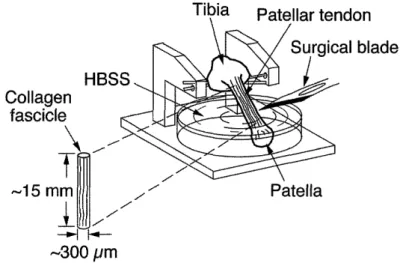
(2) 2. Memoirs of The School of B. O. S. T. of Kinki University No. 19 (2007). studied in immobilized animal knees (12-15). For example, Woo et al. (13) reported that knee immobilization decreased the strength of the medial collateral ligament in the rabbit. On the other hand, several studies have shown that exercise and training increased the strength of joint tendons and ligaments (16-18). For the direct and quantitative evaluation of the stress effects, we have developed unique techniques of stress deprivation and stress enhancement. With these methods, we have studied biomechanical responses of knee joint tendons and ligaments to stress shielding (10,19-25), restressing after stress shielding (10,20,26), and overstressing (10,20,27). These studies imply that the biomechanical effects on the tissue properties and structures strongly depend upon the magnitude of stress. However, the mechanisms of these phenomena have not been studied fully. The results from in vivo animal experiments are affected by many factors because of complex environment inside the body. Therefore, it is very difficult to rigorously determine relations between stress and remodeling. In tissue culture experiments, in contrast, we can quantitatively and easily control mechanical and environmental conditions. For example, we can apply an exact amount of stress to tissues at some frequency for a prescribed period. Furthermore, we can control the composition, temperature, and pH of culture medium, isolating tissues from systemic metabolic changes that occur in vivo. For these reasons, in vitro culture experiments are useful to study the mechanisms of tissue remodeling. This review article primarily described the experimental findings obtained by us and others regarding the biomechanical response of tendinous and ligamentous tissues to stress during culture. In particular, the following stress effects on the biomechanical properties of cultured tissues were mainly addressed: (1) effects of stress deprivation, (2) effects of the magnitude of cyclic stress, (3) effects of the frequency and duration of cyclic stress, (4) effects of the magnitude of static stress, and (5) effects of restressing after stress deprivation. Moreover, the results obtained from in vitro tissue culture experiments were compared with those from in vivo animal studies, and we discuss tissues remodeling of tendons and ligaments under both in vitro and in vivo conditions.. 2. Effects of Stress Deprivation Treatment of musculoskeletal injuries often includes immobilization as a part of the therapeutic regimen. This method has been necessary to protect the injured tissue from disruptive forces during early healing period. Effects of stress deprivation on the biomechanical properties of knee joint tendons and ligaments have so far been studied by the experiments of immobilizing or disusing animals knees (12-15,28,29). Immobilization and disuse decrease both mechanical stress and motion. In these experiments, however, we do not know the exact amount of the reduction of stress. Actually, stress applied to tendons and ligaments during immobilization is not always zero. To directly and quantitatively deprive stress, we have developed novel methods, and have been applying them to the rabbit patellar tendon for the studies of the biomechanical effects of stress shielding (19,23,24). These studies indicated that the mechanical properties of the tendon were very much affected by stress; for example, stress shielding rapidly and markedly decreased the modulus and strength of the tendon. However, no studies have been done on the mechanisms of the phenomenon. In particular, it is difficult to isolate the effects of complete stress shielding on tissue remodeling from the in vivo system having complex mechanical and biological environment. Therefore, an in vitro culture model was developed to study the effects of stress deprivation on tendinous tissues. With this tissue culture method, we studied the effects of no load condition on the mechanical properties of collagen fascicles obtained from rabbit patellar tendons. Animals were sacrificed by excessive injection of thiamylal sodium under pentobarbital anesthesia. The patellar tendon with the entire patella and tibia (patellar tendon-bone complex) was aseptically harvested from each left hindlimb immediately after sacrifice. Then, it was immersed in Hanks' balanced salt solution (HBSS), and stored at 4°C until the dissection of thin tissues which was performed within 6 hours postmortem. Prior to the dissection, a stainless steel pin (1 mm diameter) was inserted into the tibial tubercle, and the patellar tendon-bone complex was attached to a specially designed holder using the pin (Fig. 1). The patella was then picked up with a forceps, and the patellar tendon was lightly pulled using the forceps. Thin tissues having the diameter and length of approximately 300 )lm and 15 mm, respectively, were carefully dissected with a surgical knife in parallel to the axis of the tendon under sterile condition (30-33). We call these thin tissues collagen fascicles, noting, however, that they may not be precisely equivalent to the well-defined fascicles described in the tail tendon in the rat (34,35) and mouse (36,37). During dissection, the tendon substance and collagen fascicles were kept wet with HBSS. Collagen fascicles obtained from each rabbit fascicles were placed in a culture dish under no load condition in Dulbecco's modified Eagle medium.
(3) 3. (DMEM) supplemented with 10% fetal calf Tibia serum (FCS), 100 D/ml penicillin, and 100 flg/ml streptomycin. This medium was Surgical blade renewed every other day. The culture dish was put in an incubator filled with a gas mixture of 5% CO2 and 95% air of 37°C for 1, 2, or 3 weeks. Biomechanical tests were performed on the collagen fascicles cultured for 1, 2, or 3 weeks under no load condition. The diameters of each Patella collagen fascicle were measured from 36 directions at the angular interval of 5 degrees with a specially designed apparatus which consisted of a low magnification microscope, a Fig. 1 Resection of collagen fascicles from a rabbit CCD .camera, and a video dimension analyzer patellar tendon in Hanks' balanced salt solution (HBSS) (38). The cross-sectional area was calculated using a surgical blade (30-33). from averaging the diameters, assuming that the cross section was circular. Our previous study indicated that this assumption is applicable to collagen fascicles (38). These measurements were done at the middle of each fascicle, at 2 mm proximal position from the middle, and at 2 mm distal position to the middle. An averaged cross-sectional area was obtained from these data. During the diameter measurement, each collagen fascicle was immersed in physiological saline solution of 37°C. The cross-sectional area of each fascicle was obtained under one load condition. We measured the area while applying the load of 0.01 N to the axial direction. The cross-sectional area measured from each fascicle under this load condition was used for the determination of its mechanical properties. The mechanical properties of collagen fascicles were determined using a specially designed micro-tensile tester (38) which was composed of specimen holders, a load cell attached to one of the holders, and a linear stage that is actuated by a microprocessor-controlled stepping motor. Small acrylic blocks were attached to both ends of a fascicle with cyanoacrylate adhesives for specimen gripping ..Two markers were drawn with a stain (Nigrosine) on the specimen surface at the mid portion about 5 mm apart. The distance between the markers was measured with the above-mentioned video dimension analyzer using a tracking function for the determination of strain. The specimen was mounted onto the micro-tensile tester, and was immersed in physiological saline solution of 37°C during tensile testing. First, a preload of 0.01 N was applied to the fascicle in the axial direction, and zero strain was defined at this load. Then, the fascicle was preconditioned with ten cycles of loading and unloading between 0 and 2% strain at the strain rate of 1.6 %/sec, followed by stretch to failure at the same rate. The strain rate was calculated from the averaged initial length (9.6 mm) of all the specimens used for the data analysis of mechanical properties and cross-head speed (10 mmlmin). Tensile load and the distance between the two markers were recorded on a personal computer and an X-T recorder. Stress was calculated form dividing tensile load by the initial cross-sectional area of the fascicle. From these data, stress-strain curves, tangent modulus, tensile strength, and strain at failure were obtained, where the tangent modulus was defined by the slope of each stress-strain curve between 2 and 5% strain. Figure 2 demonstrates the averaged stress-strain curves of the fascicles cultured under non-loaded condition for 1, 2, and 3 weeks and the control fascicles. There were no noticeable differences in the shape of the curves between the control and non-loaded groups. The tangent moduli of the fascicles cultured under no load condition (85.3 ± 30.8, 59.7 ± 25.7, and 65.3 ± 12.0 MPa at 1, 2, and 3 weeks, respectively) were significantly lower than that of control fascicles (180.0 ± 33.8 MPa) (Fig. 3). The tensile strength of the non-loaded fascicles (9.5 ± 1.3, 7.3 ± 1.6, and 6.3 ± 2.6 MPa at 1, 2, and 3 weeks, respectively) were also significantly lower than that of control fascicles (17.8 ± 4.3 MPa) (Fig. 3). The strain at failure in the control group was 13.1 ± 5.7%, while those of the fascicles cultured under no load condition for 1,2, and 3 weeks were 17.4 ± 5.6, 19.3 ± 5.3, and 18.4 ± 6.0%, respectively (Fig. 3). There was no significant difference in the strain at failure between the control group and each non-loaded group. These experimental results clearly indicate that the mechanical strength of cultured collagen fascicles decreases remarkably if they are released from tension.. k.
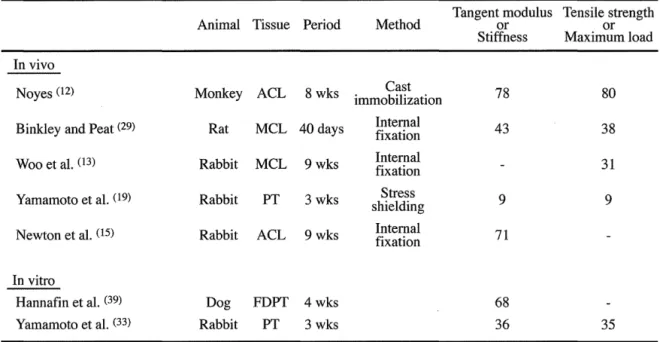
(4) 4. Memoirs of The School of B. O. S. T. of Kinki University No. 19 (2007). --- Control (n =10) To our knowledge, there has been only one -0- Non-loaded for 1 wk (n =9) 30 in vitro study on the biomechanical properties -A- Non-loaded for 2 wks (n =9) of tendons and ligaments cultured under no -0- Non-loaded for 3 wks (n =6) ctS load condition. Hannafin et al. (39) examined c.. :?! 20 the effects of stress deprivation on the mechanical and histological properties of b canine flexor digitorum profundus tendons C/) using an in vitro system. They reported that the C/) 10 Q) 10elastic modulus of the tendons cultured for 4 +-' C/) weeks under non-loaded condition was (Mean ± S.D.) significantly lower than that of the control 10 20 30 tendons, and that tensile loading maintained Strain E (%) the normal histological pattern of the tendons. In the same way as our in vitro study, their Fig, 2 Stress-strain curves of control fascicles and the results have suggested that mechanical load is fascicles cultured under no load condition (33). essential for the health of collagenous tissues such as tendons and ligaments. Table 1 shows reported data regarding in vivo studies on the effects of stress deprivation on the biomechanical properties of joint tendons and ligaments, comparing with the results obtained from in vitro studies. For example, previous investigations on the effects of knee immobilization on the ligament mechanics demonstrated 20% decrease of the tensile strength in the primate anterior cruciate ligament (ACL) after 8 weeks (12) and 69% decrease of the maximum load in the rabbit medial collateral ligament (MeL) after 9 weeks (13). These biomechanical studies indicate that the mechanical strength of knee joint ligaments is significantly reduced by immobilization. However, there is a large difference in the change of the mechanical strength between the experiments of direct stress shielding and those of immobilization, indicating that tension applied to the ligament is not completely released by immobilization treatment (Table 1). Yamamoto et al. (19), Keira et al. (21), and Majima et al. (22) reported that the tangent modulus and tensile strength of the rabbit patellar tendon and canine anterior cruciate ligament were significantly decreased by complete and partial stress shielding. Essentially similar phenomena were, observed in our in vitro study (33) on the cultured collagen fascicles obtained from the rabbit patellar tendon (Table 1). That is, both patellar tendons and collagen fascicles do not maintain their mechanical properties if the applied stresses is completely released. Moreover, Yamamoto et al. (23) carried out mechanical tests of the collagen fascicles resected from in vivo stress-shielded rabbit patellar tendons, and showed that stress shielding significantly decreased the tangent modulus and tensile strength. These results are almost similar to those observed in our study (33) on the collagen fascicles cultured under no load condition. For example, the tensile strength of the collagen • Control group fascicles obtained from in vivo stress-shielded (Mean ± S.D.) patellar tendons was 74 and 44% of the control D Non-loaded group * P < 0.05 vs Control value at 1 and 2 weeks, respectively, while the 300 50 30 strength of the fascicles cultured in vitro under C? C? a... a... no load condition decreased to 62 and 50%, ~40 6 6 respectively. The similarity of the results IIII W UJ 200 20 0 obtained from the two experiments indicates (f) Q) 30 .... ..c .2 +-' that the in vitro model proposed in our .2 :::J 0') '(ij '0 c: 0 experiment is useful for the fundamental and -- 20 ~ * ~ * (f) 10 ~c: 100 detailed studies of the effects of mechanical c: ~ Q) .~ 10 stress on the remodeling of tendons and 0') ' w c: c: en ligaments. In addition, it appears certain that ~ ~ mechanical stress is essential for the health of 0 0 0 0123 0123 0123 tendons and ligaments and that stress Culture period T (weeks) deprivation results in an alteration in the Fig. 3 Mechanical parameters of Icontrol fascicles and the biomechanical properties of tendinous and fascicles cultured under no load condition (33). ligamentous tissues in vivo and in vitro.. --. -. of-'.
(5) 5. Table 1 Biomechanical response of in vivo and in vitro tissues to stress deprivation (% control value). Animal Tissue Period. Method. Tangent modulus Tensile strength or or Stiffness Maximum load. In vivo Noyes (12) Binkley and Peat (29) Woo et al.. Cast immobilization Internal MCL 40 days fixation Internal MCL 9wks fixation. Monkey ACL. Rabbit. (13). Yamamoto et al. Newton et al.. Rat. (19). (15). In vitro Hannafin et al. (39) Yamamoto et al. (33). 8 wks. 78. 80. 43. 38 31. Rabbit. PT. 3 wks. Stress shielding. 9. Rabbit. ACL. 9wks. Internal fixation. 71. Dog. FDPT. 4wks. Rabbit. PT. 3 wks. 68 36. 9. 35. ACL: Anterior cruciate ligament, MCL: Medial collateral ligament, PT: Patellar tendon, FDPT: Flexor digitorum profundus tendon.. 3. Effects of the Magnitude of Cyclic Stress Relatively high mechanical stresses are applied to joint tendons and ligaments by exercise and training, and their effects on the material and structural properties of the tissues have been studied extensively (16-18,40-42). For example, Cabaud et al. (16) studied the effects of treadmill exercise on the biomechanical properties of the rat anterior cruciate ligament (ACL), and found that exercise yielded a large increase in the mechanical strength. Woo et al. (41,42) reported that 12-month training increased the mechanical strength of the swine extensor tendon, but induced no effects on the flexor tendon. Taken together, some of these studies showed that exercise and training were effective for the improvement of the mechanical properties of tendons and ligaments, whereas others indicated that they did not work. In these studies, it was not clear how much stress applied to in vivo tissues was increased by exercise and training. Therefore, their effects on the mechanical strength of tendons and ligaments have not been fully understood and the results obtained are controversial. To overcome the problems regarding with such in vivo animal experiments, in vitro tissue culture studies are useful, because we can quantitatively and easily control mechanical and environmental conditions in tissue culture experiments. For example, we can apply an exact amount of stress to tissues for a prescribed period and can control the composition, temperature, and pH of culture medium. For these reasons, in vitro culture experiments are useful to study the mechanisms of tissue remodeling. We hypothesized that collagen fascicles obtained from the rabbit patellar tendon respond to cyclic stress in vitro and change their biomechanical properties, and that there is some optimal stress for keeping the original mechanical properties. To examine this hypothesis, we carried out tensile tests of the collagen fascicles cultured under cyclic stress conditions and studied the relation between the mechanical properties of the fascicles and the stresses applied to them during culture. Collagen fascicles were dissected from the patellar tendon by means of the same procedure as that described above (30-33). A newly designed apparatus was used for the culture of collagen fascicles under cyclic load conditions (Fig. 4). Both ends of each fascicle specimen were attached with small polycarbonate-made interlocking grips having serrated surface, and were installed into holders. The specimen length between the grips was approximately 11 mm. One of the holders was connected with a load cell which was fixed on an X-stage, and the other was connected to a linear actuator for applying cyclic load to the fascicle. In a culture bath, the specimen was immersed in a solution containing DMEM supplemented with 10% FCS and antibiotics (penicillin and streptomycin). The culture bath was.
(6) 6. Memoirs of The School of B. O. S. T. of Kinki University No. 19 (2007). put inside a culture chamber, and the Thermostatic bath rr=I>:l===~~===il Culture ' temperature in the chamber was kept at 37°C chamber with circulating heated water. The pH of the Collagen fascicle culture medium was maintained at 7.4 with a moistured gas mixture of 5% CO2 and 95% air perfused in the chamber. Four fascicles can be set up in the culture bath, and can be loaded simultaneously. Cyclic load having the peak load of approximately 0.06, 0.2, or 0.3 Nand the minimum load of 0 N was applied to each fascicle at 4 Hz cyclic rate for 1 hour per day for the period of 1 or 2 weeks. The load of 0.06, X-stage Load cell Holder Grip DMEM+ 1O%FCS 0.2, and 0.3 N were approximately 3, 10, and Fig. 4 Apparatus for the culture of collagen fascicles under 15% of the maximum failure load cyclic load condition. The fascicles were immersed in (approximately 2 N) of control fascicles (38), Dulbecco's modified Eagle medium (DMEM) supplemented respectively. The cyclic rate of 4 Hz was with 10% fetal calf serum (FCS) (31). selected because the frequency of the in vivo tension applied to the rabbit patellar tendon was 4 Hz (43). The duration of loading (l hour per day) was determined from our observation that rC:J.bbits walked for approximately 15 seconds in 5 minutes. This duration is equivalent to 72 minutes in 24 hours. Based on this, the duration of 1 hour per day was selected in our study (31). During culture, the load applied to each fascicle was continuously monitored with the load cell. Peak stresses applied to the fascicles ranged between 0 and 5 MPa, depending upon the applied load and cross-sectional areas. Non-loaded fascicles used for biomechanical tests were immersed in the medium inside the culture bath together with loaded fascicles. Collagen fascicles cultured for 1 or 2 weeks under cyclic and no load conditions were used for biomechanical assessment using a specially designed apparatus utilized for the optical measurement of the cross-sectional area of each fascicle (38) and a specially designed micro-tensile tester (38). Figure 5 shows several typical stress-strain curves of the collagen fascicles cultured under different applied peak stresses, together with the averaged curves of the fascicles cultured under no load and those of control fascicles. Each stress-strain curve was almost linear between 2% and 5% strains, with a toe region under 2% strain. From the tissue culture experiments, we determined the relationships between the peak stress applied to fascicles during culture and their mechanical properties. Statistically significant correlations were observed between the applied stress and tangent modulus. The relations were described by a quadratic function (Fig. 6), which showed that the modulus was maximal at the stress of 1.9 MPa for the pooled data obtained at 1 and 2 weeks. The modulus values of the fascicles. (A) 30 Cultured for 1 wk. (8) 30 Cultured for 2 wks. -II- Control (n = 36). -II- Control (n. ......... -I:r- Non-loaded (n = 18). -I:r- Non-loaded (n = 18). a... -. «S. ~. co a... Cyclically-loaded. -. 20. ~. en en ~ 10 .-. (j). (JA (JA. = 0.44 MPa. -. = 36). Cyclically-loaded. 20. en en ~ 10 .-. (j). =4.15 MPa. (JA. (JA = 0.36 MPa = 4.51 MPa. X Breaking point O~=-----------~----~----~. o~------------------~----~. Strain E (%). Strain E (%). o. 10. 20. X Breaking point. o. 10. Fig. 5 Typical stress-strain curves of the fascicles cultured under different cyclic applied stresses (O'A) for 1 (A) or 2 (B) weeks, and averaged curves of control and non-loaded fascicles (31).. 20.
(7) 7. • Control (n = 36) cultured between 0.9 and 2.8 MPa were similar (A) 400 t;,. Non-loaded (n =18)] Cultured for to those of control fascicles. Similar 1 wk o Cyclically-loaded ... Non-loaded (n = 18)] Cultured for correlations were also observed between the • Cyclically-loaded 2 wks tensile strength and applied peak stress (Fig. 6). o fW The maximum tensile strength (19.4 MPa) was (J) obtained at the stress of 1.8 MPa for the pooled -§ 200 "0 data. If fascicles were cultured under stresses o E between 1.1 and 2.6 MPa, their strength were E <D 0'> within a range of control values. In addition, C ~ the tangent modulus and tensile strength of the 2wks (r =0.75, P < 0.05) fascicles cultured under stresses below 1.0 0~--~O~.9~----~--~~----~ 4 o 123 MPa or above 2.7 MPa were significantly Applied peak stress OA (MPa) lower than those of control fascicles (Fig. 6). These results indicate that the tangent modulus • Control (n = 36) and tensile strength strongly depend upon the (8) 30 t;,. Non-loaded (n =18)] Cultured for o Cyclically-loaded 1 wk magnitude of cyclic stresses; they are ... Non-loaded (n =18)] Cultured for (1.8,19.4) maintained at control level under stresses • Cyclically-loaded 2 wks between 1.0 and 2.7 MPa, but are decreased at higher and lower stresses. Unlike the tangent modulus and tensile strength, negative linear correlations were observed between the aB =6.7 + 14.1aA - 3.9aA2 applied stress and strain at failure (Fig. 6). (r = 0.68, P < 0.05) 1 wk However, the strain at failure at stresses (r", 0.68, p < 0.05) 2wks between 1.0 and 2.7 MPa were also similar to (r = 0.71, P < 0.05) that of control fascicles. This result also o~~--~--~~--~--~~--~ 1.1 2.6 indicates that stresses between 1.0 and 2.7 1 234 o Applied peak stress OA (MPa) MPa are effective to maintain the mechanical properties of cultured collagen fascicles at (C) 30 • Control (n =36) control level. t;,. Non-loaded (n =18)] Cultured for o Cyclically-loaded 1 wk We estimated the peak stress applied to a ... Non-loaded (n =18)] Cultured for single collagen fascicle in vivo. Briefly, we • Cyclically-loaded 2 wks • W 20 assumed that the ratio of the maximum failure o • • load of the tendon (800 N) (44) to that of the fascicle (1.72 N) was equal to the ratio of the of control values 1U in vivo peak tension in the tendon (82 N) (27,43) c 10 .~ to that in the fascicle. The in vivo peak tension U5 applied to a collagen fascicle calculated from 1 wk 2wks (r = 0.60, P < 0.05) (r = 0.39, N.S.) these values becomes approximately 0.18 N. o~----~----~------~----~ o 1 234 The in vivo peak stress applied to a fascicle, Applied peak stress OA (MPa) which is calculated from the in vivo peak tension (0.18 N) and the cross-sectional area Fig. 6 Applied peak cyclic stress versus tangent modulus (0.08 mm2) , is approximately 2.3 MPa. Our (A), tensile strength (B), and strain at failure (C) of cultured experiments (31) demonstrated that the tangent collagen fascicles (31). Statistically significant correlations, modulus and tensile strength of the fascicles which were expressed by quadratic functions, were observed between the applied peak stress and the tangent cultured under stresses between 1.0 and 2.7 modulus and or the tensile strength. MPa were similar to those of control fascicles (Fig. 7). Furthermore, the fascicles cultured under stresses of lower than 1.0 MPa and higher than 2.7 MPa exhibited values which were reduced compared to the original tangent modulus and tensile strength. The stresses of 1.0 and 2.7 MPa are equivalent to 40 and 120% of the above-calculated in vivo peak stress (2.3 MPa), respectively. These results indicate that the tangent modulus and tensile strength of cultured collagen fascicles are maintained at control level if applied stresses are between 40 and.
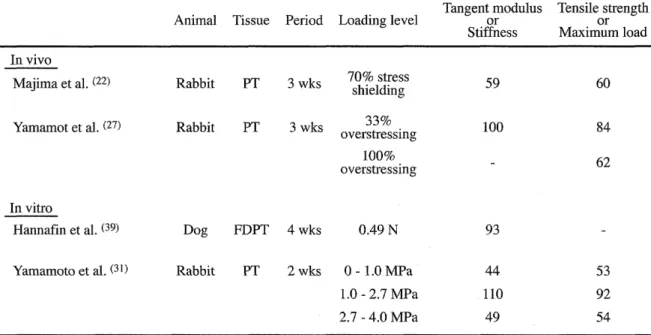
(8) 8. Memoirs of The School of B. O. S. T. of Kinki University No. 19 (2007). 120% of the in vivo peak stress, and that the modulus and strength decrease at lower and higher stresses than this range. In addition, collagen fascicles are biomechanically more sensitive to stress enhancement (overuse) than to stress deprivation (disuse). We have done a series of in vivo experimental studies on the biomechanical response of tendons and ligaments to stress alteration (10,20). For the direct and quantitative evaluation of the effects of stress, we have developed unique methods of stress deprivation and stress enhancement for knee joint tendons and ligaments, and applied these techniques to the studies of the biomechanical effects of complete stress shielding (19,21), partial stress shielding (22), and overstressing (27). As shown in Table 2, the results obtained have demonstrated that the tangent modulus and tensile strength of the rabbit patellar tendon are significantly reduced by complete stress shielding (zero applied stress) (19,22), partial stress shielding (30% of the normal in vivo stress) (22\ and 100 % overstressing (200%) (27), although those are not changed by 33% overstressing (133%) (27). In addition, the tangent modulus of the canine anterior cruciate ligament was decreased by complete stress shielding (0%) (21) and 300 to 700% overstressing (400 to 800%) (21), although it was not changed by 30 to 50% overstressing (130 to 150%) (20). These results are similar to those obtained from our experiments (31) on the collagen fascicles which were harvested from the rabbit patellar tendon and cultured under cyclic stress conditions (Table 2). Therefore, we can say that tendon and ligament tissues have an ability of maintaining normal properties regardless of in vivo or in vitro conditions, if the magnitudes of applied stresses are within a certain range. There have been no in vitro culture studies on the effects of cyclic load on the biomechanical properties of tendons and ligaments, except for the work done by Hannafin et al. (39). They studied the effects of cyclic tensile load on the material properties of cultured canine flexor digitorum profundus tendons. The results reported by Hannafin et al. (39) have shown that stress deprivation significantly decreased the elastic modulus, say to 80% and 68% of the control value at 2 and 4 weeks, respectively (Table 2). However, the application of intermittent cyclic load of 0.49 N (50 gf) for 2 hours per day prevented the decrease in the modulus; the modulus was 87% and 93% of the control value at 2 and 4 weeks, respectively. These results are partially similar to the results obtained from our experiments. However, they did the experiments under only one condition of cyclic load, and did not study the effects of the magnitude of applied stress. With regard to the effects of the magnitude of cyclic stress in our study (31), the fascicles cultured under applied peak stresses of lower than 40% and higher than 120% of the in vivo peak stress do not keep the original strength and modulus. These results indicate that the mechanical properties of cultured collagen fascicles strongly depend upon the magnitude of the stress applied during culture, which are similar to our previous results observed in stress-shielded and overstressed patellar tendons in vivo.. Table 2 Effects of the magnitude of cyclic stress on the biomechanical properties of in vivo and in vitro tissues (% control value).. Animal. Tissue. Period. Loading level. Tangent modulus or Stiffness. Tensile strength or Maximum load. Rabbit. PT. 3 wks. 70% stress shielding. 59. 60. Rabbit. PT. 3 wks. 33% overstressing. 100. 84. In vivo Majima et al.. (22). Yamamot et al.. (27). 100% overstressing In vitro Hannafin et al.. (39). Yamamoto et al. (31). 62. Dog. FDPT. 4wks. 0.49N. 93. Rabbit. PT. 2wks. 0- 1.0 MPa. 44. 53. 1.0 - 2.7 MPa. 110. 92. 2.7 - 4.0 MPa. 49. 54. PT: Patellar tendon, FDPT: Flexor digitorum profundus tendon..
(9) 9. 4. Effects of the Frequency and Duration of Cyclic Stress The results from in vivo animal experiments are influenced by many factors due to complicated in vivo conditions. Moreover, it is hard to control and monitor mechanical load applied to tissues throughout experimental periods. Therefore, we cannot fully elucidate quantitative relationships between stress and remodeling from in vivo experiments. In tissue culture experiments, on the other hand, we can easily and quantitatively control mechanical and environmental conditions. For example, an exact amount of stress can be applied to in vitro tissues at some frequency for a prescribed period. We have studied the mechanical properties of collagen fascicles cultured under cyclic stresses (31). The results have shown that the mechanical properties of cultured fascicles strongly depend upon the magnitude of stress applied during culture, and that there are optimal stresses to keep original properties. In the case of cyclic stress of 4 Hz (1 hour/day for I and 2 weeks), for example, mechanical properties are kept at control level when 40 to 120% of the in vivo peak stress in the intact rabbit patellar tendon was applied (31). The frequency (4 Hz) and duration (I houriday) of the cyclic stress were considered to be similar to those of in vivo tension applied to the patellar tendon inside the body (43). However, the effects of frequency and duration of cyclic stress have not been studied yet. To our knowledge, there have been no in vivo studies on the effects of frequency and duration of cyclic load on the properties of normal tendons and ligaments, probably because of difficulties in experimental techniques. However, only one biomechanical study has been reported on the effects of the frequency and duration of controlled, passive mobilization on tendon healing (45). This study demonstrated that higher frequencies are more beneficial on the improvement of the biomechanical properties of healing tissues. Several in vitro culture experiments have recently been done to examine the effects of frequency of cyclic tensile strain on such cell biological responses as enzyme synthesis (46,47). Lavagnino et al. (47) reported that the increased frequency of cyclic strain totally eliminated MMP-I (interstitial collagenase) rnRNA expression at low strain amplitude level. Therefore, the frequency and also duration of cyclic load would be one of the important factors in the homeostatic response of tendons and ligaments to mechanical stress. To know the effects of frequency or duration of cyclic stress on the mechanical properties of tendon tissues, we applied an in vitro tissue culture technique to collagen fascicles from the rabbit patellar tendon. With this method, we can precisely control the frequency and duration of cyclic stress. It was our hypothesis that the biomechanical response of cultured collagen fascicles to cyclic stress depends upon its frequency and duration. Collagen fascicles dissected from rabbit patellar tendons were cultured under cyclic load by means of the same procedure as that mentioned above (31) using an apparatus for the culture of collagen fascicles under cyclic load condition (Fig. 4). Cyclic load having the peak load of approximately 0.2 N and the minimum load of 0 N was applied to collagen fascicles at I Hz for I hour/day (IHz-Ih group), at I Hz for 4 hours/day (IHz-4h group), and at 4 Hz for I hour/day (4Hz-Ih group). The peak load of 0.2 N is equivalent to the stress of2 MPa, if the cross-sectional area of fascicles assumed to be 0.1 mm2 which is almost the same as the area of control fascicles. This stress is similar to the in vivo peak stress applied to fascicles in the rabbit patellar tendon (31). As described in the foregoing, the mechanical properties of cultured collagen fascicles were maintained at the original level by the application of cyclic peak stress of approximately 2 MPa at 4 Hz for I hour/day (31). Based on this result, the peak stress of 2 MPa was selected for the present experiment. Because the frequency of load applied to the rabbit patellar tendon during running is approximately 4 Hz (42\ we chose this frequency. The frequency of I Hz was selected as an example of smaller frequencies than 4 Hz. During culture, load applied to each fascicle was continuously monitored with each load cell. Biomechanical tests were performed on non-cultured, control fascicles, and fascicles cultured under cyclic load and no load conditions for I or 2 weeks. A specially designed apparatus (38) was used for the optical non-contact measurement of the cross-sectional area of each fascicle which was immersed in a physiological saline solution of 37°C. We used a specially designed micro-tensile tester (38) to study the mechanical properties of collagen fascicles. There were no noticeable differences in the shape of stress-strain curves among the' experimental groups at I and 2 weeks (Fig. 7). The results of tangent modulus were essentially similar to those of tensile strength (Fig. 8). The modulus and strength in the IHz-Ih group were significantly lower than those in the control group both at I and 2 weeks, but showed no significant differences compared to the non-loaded group. Although these mechanical parameters in the IHz-4h group were also significantly smaller than those in the control group, they were significantly larger than those in the non-loaded group except for the tangent modulus at I week. Moreover, the strength in the IHz-4h group was significantly higher than that in the IHz-Ih group at 2 weeks. In contrast, the tangent modulus and tensile strength in the 4Hz-Ih group were significantly higher than those in the control group at.
(10) Memoirs of The School of B. O. S. T. of Kinki University No. 19 (2007). lO. (A). - - . . - Control (n = 12) - 0 - - Non-loaded (n = 10) -D-1Hz-1h (n = 6) --i::r- 1Hz-4h (n = 6) -3ii1-- 4Hz-1h (n = 6). 30. ...ctS. ~. ---o. (8). Cultured for 1 wk. Cultured for 2 wks - - . . - Control (n = 12). 30 (Mean ± S.D.). - 0 - - Non-loaded (n. -D-1Hz-1h (n = 6) --i::r- 1Hz-4h (n =6) ~4Hz-1h (n = 6). ...ctS. =9) (Mean ± S.D.). ~ 20. 20. ---b (J). (J) (J). ~ 10. ~ 10 .....,. ".....,. CJ). CJ). +. Breaking point. O~~----~------~------~. o. 10. 20. Strain E (%). 30. Oa=~----~----~~------~. o. 10. 20. 30. Strain E (%). Fig. 7 Stress-strain curves of the fascicles cultured under different frequencies and duration of cyclic stress for I (A) or 2 (B) weeks, and the curves of control and non-loaded fascicles (32). I week; however, no significant differences were observed between the 4Hz-Ih and control groups at 2 weeks. There was a significant difference in the tensile strength in the 4Hz-Ih group between I and 2 weeks. Regardless of culture period, the modulus and strength in the 4Hz-Ih group were significantly higher than those in the non-loaded and IHz-Ih groups. Unlike the tangent modulus and tensile strength, the effects of load on the strain at failure were small (Fig. 8). The strain at failure in the IHz-Ih and IHz-4h groups were significantly larger than that in the control group except for the IHz-Ih group at I week. However, there were no significant differences in the strain between the 4Hz-Ih and control groups both at I and 2 weeks. The mechanical parameters of collagen fascicles in the 4Hz-Ih group were similar to those of the original, control fascicles regardless of culture period, although this was not the case in the IHz-Ih and IHz-4h groups (Fig. 8). As mentioned above, the frequency of 4Hz and the duration of I hour/day of cyclic stress are considered to be similar to those of the in vivo load applied to the rabbit patellar tendon inside the body. Under these conditions, therefore, the properties may have been maintained at control levels. In contrast, the tangent modulus and tensile strength in the IHz-Ih group were significantly lower than those in the control group, and showed no significant differences compared to the non-loaded group. These results suggest that the mechanical properties of cultured fascicles deteriorate under lower frequencies of cyclic stress than that of in vivo stress. Similarly to the IHz-Ih group, the modulus and strength in the IHz-4h group were significantly lower than those in the control group as well; however, they were significantly higher than those in the non-loaded group except for the modulus at I week. These results indicate that the mechanical properties of cultured fascicles are improved in comparison to those exposed to non-loaded condition, if cyclic stress is applied for the duration experienced inside the body even at a low frequency. These findings are very important for understanding the remodeling phenomena of tendons and ligaments. Further studies on the biomechanical effects of different frequencies and durations of cyclic stress may be useful for the design of exercise programs for healthy tendons and ligaments, and also of rehabilitation protocol after ligament reconstruction. The tangent modulus and tensile strength of the 4Hz-Ih group were significantly larger in comparison with the control group at I week; however, this was not the case at 2 weeks. Therefore, we cannot say that the load condition of 4Hz-Ih was related to the increase in the mechanical strength of cultured collagen fascicles. Further studies should be done to find optimal stress for increasing the strength..
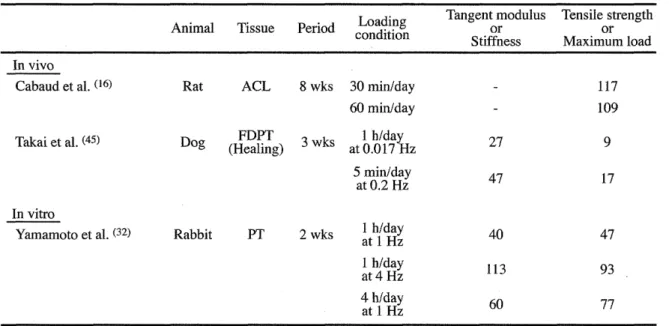
(11) 11. (A). 0 Cultured for 1 wk 400 • Cultured for 2 wks. *# <<. C?. a... e. 300. p 0.05, p 0.05, $ p < 0.05,. VS. VS. VS.. (8) (Mean ± S.D.). Control group Non-loaded group at each period 1Hz-1 h group at each period. 0 Cultured for 1 wk 30 • Cultured for 2 wks. *# <<. p 0.05, p 0.05, $ p < 0.05,. VS. VS. VS.. (Mean ± S.D.) Control group Non-loaded group at each period 1Hz-1 h group at each period. u.T C/). :J. -5o. 200. E c. ..-. ~ 100. c. ~. o. L...J.::o~---L----'. Control Non-loaded. (C). OL..l..llo~---L. 1Hz-1h. 0 Cultured for 1 wk 40 • Cultured for 2 wks. * p < 0.05, vs. Control group. 1Hz-4h. 4Hz-1h. Control Non-loaded. 1Hz-1 h. 1 Hz-4h. 4Hz-1h. (Mean ± S.D.). ~. ~ 30 co. w (I) J..... .2. -. '(ij 20. Cii c. .~ 10. en. O~...::...lo.I---L. Control Non-loaded. 1 HZ-1 h. 1 Hz-4h. 4Hz-1h. Fig. 8 Tangent modulus (A), tensile strength (B), and strain at failure (C) of collagen fascicles. The tangent modulus and tensile strength of the fascicles in the 4Hz-Ih group were similar to those in the control group; however, the fascicles in the IHz-Ih and IHz-4h groups had significantly lower values than those in the control group (32).. Only one biomechanical study has been reported on the effects of the frequency and duration of controlled, passive mobilization on tendon healing (45). This study demonstrated that higher frequencies are more beneficial on the improvement of the biomechanical properties of healing tissues (Table 3). Many in vivo animal experiments have been done on the response of tendons and ligaments to exercise and repetitive motion (16-18,48-50). For example, the study done by Loitz et al. (50) compared the mechanical properties of rabbit tibialis anterior tendons among normal hindlimbs (control), immobilized ones, and ones continuously applied passive motion for 3 weeks. They reported that the passive motion prevented deleterious tissue changes induced by immobilization. This result is essentially similar to that observed in our study (31) on the collagen fascicles cultured under non-loaded and cyclically loaded conditions except for the case of the application of cyclic stress at a low frequency for a short duration. Namely, the tangent modulus and tensile strength of collagen fascicles cultured under no load condition (non-loaded group) were significantly lower than those of the non-cultured, fresh fascicles (control group), whereas the modulus and strength of fascicles cultured under cyclic stress at a low frequency for a long duration (lHz-4h group) and at a high frequency for a short duration (4Hz-Ih group) were significantly larger than those of the non-loaded fascicles except for the case of the modulus in the 1 Hz-4h group at 1 week. Until now, there has been only one report on the in vivo study of the effects of frequency and duration of exercise on the biomechanical properties of tendons and ligaments (16). Cabaud et al. (16) exercised rats for 30 or 60 min/day daily or every other day using a motorized treadmill, and studied the mechanical properties of the anterior cruciate ligament 8 weeks after. There was a significant increase in tensile strength in the exercised rats; the increase was greater in rats exercised every day rather than every other day.
(12) 12. Memoirs of The School of B. O. S. T. of Kinki University No.19 (2007). Table 3 Effects of the frequency and duration of cyclic stress on the biomechanical properties of in vivo and in vitro- tissues (% control value).. In vivo Cabaud et aL. (16). Takai et aL (45). In vitro Yamamoto et al.. Animal. Tissue. Period. Loading condition. Rat. ACL. 8 wks. 30 min/day 60 min/day. Dog. (32). Rabbit. FDPT (Healing). PT. Tangent modulus or Stiffness. h/day 3wks at 10.017 Hz. 2 wks. Tensile strength or Maximum load 117 109. 27. 9. 5 min/day at 0.2 Hz. 47. 17. 1 h/day at 1 Hz 1 h/day at4Hz. 40. 47. 113. 93. 60. 77. 4 h/day at 1 Hz. ACL: Anterior cruciate ligament,PT: Patellar tendon, FDPT: Flexor digitorum profundus tendon. and for shorter duration (30 min/day rather than 60 min/day). In our experiment (31), when cyclic stress was applied to collagen fascicles at the same frequency (1 Hz), their strength was higher in the case of stress application for longer duration (1Hz-4h group) than for shorter one (1Hz-lh group) (Table 3). With respect to the effect of duration, the result obtained by Cabaud et al. (16) is different from that observed in our study (31), which may be attributable to the differences of experimental methods (in vivo animal vs. in vitro culture), animal species (rat vs. rabbit), and tissues (anterior cruciate ligament vs. patellar tendon). However, we can say that the frequency and duration of cyclic stress significantly affect the mechanical properties of cultured collagen fascicles. If we apply cyclic stress having the frequency and duration which are experienced in vivo, the biomechanical properties are maintained at control, normal level. Lower frequencies or fewer _cycles than those of in vivo load seem to induce adverse effects on cultured collagen fascicles.. 5. Effects of the Magnitude of Static Stress Several in vitro culture studies have been done on the effects of cyclic tensile load on the synthesis of collagen, proteoglycan, DNA, and glycosaminoglycan (51-53). However, to our knowledge, there has been only one in vitro study on the biomechanical effects of stress in cultured tendons. Hannafin et al. (39) examined the effects of stress deprivation and cyclic loading on the mechanical and histological properties of canine flexor digitorum profundus tendons using an in vitro system. They reported that the elastic modulus of the tendons cultured for 4 weeks under cyclic load condition was significantly larger than that of stress-deprived tendons, and that tensile loading maintained the normal histological pattern of the tendons. Although their results have suggested that mechanical load is essential for the health of collagen tissues, the relation between remodeling and stress remains unknown. In addition, the effects of static tensile stress have not been studied. Based on the above mentioned results from in vivo and in vitro experiments on tendons and ligaments, we hypothesized that collagen fascicles cultured in vitro also respond to mechanical stress and change their biomechanical properties, and that there is some stress which yields optimal function. To examine this hypothesis, we have been doing a series of in vitro culture experiments on the effect of stress on the mechanical properties of collagen fascicles. As the first step, we carried out tensile tests of collagen fascicles cultured under static stress condition, and determined relations between stress applied to the fascicles during culture and their mechanical properties. We applied static stress to fascicles, aiming to obtain basic knowledge of their response to mechanical stress..
(13) 13. Collagen fascicles, which were aseptically Collagen fascicle dissected from the rabbit patellar tendon, were cultured under static stresses. Small DMEM + 10%FCS polycarbonate grips were attached to both ends of a fascicle. One of the grips was fixed to the base of a culture bath, and the other was connected to a polypropylene suture (Fig. 9). A stainless steel weight was suspended using the suture in order to apply static load of 0.05, 0.1, 0.15, or 0.2 N to the fascicle (static load group). These tensile loads could be exactly applied to Polypropylene suture Weight collagen fascicles during culture. The load of 0.05, 0.1, 0.15, and 0.2 N were approximately Fig. 9 Apparatus for the culture of collagen fascicles under 3.3, 6.6, 10, and 13.3% of the maximum load static load condition. The fascicles were immersed in (approximately 1.5 N) of control fascicles (38), Dulbecco's modified Eagle medium (DMEM) supplemented respectively. Four fascicles were set up in the with 10% fetal calf serum (FCS) (30). apparatus for each load group (0.05, 0.1, 0.15, and 0.2 N groups); fascicles for no load group and cell viability testing were placed inside the bath. They were immersed in DMEM supplemented with 10% FCS. The apparatus was put in an incubator filled with a gas mixture of 5% CO 2 and 95% air of 37°C for 1 or 2 weeks. After collagen fascicles were cultured under the above mentioned conditions, their mechanical properties were determined with an apparatus for the measurement of cross-sectional area and a micro tensile tester (38). Stress-strain curves of the collagen fascicles cultured under different applied stresses and those of the control fascicles were almost linear between 2 and 5% strain, with toe region under 2% strain (Fig. 10). Statistically significant correlations were observed between applied stress and tangent modulus; they were expressed by quadratic functions (Fig. 11). These correlations were observed not only in the data obtained from the fascicles cultured for each 1 and 2 weeks but also in the combined data for the two periods. The quadratic function for all the data had the maximum modulus of 175 MPa at the applied stress of 1.3 MPa. Similar statistically significant correlations were also observed between applied stress and tensile strength; the quadratic function for all the data had the maximum strength of 16.7 MPa at the applied stress of 1.2 MPa (Fig. 11). Such quadratic relations as observed in the tangent modulus and tensile strength were not observed in the strain at failure, which gradually decreased with increase in applied stress (Fig. 11). Statistically significant linear relations were observed between applied stress and strain at. (A) 30 Cultured for 1 wk ____ Control (n =16) --A- Non-loaded (n =8) - - Statically-loaded ro a.. 20. (8) 30. ____ Control (n. --ro. --..... ~. - - Statically-loaded. -~. b. b. en en. =16) =8). --A- Non-loaded (n. a.. 20. ~. (J). Cultured for 2 wks. en en. (J). 10. ..... ~. 10. CJ). CJ). X Breaking point. 0. 0. 10. Strain E (%). 20. 10. Strain E (%). Fig. 10 Typical stress-strain curves of the fascicles cultured under different static applied stresses (O"A) for 1 (A) or 2 (B) weeks, and averaged curves of control and non-loaded fascicles (30).. 20.
(14) 14. Memoirs of The School of B. O. S. T. of Kinki University No. 19 (2007). failure not only in the data obtained from the fascicles cultured for each I and 2 weeks but also in the combined data for the two periods: There have been many in vivo studies on the remodeling of tendons and ligaments induced by stress deprivation and stress enhancement. However, there were no previous studies on the effects of static stress on the biomechanical properties of the tissues, because it is difficult to precisely apply constant stresses to tissues in vivo. Our in vitro culture model (30) was developed to study the effects of static stress on collagen tissue • Control (n =16) (A) 300 h. Non-loaded (n =8) ] Cultured for quantitatively. With this tissue culture method, o Statically-loaded 1 wk we studied the effects of static stress on the .. Non-loaded (n =8) ] Cultured for <? (1.3, 175.0) 0 a.. • Statically-loaded 2 wks mechanical properties of collagen fascicles e, obtained from rabbit patellar tendons. There W 200 was a statistically significant correlation ::::I ""5 1 and 2wks between tangent modulus and applied stress, -0 o ET = 106.2 + 104.50A - 39.70A2 E (r =0.66. P < 0.05) and the relation was expressed by a quadratic C/). equation (Fig. 11). The modulus was maximal at the applied stress of 1.3 MPa; the maximum value was 175.0 MPa, which was within a range of control values. A similar significant correlation was also observed between tensile strength and applied stress, with the maximum strength of 16.7 MPa at the applied stress of 1.2 MPa (Fig. 11). These results indicate that the mechanical properties of cultured collagen fascicles strongly depend upon statically applied stress. That is, the tangent modulus and tensile strength of cultured collagen fascicles are maintained at control level with the static tensile stresses of 1.2 to 1.3 MPa; they decreased at higher and lower stresses. There was a negative correlation between strain at failure and applied stress (Fig. 11). The strain at failure at the stresses between 1.2 and 1.3 MPa was approximately 11 %, which was also within the range of control values. This result also shows that the stress of 1.2 to 1.3 MPa was effective to maintain the mechanical properties of cultured collagen fascicles at control level. As mentioned in the foregoing, in vivo peak stress applied to the fascicle, which is calculated from the in vivo peak tension (0.18 N) and the cross-sectional area (0.075 mm2) of the fascicles, is approximately 2.4 MPa. In our study, significant correlations were observed between the stress applied to cultured collagen fascicles and their mechanical properties, and the tangent modulus and tensile strength were maximal at the stresses of approximately 1.2 and 1.3 MPa, respectively. These stresses are about a half of the in-vivo peak stress applied to the fascicle during normal running (2.4 MPa). These. C 100. •. (]). OJ. wks = 0.70. P < 0.05). C. ctI. I-. wk. =0.65, P < 0.05). (r 0L---~1~.6--~--~---2~.O~~--~. o. 1 2 3. Applied peak stress. OA. (MPa) • Control (n = 16) h. Non-loaded (n = 8) ] Cultured for. 1 wk o Statically-loaded .. Non-loaded (n =8) ] Cultured for • Statically-loaded 2 wks. o. <?. a... :2 -: 20. b OB. (r. =11.6 + 8.6oA- 3.6oA2. =0.57, P < 0.05) wks. (r = 0.67. P < 0.05). 1 wk. (r = 0.57, P < 0.05). 0~--~O~.8~--~1~.6--~------~. o. 1. 2. Applied peak stress. (C). OA. 3. (MPa) • Control (n. 20. =16) =8). h. Non-loaded (n. ] Cultured for o Statically-loaded 1 wk .. Non-loaded (n =8) ] Cultured for • Statically-loaded 2 wks. • III. W. 1 wk. (r = 0.41. P < 0.05). 1 and 2 wks cB=12.7-1.30A. 2wks (r = 0.54. P < 0.05). (r = 0.48. P < 0.05). 1 2 3. Applied peak stress. OA. (MPa). Fig. 11 Applied static stress versus tangent modulus (A), tensile strength (B), and strain at failure (C) of cultured collagen fascicles (30). Statistically significant correlations, which were expressed by quadratic functions, were observed between the applied peak stress and the tangent modulus and or the tensile strength..
(15) 15. results indicate that the tangent modulus and tensile strength of cultured collagen fascicles are maintained at control level if static tensile stress is 50 % of the in-vivo peak stress. The tangent modulus and tensile strength decrease at higher and lower stresses than this value. 6. Effects of Restressing After Stress Deprivation Many studies have been done on the remodeling of tendons and ligaments in in vivo animal models (9-11). For example, the immobilization (15,27,54) and remobilization (12, 13,55) of the animal knee joint affect the biomechanical properties of tendons and ligaments. Although immobilization and remobilization may change stress applied to these tissues, we cannot precisely control the amount of stress. To solve this problem, we have developed a unique method for quantitatively depriving stress in the patellar tendon, and applied it to the studies of biomechanical effects of stress shielding (19) and restressing after stress shielding in the rabbit (25). These studies indicated that the mechanical properties of the tendon largely change in response to mechanical stress. Such in vivo animal experiments are very important to know and study the remodeling phenomena of tendons and ligaments under physiological conditions. However, the results from the in vivo experiments may have been affected by many biological and biomechanical factors due to complicated environment inside the body. Thus, rigorous relationships between stress and remodeling remain unknown. The effects of restressing after stress shielding on the properties of culturing collagen fascicles are of great importance, in particular for understanding the mechanisms of the remodeling of tendons and ligaments. The purpose of our study (33) was to know the effects of restressi~g after stress shielding on the mechanical properties and morphology collagen fascicles under culture. We hypothesized that their properties and crimp morphology adversely affected by stress shielding are improved by restressing. To examine this hypothesis, collagen fascicles obtained from rabbit patellar tendons were cultured under no load condition for 1 week, and then they were applied static stress for the following 1 or 2 weeks. Collagen fascicles were dissected by means of the same procedure as that mentioned previously. Both ends of each fascicle were attached with small polycarbonate-made interlocking grips. One of the grips was fixed to the base of a culture bath, and the other was connected to a polypropylene suture. Four fascicles set up in the apparatus (Fig. 9) at the same time were soaked in DMEM supplemented with 10% FCS and antibiotics. They were simultaneously cultured under identical load conditions. The apparatus was placed in an incubator filled with a gas mixture of 5% CO2 and 95% air at 37°C. First, we just hung the end of the suture on pulleys in the apparatus to keep each fascicle almost straight, but suspended no weight. After culture under this no load condition for 1 week, we suspended a stainless steel weight using the suture to apply static load of 0.1 N to the fascicle for the following 1 or 2 weeks (restressed groups). The stress applied to each fascicle during culture was approximately 1.2 MPa. Together with the above-mentioned culture experiments, we Control group [ --®cultured the other fascicles for 1, 2, and 3 - - 0 - Non-loaded for 1 wk (n =9) weeks under no load condition by just Non-loaded group - 0 - Non-loaded for 2 wks (n =9) [ placing them in the culture bath (non-loaded 30 -<>- Non-loaded for 3 wks (n =6) Loaded for 1 wk after groups). Non-cultured, fresh fascicles were Restressed ~ non-loaded for 1 wk (n =6) group ~ Loaded for 2 wks after [ used to obtain control data (control group). .non-loaded for 1 wk (n =6) ctS Collagen fascicles cultured for 1, 2, or 3 weeks were used for biomechanical ~ 20 assessment using a specially designed b apparatus utilized for the optical en en measurement of the cross-sectional area of ~ 10 ...... each fascicle and a specially designed (f) micro-tensile tester (38). (Mean ± S.D.) The stress-strain relations of control and Breaking point cultured collagen fascicles between 2 and 5 % strain were almost linear (Fig. 12), with 10 20 30 correlation coefficients of more than 0.97 in Strain E (%) all the groups. Tangent modulus and tensile Fig. 12 Stress-strain curves of collagen fascicles in the strength in the non-loaded groups were control, non-loaded, and restressed groups (33).. --. +.
(16) 16. Memoirs of The School of B. O. S. 1. of Kinki University No. 19 (2007). I. significantly lower at I to 3 weeks compared to Loaded for 1 wk after (A) 300 II Control group ~ ~ non-loaded for 1 wk Restressed the control group, and showed a tendency of Non-loaded ~ Loaded for 2 wks after group CCS O group I::;j non-loaded for 1 wk 0.. slightly decreasing during this period (Fig. 13). 6 For example, the strength was 53%, 41 %, and (Mean ± S.D.) I*p < 0.05 VS. Control W 200 35% of the control value at 1, 2, and 3 weeks, **p < 0.05 en ** .--, respectively. The modulus and strength in the 2:;:, * restressed groups were significantly higher "C 0 than those in the non-loaded groups at each * .....E culture period except for the tangent modulus c (J.) 0> at 2 weeks. There were also significant C differences between the restressed and control ~ groups; for example, the strength in the 0 o 1 2 3 restressed groups was only 64% and 68% of Culture period T (weeks) the control value at 2 and 3 weeks, respectively. Loaded for 1 wk after Irrespective of the period of restressing, the (8) 30 II Control group ~ ~ non-loaded for 1 wk Restressed Non-loaded ~ Loaded for 2 wks after group modulus and strength in the restressed groups O group I::;j non-loaded for 1 wk were similar to or larger than those in the (Mean ± S.D.) I-week non-loaded group. No significant * p < 0.05 VS. Control # p < 0.05 VS. Non-loaded (1 wk) differences were observed in the strain at **p<0.05 failure among the groups (Fig. 13). The tensile ** .--, strength of non-loaded fascicles was approximately 55% of the control value at 1 * week, and gradually decreased to approximately 40% and 35% at 2 and 3 weeks, respectively. However, the application of stress (approximately 1.2 MPa) to the fascicles o o 1 2 3 non-loaded for 1 week stopped the decrease of Culture period T (weeks) strength. The strength of restressed fascicles were significantly higher than those of the Loaded for 1 wk after 1 (C) 50 II Contro I group ~ ~ non-loaded for 1 wk Restressed time-matched, non-loaded fascicles at 1 and 2 Non-loaded ~ Loaded for 2 wks after group O group . I::;j non-loaded for 1 wk weeks after the onset of restressing; however, ~ (Mean ± S.D.) 40 0 they were still significantly lower than that of I II W the fresh, control fascicles. The data of tangent (J.) "- 30 modulus were essentially similar to those of 2 tensile strength. These results indicate that the ~ ...... 20 deterioration of mechanical properties in CCS c non-loaded fascicles was prevented by the '(\1 application of stress, but that they are not ....."(J) 10 recovered to the control level. Many in vivo animal experiments have been o o 1 2 3 done on the effects of remobilization after Culture period T (weeks) immobilization of the lower extremity on the biomechanical properties of knee joint tendons Fig. 13 Tangent modulus (A), tensile strength (B), and strain at failure (C) in the control, non-loaded, and and ligaments (12,13,55) (Table 4). For example, restressed groups (33). Noyes (12) demonstrated in rhesus monkeys immobilized for 8 weeks by body-cast that a 5 month period of remobilization was not enough for the anterior cruciate ligament to recover its structural properties to normal level. Woo et al. (13) showed that the ~aximum load of the rabbit medial collateral ligament immobilized for 9 weeks was increased by the subsequent 9 week remobilization, but it was not recovered fully. To quantitatively decrease the stress applied to the patellar tendon, we have developed a unique technique of stress deprivation, and applied it to the rabbit for the study on the biomechanical effects of restressing after stress shielding (25). This study. --. I. ----.
(17) 17. Table 4 Biomechanical response of in vivo and in vitro tissues to restressing after stress deprivation (% control value).. Animal Tissue In vivo Noyes (12) Woo et al.. Monkey ACL (13). Period Stress Restressing deprivation. 8 wks. 5 months. Rabbit. .MeL. 9wks. 9wks. Tangent modulus or Stiffness. Tensile .strength or Maximum load. 93. 79 79. Yamamoto et al.. (26). Rabbit. PT. 2 wks. 6wks. 64. 60. In vitro Yamamoto et al.. (33). Rabbit. PT. 1 wks. 2 wks. 59. 68. ACL: Anterioe cruciate ligament, MCL: Medial collateral ligament, PT: Patellar tendon. demonstrated that the tangent modulus and tensile strength of stress-shielded patellar tendons were increased by restressing, although the recovery was much slower in comparison to their rapid changes during stress shielding (Table 4). These in vivo animal experiments indicate that reduced mechanical strength in stress-deprived tendons and ligaments is slowly recovered by the resumption of loading, but that it is not returned to original strength even after a prolonged period of loading. Essentially similar phenomena were observed in our study on cultured collagen fascicles (33). The tangent modulus and tensile strength of the fascicles cultured under no load condition for 1 week were not recovered even after 2-week restressing. From these in vivo and in vitro experiments, we can say that restressing for the period of time equivalent to that of stress deprivation is not sufficient for such collagenous tissues as tendons and ligaments to recover their mechanical properties, if they were once exposed to no load condition even for short duration. An important clinical implication of our study (33) is related to the recovery of the mechanical integrity of such collagenous tissues as tendons and ligaments that were previously exposed to the condition of stress deprivation. The mechanical strength of tendons and ligaments in the patients treated with, for example, cast immobilization may be reduced for a few months after the treatment even if the period of the treatment is within a few weeks. Therefore, the aggressive rehabilitation like the application of excessive load to the tissues should be avoided at an early stage of remobilization. In conclusion, the application of static stress (restressing) prevents the deterioration of the mechanical properties of collagen fascicles cultured under no load condition; however, the properties are not completely recovered by a short period of restressing.. 7. Concluding Remarks Cultured collagen fascicles change their biomechanical properties in response to stress, which is essentially similar to the phenomenon observed in tendons and ligaments in vivo. The results obtained from in vitro studies are summarized as follows: (1) The mechanical properties of cultured collagen fascicles strongly depend upon the magnitude of mechanical stress. (2) Cultured collagen fascicles are biomechanically more sensitive to stress enhancement than to stress deprivation. (3) The optimal peak stress to keep the original strength is almost the same as the in vivo peak stress. (4) The frequency and duration of applied stress affect the mechanical properties of cultured collagen fascicles. (5) It takes much time to recover the mechanical properties of cultured collagen fascicles, once they are exposed to no stress condition even for a short period of time. These findings are very important for understanding the remodeling phenomena of tendons and ligaments. The methodologies used and the results obtained would be useful for the determination of mechanical conditions to optimize the synthesis of fibrous tissues in tissue engineering as well. Biochemical and microstructural studies should be conducted to fully understand the mechanisms of the remodeling of tendons and ligaments..
(18) 18. Memoirs of The School of B. O. S. T. of Kinki University No. 19 (2007). 8. Acknowledgements The author greatly appreciates his collaborates, Drs Kozaburo Hayashi (Okayama University of Science), Noritaka Yamamoto (Ritsumeikan University), and Hiroshi Miyazaki (Osaka University), as well as his former students, Susumu Tokura and Daisuke Kogawa. This research work was financially supported in part by the Grant-in-Aid for Scientific Research (A) (2) (nos. 12308047 and 15200036) from the Ministry of Education, Culture, Sports, Science and Technology, Japan, and the Japan Space Forum for the Ground-Based Research for Space Utilization. 9. References (1) Cowin, S. C., (2000) How is a tissue built?, Trans. ASME, J. Biomech. Eng., Vol. 122, pp. 553-569. (2) Fung, Y. C., (1990) Biomechanics - Motion, Flow, Stress, and Growth, Springer-Verlag, New York. (3) Carter, D. R., and Beaupre, G S., (2001) Skeletal Function and Form: Mechanobiology of Skeletal Development, Aging, and Regeneration, Cambridge University Press, Cambridge. (4) Rubin, C. T, and Lanyon, L. E., (1984) Regulation of Bone Formation by Applied Dynamic Loads, J. Bone Joint Surg., Vol. 66A, pp. 397-402. (5) ,Cowin, S. c., Hart, R.T, Balser, J.R., and Kohn, D.H., (1985), Functional Adaptation in Long Bones: Establishing In Vivo Values for Surface Remodeling Rate Coefficients, J. Biomech., Vol. 18, pp. 665-684. (6) Fyhrie, D. P., and Schaffler, M. B., (1995) The Adaptation of Bone Apparent Density to Applied Load, J. Biomech., Vol. 28, pp. 135-146. (7) Turner, C. H., (1998) Three Rules for Bone Adaptation to Mechanical Stimuli, Bone, Vol. 23, pp. 399-407. (8) Burr, D. B., Robling, A. G, and Turner, C. H., (2002) Effects of Biomechanical Stress on Bones in Animals, Bone, Vol. 30, pp. 781-786. (9) Woo, S. L.-Y., Wang, C. W., Newton, P.O., and Lyon, R. M., (1990) The Response of Ligaments to Stress Deprivation and Stress Enhancement - Biomechanical Studies, Knee Ligaments: Structure, Function, Injury, and Repair, Daniel, D., Al\eson, W. H., and O'Conner, J. J., eds., Raven Press, New York, pp. 337-350. (1 0) Bayashi, K., (1996) Biomechanical Studies of the Remodeling of Knee Joint Tendons and Ligaments, J. Biomech., Vol. 29, pp. 707-716. (11) Yasuda, K., and Hayashi, K., (1999) Changes in Biomechanical Properties of Tendons and Ligaments from Joint Disuse, Osteoarthritis and Cartilage, Vol. 7, pp. 122-129. (12)Noyes, F. R., (1977) Functional Properties of Knee Ligaments and Alterations Induced by Immobilization. A Correlative Biomechanical and Histological Study in Primates, Clin. Orthop., Vol. 123, pp. 210-242. (13) Woo, S. L.-Y., Gomez, M. A., Sites, T J., Newton, P.O., Orlando, C. A., and Akeson, W. H., (1987) The Biomechanical and Morphological Changes in the Medial Collateral Ligament of the Rabbit After Immobilization and Remobilization, J. Bone Joint Surg., Vol. 69A, pp. 1200-1211. (14) Muneta, T., Yamamoto, H., Takakuda, K., Sakai, H., and Furuya, K., (1993) Effects of Postoperative Immobilization on the Reconstructed Anterior Cruciate Ligament, Am. J. Sports Med., Vol. 21, pp. 305-313. (15)Newton, P.O., Woo, S. L.-Y., MacKenna, D. A., and Akeson, W. H., (1995) Immobilization of Knee Joint Alters the Mechanical and Ultrastructual Properties of the Rabbit Anterior Cruciate Ligament, J. Orthop. Res., Vol. 13, pp. 191-200. (16)Cabaud, H. E., Chatty, A., Gildengorin, v., and Feltman, R. J., (1980) Exercise Effects on the Strength of the Rat Anterior'Cruciate Ligament, Am. J. Sports Med., Vol. 8, pp. 79-86. (17) Woo, s. L.-Y., Ritter, M. A., Amiel, D., Sanders, T M., Gomez, M. A., Kuei, S. c., Garfin, S. R., and Akeson, W. H., (1980) The Biomechanical and Biochemical Properties of Swine Tendons - Long Term Effects of Exercise on the Digital Extensors, Connective Tissue Res., Vol. 7, pp. 177-183. (18)Tipton, C. M., Vailas, A. c., and Matthes, R. D., (1986) Experimental Studies on the Influences of Physical Activity on Ligaments, Tendons, and Joint: A Brief Review, Acta Med. Scand., Suppl., Vol. 711, pp. 157-168. (19) Yamamoto, N., Ohno, K., Hayashi, K., Kuriyama, H., Yasuda, K., and Kaneda, K., (1993) Effects of Stress Shielding on the Mechanical Properties of Rabbit Patellar Tendon, Trans. ASME, J. Biomech. Eng., Vol. 115, pp. 23-28..
(19) 19. (20) Hayashi, K., Yamamoto, N., and Yasuda, K., (1996) Response of Knee Joint Tendons and Ligaments to Mechanical Stress, Biomechanics - Functional Adaptation and Remodeling, Hayashi, K., Kamiya, A., and Ono, K., eds., Springer-Verlag, Tokyo, pp. 185-212. (21) Keira, M., Yasuda, K., Kaneda, K., Yamamoto, N., and Hayashi, K., (1996) Mechanical Properties of the Anterior Cruciate Ligament Chronically Relaxed by Elevation of the Tibial Insertion, J. Orthop. Res., Vol. 14, pp. 157-166. (22) Majima, T., Yasuda, K., Fujii, T., Yamamoto, N., Hayashi, K., and Kaneda, K., (1996) Biomechanical Effects of Stress Shielding of the Rabbit Patellar Tendon Depend on the Degree of Stress Reduction, J. Orthop. Res., Vol. 14, pp. 377-383. (23) Yamamoto, E., Hayashi, K., and Yamamoto, N., (1999) Mechanical Properties of Collagen Fascicles from Stress-Shielded Patellar Tendons in the Rabbit, Clin. Biomech., Vol. 14, pp. 418-425. (24) Yamamoto, E., Hayashi, K., and Yamamoto, N., (2000) Effects of Stress Shielding on the Transverse Mechanical Properties of Rabbit Patellar Tendons, Trans. ASME, J. Biomech. Eng., Vol. 122, pp. 608-613. (25) Yamamoto, E., Hayashi, K., and Yamamoto, N., (2000) Mechanical Properties of Collagen Fascicles from in Situ Frozen and Stress-Shielded Rabbit Patellar Tendons, Clin. Biomech., Vol. 15, pp. 284-291. (26) YaI?amoto, N., Hayashi, K., Kuriyama, H., Ohno, K., Yasu?a, K., and Kaneda, K., (1996) Effects of Restres sing on the Mechanical Properties of Stress-Shielded Patellar Tendons in Rabbits, Trans. ASME, J. Biomech. Eng., Vol. 118, pp. 216-220. (27) Yamamoto, N., Hayashi, K., Hayashi, E, Yasuda, K., and Kaneda, K., (1999) Biomechanical Studies of the Rabbit Patellar Tendon After Removal of Its One-Fourth or a Half, Trans. ASME, J. Biomech. Eng., Vol. 121, pp. 323-329. (28)Amiel, D., Woo, S. L-Y., Harwood, E L., and Akeson, W. H., (1982) The Effect of Immobilization on Collagen Turnover in Connective Tissue: A Biochemical-Biomechanical Correlation, Acta Orthop. Scand., Vol. 53, pp. 325-332. (29) Binkley, J. M., and Peat, M., (1986) The Effects of Immobilization on the Ultrastructure and Mechanical Properties of the Medial Collateral Ligaments of Rats, Clin. Orthop. ReI. Res., Vol. 203, pp. 301-308. (30) Yamamoto, E., Iwanaga, W., Miyazaki, H., and Bayashi, K., (2002) Effects of Static Stress on the Mechanical Properties of Cultured Collagen Fascicles from Rabbit Patellar Tendon, Trans. ASME, J. Biomech. Eng., 124, pp. 85-93. (31) Yamamoto, E., Tokura, S., Hayashi, K., (2003) Effects of Cyclic Stress on the Mechanical Properties of Cultured Collagen Fascicles from the Rabbit Patellar Tendon, Trans. ASME, J. Biomech. Eng., Vol. 125, pp. 893-901. (32) Yamamoto, E., Kogawa, D., Tokura, S., Hayashi, K.,(2005) Effects of the Frequency and Duration of Cyclic Stress on the Mechanical Properties of Cultured Collagen Fascicles from the Rabbit Patellar Tendon, Trans. ASME, J. Biomech. Eng., Vol. 127, pp. 1168-1175. (33) Yamamoto, E., Kogawa, D., Tokura, S., Hayashi, K., Biomechanical Response of Collagen Fascicles to Restressing After Stress Deprivation During Culture, J. Biomech., in press. (34)Kastelic, J., Galeski, A., and Baer, E., (1978) The Multicomposite Structure of Tendon, Connect. Tissue Res., Vol. 6, pp. 11-23. (35)Haut, R. C., (1985) The Effects ofa Lathyritic Diet on the Sensitivity of Tendon to Strain Rate, Trans. ASME, J. Biomech. Eng., Vol. 107, pp. 166-174. (36)Derwin, K. A., and Soslowsky, L. J., (1999) A Quantitative Investigation of Structure-Function Relationships in a Tendon Fascicle Model, Trans. ASME, J. Biomech. Eng., Vol. 121, pp. 598-604. (37)Derwin, K. A., Soslowsky, L. J., Kimura, J. H., and Plaas, A. H., (2001) Proteoglycans and Glycosaminoglycan Fine Structure in the Mouse Tail Tendon Fascicle, J. Orthop. Res., Vol. 19, pp. 269-277. (38) Yamamoto, E., Hayashi, K., and Yamamoto, N., (1999) Mechanical Properties of Collagen Fascicles from the Rabbit Patellar Tendon, Trans. ASME, J. Biomech. Eng., Vol. 121, pp. 124-131. (39) Hannafin, J. A., Arnoczky, S. P., Hoonjan, A., and Torzilli, P. A., (1995) Effect of Stress Deprivation and Cyclic Tensile Loading on the Material and Morphologic Properties of Canine Flexor Digitorum Profundus Tendons: An in Vitro Study, J. Orthop. Res., Vol. 13, pp. 907-914. (40)Laros, G. S., Tipton, C. M., and Cooper, R. R., (1971) Influence of Physical Activity on Ligament Insertions in the Knee of Dogs, J. Bone Joint Surg., Vol. 53A, pp. 275-286..
図


+7




関連したドキュメント
In this paper, under some conditions, we show that the so- lution of a semidiscrete form of a nonlocal parabolic problem quenches in a finite time and estimate its semidiscrete
Keywords: continuous time random walk, Brownian motion, collision time, skew Young tableaux, tandem queue.. AMS 2000 Subject Classification: Primary:
Thus, we use the results both to prove existence and uniqueness of exponentially asymptotically stable periodic orbits and to determine a part of their basin of attraction.. Let
The main problem upon which most of the geometric topology is based is that of classifying and comparing the various supplementary structures that can be imposed on a
Then it follows immediately from a suitable version of “Hensel’s Lemma” [cf., e.g., the argument of [4], Lemma 2.1] that S may be obtained, as the notation suggests, as the m A
Applications of msets in Logic Programming languages is found to over- come “computational inefficiency” inherent in otherwise situation, especially in solving a sweep of
Shi, “The essential norm of a composition operator on the Bloch space in polydiscs,” Chinese Journal of Contemporary Mathematics, vol. Chen, “Weighted composition operators from Fp,
[2])) and will not be repeated here. As had been mentioned there, the only feasible way in which the problem of a system of charged particles and, in particular, of ionic solutions
