administrative staff in university reform in
Japan : Beyond collaboration between academic
faculty and administrative staff in
universities
journal or
publication title
Bulletin of Kobe Tokiwa University
number
13
page range
53-67
year
2020-03-31
原著
Abstract
The Japanese Ministry of Education, Culture, Sports, Science, and Technology (MEXT) has highlighted the importance of greater collaboration between academic faculty and administrative staff for improving university governance. However, based on our experiences of collaboration between faculty and administrative staff in universities, we think that shifting from collaboration between academic faculty and administrative staff to co-creation, and enhancing that co-creation, is the next step toward successful university reform in a society that is becoming increasingly diversified, sophisticated, and complex. The purpose of this study is to clarify the importance and necessity of co-creation by faculty and staff by reflecting on our collaborative experiences at Kobe Tokiwa University. This study found that our activities included not just collaboration but co-creation, and by creating a setting with access to human resources, we could nurture a knowledge exchange that could facilitate co-creation and bridge boundaries between experts and non-experts. This kind of environment fosters harmony and leads not only to the exchange of knowledge but also to the creation of new knowledge. Co-creation in such an environment allows the unobstructed flow of knowledge and encourages the development of new ideas to facilitate successful reform. Key words: co-creation, collaboration, academic faculty, administrative staff, university reform
Co-creation by academic faculty and administrative staff in
university reform in Japan: Beyond collaboration between
academic faculty and administrative staff in universities
大学改革における教職共創・協創:教職協働を超えて
中田 康夫
1)2)3)高松 邦彦
2)3)4)伴仲 謙欣
2)3)5)野田 育宏
2)3)6)光成 研一郎
3)Yasuo NAKATA
1)2)3), Kunihiko TAKAMATSU
2)3)4), Kenya BANNAKA
2)3)5),
Ikuhiro NODA
2)3)6), and Kenichiro MITSUNARI
4)1)Department of Nursing, Faculty of Health Sciences 2)Center for the Promotion of Excellence in Research and Development of Higher Education 3)Organization for the Advancement of Higher Education 4)Department of Child Education, Faculty of Education
Introduction
Circumstances in Japanese universities have changed significantly over the past decade, because numerous social revolutions have necessitated changes to higher education. The Organisation for Economic Co-operation and Development (OECD) has indicated that Japan’s university enrollment rate was 51% in 2010 1). Japanese universities have changed from the ‘mass type’ to the ‘universal access type,’ thereby necessitating reforms and structural changes. However, university reform and the resulting complications are becoming increasingly diversified, along with society’s increasing sophistication and complexity, and as a result of factors related to globalization.
The Ministry of Education, Culture, Sports, Science and Technology (MEXT) announced that university reform is necessary to enable academic institutions to adapt and respond to changing requirements precipitated by a rapidly declining birth rate, the decreasing size of local communities, and the increasing borderlessness between Japanese universities and those elsewhere in the world due to globalization 2). In the past half-decade in particular, many recommendations and reports have pointed out the importance of strengthening the universities’ educational and research environment in the context of globalization to foster the innovation needed to drive society, better prepare students for their role in society, reinforce university governance, and establish a financial foundation that will strengthen university management 3).
When the Central Council for Education (CCE) was part of MEXT, it proposed educational policies. In its 2015 report, ‘Guidelines for improvement and enhancement of university management’4), the CCE stated that ‘the position of academic faculty and administrative staff in the university is equal and collaboration between academic faculty and administrative staff is important.’ In addition, in a 2014 report titled ‘Promotion of university governance reform 5), the CCE wrote, ‘Society is changing rapidly. To enhance the function of the university, it is important that the university constructs novel governance independently.’ The practice of enhancing governance in universities includes fostering collaboration between academic faculty and
要旨
文部科学省は、大学のガバナンスを改善するために、教職協働の重要性をこれまで以上に強調している。し かし、ますます多様化、高度化、複雑化する社会において大学改革を成功へと導くためには、教職協働にとど まらずそれを超えて、その次の段階であろう教職共創・協創へと速やかに移行していくことが重要だと考える。 本研究の目的は、神戸常盤大学でのわれわれの経験にもとづき、教職共創・協創の重要性と必要性 を明らかに することである。本研究では、本学で行ってきたわれわれの活動には協働だけではなく共創・協創が含まれて いることが明確となった。学内の人材の知的活動を容易にする環境を構築することで、共創・協創を促し、専 門家と非専門家の境界を越境した知の交流を図ることが可能となった。このような人材交流の環境は調和をも たらし、知の交流だけではなく、新しい知の創造にもつながるため、大学改革の成功へとつながる新しいアイ デアの開発を促進する。 キーワード:共創・協創、協働、教員、職員、大学改革administrative staff. Moreover, the CCE stressed the importance of constructing university-wide learning and teaching management in its 2012 report titled ‘Toward the qualitative transformation of university education in order to build a new future’6).
Based on these reports, we recognize that collaborative work between faculty and staff can enhance governance at a university. However, until now, there has been an obvious differentiation between faculty and university staff 7). Moreover, the positions of faculty and staff are not on an equal footing at universities. From the staff perspective, they checked the work performed by faculty such as teaching and research. From the opposite perspective, the faculty required non-academic support. This means that staff support both students and faculty.
These trends began to change in the late 1990s. The Japan Association of University Administrative Management (JUAM) was established in 1997 to develop professional university administrative management staff. A report by the Council for Universities 8) highlighted the importance of advancing professional university administrative management staff to positions that are on an equal footing to those of faculty and staff at universities. Moreover, the CCE clarified the importance of achieving effective collaboration between academic faculty and administrative staff by advancing administrative staff 5). Even though the birthrate continues to rapidly decline, universities have continued to admit the same numbers of students, resulting in an overall decline in average student academic achievement levels. This situation increases the workloads for both faculty and staff due to the need to provide additional support for weaker students. Therefore, to improve governance in universities in general, and to promote reforms at our own university, we focused our study on evaluating collaborations between academic faculty and administrative staff.
Japan’s Kobe Tokiwa University opened in 2008 and established the Research Cooperative Division (RCD) to foster collaboration between academic faculty and administrative staff. The RCD’s primary purpose was to support faculty research and education, and it employed five staff. Two members held both faculty and staff positions, and three were full-time staff members. Two years later, in 2010, the two faculty and staff members left the RCD to become full-time faculty members. The RCD provided a meeting place for both faculty and staff. In 2015, seven members decided to conduct collaborative research for the university, four faculty members (including the two former staff members mentioned above) and three staff. The faculty members focused on the following primary themes: one on bioinformatics, two on education, and one on nursing. Two were RCD staff, and one was the Director-General of University Cooperation. All those who collaborated with us in the RCD did so on a voluntary basis.
The purpose of this study is to clarify the importance and necessity of co-creation by faculty and staff.
Methods
1. Research design and method
This study adopted a qualitative research design to clarify the importance and necessity of co-creation by faculty and staff by reflecting on our collaborative experiences at Kobe Tokiwa University, using quantitative analyses to document our findings and recommendations.
2. Materials (our collaborative experiences)
We began our study by reflecting on and qualitatively analyzing our collaborative experiences with faculty and staff at Kobe Tokiwa University over the period 2015–2018.
In March 2015, we discussed our own university’s reform through a collaboration between academic faculty and administrative staff. Then in 2016, using a strengths, weaknesses, opportunities, and threats (SWOT) analysis (developed as part of a Harvard Business Policy in the 1960s), we were able to identify our university’s strengths and weaknesses9). To visualize the result of the SWOT analysis, we also conducted a complex network analysis. The complex networks field analyzes the features of large and complex networks, and what Watts and Strogatz10) later described as ‘small-world’ networks.
In our SWOT analysis, the researchers̶five faculty members and two staff members̶discussed and identified our university’s Strengths, Weaknesses, Opportunities, and Threats, and 120 characteristics. We classified these characteristics into six categories, from A to F. Category A related to the institution (24 items), B to students, faculty, and staff (16), C to the learning and teaching resources and institutional management system (35), D to extracurricular education (12), E to miscellaneous items (11), and F to the university’s purpose (22 items).
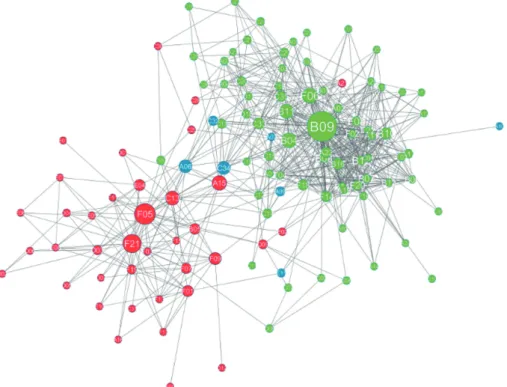
Using these data, we created a matrix-vector of 120 by 120 items. When two items had a relationship, a value of 1 was assigned to the corresponding matrix element; otherwise, a value of zero was assigned. This matrix-vector is known as an adjacency matrix. Next, using the igraph library, we transformed the adjacency matrix into an adjacency list11) of a statistical computing language “R”12). Finally, we visualized the network data using Cytoscape 13) (Figure 1). A node’s size depended on the number of edges that connected to the node. The biggest node was B09; for this item lack of awareness of higher education reform of faculty and staff.
Figure 1. Visualization of the networks of our university’s strengths, weaknesses, opportunities, and threats. 9)
Following careful consideration of the above results, in 2016 we drafted recommendations premised on collaboration between academic faculty and administrative staff that would lead to innovative management of the teaching and learning at Kobe Tokiwa University 14). We identified four issues for our university’s reform: (1) paradigm shifts from teaching to learning in a university faculty, (2) reforming students’ learning styles from knowledge acquisition to knowledge creation, (3) reconstructing non-professional education, and (4) developing a learning method to empower collaboration with others. This conceptual proposal provided the direction for our university’s reform and treated the institution as a single university.To reconstruct the non-professional education, we first drafted five common policies: a diploma policy (DP), a curriculum policy (CP), an admission policy (AP), a student support policy (SSP), and an assessment policy (ASP). The SSP is a novel and remarkable concept in Japan’s universities.
We then designed 39 basic education courses, based on the 19 ‘Tokiwa competencies (Table 1),’ as part of the innovative management of learning and teaching at Kobe Tokiwa University 14)15). In this article, we define a competency as a functionally linked complex of knowledge, skills, and attitudes that enables the successful performance of tasks and problem solving 16). The Tokiwa competencies indicator evaluates 19 types of indicators: culture, common sense, professionalism/expertise, media literacy, logical thinking, critical thinking,
intellectual curiosity, exploration, continuity, self-management, reflection, design thinking, presentation, judgment, implementation, responsibility, contribution, communication, and cooperation and collaboration 14)17).
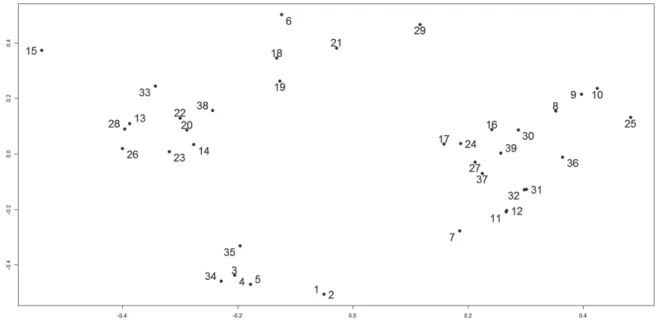
In 2017, to promote competency-based education in Kobe Tokiwa University, we created a proposal for an educational visualization method called ‘A New Way of Visualizing Curricula using Competencies: Cosine Similarity, Multidimensional Scaling Methods (MDS), and Scatter Plotting.’ 18) There are seven groups, and each group is involved in different courses (Figure 2). We usually think that there is no relationship between these courses, but the visualized curricula show some overlap in the relevant competencies. Using this ‘New Way,’ we constructed prototype methods that teachers employ to advise students taking courses based on competencies 19). To support the prototype methods, we created a web-based support system using Tokiwa competencies that students could use to select courses 17). Starting in 2018, in addition to the 40 common liberal and general education courses, Kobe Tokiwa University added additional syllabi of more than 200 courses in basic education, for which it was necessary to show the relationships among the 19 competencies in the rubric. In this case, the figures obtained by visualizing curricula based on competencies and using cosine similarity, MDS methods, and scatter plotting are much more complex than the map of 40 common liberal and general education courses. We thus investigated other methods to reduce dimensions. As a result, in particular, t-SNE methods have recently been used in bioinformatics 20) with good results. Thus, we applied t-SNE methods instead of MDS methods. We found that the t-SNE method is better than MDS methods for the purposes of displaying the similarities in curricula. In the future we will apply this method to the data for more than 200 courses offered at Kobe Tokiwa University in 2018 (Figure 3) 21).
To address many pressing and important problems of university reform, we had, over the past three years, determined research questions about these problems and resolved each of them when a problem presented itself, publishing our findings as reports or presenting in meetings. Before we began this research, we thought that there were no relationships between our studies. However, in this study, we reflected on
Figure 2. Visualizing curricula using 19 competencies for 39 courses using the MDS method. There are seven groups, and each group is involved in different courses. Each group consists of courses with similar competencies. 18)
our research during the last three years and looking back, we discovered that we can classify our research into six groups by context analysis: Group 1: university reform and collaboration between academic faculty and administrative staff; Group 2: proposal of novel knowledge-creation models; Group 3: novel visualization methods for education; Group 4: information and communication technology for education; Group 5: evidence-based education; and Group 6: first-year experience. We discovered that these six fields can be integrated into one by following the existing concept of bioinformatics and advocating a new concept of ‘eduinformatics’ as an interdisciplinary field (Figure 4) 22). Eduinformatics applies scientific fields to education; in other words, it is an interdisciplinary field and management information system for education with many practical applications. We can also say that the novel interdisciplinary concept of ‘eduinformatics’ also fuses education and Information and Communications Technology (ICT) (Figure 5). ICT supports an important role in new visions for education. It has released the traditional higher education system from spatial and temporal constraints, providing the foundation for bringing a new kind of higher education to the world 23). Based on this concept, we believe that eduinformatics in higher education will lead to a higher quality of education for students.
In 2016, an office for institutional research (IR) promotion was established at Kobe Tokiwa University. The purpose of this office is to propose, manage, arrange, and collect information on students at the university, not only as a general management strategy, but also to provide enrollment management. Work at the IR promotion office officially began in 2016, at which point we began to perform university data management and collection duties. A promotion unit for IR was also newly established in 2017. In contrast to IR promotion practices in which the department is run solely by an administrative staff, the IR promotion unit at Kobe Tokiwa University is a collaborative group consisting of both staff and faculty. In this unit, we carried out an analysis focusing on ‘student dropout’ by using data from both current, graduate, and dropout students.
Our database currently contains 3,495 data points (i.e., headcounts), each containing 1,246 items of
Figure 3. Visualizing curricula using syllabi: 19 competencies for 40 courses using the t-SNE method. There are seven groups, and each group is involved in different courses. Each group consists of courses with similar competencies. 21)
Figure 4. Concept of Eduinformatics 22)
Table 2. Correct answer rate for the training and test sets of the three machine learning methods 24)
numerical value. We obtained results with these data by processing them through a machine-learning technique using three methods; lasso regression, ridge regression both of which are logistic regression, and random forest. The correct answer rate was about 25 points higher for the random forest when compared to the logistic regression (Table 2) 24). This analysis was conducted based on the above eduinformatics.
Results
This section summarizes the results of our analyses.
1. First outcome
SWOT analysis is a tool used not only to evaluate a company’s Strengths, Weaknesses, Opportunities, and Threats, but also to facilitate a strategic planning process. Using SWOT analysis, we were able to evaluate the university’s management as a whole. As depicted in Figure 1, we found that using existing business methods such as SWOT analysis was very useful, and would improve and expand collaboration between academic faculty and administrative staff 25). In the first outcome, a better analysis was achieved by combining academic and class points that the only faculty can notice and institutional and administrative points that the only staff can notice.
2. Second outcome
In our second collaboration, we examined the need for people to have global competencies and comparable skills in today’s flat world, and be able to integrate them across disciplines, so they can comprehend global events and respond appropriately. Global competencies include the attitudinal and ethical dispositions that make it possible to interact peacefully, respectfully, and productively with fellow human beings from diverse geographies 26). As a result, competency-based education, which is an approach to teaching and learning used more often in learning concrete skills than in abstract learning, has today become a hot topic in higher education circles. However, competency-based education has only just been introduced in Japan, so a second requirement is to create an innovative university, for which our university developed a common evaluation indicator called the ‘Tokiwa competencies’ that students can acquire through regular, quasi-regular (or remedial), and extra-curricular (or club) activities. These are one of the core elements of university reform. In the second outcome as well, we were able to determine the competencies needed for students in our university by fusing the educational point of view that only faculty can notice and the recruitment points that only staff can notice.
3. Third outcome
Most students are only interested in course content, and not the competencies they can acquire from the courses. Curriculum maps are very useful for students who need to understand the relationships among their courses and lectures as they study. However, curriculum maps do not consider course content alone, and when students choose courses, the groupings these maps provide are useful. For example, if students want to obtain a wide range of competencies, they have to choose courses from different groups.
Thus, visualizing curricula using competencies is very useful for students deciding which courses to select. Until now, however, such maps have not existed. We believe that visualizing curricula is the best way to employ competencies and MDS, rather than using syllabi or network visualizations. In the third outcome, better curriculum maps were created by combining contents of course that the only faculty know and administrative perspectives that the only staff know.
4. Fourth outcome
‘Evidence-based’ is the latest buzz-word in education. The relatively consequence-free environments in which many teachers work can be breeding grounds for apathy and low job satisfaction. In order to preserve a teacher’s self-esteem, increase job satisfaction, and generally re-energize such situations, a form of evidence-based education can be adopted. Evidence-based education refers to policy and practice that can be justified in terms of sound evidence about their likely effects 27).
We think that the current environment around higher education is similar to an older era of life sciences. Following the creation of bioinformatics, the life sciences became more evidence-based and emphasized collaboration between biology and informatics. Members of our team have many different specialties such as higher education, nursing, mathematics, bioinformatics, and teaching/learning management; we can collaborate and apply new methods to education. We have recently been encouraging collaboration between many different researchers at Kobe Tokiwa University. In this situation, we were able to unite our research into the novel concept we call ‘eduinformatics,’ outlined earlier and which connects artistic and scientific fields. Our analysis is that this outcome can be attributed to the mutual exchange between theoretical/ academic knowledge of faculty members and practical/experiential knowledge of the staff through collaboration.
5. Fifth outcome
A 2008 central council report titled ‘Toward constructing bachelor degree education’ clarified that the most important thing in carrying out the reform is that each university clearly defines the three policies; diploma policy, curriculum policy and diploma policy 28). Subsequent to this report, scientific thinking styles involving statistical data and ‘evidence-based’ research gradually became required at the university level.
Following this trend, regulations for the enforcement of school education laws were renewed in 2011. In addition, the educational information that each university was required to provide was clarified. A ‘University Portrait’ was then developed by the central council in 2012 as a glossary providing information, entitled ‘Toward the qualitative change of university education to build a new future: To the university that continues to learn life and develops the ability to think independently.’ Here, we found a description related to IR stating that ‘because of the need to maintain a university portrait 28), the university should grasp and analyze its activity by using educational information to lead reform (i.e., improve the function referred to as IR)’ 6). Japanese interest in university IR increased after this report was published.
A major role of IR is to collect and analyze institutional data regarding student, faculty, curriculum, the offering of courses, and learning assessment. This requires staff who are good at the scientific thinking style,
but there is no staff trained to acquire such abilities at IR office in our university. So, faculty members who specialize in statistics or in education supported the staff to achieve IR.
6. Our latest activity
In a 2018 report titled ‘Grand design of higher education for 2040, 29) stated that grasping, measuring, and visualizing learning outcomes are very important from the viewpoint of reviewing educational activities and accountability to society. Therefore, we are developing hard on measuring and visualizing learning outcomes using eduinformatics in 2019.
Recently, we have employed eduinformatics when examining first year education 30)31)32)33). In these studies, we examine the assessment of rubric-based evaluations in first-year education. In addition, we have recently applied eduinformatics on competency-based education 34)35). In the related article, we captured how the prototype of competency-based education was developed in Kobe Tokiwa University. We introduced our own efforts to effectively conduct competency-based education and focused on describing the prototype of lecture-select-coaching through a combination of competency-based education and a web-based support system that enables students to select courses using Tokiwa competencies. The Web-based Radar Chart System of Tokiwa Competencies facilitates a new way of visualizing curricula using Tokiwa competencies through a combination of cosine similarity, multidimensional scaling methods (MDS), and scatter plotting. Finally, we conclude that it is important that students can reflect on and interpret Tokiwa competencies for themselves.
Above mentioned, it is important to combine higher education and informatics in university significant reform. Now, we try to develop new ways to visualize the learning outcomes of students using competencies. The important thing here is to create something that can be used. This requires not only faculty but also the support of staff who are non-expert. This is because it may be biased toward academic aspects if it is created only by a faculty member.
Discussion
We conducted SWOT and complex network analyses, and used our analyses to draft recommendations for innovative management of teaching and learning at the university. Based on this, we formulated Tokiwa competencies, and developed new curriculum maps and a new way of visualizing learning outcomes using eduinformatics which is a new academic field developed by us. In this experience of ours, collaboration between faculty and staff, as opposed to working solely with faculty, increased the level of achievement in that we were able to get meaningful and useful results.
All of our collaborations were conducted through numerous dialogues and discussions from various perspectives on the issues to be solved. It is no exaggeration to say that the key to the success of our collaboration is in-depth dialogues and discussions. When considered from the viewpoint of ‘knowledge,’ the collaboration between academic faculty and administrative staff can be seen as mutual exchanges between different experts. Nonetheless, mutual exchanges of knowledge are far from easy. As long as the
boundary lines between ‘experts’ and ‘non-experts’ are fixed, the flow of intelligence is unidirectional; the environment must be improved so that parallel intelligence can be used to promote the exchange of knowledge 36). The RCD which is an open space and everyone is able to gather there freely at any time, exemplifies a setting with access to human resources that can facilitate collaboration. In this kind of environment, dialogue and discussion facilitate, the possibility of serendipity arises, leading in turn to the creation of new knowledge as well as the exchange of knowledge. Collaboration in such an environment allows the unobstructed flow of knowledge, and fosters new ideas to facilitate successful reform.
The urgent need for dialogue between scientists and citizens has been promoted by the development of the new field of trans-science. It can be said that the need for collaboration between academic faculty and administrative staff is also being advocated in university governance, as a sign that recognition of the limits of such a division of labor has emerged. From our experiences, we also consider that collaboration between academic faculty and administrative staff is critical to achieving robust and effective university reform through co-creation and an open exchange of ideas and knowledge.
By reflecting on our collaborative experiences at Kobe Tokiwa University, we achieved this study’s objective of clarifying the key points of successful collaboration between faculty and staff. In conclusion, this study found that our activities are not just collaboration but co-creation. In this case, co-creation means not only solving university problems but also creating new knowledge, problem solving methods, policies, culture, and values based on evidence found through collaboration. By creating a setting with access to human resources, we could nurture a knowledge exchange that can facilitate co-creation and bridge boundaries between experts and non-experts. This kind of environment fosters serendipity, and leads not only to the exchange of knowledge, but also to the creation of new knowledge. Co-creation in such an environment allows the unobstructed flow of knowledge, and encourages the development of new ideas to facilitate successful reform.
Part of this article was presented orally at the 14th International Workshop on Higher Education Reform (HER).
References
1) OECD. Education at a glance: OECD indicators. 2012.
http://www.oecd-ilibrary.org/docserver/download/9612031e.pdf, (reference 2019-09-01).
2) Ministry of Education, Culture, Sports, Science and Technology (MEXT). Daigaku kaikaku jikko puran ni tsuite [Reform plan for universities]. 2012.
http://www.mext.go.jp/b_menu/houdou/24/06/1321798.htm, (reference 2019-09-01).
3) Council for Revitalization of Education. Korekara no daigaku kyoiku tou no arikata ni tsuite (dai 3 ji teigen) [The way of future higher education in Japan (third proposal)]. 2013
http://www.kantei.go.jp/jp/singi/kyouikusaisei/pdf/dai3_1.pdf, (reference 2019-09-01).
for improvement and enhancement of university management]. 2016.
http://www.mext.go.jp/b_menu/shingi/chukyo/chukyo4/015/attach/1366193.htm, (reference 2019-09-01). 5) Central Council for Education. Daigaku no gabanansu kaikaku no suishin ni tuite (shingi matome)
[Promotion of university governance reform (conclusion)]. 2014.
http://www.mext.go.jp/b_menu/shingi/chukyo/chukyo4/houkoku/1344348.htm, (reference 2019-09-01). 6) Central Council for Education. Aratana mirai o kizuku tameno daigaku kyoiku no shitsutekitennkan ni
mukete [Toward the qualitative transformation of university education in order to build a new future]. 2012.
http://www.mext.go.jp/b_menu/shingi/chukyo/chukyo0/toushin/1325047.htm, (reference 2019-09-01). 7) Oba, Jun. Curriculum management practices from the perspective of studies of university staff and
academic-administrative collaboration. Journal of the Liberal and General Education Society of Japan. 2014, vol. 36, no. 1, p. 53–58.
8) Council for Universities. 21 seiki no daigaku zou to kongo no kaikakuhosaku ni tsuite [Image of the university in the 21st century and future reform measures]. 1998.
http://www.mext.go.jp/b_menu/shingi/old_chukyo/old_daigaku_index/toushin/1315932.htm, (reference 2019-09-01).
9) Takamatsu, Kunihiko; Kirimura, Takafumi; Bannaka, Kenya; Noda, Ikuhiro; Mitsunari, Kenichiro; Omori, Masato; Adachi, Ryohei; Nakamura, Tadashi; Nakata, Yasuo. SWOT analysis and Complex Network analysis to enhance governance in universities by collaboration between academic and administrative faculty. Proceedings of International Institute of Applied Informatics (IIAI) International Congress on Advanced Applied Informatics (AAI) 5th International Conference on Data Science and Institutional Research (DSIR 2016) on IEEE, 2016, p. 1188–1189.
10) Watts, Duncan J.; Strogatz, Steven H. Collective dynamics of ‘small-world’ networks. Nature. 1998, vol. 393(6684), p. 440–442.
11) Csárdi, Gábor; Nepusz, Tamás. The igraph software package for complex network research. InterJournal Complex Systems. 2006, vol. 1695, no. 5, p. 1–9.
12) Ihaka, Ross; Gentleman, Robert. R: A language for data analysis and graphics. Journal of Computational and Graphical Statistics. 1996, vol. 5, no. 3, p. 299–314.
13) Shannon, Paul; Markiel, Andrew; Ozier, Owen; Baliga, Nitin S.; Wang, Jonathan T.; Ramage, Daniel; Amin, Nada; Schwikowski, Benno; Ideker, Trey. Cytoscape: A software environment for integrated models of biomolecular interaction networks. Genome Research. 2003, vol. 13, no. 11, p. 2498–2504.
14) Kirimura, Takafumi; Takamatsu, Kunihiko; Bannaka, Kenya; Noda, Ikuhiro; Mitsunari, Kenichiro; Nakamura, Tadashi; Nakata, Yasuo. Innovate the management of teaching and learning at our own university through collaboration between academic faculty and administrative staff. Bulletin of Kobe Tokiwa University. 2017, vol. 10, p. 23–32.
15) Kirimura, Takafumi; Takamatsu, Kunihiko; Bannaka, Kenya; Noda, Ikuhiro; Mitsunari, Kenichiro; Nakata, Yasuo. Designing the basic education courses as part of the innovation of management of learning and teaching at Kobe Tokiwa University through collaboration between academic faculty and administrative
staff. Bulletin of Kobe Tokiwa University. 2108, vol. 11, p. 181–192.
16) Spady, William. G. Outcome-based education: Critical issues and answers. Arlington, VA.: American Association of School Administrators. 1994.
17) Takamatsu, Kunihiko; Murakami, Katsuhiko; Kirimura, Takafumi; Bannaka, Kenya; Noda, Ikuhiro; Mitsunari, Kenichiro; Nakata, Yasuo. Web-based support system for students to select courses using Tokiwa Competencies. Proceedings of International Conference on Education, Psychology, and Learning (ICEPL 2017). 2017, p. 74–80.
18) Takamatsu, Kunihiko; Murakami, Katsuhiko; Kirimura, Takafumi; Bannaka, Kenya; Noda, Ikuhiro; Lim, Wei R-J.; Mitsunari, Kenichiro; Nakamura, Tadashi; Nakata, Yasuo. A new way of visualizing curricula using competencies: Cosine similarity, multidimensional scaling methods, and scatter plotting. Proceedings of International Institute of Applied Informatics (IIAI) International Congress on Advanced Applied Informatics (AAI) 6th International Conference on Data Science and Institutional Research (DSIR 2017) on IEEE. 2017, p. 192–197.
19) Nakata, Yasuo; Matsumoto, Eriko; Bohgaki, Miyako; Seki, Masayuki; Imanishi, Akiko; Kirimura, Takafumi; Bannaka, Kenya; Noda, Ikuhiro; Mitsunari, Kenichiro; Takamatsu, Kunihiko. Construction of a prototype of a method for advising students regarding courses using competencies. Proceedings of 23rd International Conference on Teaching, Education & Learning (ICTEL). 2017, GICICTEL1710070.
20) Karaiskos, Nikos; Wahle, Philipp; Alles, Jonathan; Boltengagen, Anastasiya; Ayoub, Salah; Kipar, Claudia; Kocks, Christine; Rajewsky, Nikolaus; Zinzen, Robert P. The Drosophila embryo at single-cell transcriptome resolution. Science. 2017, vol. 358, no. 6360, p. 194–199.
21) Takamatsu, Kunihiko; Murakami, Katsuhiko; Kozaki, Yasuhiro; Bannaka, Kenya; Noda, Ikuhiro; Lim, Wei R-J.; Mitsunari, Kenichiro; Nakamura, Tadashi; Nakata, Yasuo. A new way of visualizing curricula using competencies: cosine similarity and t-SNE. Proceedings of International Institute of Applied Informatics (IIAI) International Congress on Advanced Applied Informatics (AAI) 7th International Conference on Data Science and Institutional Research (DSIR 2018) on IEEE. 2018. p. 390–395.
22) Takamatsu, Kunihiko; Murakami, K., Kirimura, Takafumi; Bannaka, Kenya; Noda, Ikuhiro; Lim, Wei R-J.; Mitsunari, Kenichiro; Seki, Masayuki; Matsumoto, Eriko; Bohgaki, Miyako; Imanisi, Akiko; Omori, Masato; Adachi, Ryohei; Yamasaki, Mayumi; Sakamoto, Hideo; Takao, Kazutaka; Aasahi, Junichiro; Nakamura, Tadashi; Nakata, Yasuo. “Eduinformatics”: A new education field promotion. Bulletin of Kobe Tokiwa University. 2018, vol. 11, p. 27–44.
23) Furukawa, Takao; Shirakawa, Nobuyuki. ICT use and increasing openness in higher education: Advanced e-learning and open educational resources. Science & Technology Trends Quarterly Review. 2011, no. 40, p. 58–69.
24) Murakami, Katsuhiko; Takamatsu, Kunihiko; Kozaki, Yasuhiro; Kishida, Aoi; Bannaka, Kenya; Noda, Ikuhiro; Asahi, Jyunichiro; Takao, Kazutaka, Mitsunari, Kenichiro; Nakamura, Tadashi; Nakata, Yasuo. Predicting the probability of student dropout through EMIR using data from current students and graduates. Proceedings of International Institute of Applied Informatics (IIAI) International Congress on Advanced Applied Informatics (AAI) 7th International Conference on Data Science and Institutional
Research (DSIR 2018) on IEEE. 2018, p. 478–481.
25) Kirimura, Takafumi; Takamatsu, Kunihiko; Bannaka, Kenya; Noda, Ikuhiro; Nakata, Yasuo. Knowledge creation through collaboration between academic and administrative faculty: Strategies to increase serendipity. Bulletin of Kobe Tokiwa University. 2016, vol. 9, p. 71–78.
26) Reimers, Fernando. Educating for global competency. In Cohen, Joel E.; Malin, Martin B. (Eds.), International perspectives on the goals of universal basic and secondary education. New York: Routledge. 2009, p. 183–202.
27) Coe, Rob. Manifesto for evidence-based education. 1999.
http://www.cem.org/attachments/ebe/manifesto-for-ebe.pdf, (reference 2019-09-01).
28) Central Council for Education. Gakushi katei kyoiku no kochiku ni mukete (shingi no matome) [Toward constructing bachelor degree education]. 2008.
http://www.mext.go.jp/b_menu/shingi/chukyo/chukyo4/houkoku/080410.htm, (reference 2019-09-01). 29) Central Council for Education, University Subcommittee, Future Planning Committee. 2040 nen ni
muketa kotokyoiku no gurando dezain (toshin) [Grand design of higher education for 2040]. 2018.
http://www.mext.go.jp/component/b_menu/shingi/toushin/__icsFiles/afieldfile/2018/12/20/1411360_1_1 _1.pdf, (reference 2019-09-01).
30) Kirimura, Takafumi; Mitsunari, Kenichiro; Kunisaki, Taion; Gozu, Tetsuhiro; Takamatsu, Kunihiko; Bannaka, Kenya; Nakata,Yasuo. Effectiveness of first year experience’s course “Manaburu” at Kobe Tokiwa University for university students by using textual analysis. Bulletin of Kobe Tokiwa University. 2018, vol. 11, p. 193–208.
31) Nakata, Yasuo; Kawasaki, Hiroya; Kozaki,Yasuhiro; Kishida, Aoi; Bannaka, Kenya; Takamatsu, Kunihiko. The first-year experience incorporating the organizational development approach at Kobe Tokiwa University. PEOPLE: International Journal of Social Sciences. 2019, vol. 4, no. 3, p. 1761–1773.
32) Nakata, Yasuo; Kozaki, Yasuhiro; Mitsunari, Kenichiro; Kirimura, Takafumi; Kunisaki, Taion; Bannaka, Kenya; Gozu, Tetsuhiro; Noda, Ikuhiro; Takamatsu, Kunihiko. Ensuring equal evaluation among teachers in first-year education courses through rubrics: A multiple comparison analysis. International Conference on Education, Psychology, and Learning (ICEPL2018). 2018, p. 40–46.
33) Nakata, Yasuo; Kozaki, Yasuhiro; Kunisaki, Taiion; Gozu,Tetsuhiro; Bannaka, Kenya; Takamatsu, Kunihio. Assessment of rubric-based evaluation by nonparametric multiple comparisons in first-year education in a Japanese university. PEOPLE: International Journal of Social Sciences. 2018, vol. 4, no. 1, p. 631–641. 34) Takamatsu, Kunihiko; Kozak, Yasuhiro; Muarakami, Katsuhiko; Matsumoto, Eriko; Bohgaki, Miyako;
Seki, Masayuki; Imanishi, Akiko; Bannaka, Kenya; Noda, Ikuhiro; Mitsunari, Kenichiro; Nakata, Yasuo. Web-based radar chart system of Tokiwa competencies in eduinformatics. International Conference on Education, Psychology, and Learning (ICEPL2018). 2018, p. 30–37.
35) Matsumoto, Eriko; Takamatsu, Kunihiko; Bohgaki,Miyako; Imanishi, Akiko; Seki, Masayuki; Nakata, Yasuo. Development of course guidance support method for “competency-based education (CBE)” in university and its issues. Bulletin of Kobe Tokiwa University. 2019, vol. 12, p. 17–28.