.Introduction
The first tariff act of the United States in has significance worthy of attention. Before its establish-ment, each State had its own tariff imposed on the goods from abroad as well as those from other State. It was just a chaotic situation. Most of tariff collection involved loss and due to complicated and inconsistent tariff system, local tariff official was confused. Then under the new Constitution, each State gave up its right of imposing customs duties to the Congress. The Congress was able to impose uniform duties on imports from abroad. Its function can liken to be a common external tariff of a cus-toms union. In this sense, the tariff act was an epock-making measure. It is quite reasonable for a new government to lay and collect taxes to provide for the common defense and general welfare of a nation which the Constitution Section . stipulates. The government needs revenue to run, and so tariff for revenue may be justified based on the section ..Generally the original idea of the tariff act of was revenue-oriented in the light of the Con-stitution of the United States of America. It was so called “The First Federal Revenue Law.”
But protective element was grafted into the act through sectional struggles in the tariff debates in the Congress. Therefore, significance of the act had been debated if it was a protective tariff or not.
The purpose of the paper is to describe how pro-tective elements were incorporated into a revenue bill and tries to clarify the significance of the tariff act of .The findings are as follow: )various elements of protectionist ideas had been put forth in the debates of . )it was intended to be a temporary measure to justify infant industry protec-tion. )legislation process of the tariff act was a gradual change of James Madison’s friendly policy from free commerce to protectionism.
.Various evaluations or interpretations of the tariff act
Significance of the tariff act has been already dis-cussed by quite a few researchers.
Miller, J.C. said that it is a compromise between the advocates of high protective duties and those who favored a tariff for revenue only.
Mathew Carey says that the tariff of didn’t give adequate protection to manufacturing industry.
U.S. Tariff Act of
Tetsuya K
URATANIABSTRACT
We discuss how protective factors of American manufactures were grafted into the first tariff of the U.S. aiming at securing government revenue from its custom duties enacted by the federal con-gress. Initially, the aim of enactment was mainly to generate revenues for the new government, how-ever through the tariff debates in congress, protective ideas were incorporated into the legislation. Its end product is evidently stated in section of the act that it is necessary for the support of govern-ment, for the discharge of the debts of the United States, and the encouragement and protection of manufactures, that duties be laid on goods, wares and merchandise imported. Through sectional struggles a tariff for revenue was transformed into a tariff act with an intent of protection, that is, a politically compromised tariff. However, protective effect from imposing the tariff would ensue re-gardless of their intention of protection.
KEYWORDS: protectionism, Tariff Act of ,protection of manufactures
Bull. Shikoku Univ. : − ,
The inadequate protection came from the concur-rence in one object of four descriptions of citizens. .Mercantile class has been opposed to the protec-tion given to the manufacturers because it is injuri-ous to the prosperity of commerce. .Agriculturalists have been jealous of the manufacturers and opposed the imposition of duties sufficiently enough to pro-tect manufacturing industry. They dreaded a rise of price as a necessary result of securing the home market to their fellow citizens. .Free traders con-tended that trade ought to be allowed to regulate it-self. .Class of political economist such as Mathew Carey who believes that relieving the nation of its dependence on foreign markets for the dis-posal of its agricultural surpluses and for a supply of manufactures is advantageous.
Taussig refers the first tariff act as protective in intention and spirit. The general range of duties was by no means such as would have been thought pro-tective in later days ; but the intention to protect was there. Some selected articles such as hemp, cordage, nails, manufactures of iron, and glass were made subject to the specific duties, with the clear intent of stimulating domestic production.
Thompson’s interpretation of the purpose of the tariff act is simple. Protection is one of its purposes because its preamble says :
“Whereas, it is necessary for the support of the Government, the discharge of the debts of the United States, and the encouragement and protection of manufactures, that duties be laid on goods, wares, and merchandises imported.”
It asserts three distinct propositions: .that duties should be laid for the support of the Government; .that they should be laid for the payment of the public debt ; and . that they should be also laid for the encouragement and protection of manufac-tures.
British reaction to the enactment of the tariff is no complainer of those duties. Report of a Commit-tee of the Lords of the Privy Council commented on the act of saying, according to the mer-chants they consulted, the present duties are on the whole not higher than those to which British goods so imported were made subject by individual States before the new Constitution. Their statement might be plausible since for the United States, nine-tenths of the articles from Great Britain are British manu-factures.
Knowles’ idea is that it was in reality a revenue rather than a protectionist scheme. In other words, the tariff was a slight concession to the protectionist party and the duties were too low to be anything like a protectionist tariff. He gives the following reasons. The industrial condition at that time did not require protection. Nine-tenths of population were engaged in agriculture and they wanted cheap im-ports. Infrastructure such as internal distribution was poor and therefore there was not a sufficient market for the manufacturers to flourish. etc.
Hill believed that “the encouragement and protec-tion of manufactures” was at least as important as any other motive in securing the passage of the act because of the following reasons : several states wanted to continue protection or aid similar to those given before the new Constitution ; the bulk of American imports was formed with British manufac-tures urging the Americans to depart from free trade ; protective motives of tariff-makers were re-vealed in the tariff debates in the first Congress .
Bishop sees that the principle of legislative protec-tion to American industry in the first Revenue bill was recognized by a nearly unanimous vote of many who had been active in framing the Constitution and in urging its adoption in the legislatures and conven-tions of their respective States. Behind this scene there was the first petition presented to Congress af-ter its first assembling in March, ,which came
from around seven hundred of the mechanics, trades-men and others of the town of Baltimore, latrades-menting the decline of manufactures and trade since the Revolution, and praying that the efficient government with which they were then blessed for the first time, would render the country “independent in fact as well as in name,” by an early attention to the en-couragement and protection of American Manufac-tures by imposing on “all foreign articles which could be made in America, such duties as would give a decided preference to their labors.”
At the establishment of the new government, the popular mind turned to it with ardent expectation that it would supply the long-left need of protection to home industry.
Mason’s point of view is that the government em-powered with the Constitution has responsibility to protect home industry.
Ely stated that the first tariff act was mainly for revenue, while protection was incidental. At least the duties up to were for revenue with incidental protection.
Possible motive for the tariff act is well described by Adams. It was the spirit of nationality which was so pronounced in the early federalists. It was hoped by means of a tariff on imported commodities and by the use of domestic products to weld to-gether the different states into a strong union.
Harriman of the American Protective Tariff League calls the act of ,a protective tariff say-ing the Congress passed a Tariff Act in the interest of protection and not for “revenue only,” for in the Preamble to the Act. A large majority of that first Congress were farmers but they saw the necessity of encouraging and protecting manufactures, in order that they might be free from servile and dangerous dependence upon foreign nations for the arms, the implements of farming and other machinery needed for their own safety, protection and independence. The men who formulated our glorious Constitution,
and secured its adoption by the several States―all voted for the Protective Tariff Bill and rejoiced greatly when it became a law.
Bastable tells us that the belief that the industries unduly retarded by the colonial system required some compensating encouragement and the pressing fiscal necessities of the new government combined to bring about the establishment of a moderate tariff on imported goods, and that the rates were so low as to act chiefly as revenue duties.
Ashely describes the Act as a policy of protec-tion, chiefly for manufactures, modified partly by the inexperience of the legislatures and partly by regard to consideration of revenue.
According to Taylor, a protective element had been present in the very first tariff act, that of , but Hamilton’s ambitious protective system had not been adopted by Congress. Until the War of rates remained relatively low, less than per cent on the value of dutiable products, and revenue consideration clearly overshadowed the pro-tective features.
According to Ford, from the very first, then, a tariff has been recognized as a measure for raising revenue, for protecting and encouraging domestic manufactures, and as an instrument for regulating commerce. Some of the states had already adopted regulations which were intended to give such en-couragement to their industries, although this encour-agement was secured at the expense of the other states ; and in ceding this power to make such laws to the general government, it was claimed that the states had expected a continuance of this recognized policy. So that the weight of opinion was in favor of the right to regulate commerce by import duties or other taxes, and chiefly on the ground that the power was generally exercised among nations.
The tariff debates in Congress show that protec-tion to the infant manufactures was considered origi-nally as an essential part of the whole legislation.
The minute discussion which followed upon the tar-iff, and the antagonism of interests which was mani-fested, showed the protectionist intentions of the rep-resentatives of the country.
According to Rabbeno, the protective policy was not distinctly adopted in ,nor for many years after, because on the whole the industrial condition of the country did not require it, and would not have allowed it.
According to Smart, the first tariff under the Con-gress of ,which ranged only from per cent. to per cent., with an average of / per cent., seems dictated over-whelmingly by the finan-cial needs of the Federal Government. After , the capital and energies of the nation had not been to any great extent devoted to manufactures. There was an immense demand abroad for American prod-ucts, especially foodstuffs, timber, and cotton, and America followed the economic line of making the most of her natural resources, developing her agri-culture and her carrying trade.
Sumner tells us that the tariff of avowedly adopted the principle of protection, because its pre-amble read so and because it was declared to be only temporary in order to give infant industries a start and was limited to .
.Tariff as revenue generating measure :
It was urgent to produce sufficient revenue to supply the operational needs of the government and to pay the interest and principal on the foreign and domestic debt. As you can see in Figure in the years and ,almost all the government reve-nue was generated from tariff. In the United States, prior to the Civil war, tariffs provided up to % of government revenue. The early tariffs of the United States were mainly revenue-generating meas-ure rather than protective one. Some twenty-five tar-iff laws were passed between and , and almost all the duties imposed were designed for revenue purposes rather than for protection, Because
Source : Historical Statistics of the United States,1789−1945.p. .
the government during this period found great diffi-culty in devising an adequate system of taxation, and consequently relied on the tariff for the bulk of the revenue of the state. This ratio fell sharply with the introduction of income tax in .
Idea of tariff for revenue is nothing new : one of the oldest purposes of levying tariffs was for the sake of financing government expenditure, the king’s customs, and from time immemorial foreign trade has been an object of taxation. Just like that the tar-iff was the chief source of government revenue, so that the tariff system had to adapt itself not merely to the protectionist or free trade notions of the mo-ment but also to the requiremo-ments of the Treasury. When it come to revenue, it is quite vital for the newly government to exist. Without revenue and a government never has any resources except what it derives from people regularly and uniform obtain-able, no governmental machinery for the protection of life and property, through the dispensing of jus-tice and the providing for the common defense, could long be maintained.
The articles on which tariff for revenue are im-posed may be divided into two group. The first group includes articles which are not produced do-mestically and in association with which there can be unlikely to foster a home industry. They are, for example, coffee, tea, spices and some tropical and luxury items. Taxation on these articles is generally considered a good way for the new government to secure revenue. The second group has manufactured imports that at the same time domestic manufactur-ers produce of the similar kind. If the domestic prices are raised by tariff duties, there may be a hidden bounty given to the domestic manufacturers.
Revenue tariff is usually imposed on the imports that were either not produced at home or produced in insufficient quantity to meet American demand. Granted that duties on non-competing items from abroad were passed without much debate, in some
cases there were debates about the revenue tariff due to the roles played by articles. That is whether the article is an input or output in production.
.Basic model of the tariff act of
Under the confederation of the Continental Congress made numerous efforts to induce the states to join in levying taxes on imports for the benefit of common treasury. Indeed this was about the only feasible method of raising revenue that the articles would allow. But it was futile. The Rhode Island was the most obstinate in its refusal to comply with the request of Congress. According to Bates, in re-viewing Rhode Island’s action on the impost, its motives may be reduced to three: .A misunder-standing of the effects of an import duty. .Anxiety respecting the disposal of western lands. .A jeal-ousy of yielding to outside authority any power over her internal affairs.
To pay the interest and principal of the debt, Congress had twice proposed an amendment to the Articles granting them the power to lay a % duty on imports, but amendments required the consent of all thirteen states. Rhode Island and Virginia re-jected the impost plan while Rhode Island re-mained obdurate and several other states had grown skeptical and the revised plan bogged down. The new revenue provisions were to be limited and temporary. Congress was permitted to raise only revenue necessary for the “discharge of the interest or principal of the debts contracted on the faith the United States, for supporting the war.” Moreover, both the tariff and the requisition expired after years.
The Table shows the propositions of , which have been generally approved by several States. James Madison made them the basis of the proposal of April ,of . In short, it was the duty of five per cent on the value of all goods
ported, and an additional duty on a few enumerated articles shown in the Table .
.Tariff for government revenue : an only choice available
Internal taxes were hated by people because new taxes mean that a new body of tax collectors would join local and state officials in separating American taxpayers from their money. The Americans at that time had been resisting the taxation imposed by England and direct taxation and excise duties were impossibility, coupled with a jealousy of the states against what they would have deemed interference in the affairs of their citizens. Direct taxes could not be laid until an enumeration of the population had been finished. In addition, laying a tariff on ex-ported products was prohibited by the Constitution. With insufficient administrative capabilities, trade taxes may be the easiest way for government to raise revenue, since tariffs have lower collection costs than other tax instruments. It is possibly easier to tax goods than incomes and moreover, and goods are subjected typically to the constriction of a port
or border crossing. To collect the tariff all they need is a few customs officers in the ports checking the ships as they come in.
James Madison, progenitor of the tariff act knew it well and said that a national revenue must be ob-tained, but the system must be such a one that, while it secures the object of revenue, it shall not be oppressive to our constituents. He is very shrewd as a politician almost eliminating voices of domestic opposition to imposition of tax because a tariff is essentially a tax on the opportunities of foreign pro-ducers, it is a form of taxation without representation--a tax on foreign producers over which the foreign producers have no say. He perceived that both these objects might be obtained from an impost on articles imported into the United States.
.James Madison s temporary system mainly for securing revenue
The most challenging and urgent issue for the newly created government is how to secure financial resources for paying public debts and running the government. Therefore there was no objection to se-Table : The Congressional recommendations of ,March
Source : The Paper of James Madison vol.1. pp. − .
cure government revenue. It was the revenue for the government that was the first matter debated in committee of the whole in the first House of Repre-sentatives. On the th of April, James Madi-son, progenitor of the tariff act called for raising a national revenue to remedy the evil of a deficiency in the treasury. His idea is to secure the object of revenue at the same time it shall not oppress their constituents. As we have seen the only way open to him seemed to be revenue from an impost.
Madison who at the outset assumed a position of leadership, in the Committee of the Whole on April introduced a resolution for the establishment of an impost similar to the one discussed in the Con-gress of the Confederation in . That is His resolution includes freedom of trade from the shack-les of regulation as long as the policy of nations will admit. It can be characterized as mildly pro-tectionist. In addition to discriminating vessel duties, it demands ad valorem duties on most items, but on the others, the enumerated list, higher specific duties would be levied for protection.
Madison identified himself as the friend to the very free system of commerce and described restric-tion of trade as unjust and impolitic, yet he also recognized that in establishing the new nation, ex-ceptions might have to be made. He did not object to government regulation of trade or protective tariff policies as long as such measures proved tempo-rary. Having been generally approved by the sev-eral States in some form or another the propositions of was made to be a temporary system. He wished the committee to adopt it.
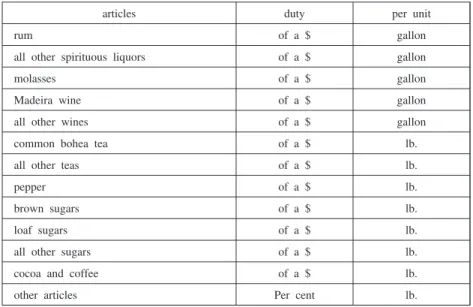
The situation admitted of no delay ; the spring importations would shortly reach port ; and therefore Madison proposed ”such articles of requisition only as are likely to occasion the least difficulty.” The articles upon which specific duties were to be laid were eight in number : rum and spirituous liquors, molasses, wines, tea, pepper, sugar, cocoa, and cof-fee(See table ). John Lawrence of New York supported Madison’s proposal, arguing that “the more simple a plan of revenue is, the easier it be-comes understood and executed.” But He came
articles duty per unit
rum of a $ gallon
all other spirituous liquors of a $ gallon
molasses of a $ gallon
Madeira wine of a $ gallon
all other wines of a $ gallon
common bohea tea of a $ lb.
all other teas of a $ lb.
pepper of a $ lb.
brown sugars of a $ lb.
loaf sugars of a $ lb.
all other sugars of a $ lb.
cocoa and coffee of a $ lb.
other articles Per cent lb.
Table :James Madison s original plan presented in the committee of the Whole on April ,
Source : Gales and Seaton’s Annals of First Congress, First Session, pp. − .
across objections from sectional interests.
.The protection of infant manufactures -an essential part of the whole legislation
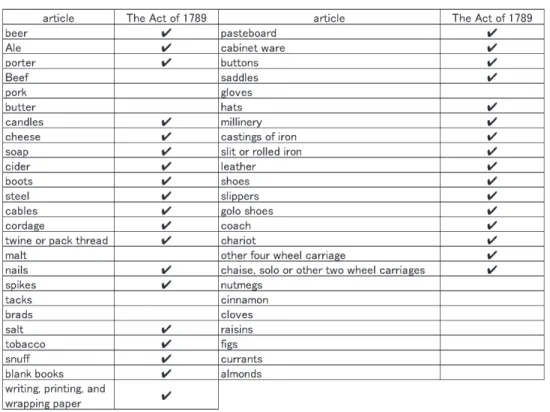
The course of freedom of trade steered by James Madison had to somehow change its direction. Tho-mas Fitzsimons, a wealthy merchant of Philadel-phia, the next day offered an amendment declaring additional duties on manufactured articles(especially those produced in Pennsylvania)“to encourage the productions of our country and to protect our infant manufactures.” His resolution included a large and varied list of articles of drink, food, clothing, vehi-cles etc(See Table ).Some were calculated to en-courage the production of America and protect its infant manufactures. The others might work as
sumptuary restriction upon luxury goods.
Madison acknowledged that there might be some reasons for imposing higher tariffs on some addi-tional items, saying “I see no very strong reason against receiving them for consideration.” The house tentatively added Fitzsimons’ list to Madison’s original list and then protective tariff debates began. As you may see in Table the effect of recommen-dation by Fitzsimons on the tariff act of , items out of were adopted in the end.
In Congress, protectionist presented their idea about why protection is necessary.
Protectionists give us the following reasons : )Promotion of the national wealth
Thomas Hartley(PA)comments on the conditions of manufacture saying, “our manufactures are able to furnish some in sufficient quantity to answer the
Table :The articles enumerated for duty recommended by Fitzsimons and its adopted items(
䘠
)in the act ofSource : Gales and Seaton’s Annals of First Congress, First Session, p. .and Tariffs Acts passed by
Congress from 1789 to 1909,pp. − .
consumption of the whole Union, while others are daily growing into importance. Our stock of materi-als is, in many instances, equal to the greatest de-mand, and our skilled workers can work them up even for exportation. Under the encouragement to perfect manufacturers, the industry of the manufac-turer will be employed to add to the wealth of na-tion.
Thomas Fitzsimons(PA)counseled that Congress should set aside local distinctions, because what op-erates to the benefit of one part in establishing use-ful institutions will eventually operate to the whole.
)giving price-competitiveness in the future Thomas Hartley(PA)supported protection because he believes protection will give home manufactures advantage in the price when products are brought to market as has been proved in the history of ancient world.
)Self-sufficiency
A desirable goal of the United States is to be as self-sufficient as possible. Protection of our infant industries is a prerequisite.
)Relief from the decline of trading and manufac-turing
On April ,William Smith of Maryland, a man of wide commercial experience presented a petition from the tradesmen, manufacturers, and asking relief from the supreme legislature of the United States as the guardians of the whole empire.
)Import substitution urged
Smith(Maryland)also urged imposition of tariff on all foreign articles, which can be made in Amer-ica.
)National defense
Madison argued that whatever relates to the opera-tions of war, no State ought to depend upon a pre-carious supply from any part of the world. Embar-goes in times war may necessarily occur and shackle the freedom of commerce.
)Hysteresis effect
Some of the States had already provided regula-tions and succeeded in producing establishments. They ought not to be allowed to perish, from the alteration which has taken place : it would be cruel to neglect them and divert their industry to other channels : for it is not possible for the hand of man to shift from one employment to another with-out being injured by the change. Madison claims that legislative attention will be necessary to collect the proper objects for some manufactures which need the fostering hand of the government.
)Sumptuary prohibition
Regarding the articles added by Fitzsimons, Madi-son observes that a sumptuary prohibition is within the view of some of the proposed articles, and forms another exception to the principles of free trade. In his view, sumptuary duties in some form or other will prevail and take effect, because in gen-eral, imposition of tariffs tend to depress the con-sumption, even it is not called sumptuary duties.
)Development of a market for domestic farmers If the duty on beer, ale and porter was high enough to effect a prohibition, its domestic manufac-ture would increase and at the same time, increased domestic production would advance agricultural inter-est, since the materials were produced in America.
.How Individual articles were added to the list?
The result of divided counsels was a debate of seven weeks, devoted chiefly to the rates to be im-posed upon molasses, distilled spirits, iron and steel, nails, candles, and cotton, and etc.
)Glass
glass was put on the list of enumerated article by Boudinot of New Jersey. We are capable of manu-facturing and almost all its materials are being pro-duced in the United States.
)Anchors, wool cards, wrought tin ware, every box of lemons, barrels of limes
In order to make the list as complete as possible, Mr. Goodhue of Massachusetts begged to add them to the list, and the committee of the whole agreed.
)Rum
Rum is an article of great consumption and though it cannot be reckoned a necessity of life, yet it is such a great use, that it may be expected to pay a very considerable sum into treasury.
Mr. Sherman of Connecticut moved that the arti-cle of rum should be charged with fifteen cents per gallon. Then, Mr. Smith was apprehensive fifteen cents would be too high, and therefore moved ten cents, which he thought would raise more revenue than the other. William Smith of South Carolina suggested that a lower tariff would generate even more revenue. On motion of Mr. Gale the word rum was changed into distilled spirits of Jamaica proof. In ,Jamaican rum cost about cents a gallon. So a fifteen cent duty was a % tax. This is too high as a tariff. Fitzsimons was in favor of the highest sum saying a difference between twelve and fifteen cents can only be matter of opin-ion. And The highest sum may be achievable from the previous experience. The highest sum proposed to the committee very little exceeds that collected in Pennsylvania. Madison agreed with a duty as high as can be collected. From what he has heard, in the sense of people of America, this article should have a duty imposed upon it weighty indeed. In his opin-ion the government of the Unopin-ion is capable of col-lecting higher duties than the particular States did, because their purposes of collection of duties were not for the benefit of all the States but for individ-ual State. Mr. Lawrence of New York expressed his fear that it can’t be collected, because the sum proposed(fifteen cents)is higher than the duty col-lected in New York, which is about eight cents. A higher tax may lead mankind to an evasion of the
law perhaps by smuggling, and they shall lose a great deal of revenue. As of April , ,the committee agreed to tax ardent spirits of Jamaica proof, fifteen cents ; and all other spirituous liquors twelve cents.
In the bill passed by both houses, the duty on rum was cents per gallon. That is to say, the duty on all distilled spirits of Jamaica proof, im-ported from any kingdom or coutry whatsoever, per gallon, is ten cents in the tariff act of .
)Molasses
The government protected the importation of mo-lasses through protective tariffs going back to the first tariff in . The duty was to be levied solely for revenue, because no sugar cane was being grown in the United States in . Nevertheless the debate was bitter as long as industry interests were involved.
Mr. Madison thinks eight cents per gallon will al-low a sufficient advantage to manufacturing of rum in America, but of this, he is not positive and shall not pertinaciously adhere to that sum. Mr. Parker of Virginia said “If the duty on molasses operated to discourage the consumption of New England rum, it would have very happy consequences.” He there-fore seconded the notion for eight cents. Mr. Law-rence was opposed to higher rate such as eight cents. First, molasses is an article of necessity for the poorer class of citizens, and higher tax would burden them heavily. Secondly, molasses is a raw material for manufacture, and when it is distilled, exported in considerable quantities. If heavy duty is laid, it will probably prevent the exportation. Mr. Madison responded saying, “The great exportation from New York is made to the different parts of the United States and not to the foreign countries ; the duty, therefore will not be paid by our own citi-zens, because under the new constitution admission of that commodity into every State is perfectly duty-free. Others agreed with lower tariff and Madison
proposed reducing the molasses tariff from eight to seven cents. The question was put on seven cents and lost, and a tariff of six cents adopted.
)Madiera wine
Mr. Sherman moved fifteen cents Mr. Gilman moved twenty cents and Mr. Hartley moved thirty cents. Mr. Fitzsimons moved fifty cents. He believes that Madeira wine is not a necessary of life at least to those whose incomes are only sufficient for a temperate subsistence and then the propriety of a high tax on wines is self-evident. Mr. Muhlenberg seconded the motion for fifty cents. Mr. Bland thinks that they shall not be able to obtain any revenue whatsoever if the tax is laid so high. Mr. Boudinot observes that there is a considerable loss attends keeping Madeira. He thinks it may be admit-ted that twenty or twenty-five per gallon is a suffi-cient tax. Also he believes that a higher tariff such as fifty cents tends to discourage the Madeira trade. Mr. Lawrence thinks a tariff of fifty cents would operate as a premium to encourage smuggling and therefore was not inclined to vote for more than twenty cents. Then Mr. Fitzsimons withdrew his mo-tion for fifty cents and moved thirty-tree and one-third cents. The question was put on thirty-three and one-third cents as the highest sum and agreed to. The tariff was adopted but only narrowly being twenty-one votes for it, and nineteen against it.
)All other wines
There were a great variety of wines in that gen-eral expression, the prices of which were very dif-ferent. Therefore, the propriety of discriminating and taxing them according to their value was proposed, which was rejected. It was agreed to lay twenty cents on all other wines.
)Sugar
The committee of the whole agreed to tax com-mon sugar one cent per pound, loaf sugar three cents per pound and all other sugars one and a half cent per pound. Mr. Fitzsimons gave an explanation
why the one cent tax is proper for common sugar; .one cent tax on sugar could be comparable to the duty of molasses(less than one cent per pound), . if the quality of both molasses and sugar are infe-rior, they are articles of general consumption, more or much of which accounts for the consumption of the poor,.molasses will sweeten more, according to its weight, than even the best sugar.
)Beer, ale, and porter
Mr. Fitzsimons moved nine cents per gallon, cit-ing the successful case of establishcit-ing breweries with the small protecting duties laid in Pennsylvania. Mr. Lawrence seconded the motion and preferred higher duties to give a decided preference to Ameri-can beer ; it would tend to encourage agriculture, because the molts and hops consumed in manufac-ture were the produce in America. Mr. Smith of Maryland was opposed to such a higher duty ; he thought enough might be raised if the tax was low-ered. Mr. Gale thought a duty of nine cents would work as prohibitive tariff defeating the purpose of obtaining revenue and giving the brewers in America a monopoly. Namely He was against a nine cents duty. Mr. Sinnickson of New Jersey agreed with a prohibitive tariff to increase production of domestic manufactures, which would advance domestic agri-cultural interest, since the materials are produced in America. Then Madison moved to lay an impost of eight cents on all beer imported. He hoped it would increase both manufacturing and agricultural interests. He believes eight cent duty is all right. He gives a proof that in the State of New York, the article brought in foreign vessels takes eight cents as a duty and yet quantities of it were still imported. The committee agreed to charge it at eight cents. On all beer, ale or porter, imported in bottles per dozen, without debate they agreed to twenty-five cents.
)Coffee
America imports great quantities of coffee, tea,
and produces none of them. Duties on coffee and tea were strictly for revenue and were passed with-out much debate. On coffee two and a half cents per pound was agreed.
)Salt
Mr. Burke of South Carolina was against the tax since salt is a necessary of life for people and cat-tle. and for inhabitants of South Carolina and Geor-gia, the price is already oppressively great due to transportation cost and the burden of tax sustained by those who live remote from the sea-shore suffi-ciently unequal. Mr. Lawrence hoped a duty would be laid ; it was in general use, and the consumption so regular ; that it was much to be depended upon as a source of revenue. But it should not be so high as to make it oppressive. He moved to impose a duty of six cents per bushel. Thomas Tucker (SC)felt an aversion to laying a duty on salt, and said that the duty would bear hardest on the poor because a poor man consumes as much salt as a rich man. In this point of view, it operates as a poll-tax, the most odious of all taxes… but is heav-ier on the poor than the rich, because the poor con-sume greater quantities of salted provision than the rich. Thomas Scott of Pennsylvania declared himself decisively against the duty, and stated that in some parts of America, transportation cost makes the price of salt already higher, which is equivalent to a suf-ficient tax on consumer. Andrew Moore of Virginia didn’t agree to the duty, because the tax appeared to him not only unpopular but unjust. Mr. Lawrence in favor of this duty responded that taxes, to be just, should affect all, and equally affect them, and not be left to fall partially upon a few. This is more the case with salt than any other article which has yet been taxed. He also defended the duty say-ing, “This article is of general consumption ; per-haps it may be averaged at three bushels to a fam-ily annually ; the tax on this will be light, none can be oppressed, and yet it will bring into the
treasury a very large sum. etc.” Madison said, “In order to determine whether a tax on salt is just or not, we must consider it as part of a system, and judge of the operation of this system as if it was but a single article ; if this is found to be unequal, it is also unjust. Previously adopted tariffs would have a disproportionate effect on the wealthy ; therefore, by adding this article, we shall rather equalize the disproportion than increase it.
The question on imposing six cents on salt was put and carried.
)Candle
Mr. Fitzsimons moved to lay a duty of two cents on all candles of tallow per pound telling the suc-cessful case of import substitution in Pennsylvania with a duty of two pence per pound. Mr. Tucker of South Carolina observed that some States were im-porting considerable amount of this article while oth-ers had enough for their own consumption, therefore the burden would be partially borne by such States. The impost would bear unequally on South Carolina. Mr. Boundinot expected that domestic producers could make it cheaper than foreign producers with a small amount of encouragement from the govern-ment, as the materials were to be had in abundance in America. Mr. Lawrence seconded Mr. Fitzsimons’ motion for two cents, saying, “if the candles are an object of considerable importation, they ought to be taxed for the sake of obtaining revenue, and of they are not imported in considerable quantities, the bur-den on consumer will be small, while it tends to cherish a valuable manufacture.” The Fitzsimons’ motion for two cents was carried in the affirmative on the question being put.
)Steel
Mr. Lee of Virginia move to strike out steel from the list. Its consumption is very great and essentially necessary to agricultural improvements. The Union could not fabricate enough of this article to answer the consumption. The tax would operate as an
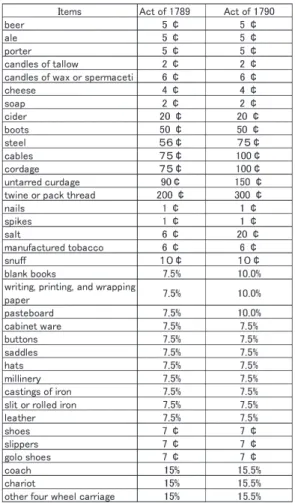
Table :Comparison of tariff recommended by Fitzsimons and adopted in the tariff acts of
and
Source : Tariff Acts passed by Congress from 1789 to
1909,pp. − .
pressive. Mr. Tucker agreed with him and told that it was better to give a bounty to increase domestic production than an impost which would lessen the consumption and make it dear also. In addition, he considered the smallest tax on steel to be a burden on agriculture, which ought to be considered an in-terest most deserving protection and encouragement. The manufacture of steel was described by Mr. Clymer as in its infancy, but likely to emancipate the country from the control exercised by foreign manufacturers. It had, however, been attended with considerable success. The materials necessary to make the article were the product of almost every State in the Union. Mr. Fitzsimons thought that five shillings per hundred weight would not be oppres-sive, and that even if it were partial duty, the evil would be soon overbalanced by the establishment of an important manufacture with a small encourage-ment from the General governencourage-ment. Lee’s motion to strike out was not carried and Mr. Boudinot’s mo-tion of fifty-six cents per one hundred and twelve pounds was adopted.
.Several features of the tariff act of
)Emergency measure and protection insufficient : Judging from the shorter period, namely days be-tween the appointment of the committee to consider the tariff matter and the approval of President Washington, the tariff act of was an emer-gency measure to secure government revenue. More-over, the act of lasted only about one year and was replaced by the act of .It was so short-lived that protection to some manufacture was not sufficiently given. The act of seemed to fill the deficiency. The duty on tarred cordage was increased from cents to cents ; on untarred from cents to cents ; all of which changes were in favor of the rope-makers. The duty on steel was raised from to cents per
hundred-weight. The higher rate was imposed on manufac-tured articles such as coach, chariot, and other four wheel carriage(See Table ).
)Logrolling :
Another feature of the tariff act is there seems to have been logrolling for the first time in Congress. Without substantial debate, several items were put on the tariff list. Mr. Carroll of Maryland proposed a tariff on window and other glass, because a manu-facture of this article was begun in Maryland, and
attended with considerable success ; if the legislature were to grant a small encouragement, it would be permanently established. A desultory conversation arose in the committee respecting the propriety of receiving the motion at this time, when it was agreed to add on all window and other glass, ten percent ad valorem. Then Mr. Clymer of Pennsylva-nia called attention to the state of paper mills of Pennsylvania. Thereupon it was agreed to lay an im-post of seven and a half per cent ad valorem on blank books, writing, printing, and wrapping paper, and pasteboard. Without debate, the same was laid on canes, walking sticks, whips, clothing ready made, on gold, silver, and plated ware, and on jew-ellery and metal, paste work ; on cabinet ware, but-tons of metal, saddles, gloves of all leather, all hats of beaver, fur, wool, or mixture of either, all milli-nery, castings of iron, or slit or rolled iron, all leather tanned or tawed, or manufactures thereof. On every coach, chariot, or other four wheel carriage, and every chaise, solo, or other two wheel carriage, or parts thereof, fifteen per cent ad valorem. Next day, on motion of Mr. Goodhue of Massachusetts, anchors at seven and a half per cent. ad valorem was added. On motion of Sherman of Connecticut, nutsmegs, cinnamon, raisins, figs, currants, and al-monds, were deleted. Mr. Ames of Massachusetts proposed a tariff on wool cards. And a duty of fifty cents per dozen was imposed on wool cards.
)Discriminating duties :
To encourage the China and India trade, the
House reduced the tariff on tea imported from China and India rather than Europe. Also preference was given depending on whether it was made in Amer-ica and owned by AmerAmer-ican or not(See Table ). In addition to a few specific discriminating duties such as those on tea, the tariff law provided in gen-eral that a discount of per cent of the authorized duty should be allowed on all goods, wares and merchandise imported in American vessels.
)Tariff rate :
The duties were partly ad valorem and partly spe-cific. Even then, British merchants supposed that by and large the duties are not higher than those on the British goods imposed by individual States be-fore the new Constitution.
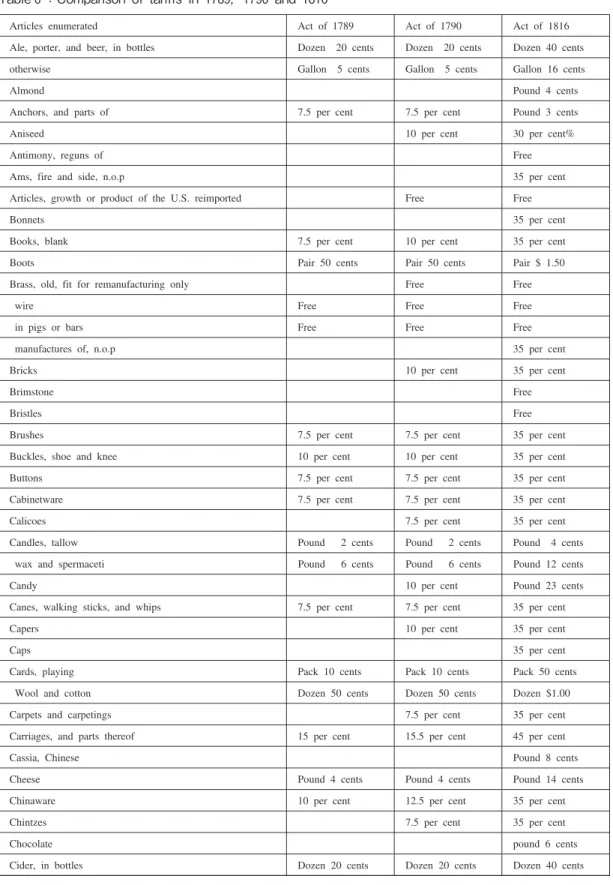
Tariff rate of average .% ad valorem embodied in an Act of was not regarded as protection-intended comparing to the tariff, where import duties were about % for almost all manufactured goods(See Table ).
Revenue was insufficient and rates were raised about . per cent, in the tariff act of . The purpose was mainly revenue, and not protection, be-cause the preamble of the act of clearly states that “And whereas the support of government and discharge of the said debt, render it necessary to in-crease the said duties.”
Table :Specific duties on tea by the ownership of the vessel(unit : cent per pound)
Source : Tariff Acts passed by Congress from 1789 to 1909.p. .
Articles enumerated Act of 1789 Act of 1790 Act of 1816 Ale, porter, and beer, in bottles Dozen 20 cents Dozen 20 cents Dozen 40 cents
otherwise Gallon 5 cents Gallon 5 cents Gallon 16 cents
Almond Pound 4 cents
Anchors, and parts of 7.5 per cent 7.5 per cent Pound 3 cents
Aniseed 10 per cent 30 per cent%
Antimony, reguns of Free
Ams, fire and side, n.o.p 35 per cent
Articles, growth or product of the U.S. reimported Free Free
Bonnets 35 per cent
Books, blank 7.5 per cent 10 per cent 35 per cent
Boots Pair 50 cents Pair 50 cents Pair $ 1.50
Brass, old, fit for remanufacturing only Free Free
wire Free Free Free
in pigs or bars Free Free Free
manufactures of, n.o.p 35 per cent
Bricks 10 per cent 35 per cent
Brimstone Free
Bristles Free
Brushes 7.5 per cent 7.5 per cent 35 per cent
Buckles, shoe and knee 10 per cent 10 per cent 35 per cent
Buttons 7.5 per cent 7.5 per cent 35 per cent
Cabinetware 7.5 per cent 7.5 per cent 35 per cent
Calicoes 7.5 per cent 35 per cent
Candles, tallow Pound 2 cents Pound 2 cents Pound 4 cents
wax and spermaceti Pound 6 cents Pound 6 cents Pound 12 cents
Candy 10 per cent Pound 23 cents
Canes, walking sticks, and whips 7.5 per cent 7.5 per cent 35 per cent
Capers 10 per cent 35 per cent
Caps 35 per cent
Cards, playing Pack 10 cents Pack 10 cents Pack 50 cents
Wool and cotton Dozen 50 cents Dozen 50 cents Dozen $1.00
Carpets and carpetings 7.5 per cent 35 per cent
Carriages, and parts thereof 15 per cent 15.5 per cent 45 per cent
Cassia, Chinese Pound 8 cents
Cheese Pound 4 cents Pound 4 cents Pound 14 cents
Chinaware 10 per cent 12.5 per cent 35 per cent
Chintzes 7.5 per cent 35 per cent
Chocolate pound 6 cents
Cider, in bottles Dozen 20 cents Dozen 20 cents Dozen 40 cents
Table :Comparison of tariffs in , and
Cinnamon 10 per cent Pound 40 cents
Clay, unwrought Free
Clocks, and parts of 10 per cent 35 per cent
Clothing, ready−made 7.5 per cent 7.5 per cent 30 per cent
Cloves 10 per cent Pound 40 cents
Coal Bushel 2 cents Bushel 3 cents Bushel 10 cents
Cocoa Pound 1 cent Pound 1 cent Pound 4 cents
Coffee Pound 2.5 cents Pound 4 cents Pound 10 cents
Colors, painters’ dry or in oil 10 per cent 35 per cent
Comfits 10 per cent 35 per cent
Copper, in bars or pigs Free
in plates (sheathing) Free Free Free
old Free
manufactures, n.o.p 7.5 per cent 35 per cent
Cordage, tarred Cwt 75 cents Cwt $1.00 Pound 4 cents
untarred and yarn Cwt 90 cents Cwt $1.50 Pound 5 cents
Cork bark, unmanufactures Free
Cosmetics 35 per cent
Cotton, unmanufactured Free Pound 3 cents Pound 6 cents
goods not print’d, stain’d or col’d (muslins) 35 per cent
manufactures, n.o.p 7.5 per cent 35 per cent
Currants 10 per cent Pound 4 cents
Dates 10 per cent 35 per cent
Dolls 35 per cent
Drugs, medical 7.5 per cent 35 per cent
exclusively for dyeing Free Free Free
Dye−woods, Nicaragua and other Free Free Free
Earthenware 10 per cent 10 per cent 35 per cent
Fans 35 per cent
Feathers and flowers, ornamental and artificial 35 per cent
Figs, in jars or boxed 10 per cent Pound 4 cents
Fish, dried or smokes Quint 50 cents Quint $1.00
pickled, n.o.p Barrel 75 cents
mackerel, herrings, pickled or salted Barrel $ 1.20
Fish, salmon, pickled Barrel $ 2.00
all other, pickled in barrels Barrel 80 cents
Floor cloth 35 per cent
Fruits, n.o.p 10 per cent 30 per cent
Furs, undressed Free Free Free
Gauzes 7.5 per cent 30 per cent
Ginger 10 per cent 35 per cent
Girandoles 45 per cent Glass, all manufactures, n.o.p. except black quart bottles 10 per cent 12 per cent 45 per cent
bottles, black Gross $1.20
window
not above 8 by 10 inches 100 sq. feet $3.20
above 8 by 10, not 10 by 12 inches 100 sq. feet $3.50
10 by 12 inches 100 sq. feet $4.50
Glauber, salts Cwt $4.00
Gloves, leather, men’s, &c 7.5 per cent 7.5 per cent 35 per cent
Glue Pound 8 cents
Gold and silver coin and bullion Free Free
leaf 10 per cent 10 per cent 80 per cent
lace and tassels 10 per cent 10 per cent 35 per cent
plated ware 7.5 per cent 10 per cent 35 per cent
Gunpowder 10 per cent 10 per cent Pound 8 cents
Hair powder Pound 8 cents
Hats 7.5 per cent 7.5 per cent 35 per cent
Hemp, unmanufactured Cwt 60 cents Cwt 54 cents Cwt $2.00
Hides and skins Free Free Free
Indigo Pound 16 cents Pound 25 cents Pound 50 cents
Iron, sheets Pound 3 cents
cut, hoop, slit, rolled 7.5 per cent 7.5 per cent Pound 2 cents
rolled or hammered 7.5 per cent 7.5 per cent 35 per cent
cables or chains Cwt 75 cents Cwt $1.00 Pound 4 cents
castings, n.o.p 7.5 per cent 7.5 per cent 35 per cent
manufactures, n.o.p 7.5 per cent 35 per cent
Jewelry and pastework 7.5 per cent 10 per cent 35 per cent
Laces 7.5 per cent 35 per cent
Lampblack 10 per cent 30 per cent
Lapis calaminaris Free
Lawns(cotton) 7.5 per cent 30 per cent
Lead Free
bars and pigs and manufactures Pound 1 cent Pound 2 cents
white and red Pound 4 cents
Leather, tanned and tawed, sole and bend 7.5 per cent 7.5 per cent 35 per cent
Leather, manufactures, n.o.p 7.5 per cent 7.5 per cent 35 per cent
Lemons 10 per cent 35 per cent
Lime Cask $1
Limes 10 per cent 35 per cent
Linens 30 per cent
Mace 10 per cent Pound $2.50
.Concluding remarks
The tariff of had a protective purpose, partly because its preamble clearly states its purpose, and partly because the tariff debates in the Congress showed the protectionist intentions of the representa-tives of the country. It reflected the basic compro-mise between Madison and Fitzsimons, it had two
express purposes : one was “the support of govern-ment and the discharge of the debts of the United States,” the other “the encouragement and protection of manufactures.”
Achieving two goals at the same time is not easy task to take. Too much attention to protection hurts revenue : the prohibitive tariff fills no coffers. An interesting example is Britain’s free trade era
be-Malt Bushel 10 cents Bushel 10 cents Bushel 20 cents
Marble, and utensils of 10 per cent 35 per cent
Mats and mattings 35 per cent
Millinery, ready−made 7.5 per cent 7.5 per cent 35 per cent
Mits and mittens, wool 7.5 per cent 7.5 per cent 35 per cent
Molasses Pound 2.5 cents Pound 3 cents Gallon 10 cents
Mortars, marble or slate 10 per cent 30 per cent
Muskets 35 per cent
Mustard, flour 10 per cent 35 per cent
Nails, iron Pound 1 cent Pound 1 cent Pound 4 cents
Nankeens 7.5 per cent 35 per cent
Nutmegs 10 per cent Pound $1
Ochres or ochery earth, dry Pound 2 cents
ground in oil Pound 3 cents
Olive 10 per cent 35 per cent
Oranges 10 per cent 35 per cent
Paints, all in oil, excluding for dyeing 10 per cent 10 per cent 30 per cent
Paper 7.5 per cent 10 per cent 30 per cent
hangings 7.5 per cent 10 per cent 35 per cent
for sheathing 35 per cent
Parchment 10 per cent 30 per cent
Pepper, black Pound 6 cents Pound 12 cents
Perfumery, &c., 35 per cent
Pewter, old or unmanufactured Free Free Free
manufactures, n.o.p 7.5 per cent 7.5 per cent 35 per cent
plates and dishes 10 per cent Pound 8 cents
Philosophical apparatus specially imported for any seminary of learning
Free Free
Source : Committee of Finance, United States Senate, The Existing Tariff on Imports into the United States, pp. − .
tween and .They retained revenue tariffs on only a few articles of consumption, sugar, to-bacco, tea, spirits, wine and beer and the total reve-nue from the tariff rose sharply.
When we use a partial equilibrium analysis, a tar-iff for revenue only is one where the protective and redistributive effects are missing. The consumption effect will be eliminated only under the limiting as-sumption that prices abroad fall by the full amount of the tariff, so that the tax is in effect borne by the foreign producer. A tariff for revenue only can be on goods which are not produced at home at all ; or one where an equal tax is imposed on do-mestic production to eliminate the protective and the redistribution effects. So it is generally expected that imposition of a tariff includes protective effect, i.e. increase of domestic production, regardless of the ideas or intention of tariff-makers.
But there was not sufficient information on how far it would go to achieve the goal of protection or the Congressmen did not really bother much about theory. If the sections they represented dealt only in raw materials for export, they were free traders and they learned what Adam Smith had to say. But if their sections manufactured goods that needed pro-tection from imports, they were for raising the tariff without bothering why. If the section he represented changed its character, the Congressman changed his theory. The end result was that the tariff act of lasted only for about one year and was revised to increase revenue from tariff.
References :
Adams, Henry Carter. Taxation in the United States
1789−1816. Baltimore : N. Murray, Publication Agent, Johns Hopkins University. .
Adams, James Truslow. New England in the
Repub-lic,1776−1850.Boston : Little, Brown. . Andrews E. Benjamin. History of the United States
from the earliest discovery of America to the present day. New York : Charles Scribner’s Sons. .
Ashley, Percy, Modern Tariff History : Germany ―
United States ― France. London : John Murray. . Bancroft, George. History of the formation of the
Con-stitution of the United States of America. New York : D.
Appleton and Company. .
Banning, Lance. The Sacred Fire of Liberty : James Madison and the Founding of the Federal Republic.
Ith-aca, NY. : Cornell University Press. .
Barbee, David Rankin. “The tariff in American Politi-cal history,” Congressional Digest March , .pp. − .
Bastable, C. F. The commerce of nations. London : Methuen & co. .
Bates, Frank Greene. Rhode Island and the Formation
of the Union. New York : Macmillan. .Page num-ber:
Bates, Ernest Sutherland. The Story of Congress,1789 −1935.New York : Harper & Brothers. .Page num-ber:
Bauer, Raymond A. American Business and Public
Policy : The Politics of Foreign Trade. New York :
Atherton. .
Beard, Chales A. Economic Origins of Jeffersonian
De-mocracy. New York : Macmillan and Co. . Benson, William Edmunds. A political history of the
tariff 1789−1861.Xlibris Corporation. .
Bishop, J. Leander. A history of American
manufactur-ers from 1608 to 1860. Vol.II. Philadelphia : Edward Young & Co. .
Blaine, James G. Twenty Years of Congress : From Lincoln to Garfield. Volume:1.Norwich, CT. : Henry Bill. .
Blejer, Mario I. Macroeconomic Dimensions of Public
Finance : Essays in Honour of Vito Tanzi. edited by,
Teresa Ter-Minassian. London : Routledge. . Bolles, Albert S. The Financial History of the United
States from 1789 to 1860.New York : D. Appleton and Company. .
Bryce, James. The American Commonwealth. New York : Macmillan and CO. .
Capers, Gerald M. John C. Calhoun, Opportunist : A
Reappraisal. Gainesville, FL. : University of Florida Press. .p. .
United States. Bureau of The Census. Historical
Statis-tics of the United States,1789−1945.Washington, DC. : U.S. Dept. of Commerce. .
Carey, Matthew. The new olive branch, or, An attempt
to establish an identity of interest between agriculture, manufactures, and commerce. Philadelphia : M. Carey &
Son. .
Carman, Harry J. and Syrett Harold C. A History of
the American People. New York : Alfred A. Knopf. .p.
Channing, Edward. The United States of America 1765 −1865.London : Macmillan and Co. .
Cole, Wayne S. An Interpretive History of American
Foreign Relations. Homewood, IL. : Dorsey Press. . the Committee on Finance, United States Senate. The
existing tariff on imports into the United States, etc. and the free list, together with comparative tables of present and past tariffs, and other statistics relating thereto.
Washington : Government Printing Office. January
, .
Conti, Delia B. Reconciling Free Trade, Fair Trade,
and Interdependence : The Rhetoric of Presidential Eco-nomic Leadership. Westport, CT. : Praeger. .P..
Cooke, Jacob E. The Federalist. Middletown, CT. : Wesleyan University Press. .
Crompton, George. The Tariff : An Interpretation of a
Bewildering Problem. New York : Macmillan Co. . p. .
Crowther, Samuel. America Self-Contained. Garden City, NY : Doubleday, Doran & Company, inc. .
Currie, David P. The Constitution in Congress : The Federalist Period 1789−1801.Chicago : University of Chicago Press. Place of Publication : Chicago. .
Curtiss, George B. The Industrial Development of
Na-tions and a History of the Tariff Policies of the United States, and of Great Britan, Germany, France, Russia and Other European countries Volume II The United States from 1607 to 1860.Binghamton, N.Y. . Department of State, Report of a Committee of the lords
of the Privy council on the trade of Great Britain with the United States. January, .Washington : Department of State. .
Deusen, John G. Van. Economic Bases of Disunion in
South Carolina. New York : Columbia University Press. .p. .
Dewey, Davis Rich. Financial History of the United
States. New York : Longmans Green and Co. .
Eckes Jr., Alfred E. Opening America’s Market : U. S.
Foreign Trade Policy since 1776. Chapel Hill, NC. : University of North Carolina Press. .p. .
Ely, Richard T. Problems of to-day a discussion of
protective tariffs, taxation, and monopolies. New York :
T. Y. Crowell & co. .
Emory R. Johnson, T. W. Van Metre, G. G. Huebner, D. S. Hanchett. History of Domestic and Foreign
Com-merce of the United States. Volume : 1 Washington, DC. :
Carnegie Institution of Washington. .
Evans, Michael W. “Foundations of the Tax Legisla-tion Process : The ConfederaLegisla-tion, ConstituLegisla-tional Conven-tion, and First Revenue Law,” Tax Notes magazine,
Janu-ary , .p. .
Faulkner, Harold Underwood. American Economic
His-tory. New York : Harper & Brothers. .
Faulkner, Harold Underwood. American Economic
His-tory, New York : Harper & Row, Publishers, Inc. . Ferguson, E. James The Power of the Purse : A
His-tory of American Public Finance,1776−1790.Chapel Hill, NC. : University of North Carolina Press. .
Ford, Worthington C. “Tariffs of the United States,”
John Joseph Lalor, Cyclopaedia of Political Science, Po-litical Economy, and of the PoPo-litical History of the United States, vol.3 Oath ― Zollverein. Chicago : Mel-bert B. Cary & Company. .
Frederick, John H. The Development of American
Com-merce. New York : D. Appleton and Company. . George Crompton The Tariff : An Interpretation of a
Bewildering Problem. New York : Macmillan Co. .p. .
George, Henry. Protection or Free Trade, An
Examina-tion of the Tariff QuesExamina-tion, with especial Regard to the Interests of Free Trade. New York : Doubleday, Page, and Co., .
George Rogers Taylor The Great Tariff Debate,1820−
1830.Publisher : Heath. Place of publication : Boston. : .p.iii.
Gerhart, Peter M. “The World Trade Organization and Participatory Democracy : The Historical Evidence,”
Van-derbilt Journal of Transnational Law. Volume: .Is-sue: .Vanderbilt University, School of Law. .
Glover, John George. The Development of American
Industries, Their Economic Significance. edited by
Wil-liam Bouck Cornell. New York : Prentice-Hall. . Goldstein, Judith. Ideas, Interests, and American Trade
Policy. Ithaca and London : Cornell University Press. .
Goss, John Dean. The History of Tariff Administration
in the United States From Colonial Times to the
ley Administrative Bill. New York : Columbia Univer-sity. .
Harriman, Daniel, G. American tariffs from Plymouth
Rock to Mckinley A Complete and Impartial History of our Tariff Systems. New York : American protective
tar-iff league. Sept., .
Hays , Arthur Garfield. Democracy Works. New York : Random House. New York. .
Hening, William Waller. The statutes at large being a
collection of all the laws of Virginia, from the first ses-sion of the legislature, in the year 1619.Published
pursu-ant to an act of the General assembly of Virginia, passed on the fifth day of February one thousand eight hundred and eight.vol.I. New York : R. & W. & G. Bartow. .
Hill, William. The First Stages of the Tariff Policy of
the United States. vol.8,No.6.Baltimore : American Eco-nomic Association. November, .
Hill, W. “Protective purpose of tariff act of ,”
Journal of Political Economy, December ,v.,The University of Chicago Press. pp. − .
Hockett, Homer Carey. Political and Social Growth of
the American People,1492−1865.New York : Macmil-lan. .
Homans, J. Smith. Historical and Statistical Account of
the Foreign Commerce of the United States. New York :
G.P. Putman & Co. .
Jennings,Walter W. A History of Economic Progress in
the United States. New York : Thomas Y. Crowell. .
Jensen, Merrill. The New Nation : A History of the
United States during the Confederation,1781−1789.New York : Vintage Books. .Page number:
the Joint committee on printing. Tariff acts passed by
the Congress of the United States from 1789 to 1909 in-cluding all acts, resolutions, and proclamations modifying or changing those acts. Washington : Government
Print-ing Office. .
Johnson, Allen. Union and Democracy. Boston : Houghton Mifflin Company. .p. .
Johnson, Emory R. Government Regulation of
Trans-portation. New York : D. Appleton & Company. . Kindleberger, C.P. Foreign Trade and the National
Economy. New Haven and London : Yale University Press. .
Kip, Frederic E. The Democratic Underwood-Simmons
tariff bill a colossal failure and most disastrous to labor, industry and agriculture, as has been all legislation for ”tariff for revenue only” from 1789 to 1913.New York city. .
Koht, Halvdan. The American Spirit in Europe : A Survey of Transatlantic Influences. Philadelphia :
Univer-sity of Pennsylvania Press. .
Knowles, L.C.A. Economic Development in the
Nine-teenth Century France, Germany, Russia, and the United States. London : Gorge Routledge & Sons, Ltd. .
Kowalski ,Kathiann, M. Taxes. Tarrytown, NY. : Mar-shall Cavendish Benchmark. .
Kreider, Carl. The Anglo-American Trade Agreement :
A Study of British and American Commercial Policies,
1934−1939.London : Princeton University Press. : Lon-don. .
Lippincott, Isaac. Economic Development of the United
States. New York : D. Appleton. .
Low, A. Maurice. Protection in the United States. London : P.S. King & Son. .
Lowenthal, Abraham F. Latin America in a New World. edited by Gregory F. Treverton-Boulder, CO. :
Westview Press. .P. .
Manley II, Walter W. and Shrode, William A. Critical
Issues in Business Conduct : Legal, Ethical, and Social Challenges for the 1990 s. New York : Quorum Books.
.
Mason, David H. A Short Tariff History of the United
States from the Earliest to the Present Time. Chicago :
published by the author. .
McDonald, Forrest. Alexander Hamilton : A Biography. New York : Norton. .
McLaughlin, Andrew C. Cyclopedia of American
Gov-ernment. Volume:3.edited by Albert Bushnell Hart. Gloucester, MA. : Peter Smith. .
Mikesell, Raymond F. United States Economic Policy
and International Relations. New York : McGraw-Hill. .
Miller, John C. The Federalist Era:1789−1801.New York : Harper & Brothers Publishers, .
Raguet, Condy. Principles of free trade. Philadelphia : printed for the author. .
Myers, Margaret G. A Financial History of the United
States. New York : Columbia University Press. . Northrup, Cynthia Clark and Turney, Elaine C. Prange
Encyclopedia of Tariffs and Trade in U.S. History. Vol-ume : 3.The Texts of the Tariffs Westport, CT : Green-wood Press. .Page Number: .
Northrup, Cynthia Clark and Turney, Elaine C. Prange
Encyclopedia of Tariffs and Trade in U.S. History. Vol-ume : 2.Debating the Issues : Selected Primary Docu-ments Westport, CT : Greenwood Press. .
Northrup, Cynthia Clark and Turney, Elaine C. Prange
Encyclopedia of Tariffs and Trade in U.S. History.
ume : 1.The Encyclopediqa. Westport, CT : Greenwood Press. .
Powers, O. M. Powers. Commerce and Finance. Pow-ers & Lyons. .
Rabbeno, Ugo. The American Commercial Policy : Three Historical Essays. London : Macmillan. .Page Number: .
Risjord, Norman K. Chesapeake Politics,1781−1800. New York : Columbia University Press. .
Rowe, Kenneth Wyer. Mathew Carey : A Study in American Economic Development. : Baltimore, MD : The
Johns Hopkins Press. .
Smart, William. Economic Annals of the Nineteenth
Century. London : Macmillan. .
Smith, James Gerald. Economic Planning and the
Tar-iff : An Essay on Social Philosophy. Princeton, NJ : Princeton University Press. .
Stanwood, Edward : American Tariff Controversies in the Nineteenth Century. Archibald Constable & CO.,Ltd.
.
Stiglitz, Joseph E. and Charlton, Andrew. Fair Trade
for All : How Trade Can Promote Development. New
York : Oxford University Press. .
Studenski, Paul and Krooss Herman E. Financial
His-tory of the United States : Fiscal, Monetary, Banking, and Tariff, Including Financial Administration and State and Local Finance. New York : McGraw-Hill. .Page Number : iii.
Studenski, Paul. and Krooss, Herman E. Financial
His-tory of the United States : Fiscal, Monetary, Banking, and Tariff, Including Financial Administration and State and Local Finance. New York : McGraw-Hill. Place of
Publication : New York. .Page. .
Sumner, W. G. Lectures on the history of the United
States. New York : Putnam’s sons. .
Suneja, Vivek. Understanding Business : A
Multidimen-sional Approach to the Market Economy. London :
Rout-ledge. .
Tarbell, Ida M. The Tariff in Our Times. New York. : Macmillan. .P .
Taussig, F.W., State Papers and Speeches on the
Tar-iff, with an Introduction by F.W. Taussig. Cambridge,
Mass. : Harvard University, .
Taussig, F.W. “Tariff”, Encyclopedia Britannica 11 th
edition, ,Volume XXVI, pp. − .
Tausig, F.W. The Tariff History of the United States. New York and London : The Knickerbocker Press. .
Taylor ,George Rogers. The Great Tariff Debate,1820 −1830.Boston : D. C. HEATH AND COMPANY. .
Tobita Shigeo To understand the American Constitution
in English(written in Japanese)Tokyo : Chuokohron-sha. .
United States. Bureau of The Census. Historical
Statis-tics of the United States,1789−1945.Washington, DC : U.S. Dept. of Commerce. .
United States, Public Statutes at Large of the United
States of America, Vol.I. Boston : Charles C. Little and
James Brown. .
Walker, Thomas. Making the Tariff in the United
States. New York : McGraw-Hill Book Company, Inc. .
Wright, Chester W. Economic History of the United
States. New York : McGraw-Hill. . ――――――――――
Miller, J.C. p. . Carey. pp. − .
Taussing( ).pp. − . Rowe.p. .
Public Statutes at Large, vol. I. p. .
Thompson was regarded as a protectionist by Rab-beno, p. .
Department of State. p. .
Knowles. pp. − . The industrial characteristics of the United States in are given in a Report of
a Committee of the Lords of the Privy Council on the Trade of Great Britain with the United States(pp. − ).
In ,percent of agricultural pursuit years and over is ..Bureau of Census. p. .
Hill(December, ).pp. −
;Hill(Novem-ber, ),pp − .
Bishop. p. .
Bishop. p. ;Gales and Seaton’s Annals of First Congress, First Session, pp. − .
Mason. p. . Ely.p. ,p. . Adams, Harriman, pp. − . Bastable, p. . Ashley, p. . Taylor, p.. Ford, pp. − . Rabbeno, p. . Smart. p. . Sumner, p. . Crompton, p. .
Miller, p. Of all the exigencies confronting the Federal government in ,revenue was the most critical. The lack of an adequate and dependable