Empirical research on gains and losses under
Japanese GAAP and IFRS: focusing on the
impairment losses and presentation of the
income statement
著者
INOUE SHU
学位授与機関
Tohoku University
学位授与番号
11301
1
Empirical research on gains and losses
under Japanese GAAP and IFRS:
focusing on the impairment losses
and presentation of the income statement
Doctoral Dissertation
Shu Inoue
Graduate School of Economics and Management
Tohoku University
2
Table of contents
Chapter 1. The purpose of this paper ... 8
1. Introduction ... 8
1.1. Aim of this paper ... 8
1.2. The structure of this paper ... 9
2. The current issues of Convergence between J-GAAP and IFRS ... 11
3. Prior studies ... 13
4. Characteristic of this paper ... 24
5. Summary of each chapter in this paper ... 25
5.1. Chapter 2. Goodwill impairments and future operating cash flows under Japanese GAAP and IFRS: Evidence from Japan ... 25
5.2. Chapter 3. The Quality of Tangible Long-Lived Asset Impairments under Japanese GAAP and IFRS ... 26
5.3. Chapter 4. Investigation on reversals of impairment losses under IFRS: Evidence from Japan ... 27
5.4. Chapter 5. Classification Shifting using Discontinued Operations and Impact on Core Earnings: Evidence from Japan ... 27
5.5. Chapter 6. Earnings Quality on Income Statement Under Japanese GAAP and IFRS ... 28
5.6. Chapter 7. Earnings Management using OCI Recycling: Evidence from Japan .... 28
6. Contribution ... 29
Chapter 2. Goodwill impairments and future operating cash flows under Japanese GAAP and IFRS: Evidence from Japan ... 31
1. Introduction ... 32
2. Background and Prior research ... 35
2.1. GW Impairments Standard Under J-GAAP and IFRS ... 35
2.2. Goodwill Impairment Accounting Research ... 36
2.3. Impairment and Future Cash Flow ... 38
3. Hypothesis development ... 39
3.1. Differences in Recognition and GW Amortization ... 39
3.2. GW Impairment and Past OCF ... 40
3
4. Research design ... 41
5. Sample and Descriptive statistics... 44
6. Empirical results ... 45
7. Additional analyses ... 47
7.1. Propensity Score-matched (PSM) ... 47
7.2. Eliminating the First Year of IFRS Adoption ... 48
8. Conclusions ... 48
Tables ... 50
Appendix A ... 56
Chapter 3. The Quality of Tangible Long-Lived Asset Impairments under Japanese GAAP and IFRS ... 57
1. Introduction ... 58
2. Background and prior research ... 61
2.1. Impairments under J-GAAP and IFRS ... 61
2.2. Prior research on impairment accounting ... 64
3. Hypotheses development ... 66
3.1. Determinants of impairments ... 66
3.2. LLA impairments and future OCF ... 68
4. Research design ... 69
4.1. Determinants of impairments ... 69
4.2. LLA impairments and future OCF ... 72
5. Sample and descriptive statistics ... 74
6. Empirical results ... 76
6.1. Determinants of tangible LLA impairments under J-GAAP and IFRS ... 76
6.2. Future OCF and tangible LLA impairments under J-GAAP and IFRS ... 77
7. Conclusions ... 77
Tables ... 79
4 Chapter 4. Investigation on reversals of impairment losses under IFRS: Evidence from
Japan ... 86
1. Introduction ... 86
2. Previous research ... 87
3. Understanding for the situation of impairment reversals among IFRS firms in Japan .. 88
3.1. Sample selection ... 88
3.2. Status of IFRS firms and reversal implement firms ... 88
3.3. Comparison of impairment reversal by asset type ... 90
3.4. Analysis of reasons for impairment reversals ... 91
4. Comparison of reversal implementation firm and non-implementation firm ... 92
4.1. Basic statistics of reversal firm and no-reversal firm ... 93
4.2. Comparison of average difference test (statistical analysis) ... 93
5. Conclusion ... 95
Chapter 5. Classification Shifting using Discontinued Operations and Impact on Core Earnings: Evidence from Japan ... 98
1. Introduction ... 98
2. Prior Research ... 100
2.1. Prior Research on Classification Shifting ... 100
2.2. Prior Research on Discontinued Operations ... 102
2.3. Prior Research on Restructuring Charges ... 103
3. Hypothesis Development ... 104
3.1. Classification Shifting Using Discontinued Operations ... 104
3.2. Impact On Core Earnings... 106
4. Research Design... 107
4.1. Expected Core Earnings Model (McVay 2006) ... 107
4.2. Classification Shifting Using Discontinued Operations ... 109
4.3. Income-Decreasing Discontinued Operations ... 110
4.4. Special Items and Core Earnings of Discontinued Operations ... 111
5. Sample and Descriptive Statistics ... 113
6. Empirical Results ... 114
6.1. Level of Unexpected Core Earnings ... 114
5
7. Additional Analyses ... 115
7.1. Meeting or Beating Benchmarks ... 115
7.2. Moldes with Current-year Accruals ... 116
8. Conclusions ... 116
Tables ... 119
Appendix A ... 124
Chapter 6. Earnings Quality on Income Statements Under Japanese GAAP and IFRS ... 125
1. Introduction ... 125
2. Background ... 128
2.1. Presentation of Income Statement under J-GAAP ... 128
2.2. Presentation of Income Statement under IFRS ... 128
2.3. Non-GAAP Earnings and Ordinary Income as GAAP-Based Earnings ... 129
2.4. Prior Research on Earnings Quality ... 130
2.5. Prior Research on Non-GAAP Earnings... 131
3. Research design ... 131
3.1 Earnings Persistence ... 132
3.2. Earnings Predictability ... 133
3.3. Earnings Smoothness ... 134
3.4. Value Relevance ... 136
3.5. Timeliness and Conditional Conservatism ... 137
4. Sample and Descriptive statistics... 139
5. Empirical results ... 140
5.1 Earnings Persistence ... 140
5.2. Earnings Predictability ... 140
5.3. Earnings Smoothness ... 141
5.4. Value Relevance ... 141
5.5. Timeliness and Conditional Conservatism ... 142
6. Conclusion ... 143
Tables ... 145
Appendix A ... 151 Chapter 7. Earnings Management using Other Comprehensive Income Recycling:
6
Evidence from Japan ... 153
1. Introduction ... 153
2. OCI Regulation and Prior Research ... 155
2.1. OCI Regulation in IFRS ... 155
2.2. OCI Regulation in J-GAAP ... 156
2.3. Prior Research on OCI Recycling ... 158
3. Hypothesis Development ... 159
3.1. Meeting or Beating Zero Earnings ... 160
3.2. Meeting or Beating Prior Year’s Earnings ... 161
3.3. Meeting or Beating Managers’ forecasts ... 161
3.4. Income Smoothing ... 162
3.5. Big Bath Accounting... 163
3.6. The Effect of Adopting IFRS on OCIR ... 164
4. Research Design ... 165
4.1. Models for Meeting or Beating Prior Year’s Earnings ... 165
4.2. Models for Income Smoothing and Big Bath Accounting ... 167
5. Sample Selection Descriptive Statistics ... 169
6. Regression Results ... 170
7. Additional test ... 172
8. Conclusion ... 173
Tables ... 175
Appendix A ... 182
Chapter. 8 Findings and Future improvement ... 184
1. Findings ... 184 2. Future improvement ... 188 2.1. Chapter 2 ... 188 2.2. Chapter 3 ... 188 2.3. Chapter 4 ... 189 2.4. Chapter 5 ... 189 2.5. Chapter 6 ... 189 2.6. Chapter 7 ... 190 3. Main caveats ... 190
7 4. Potentials for future research ... 191 References ... 192
8
Chapter 1: The purpose of this paper
1. Introduction
1.1. Aim of this paper
This study conducts an empirical analysis of gains and losses from the perspective of presentation in the income statement under Japanese generally accepted accounting principles (J-GAAP) and international financial reporting standards (IFRS). In this study, the technical term “gains and losses” has two meanings. One is special items used in practice under US GAAP and IFRS in the narrow sense of gains and losses. In this case, special items under international standards are the same as extraordinary gains and losses under Japanese GAAP. Both are treated as special items herein unless otherwise noted. Adding to the above, the other is including discontinued operations under US GAAP and IFRS and other comprehensive income (OCI) in the broad sense of gains and losses. Firstly, the nature of income from discontinued operations is unusual and non-recurring and is therefore partially treated as special items under J-GAAP.1 Secondly, OCI is “gain and loss” in the Conceptual Framework
(FASB 1985 No. 6, par. 74, IASB 2010, par. 4.31 and 43.5) due to the characteristic of OCI that should be clearly distinguished from operating income. OCI items are economic gains and losses affected by external management factors, such as market value difference of securities and foreign currency translation. The reason I focus on the gains and losses from the perspective of the presentation of the income statement is that these are presented separately. Figure 1 shows the uniqueness of the presentation form of gains and losses in the income statement.
Figure 1: The presentation form of special items in the income statement
Interestingly, the presentation remains a significant difference between J-GAAP and IFRS, even after the comprehensive progression of the convergence project. Special items in Figure
1 The reason it is “partially” treated as special items under J-GAAP is the contents of income from discontinued
operations are operating income and special items, such as a capital gain and loss of selling a subsidiary, restructuring loss, and impairment loss.
(Income from continuing operations)
( )
S e p a r a t e ① gains and losses in the narrow sence
( )
S e p a r a t e ② Income from discontinued operations
(gains and losses in the broad sence)
Other comprehensive income
9 1 are separated only under J-GAAP (1), while discontinued operations are separated only under IFRS (2). Moreover, J-GAAP clearly draws the line between net income and other comprehensive income, resulting in much being made of the “recycling of OCI.” Therefore, the separation between net income and OCI is significant for J-GAAP (3). On the other hand, IFRS does not emphasize the concept of net income itself; thus, the separation is not clear, causing the restriction on OCI recycling. These differences stem from the difference in the accounting view between J-GAAP and IFRS. Therefore, this study directly sheds light on the international debate on the convergence of accounting standards. Another aspect of the theme of this study is explained by the existence of “Japan's Modified International Standards (JMIS or J-IFRS).” J-IFRS is highly unique (or maybe quite unusual) in Japanese accounting regulations; its peculiarity stands out in that no firm has adopted it. The purpose of J-IFRS seems to be to encourage more listed firms to adopt IFRS (ASBJ, 2015b); however, J-IFRS successfully reflects the relentless commitments of J-GAAP that will never be convergent with IFRS, that is, “goodwill impairment (ASBJ, 2015c),” “net income,” and “OCI recycling (ASBJ, 2015a).”These commitments are the same as the points of the main topic of this paper. From a different viewpoint, the other issues are either already in convergence or, if not, only minor differences that the J-GAAP can tolerate. Therefore, this study considers the most important accounting issue attributed to the significant differences between J-GAAP and IFRS.
1.2. The structure of this paper
This study investigates gains and losses from the perspective of presentation in the income statement under J-GAAP and IFRS. Regarding special items as the narrow sense of gains and losses, one of the significant differences between the standards is “impairment loss.” The accounting standard is internationally controversial because there are notable differences among J-GAAP, US GAAP, and IFRS. Considering the impact and importance of impairment losses in practice, the differences in these standards could be a serious issue for users of financial statements. Therefore, this study first considers one of the most controversial accounting issues, “impairment loss.”
In chapter 2, I investigate goodwill impairment loss under J-GAAP and IFRS, focusing on the predictive value for future operating cash flows. The argument regarding the accounting treatment for goodwill impairment reflects the characteristics of both standards. The impairment method under IFRS differs from J-GAAP in two principal ways: (1) non-amortization and (2) annual impairment tests. Both differences have long been debated
10 internationally in the accounting field, and the impairment approach is about to drastically change in the current movement among US GAAP and IFRS (FASB, 2017; IASB, 2018). This study can contribute to the international debate from Japan. In chapter 3, I compare the quality of tangible long-lived asset impairments under J-GAAP and IFRS. Not only goodwill impairment, but also impairments of the aforementioned assets under J-GAAP also differ significantly from that under IFRS, mainly in terms of recognition criterion and impairment reversals. Furthermore, the ratio of tangible assets is significantly higher due to the great development of the manufacturing industry in Japan. Focusing on the differences, I attempt to reveal which impairment standard has higher quality in terms of the predictive value for future cash flow and determinations of impairment. Besides, I also investigate the reversals of impairment losses under IFRS in chapter 4.
Regarding gains and losses of presentation in the income statement, discontinued operations is the specific regulation of IFRS. In chapter 5, I analyze the classification shifting using this and the impact on core earnings. I attempt to reveal the potential problems and usefulness of such operations under IFRS, assuming future adoption as J-GAAP (ASBJ, 2009).2 This is the first empirical investigation on classification shifting using discontinued
operations by the IFRS sample.
In chapter 6, I survey the earnings quality on the income statement under J-GAAP and IFRS. I compare subtotal incomes in the presentation, such as operating, ordinary, and income from continuing operations because the presentation of the income statement relies heavily on the view of income, which stems from the whole accounting view.
Finally, since the ASBJ accepted the regulation on the presentation of comprehensive income (ASBJ Statement No. 25) as a part of the convergence project between J-GAAP and IFRS in 2010, Japanese listed firms disclose comprehensive income in addition to net income. However, while J-GAAP requires full recycling for the sake of emphasizing net income in the income statement, IFRS fundamentally prohibits OCIR due to earnings management concerns. In chapter 7, I investigate the earnings management using OCI recycling comparing J-GAAP and IFRS.
Figure 2 describes the big picture of the research framework and structure, indicating the relationship between all issues in this study and the difference between J-GAAP and IFRS.
2 ASBJ (2009) considers the adoption of the accounting standard on discontinued operations by comparing the
11 Figure 2: Research framework and structure of this study
2. The current issues of Convergence between J-GAAP and IFRS
With the "Accounting Big Bang" in the late 1990s, the development of accounting standards in Japan has made significant progress. After that, with the rapid globalization of the capital market after 2000, overseas trends began to directly affect Japanese accounting standards so as to keep pace with the global standard, which is known as “Convergence.” As a result, the development of accounting standards in Japan for internationalization has been promoted at an even faster pace. In response to the organizational reforms of the International Accounting Standards Board (IASB), the Accounting Standards Board of Japan (ASBJ) was established in April 2001 as an independent private accounting standard-setter in Japan. Since then, global convergence centered on International Financial Reporting Standards (IFRS) has accelerated, and ASBJ's activities have also been strongly influenced by the evaluation of accounting standards in the European Union (EU). Convergence has become central for Japan. With the requirement to apply IFRS to consolidated financial statements prepared by firms in the region listed on the European market from 2005, “the 2005 issue” was going to be discussed in Japan in July 2004. This is because there was concern that it would have a significant impact on Japanese firms listing in the European market. Non-EU securities issuers are required to prepare financial statements in accordance with IAS or IAS-equivalent domestic standards from 1st January 2007. The European Commission (EC) is required to establish a mechanism to assess the equivalence of accounting standards in countries outside of the EU. In June 2004, the EC issued an instruction to the European Securities Regulators Commission (CESR) to provide technical advice on the equivalence of US GAAP, J-GAAP, and Canadian GAAP.
CESR conducted a technical assessment of its equivalence to US GAAP, J-GAAP and Canadian GAAP, and published technical advice to EC on July 5, 2005. Despite the fact that
- Operating Income
Chapter 6. Earnings Quality on Income Statement
Ordinary Income
Chapter 2. Goodwill Impairments and future operating cash flows Chapter 3. The Quality of Tangible Long-Lived Asset Impairment Chapter 4. Reversals of Impairment losses under IFRS
↑
Chapter 5. Classification Shifting using Discontinued Operations
↓
and Impact on Core Earnings
-
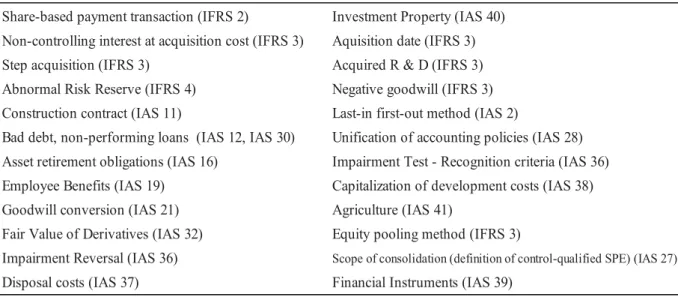
12 the Financial Services Agency, ASBJ, and Nippon Keidanren (Japan Federation of Economic Organizations) have complained that Japanese accounting standards are equivalent to IAS, CESR's advice was shocking to Japanese standards as follows. CESR, along with US GAAP and Canadian GAAP, called for certain supplementary measures, albeit "overall equivalent." The important differences subject to supplementary measures were 26 items for J-GAAP, 19 items for US GAAP, and 14 items for Canadian GAAP. The crucial differences in J-GAAP by complementary measures pointed out by CESR are as follows in Figure 3.
Figure 3: The crucial differences in J-GAAP from IFRS pointed out by CESR
Convergence work proceeded as planned in the "Tokyo Agreement" published by ASBJ and IASB in 2007 regarding the critical differences from IFRS. As a result of that convergence, in April 2008, the EC adopted the conclusion that J-GAAP, as well as US GAAP, are equivalent. The accounting standard equivalence evaluation that began in 2004 is now settled, and it has become possible that Japanese firms continue to be listed on the European market after 2009 using financial statements prepared in accordance with Japanese standards. Agriculture (IAS 41) is excluded from the consideration of convergence because it is not necessary for Japanese standards. Regarding the capitalization of development costs (IAS 38), it is not an urgent matter because it is a rule that is not permitted by US GAAP and is treated in the same way as J-GAAP, but convergence is currently under consideration.
Interestingly, Impairment Reversal (IAS 36) Disposal costs (IAS 37) Impairment Test (IAS 36) that are all related to gains and losses treatment remains to be converged among the crucial differences. In other words, the most significant differences between J-GAAP and IFRS exist in the income statement, what is more, gains and losses. That is why this study investigates the practice and situation of impairment reversals under IFRS using a Japanese sample in Chapter 4 and empirically analyzes the difference of impairment loss recognition between J-GAAP and IFRS in Chapters 2 and 3. Besides, the presentation of the income statement is also
Share-based payment transaction (IFRS 2) Investment Property (IAS 40) Non-controlling interest at acquisition cost (IFRS 3) Aquisition date (IFRS 3)
Step acquisition (IFRS 3) Acquired R & D (IFRS 3)
Abnormal Risk Reserve (IFRS 4) Negative goodwill (IFRS 3)
Construction contract (IAS 11) Last-in first-out method (IAS 2)
Bad debt, non-performing loans (IAS 12, IAS 30) Unification of accounting policies (IAS 28) Asset retirement obligations (IAS 16) Impairment Test - Recognition criteria (IAS 36)
Employee Benefits (IAS 19) Capitalization of development costs (IAS 38)
Goodwill conversion (IAS 21) Agriculture (IAS 41)
Fair Value of Derivatives (IAS 32) Equity pooling method (IFRS 3)
Impairment Reversal (IAS 36) Scope of consolidation (definition of control-qualified SPE) (IAS 27)
13 considered to be one of the important differences between J-GAAP and IFRS. In this regard, the “Analysis of Issues Regarding Presentation of Financial Statements” published by the Accounting Standards Board of Japan (ASBJ) in 2009, comparing the usefulness of information with the burden on financial statement preparers. It is specified that the introduction of IFRS 5 “Non-current Assets Held for Sale and Discontinued Operations” will be considered in the future (ASBJ, 2009). Therefore, assuming that IFRS 5 may be introduced in Japan near future, and that is why this study analyzes discontinued operations in Japan in Chapter 5. This study can contribute to adopting the regulation on discontinued operation as a part of J-GAAP and indicate potential issues of this standard. ASBJ (2009) also considers the difference in the treatment of gains and losses in the income statement presentation and whether to distinguish them from operating income or include them like IFRS. Therefore, I take this significant issue regarding the presentation of the income statement as a current issue of convergence in the way of comparing the earnings quality of each stepwise income stages that stem from the treatment of gains and losses in Chapter 6.
Lastly, here is another difference between J-GAAP and IFRS regarding gains and losses that is other comprehensive income (OCI) recycling. While J-GAAP requires full recycling for the sake of emphasizing net income in the income statement, IFRS fundamentally prohibits OCIR due to the earnings management concerns. There is ongoing debate over the years whether to prevent OCI recycling or not. IASB revise the conceptual framework (IASB 2018, para.7.36) suggests that the current recycling rule has no clear guidance regarding when an item of income or expenses should be included in the income statement or the statement of OCI, and this issue needs to be addressed in future standards. Following the evidence from this study in Chapter 7, both IASB and J-GAAP may need to reconsider whether current recycling rules should be eliminated.
3. Prior studies
This paper basically belongs to the comparability of domestic standards and IFRS in terms of the quality of accounting standards (ex. Barth et al., 2008). As I show prior research below in Figure 5, most previous studies focus on earnings quality (Schipper and Vincent, 2003; Francis et al., 2008; Dechow et al., 2010) using several indexes of earnings qualities (ex. discretionary accruals, accruals quality, persistence, predictability, smoothness, value relevance, timeliness, conservatism). While previous studies have compared the impact and quality of different accounting standards on summarized accounting measures (Barth et al., 2008; Barth et al., 2012), there is no guarantee that all financial statement items are equally comparable even if accounting standards have high comparability between a domestic standard and IFRS as a whole. Considering that, this study examines the quality of aggregated earnings (Dechow, 1994; Barth et al., 2001; Gordon and Hsu, 2018), extending one of the most controversial accounting issues, such as impairment losses, discontinued operations, and the
14 recycled net income, which differs significantly between J-GAAP and IFRS.
The prior research on the comparability of international accounting standards has begun in the U.S. to compare the accounting quality of US GAAP to IAS as non-US GAAP (Harris and Muller, 1999; Lang et al., 2003; Lang et al., 2006). After the position of IASB rose in the European countries when IFRS was adopted as a national accounting standard in place of the domestic standard, the study on compatibility on IFRS with US GAAP gradually conducted among U.S. and each European countries (Gordon et al., 2008; Hughes and Sander, 2008; Bradshaw and Miller, 2008). In addition to European countries, it is a major research topic in Canada and Australia after a decision to adopt IFRS as domestic accounting standards. The more countries decided to adopt IFRS, the more international research using global data was conducted, and individual Asian and African countries.
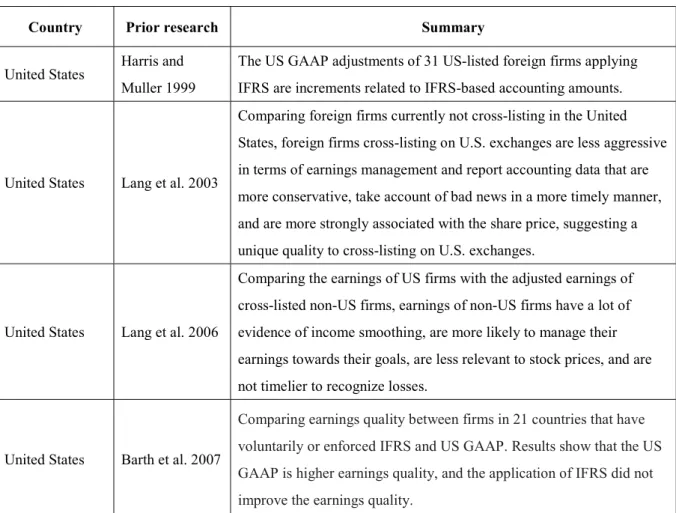
IFRS comparability studies are classified based on which domestic standard to be compared with IFRS. Figure 4 is a table showing the primary prior research based on the area of domestic standards, including studies using global data (cross-country study).
Figure 4: The primary prior research based on the country
Country Prior research Summary
United States Harris and Muller 1999
The US GAAP adjustments of 31 US-listed foreign firms applying IFRS are increments related to IFRS-based accounting amounts.
United States Lang et al. 2003
Comparing foreign firms currently not cross-listing in the United States, foreign firms cross-listing on U.S. exchanges are less aggressive in terms of earnings management and report accounting data that are more conservative, take account of bad news in a more timely manner, and are more strongly associated with the share price, suggesting a unique quality to cross-listing on U.S. exchanges.
United States Lang et al. 2006
Comparing the earnings of US firms with the adjusted earnings of cross-listed non-US firms, earnings of non-US firms have a lot of evidence of income smoothing, are more likely to manage their earnings towards their goals, are less relevant to stock prices, and are not timelier to recognize losses.
United States Barth et al. 2007
Comparing earnings quality between firms in 21 countries that have voluntarily or enforced IFRS and US GAAP. Results show that the US GAAP is higher earnings quality, and the application of IFRS did not improve the earnings quality.
15
United States
Gordon et al. 2009, Hughes and Sander 2008
Comparing earnings attributes of earnings based on IFRS and US GAAP adjustments provides evidence that the earnings adjusted under IFRS and US GAAP are comparable, but the quality of earnings adjusted under US GAAP is higher.
United States Bradshaw and Miller, 2008
Non-US firms that have adopted US GAAP tend to adjust items that need to be required by US GAAP. There are moves to ensure comparability by approaching US standards.
Australia Goodwin et al. 2008
Indicating that while there is weak evidence of a decline in earnings value relevance, firms that capitalize intangibles have increasing earnings value relevance.
Australia Bryce et al. 2015
The quality of accounting has not improved significantly since the adoption of IFRS in Australia.
Australia, France, England
Jeanjean and Stolowy 2008
There is no evidence that earnings management is suppressed after the compulsory application of IFRS in Australia and the United Kingdom, whereas there is evidence that earnings management is promoted in France.
Brazil Eng et al. 2019
In the post-IFRS implementation period, there has been no improvement in revenue information, analyst forecast accuracy, or post-employment liquidity.
UK, France and
German Barth et al. 2014
Net income adjustments focusing on IAS 39 Financial Instruments, IFRS is more value relevant than European domestic standards.
Canada Jermakowicz et al. 2018
The adoption of IFRS in Canada has produced a better financial report on the book value and net income of equity in the post-employment period.
China DeFond et al. 2019
The association between earnings and returns generally declines after IFRS adoption, consistent with reduced earnings quality because China’s institutional setting creates weak incentives for managers to produce high-quality financial statements.
Finland Jarva and Lantto 2010
Earnings under IFRS are no more timely in reflecting publicly available news than earnings under Finnish standards. Furthermore, book values of assets and liabilities measured under IFRS are no more value relevant than they are under FAS.
France Armstrong et al. 2010
For French banks, the application of IAS 39 reduces the usefulness of financial statements. This suggests that French securities regulators may have weakly enforced the standards, which may have reduced the relevance of net income adjustments associated with IAS39.
Germany Gassen and Sellhorn 2006
Analyzing German firms from 1998 to 2004, the earnings quality is higher for firms that voluntarily changed from German accounting
16
standards IFRS (IAS).
Germany
Van Tendeloo and Vanstraelen, 2005
Using a sample of German firms, we show that voluntary adoption of IFRS cannot be associated with reducing profit management behavior.
Germany Bartov et al. 2005
Using the German firms, the value relevance of US GAAP and IAS- based income is higher than the value relevance of German GAAP.
Germany Daske 2006
Investigating the hypothesis that the adoption of IAS / IFRS or US- GAAP reduces the cost of capital of German companies, the analysis based on the period from 1993 to 2002 shows firms applying IAS / IFRS or US-GAAP fail to find a reduction in the expected cost of equity capital.
Germany Jermakowicz et al. 2007
Analyzing major German firms, finding that the value relevance of earnings after voluntarily applying IFRS or US GAAP has improved.
Germany
Van Tendeloo and Vanstraelen 2005
Investigating the discretionary accruals when German firms voluntarily apply to IFRS, and finding that the discretionary accruals are not suppressed by the application of IFRS, but rather increased
Germany
Gontcharov and Zimmermann 2007
Voluntary transitions from German accounting standards to IFRS report no evidence of restraining management's opportunistic discretionary behavior.
Germany Paananen and Lin 2009
Comparing the earnings quality before and after the compulsory application to IFRS in German accounting standard, the earnings quality deteriorates after the compulsory application because earnings management is rather promoted, and the recognition of losses is delayed.
Germany Bartov et al. 2005
The earnings response coefficient is the highest among German firms applying US GAAP, followed by firms applying IFRS, and followed by firms applying German GAAP.
Greece Bellas et al. 2007
Evidence that the adjustments of Greece's accounting standard to net income improve incremental value relevance.
Indonesia Shara and Mita 2017
The convergence of IFRS shows that Indonesian SMEs will increase the number and proportion of foreign ownership by countries adopting IFRS.
Italy Paglietti 2009
IFRS adoption contributes to an improvement in accounting quality by documenting value relevance improve after the mandatory IFRS application.
17
Malaysia Ismail et al. 2013
IFRS adoption is associated with higher quality of reported earnings. Earnings reported during the period after the adoption of IFRS are associated with lower earnings management and higher value relevance.
New Zealand Islam et al. 2009
Analyzing absolute discretionary accruals are significantly higher under IFRS than under pre-IFRS NZ GAAP, suggesting lower earnings quality under IFRS than under pre-IFRS NZ GAAP.
Nigeria Udofia 2018 Finding a positive perception from users and preparers of financial statements on the benefits derived from IFRS adoption in Nigeria.
Norway Gjerde et al. 2008
Little evidence of increased value relevance after adopting IFRS for Norwegian listed companies applying IFRS
Norway Beisland and Knivsfla 2010
The result shows IFR increases the value relevance of book values and decreases the value relevance of earnings because of the fair value accounting.
Polrtgy Morais and Curto 2008
Comparing the earnings quality and value relevance of accounting data of 34 Portuguese listed firms before and after the adoption of IFRS, finding that IFRS firms report less smooth earnings than those firms that adopted domestic accounting standards, suggesting an
improvement in earnings quality while the value relevance of accounting information decreases with the adoption of IFRS. Singapore,
Malaysia, Indonesia
Joshi et al. 2016 The analysis of the data shows that accounting professionals in Singapore, Malaysia, and Indonesia strongly supported IFRS adoption;
South Africa Negash 2008, Ames 2013
There is no evidence that value relevance does not improve after adopting IFRS, resulting in the earnings quality is not significantly ameliorated post-adoption.
South Korea Kwon et al. 2017
Significant IFRS adoption effects by documenting smaller absolute values in discretionary accruals and real earnings management, higher accrual quality, stronger earnings persistence, and less frequent negative earnings, providing evidence of improved earnings quality with Korea’s mandatory IFRS adoption.
Spain Callao et al. 2007
The application of IFRS worsens comparability as a result of the large deviation between Spanish national standards and IFRS. There is no improvement in the relevance of financial reporting to local equity market operators.
18
Sweden Paananen 2008
The quality of financial reporting has not improved in the first two years after the adoption of IFRS in Sweden. On the contrary, there are some signs of poor financial reporting quality measured as earnings smoothing, timely loss recognition, and value relevance.
Turkey Turel 2010 The value relevance has improved after the compulsory application of IFRS for Turkish firms.
United Kingdom Horton and Serafeim 2010
Using a sample of a large non-financial UK firm that adopted IFRS mandatorily provide evidence of value relevance of adjustments related to total net income adjustments and some individual criteria.
EU Christensen et al. 2015
Earnings management (smoothing) has increased following the 2005 mandatory IAS/IFRS adoption in the (EU.
EU Chen et al. 2010
The compulsory application of IFRS improves the earnings quality in 15 EU countries (the profit adjustment of loss avoidance is suppressed, and the absolute value of discretionary accounting accrual is reduced).
EU Kvaal and Nobes 2010
Covering five EU countries and points out that principle-based IFRS is more susceptible to management judgment and discretion than rule- based accounting standards.
EU Kaserer and Klinger 2008
The quality of profits does not improve because fair value information with low verifiability impairs the information value.
Global Barth et al. 2008
Value relevance increased after firms voluntarily adopted IFRS. Firms applying IAS from 21 countries generally have less earnings
management, more timely loss recognition, and more value relevant accounting amounts than matching sample firms applying non-U.S. domestic standards.
Global Daske, 2008
Examining the economic impact of mandatory IFRS among 26 countries that are required to adopt IFRS. By analyzing market liquidity, cost of capital, and Tobin's q, they find that market liquidity increases before and after the introduction of IFRS, which indicate market liquidity increases around the time of the introduction of IFRS as well as a decrease in firms' cost of capital and an increase in equity valuations.
Global Ahmed et al. 2010
Discovering that the earnings quality has deteriorated in 21 countries that enforced IFRS in 2005
Global Atwood et al. 2010
Regarding 21 countries applying IFRS, it is pointed out that the earnings quality of IFRS is even worse than that of their own domestic standards.
19
US and Global Barth et al. 2012
The application of IFRS by non-US firms generated a better accounting system, which is more value relevant and comparable with US firms when IFRS firms adopt IFRS rather than national standards.
Some of the IFRS comparability studies pay attention to the significance of the fair value accounting as a major characteristic of IFRS (Ball, 2006), based on the usefulness of the balance sheet by comparing the value relevance of net assets or capitalization of intangible assets such as R&D (Lin and Chen, 2005; Hung and Subramanyam, 2007; Agostino et al., 2008; Capkun et al., 2008; Chalmers et al., 2011a; Gjerde et al., 2008; Kinsey et al., 2008; Paananen and Parmaer, 2008; Horton and Serafeim, 2010; Karampinis and Hevas, 2009; Morricone et al., 2009; Truel, 2009; Beisland and Knivslfa, 2010; Devalle et al., 2010; Jarva and Lantto, 2010; Oliveira et al., 2010). Another notable aspect of comparing with IFRS is principle-based, especially comparing rule-based accounting of US GAAP (Barh et al., 2007; Kvaal and Nobes, 2010).
Most of the prior research shown in Figure 4 mainly focuses on earnings quality using several indexes of earnings quality. Therefore, the income statement is the most significant element of a financial statement when comparing the quality accounting standard. That is why this study focuses on the income statement, including a presentation to analyze the comparability of IFRS to J-GAAP. Even IFRS is thought to be a high-quality accounting standard; prior research provides mixed evidence on whether the transition to IFRS deters or contributes to greater accounting outcomes. This paper also investigates the earnings qualities between J-GAAP and IFRS in Chapter 6, which is more specific to J-GAAP earnings, named “ordinary income.” This specific income, based on the philosophy to be separated gain and losses from ordinal income under J-GAAP, successfully reflects J-GAAP uniqueness against IFRS because it treats gains and losses included in the operating income.
Interestingly, there is no international analysis using global data with Japanese IFRS firms because of the limitation of a sample and voluntary adoption. Furthermore, it seems that there is little research on compatibility between IFRS and domestic standards in Japan because of the sample limitation. Gray et al. (2019) investigate what factors make Japanese firms motivate to adopt IFRS voluntarily. They find that Japanese firms are motivated to better communicate with global capital market participants through using IFRS. Kim et al. (2019) investigate the effect of voluntary IFRS adoption on information asymmetry among investors in Japan and fail to find a statistically significant association between bid-ask spread, which is our proxy for information asymmetry, suggesting that voluntary IFRS adoption does not affect information asymmetry in Japan.
While most of the prior studies on comparability of IFRS focus on the quality of earnings summarized accounting measures, some international studies deal with specific items such as
20 R&D or impairment losses because there still remains the differences between US GAAP and IFRS even after convergence. Tsoligkas and Tsalavoutas (2011) study the relationship between R & D assets and the value of costs in the UK since 2005, showing that the capitalized portion of R & D has a significant positive relationship with the market value. This suggests that the market recognizes these items as successful projects with future economic benefits. Gordon and Hsu (2018) and (2019) investigate the quality of impairment losses comparing UG GAAP and IFRS using global data except for Japan. They conclude that impairment losses of long-lived assets under IFRS are more related to the decline of future cash flow and firm-specific factors. Szczesny and Valentincic (2013), working on asset impairments of German private firms during the period of adoption of IFRS (between 2003 and 2006), find that German firms that are profitable, have financial liabilities, and pay dividends tend to report assets impairment losses. Hong et al. (2018) sample firms in a single country to study US and IFRS foreign firms listed in the United States and compare the two impairment criteria. The IFRS impairment process requires impairments to be recognised based on direct discounted cash flows and allows the impairment to be reversed if the asset’s economic conditions change. On the one hand, this reveals that incentives reflect the firm’s unique economic setting. On the other hand, US GAAP impairments require recognition based on discounted cash flows and prohibit the reversal of impairment losses. Previous studies on impairment rehearsals tend to regard them as an earnings management tool and find evidence consistent with this belief (Duh et al., 2009; Trottier, 2013; Cao et al., 2018; Tan and Trotman, 2018; Shaari et al., 2017). Considering prior studies show no positive aspect of impairment reversals, there is room to indicate the benefit of impairment reversals in accordance with the orient of accounting standards.
The difference of recognition criteria of impairment losses evokes another academic question, which is goodwill impairment losses between J-GAAP and IFRS. In 2014, the Accounting Standards Board of Japan (ASBJ), the European Financial Reporting Advisory Group (EFRAG), and the Italian Standards Setter (OIC) published the discussion paper (ASBJ, EFRAG, and OIC, 2014) and concluded that it would be appropriate to reintroduce GW amortization based on a survey conducted through a questionnaire, and a majority of respondents also agreed with the proposed view that GW amortization should be reintroduced (ASBJ, EFRAG, and OIC, 2015). Churyk and Chewning (2003) show that in the initial abolishment of systematic GW amortization in the US, only weak support for GW impairment is found, but strong evidence of subsequent impairment is found later, supporting the decision of regulators to eliminate GW amortization. Some empirical studies that have investigated GW amortization (Jennings et al., 2001; Moehrie et al., 2001; Yamaji and Miki, 2011), implying that earnings before amortization are more relevant than earnings after amortization. On the contrary, Henning et al. (2000) point out that the equity market may not see goodwill as an
21 expense because the amortization of goodwill is not necessarily negatively evaluated in the equity market.
While the impairment test and GW amortization became a controversial topic again internationally these days, there is no empirical research on comparing the impairment test with GW amortization and without amortization these days. Therefore, there still remains to be investigated the difference of goodwill impairment test recognition with amortization from the international perspective. Once GW impairment testing has been discussed after the FASB issued SFAS 121 (FASB, 1995), Riedl (2004) investigate its effect on the characteristics of reported impairments prior to the issuance of SFAS 121. His results reveal that economic factors are weakly associated with impairments after SFAS 121, suggesting that impairments reporting under SFAS 121 are of poor quality. Jarva (2009) finds that the reporting of GW impairment under SFAS 142, which calls for the non-amortization and annual impairment test, is relevant to future cash flows. There are many prior studies on problems of the impairment test under SFAS 142. Some investigations under IFRS also point out the same issues (e.g., André et al., 2015; Carlin and Finch, 2010; Caruso et al., 2016; D’Alauro, 2013; Saastamoinen and Pajunen, 2016). However, some studies support the benefits of the current impairment test. Stokes and Webster (2010) show that the IFRS-based GW impairment reflects the underlying economic conditions of firms under the circumstance where the enforcement and implementation of IFRS are ensured with higher audit quality by large audit firms. Chalmers et al. (2011b) found that GW impairment losses, as IASB expects, reflect the underlying economic attributes of GW better than systematic amortization in Australia. Abughazaleh et al. (2012) further explored the value relevance of GW impairment in the U.K. They provide evidence that the reported GW impairment is significantly and negatively associated with market value. This result implies that investors adequately recognize the decline in value of GW through impairment and incorporate it in their assessments of firms' value. Karampinis and Hevas (2014), using an international sample, find that GW impairments under IFRS are enhanced timeliness but less reliable in predicting future OCF compared to impairments of tangible long-lived assets.3 Andreicovici et al. (2020) explore whether disclosing GW
3 Recent prior research reveals conditions when the GW impairment test works. Knauer and Wöhrmann (2016)
suggest that when the level of legal enforcement in a country is low, investors respond to GW impairment more negatively and allow more management discretion. Besides, the market response to GW impairment is associated with managers' explaining the valuation and reports on which they rely to verify these explanations. The market reacts more positively when provided with a verifiable external explanation while more negatively when given a non-verifiable internal explanation. Andreicovici et al. (2020) explore whether the disclosing GW impairment tests is useful to analysts or not. They find that the transparency of disclosures is negatively related to not only information disparities between analysts but also between analysts and managers. They also point out that opportunistic and boilerplate disclosures disturb their ability to resolve information asymmetries and information
22 impairment tests is useful to analysts or not. They find that the transparency of disclosures is negatively related to not only information disparities between analysts but also between analysts and managers. They also point out that opportunistic and boilerplate disclosures disturb their ability to resolve information asymmetries and information uncertainties. Investigating prior literature on the GW impairment test, there are a majority of conclusions that capture the native aspect of GW impairment testing in US-based research, while they tend to be mixed conclusions of both native and positive in the IFRS-based research. The GW impairment test between SFAS 142 and IFRS is not yet fully unified. Furthermore, this difference may be due to institutional factors significantly affecting the quality of accounting reporting (Leuz et al., 2003; Burgstahler et al., 2006; Lang et al., 2006; Barth et al., 2012; Gordon and Hsu, 2018). Therefore, it is worth considering the effectiveness of the IFRS-based GW impairment test in Japan, which is becoming a large IFRS user country.
One of the international discussion which Japan does not pay attention to is “Discontinued operations” between SFAS 144 and IFRS 5. In 2002, SFAS 144 broadened the definition of discontinued operations by replacing the business segment requirement under APB 30 with the component of an entity concept. This change allowed firms to report smaller asset dispositions as discontinued operations, increasing the reporting frequency. As a result of that, the recognition of discontinued operations significantly increased after SFAS 144. Taking that issue into consideration, the joint FASB/IASB convergence project sought to define the scope of transactions reported in discontinued operations. Later, in 2010, amendments were made for convergence with the IASB, where frequent reports of discontinued projects were questioned. In response, the 2014 revision (ASU 2014-08) clarified the definition of discontinued projects, and it is expected that the frequency of reporting discontinued projects will decrease after the revision. Those two FASB/IASB standards of discontinued operations are quite similar thanks to the convergence project. However, the IFRS Interpretations Committee discusses problems with the practical application and interpretation of the scope of discontinued operations under IFRS 5, how to display intra-group transactions between continuing and discontinued operations, and non-continuing operations. It includes a review of the current definition of discontinued operations because how to set the requirements for classification as discontinued projects has a strong influence on the quality of discontinued projects. Barua et al. (2010) is the first to investigate classification shifting using discontinued operations that are segregated from the results of continuing operations and are presented separately in the income statement. Curtis et al. (2014) find no evidence of opportunistic growth when comparing APB 30 and SFAS 144. They emphasize the usefulness of a wide range of discontinued operations under SFAS 144. On the contrary to previous SFAS 144,
23 Accounting Standards Update 2014-08 (ASU 2014-08) narrows the scope of discontinued operations. Ji et al. (2020) discover that the application of ASU 2014–08 results in fewer opportunities for earnings management using discontinued operations. However, Kang et al. (2018) insist that ASU 2014-08 lowers the quality of core earnings based on the evidence that the persistence and response coefficient of core earnings significantly reduces, resulting in that analysts’ forecast error and dispersion increase. Given these previous studies, the range of discontinued operations in the standard could affect both usefulness and earnings management practices; however, both Curtis et al. (2014) and Ji et al. (2020) do not find significant earnings management behavior of discontinued operations according to the new accounting standard. Focusing on income decreasing (negative) discontinued operations, Darrough et al. (2019), using the date of U.S. firms, investigate whether managers shift income-decreasing special items to discontinued operations. They obtain the evidence that managers classification-shift asset write-downs to discontinued operations. Skousen et al. (2019) find that more capable managers reduce the degree of classification shifting using discontinued operations, and the shifting is mainly driven by firms with income-decreasing discontinued operations. Kaplan et al. (2019) find that the asymmetric phenomenon of shifting operating expenses to negative discontinued operations is due to the fact that positive discontinued operations are valued higher than negative discontinued operations. Silva et al. (2018), one of the limited prior literatures on discontinued operations under IFRS based, examine 191 discontinued operations in Brazil firms that adopted IFRS. The results do not show that managers incur in opportunistic decisions to discontinue operations to increase the core earnings. At the moment, there is no prior study finding earnings management evidence regarding classification shifting using discontinued operations under IFRS.
Finally, OCI recycling (OCIR) substantially differ between J-GAAP and IFRS. The ASBJ accepted the Accounting Standard for Presentation of Comprehensive Income (ASBJ Statement No. 25) as part of the convergence project between J-GAAP and IFRS in 2010; thus, Japanese listed firms disclose comprehensive income in addition to net income. However, while J-GAAP requires full recycling to emphasize net income in the income statement, IFRS fundamentally prohibits OCIR due to earnings management concerns. There is an ongoing debate on whether to prevent OCI recycling. Historically, the topic of OCIR has been controversial. That OCIR can be used to manage earnings is a major concern, as expressed by the Financial Accounting Standards Board (FASB) members (FASB, 1993). Prior literature provides evidence that eliminating OCIR helps control earnings management (Rees and Shane, 2012). Previous studies in the United States investigate the opportunistic use of OCIR, focusing on a single industry (e.g., banks or insurance companies) and specific OCI items (Barth et al., 2014; Graham et al., 2005; Lee et al., 2006). Jones and Smith (2011) argue that managers' discretion over investment choices and the timing of realization encourage earnings management concerns regarding OCIR. Graham et al. (2005) conduct a survey in the United
24 States on whether respondents consider the benefits of selling investments and other assets to meet or beat the prior year's earnings. Lee et al. (2006) reveal that U.S. insurance company managers engage in ‘cherry-picking’ to timely coordinate the realization of security gains or losses to manage earnings. Barth et al. (2014) provide further supporting evidence for this finding. They reveal that U.S. banks engage in income smoothing and big bath accounting through the sale of AFS securities.
While the abovementioned previous studies mainly deal with the sale of AFS financial assets as a means of OCIR, another relevant area is “cash flow hedge accounting.” Chiorean et al. (2017) examine whether U.S. firms engage in OCIR earnings management using cash flow hedge accounting. Their findings reveal that managers opportunistically reclassify the OCI of cash flow hedges and strategically designate and de-designate derivatives in cash flow hedges to achieve earnings benchmarks such as analysts’ forecasts, prior period return on assets (ROA), and zero earnings in the current period. Furthermore, they find that adopting the revised standard (ASU 2011-05) regarding OCIR does not eliminate earnings management but reduces it significantly. Arthur et al. (2017), based on a sample of Australian firms, find that there is a positive link between OCIRs that increase revenue and meeting or exceeding both last year's revenue and analyst forecasts. However, there is no evidence of using OCIR to avoid losses. In addition, they show that companies whose OCIR-managed earnings far exceed revenue benchmarks used OCIRs to reduce earnings. This is consistent with the income smoothing hypothesis. Finally, they suggest that OCIR and discretionary accrual complement each other rather than compete with each other, providing additional evidence of a significant positive association between OCIR and discretionary accruals. Rees and Shane (2012) examine whether the demand for OCIR stems from the importance of EPS calculations. If investors emphasize EPS based on net income, and OCIR recognizes all realized cumulative transactions through OCI in the net income, EPS will be calculated more favorably than without OCIR (Rees and Shane, 2012). As long as net income is highlighted in the income statement, OCIR keeps net income a key performance indicator (Detzen, 2016). However, Frendy and Semba (2016) investigate the usefulness of OCI recycling in Japan and reveal that unlike ASBJ's expectations that recycling enhances the usefulness of net income, the inclusion of recycling reduces sustainability and increases net income volatility.
4. Characteristic of this study
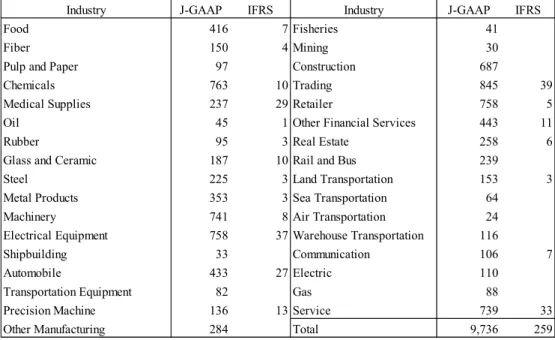
This study is the first comprehensive investigation of gains and losses in the income statement under J-GAAP and IFRS in Japan and has three exclusive characteristics. The first is the use of an IFRS sample from Japan. From the fiscal year ended March in 2010, voluntary application of IFRS to the consolidated financial statements of listed companies was permitted in Japan. Since then, listed firms in Japan start considering voluntary adoption of IFRS from
J-25 GAAP. For the moment of 2020, 224 listed firms have adopted IFRS in Japan (6 percent in the listed firms), including those to be applied. In the firms, 203 firms shifted from J-GAAP to IFRS and 21 firms newly listed. Considering the current trend that the number of IFRS-applied firms is increasing, it is necessary to investigate which standard is better for Japan. This study attempts to reveal the accounting quality between J-GAAP and IFRS, contributing to the current policy debates for standard setters in Japan regarding whether to adopt IFRS fully for all listed firms.
Another characteristic is using an exclusive data set for impairment loss and special items under IFRS. Because the sample data regarding goodwill impairment and impairment of tangible long-lived assets under US GAAP and IFRS are not available in the Japanese database, data were hand-collected from the annual report in Japan. International empirical research on impairment is conducted on each type of asset. Due to the restriction of the dataset in Japan, there is a lack of previous research on impairment by asset type in Japan, much less research on IFRS. This study is a pioneering approach to IFRS comparative and impairment research in Japan.
The last characteristic of this study is the adoption of a fixed effects model for regression. When using panel data, controlling fixed effects is crucial. Whether to control the firm-specific effect, the ‘Hausman test’ is necessary (Hausman et al., 1981). Except for “expected core earnings regression” in chapter 5,4 the results of the Hausman test support the fixed effects
model; thus, I adopt fixed effects regressions to deal with correlated omitted variables. The greatest merit of the model is that the individual (firm) effect, which cannot be made variable, does not affect the estimated value because the individuality of each firm is completely eliminated. In pooling regression analysis using panel data, the estimates are far from appropriate because the unobserved heterogeneity biases the estimates. To distinguish this study from others, regression analysis is consistently performed using a fixed effects model. 5. Chapter summary
5.1. Chapter 2. Goodwill impairments and future operating cash flows under Japanese GAAP and IFRS: Evidence from Japan
This study examines the predictive value of goodwill impairment for future operating cash flows under J-GAAP and IFRS using a Japanese sample. I investigate whether the difference
4 There are two exceptions of results from fixed-effects regressions. First, expected core earnings in chapter 5 are
predicted using McVay (2006)’s model and estimated by industry-year, excluding individual firms from the estimation. Second, I could not partially find expected significant results with the fixed-effect model in Chapter 3.
26 in the predictive value of goodwill impairment is due to distinctions in recognition and goodwill amortization under both impairment standards. I find that goodwill impairments reported under IFRS, which requires an annual impairment test with non-amortization of goodwill, are more negatively related to changes in future operating cash flows than those under J-GAAP, which requires a two-step impairment test and amortization of goodwill. Furthermore, evidence suggests that the goodwill impairment of firms that switched their accounting standard from J-GAAP to IFRS is also negatively associated with changes in future operating cash flows after shifting the standard. This result implies that goodwill impairments under IFRS are more informative and timelier than those under J-GAAP, even in the case of voluntarily shifting to IFRS. This study supports the adoption of non-amortization and annual impairment tests in Japan and sheds light on the current movement for the improvement of goodwill impairment tests and amortization.
5.2. Chapter 3. The Quality of Tangible Long-Lived Asset Impairments under Japanese GAAP and IFRS
This study samples Japanese firms to examine the quality of tangible long-lived asset impairments under J-GAAP and IFRS, with a specific focus on two aspects: (1) the determinants of impairments and (2) the predictive value for future operating cash flows. I investigate whether the quality of such impairments is due to differences in the recognition process, including the reversing between two standards. This study clarifies the impact of differences in the recognition criteria of tangible long-lived assets under J-GAAP and IFRS. Consistent with Gordon and Hsu (2019), a sample of firms adopting J-GAAP or IFRS in Japan reveals that IFRS impairments relate more to macroeconomic factors consistent with the one-step impairment model expected to capture declines in profitability in a more timely manner. By contrast, J-GAAP impairments further relate to macroeconomic factors consistent with the two-step impairment model expected to delay recognition. These results also indicate that J-GAAP impairments are associated with reporting incentives more than IFRS impairments. Consistent with Gordon and Hsu (2018), this study also demonstrates that impairments reported under IFRS, which require a one-step impairment model and allow for reversing impairments, are negatively associated with changes in future operating cash flows. However, those under J-GAAP are not and require a two-step impairment model and prohibit reversing impairments. Thus, adopting IFRS impairment standards can contribute to higher-quality impairments as they provide accounting-specific information and an association with future declines in
27 operating cash flows consistent with impairments-related accounting standards.
5.3. Chapter 4. Investigation on reversals of impairment losses under IFRS: Evidence from Japan
The purpose of this survey is to clarify the status of reversing impairment losses of firms applying IFRS by examining the tendency of firms to reverse impairment losses. The results reveal a unique trend in specific firms and industries in reversing impairment losses in Japanese IFRS firms. I find that the types of assets with impaired losses that can be reversed are slightly more intangible fixed assets than tangible fixed assets. In addition, I statistically examine whether there is a difference in performance between the reversal firm and no-reversal firm. Results indicate a significant difference in both net income and operating cash flow in the medical product and food industries, which have a high rate of reversing impairment losses on intangible assets. On the other hand, the difference in business performance disappeared as the industry reversed more tangible fixed assets. In some actual disclosure examples in practice, there are cases in which detailed disclosure regarding the reversal of impairment is not appropriately made, which is considered to be an institutional issue in IFRS.
5.4. Chapter 5. Classification Shifting using Discontinued Operations and Impact on Core Earnings: Evidence from Japan
Using reported discontinued operations among Japanese firms adopting IFRS, this study investigates whether managers engage in earnings management through classification shifting to manage core earnings. Using a methodology based on McVay (2006) and Barua et al. (2010), I find evidence that firms shift operating expenses of continuing operations to discontinued operations to increase core earnings, consistent with Barua et al. (2010). Additionally, I desegregate reported discontinued operations into core and non-core earnings because previous literature assumes that firms engage in classification shifting using special items. Results reveal that firms employ the classification shifting using negative non-core earnings (negative special items) of discontinued operations. These results would be beneficial for both standard setters and investors by clarifying the potential risks of the income statement under IFRS. Furthermore, the income-increasing discontinued operations negatively influence both current and future core earnings, while income-decreasing discontinued operations do not. This result demonstrates the usefulness of disclosing discontinued operations as a premise of the importance of core earnings to evaluate firms’ performance.
28 5.5. Chapter 6. Earnings Quality on Income Statements Under Japanese GAAP and IFRS This study investigates the quality of stepwise earnings on income statements, such as operating, ordinary, and net income, under J-GAAP and IFRS. A sample of Japanese firms adopting J-GAAP or IFRS is used to compare multiple attributes of J-GAAP versus IFRS earnings, including their closest J-GAAP equivalent similar to ordinary income, by adjusting IFRS earnings. J-GAAP earnings are found to be superior to IFRS earnings in terms of persistence, predictability, smoothness, value relevance, and timeliness, while IFRS earnings are superior in conditional conservatism. However, the results also reveal that “pseudo-ordinary” income in the IFRS sample is ultimately better than GAAP-based IFRS earnings and equivalent to the J-GAAP earnings in persistence, predictability, smoothness, and value relevance. The comparison of IFRS earnings attributes with pseudo-earnings that are the closest to J-GAAP ordinary income reflects the demand for value-relevant measures of financial performance beyond GAAP-based IFRS earnings. The results do not support the adoption of IFRS in Japan to improve earning quality. Further, IFRS should disclose compulsorily “ordinary income (or core earnings)” as GAAP earnings that require regulation and statutory auditing.
5.6. Chapter 7. Earnings Management using Other Comprehensive Income Recycling: Evidence from Japan
This study investigates other forms of comprehensive income recycling (OCIR) as a tool for classification shifting for earnings management and compares J-GAAP and IFRS to determine whether adopting IFRS prevents classification shifting using OCIR. Based on a sample of Japanese firms, I find a positive association between income-increasing OCIR and meeting or beating zero earnings, prior year’s earnings, and managers’ forecasts among J-GAAP firms while earnings management behaviors using OCIR disappear in the firms under IFRS except for meeting or beating management’s forecast of EPS. Additionally, I investigate the relationship between OCIR and net income before OCIR (PRNI) to test the hypothesis of “Big Bath” hypothesis and “Income Smoothing,” that is, whether firms use OCIR to influence the current earnings. The result shows that firms with PRNI below zero use OCIR to reduce current earnings and magnify losses under J-GAAP, consistent with the “Big Bath” hypothesis, while there is no supportive evidence under IFRS. However, I do not obtain the evidence both under J-GAAP and IFRS for the income smoothing hypothesis that firms with PRNI above
29 zero use OICR to reduce current earnings. Given these results, permitting OCIR entirely under J-GAAP encourages Japanese firms to engage in earnings management using OCIR while adopting IFRS can successfully prevent classification shifting.
6. Contribution
The contributions of this study are as follows. First, this study is one of the first papers to conduct empirical research that comprehensively compares gains and losses, including the presentation in the income statement under J-GAAP and IFRS in Japan. Given the unique situation in which Japan allows listed firms to choose accounting standards among J-GAAP, US GAAP, pure-IFRS, and J-IFRS, I can compare J-GAAP and IFRS in a single country, and differences in institutional settings between countries can be ignored. This allows me to focus on the difference between J-GAAP and IFRS and compare them more adequately and accurately because previous studies demonstrate that national institutional incentives, including regulatory systems, legal environment, and enforcement, influence the quality and properties of accounting information (Ball et al., 2000; Ball et al., 2003; Lang et al., 2006; Bradshaw and Miller, 2008).
Second, the results provide evidence that the quality of IFRS is higher than J-GAAP in terms of impairments of both goodwill and tangible assets, impairment reversals, and OCI recycling that are crucial differences between J-GAAP and IFRS. However, the results also show that the investigation on discontinued operations in chapter 5 and earnings quality in the income statement in Chapter 6 indicate mixed results. While I find evidence that is consistent with earnings management behavior using discontinued operations, the results also indicate the useful aspect regarding the impact of core earnings. Likewise, the survey on earnings quality in chapter 6 complements the positive result on the high quality of J-GAAP earnings while the advantage of IFRS earnings on conditional conservative. As a whole, this study supports the adoption of each individual accounting standard of IFRS regarding gains and losses. However, considering the supportive results for J-GAAP earnings quality, adopting IFRS in Japan might not lead to improvement regarding earnings quality. Additionally, one supportive suggestion from J-GAAP is the value of “ordinary income.” The result of chapter 6 supports the adoption of J-GAAP ordinary income for IFRS firms to improve the usefulness of accounting information. Overall, the common view from this paper is that the quality of accounting could rely on the treatment of gains and losses.
30 in Japan. Since accounting standards are different in J-GAAP and IFRS, standard setters should pay attention to the impact on financial reporting outcomes and differences in predicted gains and losses, including the presentation of the income statement. As regulators in Japan are considering adopting IFRS and have expressed concern about material differences in certain items, it is also essential to pay attention to differences in specific standards. Since IFRS is the predominant set of high-quality accounting standards worldwide, financial statement users will be interested in the implications of this study.
31
Chapter 2: Goodwill impairments and future operating cash flows
under Japanese GAAP and IFRS: Evidence from Japan
ABSTRACT
This study investigates whether the difference in the predictive value of goodwill impairment for future cash flows is caused by the distinctions between recognition and goodwill amortization under the Generally Accepted Accounting Principles in Japan (J-GAAP) and International Financial Reporting Standards (IFRS) using a Japanese sample. I find that goodwill impairments reported under IFRS, which require an annual impairment test with a non-amortization of goodwill, are more negatively related to changes in future operating cash flows than those under J-GAAP, which requires a two-step impairment test with an amortization of goodwill. Subsequent evidence suggests that the goodwill impairment of firms that switched their accounting standard from J-GAAP to IFRS is also negatively associated with changes in future operating cash flows. This result implies that goodwill impairments under IFRS are more informative and timelier than those under J-GAAP, even in the case of voluntarily shifting to IFRS.