Unveiling the Successful Process of
Technological Transition :A Case Study of
Matsushita Electric
著者
SHIBATA Tomoatsu
journal or
publication title
Discussion Papers (Tohoku Management &
Accounting Research Group)
year
2011-11
TOHOKU MANAGEMENT
&ACCOUNTING RESEARCH GROUP
GRADUATE SCHOOL OF ECONOMICS AND
MANAGEMENT TOHOKU UNIVERSITY
KAWAUCHI, AOBA-KU, SENDAI,
980-8576 JAPAN
Discussion Paper No. 104
Unveiling the Successful Process of Technological Transition : A Case Study of Matsushita Electric
Tomoatsu Shibata
November 2011
1
Unveiling the Successful Process of Technological Transition :
A Case Study of Matsushita Electric
1Tomoatsu SHIBATA
TOHOKU University, Japan
27-1, Kawauchi, Aoba-ku, Sendai, Miyagi-Pref., 980-8576, Japan e-mail : [email protected]
Abstract:
Changing technological strategies requires serious management decisions because it essentially means withdrawing from an existing technology, in which the company has been successful, and shifting management resources to a new technology with a high degree of uncertainty. Most of existing research has focused on examples of failure, to shed light on the causes of failure. However, we will analyze in detail an example of a successful transition to a new technology.
The subject of our analysis is the transition in technological strategies made by Matsushita Electric Group (MEG), a large corporate group representative of Japanese companies, at the time of its commercialization of plasma TVs. The purpose of this paper is to analyze in detail this transition process and to discover findings and insights for successful transition process from accumulated technology to new technology.
Our analysis yields key conceptual contributions about technological transition from old to new
technology as follows. Old and new technology can differ in their knowledge base. According to existing
literature, when the knowledge base is radically different, incumbent firms have a difficulty adapting to
the technological change. On the other hand, when the knowledge base is very similar, incumbent firms
have no trouble adapting to the change. Beyond these established existing understandings, this paper
argues that when the knowledge base is moderately different, managers can increase the likelihood of
successful transition by implementing a set of organizational strategies. Among these strategies, a
particularly insightful one is that through the parallel development process of both existing and new
technologies, managers can eventually integrate the advantages of both technologies by implementing a
flexible resource allocation mechanism to overcome the dichotomy between old and new.
1
Although Matsushita Electric Industrial Co., Ltd. changed its company name to Panasonic Corporation in 2008, this paper focuses on the period during which the company was known as Matsushita Electric Industrial Co., Ltd. (MEI) and therefore that name is used throughout this paper.
2 Keyword:
Technological transition, Technological change, Parallel development, Plasma TV
1. Introduction
Making
d
ecisions regarding a technological transition is a serious management issue that confrontscorporate organizations throughout the world, regardless of the size or age of the organization. A
technological transition refers to the transition from an existing technology, in which a company has
experienced success and accumulated considerable technological assets, to a new and uncertain
technology.
Because of the inherent risks, companies since the industrial revolution have failed in their attempts
to meet this challenge and have therefore avoided involvement. On the other hand, companies that have
succeeded in making strategic shifts in technology have contributed to the creation of new businesses
and new industries.
Although there is a large body of research covering various angles of this management issue, most
of this research has focused on examples of failure in order to shed light on the causes of failure
(Henderson and Clark, 1990; Tushman and Anderson, 1986; Christensen, 1997; Leonard-Barton, 1992;
Foster, 1986).
In contrast to these previous studies we will analyze in detail a case of a successful technological
transition. From this in-depth case analysis we can draw key factors for success. The subject of this
analysis is the technological transition made by Matsushita Electric Group (MEG), a large corporate
group representative of Japanese companies, at the time of its commercialization of the plasma TV2 The plasma television industry emerged as the result of competitive technological innovations
achieved by corporations in Japan and the United States over a period of more than 40 years (Murtha,
Lenway and Hart, 2001). Ultimately, it was MEG that reaped the greatest economic reward from these .
2
Plasma TV means a TV that uses a plasma display panel (PDP) as the display device. The CRT TV of the past used a cathode-ray tube (CRT) as the display device.
3 developments, and one of main contributing factors to this achievement was the successful transition
from accumulated DC (direct current) PDP technology to AC (alternating current) PDP technology, in
which the company had no developmental experience at all. This paper will focus on and clarify the
processes and changing circumstances at MEG that contributed to the group's successful technological
transition.
Our analysis yields key conceptual contributions about technological transition from old to new
technology as follows. Old and new technology can differ in their knowledge base. According to existing
literature, when the knowledge base is radically different, incumbent firms have a difficulty adapting to
the technological change. On the other hand, when the knowledge base is very similar, incumbent firms
have no trouble adapting to the change. Beyond these established existing understandings, this paper
argues that when the knowledge base is moderately different, managers can increase the likelihood of
successful transition by implementing a set of organizational strategies. Among these strategies, a
particularly insightful one is that through the parallel development process of both existing and new
technologies, managers can eventually integrate the advantages of both technologies by implementing a
flexible resource allocation mechanism to overcome the dichotomy between old and new.
The following section confirms the academic stance of this study in relation to earlier studies, and
describes our research methodologies. The paper then continues to analyze in detail the technological
transition process. Finally, we will explore findings and discuss the reasons MEG succeeded in its
technological transition from the DC to the AC system, through the parallel development process.
2. Previous Studies
Previous studies have highlighted various reasons that established companies have foundered in
attempting to cope with technological transition (Henderson and Clark, 1990; Tushman and Anderson,
1986; Chistensen, 1997; Leonard-Barton, 1992; Foster, 1986; Tripsas and Giovanni, 2000). Four factors
4 The first factor causing delayed adaptation to technological change is over-adherence by a
corporation to its own resource base (Tushman and Anderson, 1986; Leonard-Barton, 1992). Company
resources previously achieving superior results can conversely produce entrenched organizational inertia
that can result in slow responses to new technologies. Additionally, when a new technology emerges and
disempowers a company’s managerial resources there is a clear tendency for rational decision making
regarding the new technologies and approaches to it to become retarded.
The second factor is corporate bias toward listening to existing customers and markets
(Christensen, 1997). In his historical analysis of the hard disk industry, Christensen found that one of the
biggest failings of well-managed companies was their tendency to focus exclusively on the needs and
requirements of their existing customers. Since companies tend to act within the value criteria of an
existing value network, it is difficult for companies to respond effectively to customers or markets
having new value criteria. This pattern was illustrated by hard disk manufacturers, which operated
within a value network placing primary importance on memory capacity and processing speed, as
opposed to the new value network created by emerging demand for more compact design and lower
power requirements.
The third factor is the destruction of a firm’s architectural knowledge, resulting in a mismatch
between product architecture and organizational communication patterns (Henderson and Clark, 1990).
In analyzing a failed attempt to develop a semiconductor aligner, Henderson and Clark found that the
mode of product architecture defining the interdependence of parts is embedded in the communication
patterns that exist between the departments within an organization. Since it is difficult to alter existing
communication patterns, it is difficult for established organizations to adopt new product architecture.
The forth factor is the role of managerial cognition in directing search processes in a new learning
environment (Tripsas and Giovanni, 2000; Garud and Rappa, 1994). Tripsas and Giovanni examined the
5 knowledge of the competing digital imaging technology, Polaroid failed to adapt to the technological
change. To understand this paradoxical behavior, they examine how managerial cognitive
representations play a central role in terms of constraining organizational behavior. The Polaroid story
clearly illustrates the importance of these managerial cognitive representations.
The existing research such as that mentioned above has focused on the causes of failure. On the
other hand, findings and implications from successful process can be drawn to help understand the
factors and conditions necessary for technological transition. In recent years, research aimed at
clarifying the various criteria required to overcome the difficulties surrounding technological
transitioning has been announced. (Hill and Rothaermel, 2003; Rothaermel, 2001; Ahuja and Lampert,
2001; Rosenbloom, 2000).
For instance, these research findings argue that the performance of incumbent firms in the radical
innovation will be higher if the firms possess downstream complementary assets that are critical to the
commercialization of the new technology. Also, they assert that organizational slack is a predictor of
incumbent performance in the face of radical innovation. Several factors like those above that help to
explain incumbent performance in radical innovation have been discussed in these research findings.
However, a complete picture of the entire process by which companies faced with the emergence of
a new technology successfully achieve a transition from their existing technology has not been entirely
clear. To address this issue, we have intentionally selected an example of success rather than failure as
the focus of analysis and looked at the entire process of the transition.
3. Methods Case study
Due to the exploratory nature of this study, we adopted a qualitative, in-depth case study
methodology. This study enabled us to collect comprehensive data and generate theoretical findings that
6 using case studies, the researcher is able to initiate the study as close as possible to the ideal of no theory
under consideration and no hypothesis to test.
Various scholars (Glaser and Strauss, 1967; Eisenhardt, 1989; Yin, 1994; Siggelkow, 2007) have
discussed the validity of case studies. Case studies make it possible to explain the relevance and
cause-and-effect relationships of a variety of observations through detailed insights with consideration given to
qualitative information. Case studies not only compensate for the weakness of generalities but are also
indispensable in new, creative theorization.
Research Setting
The subject of this case study is the successful technological transition made by MEG. Two
companies within MEG participated in the technological transition process - Matsushita Electric Corp.
(MEC) and Matsushita Electric Industrial Co. (MEI). Established by Konosuke Matsushita in 1952 as a
joint venture with MEI and Philips of the Netherlands, MEC was set up in order to import Philips’
leading semi-conductor component technology and was thus uniquely positioned within MEG.
MEC began developing and manufacturing electronic components such as cathode-ray tube displays,
valves, fluorescent lights and semiconductors, while MEI procured those parts from MEC to assemble
completed products such as televisions and so forth. The basic nature of the relationship between these
two companies was also continued during plasma TV development, which meant that MEC proceeded
with developing the PDP (plasma display panel) display device and supplying these to MEI, who
assembled the completed plasma TV.
During the plasma TV commercialization process, MEG made a successful transition from DC to
AC PDP technology. Following evaluations in the latter half of the 1990s of the AC technology and
parallel development of the AC and DC systems, MEG began this transition away from its technological
affiliation with DC in favor of the AC technology, the technology that would eventually be used in the
7 friction between AC group and DC group within MEG3 (Kano, 2008).
Data collection
Table 1. Individuals Interviewed (Insert)
Data analyzed from this study came from interviews4 with people involved with this technological transition process, information provided through e-mail by those people, information in the public
domain, research papers, and company history. Company history provided detailed explanations about
the activities of MEG from 1978 until 2007, published by Matsushita Electric Industrial Co. in 2008.
Semi-structured interviews approximately two hours in length were conducted with the people listed in
Table 1 from January to December 2007 and all interviews were recorded by tape recorder. When
reconfirmation of details was necessary, either an additional interview was conducted or inquiries were
made by e-mail. The case study was subsequently prepared by checking details against information
available in the public domain, research papers and company history. After its preparation, the case study
was circulated to all those who had been interviewed with a request for them to read and confirm details.
When comments were received, the case study was amended to reflect these.
Framework of analysis
In studying this successful transition process, there are three observations that were found to be
particularly interesting and insightful. This paper focuses on these observations as research questions.
3 In the interviews with Mssrs. Sumita and Endo, both attested that there was a significant
conflict between two groups.
4 The author wishes to extend his heartfelt appreciation to those who agreed to be interviewed in person. In
addition to face-to-face interviews, information was provided to the author via e-mail from Mr. Tsuneharu Nitta (Director of Matsushita Electric and Director of MEI Central Research Laboratories at the time), Mr. Kazuma Danjo (former president of Matsushita Electronics Corporation), and Mr. Fumiya Konishi (current president of IP Infusion Inc. and former president of Matsushita Technoresearch Inc.). The author wishes to take this opportunity to acknowledge the contribution of these people by mentioning them here. Also, the author wishes to express appreciation to Prof. Jeffrey Hart for his helpful comments.
8 The first question is how MEC broke its entrenched path dependency on DC PDPs and initiated the
transition to the AC technology. As a device manufacture, MEC was locked into a path dependency on
DC, not only because it had accumulated DC monochrome PDP technology through the success of their
laptop PCs, but also because it had a strong relationship with NHK (Japan Broadcasting Corporation), an
important customer that had already committed to the DC system.
The second question is how MEG was able to produce the proprietary “Matsushita AC” panel, a
panel superior in terms of mass productivity and cost. In answering this question, we must examine the
relationship between the DC and AC groups that continued during the period of parallel development,
and the synergic effects that arose between the two groups.
The third question is how the transition process was brought to a conclusion, in other words, by
what means was the smooth withdrawal from the DC technology made finally. An example highlighting
the difficulties involved in withdrawing from an existing technology was Intel’s withdrawal from the
DRAM technology. (Burgelman, 1994; Burgelman, 1996; Burgelman, 2002; Grove, 1996). The issue is,
nevertheless, how MEG achieved its smooth withdrawal.
In resolving these questions, we find three key steps for successful technological transitions. The 1st step is breaking the path dependency on existing technology with help of a different organization, and
the 2nd step is sourcing new technology from outside the company and engaging in a period of parallel development to ascertain which technology works better. Through the parallel development process,
when the knowledge base is moderately different, companies can create synergistic effects between old
and new technology and produce a superior product through organizational strategies including flexible
resource allocation mechanisms and knowledge sharing. Finally, the 3rd step is the smooth withdrawal from the existing technology by implementing internal selection mechanisms within companies such as
9
4. Case Study Analysis: The Transition Process in MEI’s Plasma TV Business5
In its account settlement for fiscal 2001 (March 2002), MEI posted a deficit of 427.8 billion yen, the
company’s largest deficit since it was founded. The company’s funds on hand, which had been so
abundant in the past that the company was once jokingly referred to as “Matsushita Bank,” suddenly
dwindled to the point where net financial assets, which had reached 1,159.9 billion yen at the end of
March 1990, plummeted to an unbelievable low of 352.4 billion yen by March 2002. Looking back at
that period, Atsushi Murayama, who was executive vice president at the time, described those conditions
by saying, “For a period of about one year, there was a genuine sense of crisis that the company was
going to go belly up6
Matsushita subsequently made a spectacular and rapid recovery, and in the following two years,
fiscal years 2002 and 2003, Matsushita posted operating profits of 126.6 billion yen and 195.5 billion
yen respectively. This was a genuine V-shaped recovery, thanks largely to the success of what was
known in the company as the Nakamura Reforms. One of the key products that contributed to this
V-shaped recovery was the plasma TV, although it had taken many years before Matsushita was able to
transform the plasma TV into a viable business. .”
In fact, 40 years had already passed since the fundamental PDP principle was first presented at the
University of Illinois, and it took Matsushita more than 20 years of trial and error to produce the final
PDP as a commercially viable product.
In 1966 the AC PDP principle was presented at an academic conference by a research team from the
University of Illinois. Later a different DC system was invented by Burroughs Corporation, a US
computer manufacturer. Thereafter, development of the plasma TV became divided into two camps, with
some companies adopting the AC system and others the DC.
Fujitsu, which was granted the license for the technology directly from the University of Illinois,
5
The author assumes sole responsibility for the interpretation and presentation of facts as stated in this paper. 6
Kazuo Mori, “Kunio Nakamura, the Man who Destroyed the Konosuke Myth,” Nikkei Businessperson
10 proceeded with development using an AC system, while Matsushita and Hitachi undertook development
using DC systems. NHK, which indicated a preference for large flat-screen TVs for high-definition
broadcasting, also proceeded with developing a DC system. Although DC was the mainstream system in
use with the old monochrome plasma displays, AC has become the established system for the plasma TV
of today.
Summary Description of PDP Technology
A plasma display panel consists of electric discharge cells sandwiched between 2 glass panels.
Controlling the voltage at the electrodes in these electric discharge cells produces a plasma in the cells
(See Appendix about the structure and characteristics of PDP). The plasma in the cells emits ultraviolet
light which is converted to visible light via fluorescent materials inside the cells. PDPs can be said to
consist of 4 technologies - electric discharge control, electric discharge cell design, materials and
production technologies.
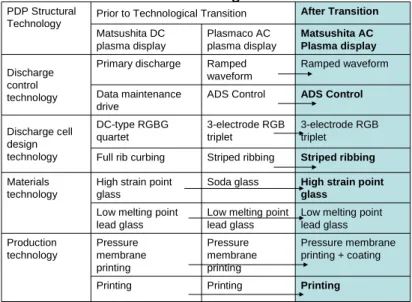
There are 2 types of plasma display panel systems, AC and DC. Table 2 compares these two systems
in terms of the above 4 technologies. As described in the table, the electric discharge control and electric
discharge cell design technologies are substantially different, although the materials and production
technologies are similar in many respects. In this sense, the overall degree of difference in the
knowledge base between the 2 technologies is moderate.
Matsushita’s technological transition was not just a simple case of choosing either the AC or DC
technology, rather, the company’s unique AC technology was the result of prolonged integration of both.
These processes are described in more detail below.
Table 2 Comparison of AC and DC plasma display technologies
11 Beginning around 1980, MEC began to develop a DC-type monochrome PDP for a small initial
market. This type of PDP was first used chiefly for ticket machines at train stations and gasoline gauges
at service stations. In 1983, however, MEC found a market for the displays in laptop computers. The
market rapidly expanded thereafter, with MEC’s PDP business growing to 100,000 units in 1987. In
1990 cumulative sales soared to over two million units as the PDP business grew to a business with
annual sales worth 20 billion yen7
However, during the same period LCD (liquid crystal display) technology was rapidly gaining
ground and could be easily adapted to colorization. As a result, it eventually dominated the market for
PC displays and brought to an end to the era of monochrome PDPs. In 1984 Epson launched the world’s
first pocket-sized color LCD TV, and in July 1989 Japan’s first color LCD laptop computer
(PC-9801LX5C) arrived on the market from NEC Corporation. (Kano, 2008).
In view of these developments, it was only natural that producing color PDPs became more urgent.
After the monochrome PDP enterprise was scaled down in 1989, MEC had entered into a joint
development agreement of DC color PDP with NHK, which was taking the lead in DC color PDP
technology. Thereafter, the two partners made a concerted effort to develop a color PDP based on the DC
technology.
The Beginning of the Transition: Exploration and Evaluation
Through the joint development with NHK, MEC had learned and accumulated DC color technology
from NHK. Also at about this time, Fujitsu exhibited at the 1992 Electronics Show an AC display with
picture quality significantly surpassing that of earlier PDPs. General Manager Wani of MEC (who later
also served as liaison coordinator with Plasmaco, Inc.) commented on how surprised he was to learn
about how much progress Fujitsu had made in AC color PDP. The luminance was almost twice that of
the earlier DC technology and there were 256 gradations. The ADS system invented by Shinoda in 1990
7
Hiroyuki Hagiwara, “Trajectories of Development: the Plasma TV,” Nikkei Mechanical, Nikkei BP (2003-2004).
12 made possible this 256 gradation capability in the AC-type. With this Fujitsu model, the picture quality
of the AC-type PDPs came close to the picture quality of the DC displays.
From this point onwards, the technical question of whether to opt for DC or AC became extremely
compelling, and although initial concerns were confined to divisions directly involved with PDP,
eventually the technical issues involved came to the fore throughout the entire Matsushita group, when a
statement on this issue made by Masaharu Matsushita, then chairman of MEI, was recorded at the
general shareholders’ meeting on June 30, 1994. He stated, “It seems that plasma TVs have both AC and
DC types. To determine which is better, development must proceed with an understanding of the
characteristics of both types8.” At a later date, Masaharu Matsushita requested that Shiro Horiuchi, then managing director in charge of technology, seek further assistance from Central Research Laboratories
regarding the development of the plasma TV9
There is evidence that immediately after the general shareholders meeting, engineers were
summoned by Director Nitta to the Central Research Laboratories, where they explained PDP
technologies and suggested that the company should adopt the AC technology. .
The above indicates that the head of Matsushita himself perceived the decision regarding AC and
DC as being important. Remarks made by the head of Matsushita also had a significant impact within
the company. Previously, Matsushita’s Central Research Laboratories had paid little attention to PDP, but
after Masaharu Matsushita’s statement the Central Research Laboratories also became deeply involved
in the AC and DC technology selection process, and it became the driving force behind the technological
transition to AC.
Whether to choose AC or DC now became important for the entire company. Therefore in 1995, a
company-wide PDP development team consisting of both an AC group and a DC group was established
within Matsushita, as indicated in Figure 1.
8
Memo from Mr. Sano
9
13 Figure 1. Establishment of AC and DC groups (1994-95) (Insert)
MEC proceeded with DC development while Matsushita’s Central Research Laboratories began
research on the AC system10
The objective of the company’s TV business division and production technology research laboratory
was to provide technologies required by both the DC and AC groups. This was possible because much of
the image processing and production technologies required by each group were similar.
. In the DC group, MEC’s special color PDP project led DC development in
cooperation with NHK. At the same time, the AC group was making efforts to promote AC development
under its new business promotion division with cooperation from Plasmaco, Inc. However, a look behind
the scenes at that time would have revealed that the development resources of the DC group far
surpassed those of the AC group, both in personnel and equipment. Moreover, the DC group had
maintained a continuum of development from the time of monochrome PDP development and had the
benefit of accumulated technical knowledge to draw from. Conversely, it would not be an
understatement to describe the AC group’s activities at this time as a group of persons engaged in
sourcing and evaluating technologies rather than their actual development.
Encounter with Plasmaco, Inc. and its acquisition
Plasmaco, Inc., which has already been mentioned several times in this paper, was a venture
company established by Larry Weber in 1987 and had already accumulated technologies relating to the
AC PDP11
10 The account given in this paragraph was based on interviews with Mssrs. Sumida, Endo, and Nagaoka.
. Although MEG had amassed DC technical knowledge over a long period of time, it would
have been difficult for the company to transition from the DC to the AC system without the cooperation
of Plasmaco, since the company did not have sufficient expertise in this area. In the end, the support of
Plasmaco was a deciding factor when MEI made the decision to switch its technological strategy to AC
development.
11
14 It is interesting how Matsushita learned about Plasmaco and its founder Larry Weber12. The person who created the opportunity for Matsushita to come into contact with Plasmaco was Peter Holden, who
had previously worked in MEI’s International Business Division. At that time, Holden’s work involved
introducing American intellectual property to Japan at CTT (Competitive Technologies Inc.
headquartered in Fairchild, Connecticut) and he was particularly committed to pitching the patents held
by the University of Illinois to Japanese companies. After viewing Plasmaco’s exhibit at the SID
Exhibition (The Society For Information Display, a large international conference covering display
technologies) in June 199413
Plasmaco’s display at SID had a huge impact, verified by its being featured on SID’s website as an
historic display and its having received SID’s Special Recognition Award in 1995. Konishi talked about
Plasmaco to his old acquaintance Tsuneharu Nitta, Director of Matsushita and Director of Central
Research Laboratories. Nitta showed interest in the company and requested that Konishi have Weber
conduct a demonstration at the Central Research Laboratories. Weber visited the Central Research
Laboratories of Matsushita in August of that year and conducted a demonstration of Plasmaco’s AC PDP
for Matsushita’s engineers. There was a mixed response from the Matsushita attendees. Wani, an
attendee at the demonstration, recalled that at the time he “was not able to accept at face value
Plasmaco’s proprietary technologies as described by CEO Weber.”
, Holden compiled a report for Fumiya Konishi, former CEO of Matsushita
Techno Research and then CEO of IPI (Innovation Partners International Co., Ltd.), of which Holden
himself was an executive vice president, on the high-quality technologies possessed by Plasmaco and
Plasmaco’s requirement for development capital.
14
12
Details of the acquisition of Plasmaco, Inc. are based on an interview with Mr. Sano and information forward by Mr. Nitta via e-mail.
This was the first time MEI came
into contact with Plasmaco.
13
The exhibit at the time was not of moving images but of still images displayed for only two hours, and consisted merely of a projection of three stripes on the display panel. According to Johnston (2006), Weber saw very favorable response from exhibition visitors and understood that there was a latent demand in the market. Weber later devised and patented a new driver circuit that improved the contrast ratio five-fold.
14 According to “The History of Development of the MEC Color PDP,” a memo prepared by Mr. Wani on
15 Subsequently Matsushita’s engineers visited Plasmaco on several occasions, with Plasmaco’s
technologies successively showing signs of further progress. Wani recalled his utter amazement during
his visit in February 1995 when he learned that a panel with a 250cd/m2 luminance had been created15
Plasmaco’s technologies afterwards showed further improvements in luminance and contrast
.
Through these exchanges, Nitta began to acknowledge Plasmaco’s technologies and Weber’s future
potential and finally signed a joint development agreement with the company in May 1995. 16
The patents of Plasmaco are worthy of brief mention here. One representative example is
Plasmaco’s technology for dramatically increasing the contrast ratio, which brought the AC PDP picture
quality close to the level required for TV. In pre-existing technologies, a high voltage was generally
applied at a burst to ensure a reliable gas discharge, but in contrast, Plasmaco’s method was to gradually
apply voltage with a corrugated ramp (a gradual inclination) waveform. A patent for this technology was
filed in the United States Patent and Trademark Office as Patent No. 574086.
. MEI,
which had included a proviso regarding the acquisition of Plasmaco in the joint development agreement
it had concluded, acquired Plasmaco in January 1996.
Matsushita learned this technology from Plasmaco. According to Sumida, who was seconded to
Plasmaco as the senior executive vice president, a total of six individuals including Sumida were
seconded to Plasmaco between 1995 and 1996. One person was in charge of accounting and the
remaining five were engineers. The period of secondment was about three years for some of the staff and
was as long as nine years for others.
In 1996, Fujitsu entered the market with a jumbo 42-inch full-color plasma TV, making Fujitsu the
first company to commercialize an AC plasma TV. However, the picture quality of Fujitsu’s product at
that time was not good enough for TV. Plasma TV still had not reached a high level of perfection. In
reply to the author’s query, one of Matsushita’s engineers who had analyzed Fujitsu’s plasma TV at the
15 According to “The History of Development of the MEC Color PDP,” a memo prepared by Mr. Wani on
August 28, 1999.
16 Contrast means the luminance ratio between the brightest and darkest parts of the image. In specific
16 time commented, “I had the impression that because Fujitsu’s product had sub-standard picture quality,
we would be able to put up a good fight from then onwards even though we had a late start.”
From this time onwards, as a dominant panel module design became more or less established, the
technologies used in the image-processing circuit were gradually getting closer to achieving picture
quality that would be accepted in the TV market.
Establishment of an SBU
For the purpose of development, manufacturing and sales of plasma TV, a devoted division was
established as an SBU (strategic business unit) around 1996 by CEO Morishita. Matsushita SBUs are
worthy of a brief explanation17
The aim of an SBU is to create new businesses and therefore includes not only development and
design functions but also manufacturing and marketing. However, SBUs do not have indirect division
staff such as personnel and accounting sections. Rather, each SBU acquires indirect division staff only
when it advances to the level of a BU (business unit). In summary, new business development at
Matsushita, viewed from its structure within the organization, begins as a new division with only a
development function, then progresses to an SBU and finally to a BU. The important point in the
evolutionary process of this business structure is that once the organization reaches the level of an SBU
and higher, it becomes responsible for profit generation. This major difference sets BUs apart from the
so-called cross-departmental project team system.
here because the functions of SBUs are slightly different from one
company to the next. Matsushita introduced SBUs in the latter half of the 1980s as organizations in the
process of launching new businesses. The development of a new business at Matsushita starts as a new
division which aims to grasp technical issues and assess them. Once the business has a firm footing in
the target area, it takes on the business structure of an SBU.
Following Matsushita’s method for turning new technologies into business enterprises, the SBU set
17 up under MEC around 1996 accordingly became a financially independent organization. The SBU was
organizationally part of MEC, but people came from not only MEC but also MEI. The SBU started
initially with a total of 33 staff members, comprised of sales, manufacturing, engineering and other
personnel. The design staffs were provided by the technology division at headquarters; the sales and
marketing staff were provided by the TV business division; the panel manufacturing staffs were provided
by MEC; and the TV set manufacturing staffs were also provided by the TV business division.
The goal of the SBU was to make the plasma TV a viable business enterprise as a next-generation
technology designed to succeed the CRT TV, although at that time, the final decision as to whether
Matsushita would proceed with the AC or DC type had not yet been made and the parallel development
of both types was still in progress (Figure 2).
Figure 2. Parallel Development within the SBU (1996-97) (Insert)
The SBU under MEC was located in Takatsuki City, Osaka, but the base for the DC group was
located in the northern area of the city while the base for the AC group was located in the southern area.
It is interesting that while part of the same SBU, the two teams were divided into two bases. Moreover,
since the two teams shared a substantial number of technological aspects, it may have been more
effective to conduct development at one location where they could share information more readily. One
of the main reasons why they didn’t was logistics. Due to limited building space, development could not
take place under one roof. Another factor that may have affected arrangements was that Matsushita’s
partners in DC and AC development were different. DC development was conducted in cooperation with
NHK while AC development was in cooperation with Plasmaco.
Although the bases were not far apart, their geographical separation could easily have led to a
breakdown in the exchange of information unless active efforts were made in that regard. Endo, who
18 because the AC and the DC types were not completely different technologically, and a significant
amount of technology could be shared.
On this point, Okumura, who had been involved in design in the SBU and had attempted to develop
a common system for the driver circuit of the AC and DC, recalls - “Although we were not able to
achieve our goal in the end, we attempted to create a common platform for the driver circuit section18 Endo, who directly supervised the SBU, attempted to develop a common glass panel as well as a
common driver circuit. As he put it, “There are many areas common to both DC and AC, such as
material and construction method development, and trial production of glass panels, which is most
important and involves a heavy volume of work
.”
19
Also, Fujitsu’s Shinoda summed up the technical differences and similarities between AC and DC
by saying, “The technology relating to the drive system and protective layer (magnesium oxide) are the
main differences between the AC and DC types. Other than these, the AC and DC technologies are very
similar in many respects
”.
20
In this regard, it is possible to undertake common development of technological content. For
instance, of the 13 engineers involved in the product design, 5 were assigned to a common block, 4 to
AC development, and 4 to DC development. The engineers proceeded with their work, helping each
other out when the need arose. .”
As a result of these efforts, the outcomes of interactions between the DC and AC teams were
significant. According to Endo, Matsushita’s present AC panel has a different structure and is superior in
mass productivity and cost in comparison with the AC panels of other companies, and these areas of
superiority must be seen as outcomes of the efforts to produce an AC panel structure using construction
methods common with the DC panel development21
.
18 Interview with Mr. Okumura on March 26, 2007
19
Information from Mr. Endo provided by e-mail on December 28, 2007
20
Interview with Mr. Shinoda on March 23, 2007
21
19
The Growth of the SBU and Parallel Development
With the acquisition of Plasmaco and the establishment of an SBU in 1996, MEI focused on the
commercialization of a plasma TV, as shown by its applications for patents at that time. A plot of the
numbers of PDP-related patents filed by companies shows that beginning in 1996, there were notable
annual increases in the number of MEI patent applications (Fig 3). Until that time Fujitsu had held the
lead in filing applications.
Figure 3. Trends in PDP-related Patent Applications by Companies (Insert)
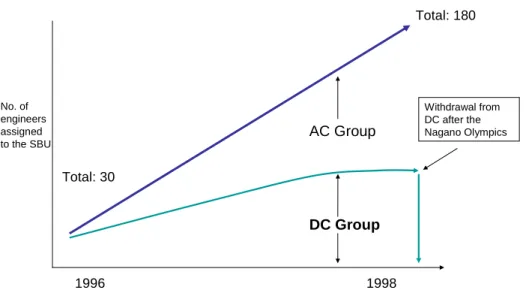
The SBU started with a staff of about 30 individuals, but swelled to about 180 just before the
Nagano Olympics in February 1998. The SBU was responsible only for the development of the panel
module, not for the development of the image-processing circuitry necessary for the TV sets. Rather, the
image-processing circuit was developed by the TV business division at MEI. Including this section, the
number of staff members engaged in plasma TV development just prior to the Nagano Olympics was
about 500.
This extraordinary increase raises the question as to why Matsushita made a commitment to PDP so
suddenly. The reason was its contract with NHK, an extremely important customer for Matsushita.
In the beginning of 1997, the TV division of MEI agreed to supply 30,000 units of 42-inch DC PDPs
for the Nagano Olympics. However, it soon became clear that supplying 30,000 units was out of the
question and the number was reduced to 3,000. Even so, this number was also too difficult to achieve. In
the end, Matsushita was able to supply a mere 88 DC plasma TVs to NHK. These drastic reductions
reflect the degree of difficulty involved in the development and manufacture of color DC displays.
According to Okumura, at that time there were three issues regarding the commercialization of DC
PDPs22
22
Interview with Mr. Okumura on March 26, 2007 .
20 The first issue was the inability to achieve sufficient luminance. In estimates at that time, DC
displays were able to achieve only around 130 candelas. In contrast, the AC-type achieved 450 candelas.
The second issue was the high electricity consumption of the DC type, which required more than
1KW. This was due to its poor efficiency in converting input electricity into light. Consequently, a lot of
electricity was required to produce an image with sufficient brightness, which also generated
considerable heat inside the TV.
The third issue was related to mass productivity in terms of process yield and cost. With a large
number of elements and a complicated structure, it was difficult to raise the process yield and
consequently its cost was higher than that of AC. Because the AC had a striped rib structure it was easier
to join the front and rear substrates and align the parts to their correct positions. On the other hand,
because so much emphasis was placed on the picture quality of the DC, the joining of the front and rear
substrates required a higher degree of accuracy.
End of the Transition: Withdrawal from DC
These issues were identified during the parallel development of the AC and DC types from 1996 to
1997. The poor process yield and high costs of mass production made it clear that the DC-type was at a
disadvantage compared with its competitor - the AC-type, as illustrated by Matsushita’s inability to
supply the promised number of DC plasma TVs to NHK at the time of the Olympics. According to Endo,
even after investment in about 2,000 glass substrates, good quality panels could not be produced.
Although these issues were not very serious at the trial production stage, they became more serious at
the stage of mass production. The last piece of the DC jigsaw puzzle - mass production - was still
missing.
In contrast, the last missing piece of the AC jigsaw puzzle was found. Engineers from the TV
business division tackled the problem of picture quality, particularly the contrast problem, and achieved
21 further improvements thanks to the technology of Plasmaco’s ramp patent. As a result, picture quality on
a par with the DC-type was achieved. Of particular note was the discovery that a large number of
neutrons were produced by changing the direction of the crystalline orientation through a method of
manipulating the MgO (magnesium oxide) protective layer. This was the area that had not been
scientifically developed and had not been explored sufficiently.
The question then, is who made the final decision to settle on the AC-type and at what point this
decision was made. The author has found no evidence indicating that a specific person made a top-down
decision to choose AC. A more logical conclusion is that a common understanding gradually emerged
regarding the limitations of the DC type mass production during the engineers’ all-out efforts to supply
DC for the Nagano Olympics. A consensus gradually developed within the company to produce the DC
for the Nagano Olympics due to the contract with NHK, but to develop the AC for mass production. A
shift in technological strategy from the DC to the AC had emerged.
The change in the ratio of management resources allocated to AC and DC development within the
SBU reflects this shift. According to Endo, in contrast to the approximate 80% of human resources
engaged in DC development at the time of the establishment of the SBU, the ratio of human resources
for DC and AC was about fifty-fifty at the time of the Nagano Olympics23
. During the period of
operation of the SBU, the allocation of management resources tended away from DC toward AC as AC’s
share of resources rose from 20% to 50% (Figure 4).
Figure 4. Changes in the Allocation of Management Resources (Insert)
After the Transition in Technology
When the Nagano Olympics ended in February 1998, so too did the period of parallel development
of AC and DC. Thereafter, Matsushita focused its management resources solely on AC development. In
22 August 1998, Matsushita formally established a PDP business division unit (BU) and moved ahead with
the full-scale commercialization of the AC plasma television.
As mentioned earlier, the business division is the final stage in organizational evolution at
Matsushita when it turns a new business into a viable commercial enterprise. To convert the SBU into a
working business division, indirect divisions such as personnel and accounting were added to it. The
PDP business division is an organization under the direct control of the CEO. With MEC and the TV
business division of MEI at the core of the PDP division, plasma TV products were established and mass
production undertaken. Initially the staff lineup including production workers was less than 100 people24
By 2000 to 2001 the staff had grown to about 200 individuals in total, and a system to get PDP
operations in full swing was established. A system was put in place for image technology to be
developed by the TV business division at MEI, with the panel modules to be supplied by MEC and
component manufacturers. At that time, MEI cooperated with Toray Industries, Inc. in the rear substrate
technology, and in 2001, a plant dedicated to mass production was opened in Ibaraki City, Osaka.
Internal cooperation within the Matsushita group and external cooperation with the component
manufacturers including Toray meshed together smoothly and the PDP business was operating at full
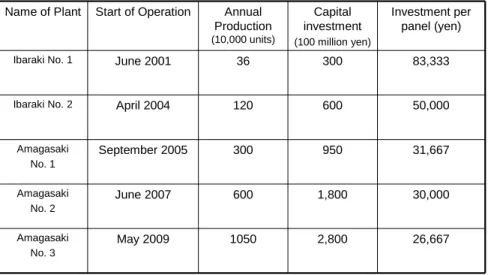
swing, as shown in Tables 3. The PDP business became a great success, and the main reason for the
V-shaped recovery achieved by Matsushita Electric Industrial Co., Ltd.
.
Matsushita produced its first commercial AC plasma TV, a 42-inch model, in December 1998. Since
Fujitsu had introduced its first AC plasma TV to the market in 1996, Matsushita was lagging behind by
about two years.
Table 3. Overview of MEI’s Major PDP Plants (Insert)
5. Findings and Discussion
24
23 There are obvious limits to what can be inferred this single case analysis. But the wealth of detail
available in this case should provide insights and findings relevant to the technical transition process
(Rosenbloom, 2000). Based on the case analysis, the author wishes to discuss the three research
questions mentioned earlier. The first issue is to discover how MEC was unlocked from DC and how the
transition was initiated. In this regard, the following findings and discussions can be drawn from the case
study.
Breaking MEC’s path dependency through leverage of MEI
At the time, MEC was locked into DC due to 2 central factors - the accumulation of DC
monochrome PDP technology and its commitments to NHK, a major customer (Christensen, 1997).
NHK had pursued DC development from the 70’s, and because MEC had a joint DC development
contract with NHK, the company also continued with DC development. Therefore, the circumstances
that enabled MEC to break away from its binding obligations must have been deciding factors at the
outset of the technological transition.
MEC did not embark on independent evaluation of the emerging AC systems or engage in
development, since as is pointed out in the existing research, the company had become dependent on its
own accumulated DC technology and the adaptations required for technological transition were delayed
(Tushman and Anderson, 1986; Leonard-Barton, 1992). Instead, it was MEI, the TV set assembler, that
became the center for the AC evaluation and development.
For instance, it was Wani in middle management at MEC who felt most keenly that the picture
quality of the AC models had closed in on DC through adoption of the ADS system invented by Shinoda
of Fujitsu. Commenting on the quality, Wani remarked, “I feel that it (AC) has reached an extremely
high level of completion.” However, exploration and evaluation of AC had not occurred within MEC.
Through instructions from Masaharu Matsushita, then chairman of MEI, evaluations of the AC
24 exploration and evaluation of AC.
Unencumbered by the path dependency problem, MEI became the driving force behind the
technological transition process to the AC system. It was also desirable for MEC, responsible for
display technology, to break away from the forces of path dependency although as a different company
with organizational separation from MEI, the TV set manufacturer. Path dependency causes
organizational lock-in (Teece, Pisano and Shuen, 1997) and therefore participation from an autonomous
company like MEI is an ideal solution. Had both departments been merged, both departments would
have probably become path dependent. By separating the organizations it was possible to quarantine
MEC, the company locked into DC, and begin AC evaluation and development centered at MEI hence
avoiding the path dependency issue.
However, in actual plasma TV development, it proved to be more effective to have the TV set
section and display panel sections integrated into a single organization, and so in ’98 the departments
were merged to create the PDP division, then in 2003 affiliated with AVC Networks (Panasonic)
enabling closer information exchange and regulation. This was found to be necessary upon consideration
of the product characteristics of plasma televisions, and streamlined the television design process by
enabling unified participation from both departments.
CRT tubes make use of electrons flowing through a vacuum subjected to magnetic and electric
fields to form the image on the screen, whereas image processing circuits make use of semiconductors
through which the electrons pass25
25
statement in this paragraph is based on the information provided by Mr. Nagaoka via e-mail on February 6, 2010
. Since the CRT tubes are completely different from the image
processing circuits both physically and technologically, individual engineers are able to work on designs
separately. This is because in the case of the plasma TV, the semiconductor technologies used for pixel
scanning and drive have similar characteristics to those used for image processing and it is not easy to
draw a line delineating these. A useful approach is to think of these as interdependent. For instance,
25 in video signal to also participate in display panel improvements.
Existing research has clearly shown the existence of congruous relationship between the
organization and the product from several viewpoints (Woodward, 1965; Perrow, 1967; Henderson and
Clark, 1990; Christensen, 1997). This is the reason the display device department and the TV set
department were merged, although as a company approaches a technological transition it is not the
merging of departments, but division that is required to break free from the forces of path dependency.
This means that there must be alternating organizational merging and division in response to changing
circumstances. The ability to integrate and reconfigure competencies to address such changes is the
essence of dynamic capability (Teece, Pisano, and Shuen, 1997). The next issue is why and how MEG
was able to produce a proprietary AC panel that is superior to other companies’ products.
In answering this question, this paper suggests the evolution of the relationship between AC group
and DC group lead to an eventual creation of what is known as a “Ba” within the SBU. Ba is a Japanese
concept that was introduced as a foundation for knowledge creation (Nonaka and Konno, 1998). The
following findings and discussions can be drawn from this case study.
Transcending the AC or DC dichotomy through building a “Ba”.
From the organizational point of view, it is important to consider how to design organizational
relationships and linkages between existing accumulated and new technologies. Should these be
separated or integrated? Researchers differ on how to design organizations to adopt technological
transition.
One viewpoint argues for autonomous design separating the new technology from accumulated
technology, because inertia, resource allocation pressure and strong exploitative biases prevent
companies from innovating new technology (Foster, 1986; Christensen, 1997). Therefore, innovators
should be autonomous to establish a separate context.
26 (Brown and Eisenhardt, 1997; Iansiti, 1997), because internal resources and capabilities are the
foundation for competitive advantage.
Previous studies implicitly regarded the nature of the relationship of the two divisions as static. This
paper suggests the desirability of adjusting the degree of divisional separation and integration according
to the progress of the transition, rather than considering the arrangement as fixed. This means that the
relationship of the two divisions must be separate at certain times and integrated at other times to
appropriately accommodate the various stages of progress during the transition.
During the evaluation period from 1994 to 1995, the development of DC technology was undertaken
mainly at MEC while the development of AC was undertaken at the Matsushita Central Research Labs at
MEI. According to surveys conducted by the author, these divisions were independent. Although both
were part of the Matsushita group, there was no indication that knowledge sharing or technical transfers
took place at that time.
When MEG reached the stage of forming an SBU for commercializing the technology with the
acquisition of Plasmaco in 1996, the level of integration of the two groups increased. The AC and DC
groups existed concurrently within the SBU. Existing barriers to knowledge sharing between the two
were intentionally eliminated and the exchange of knowledge was encouraged. Efforts were made to
create a common platform for both the AC and DC technologies by trying to make the elemental panel
structure technology and methods of construction common to both.
As a result, the AC technology developed by Matsushita proved to be superior to that of other
companies in terms of mass production and cost. Commenting on this achievement, Endo, who
supervised the SBU as the sub-project leader stated, “We tried to eliminate the barriers to knowledge
sharing and we were able to develop a product that incorporated the advantages of both technologies. 26 In other words, MEI went beyond the dimension of simply making effective use of existing
technology and succeeded in creating synergistic effects between the DC and AC technologies. Through ”
26
27 building a “Ba” (Nonaka and Konno, 1998) within the SBU, MEI successfully transcended the
dichotomy between the AC and DC systems and succeeded in knowledge creation.
A “Ba” is a place offering a shared context. Knowledge needs a context to be created, as it is
context specific (Nonaka and Takeuchi, 1995). The context defines the participants and nature of
participation. The context is social, cultural and even historical and provides a basis for people to
interpret information and hence create meaning that becomes knowledge. Participating in a Ba means
transcending one’s own limited perspectives or boundaries and contributing to a dynamic process of
knowledge creation (Nonaka and Konno, 1998; Kodama, 2007). Therefore, Endo made efforts to build a
Ba within the SBU by eliminating barriers to knowledge sharing. In the SBU, members who possess
different values and knowledge consciously created the shared context of the Ba and used it to transcend
the dichotomy between AC and DC27. In this way, the relationship between the existing and new divisions can be considered as evolving as the technological transition progresses, and finally reaching
the creation of the Ba (Figure 5).
Figure 5. Evolution of Organizational Relationships during the Transition Process (Insert)
The final issue is to evaluate how the transition process was brought to a conclusion. The Following
findings and discussions can be drawn from this case study.
Emerging common understandings about the limitations of existing technology through the selection mechanism
27 By examining the Japanese character of “Ba” (Bennett, 2001) reported as follows: ‘The top right character represents the sun; the character on the left the earth; and the bottom right (loosely) “rays of light falling to the ground”. Thus to the Western (though not the Japanese) eye, Ba is interpretable as “a place of illumination”, where the sun and the earth unite and enlightenment happens’.
28 Whether the process is slow or rapid, a technological transition comes to an end with the complete
withdrawal from the existing technology. This eventually happens as management resources are
gradually shifted away from the existing to the new technology.
There are also potential difficulties in achieving a smooth withdrawal, as is highlighted by the
example of Intel’s withdrawal from its DRAM technology (Burgelman, 1996; Burgelman, 2002; Grove,
1996), which was due primarily to engineers’ dependency on the existing technology and their resistance
to change.
The MEG case is similar to the Intel case in that there were a number of incompatibilities between
the existing and new technologies. The difference between MEG and Intel is that the former finally
achieved a smooth withdrawal from DC while the latter met with strong resistance from engineers even
after the official announcement by top management.
Because engineers generally have a strong commitment to the technology they are involved in, it is
often hard for them to recognize its limitations. Nevertheless, what made this realization possible at MEI
was the emergence of common understanding of these limitations during development for Nagano
Olympics. MEG had a contract with NHK to deliver 30,000 units for the Olympics, but in the end failed
to do so. During the development process to fulfill this commitment, engineers were aware of the
limitations of the DC system, which in terms of mass productivity was far inferior to the AC system.
Kano, who led DC development at MEC said, “At this stage, we strongly believed that the AC
technology was definitely the path that the Matsushita group should take” (Kano, 2008).
The efforts the company made to fulfill this commitment revealed that the DC system was inferior to
its AC counterpart and acted as an internal selection mechanism (Burgelman, 1991; Burgelman, 1994)
within the company. To make the selection mechanism feasible within the company, it was essential to
establish an evaluation dimensionality, and this need was filled by NHK’s order for 30,000 units for the
Nagano Olympics. The “Nagano Olympics” acted as a time frame, and the “30,000 units” was the scale
29 taken a considerably longer period of time for engineers to reach a common understanding regarding the
limitations of the DC technology. From this it can be seen that the establishment of an appropriate
evaluation dimensionality is effective in initiating an internal selection mechanism based on a shared
understanding of the limitations of a technology.
We confirm that these successful processes can mitigate the specific obstacles to technological
transition identified in the previous studies. The first obstacle, over-adherence by a corporation to its
own resource base, was mitigated with help of MEI. MEC and MEI had different backgrounds and hence
were not locked in onto the same technological trajectory. MEC had a long history in DC technology,
and had not explored or evaluated the AC technology. The initiative for transition to AC came from MEI,
outside MEC, mitigating the first obstacle. Also, the second obstacle, corporate bias toward listening to
existing customers, was mitigated through the parallel development mechanism involving both the DC
and AC groups, because the existing important customer, NHK, was in close cooperation with only the
DC group, whereas the AC group was free from bias due to that existing customer. Similarly, this
parallel development mechanism can mitigate both the third and fourth obstacles, because effects
brought about by existing architecture knowledge and cognitive representations were confined within the
DC group, which was isolated from the AC group.
6. Implications and Conclusions
Some of the findings that we have offered may not be entirely unique. However, we submit that the
major contribution this paper makes is that it reveals the following finding - that during the process of
parallel development, MEG’s successful integration of the advantages of both AC and DC technologies
helped it to overcome the dichotomy between the AC and DC systems. This finding is insightful for
managers as well as academics. In this section, we will discuss the implications for parallel development
of existing and new technologies.
30 technology and a new technology. The only ways to get past this quandary and transition to the new
technology are to either abandon the existing technology or to have full confidence in the future
potential of the new technology. The problem is that it is practically impossible to have full confidence
in the future potential of a new technology initially (Foster, 1986).
For this reason, companies normally tend to continue current technology development in parallel
with new technology development (Shibata and Kodama, 2008). Parallel development has the advantage
of offering more than one option and thus allows decision making to be postponed until the level of
uncertainty surrounding the new technology has been sufficiently reduced, but carries with it a risk due
to consumption of extra business resources. Therefore over the long term, parallel development can lead
to weakened corporate capability due to resource investment in more than one technology (Shibata and
Kodama, 2008). Hence, the difficulties with parallel development lie in resolving this trade-off.
We often look at decisions as series of either-or propositions, of trade-offs. This is the same for
parallel development of existing and new technologies. Usually the question is simply whether to select
the existing or the new technology, but this paper shows that there is a way to integrate the advantages of
both technologies without cancelling one of the developmental programs.
MEG was able to successfully develop a superior AC system by merging the strengths of both the
AC and DC technologies. In other words, the AC and DC parallel development undertaken by MEG did
not lead to the company having to choose one technology over the other, but brought about a synergy
between the two systems. The AC and DC groups were located in geographically different locations, and
even in this type of separated environment the two groups were able to form a “Ba” to overcome this
limitation and promote mutual interaction. What types of managerial strategies made this possible? The
author would like to make the following two points in answer to this question.
The first point is that a common driving objective was set for both groups. To drive the knowledge
31 Konno, 1998). At the time, the AC group objective was superiority over other companies’ products
through the commercialization of the AC system. On the other hand, the DC group had a commitment to
NHK to exhibit 3000 (revised down from 30,000) DC televisions at the Nagano Olympics, and since
fulfilling this obligation was MEG's number one priority, the DC group pushed forward towards this
objective. At a glance, it appears that although in the same SBU, the AC group and the DC group were
working towards differing objectives. However, since both groups were working towards the
commercialization of television apparatus to succeed the old CRT technology, both groups did in fact
have a common objective. Forming a common driving objective was made possible by a single
supervisor - Endo - who oversaw both the AC and DC groups. He had the following to say regarding this
point:
“It may have appeared that there were differing objectives within the SBU, but as the successor
product to the CRT television there was no disagreement that the overall aim was to develop and
commercialize the plasma TV, regardless of whether it was to be the AC or DC type28
The second point is the flexible approach taken to allocate resources between the AC and DC groups
based on such a driving objective. Sub-project manager Endo was able to make this possible from his
position as manager of both of the groups. All the AC and DC developmental states were reported
directly to Endo, who then expediently and flexibly performed managerial resource allocation on a
monthly basis. Endo said the following:
.”
“Although there was segmentation between the AC and DC groups, I always maintained a flexible
approach to monthly personnel temporary assignment based on needs. Ensuring this flexibility was of
utmost importance, and is the major reason I was able to fully grasp the AC and DC development by
myself 29
Having substantive and autonomous authority required for personnel dispatch vested in one person
is a critical point. This enables a flexible and adaptive approach to constantly changing circumstances. ”.
28
Information provided by Mr. Endo via e-mail on February 22, 2008.
29
32 It is a fact that there were many technological elements common to both the AC and DC
developments, although that is not to say that the synergy between the AC and DC groups occurred
naturally. For that to happen, clear-sighted intentions and management were necessary. Especially since
engineers have to commit to the technology to which they are charged, it is normally impossible for
them to consider such synergistic effects with the competing technology. For these reasons, the debate
surrounding parallel development tends to fall into an argument about whether to choose the existing or
the new technology. As a result, corporations are faced with the dilemma of having to decide whether to
continue with an existing technology or move to a new one. In contrast, this example shows that it is
possible to overcome such and impasse and choose a 3rd route, which is not a clear-cut choice of two options, but an integration of them.
This paper provided a detailed analysis of MEG as a single case study and extracted several findings
and discussions. The major limitation of this study was the derivation of the findings from the analysis
of only one company. To confirm the universality of these findings, it will be necessary to broaden such