HOUSEHOLD WASTE MANAGEMENT IN INDONESIA: What
is an effective means to household waste
reduction in Indonesia?
著者
Anjani Annisa
学位授与機関
Tohoku University
MASTER THESIS
HOUSEHOLD WASTE MANAGEMENT IN INDONESIA:
What is an effective means to household waste reduction in Indonesia?
Annisa Anjani
A9GM5201
TOHOKU UNIVERSITY
JULY, 2011
i
HOUSEHOLD WASTE MANAGEMENT in INDONESIA:
What is an effective means to household waste reduction in Indonesia?
ANNISA ANJANI
A9GM5201 TABLE OF CONTENTS Table of content ... i List of Tables ... iv List of Figures ... v Chapter 1. INTRODUCTION 1.1 Background of the study ... 11.2 Objectives ... 7
Chapter 2. FRAMEWORK OF THE STUDY 2.1 Previous study on household waste management in developing Countries ... 8
2.1.1 Sustainable Development in Malaysia: A case study on Household Waste Management ... 8
a. Topic of the research ... 8
b. Research Method ... 9
c. Conclusion ... 10
2.1.2 How essential is Community-based Solid Waste Management in Periurban Indonesia? Study case: Jakarta Periurban Areas ... 10
a. Topic of the research ... 10
b. Conclusion ... 11
2.2 Characteristic of the study ... 11
2.3 Theoretical framework of the study ... 12
Chapter 3. CURRENT CONDITION OF HOUSEHOLD WASTE in INDONESIA 3.1 Data and analysis ... 19
3.1.1 Introduction on waste in Indonesia ... 19
a. Waste generation... 19
3.1.2 Current condition on household waste in Indonesia ... 25
ii
b. Temporary disposal site ... 28
c. Waste transportation vehicle ... 28
d. Final disposal site ... 29
e. Waste treatment facility ... 29
f. Recycle activity ... 30
3.1.3 Waste management in Indonesia ... 32
a. Waste management authority ... 32
b. Financial aspect ... 34
c. Public participation ... 35
d. Regulation ... 36
3.2 Conclusion ... 37
Chapter 4- LEGAL BASIS OF WASTE MANAGEMENT POLICY 4.1 Legal basis ... 40
4.1.1 Introduction ... 40
a. Waste related Law before Waste Management Law No 18 2008 ... 42
4.1.2 Basic Law ... 48
a. Background of the law ... 48
b. Waste management law and its content ... 50
c. Aim of the waste management policy ... 55
4.2 Reference: Waste Management Regulation in Japan ... 56
4.3 New Targets on waste management policy ... 62
4.4 Principles concerning actor concern in implementing waste management policy ... 63
4.5. Conclusion ... 64
Chapter 5- THE POSSIBLE WAYS OF HOUSEHOLD WASTE REDUCTION IN INDONESIA 5.1. Introduction ... 66
5.2. Consideration to the possibility of waste reduction in Indonesia ... 74
5.2.1. Public Administrator ... 74
5.2.2. Manufacturer as producer ... 76
5.2.3. Citizen as consumer ... 78
5.3. One of methods to household waste reduction in Indonesia ... 78
iii
5.3.1. Economic measures (charge) for waste discharge (collection) from free to
fee based ... 83
5.3.2. A commission of waste disposal is free charge ... 86
5.3.3. A commission of waste is fixed on charge or flat rate system... 88
5.3.4. A commission of waste disposal is a specific duty ... 89
5.3.5. Case of Sendai city, Miyagi Prefecture, northern part of Japan for waste collection system ... 91
5.4. Conclusion ... 92
5.4.1. Current condition of household waste in Indonesia ... 93
5.4.2. Waste management policy in Indonesia ... 94
5.4.3. Economic measure is an effective means to reducing waste in Indonesia at the present stage, about its theoretical ground ... 95
REFERENCES... 98
iv
LIST OF TABLES
Table 1-1 Waste generated by province ... 4
Table 3-1 Estimation of total waste in Indonesia ... 20
Table 3-2 Estimation of waste by province, 2000-2007 ... 21
Table 3-3 Estimation of waste generation by composition ... 23
Table 3-4 Estimation of people served ... 25
Table 3-5 Estimation of Total Amount of Temporary disposal site ... 28
Table 3-6 Estimation the number of waste transportation truck Amount ... 28
Table 3-7 Number of still used TPA (Final Disposal Site) ... 29
Table 3-8 Total of Expenditure ... 34
Table 4-1Population in Indonesia ... 49
Table 4-2 Law of promotion of effective reused of resources in 2000 ... 57
Table 4-3 Act on promotion of sorted garbage collection and recycling of containers and packaging ... 58
Table 4-4 Food Waste in 1966 in Japan ... 58
Table 4-5 Legislation to automobile recycling ... 59
Table 4-6 The target of recycling of used car ... 59
Table 4-7 Home appliance recycling ... 60
v
LIST OF FIGURES
Figure 1-1 Waste’s relationship with the sustainability ... 2
Figure 1-2 Waste generation by source in 2006 ... 5
Figure 2-1 Theoretical framework of the study ... 13
Figure 3-1 Flow chart of waste ... 17
Figure 3-2 Estimation of waste generation based on top five major provinces 2000-2007... 22
Figure 3-3 Estimation of total waste generation in Indonesia, 2000-2007 ... 22
Figure 3-4 Waste generation by source in 2006 ... 25
Figure 3-5 Estimation of Waste Quantity Collected by Local Government ... 26
Figure 3-6 Estimation of waste handling systems after waste collected by community from housing area ... 27
Figure 3-7 Number of treatment facilities ... 30
Figure 3-8 3R activities conducted by municipality ... 31
Figure 3-9 Employee involved in waste management authority ... 32
Figure 3-10 Private party involvement... 33
Figure 3-11 Base of retribution rate ... 35
Figure 3-12 Retribution billing system ... 35
Figure 3-13 Public participation ... 36
Figure 4-1 Relation between waste management policy and treatment of waste ... 41
Figure 4-2 Waste composition by item in Japan ... 56
Figure 4-3 Flowchart of used home appliances ... 61
Figure 4-4 Organizational structure of Ministry of Environment (MoE) ... 64
Figure 5-1 Waste management hierarchy in Indonesia ... 70
Figure 5-2 Waste management hierarchy suggestion for Indonesia ... 70
Figure 5-3 Relation between stakeholder, law and reduction ... 78
Figure 5-4 Flowchart of the relation between resources an economy ... 81
vi
Figure 5-6 A commission of waste disposal is free charge ... 87 Figure 5-7 A commission of waste disposal is a specific ... 89
1 CHAPTER 1 INTRODUCTION
1.1 BACKGROUND OF THE STUDY
Ecosystem is place which give material depot, providing services and also as a waste repositories to human. Besides, ecosystem also has some function for provision of resources including food, fiber, water, provision of Eco-services such air and water purification, climate control, nutrient cycling, and soil production. The most important function of the ecosystem is our living space. But human sometimes do not really care about their ecosystem. They exploit ecosystem and generate waste. That could be deteriorating ecosystem and raises environmental issues.
Constructing a safety, stable and sustainable society is one of the basic tasks of environmental issues. These basic tasks contain increase of energy demand, increase of waste, increase of water and food demand. All are caused as the result of continuous population growth, also increase of social development and economic activities of human being. Along economic development, population growth and change in production and consumption patterns, waste has steadily increased and expected will continue increasing during the next few decades.
Household waste is a major concern because household waste represents a valuable source of resources such material and energy and at the same time, it is also a source of pollution and environmental degradation when treated inappropriately.
As figure 1-1 explains the relationship between waste, sustainability and environment. Waste causes damage on environment if treated inappropriately. It is also threatening the foundation of human survival and human livings, it has significant impact on human health as well. Our life, livelihood and community will be plunged in a crisis, this is a result of destruction of human survival and human livings such destroying natural resources, like soil, water and air. If untreated wastes are discarded
2
in soil, water or polluted air it will give bad effects, such as sluggish production activity, a consequent shortage in food, and will damage of living environment.
It is also result in the destruction of ecosystem such the ecological service functions as essential needs of life. How to treat them is the urgent task for us.
Figure 1-1. Waste’s relationship with the sustainability Untreated waste
Water pollution
Food and water shortage Sluggish production activity Damage on living environment Air pollution Health hazard to human Damage on living environment Soil pollution
Food and water shortage Sluggish
production activity Damage on living
environment
Destruction of human survival and human livings
Instability of the lives and livelihood of individual human beings
3
It is coherent need to environmental policy, legislation, institutional structure, and community participation.
One of my reasons to choose waste’s discussion is that waste issue is a problem facing the world, whether advanced or developing countries and there is connection between waste with social economic aspect. Increase of waste, both, industrial and household waste is the result of the economic development and population growth.
There are various understanding of waste. Waste has been described as “useless remains”. (Concise Oxford Dictionary). Waste as general is a by-product of human activity. It is material that is abandoned or discarded because the person who has it or owns it or is in position to extract value from it chooses to rid himself of it. [5]. Whereas according to Waste Management Law no 18/ 2008 concerning waste management, waste is the rest in everyday human activities and natural processes that have the shape or solid. Waste is found in urban area which in solid form called urban solid waste, municipal solid waste or household waste. Urban solid waste is called municipal solid waste (MSW) because the municipality, the governmental authority at the local level due to its proximity to the site of waste generation, is considered best placed to collect it for the purposes of disposal [5].As economic conception, waste is produced as the result of natural resource consumption, so the ways to cope with this issue are focused on reducing its amount, recycling and reusing it as much as possible. In my study I consider waste as one form process of transformation of matter and also try to study the possibility that we put away the concept of waste, it is means that we should change our thinking of waste, look at waste from different angle as reusable substances, not just set up and useless corps, ending up in the garbage. Here, I would like to introduce the idea of ‘resource productivity’ and increasing the resource productivity. This means keeping consumption of resources as raw materials
4
at the lowest level, maintaining products obtained by transformation of materials and utility, also the volume of work obtained from its transformation process constant.
I take research site in Indonesia because the population growth in Indonesia is one of the highest in ASEAN countries, about 235 millions and growth rate of 1.3% per year based on the central statistic agency. In 2008 Indonesian population is increase in most major city in Indonesia, based on data source from Ministry of Environment. The population growth brings about the increasing amount of the waste which becomes a problem facing the government also it has created poor environmental living conditions that significantly affect sanitary conditions.
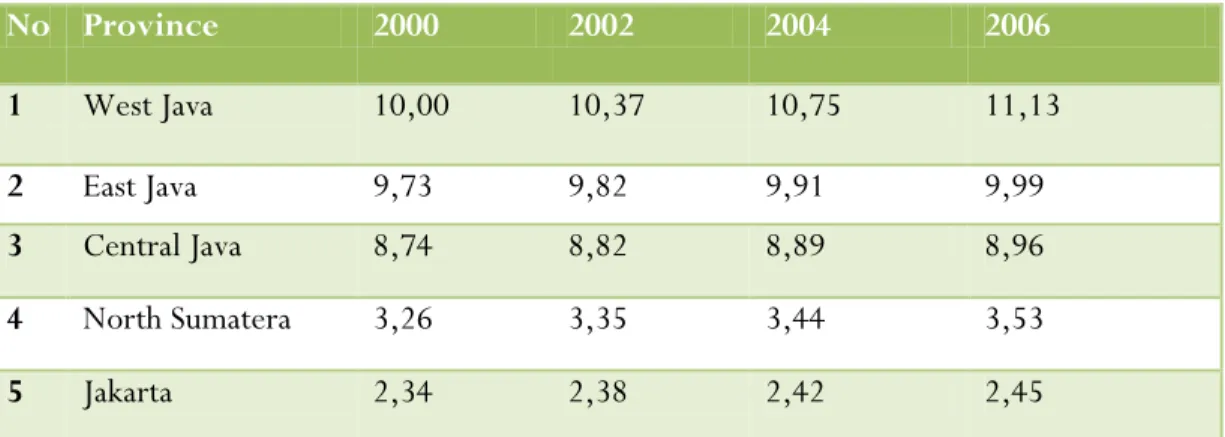
No Province 2000 2002 2004 2006 1 West Java 10,00 10,37 10,75 11,13 2 East Java 9,73 9,82 9,91 9,99 3 Central Java 8,74 8,82 8,89 8,96 4 North Sumatera 3,26 3,35 3,44 3,53 5 Jakarta 2,34 2,38 2,42 2,45
Source: Environmental Status of Indonesia 2008, p. 131, Ministry of Environment (MoE) 2008
Table 1-1 shows total amount of waste in Indonesia is increasing about 2-4% per year. In FY 2000, total amount of waste is 57,44 gigagram, then become 62,97 gigagram in 2007. Data from Ministry of Environment explained that the highest volume of waste is in West Java, then follows East Java, Central Java, North Sumatera and Jakarta.
5 Figure 1-2. Waste generation by source in 2006
43% 20% 8% 6% 9% 9% 5% households markets office industries public facilities street others
Source: Ministry of environment (MoE), 2006
From the figure 1-2 we can see that the most of waste generated is household waste reaching 43% of total waste generation by source, then followed by markets waste, street and public facilities waste, office waste, industries waste and other. It is also the fact that household waste needs handling properly.
But, there are no proper activities in handling it so many wastes that is not transported. There are other limitations and obstacles dealing with the waste management, including limited budget for waste management because of the low rate of private investment. And there was no waste national policy until 2007 describing concepts, aims, and measures in national waste management [1]. The new regulation for waste management, Waste Management Law No.18/2008 concerning waste management has been recently issued by the management policy. The latest waste policies are related to waste management and recycling which is new in waste policies in Indonesia, it can be an indicator that the Government is starting to concern about the waste problem and try to solve the problem regarding waste.
6
Manage waste is not just discarding it to landfill, but also should be processed and separated from the source. In accordance with Waste Management Law No.18/2008 concerning waste management which put forward the principle of 3Rs, reduce, reuse and recycle. To overcome the problem the integration of all parties, government, citizens and private will be required. The most important thing is changing the paradigm that garbage is not something that is useless but can also have economic value.
In this research I focus my topic on waste management, especially household waste management in Indonesia. Then in this research I also analyze about the effectiveness of economic measures in order to reduce waste and awaken waste awareness of citizens.
Thesis consists of five main chapters:
1.
Chapter 1, Introduction:This chapter explains about my background of the study.
2.
Chapter 2, Framework of the study :This chapter explains about framework of the study. Give some data about previous study and explain characteristic of the study.
3.
Chapter 3,Current condition of household waste in Indonesia:This chapter explains about current condition of household waste in Indonesia. Statistical data being used here, about current condition in Indonesia refers to data released by Ministry of Environment. I also put case study in Japan regarding household waste treatment.
4.
Chapter 4,Legal basis of waste management policyThis chapter explains about legal basis of waste management policy being applied in Indonesia, Waste Management Law No 18, 2008.
5. Chapter 5, Theoretical Rationalization
This chapter explains about the possible way to reduce waste in Indonesia at the present stage, how the concerned parties participate in reducing waste and also try
7
to analyze from economic point of view about what is an effective means to reduce waste in Indonesia.
1.2. OBJECTIVES
The main objective of this study is to analyze influence of economic force in order to awaken citizen’s awareness and reduce waste.
To reach the main objective, there will be some question to be considered, they are: 1. How is current condition of household waste in Indonesia?
2. How is the waste management policy in Indonesia?
3. What is an effective means to reducing waste in Indonesia at the present stage? Is an economic measure is the effective means to waste reduction: About its theoretical ground.
References
1. Meidiana, C., Thomas G. Development of Waste Management Practices in Indonesia.
European Journal of Scientific Research, Volume 40 No 2 (2010), pp 199-210.
2. The World Bank, What a waste: Solid Waste Management in Asia. May 1999.
3. The Republic of Indonesia, State Ministry of Environment. Environmental status of
Indonesia.2006-2008.
4. Suyoto, Bagong. Fenomena gerakan mengolah sampah. 2008
5. Dhamija, Urvashi. Sustainable solid waste management. Issues, policies and structures. 2006. New Delhi, India.
6. The Republic of Indonesia, State Ministry of Environment. Waste Management Law No
8
7. Setiawati, Indah. Gov urges community to apply waste management. The Jakarta Post 27 March 2010.
CHAPTER 2 FRAMEWORK OF THE STUDY
2.1 PREVIOUS STUDY on HOUSEHOLD WASTE MANAGEMENT in
DEVELOPING COUNTRIES
2.1.1 Sustainable Development in Malaysia: A case study on Household Waste Management.
Author: Dr. Md. Abdul Jalil,
“Department of Business Administration, Faculty of Economics and Management - International Islamic University of Malaysia”
a. Topic of the Research
This research focuses on household waste management with the concept of sustainable development. Sustainable development is a concept which is originated in the 1970s when developed world undertook massive development project in terms of cutting and clearing forests and constructing high rising buildings and spacious highways. This concept began to think about in the 1970s then brought to Brundtland Commission Report in 1987 by United Nations. Sustainable Development defines as development which meets the needs of the present without compromising the ability of future generation to meet their own needs (Brundtland Commission Report, 1987).
One cause of waste problem in a country, including Indonesia and Malaysia is due to increasing population. With the increasing population, the consumption activities that generate waste also increased. It is required the handling of government and community participation in household waste issues.
There is drastically increase on waste every 10 years in Malaysia since 1970 until 2006 and organic waste has the biggest amount on waste generated in Malaysia.
Malaysia government made some way in addressing the waste problem. Until the late 1970s they used simple way to manage the waste, at that time the local
9
district health offices only clean up the streets of waste and was brought to the open dumping facilities have been provided.
Along with increasing waste generated later in the 1990s, government takes the initiative to privatize the handling of waste management. In addition, the government also conducted a campaign to Malaysian society about cleanliness and public health such about waste and its problems. The objective of privatization is providing an integrated, effective, efficient, and technologically advanced solid waste management system.
But without public participation, the program will not be performing well. In 1988, the government introduced the Action Plan for a Beautiful and Clean (ABC) Malaysia, and recycling campaigns [1]. Campaign program is going well, which is marked by the results of a survey in 1999 that 59% of respondent were moderately aware with some basic knowledge and were mildly alert to the management of solid waste [1]. Campaign can be one tool to give sense to the public about the waste and its problem.
In order to manage solid waste in Malaysia, the Solid Waste and Public Cleansing Management Act 2007 (SWPCM Act 2007) was passed as law in 2007. The Act is administered by the Ministry of Housing and Local Government. This Act is focused on public cleanliness management through 3R (Reduce, Reuse and Recycle). Producing vermicompost is one of the way Malaysian to reduce the volume of organic waste.
b. Research Method
In this research, the author used descriptive and analytical research methodology to analyze data from books, journal articles, government working papers and laws on sustainable development.
10 c. Conclusion
There is some conclusion from this research:
1. The SWPCM Act 2007 gives the duty of the collection and disposal of waste to private organizations under license. It is duty of The Solid Waste and Public Cleansing Management Corporation to took after the acts of the private organizations.
2. The SWPCM Act 2007 also requires residents to separate non organic waste from the organic waste.
3. The SWPCM Act 2007 uses the 3R, Reduce, Reuse and Recycling.
4. Recycling of solid waste is very important and the recycling project has another benefit of producing compost or vermicompost from the organic waste. In this study, the author discussed the sustainable solid waste management through the implementation of 3R methods contained in the SWPCM Act 2007. And granting authority to the private parties to process organic waste into vermicompost is one form of private sector involvement in waste management.
2.1.2 How essential is Community-based Solid Waste Management in Periurban Indonesia? Study case: Jakarta Periurban Areas
Author: Adiyanti Sutandyo-Buchholz a. Topic of the Research
This research is discusses about community based solid waste management in periurban area in Jakarta. Because periurban area is burdened by urban waste as it is often used as disposal waste. Parties involved in solid waste collection scheme in periurban Jakarta are the communities in neighbourhood units, groups of waste collectors operating waste as micro-enterprises, and local administrators. The main problems faced by the periurban area are health and environmental consequences, lack of sanitation, unplanned
11
settlements and the surroundings areas of waste disposals. How the role of the community can improve solid waste collection system became the main objective in this study.
b. Conclusion
Conclusions of this research are:
1. Participation of community members in planned and unplanned settlements in periurban area plays an important role.
2. The involvement of all parties could take place if they would change their sanitary behaviour about ‘waste as resource’ instead of waste as a useless end-product.
3. If solid waste management in periurban area is built into a ‘compact integrated partnership’, maybe through a proper law, they could exercise political pressure on urban waste not to be excessively dumped into periurban areas. Government needs to pay attention to periurban areas that usually become a place which is urban waste’s dump. By giving them information about environmentally sustainable waste management will be able to change the paradigm that has been mentioned that garbage is useless remains. In addition, with proper waste management will create a healthy environment.
On several case studies, there is no writing that discussed or analyze about economic force and its relation to awaken citizen’s awareness and reduce waste. That is why the author gives a solution to waste reduction through economic measures.
2.2. CHARACTERISTIC OF THE STUDY
My research, titled household waste treatment in Indonesia: “what is an effective means to reducing waste?”. One of the theories is using the basic theory of resource productivity. The theory is one of four central strategies of natural
12
capitalism that are means to enable countries, companies, and communities to operate by behaving as if all forms of capital were valued. Natural capital includes all the familiar resources used by human kind: water, minerals, oil, trees, fish, soil, air, etc including life supporting system [2]. Natural capitalism recognizes the interdependency between the production and use of human made capital and the maintenance and supply of natural capital.
By using resources more effective, there are three significant benefits such it slows resource depletion at one end of the value chain, lower pollution at the other end, and provides a basis to increase worldwide employment with meaningful jobs. Not only use existing resources effectively but also increasing resource productivity by using less material and energy but still obtaining the same amount and energy.
So far in the industrialization that is used is human capital, financial capital and manufactured capital. The third capital changed its natural capital into something that can be efficient and have value.
On the previous study discussed about sustainable development by using Vermicompost as one way of good treatment. In this thesis I also analyzes whether or not the waste treatment could use economic measures as one effective tool for reducing waste in Indonesia at present stage that is my characteristic of study. In my opinion, now the time for us to reducing waste instead of treatment waste. Because waste generated per year is increasing. So, we should reduce the waste from the source before it discards to the disposal site and I try to analyze it from the economic point of view.
2.3 THEORETICAL FRAMEWORK OF THE STUDY
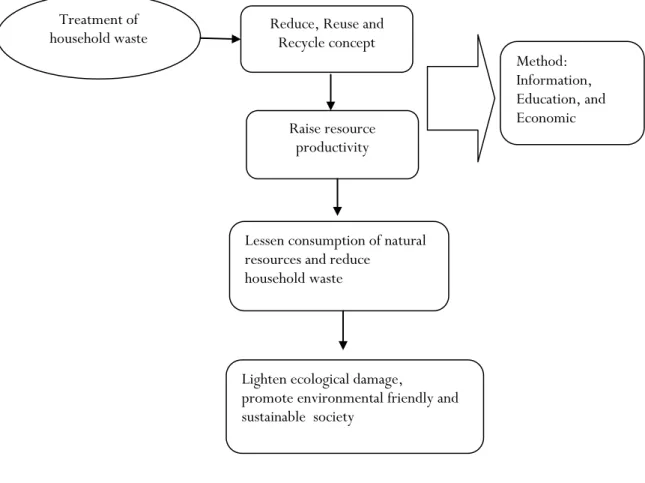
Handling of waste through reduce, reuse and recycle can increase the resource productivity. In this case the waste is something that has value in order to serve as a resource for other products. With the increase in resource productivity can reduce the use of natural resources and reduce waste. If that framework could be realized it
13
could lighten ecological damage, promote environment friendly and sustainable society.
Descriptive methodology has been applied in this research. The data from books, laws on household waste management and waste related law, government working paper and journal articles are analyzed.
Figure 2-1. Theoretical framework of the study Treatment of
household waste Reduce, Reuse and Recycle concept
Raise resource productivity
Lessen consumption of natural resources and reduce
household waste
Lighten ecological damage,
promote environmental friendly and sustainable society
Method: Information, Education, and Economic
14 References
1. Jalil, Dr.Md Abdul. Sustainable Development in Malaysia: A case study on Household
Waste Management. Vol 3 No.3 September 2010.
2. Hawke,Paul, Amory Lovins and L. Hunterlowis. Natural Capitalism. Creating the
next industrial revolution. 1999, p.2, p.4, p.10.
3. Sutandyo, Adiyanti, Buchholz. How is essential-based Solid Waste Management in
Periurban Indonesia, Study case: Jakarta Periurban Area. South East Asean-German
summer school 2005.
4. Arzumanyan, Georgi. Municipal Solid Waste Management in Armenia. Current Trends and steps forwards. 2004.
15
CHAPTER 3 CURRENT CONDITION OF HOUSEHOLD WASTE IN INDONESIA
Indonesia is an archipelago with a population of 237,56 million by the year 2010, according to central statistical agency. The population is increasing year by year with the growth rate 1.2 % per year (World Bank, 2009). The growth of population is uneven, but concentrated in urban area. By 2020, the estimated urban population in Indonesia will reach 50% of the total population. It means that activities carried out by citizen such as waste will increase too. Besides increasing population, economic development and urbanization also led the increase of waste. With economic development, the level of social welfare also improves and it affects the pattern of consumption that can lead to the increase waste of produced by community.
One of the environmental issues faced by Indonesia, therefore, is the problem of waste. We need to recognize what is waste, then what is waste management, how the waste is produced, also about the condition of waste in Indonesia, in order to handle the waste problems.
The first is about understanding of the waste:
Based Waste Management Law, waste produced by human is a result of residual activity from human and or natural processes that form solid. [1]
Solid waste is unwanted material, a by-product of production and consumption abandoned within municipal limits for whose safe disposal, government agencies are responsible. [2]
Waste according to the Basel Convention: Wastes are substances or objects which are disposed or are intended to be disposed or are required to be disposed of by the provisions of national laws.
Waste according to The United Nations Statistic Division: Wastes are materials that are not prime products (that is products produced for the market) for which the generator has no further use in terms of his/her own purposes of production, transformation or consumption, and of which he/she wants to dispose. Wastes may
16
be generated during the extraction of raw materials, the processing of raw materials into intermediate and final products, the consumption of final products, and other human activities. Residuals recycled or reused at the place of generation are excluded. Based on some understanding above, in my opinion waste is residual of living organisms in the form of solid or liquid which is not desirable, but along with an increasing amount of waste, it can be treated as the main raw material of other goods so it could reduce the amount of waste. While household waste is waste generated by households considering the production process to consumption in the form of solid. After considering about waste then now is formation of waste. Waste’s formation process starts from the production process. There is the relationship between the production and consumption processes regarding waste. It begins as an item or goods that are produced by the manufacturer through the production stage. Then the goods are marketed to the public through the marketing stage. After that people consume these goods until eventually the rest of the usage becomes waste. Figure 3-1 shows the flow of household waste.
Starting with potential generation stage, there are several factors that led to the emergence of waste, namely product development, consumption behavior, control of waste and living practice. The manufacturers must assume the responsibility for the environmental impacts of their product. They are responsible for their products and also the packaging of the products, one of the methods taken by manufacturers is through EPR (Extended Product Responsibility). It is voluntary measure for the manufacturers. They should take responsibilities for their product’s life cycle that is from the time the raw materials where they are extracted, transformed and distributed to consumption, through the end use and final disposal phase. [3]
17
Consumption behavior is also one of causes that generate waste. It would be better if we buy only things that we really need, so that goods can be used in a longer period of time and not being thrown away easily as garbage. As consumers we should be responsible for what we use by participating in waste management such as separation of waste from the resources.
Potential generation stage *product development
*consumption behavior
*control and avoidance of waste *living habit
Waste generation stage *collecting them by business firms (companies) *collecting by local communities
*home treatment
Discharging stage
*separation recyclable collection by municipalities *composting of raw garbage
*extraction of metals *chemical recycling
Landfill stage Figure 3-1: flow chart of waste
18
We are as a consumer should separate household waste according to the type of waste. As for producers, they should also pay attention to the laws and regulations concerning waste produced by enterprises that have been made by government. The government also could provide education to the public in order to increase awareness about waste.
The next stage is waste generation. In this phase all of the products that have been used become waste and it is collected by companies and communities. It means that all of them, companies and communities should treat their waste by themselves. If a company produces an item and eventually become waste, then the company should be responsible for such waste. As well as if a community produces garbage then they should treat it through recycling or other programs. While for the waste generated by households should also be done treatment, such as waste separation by type from the resources, or they should be reused or recycled in order to lessen the waste.
Discharging waste in this stage is the management or treatment performed by municipalities. They could do some method in order to manage the waste. For example they separate the recyclable collection between organic and non organic waste. Then another method that can be done by municipality is composting, 3R program, making waste become fuels, etc.
After understanding how the waste is formed through the picture and descriptions above, then we need to know the real situation of waste in Indonesia, particularly solid waste. In this part I provide data on the current condition of domestic solid waste in Indonesia. This data refers to statistical data released by the Ministry of Environment in 2008, titled “Indonesian Domestic Solid Waste Statistics” which discusses about:
waste management authority waste generation
waste collection and waste handling system temporary disposal site
19
final disposal site waste treatment facility recycle activity
regulation financial aspects
And the last one is public participation.
The Ministry of Environment conducted the survey in 33 provinces in Indonesia and categorized the areas into six groups, namely metropolitan/big city, Sumatera, Jawa, Balinusra (Bali and Nusa Tenggara), Kalimantan, and Sumapapua (Sulawesi, Maluku and Papua) and it is conducted in 2006. In addition to statistical data, the environment ministry has also issued the environmental status of Indonesia every year. It contain statements about the environment in Indonesia, one of them is about waste condition.
3.1. DATA AND ANALYSIS
Based on data from the Ministry of Environment I divided the discussion into three parts, the first part is an introduction about the situation of household waste then in the next part is the actual situation of household waste and the last part is about the waste management in handling waste problem.
3.1.1. INTRODUCTION on WASTE in INDONESIA a. Waste Generation
First data is the estimation of total waste generation in Indonesia per year by Sumatera, Java, Balinusra, Kalimantan and Sumapapua. Waste generation data includes waste generation at both from household and non household. In addition to these data, I also provide more detailed data regarding the development of waste generation in Indonesia starting from 2000 to 2007 in 30 provinces in Indonesia.
20
Table 3-1. Estimation of total waste generation in Indonesia
Group Area Waste generation
(million ton/year) Sumatera 8.7 Java 21.2 Balinusra 1.3 Kalimantan 2.3 Sumapapua 5.0 TOTAL 38.5
From the table 3-1, Java Island is the largest waste generated. Waste generated on Java Island reached 21.2 million ton per year. Then followed by Sumatera which generated waste 8.7 million ton per year. Total amount of waste generation in Indonesia is 38.5 million ton per year.
Java Island is the largest waste generating area in Indonesia. One of the reasons is because the Java Island is the most densely populated area in Indonesia, whether or not it is in West Java, Central Java and East Java. According to data from the Central Statistical Agency, population in Java Island is approximately 107 million. With a large population, the waste generated in Java Island is also greater than the other islands.
21
Table 3- 2. Estimation of waste generation by province, 2000-2007
(in million ton)
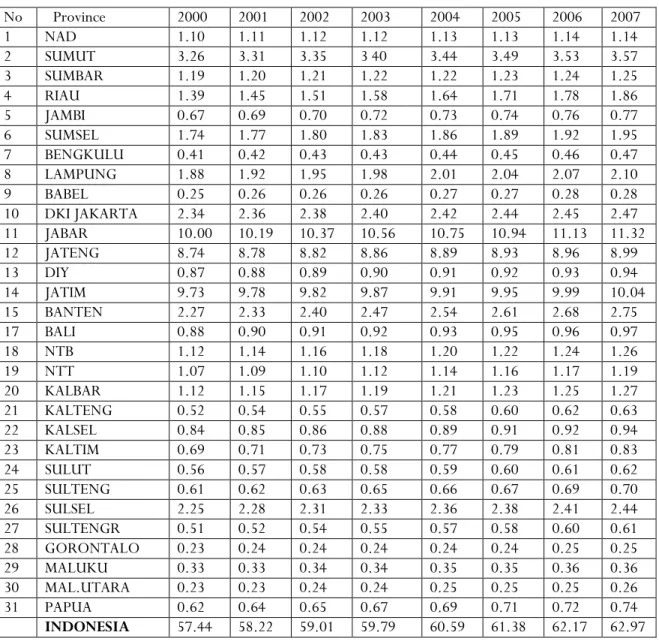
No Province 2000 2001 2002 2003 2004 2005 2006 2007 1 NAD 1.10 1.11 1.12 1.12 1.13 1.13 1.14 1.14 2 SUMUT 3.26 3.31 3.35 3 40 3.44 3.49 3.53 3.57 3 SUMBAR 1.19 1.20 1.21 1.22 1.22 1.23 1.24 1.25 4 RIAU 1.39 1.45 1.51 1.58 1.64 1.71 1.78 1.86 5 JAMBI 0.67 0.69 0.70 0.72 0.73 0.74 0.76 0.77 6 SUMSEL 1.74 1.77 1.80 1.83 1.86 1.89 1.92 1.95 7 BENGKULU 0.41 0.42 0.43 0.43 0.44 0.45 0.46 0.47 8 LAMPUNG 1.88 1.92 1.95 1.98 2.01 2.04 2.07 2.10 9 BABEL 0.25 0.26 0.26 0.26 0.27 0.27 0.28 0.28 10 DKI JAKARTA 2.34 2.36 2.38 2.40 2.42 2.44 2.45 2.47 11 JABAR 10.00 10.19 10.37 10.56 10.75 10.94 11.13 11.32 12 JATENG 8.74 8.78 8.82 8.86 8.89 8.93 8.96 8.99 13 DIY 0.87 0.88 0.89 0.90 0.91 0.92 0.93 0.94 14 JATIM 9.73 9.78 9.82 9.87 9.91 9.95 9.99 10.04 15 BANTEN 2.27 2.33 2.40 2.47 2.54 2.61 2.68 2.75 17 BALI 0.88 0.90 0.91 0.92 0.93 0.95 0.96 0.97 18 NTB 1.12 1.14 1.16 1.18 1.20 1.22 1.24 1.26 19 NTT 1.07 1.09 1.10 1.12 1.14 1.16 1.17 1.19 20 KALBAR 1.12 1.15 1.17 1.19 1.21 1.23 1.25 1.27 21 KALTENG 0.52 0.54 0.55 0.57 0.58 0.60 0.62 0.63 22 KALSEL 0.84 0.85 0.86 0.88 0.89 0.91 0.92 0.94 23 KALTIM 0.69 0.71 0.73 0.75 0.77 0.79 0.81 0.83 24 SULUT 0.56 0.57 0.58 0.58 0.59 0.60 0.61 0.62 25 SULTENG 0.61 0.62 0.63 0.65 0.66 0.67 0.69 0.70 26 SULSEL 2.25 2.28 2.31 2.33 2.36 2.38 2.41 2.44 27 SULTENGR 0.51 0.52 0.54 0.55 0.57 0.58 0.60 0.61 28 GORONTALO 0.23 0.24 0.24 0.24 0.24 0.24 0.25 0.25 29 MALUKU 0.33 0.33 0.34 0.34 0.35 0.35 0.36 0.36 30 MAL.UTARA 0.23 0.23 0.24 0.24 0.25 0.25 0.25 0.26 31 PAPUA 0.62 0.64 0.65 0.67 0.69 0.71 0.72 0.74 INDONESIA 57.44 58.22 59.01 59.79 60.59 61.38 62.17 62.97
22
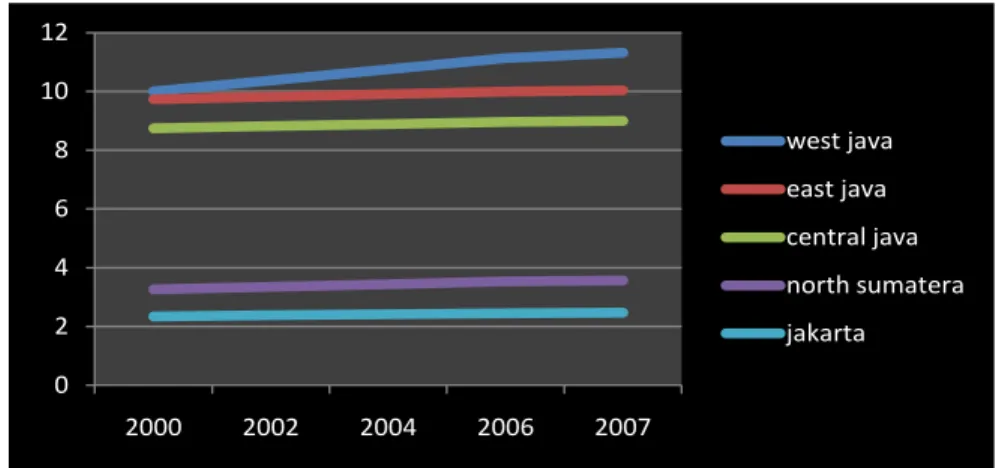
Based on the table 3-1 and 3-2, I made two figures on estimation on waste generation in 2000-2007: 0 2 4 6 8 10 12 2000 2002 2004 2006 2007 west java east java central java north sumatera jakarta 57.44 59.01 60.59 62.17 62.97 54 55 56 57 58 59 60 61 62 63 64 2000 2002 2004 2006 2007 estimation of total waste generation by province 200-2007
Figure 3-2. Estimation of waste generation based on top five major province, 2000-2007
23
Figure 3-2 shows that the trend of waste slightly increased between 2000-2007 in Java Island, North Sumatera and Jakarta. West Java is the highest increased area in the amount of waste per year compared with other regions.
Type of waste Amount
(million ton/year) Percentage (%)
Garbage 22.4 58% Plastics 5.4 14% Papers 3.6 9% Others 2.3 6% Woods 1.4 4% Glasses 0.7 2% Rubbers/leathers 0.7 2% Fabrics 0.7 2% Metals 0.7 2% Sands/Inert material 0.5 1% TOTAL 38.5 100%
The greatest amount is obtained from garbage, in the data, garbage is related to organic waste, such as food scraps, the remaining vegetables and fruit, leaves, etc.
Then followed by plastics, papers, others, woods, glasses, rubber, fabrics, metals, and the last one is sand/inert material.
Waste composition can be affected by some factors:
Weather, in areas with high water content, waste condition will also be high enough. Collection frequency, the more frequent the higher the garbage collected heap of
garbage which comes from the type of waste is not biodegradable. Season, type of waste will be determined by the fruit season
Social economic condition, the higher economies generally produce waste material consisting of cans, paper, and so forth.
Table 3-3. Estimation of Waste Generation by composition
24
Income per capita, people from low income country would generate less waste and homogeneous than the high income level.
Packaging products, packaging materials on daily need also affect waste generation. Developed countries tend to use paper as the packaging, while developing countries use a lot of plastic as packaging. [4]
Based on figure 3-4, the household provide the greatest amount of waste, followed by markets, streets, public facilities, office, industries and others.
From a general overview of waste that is shown in the data released by the Ministry of Environment some points can be taken:
The amount of waste in Indonesia is increasing, with the estimation of waste generation 2-4 % per year. [5]
It is requires proper treatment on waste. Based on the waste composition, organic waste requires rapid and precise treatment because organic waste is fast decaying. By handling properly, it will not cause negative impacts on air, land and water.
Prior to the waste treatment, waste segregation could be one way to reduce waste generated from household area, markets, streets, public facilities, office industrial area and others.
In dealing with the waste problem, there is some important thing, there are basic law on waste management in Indonesia and the implementation in accordance with the law involving all parties, central and local government also public and private community.
25
Figure 3-4. Waste Generation by source
43% 20% 8% 6% 9% 9% 5% households markets office industries public facilities streets others
3.1.2. CURRENT SITUATION of HOUSEHOLD WASTE in INDONESIA a. Waste Collection and Waste Handling system
Table 3-4. Estimation of Population Served
Group Area Total Population
(in millions) Served Population (in millions) %Population Served (%)
Sumatera 49.3 23.5 48% Java 137.2 80.8 59% Balinusra 12.6 6.0 47% Kalimantan 12.9 6.0 46% Sumapapua 20.8 14.2 68% All 232.7 130.3 56%
Source : Ministry of Environment, 2006
26
Total percentage of population served regarding waste is 56% while the remaining is not handled yet by the government. In the waste management laws chapter 3 stated that the government and local governments (municipality) in charge of ensuring the implementation of waste management and environmentally friendly in accordance with the objectives referred to this law. With the existence of these laws, the government and municipality have a duty to increase the number of population served.
Until now the municipality method in handling waste still employs end of pipe method, which means that the waste generated from urban areas is collected from the source, such from housing area, market, streets, public facilities, offices, industrial and others, waste put in temporary disposal site and then transported to final disposal site without further treatment.
Figure 3-5. Estimation of Waste Quantity Collected by Local Government
(In million tones/year)
27
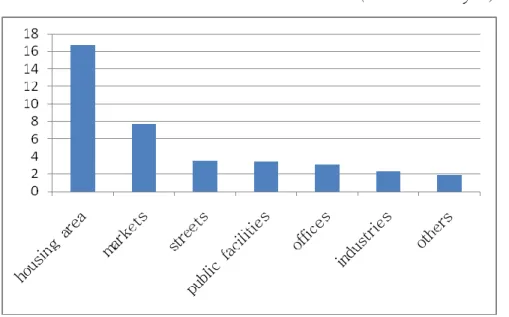
We know from figure 3-5, the quantity of waste collected from housing area is the greatest, reaching 16.7 million ton/year. While waste from markets is 7.7 million ton/year, followed by streets 3.5 million ton/year, public facilities is 3.4 million ton/year, offices is 3.1 million ton/year, industries is 2.3 million ton/year, and the remains is 1.8 million ton/ year.
.
(In million ton/year)
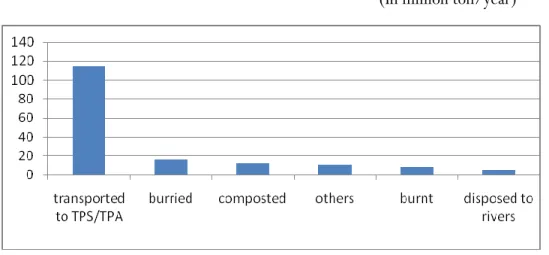
From figure 3-6 we can see that the handling and treatment of waste in Indonesia both in rural and urban areas is still conventional. Waste is transported by community (RT/RW) then placed in the final disposal without further processing. The rest of waste is buried, burnt, composted and also discharged into rivers. It is also due to the paradigm of Indonesian that still considers waste as something useless, using end of pipe approach, then the waste will become problem for Indonesia continuously. It will give various bad effects on the environment such as waste explosion that occurred in Leuwigajah final disposal in Bandung. Other waste disaster occurred in Bantargebang, Jakarta, where waste caused landslides which has resulted in several people injured and died.
Source: Indonesia Domestic Solid Waste Statistics, p.8, MoE, 2008
Figure 3-6. Estimation of waste handling systems after waste collected by community from housing area
28 b. Temporary Disposal Site
It is estimated that there are 59.000 TPS in the whole of Indonesia, 40 % which is located in Sumatera (Ministry of Environment, 2008)
Group Area TPS (in thousand units)
Sumatera 23.3 Java 11.8 Balinusra 1.8 Kalimantan 4.0 Sumapapua 18.0 Total 59.0
Group Area Number of Trucks (in thousands)
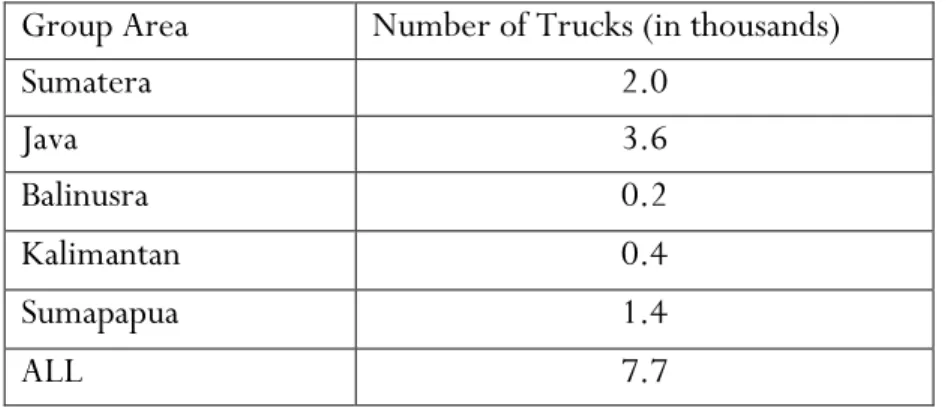
Sumatera 2.0 Java 3.6 Balinusra 0.2 Kalimantan 0.4 Sumapapua 1.4 ALL 7.7
c. Waste Transportation Vehicle
There is estimation that the total number of truck used for waste transportation in Indonesia amounts to approximately 7700 trucks which separated in Sumatera, Java, Balinusra, Kalimantan and Sumapapua.
Table 3-5. Estimation of Total Amount of Temporary disposal site
Source : Indonesian Domestic Solid Waste Statistics, p.9, MoE, 2008
Table 3- 6. Estimation the number of waste transportation truck Amount
29 d. Final Disposal Site
Table 3-7. Number of still-used TPA (Final Disposal Site)
Group Area Number of TPA
Sumatera 57 Java 75 Balinusra 11 Kalimantan 19 Sumapapua 17 All 179
From table 3-7 we can estimate that in urban or rural area there is at least one final disposal site in each area. If the waste generated continuously increases, it is certain that the capacity of final disposal sites will be over the maximum.
e. Waste Treatment Facility
Waste treatment facilities in the data means composting facility and incinerator. The table shows that in Indonesia there are many composting treatment facilities more than incinerators and other treatment facilities.
Composting activities mostly done in Indonesia. In addition to reduce waste at source is also one of the efforts to return the waste back into resources. Another benefit of composting is to reduce methane gas produced by organic waste.
One example of success story in composting is community in Kampung Banjarsari, Cilandak, South Jakarta, pioneered by Harini Bambang in 1985s. Kampung Banjarsari was crowned in 1996 as a pilot project of urban waste management by UNESCO [6] and the Jakarta government in 2002 established as a tourist destination village. [7]
30
From the figure 3-7 we could conclude that composting in Indonesia is mostly done by households, communities, cities and regions.
f. Recycling activity
In chapter 6 of the Waste Management Law no 18/2008 stated that recycling is included as one of the way of waste reduction. Government and local government must facilitate recycling activities.
Recycle concepts already started in Indonesia in the 1980s. The program was initiated by the Center for Environmental Research in ITB(PPLH). PPLH introduced the concept of industrial park waste (KIS) in the region with the goal of minimizing the level of waste to be transported to the landfill as much as possible by involving NGOs in the recycling of waste [4].
Figure 3-7. Number of treatment facilities
31 0% 10% 20% 30% 40% 50% 60% 3R activities
With the new laws on waste management, Indonesian government expects to cooperate with various parties to handle the garbage problem and also increase the number of recycle activity. In addition, past community paradigm that have considered waste as worthless things is needed to change.
In this second discussion, data explained about the actual situation related to waste problems in Indonesia and its treatment. Also I pointed out some points:
Through the data issued, Indonesian has started to realize the importance of waste treatment. It is proved by composting and recycling activity.
Until this data released, population served by government related to waste handling is 56% of the total population in Indonesia. This percentage is expected to increase along with the establishment of Law no 18 year 2008 about household waste management.
Waste is predicted to increase year by year. This situation will lead TPA/TPS to no longer accommodate with the amount of waste and also cause environmental problems. As a result, there will arise the need for municipalities to look for other
Figure 3-8. 3R activities conducted by municipality
32
more environmental friendly treatments. This needs to be considerated for the Municipality to looking for other treatment which is more environmental friendly. To raise public awareness on waste treatment, government can do several things,
such through educational and economic method. For example: to give education about waste in the school or to provide education to the community about waste management and charge of waste disposed in accordance with the amount of waste.
3. WASTE MANAGEMENT in INDONESIA a. Waste Management Authority
The number of employees involved in waste management authority and the private party involved in waste management is mentioned in Figure 8 and 9.
40%
16% 28%
4% 7% 5%
street sweeper hand cart labor truck driver final disposal waste officer
administration officer others
Figure 3-9. Employee involved in waste management authority
33
In the implementation of waste management, should be involved multiple stakeholders such as central and local government, private institution and public participation.
In urban area, municipality recruits several types of employees in order to handle waste treatment. The largest percentage was Street Sweeper then followed by handcart labor, truck driver, final disposal waste officer, administration officer and others. Looking at these data would be better if the Municipality increases the number of employees in the final disposal officer, because this section is also a vital part in waste management. In addition to increasing the number of employees, the government should provide the employees with knowledge on waste management which is environmentally friendly. 0% 1% 2% 3% 4% 5% 6% 7% 8% 9% 10%
transportation treatment final disposal others
The role of private parties is also required to assist the government in solving the garbage problem such a case in Jakarta. Jakarta Sanitation agency will ask the private sector to run the garbage processing center. The tenders would call for bids to expand
Figure 3-10. Private party involvement
34
processing capacity at waste management plants in Marunda and Sunter, North Jakarta; and in Cakung-Cilincing, East Jakarta; Jakarta Sanitation Agency chief Eko Baruna said on Wednesday. [8]
b. Financial Aspect
A financial aspect is indispensable for handling waste. In this respect, local government takes responsibility for managing the fund for waste handling. Besides, there is retribution that charge to the community within the scope of neighborhood (RT or RW) and sometimes it is determined by type of house, construction purposes and half of the retribution is conducted directly by RT/RW.
1) Source of financial and expenditure Table 3-8. Total of Expenditure
Group Area Indonesian Rupiah/year (in billion)
Sumatera 152.8 Java 370.1 Balinusra 50.2 Kalimantan 16.1 Sumapapua 41.1 Total 630.3 2) Retribution
The Waste Management Law no 18,2008 regulates about financing matter on chapter 7 articles 24. It is stated that central government and local government have an obligation to finance the waste management process through state or local budget revenue.
35 0 10 20 30 40 50 60 70 type of house construction purposes electricity voltage others
Base of Retribution Rate
Figure 3-12. Retribution billing system
0 10 20 30 40 50 60 direct
payment via water bill electricity via bill
others
Retribution billing system
c. Public participation
In Indonesia there are several different ways to handle waste problems. It is also required public participation to enable to handle waste. When viewed on these data, community initiative and retribution contribute quite big enough to handle the waste problems. Another effort made to handle waste according to a survey is waste treatment
Source: Indonesia Domestic Solid Waste Statistics, p.20, MoE,2008
36
such as composting, etc as well as education in the primary school also plays a role. Not all waste generated by households can be handled by the government, therefore the community should manage its own waste generated. Community also needs to be involved in city planning so that they can give advice to the government about the handling waste properly. And the last is waste segregation at source, this method can facilitate the treatment of waste by all relevant parties. Community involvement is necessary for waste handling program. If the community has been aware of the problems of waste, it will easily be resolved.
d. Regulation
Until the year 2007 there were no laws regulating waste management. Prior to law, regulations concerning waste handling split to several regulations, policies or ministerial regulations. In the year of 2008 the Indonesian government issued Waste Management Source : Indonesia Domestic Solid Waste Statistics, p.20, MoE, 2008
37
Law no 18 year 2008. This is a good move, since the government began to pay attention to garbage problems in Indonesia.
There were some regulations/policies regarding waste before government issued this new law:
1) Hazardous waste
Ministerial Decree 42/MENLH/11/1994 Reg.68/BAPEDAL/05/1994 Reg.1-5/BAPEDAL/09/1995 Regulation 18/1999 Regulation 74/ 2001 Ministerial Decree 18/2009 2) Waste Management
1. Waste Law 18/2008
3) Recycling2.
Ministerial Decree 2/2008With the promulgation of waste management law no 18 of 2008 then there has been a strong legal foundation that became the benchmark for implementing environmentally friendly waste management.
C. CONCLUSION
Presenting the above data is as an overview of waste situation in Indonesia. There is the relationship between population growth and economic development with an increasing amount of waste. Population of Indonesia is increasing around 2.8 million every year. We can predict the quantity of waste is also increasing 2-4% year by year. Therefore Indonesia will be faced with a difficult problem like waste treatment side by side with food shortage. But in reality there are some obstacles encountered in order to solve the garbage problem:
38
1.
PopulationIn general, the population continuously increases which would bring an increase of waste.
2.
Community paradigmCommunity paradigm still remain that waste is an undesirable and useless thing and the fact accounts for the negative involvement of community and the public in waste handling.
3.
Limited budget.Waste program is financed by local government.
4.
Limited facilities and method to treat the waste.Waste treatment facilities are too much limited and the methods of treatment are also limited and not diversified.
5.
Waste management actors have less experience6.
Therefore there are insufficient of knowledge and training in waste management.With some of these obstacles in chapter 5 will provide solutions in the form of economic approaches in dealing with waste’s problem.
39 References
1. The Republic of Indonesia, State Ministry of Environment. Indonesian Domestic Solid Waste Statistics year 2008.
2. Dhamija, Urvashi. Sustainable solid waste management. Issues, policies and structures. 2006.
3. The World Bank, What a waste: Solid Waste Management in Asia. May 1999
4. Damanhuri, Enri, Tri Padmi. College textbook on waste management. 2010. p16. 5. The Republic of Indonesia, State Ministry of Environment. Indonesian
Environmental Status. 2008.
6. Suyoto, Bagong. Fenomena gerakan mengelola sampah. 2008.p.46 7. Tabloid Rumah. 23 Oct-5 Nov 2007.
8. Simamora, Adianto P. Environment bill likely to empower ministry. The Jakarta Post, 27 August 2009.
9. Post, The Jakarta. Communities instill new habits for a cleaner Jakarta. 29 February 2009.
10. Post, The Jakarta. Garbage piles up in city rivers, streets. 24 February 2009. 11. Arditya, Andreas D. City will solicit bids to privatize 3 garbage sites. The Jakarta
Post, April 2011
12. Tammemagi, Hans. 1999. The Waste Crisis. Landfills, incinerators, and the search
for a sustainable future.
13. Johannesen, Lars Mikkel, Gabriela Boyer. 1999. Observations of solid waste
landfills in developing countries: Africa, Asia and Latin America. Urban Development
Division, Waste Management Anchor Team, The World Bank.
40
CHAPTER 4 LEGAL BASIS OF WASTE MANAGEMENT POLICY in INDONESIA
4.1 LEGAL BASIS
4.1.1 Introduction
Environmental problems, especially waste problem is the problem facing the world especially Indonesia. Discussion about the environment and sustainable development has been carried out. In 1983 the Brundtland Commission was convened by the United Nations. The commission created to address growing concern about the accelerating deterioration of the human environment and natural resources and the consequences of that deterioration for economic and social development (Wikipedia). The report mentioned that sustainable development is development that meets the needs of the present without compromising the ability of future generations to meet their own needs. Then in 1992, Agenda 21 was adopted in Rio de Janeiro. Agenda 21 is the action plan of the United Nations for sustainable development. It is a comprehensive plan of action to be taken globally, nationally and locally by organizations of the United Nations System, Governments, and Major Groups in every area in which human impacts on the environment (http://www.un.org/esa/dsd/agenda21/). One of the concerns of Agenda 21 is waste problem. The discussion is about environmentally sound management on solid waste and sewage related issues. There are four waste related programs, minimizing waste, maximizing environmentally sound waste reuse and recycling, promoting environmentally sound waste disposal and treatment, and extending waste service coverage. Agenda 21 provides a solution to manage waste problem through minimization as the priority and expected to be implemented by the members including Indonesia.
41
Indonesia has ratified some international waste legal frameworks such as Basel Convention in 1993 and Kyoto Protocol in June 2004, meaning that government considers about the potentially adverse waste effect on environment [2].
Therefore Indonesia needs regulation related to waste management in order to manage the system and implementation of waste treatment.
This chapter discusses the legal basis to handle waste problem in Indonesia. A waste problem requires a strong legal foundation to oversee the implementation of waste handling.
Laws made by the government became the basis for waste treatment. Treating waste properly will avoid damage to the ecology and promote environmental friendly and sustainable society.
Waste management policy
Basis for treatment of waste by reduce, reuse and recycle
Lighten ecological damage
Promote environmental friendly and sustainable society
42
a. Waste Related Law before Waste Management Law No 18, 2008
Waste management law in Indonesia was recently issued in 2008, named Waste Management Law no 18, 2008. Before the Waste Management Law issued, there was no laws regulatingthe waste management specifically, and previously the law discussed about the environmental issues and hazardous waste.
1) Laws issued at National Level
The following report is the law/regulation/policies before the government issued Waste Management Law no 18, 2008:
Environmental issue
i. Environment Management Act, No 23, 1997 :
This law regulates about the environment management. ii. Ministerial Decree No 86/2002 :
Guidelines for the implementation of environmental management efforts and monitoring.
iii. Ministerial Decree No 45/2005 :
Guidelines for the preparation of living management plan and monitoring plan.
Hazardous waste
i Reg.1-5/BAPEDAL/1995 : about hazardous waste. ii. President Decree No 18, 1999 :
Management of hazardous and toxic waste. iii. President Decree No 85, 1999 :
Amendment of governmental decree No 18, 1999. iv. President Decree No 74, 2001:
Management of hazardous and toxic materials. v. President Decree No 61, 1993:
Ratification of the Basel Convention on the control of trans-boundary movement of hazardous wastes and their disposal.
43
vi. President Decree No 47, 2005 :
Ratification Amendment to the Basel Convention on the control of transboundary movementof hazardous wastes and their disposal. Waste management
i Waste Management Law No 18/2008 :
The law regulates waste management for household waste, commercial waste, industrial waste, and specific waste.
Imported waste
i. Ministerial Decree No 230/1997. ii. Regulation No 18/1999.
iii Ministerial Decree 41/2008. 2) Regulations issued atCity/Municipality Level
In addition to regulations which are made by central government, local governments also have the authority to regulate rules for waste treatment of their territory. For the implementation of waste management at local level, it is implemented under jurisdiction of Governmental Sanitary Agency in City/Municipality or Province level. Therefore, waste management policy of municipalities could be varied according to the specific characteristics of the region such as local problem, society, and economic condition.
Here I will introduce some examples of regulations at the municipality level.
1. A case of “BANDUNG” (West Java) <Foundation>
It is “City Regulation No. 03” issued in 2005about Actualization of Neatness, Sanitation and Aesthetic (Peraturan Daerah Kota Bandung No 03 Tahun 2005 tentang Penyelenggaraan Ketertiban, Kebersihan, dan Keindahan).
44
a. To protect the right for good and healthy environment, local government conducts controlling effort of facilities that are potential as movable pollutant or immovable pollutant (article 21 verse 2).
b. Every permanent building (include housing) is obliged to havean independent sewage network (article 24) ; Penalty would be Rp. 1,000,000
c. Sanitary service held through coordination of RT/RW (lowest level of official administrative hierarchy, consisted of dozen to hundred houses) includes: waste storage, separation, sweeping, collecting, delivery to Temporary Disposal Posts (article 26).
d. Waste management procedure includes: 1. Waste storage and/or separation. 2. Sweeping and collection.
3. Management, regulation and provision of Temporary Disposal Posts and Final Disposal Posts.
4. Intermediate treatment. 5. Transport and delivery.
6. Final treatment (article 27 verse 1).
e. Local government is responsible for transporting of waste from Temporary Disposal Posts to Final Disposal Posts (article 27 verse 2).
f. Local government is responsible for managing, regulating and providing Temporary Disposal Posts to Final Disposal Posts (article 27 verse 2).
g. Prohibition:
Related to waste disposal, residents or out comers areprohibited for:
1. Dispose waste, dirt, or used household in sewage, road, pedestrian way, public facility, public service.
2. Damaging, burn, or removing public waste bin; Penalty in this case would be Rp. 1,000,000.
45
3. Burn garbage in potentially dangerous location; Penalty in this case would be Rp. 1,000,000.
4. Dispose liquid waste, dangerous materials, animal remains in sewage or river; Penalty would be between Rp. 1,000,000 and Rp. 50,000,000.
5. Self-connecting sewage line with drink-water line (article 40).
h. Educating and Training Residents, Controlling, Supervising (article 42, 43, 44). <Actualization>
a. Local government conducts an open dumping policy in Temporary Disposal Posts and Final Disposal Posts.
b. RT/RW collects retribution or waste service charge from housing and provide a garbage/waste collection.
c. Local government uses incinerators in Temporary Disposal Posts and Final Disposal Posts.
2. A case of “BATAM” (Riau province, Sumatera) <Regulation>
“City Regulation No. 05” was issued in 2001: named as “Batam Sanitary” (Peraturan Daerah No. 05 Tahun 2001 tentang Kebersihan Kota Batam):
The aim of this regulation is as follows:
a. Residents/Economic Boards are obliged to provide garbage/waste bin on their premises.
b. Sanitary is managed by Sanitary and Landscape Gardening Agency or appointed private partners.
46 c. Technical procedure:
1. Collection
2. Delivery: by the government-owned vehicles 3. Management:
Vehicle inspection.
Final Disposal spot only for non-hazardous materials. Unloading from vehicles is supervised by certain officers. Coverage of waste with soil.
Trash-pickers are prohibited in the premise. d. Garbage disposal instructions:
1. Soft or non-solid materials should be inserted in plastic bag and tied. 2. Hard or solid materials should be chopped in tiny pieces and tied.
3. Both types should be put in front of resident housing at the appointedtime or delivered to Temporary Disposal Spots.
e. Sanitary Education.
f. Biological waste (e.g. feces) will be collected with pump-equipped vehicles, owned by the government/partner.
g. Retribution or waste service charge varied according to house sizes or delivery processes. Crime penalty would be 6 months in Prison/the payment of maximum charge of Rp 5,000,000.
h. Prohibition:
Residents and Out comers may not: