(Original) MatsumotoShigaku 27 : 29'-39, 2ool
key words : Chinese children - Primary dental arch - Normal oeclusion
'
The Morphology of the Primary Dental Arch in Shanghai,
'
China: 72 Cases of Normal Occlusion
TAMAMI SAITO HIROSHI IWASAKI AKIRA NAKAYAMA MORITSUGU UCHIYAMA
NORIKO KAYAMOTO NAOHIRO SONODA NOBORU TAKANASHI and HIROO MIYAZAWA
Department ofPediatric DentistT y , Matsumoto Dental Universitor School ofDentistr yQIN LIAN LAN CHEN and SIZHEN SHI
Department ofPediatric Dentistiy, Sehool ofStonzatology, Tongy'i University,
Summary
To obtain the dimensional data of the dental casts of growing and developing Chinese children, and to compare the data to the Japanese, we have performed dental examinations on children in the kindergarten attached to Shanghai Teachers' University in Shanghai since 1996. As study materials, dental casts obtained between 1996 and 1999 from 72 Chi-nese children aged 3 to 6 years with normal primary occlusion were used to evaluate the mesio-distal crown diameters of the primary teeth, the sizes of the primary dental arch, and the standard values and frequency distributions ofprimary occlusion.
1. Males showed higher values in mesio-distal crown diameters in deciduous teeth, and the size ofdental arch than females.
2. In regard to the interdental spaces both in the maxi11a and mandible, primate and opmental spaces together were most frequently observed.
3. In regard to the occlusal relationship, the incidence ofterminal planes was higher in the order ofVertical type År Mesial step type År Distal step type, and the incidence of primary
canine occlusal relationship was higher in the order oftype I År type M År type I .
4. The items that were thought to be characteristic of Chinese children were the frequency ofonly primate spaces, and the incidence ofthe Mesial step type ofterminal plane and type M primary canine occlusal relationship.
Introduction
To obtain appropriate occlusal development in clinical pedodontics, it is important to understand the conditions of the mesio-distal crown diameters of the primary teeth, primary dental arch width and length, and primary occlusion, which are important information factors to predict future perma-nent dentition.
However, because the number of Chinese dentists for the population of China is markedly small,
(submitted February 26, 2001 ; accepted Apri1 16, 2001)
30
precise dental investigation is difficult, and there have been no reports of the establishment of stan-dard values for the whole of China.
We performed the investigation of the survey of dental diseases in Shijiazhuang city, China in co-operation with the hygiene agency in Hebei province in China between 1989 and 1992, and evalu-ated primary dentition in children with normal occlusioni). Furthermore, we have performed dental examinations on children in the kindergarten attached to Shanghai Teachers' University in Shang-hai as joint research with the Department of Pediatric Dentistry in the School of Stomatology at Tongii University (former Shanghai Railroad University) since 1996, and evaluated the primary dental casts obtained in 1996 using the same method as was used for the evaluation of the primary dentition in Shijiazhuang citf'.
To obtain the dimensional data of the dental casts of growing and developing Chinese children, and to compare the data to the Japanese. In this study, we performed investigation of the mesio-dis-tal crown diameters of the deciduous teeth, primary denmesio-dis-tal arch width and length, and primary oc-clusal relatiopship in Chinese children using primary dentition casts obtained from children in the kindergarten attached to Shanghai Teachers' University in Shanghai between 1996 and 1999.
Materials and Methods
We performed dental examinations and took impressions of the dentition in 749 children (390 males and 359 females)in the kindergarten attached to Shanghai Teachers' University in Shanghai between 1996 and 1999 (Table 1). As study materials, the dental casts of 72 children (37 males and 35 females, including 43 children that were investigated in 1996) aged 3 to 6 years, which were se-lected following the Japanese Society ofPediatric Dentistry (J. S. P. D.) standard for normal primary occlusion3', were used for the measurement of the mesio-distal crown diameters of the deciduous teeth, primary dental arch width and length, arch height, interdental spaces, the conditions of the deciduous second molars, and primary canine occlusal relationship. Regarding the mesio-distal crown diameters of the deciduous teeth, primary dental arch width and length, and arch height, we measured the mean values, and regarding interdental spaces, the conditions of the deciduous second molars, and primary canine occlusal relationship, we investigated the incidence (Fig.1).
Considering changes in the size of the dental arch with growth, we divided the chiIdren into a
younger group, aged between three and four
years, and an older group, aged between five and six years. We used t-test for the statistical analysis of the size of the dental arch, and used the Chi-squared test for the analysis of the in-cidence.
Regarding casts obtained from the same child Table 1 : Materials
g-,
Children in Shanghai
Male Female Total
390 359 749
Normal occlusion Youngergroup (3'4years) Oldergroup (5'6years) 37 22 15 35 22 13 72 44 28 Denta1ArchWidth a:cc-cc b/CL.CL c:D-D d,DL.DL e:E-E f:EL-EL Denta1ArchLength g:A-CC h/A.E i,A.ED DentalArchHeight i:DentalHeight k:ULA-ILA)RE}JlÅqwh\ 27(l) 2001
in a different year ofexamination, we took the cast obtained in the first year as the study material.
31
Results
1. Mesio-distal crown diameters of the deciduous teeth
As shown in Table 2, sex differences were observed only in the mandibu
Table 2: Mesiadistal erown slzes o
lar central incisor.
fdeciduous teeth
Deciduous teeth
Male (n=37)
Mean Å}S. D. (rnm) C. V. (9o)
female (n=35) Sex differences
Mean Å}S. D. (mm) C. V. (9o) Maxi11ary Central Incisor Lateral Incisor Canine First Molar Second Molar 6.72 Å} O.39 5.42 Å} O.25 6.62 Å} O.34 7.49 Å} O.39 9.22 Å} O.44 5.9 4.6 5.2 5.2 4.8 6.62 Å} O.34 5.40 Å} O.34 6.56 Å} O.31 7.32 Å} O.41 9.19 Å} O.47 5.1 6.3 4.8 5.6 5.1NS
NS
NS
NS
NS
Mandibular Central Incisor Lateral Ineisor Canine First Molar Second Molar -4.19 Å} O.33 4.70 Å} O.30 5.85 Å} O.28 8. 10 Å} O.45 10.09 Å} O.42 7.8 6.5 4.9 5.5 4.2 4.04 Å} O.28 4.61 Å} O.29 5.79 Å} O.29 8.08 Å} O.41 10.01 Å} O.56 7.1 6.4 4.9 5.1 5.6*
NS
NS
NS
NS
* :pÅq O.052. Size ofthe dental arch
The mean values are shown in Table 3.
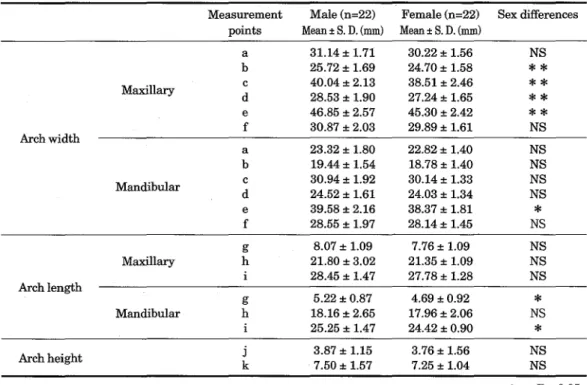
Sex differences in the group of younger children were observed in the maxillomandibular E-E (e), maxi11ary CIrCL (b), D-D (c), and DIrDL (d), and mandibular A-CC (g) and A-ED (i). Those in the group of older chil(lren were observed in the maxillomandibular DIrDL (d) and EL-EL (fi, and max-illary CC-CC (a), CL-CL (b), D-D (c), A-CC (g), and A-ED (i).
3. Interdentalspaces
Regarding sex differences, females showed a significantly higher incidence of rnaxillary primate spaces than males, whereas males with both primate and developmental spaces in the maxilla showed a higher incidence than females (Table 4).
4. Terminal planes and primary canine occlusal relationship
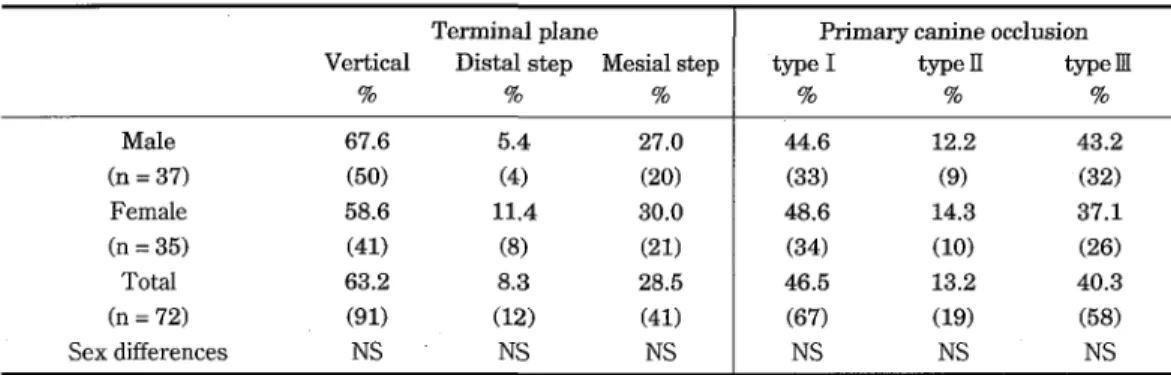
As shown in Table 5, no sex differences in any types of terminal planes or primary canine occlusal relationship were observed.
Regarding sex differences in the incidence of the combinations of terminal plane types and pri-mary canine occlusal relationships, females showed a significantly higher incidence of Distal
step-type fi , and Distal step-step-type M- than males (Table 6).
No sex differences in the incidence of the combinations of bilateral terminal plane types were ob-served (Table 7).
32 Primary Dental Arch
Table 3-1: Arch d lmenslons o
--
f deciduous dentition (3-4 years)Measurement
points Male (n=22) Mean Å} S. D. (mm) Female (n=22) Mean Å} S. D. (mm) Sexdifferences Maxi11ary a b c d e f 31.14 Å} 1.71 25.72 Å} 1.69 40.04 Å} 2.13 28.53 Å} 1.90 46.85 Å} 2.57 30.87 Å} 2.03 30.22 Å} 1.56 24.70 Å} 1.58 38.51 Å} 2.46 27.24 Å} 1.65 45.30 Å} 2.42 29.89 Å} 1.61NS
**
**
**
**
NS
Arch width Mandibular a b c d e f 23.32 Å} 1.80 19.44 Å} 1.54 30.94 Å} 1.92 24.52 Å} 1.61 39.58 Å} 2. 16 28.55 Å} 1.97 22.82 Å} 1.40 18.78 Å} 1.40 30.14 Å} 1.33 24.03 Å} 1.34 38.37 Å} 1.81 28.14 Å} 1.45NS
NS
NS
NS
*NS
Maxillary gh
i 8.07 Å} 1.09 21.80 Å} 3.02 28.45 Å} 1.47 7.76 Å} 1.09 21.35 Å} 1.09 27.78 Å} 1.28NS
NS
NS
Arch lengthMan
dibular g h i 5.22 Å} O.87 18.16 Å} 2.65 25.25 Å} 1.47 4.69 Å} O.92 17.96 Å} 2.06 24.42 Å} O.90 *NS
* Arch height j k 3.87 Å} 1.15 7.50 Å} 1.57 3.76 Å} 1.56 7.25 Å} 1.04NS
NS
* :PÅqO.05
**:PÅqO.Ol
Table 3.2 : Arch dimensions ofdecid uous dentition (5-6 years)
Measurement
points Male (n=15) MeanÅ}S. D. (mm) Female (n=13) ' Mean Å} S. D. (mm) Sexdifferences hrch width Maxillary a b c d e f 31.77 Å} 2.03 26.00 Å} 1.69 40.39 Å} 2.23 29.09 Å} 1.89 46.95 Å} 4.29 31.76 Å} 2.02 30.23 Å} 1.49 24.65 Å} 1.58 38.45 Å} 1.82 27.19 Å} 1.86 45.20 Å} 2.32 29.92 Å} 1.74 * * * *NS
* Mandibular a b c d e f 23.87 Å} 1.21 19.74 Å} 1.12 31.43 Å} 1.75 25.39 Å} 1.65 40.03 Å} 2.46 29.59 Å} 1.41 23.01 Å} 1.91 19.11 Å} 184 30.32 Å} 2.06 23.79 Å} 1.81 38.23 Å} 2.32 27.72 Å} 1.99NS
NS
NS
*NS
**
Arch length Maxillary g h i 8.20 Å} 1.04 22.34 Å} 3.84 29.14 Å} 1.90 7.35 Å} O.82 21.57 Å} 1.74 27.84 Å} 1.11 *NS
*Man
dibular gh
i 5.10 Å} O.87 18.33 Å} 3.55 25.84 Å} 1.89 4.78 Å} 088 18.57 Å} 1.40 24.99 Å} 1.39NS
NS
NS
Arch height jk
3.31 Å} 1.13 7.45 Å} 1.18 3.82Å}O.85 7.98 Å} O.88NS
NS
* :PÅqO.05
**:PÅqO.Ol
if}J4stw\ 27(1) 2001 Table 4: Inter dental spaces
33
Male
n=37 9o
Female
n=35 9o
Sex differencesMaxi11ary Spaced type
Closed type Primate Primate + Developmental Developmental close 2 34 o 1 2.7 45.9 o.o 1.4 10 21 1 3 14.3 30.0 1.4 4.3
**
*NS
NS
Mandib
ular Spaced typeClosed type Primate Primate + Developmental Developmental close 4 28 2 3 5.4 37.8 2.7 4.1 5 19 5 6 7.1 27.2 7.1 8.6
NS
NS
NS
NS
*
*
:PÅqO.05 * PÅqO.OlTable 5 : Terminal plane and primary canine occlusion
Termjnalplane Primarycanjneocclusion
Vertical Distalstep Mesialstep typeI typell typeM
9o 9o 9o 9o 9o 9o Male 67.6 5.4 27.0 44.6 12.2 43.2 (n=37) (50) (4) (20) (33) (9) (32) Female 58.6 11.4 30.0 48.6 14.3 37.1 (n=35) (41) (8) (21) (34) (10) (26) Total 63.2 8.3 28.5 46.5 13.2 40.3 (n=72) (91) (12) (41) (67) (19) (58) Sexdifferences
NS'
NS
NS
NS
NS
NS
Table 6: Relationship between terminal planes and primary canine occlusion Terminal plane Primary
canme
occlusion Malen=37
9o
Femalen=35
9o Sex differences Vertical Vertical Vertical type I type fi typeM 33.8 10.8 23.0 35.7 7.1 15.7NS
NS
NS
Distal step Distal step Distal step type I type ll typeM 4.0 1.3 o.oL5
7.1 5.7NS
* * Mesial step Mesial step Mesial step type I type ff typeM 6.8 o.o 20.3 8.6 o.o 18.6NS
NS
NS
* :PÅqO.05Table 7 : Combination ofbilateral terminal planes
[[brpes Male (n = 37) 9e Female (n = 35) 9o Sex diferences
Vertical - Vertical Vertical - Distal step Vertical - Mesial step
Distal step - Distal step
Mesial step - Mesiai step
Mesial step - Distal step
21 4 4 o 5 3 56.8 10.8 10.8 o.o 13.5 8.1 16 5 4 1 6 3 45.7 14.3 11.4 2.9 17.1 8.6
NS
NS
NS
NS
NS
NS
Discussion
1. Mesio-distal crown diameters of the deciduous teeth
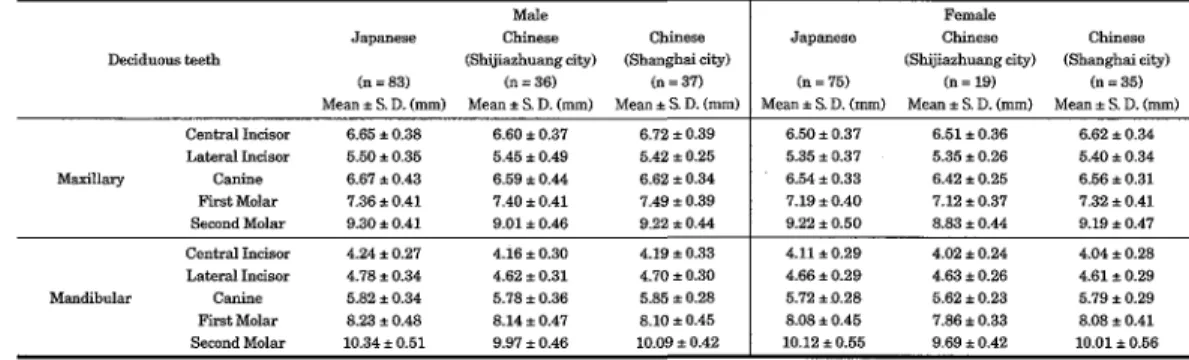
There have been reports of racial differences in the mesio-distal crown diameters of some decidu-ous teeth 2). Furthermore, we reported that there were slight differences in those values due to re-gional characteristics even in the same race `). Generally, male tend to show slightly 1arger values than females 2), and males in thiS study also tended to show larger mesio-distal crown diameters of the deciduous teeth than females (Table 8).
Table 8 : Mesio-distal crown sizes ofdeciduous teeth in different races
Male Female
Japanese Chinese Chinese Japanese Chnese Chinese Deeiduousteeth (Shijiazhuangcity) (Shanghaicity} (Shijiazhuangeity) (Shanghaicity)
(n=83) (n=36) (n=37) (n=75} (n=19) (n=35)
MeanÅ}S.D.(mm) MeanÅ}S.D.(mm) MeanÅ}S.D.{rnm) MeanÅ}S.D.(Tnm} MeanÅ}S.D.(mm} MeanÅ}S.D.(mm)
CentralIneisor 6.65Å}O.38 6.60Å}O.37 6.72Å}O.39 6.50Å}O.37 6.51Å}O.36 6.62Å}O.34 LateralIneisor 5.50Å}O.35 5.45Å}O.49 5.42Å}O.25 5.35Å}O.37 5.35Å}O.26 5.40Å}O.34 Maxillary Canine 6.67Å}O.43 6.59Å}O.44 6.62Å}O.34 6.54Å}O.33 6.42Å}O.25 6.56Å}O,31 FirstMolar 7.36Å}O.41 7.40Å}O.41 7.49Å}O.39 7.19Å}O.40 7.12Å}O.37 7.32Å}O.41
SecondMolar 9.30Å}O.41 9.01Å}O.46 9.22Å}O." 9.22Å}O.50 8.83Å}O.44 9.19Å}O.47
Centralincisor 4.24Å}O.27 4.16Å}O.30 4.19Å}O.33 4.11Å}O,29 4.02Å}O.24 4.04Å}O.28 LateralIneisor 4.78Å}O.34 4.62Å}O.31 4.70Å}O.30 4.66Å}O.29 4.63Å}O.26 4.61Å}O.29 Mandibular Canine 5.82Å}O.34 5.78Å}O.36 5.85Å}O.28 5.72Å}O.28 5.62Å}O.23 5.79Å}O.29 FirstMolar 8.23Å}O.48 8.14Å}O.47 8.10Å}O.45 8.08Å}O.45 7.86Å}O.33 8.08Å}O.41
SecondMolar 10.34Å}O.51 9.97Å}O.46 10.09Å}O.42 10.12Å}e.55 9.69Å}O.42 10.01Å}O.56
Almost no differences were observed between Japanese children 3' and children in Shanghai city, and differences between children in Shijiazhuang city investigated in our study i' and children in Shanghai city were observed only in the rnaxillomandibular deciduous first molars. Therefore, we considered that there were no differences that showed racial characteristics in the mesio-distal crown diameters ofthe deciduous teeth between Japanese children and Chinese children. 2. Size of the dental arch
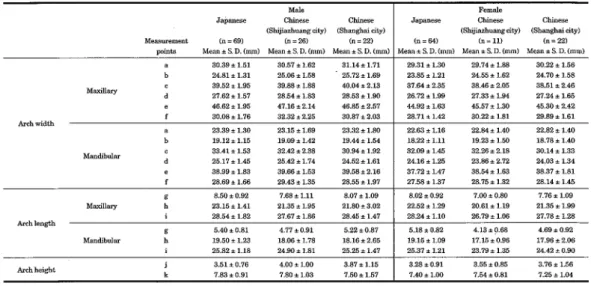
It has been reported that deep overbite was characteristic of primary dentition in Chinese chil-dren, and the incidence of deep overbite tended to decrease with age 5', shifting 'to normal occlusion ' in most cases, and deep overbite was observed in a few children after successional replacement with permanent incisors. However, we excluded deep overbite from our investigation, because we selected dental casts with normal primary occlusion following the Japanese Society of Pediatric Dentistry (J. S. P. D.) standard for normal primary occlusion 3' to investigate the mean values in this study. In comparing the results in this investigation to the size of the dental arch in Japanese children 3), both males and females in the group ofyounger children in Shanghai city showed low values exceed-ing-1 S. D. in the mandibular D-D (c) and A-E (h) (Table 9-1). Males in the group of older children
ty/tsN2ts et\ 27(1) 2001 35
Table 9-1 : Arch dimensions of deci duousdentition in different races (3-4 years)
Male Female
Jabanese Chinese Chinese Japanese Chinese Chinese (Shijiazhvangeity} (Shanghaieity) (Shijiazhuangedty) (Shanghaieity) Measurement (n=69) (n=26) (n=22) (n=64) (n=11) (n=22)
'pomts MeanÅ}sD.(mm) MeanÅ}S.D.{mm)MeanÅ}SD.(mm)MeanÅ}S.D.(mm) MeanÅ}SD.(mm)MeanÅ}S.D.(mm)
a 30.39Å}1.51 30.57Å}1.62 3L14Å}1.71 29.31 Å}1.30 29.74Å}L88 30.22Å}1.56 b 24.81Å}1.31 25.06Å}1.58 ' 25.72Å}1.69 23.85Å}1.21 24.55Å}L62 24.70Å}1.58 c 39.52Å}1.95 39.88Å}L88 40.04Å}2.13 37.64 Å}2.35 38.46Å}2.05 38.51Å}2.46 Maxillary d 27.62Å}1.57 28.54Å}L83 28.53Å}1.90 26.72 Å}1.99 27.33Å}L94 27.24Å}L65 e 46.62Å}1.95 47.16Å}2.14 46.85Å}2.57 ".92Å}1.63 45.57Å}L30 45.30Å}2.42 f 30.08Å}1.76 32.32Å}2.25 30.87Å}2.03 28.71 Å}1.42 30.22Å}1.81 29.89Å}1.61 Archwidth a 23.39Å}1.30 23.15Å}1.69 23.32Å}1.80 22.63 Å}1.16 22.84Å}L40 22.82Å}L40 b 19.12Å}1.15 19.09Å}L42 19.44Å}L54 18.22Å}Lll 19.23Å}ISO 18.78Å}1.40 c 33.41Å}1.53 32.42Å}2.38 30.94Å}1.92 32.09 Å}1.45 3226Å}2.18 30.14Å}1.33 Mandibular d 25.17Å}1.45 25.42Å}L74 24.52Å}1.61 24.16 Å}1.25 23.86Å}2J2 24.03Å}L34 e 38.99Å}1.83 39.66Å}L53 39.58Å}2.16 37.72 Å}1.47 38.54Å}L63 38.37Å}1.81 f 28.69Å}1.66 29.43Å}L35 28.55Å}1.97 2758Å}1.37 28.75Å}1.32 28.14Å}1.45
g 8.50Å}O.92 7.68Å}1.11 8.07Å}1.09 8.02 Å}O.92 7.00Å}O.80 7.76Å}1.09 Maxillary h 23.15Å}1.41 2!.35Å}1.95 2L80Å}3.02 22.52 Å}1.29 20.61Å}1.19 21.35Å}1.99
i 28.54Å}1.82 27.67Å}1.86 28.45Å}1.47 2S.24 Å}1.10 26.79Å}1.06 27.78Å}1.28 Archlength
g 5.40Å}O.81 4.77Å}O.91 5.22Å}O.87 5.18 Å}O.82 4.13Å}O.68' 4.69Å}O.92 Mandibular h 19.50Å}1.23 18.06Å}1.78 18.16Å}2.65 19.15 Å}1.09 17.15Å}O.96 17.96Å}2.06
i 25.82Å}1.18 24.90Å}1.81 25.25Å}1.47 25.37 Å}1.21 23.79Å}1.35 24.42Å}O.90 j 3.51Å}O.76 4.00Å}1.00 3.87Å}1.15 3.28 Å}O.91 3.55Å}O.85 3.76Å}1.56 Archhaight
k 7.83Å}O.91 7.80Å}1.03 7.50Å}1.57 7.40 Å}1.00 7.54Å}O.81 7.25Å}1.04
Table 9-2: Arch d lmenslonsof deciduous dentition in different races (5-6 years)
Male Female
Japanese Chinese Chinese Japanese Chinese Chinese (Shijiazhuangeity} (Shanghaielty) (Shijiazhuangedty) (Shangh'ai eity)
Measurement {n=14) (n=10) (n=15) (n=9) (n=8} (n=13}
'pemts MeanÅ}S.D.(mm) MeanÅ}S.D.{mm) MeanÅ}S.D.{rnm) MeanÅ}SD.(mm)MeanÅ}SD.(mrn) MeanÅ}S.D.(mrn)
a 31.18 Å}1.93 30.71Å}O.81 31.77Å}2.03 29.95Å}1.62 29.20 Å}1.57 30.23Å} 1.49 b 25.51 Å}1.84 25.35Å}1.18 26.00Å}L69 24.69Å}L39 23.56 Å}1.44 24.65Å}158 c 40.33 Å}2.67 39.36Å}1.61 40.39Å}2.ee 38.81Å}1.46 37.38 Å}2.66 38.45Å} 1.82 Maxillary d 28.60 Å}2.30 28.48Å}1.40 29.09Å}1.89 27.49Å}1.53 26.80 Å}1.62 27.19Å} 1.86 e 47.60 Å}2.84 47.66Å}1.65 46.95Å}4.29 46.22Å}1.35 44.11 Å}3.09 45.20Å} 2.32 f 31.16 Å}2.31 32.22Å}2.10 31.76Å}2.02 29.82Å}L14 30.39 Å}2.35 29.92Å}' 1.74 Archwidth a 23.91 Å}1.65 23.90Å}1.42 23.87Å}1.21 22.21Å}1.85 22.49 Å}1.15 23.01Å} 1.91 b 19.82 Å}1.34 19.62Å}1.64 19.74Å}L12 18.61Å}1.42 18.31 Å}O.71 19.11Å} 1.84 c 34.25 Å}2.23 3L58Å}2.16 31.43Å}1.75 32.74Å}L42 29.90 Å}2.19 30.32Å} 2.06 Mandibular d 25.94 Å}1.78 25.48Å}2.05 25.39Å}1.65 24.71Å}1.25 24.30 Å}1.74 23.79Å} 1.81 e 39.61 Å}2.41 40.14Å}2.16 40.03Å}2.46 38.70Å}L34 37.24 Å}2.23 38.23Å} 2.32 f 29.62 Å}1.72 29.67Å}L77 29.59Å}1.41 28.46Å}1.43 28.49 Å}2.60 27.72Å} 1.99 g 8.20 Å}1.05 7.14Å}O.95 8.20Å}L04 7.86Å}O.72 7.20 Å}1.30 7.35Å} O.82 Maxillary h 23.14 Å}1.57 20.23Å}1.84 22.34Å}3.84 22.55Å}1.25 21.25 Å}3.24 21.57Å} 1.74
i 29.06Å}L53 27.21Å}1.75 29.14Å}1.90 28.47Å}1.29 26.89 Å}2.00 27:84Å}Lll Archlength
g 4.97 Å}O.83 4.81Å}1.01 5.10Å}O.87 4.79Å}O.84 4.72 Å}1.07 4I78Å} O.88 Mandibular h 19.74 Å}1.18 17.44Å}1.17 18.33Å}3.55 18.86Å}1.31 17.88 Å}2.01 18.57Å} 1.40
i 26.41 Å}1.50 25.19Å}2.04 25.84Å}1.89 25.26Å}1.19 25.17 Å}2.19 24.99Å} 1.39 j 3.56 Å}1.03 4.53Å}1.29 3.31Å}1.13 3.19Å}O.74 4.09 Å}O.97 3.82Å} O.85 ltrchheight
k 7.87 Å}1.38 8.13Å}1.31 7.45Å}1.18 7.18Å}O.81 8.09 Å}1.25 7.98Å} o.ee
also showed low values exceeding-1 S. D. in the mandibular D-D (c) and A-E (h), whereas females in the group of older children showed low values exceeding-1 S. D. in only the mandibular D-D (c) (Table 9-2).
Regarding normal primary occlusion in Japanese children3), it has been reported that dental arch width tended to increase and dental arch length tended to decrease during the period in which chil-dren shifted from the younger group to the older group. Although chilchil-dren in Shanghai' city showed similar results, the dental arch length tended to slightly increase in both males and females. Consid-ering that the dental arch length tended to increase in females in Shijiazhuang city investigated in our study ", we considered that there were slight differences in the changes in the measured values with aging between Japanese children and Chinese children, and we speculated that there were slight differences in the growth changes between Japanese children and Chinese children.
3. Interdentalspaces •
Interdental spaces play an important role in the arrangement and adjustment of the permanent teeth, and primate and developmental spaces together were most frequently observed in Japanese
children and Chinese children i•2•`).
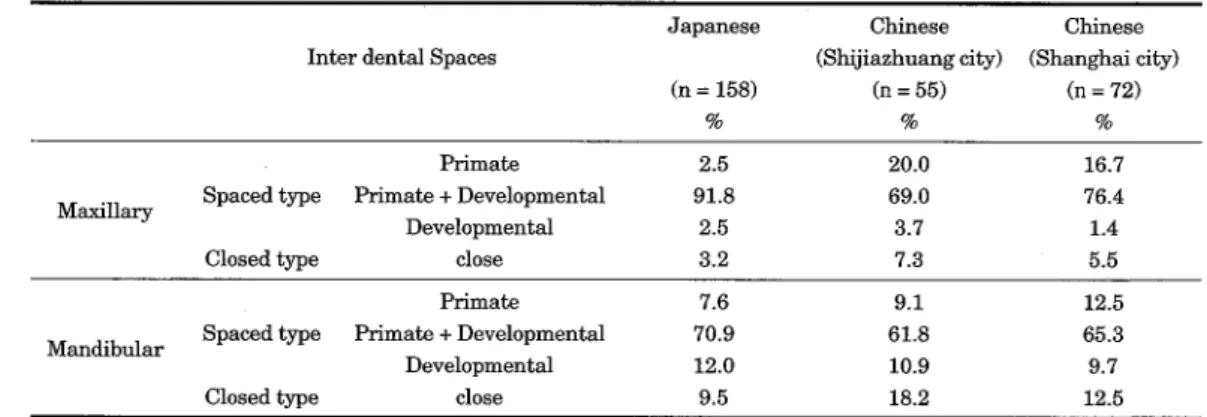
We previously reported that the frequency ofeach type ofinterdental spaces in children in Shang-hai city was between that in Japanese children and that in children in Shijiazhuang city 2'. Although the frequency that both primate and developmental spaces were observed was highest in both the maxilla and ma.ndible in Chinese children, the frequency that only primate spaces were observed was slightly higher than that in Japanese children, and we left the determination of whether this finding was characteristic of Chinese children to future evaluation.
In addition in this investigation, the frequency that both primate and developmental spaces were observed was highest in both the maxilla and mandible in Chinese children (Table 10) ; however, because as we reported i'2'`', the frequency that only primate spaces were observed was higher in both the maxi11a and mandible than that in Japanese children, we speculated that the frequency that only primate spaces were observed was characteristic of Chinese children.
Table 10: Inter dental spaces in different races
Inter dental Spaces
Japanese (n = 158) 9o Chinese (Shijiazhuang city) (n = 55) 9o Chinese (Shanghai city) (n = 72)
%
Maxillary Spaced type Closed type Primate Primate + Developmental Developmental close 2.5 91.8 2.5 3.2 20.0 69.0 3.7 7.3 16.7 76.4 1.4 5.5
Mandibular Spaced type
Closed type Primate Primate + Developmental Developmental close 7.6 70.9 12.0 9.5 9.1 61.8 10.9 18.2 12.5 65.3 9.7 12.5
4. Terminal planes and primary canine occlusal relationship
Terminal planes and primary canine occlusal relationship have been reported as factors to evalu-ate occlusion, and there have been reports that the incidence of Vertical type terminal plane was
high i•3). .
Hatae 6' reported that the frequency ofthe Vertical type ofterminal plane was highest, and that of the Mesial step type of terminal plane was second highest in Chinese children (Hong Kong and Tai-wan), and similar results were obtained in our `' investigation of Chinese children (Shijiazhuang city and Shanghai city) and in this investigation (Table 11). Chinese children also showed a markedly higher incidence of the combination of bilateral terminal planes (Mesial step-Mesial step) than Japanese children (Table 12), and we considered that the incidence of Mesial step type was charac-teristic ofChinese children.
Regarding primary canine occlusal relationship, the incidence of type I was highest in Japanese children (Table 11), and similar results were obtained in this investigation of Chinese children i'2'`), but the incidence of type I in Chinese children was lower than that in Japanese children. However, because Chinese children showed a markedly higher incidence bf type M than Japanese children, we considered that type M canine occlusal relationship was characteristic of Chinese children.
Table 11
ta7Nth\ 27(1) 2001
: Terminal plane and primary canine occlusion in different races
37
Terminalplane Primarycanineocclusion
Vertical Distalstep Mesialstep typeI typell typeM
9e 9o 9o 9o 9e 9o Male 85.0 8.4 6.6 85.6 8.4 6.0 (n=83) (141) (14) (11) (142) (14) (10)
Female
86.0 8.7 5.3 80.7 18.0 1.3 Japanese (n=75) (129) (13) '(8) (121) (27) (2) Total 85.4 8.6 6.0 83.2 13.0 3.8 (n=158) (270) (27) (19) (263) (41) (12) Male 36.1 5.6 58.3 59.7 11.1 29.2 (n=36) (26) (4) (42) (43) (8) (21)Chinese
Female
52.6 7.9 39.568A
18.4 13.2(Shijiazhuangcity) (n=19) (20) (3) (15) (26) (7) (5) Total 41.8 6.4 51.8 62.7 13.6 23.7 (n=55) (46) (7) (57) (69) (15) (26) ' Male 67.6 5.4 27.0 44.6 12.2 43.2 (n=37) (50) (4) (20) (33) (9) (32) Chinese
Female
58.6 11.4 30.0 48.6 14.3 37.1. (Shanghaicity) (n=35) (41) (8) (21) (34) (10) (26) Total 63.2 8.3 28.5 46.5 13.2 40.3 (n=72) (91) (12) (41) (67) (19) (58)Table 12 : Relationship between terminal planes and primary canine occlusion in different races
Terminal plane Priinaiv canine eeelusion ;apanese (n=S3)
%
Male Chinese (Shijiathuangcity) (n=3e) % Chinese (Shanghaiedty) {n=S7)%
Japanese (n=75)%
Female Chinese Chinese (Shijiariiuangtity) (Shanghaieity) {n=19) (n=S5)%%
Japanese {n=158}%
Total Chinese (Shijiaaliuengdity) (n=55) % Chinese (Shanghaieity) (n -L 72)%
vetiul Vetlul -Vertiul ' typeI typell typeM 77.8 3.0 4.2 25.0 6.9 4.2 33.S ' 10.8 23.0 73.3 12.0 O.7 36.8 13.2 2.6 35.7 7.1 15.7 75.6 7.3 2.5 29.1 9.1 3.6 34.7 9.1 19.4 ]istalstep ' Distalstep u Distalstep ' typeI type[ typeM 2.4 5.4 O.6 2.8 2,S o,o 4.0 1.3 o.o 2.6 6.0 o.o o.o 5.3 2.6 L5 7.1 5.7 2.5 5.7 O.3 1.S 3.6 O.9 2.8 4.2 2.8 Mesialstep -Mesialsbep r Mesialstep ' typeI typell typeM 5.4 o.o 1.2 31.9 IA 25.0 6.8 o.o 20.3 4.7 o.o O.7 31.6 o.o 7.9 8.6 o.o •18.6 5.1 o.o 1.0 31.9 os 19.1 7.6 o.o . 19.4Table 13 : Combination ofbilateral terminal planes in different races
TbTpes Japanese (n = 158) 9o Chinese (Shijiazhuang city) (n = 55) 9o Chinese (Shanghai city) (n = 72)
%
Vertical Ver'tical Vertical Distal step Mesial step Mesial step Vertical Distal step Mesial step Distal step Mesial step Distal step 77.8 9.5 5.7 3.8 3.2 o.o 32.8 3.6 14.6 3.6 43.6 1.8 51.4 12.5 11.1 1.4 22.2 1.4In regard to the combinations ofterminal plane types and primary canine occlusal relationships, although the incidence of Vertical-type I was highest in both Japanese children and children in
Shanghai city, the incidence ofVertical-type I in children in Shanghai city and that in Shijiazhu-ang city were lower than that in Japanese children (Table 13). However, children in ShShijiazhu-anghai city showed a higher incidence ofVertical-typeM and Mesial-typeM than Japanese children, and chil-dren in Shijiazhuang city showed a higher incidence of Mesial-type M than Japanese chilchil-dren, we considered that Chinese children showed a higher incidence of Mesial type terminal plane, and types I and M primary canine occlusal relationships than Japanese children, and we speculated that the incidence of Mesial step type terminal plane and that of type M primary canine occlusal re-lationship in panicular were characteristic ofChinese children.
Conclusion
To obtain the definite standard values for various items regarding the growth and development of Chinese children, we performed dental examinations on children in the kindergarten attached to Shanghai Teachers' University in Shanghai city. As study materials, dental casts obtained between 1996 and 1999 from 72 Chinese children aged 3 to 6 years with normal primary occlusion were used to evaluate the mesio-distal crown diameters of the primary teeth, the sizes of the primary dental arch, and the standard values and frequency distributions of primary occlusion based on the Japa-nese Society of Pediatric Dentistry (J. S. P. D.) standard ofnormal primary occlusion.
T[he following conclusions were drawn.
1. As a result ofthe measurement ofthe mean values ofthe mesio-distal crown diameters of the ciduous teeth, and the sizes of the primary dental arch, males showed higher values than males.
2. In regard to the interdental spaces both in the maxilla and mandible, primate and developmental spaces together were most frequently observed.
3. In regard to the occlusal relationship, the incidence ofterminal planes was higher in the order of Venical type År Mesial step type År Distal step type, and the incidence of primary canine occlusal
relationships was higher in the order of type I År type M År type ll .
4. The items that were thought to be characteristic of Chinese children were the frequency that • only primate spaces were observed, and the incidence ofthe Mesial step type terminal plane and type M primary caiiine occlusal relationship.
We presented the summary of this paper at the Second Asian Congress of Pediatric Dentistry (Shanghai city, China, November 3, 2000).
Part of this study was subsidized by The Nippon Foundation-Japan China Medical Association
aid project in 1999.
References
1) Iwasaki H, Lin YF, Miyazawa H, Miyazaki A, Suzawa Y, Zhang XY, Hai HL, Zhang YH, Lian YM, Niu MY, Li XG, Xu B, Wang YJ, Su G and Kobayashi S (1994) The Morphology of the mary dental arch ofChinese children in Shijiazhuang city Parb-I : Research concerning the size of the primary tooth crown, primary dental arch and the condition of primary ocelusion. moto Shigaku 20 : 157-71. (in Japanese, English abstract)
taJzlgetiLi!i4 27(1) 2001 39
ofthe primary dental arch of forty-three Chinese children-Comparison between Japanese dren and children in Shanghai with regard to the sizes of the primary teeth, primary dental arch and the condition ofprimary occlusion-. J Ped Dent 36 : 625-33. (in Japanese, English
stract)
3) Japanese Society of Pediatric Dentistry (1993) Research concerning the sizes of the primary tooth crown, primary dental arch and the condition ofprimary occlusions of the Japanese. J Ped Dent 31 : 375-88. (in Japanese, English abstract)
4) Iwasaki H, NakayamaA, UchiyamaM, Kondo Y, Ochiai H, Miyazawa H and Shi S (1998) The
morphology of the primary dental arch in Chinese children-Residents of Shijiazhuang and Shanghai, China-.Matsumoto Shigaku 24 : 77-92. (in Japanese, English abstract)
5) Nonaka K, Otani H, Sasaki Y, Nakata M, Ono H, Ishikawa M, Kamiyama K, Sobue S,
gasaka N, Ogura T, Deng H, Shi S, Liu DW, Wei SH, Saito T, Takei T, Amano H, Nobuke H,
Shiono K, Shimizu H, Huan W, Zhang Y, Dong JH, Hu DY, Chan JCY and Tong LSM (1993) A
study on the condition of the dental arch and malocclusion in Chinese children. J Ped Dent 31 : 527-35. (in Japanese, English abstract)
6) Hatae M (1992) A morphological study of deciduous dentition in Chinese children in Hong Kong. J Kyushu Dent Soc 46 : 647-57. (in Japanese, English abstract)
?y"en : I N-L7'i'le#iti,INF.C:6' Ct 6\LvaljIMIfi.ts,c7)ital- [Eemi-pi-A. ! .72pmJa)ttffaJ hi
rkseeMl=, #ptfi ge., pliM rybl, Pi]Lhmrkfu], diJ!I9es]:,
pamthaB,, fi-ptrkJ pa,., E'Vi[as;kl (deJ!IgtwJlc • iJNSEtsT")
kr tz, wt va, JIIi' eqk (N 'es JJit • Nte ee\ wa • iJxJE tw Isu • pFi N)
gill 6 Vi rP g.A.rixJE cDrkft • itLt t: ca-3- 6 -cafi E O;.I,,llgept e HAma:-g- 6 l 8 ler e ts }:, LhiemenJlÅq\ Nes klJre paEotwT}it-Zcbh' ig lgg6t\ ik O Xtu L(vÅr 6 . ? l '(f"lgg61F rba 6 lggglF g "(f' }:t# 6 in.klE'm'"tekA
2 g ]l. i}, iz k 3 ue rb li 6 6 ue a) th JE72pmJ (1) liiL tw 5iiJ nc ag lt IiJf t7) []ttt E *} 2 L , ij;L ta th nc ts .j Ue giL ts 5iiJ iil} op JJIc g " , frdiAJtSl,S.ts.. Åq1) itst lt 2T D k .
1. cancitLL-,d}ptdi.ts', dwgmJE!;(DJEcge"ca, SSEa)fizis'JJXc3vtsmbeii-scLfe.
2 . shFdi.9lt,.Pth)IJIkReg , rli-FXlj2 6 V:$- ftzave. 2 itEigKMtost.;t!iJlli-g-6 t, cD)bS;HisE t, fi- $e:iEM•.bt) t}, itLk.
3 . lkkArStwaS- R- J-]V7eV-- )itos'eeELgJÅriLffJdNagÅrLt,dQJ(DJua:fi. Åq , X,Jftcapt,,cE-waes-(i-}S I agÅr
M ag År ll ag (1) Jua V: fi. vÅreeE=S:IK,. ft .:"pt L L- .
4 . pP N ,N alN SE }: ng tw e9 e: reE-S- 6 2 Z k. Ci, M. tt it, (D Va , sc- ft Z Pth a) ,)5k a) agN t 5r -- R- t )V 7" l/ L-- Årt (D