An
approximation
scheme for optimal
stochastic control
problems*
Yumiharu NakanoGraduate School ofInnovation Management
Tokyo Institute ofTechnology
1
Introduction
Weconsider the optimal stochastic controlproblemsover afinite horizon $T\in(0, \infty)$ withvalue
function
$v(t, x)= \inf_{\alpha\in}E[f(X_{T}^{t,x,\alpha})+l^{T}g(s, X_{s}^{t,x,\alpha}, \alpha_{s})ds], (t, x)\in[O, T]\cross \mathbb{R}^{m}$, (1.1)
where the controlled process $\{X_{s}^{t,x,\alpha}\}$ is governedby
$[Matrix]$
(1.2)Here, $\mu$: $[0, T]\cross \mathbb{R}^{m}\cross Aarrow \mathbb{R}^{m},$$\sigma$ : $[0,T]\cross \mathbb{R}^{m}\cross Aarrow \mathbb{R}^{m\cross d},$ $f$ :$\mathbb{R}^{m}arrow \mathbb{R},$ $g$ : $[0, T]\cross \mathbb{R}^{m}\cross Aarrow \mathbb{R}$
and $A\subset \mathbb{R}^{k}$
.
The conditions imposedon
these functionsare
described inSection
2below.
Theprocess $\{W_{s}\}_{0\leq t\leq T}$is
a
$d$-dimensional standardBrownian motionon a filteredprobability space$(\Omega, \mathcal{F}, \{\mathcal{F}_{t}\}_{0\leq t\leq T}, \mathbb{P})$ satisfying the usual conditions. The class
$\mathcal{A}$ofcontrols isthecollection of
$A$-valued $\{\mathcal{F}_{t}\}_{0\leq t\leq T}$-progressively measurable processes $\{\alpha_{t}\}_{0\leq t\leq}\tau.$
One ofthemainapproachesforoptimalstochastic controlproblemsistosolve the
Hamilton-Jacobi-Bellman (HJB) equation that the value function should satisfy, and then to construct
a
control strategy via the verification argument. For
our
problem (1.1), the corresponding HJBequation is given by
$-\partial_{t}v+F(t, x, Dv, D^{2}v)=0, (t, x)\in[O, T)\cross \mathbb{R}^{m}$, (1.3)
with the terminal condition$v(T, x)=f(x),$ $x\in \mathbb{R}^{m}$, where
$F(t, x,p, M)= \sup_{a\in A}\{-\mu^{*}(t, x, a)p-\frac{1}{2}tr((\sigma\sigma^{*})(t,x, a)M)-g(t, x, a)\}$
for $x\in \mathbb{R}^{m},$ $p\in \mathbb{R}^{m}$, and $M$, a symmetric and nonnegative definite $m\cross m$ matrix. Here we
have denoted by $\partial_{t}$ the partial differential operator with respect to the time variable
$t$, by $D^{j}$
the j-th order partial differential operator with respect to the space variable$x$, and by $c^{*}$ the
transposeof amatrix $c.$
Since analytical solutions for HJB equations
are
rarely available,a
number of numericalmethods have been proposed in the literature. However, for practical applications there still
remain several challenging problems. First one is that in
some
schemes the coefficients of thefinite-difference scheme (see, e.g., Kushner and Dupuis [13]), the diffusion matrix $\sigma\sigma^{*}$ in
our
notation should basically be diagonally dominant. Althoughthisrestriction
can
beweakenedbyconsidering thegeneralized
finite-difference
that involves a nontrivial adjustmentofthe diffusionmatrix,
we
may needa
large size ofthe stencil dependingon
a problem, as wellas
thefurthercomputational efforts for the implementation. See Bonnans and Zidani [3], Bonnans et al. [2]
andthe references therein. The optimal quantization approachtaken by Pag\‘es et al. [17] works
under mildconditionson the coefficients, in particular, under quadratic growthconditions on $f$
and $g$
.
However, their scheme requires most components of the process $\{X_{s}^{x,\pi}\}$ being actuallycontrol-free. InFahimet al. [8], theyextract
an
uncontrolled generator from the nonlinearity$F,$and then
use
aprobabilistic representationof the HJB equationbasedon the process associatedwith such generator. Then the partial derivatives of the value functionin that representation
are computedby theexpectations of random variables involving the valuefunctionitself via the
integration-by-parts. These tricks cost
some
strong non-degeneracy conditionson
$F.$Secondproblemiscomputationaldifficulties in high-dimensional
cases.
In general, thefinite-difference scheme needs a spatial grid with its size growing exponentially as the dimension $m$
becomeslarge. As forthe method by [17], the quantization
error
with respecttoan
$\ell$-dimensionalrandomvariableisknownto be$O(N^{1/\ell})$ ifwe denoteby $N$the number of discretizing pointsfor
the random variable. The scheme by [8] can be applied to high-dimensional problems because
it is
based
on Monte Carlosimulationforcomputing theconditionalexpectation, butthekerneldensity estimationused in this procedure is in general suffered from thecurse-of-dimensionality.
The finite-element like schemes studied by e.g., Camilli and Falcone [5] and Debrabant and
Jakobsen [7], often called Semi-Lagrangian schemes, solve the first problem. That is, their
scheme converge to the original value functions under no special assumption on the diffusion
matrix $\sigma\sigma^{*}$. The difficulty in their scheme
is that they require the interpolation of the value
functions
in the state space, and need involvedcomputational proceduresfor theimplementationin high-dimensional problems (see Carlini et al. [6]).
In thispaper, we propose a new time-discretization schemefor the problem (1.1). Itis based
on a
probabilistic representation for the convolution of$v$ bya
probability density function. InSection 2 below, we first give a rough derivation ofthe semi-discrete scheme, and then prove
its convergence results by the viscosity solution method presented in Barles and Souganidis
[1]. With the choices of the kernel and with the estimation methods for the conditional
expec-tations, various numerical methods can be generated. Resulting numerical methods allow us
to
use
uncontrolled Markov processes to estimate the conditional expectations in the dynamicprogrammingprocedure. Moreover, they can be implemented without the interpolation of the
value function or the adjustment of the diffusion matrix. We present one of possible methods
with
Gaussian distributions
inSection 3.
$A$ numerical experiment is also performed there. Wefocus on an artificialproblemhaving two-dimensional state space, where an analytical solution
for (1.3) is easilyobtained.
Throughout this paper, wewrite $|a|=( \sum_{i,j}a_{i,j}^{2})^{1/2}$ for amatrix $a=(a_{i,j})$
.
By$C$ we denote2
Approximation of the value function
We discuss the general stochastic controlproblem (1.1) under the following assumptions onthe
coefficients:
Assumption 2.1 1. The
functions
$\mu,$$\sigma,$$f,g$are
Borel measumble withrespectto $(t, x, a)$ andcontinuous with respect to $(t, x)$ uniformly
over
$a.$2. There exists
a
positive constant $K$ such that,for
every $s,$$t\in[0, T],$ $x,$$y\in \mathbb{R}^{m}$ and$a\in A,$$|\mu(t,x, a)|+|\sigma(t,x, a)|\leq K(1+|x|)$,
$|\mu(s, x, a)-\mu(t, y, a)|+|\sigma(s,x, a)-\sigma(t, y, a)|\leq K|s-t|+K|x-y|,$ $|f(x)|+|g(t, x, a)|\leq K.$
With these conditions, the controlled stochastic differential equation (1.2) has aunique strong
solution for each control $\alpha\in \mathcal{A}$ (see, e.g., Fleming and
Soner
[9]or
Krylov [12]) and the valuefunction$v$in(1.1)becomes
bounded.
Moreover, it is known that$v$satisfies the viscosity solutionproperty. To be precise, recallthat
an
$\mathbb{R}$-valued, upper-semicontinuous function$u$on
$[0, T]\cross \mathbb{R}^{m}$issaidto be
a
viscositysubsolution of(1.3) if,for any$(t,x)\in[O, T)\cross \mathbb{R}^{m}$and any smooth function$\varphi$ such that $u-\varphi$has a local maximum at $(t, x)$ we have
$-\partial_{t}\varphi(t, x)+F(t, x, D\varphi(t, x), D^{2}\varphi(t, x))\leq 0.$
Similarly, an $\mathbb{R}$-valued, lower-semicontinuous function$u$ on $[0, T]\cross \mathbb{R}^{m}$ is said to be
a
viscosity supersolution of(1.3) if, forany $(t, x)\in[0, T)\cross \mathbb{R}^{m}$ andanysmoothfunction $\varphi$such that$u-\varphi$has
a
local minimum at $(t, x)$ we have$-\partial_{t}\varphi(t, x)+F(t, x, D\varphi(t, x), D^{2}\varphi(t,x))\geq 0.$
Wesay that$u$ isa viscosity solution of(1.3) ifit is both a viscosity subsolution and
a
viscositysupersolution of (1.3). Then, Theorem 4.3.1 in Pham [19] tells
us
thatour
value function $v$is indeed
a
viscosity solution of (1.3). In addition, by Theorem4.4.5
in [19] the followingcomparison principle holds: foreverybounded, upper-semicontinuous viscosity subsolution$u$of
(1.3) and bounded lower-semicontinuous viscosity supersolution $w$ of(1.3) such that $u(T, x)\leq$
$w(T, x),$ $x\in \mathbb{R}^{m}$,
we
have$u(t, x)\leq w(t,x) , (t, x)\in[0, T]\cross \mathbb{R}^{m}.$
Let $\{t_{i}\}_{i=0}^{n}$ be a fixed set of time indices such that $0=t_{0}<t_{1}<\cdots<t_{n}=T$ with
$h=t_{i}-t_{i-1}=T/n,$ $i=1,$$\ldots,$$n$
.
We consider $n$ sufficiently largeso
that $h\in(0,1]$.
To finda
time discretization scheme for the valuefunction, first wewrite down the dynamic programming
principle
as
follows:Replacing by its Euler-Maruyama approximation$\hat{X}_{t_{i+1}}^{t_{i},x,a}$ defined by
$\hat{X}_{s}^{t,x,a}=x+\mu(t, x, a)(s-t)+\sigma(t, x, a)\sqrt{s-t}G, t\leq s\leqt+h, a\in A,$
formally
we
have$\mathbb{E}[v(t_{i+1}, X_{t_{i+}}^{t_{i},x}i^{\alpha})+\int_{t_{i}}^{t_{i+1}}g(s, X_{s^{i}}^{t,x,\alpha}, \alpha_{s})ds]\approx \mathbb{E}[v(t_{i+1},\hat{X}_{t_{i+1}}^{t_{i},x,\alpha_{t_{i}}})]+hg(t_{i}, x, \alpha_{t_{i}})$.
Here, $G=(G_{1}, \ldots, G_{d})^{*}$is arandom variable such that $G_{i}$’s
are
mutually independent and that$\mathbb{E}[G_{i}]=0, E[G_{i}G_{j}]=\delta_{ij}, \mathbb{E}[|G_{i}|^{3}]<\infty,i,j=1, \ldots, d$, (2.1)
where $\delta_{ij}$ denote the Kronecker’s delta.
Now
we
consider the convolution $\phi^{h}*v(t_{i+1}, \cdot)$ bysome
kernel $\phi^{h}$ to approximate $v(t_{i+1}, \cdot)$.
To this end, let $\phi$ be a probabilitydensity function on $\mathbb{R}^{m}$ with full support, i.e., $\phi(y)>0$ for
all $y\in \mathbb{R}^{m}$, andthen define
$\phi^{h}(x):=\frac{\phi(x/\lambda(h))}{\lambda(h)^{m}}, x\in \mathbb{R}^{m},$
where$\lambda$isapositivefunction on
$(0,1]$. Then,for any bounded function$u$, the convolution $\phi^{h}*u$
can berepresented as
$( \phi^{h}*u)(x+\xi)=\int_{\mathbb{R}^{m}}u(z)\frac{\phi((x+\xi-z)/\lambda(h))}{\lambda(h)^{m}}dz$
$= \int_{\mathbb{R}^{m}}u(x+\lambda(h)z)\phi(\frac{\xi}{\lambda(h)}-z)dz, x, \xi\in \mathbb{R}^{m}.$
Let $\mathcal{D}^{h}$
be a subset of$\mathbb{R}^{m}$ satisfying
$\int_{\mathbb{R}^{m}\backslash \mathcal{D}^{h}}\phi(\xi/\lambda(h)-z)dzarrow 0,$ $h\searrow 0$, and let $\psi^{h}$ be an
another probability density function having $\mathcal{D}^{h}$
as
the support set. Then, roughly speaking,$(\phi^{h}*u)(x+\xi)$ is approximatedby $\int_{\mathcal{D}^{h}}u(x+\lambda(h)z)\phi(\xi/\lambda(h)-z)dz$and this
can
bewrittenas
$\int_{\mathcal{D}^{h}}u(x+\lambda(h)z)\phi(\frac{\xi}{\lambda(h)}-z)dz=\int_{\mathcal{D}^{h}}u(x+\lambda(h)z)\phi(\frac{\xi}{\lambda(h)}-z)\frac{\psi^{h}(z)}{\psi^{h}(z)}dz$
$= \mathbb{E}[u(x+\lambda(h)Z^{h})\phi(\frac{\xi}{\lambda(h)}-Z^{h})\frac{1}{\psi^{h}(Z^{h})}],$
where$Z^{h}$ isarandom variable with probability density$\psi^{h}$, which is assumed to be independent
of$G$
.
Thus, denoting $H_{h}^{t,x,a}=\mu(t, x, a)h+\sigma(t, x, a)\sqrt{h}G$, wehave$\mathbb{E}[(\phi^{h}*u)(\hat{X}_{t+h}^{t,x,a})]\approx \mathbb{E}[\mathbb{E}[u(x+\lambda(h)Z^{h})\phi(\frac{H_{h}^{t,x,a}}{\lambda(h)}-Z^{h})\frac{1}{\psi^{h}(Z^{h})}|H_{h}^{t,x,a}]]$
$= \mathbb{E}[u(x+\lambda(h)Z^{h})\phi(\frac{H_{h}^{t,x,a}}{\lambda(h)}-Z^{h})\frac{1}{\psi^{h}(Z^{h})}].$
The last expression mightbe useful since theargument of$u$ is control-free. Then,
as
$\lambda(h)\searrow 0,$the quantity $\mathbb{E}[(\phi^{h}*u)(\hat{x}_{t}^{t}\dotplus_{h}^{x,a})]$ converges to $\mathbb{E}[u(\hat{x}_{t}^{t}\dotplus^{x_{h}a})]$ under mild conditions on
$u$, so we
expect that the schemedefined by
with
$\Phi^{h}[u](t, x)=\inf_{a\in A}\{E[u(x+\lambda(h)Z^{h})\phi(\frac{H_{h}^{t,x,a}}{\lambda(h)}-Z^{h})\frac{1}{\psi^{h}(Z^{h})}]+hg(t, x, a)\}$
gives
an
approximationforthe value function$v.$Let $\beta$ be
a
functionon
$(0,1]$ defined by$\beta(h)=\sup_{t\in l0,T|,\xi\in R^{m} ,a\in A}\mathbb{E}\int_{\mathbb{R}^{m}\backslash \mathcal{D}^{h}}\phi(\frac{H_{h}^{t,\xi,a}}{\lambda(h)}-z)dz$. (2.2)
Then
we are
able to statethe following convergence result.Theorem 2.2 Let $v$ : $[0, T]\cross \mathbb{R}^{m}arrow \mathbb{R}$ be
defined
by (1.1). Suppose that Assumption2.1
issatisfied.
Suppose also that$\lim_{h\searrow 0}\frac{\lambda(h)+\beta(h)}{h}=0.$
Then,
$v^{h}(t_{i}, y) arrow v(t, x)$
as
$h\searrow 0,$ $t_{i}arrow t$, and$yarrow x$, uniformlyon
any compact subsetof
$\mathbb{R}^{m}.$Toobtain the ratesof convergenceof
our
schemes,we
imposemore
regularity conditionson
the coefficients.
Assumption 2.3 There exist positive
constants
$K’$ such that,for
every
$s,$$t\in[0, T],$ $x,$$y\in \mathbb{R}^{m}$and $a\in A,$
$|f(x)-f(y)|+|g(s, x, a)-g(t, y, a)|\leq K’|x-y|+K’|s-t|^{1/2},$
$|\mu(t, x, a)|\leq K’, |\sigma(t, x, a)|\leq K’.$
Theorem 2.4 Let$v:[0, T]\cross \mathbb{R}^{m}arrow \mathbb{R}$ be
defined
by (1.1). Suppose that Assumptions2.1
and2.3 are
satisfied.
Suppose also that $E[G_{i}^{3}]=0,$ $E[G_{i}^{4}]<\infty,$ $i=1,$$\ldots,$
$d$
.
If
$\lambda$ and $\beta$ satisfy$\lambda(h)+\beta(h)\leq Ch^{7/6}$, then we have
$0 \leq i\leq n\max|v^{h}(t_{i}, x)-v(t_{i}, x)|\leq Ch^{1/6}, x\in \mathbb{R}^{m}.$
Furthermore,
if
$\lambda(h)+\beta(h)\leq Ch^{3/2}$ thenwe
obtain$-Ch^{1/6}\leq v(t_{i}, x)-v^{h}(t_{i}, x)\leq Ch^{1/4}, x\in \mathbb{R}^{m}, i=1, \ldots, n.$
3
$A$fully
numerical method
Throughout this section, we suppose that Assumptions 2.1 and 2.3
are
satisfied. We take the$\mathbb{R}^{d}$-valued random variable $G=G^{M,q}$
as an
optimally quantized random variable in thesense
that $G^{M,q}$ isaminimizer of
randomvariables with -supporting points, where and isa -dimensional
standard
Gaussian
random variable. We refer to Grafand Luschgy [10] fora
detailed accountof optimal quantization theory, and to Pag\’es and Printems [18] for numerical procedures for
obtaining $G^{M,2}$
.
Set$G^{M,q}(\Omega)=\{\gamma_{1}, \ldots, \gamma_{M}\}, \mathbb{P}(G^{M,q}=\gamma_{i})=p_{i}, i=1, \ldots, M.$
In most of numerical realizations, the random variables$G^{M,q\prime}s$approximatelysatisfy the moment
condition (2.1). $A$reasonwhywe usethe quantization is thatweneedsufficientlymanypoints of
$H_{h}^{t,x,a}/\lambda(h)$’s
near
itsmean
tobeshot by MonteCarlo simulations of Gaussianrandom variables,with less number ofcomputations. See the comment made just after (3.2) below.
We choose thefunction $\lambda$
as
$\lambda(h)/harrow 0, h\searrow 0.$
For example, we maytake $\lambda(h)=h/(-\log h)$.
Todescribe the realizations of$H^{t,x,a}$
$h$ , weput
$\eta_{i}^{h}(t, x, a)=\mu(t, x, a)h+\sigma(t, x, a)\sqrt{h}\gamma_{i}, i=1, \ldots, M.$
As
thefunctions
$\phi$ and $\psi^{h}$,we
examine$\phi(y)=\frac{e^{-|\xi|^{2}/2}}{(2\pi)^{m/2}}, \psi^{h}(y)=\frac{e^{-|\xi|^{2}/(2\tau(h))}}{(2\pi\tau(h))^{m/2}}, y\in \mathbb{R}^{m},$
where$\tau(h)>0.$
Let $Z$be an$m$-dimensionalstandard Gaussianrandom variable. Then $\Phi^{h}[u]$ isdescribed by
$\Phi^{h}[u](t, x)=\inf_{a\in A}\{\sum_{j=1}^{M}p_{j}\mathbb{E}[u(x+\lambda(h)\sqrt{\tau(h)}Z)\phi(\frac{\eta_{j}^{h}(t,x,a)}{\lambda(h)}-\sqrt{\tau(h)}Z)\frac{1}{\psi^{h}(\sqrt{\tau(h)}Z)}]$
$+hg(t, x, a)$ .
Furthermore, we introduce the uncontrolled Markovprocess $\{S_{k}\}_{k=0}^{n}$ defined by
$S_{k+1}=S_{k}+\lambda(h)\sqrt{\tau(h)}Z_{k+1}, k=0, \ldots, n-1,$
where $\{Z_{k}\}_{k=1}^{n}$ denote
an
i.i.$d$.
sequence with $Z_{1}\sim Z$. With this process, $\Phi^{h}[u]$ can be writtenas
$\Phi^{h}[u](t_{k}, x)$
$= \inf_{a\in A}\{\tau(h)^{m/2}\sum_{i=1}^{M}p_{i}\mathbb{E}[u(S_{k+1})\exp(-\frac{1}{2}|\frac{\eta_{i}^{h}(t_{k},x,a)}{\lambda(h)}-\sqrt{\mathcal{T}(h)}Z|^{2}+\frac{1}{2}|Z|^{2})|S_{k}=x]$
$+hg(t_{k}, x, a)$
.
To computethe
conditional
expectation in (3.2),we
use
the kemeldensity estimators withsamples from Monte Carlo simulation. We refer to Longstaff and Schwartz $[15]$,
a
landmarkstudy of this approach in American option pricing, and to Bouchard and Touzi [4] and Lemor
et al. [14] in the context ofbackwardstochastic differential equations. It should bementioned
that this regression method is also adopted in [8] for the numericalstudy ofHJB equations.
In
our
framework,an
estimator $\tilde{\mathbb{E}}^{h}[Y|S_{k}=x]$ for$E[Y|S_{k}=x]$can
betakenas
$\tilde{E}^{h}[Y|S_{k}=x]=\frac{\sum_{j=1}^{N}Y^{(j)}\kappa(\frac{x-S_{k}^{(j)}}{\Delta})}{\sum_{j=1}^{N}\kappa(\frac{x-S_{k}^{(j)}}{\Delta})}$
if the denominator is nonzero. Otherwise the estimator isdefined as zero. Here,
$Y=u(S_{k+1}^{h}) \exp(-\frac{1}{2}|\frac{\eta_{j}^{h}(t_{k},x,a)}{\lambda(h)}-\sqrt{\tau(h)}Z|^{2}+\frac{1}{2}|Z|^{2})$ , $Y^{(1)},$ $\ldots,$$Y^{(N)},$ $Z^{(1)},$ $\ldots,$ $Z^{(N)}$, and$S_{k}^{(1)},$ $\ldots,$
$S_{k}^{(N)}$
are
samples from MonteCarlo simulations for$Y,$ $Z$, and $S_{k}$ respectively, and $\Delta$ denotes the bandwidth for thekernel function $\kappa.$ $A$ typical
example for $\kappa$ isthenaive kemel defined by
$\kappa(z)=1_{\{|z|\leq 1\}}, z\in \mathbb{R}^{m}.$
Werefer to Gy\"orfi et al. [11] for other estimators and its convergence analyses.
Consequently, our schemecan be implemented as follows: $V_{n}^{(\ell)}=f(S_{n}^{(\ell)}),$ $\ell=1,$
$\ldots,$$N$, and
$V_{k}^{(\ell)}= \inf_{a\in A}\{\begin{array}{l}M \sum_{j=1}^{N}V_{k+1}^{(j)}\exp(-\frac{1}{2}|\frac{\eta^{h}(t_{k},S_{k}^{(\ell)},a)}{\lambda(h)}-\sqrt{\tau(h)}Z^{(j)}|^{2}+\frac{1}{2}|Z^{(j)}|^{2})\kappa(\frac{S^{(\ell)}-S^{(j)}}{\Delta})\tau(h)^{m/2}\sum_{i=1}p_{i}\overline{\sum_{j=1}^{N}\kappa(\frac{S^{(\ell)}-S^{(j)}}{\Delta})}\end{array}$
$+hg(t_{k}, S_{k}^{(\ell)}, a) , \ell=1, \ldots, N, k=0, \ldots, n-1.$
(3.2)
We note that in general we need to set $\tau(h)$ large
so
that the values$\exp(-\frac{1}{2}|\frac{\eta_{i}^{h}(t_{k},S_{k}^{(\ell)},a)}{\lambda(h)}-\sqrt{\tau(h)}Z^{(j)}|^{2})$
actually contribute to the computation of$V_{k}^{(\ell)}.$
As for control strategies, a minimizer $a_{k}^{(\ell)}$ ofthe right-hand side in (3.2) is a numerically
optimal control at $(t_{k}, S_{k}^{(\ell)})$
.
Incase
one needs the values ofreasonable control at given grids,As
an
illustrationof
our scheme, we examine the testproblem described by$T=0.1, d=1, m=2, A=\{a=(a_{1}, a_{2})^{*}\in \mathbb{R}^{2}:a_{1}^{2}+a_{2}^{2}=1\},$
$\mu(t, x)=0, \sigma(t, x, a)=\sqrt{2}(a_{1}, a_{2})^{*},$
$f(x)=(1+T)T\sin x_{1}\sin x_{2},$ $g(t, x, a)=-2(1+t)Taa_{2}\cos x_{1}\cos x_{2}+tT\sin x_{1}\sin x2$
for
$t\in[0, T],$ $x=(x_{1}, x_{2})^{*}$, and $a=(a_{1}, a_{2})^{*}\in A.$ This example is adopted in $[7J$.
It isstmightforward to see that the value
function
$v$ in this problem is explicitly given by$v(t,x)=(1+t)T\sin x_{1}\sin x_{2},$
and that anypoint in $A$ is an optimal control.
In implementing ournumerical method (3.2), we take $h=0.01$, and set$\lambda(h)=h/(-\log(h))$
and $\tau(h)=(\sqrt{2h}/\lambda(h))^{2}$
.
We
use
$N=3\cross 10^{6}$ samples to estimate the kemel density withthe naive kemel and $\Delta=0.1$
.
The quadratic quantization with $M=100$ points is adoptedfor
$G^{(M,q)}$.
The initial valueof
the contmlled process is set to be $(\pi/2, \pi/2)^{*}$.
The resultingaverage absolute
emor
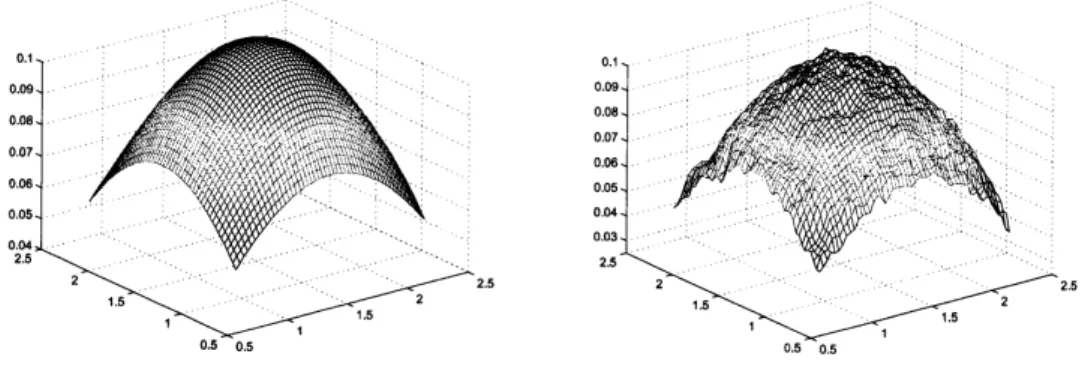
between $V_{k}^{(\ell)}$ and$v(t_{k}, S_{k}^{(\ell)}),$ $\ell=1,$$\ldots,$$N$, at $k=9$ is0.0064. Figure 1
compares $v(t_{k}, x)$ and
an
estimated valuefunction
using $V_{k}^{(\ell)\prime}s$ at $k=9$. Weuse
the averagevalues
of
$V_{k}^{(\ell)\prime}s$in suitable clusters to estimate the value
function
atuniform
$gnd$points. Thefigure indicates that our method on the whole
underestimates
the analytical solution. This maybe because the number
of
Monte Carlopaths shooting$\eta_{i}^{h}(t_{k}, S_{k}^{(\ell)}, a)/\lambda(h)$ ’s is stillinsufficient.
Figure 1: The analytical (left) and estimated (right) value functions at $t=0.09$ around $x=$
$(\pi/2, \pi/2)^{*}.$
Acknowledgements
The author is thankful to Takashi Tamura for helpful comments. This study is partially
References
[1] G. Barles and P. E. Souganidis. Convergence of approximation schemes forfullynonlinear
second order equations. Asymptot. Anal., 4:271-283,
1991.
[2] F. Bonnans, E. Ottenwaelter, andH. Zidani. A fast algorithm for thetwodimensional HJB
equationof stochastic control. Math. Model. Numer. Anal., 38:723-735,
2004.
[3] F. Bonnans and H. Zidani. Consistency of generalized finite difference schemes for the
stochastic HJB equation.
SIAM
J. Numer. Anal., 41:1008-1021,2003.
[4] B. Bouchard and N. Touzi. Discrete-time approximation and Monte
Carlo
simulation ofbackward stochastic differentialequations. Stochastic Process. Appl., 111:175-206,
2004.
[5] F. Camilli and M. Falcone. An approximationscheme for the optimal control of diffusion
processes. Math. Model. Numer. Anal., 29:97-122,
1995.
[6] E. Carlini, M. Falcone,andR. Ferretti. An efficient algorithm for
Hamilton-Jacobi
equationsin high dimension. Comput. Visual. Sci., 7:15-29,
2004.
[7] K. Debrabant andE. R. Jakobsen. Semi-Lagrangianschemes forlinearandfully non-linear
diffusion equations. Math. Comp. to appear.
[8] A. Fahim, N. Touzi, and X. Warin. A probabilistic numerical method for fully nonlinear
parabolic PDEs. Ann. Appl. Probab., 21:1322-1364,
2011.
[9] W. H. Fleming and H. M. Soner. Controlled Markov pmcesses and viscosity solutions.
Springer-Verlag, NewYork, 2nd edition, 2006.
[10]
S.
Graf
and H. Luschgy. Foundationof
quantizationfor
pmbability distributions.Springer-Verlag, Berlin,
2000.
[11] L. Gy\"orfi, M. Kohler, A. Krzyzak, andH.Walk. A
distribution-free
theoryof
nonpammetricregression. Springer-Verlag, NewYork,
2002.
[12] N. V. Krylov. Controlled
diffusion
processes. Springer-Verlag, New York,1980.
[13] H. J. Kushner and P. Dupuis. Numencal methods
for
stochastic control pmblems incon-tinuous time. Springer-Verlag, New York, 2001.
[14] J.-P.Lemor, E.Gobet,and X. Warin. Rate ofconvergence of
an
empiricalregression methodfor solving generalized backward stochastic differential equations. Bemoulli, 12:889-916,
2006.
[15] F. A. Longstaff and E. S. Schwartz. Valuing american options by simulation: a simple
least-squares approach. Rev. Finan. Stud., 14:113-147, 2001.
[16] Y. Nakano. An approximation scheme for optimal stochastic control problems. preprint,
[17] G. Pag\‘es, H. Pham, and J. Printems. An optimal Markovian quantization algorithm for
multidimensional stochastic control problems. Stoch. Dyn., 4:501-545, 2004.
[18] G. Pag\‘es and J.Printems. Optimal quadraticquantizationfor numerics: theGaussiancase.
Monte Carlo Methods Appl., 9:135-168,
2003.
[19] H. Pham.
Continuous-time
stochastic control and optimization withfinancial
applications.Springer, Berlin,
2009.
Graduate
School
ofInnovation
ManagementTokyo
Institute
of Technology2-12-1 W9-117 Ookayama 152-8552, Tokyo, Japan
$E$-mailaddress: [email protected]
$HI_{5\backslash }I\ovalbox{\tt\small REJECT} 2$ シ$\exists\sqrt[\backslash ]{}Vj?\backslash \sqrt[\backslash ]{}\nearrow^{\backslash }\}\backslash \varpi f^{p}n^{t}H^{\backslash }\backslash$