Characterization of aChaotic Economic
Dynamics
by
Unstable Periodic
Solutions
-An Application to aGeneralized Goodwin Model*
Ken-ichi Ishiyama\dagger , Yoshitaka Saiki\ddagger
Department of Mathematical Sciences
Graduate School of Mathematical Sciences, University of Tokyo
3-8-1 Komaba, Meguro, Tokyo 153-8914, Japan
Abstract
In this paperwestudy the propertiesof the chaotic behavior in agrowthcycle model and the unstableperiodicsolutions foundin the attractor, and therebywepoint outsome
similarities between them. This attempt comes from the recent work in physics. The
result implies unstable periodic solutions can be the keywords to understand the chaotic dynamics.
1Introduction
It is
no
doubt the analysis of the growth trajectory in aphase spaceis
one
of the most important themes in economic dynamics. It is oftendiscussed what happens when agrowth cycle model has been extended
in adirection. In particular, atopic has attracted much attention since
$1980\mathrm{s}$, that is, the controversy surrounding the effects of fiscal policy
on
asimple trade cycle(W01fstetter(1982), Goodwin(1990), Takamasu(1995),
Yoshidaand Asada(2001)$)$
.
Howeverlikeas
other topics thereare
also fewworks concerning this point in which the comparativedynamics involving
the chaotic behavior is discussed.
In recent work in physics(Zoldi and Greenside(1998), Kawahara and
Kida(2001), Kato and Yamada(2002)$)$, anumerical approach has been
attempted using unstable periodic solutions to explain typical chaotic
be-havior and statistical properties in chaotic solutions. The main purpose
of this paper is to propose
an
idea analogous to physics to understand thedynamics of achaotic business cycle, which
can
be expected to be usefulto clarify various chaotic phenomena shown in economic dynamics.
$.\mathrm{W}\mathrm{e}$aregratefulto Professor T. Fujimotoand Professor M. Yamadafortheiruseful comments and fruitful
discussions. The authors retain allresponsibilityforremainingerrorsand omissions.
$\uparrow E$-rnail:ishiyama@ms.
$\mathrm{u}$-tokyo.$\mathrm{a}\mathrm{c}.$jp $\iota_{E}$-rnail:8aiki\copyright ms.
$\mathrm{u}$-tokyo.ac.jp
数理解析研究所講究録 1337 巻 2003 年 92-102
The plan of this paper is
as
follows. In the next section, we give anexample of the nonlinear macr0-economic model. Section 3describes
the properties of the dynamics of the model, where the characteristics
of achaotic solution and unstable periodic solutions are illustrated. It
is cleared in section 4that the chaotic behavior in the dynamics of the
model is qualitatively and quantitatively related to the unstable periodic
solutions found in the attractor. In the final section,
we
concludeour
results and state the possibility of the application.
2The Model
First, we propose agrowth cycle model
as
an
example which representsa
chaotic behavior caused by asimple interaction between countries. The
model is based
on
Goodwin(1967) and its extensions. It consists offol-lowing assumptions.
(A1) We consider twocountries, where there exist respectively three agents:
the government, capitalists, and workers. These countries
are
al-most homogeneous, but parameters regarding astabilization policy
assumed next
can
be different.(A2) The government controls the public expenditure
as
acountercyclicalpolicy, while it is financed by income tax and bond selling. The level
of the public expenditure is decided
on
the basis of two factors: thescale ofthe domestic industry and the domestic employment
rate.l
(A3) The foreign capital share rate
as
wellas
the domestic capital share$\mathrm{r}\mathrm{a}\mathrm{t}\mathrm{e}^{2}$
concern
the amount ofinvestment in each individual country.
This is the only mutual interaction allowed for in the model. The
invested capital and the labor employed contribute to the
produc-tion activity in each country. The level of employment is linearly
dependent
on
the scale of the production.(A4) The workers bargain with capitalists for their money wages rate
tak-ing into consideration of the expected rate of inflation. Moreover the
bargaining power is influenced by the employment $\mathrm{r}\mathrm{a}\mathrm{t}\mathrm{i}\mathrm{o}.3$
(A5) The workers spend their whole disposable incomes, while the
cap-italists
save
their interest incomes besides the better part of theirlSeeWolfstetter(1982).
$2\mathrm{I}\mathrm{f}$we$\mathrm{c}\mathrm{o}\mathrm{n}8\mathrm{i}\mathrm{d}\mathrm{e}\mathrm{r}$the profitrateinstead of the
caPitalshare rate withinternationaltrade,thediscussionbecomes
extremelydIfficult.
$3\mathrm{A}\mathrm{n}$expectation-augmented wagePhillipscurve
isconsideredasYoshida and Asada(2001).
profits. The saving is devoted to the investment otherwise
purchas-ing the government bond.
(A6) The population and the productivity per capita grow with constant
rates. The price is rigid, that is to say, the gradient of change in price
is gentler than that of change in unit labor cost of $\mathrm{o}\mathrm{u}\mathrm{t}\mathrm{p}\mathrm{u}\mathrm{t}.4$
(A7) The growth of the national output depends
on
the relationshipbe-tween the demand and the supply. For convenience, the
excess
supplyis consumed by capitalists, hence the aggregate output is equal to the
aggregate income.
From above assumptions,
we
construct the model which describe thein-teraction among the labor share rates, the employment ratios, and the
expected inflation rates in two countries.
We formulate in advance the six-dimensional simultaneous ordinary
differential equations to be derived
as
follows:$\frac{du_{i}}{dt}=(\hat{w}_{i}-(\alpha+\hat{p}_{i}))u_{i}$, (1)
$\frac{dv_{i}}{dt}=(\hat{\mathrm{Y}}_{i}-(\alpha+\beta))v_{i}$, (2)
$\frac{d\pi_{i}^{e}}{dt}=\theta(\hat{p}_{i}-\pi_{i}^{e})$, (3)
$i=1,2$,
where the variable $u_{i}$
means
the labor share rate in$i$-th country,
$v_{i}$ the
employment ratio, and $\pi_{i}^{e}$ the expected rate of inflation respectively. The
constant $\gamma$ corresponds to the price rigidity assumed in (A6),
$\alpha$ the rate
of the technical
progress,
$\beta$ the growth rate of labor available, and 0isaparameter with respect to the adaptive behavior of the worker. The
symbols $\hat{w}_{i},\hat{p}_{i}$, and $\hat{\mathrm{Y}}_{i}$
represent the respective change rates of the money
wage, of the price of goods, and of the national output in $i$-th country.
They are summarized or rewritten as follows:
$\hat{w}_{i}=f_{i}(v_{i}, \pi_{i}^{e})$; $\frac{\partial f_{i}}{\partial v_{i}}>0,$ $\frac{\partial f_{i}}{\partial\pi_{i}^{e}}>0$, (4)
$\hat{p}_{i}=\gamma(\hat{w}_{i}-\alpha)$, (5)
$4\mathrm{W}\mathrm{e}$considerthepriceadjustment equationassumedin Desai(1973) withaconstant mark-upfactor.
$\epsilon\hat{\mathrm{Y}}_{i}=h_{i}(u_{1}, u_{2})+(1-c)\mu_{i}(v^{*}-v_{i})+(\delta-1)(1-c)(1-u_{i})$ , (6)
where the right-hand side in equation(6) corresponds to the
excess
de-mand5
per output, while $\epsilon,$ $c,$ $\delta,$ $v^{*}$, and $\mu_{i}$ are respectivelyan
outputadjustment coefficient, the consumption coefficient of capitalists, the
in-come
tax rate, the target employment rate set so that $f(v^{*}, 0)=\alpha$, andthe parameter of fiscal policy in $i$-th country. The function $h_{i}$ determine
the effect of the investment on the augmentation of the $\mathrm{o}\mathrm{u}\mathrm{t}\mathrm{p}\mathrm{u}\mathrm{t}.6$ It has
the following properties:
$\frac{\partial h_{\dot{l}}}{\partial u_{i}}<0,$ $\frac{\partial h_{i}}{\partial u_{j}}>0$; $i,j=1,2$ $(j\neq i)$.
In the next section,
we
will discuss numerically the properties of thesolution of the model for aspecific
case.
3The Chaotic Solution and the Unstable Periodic Solutions
In this section weconsider characteristics of the solutions of the model for
aset of parameters and specified $\mathrm{f}\mathrm{u}\mathrm{n}\mathrm{c}\mathrm{t}\mathrm{i}\mathrm{o}\mathrm{n}\mathrm{s}.7$ Here we give two functions
based
on
Yoshida and Asada(2001):$f_{i}(v_{i}, \pi_{i}^{e})=0.1(\frac{1}{1-v_{i}}-4.8)+\pi_{i}^{e}$, (7)
$h_{i}(u_{1},u_{2})=1.5(1-u_{i})^{5}-10.0(u_{i}-u_{j})^{3}$, (8)
while
we
set constants and parametersas
$\alpha=0.02,$ $\beta=0.01,$ $\gamma=0.5$,$\theta=0.8,$ $\epsilon=10.0,$ $\mathrm{c}=0.3,$ $\delta=\frac{2}{7},$ $v^{*}=0.8;\mu_{1}=1.2,$ and $\mu_{2}=8.0$
.
Note that the inequality $\mu_{1}<\mu_{2}$
means
that the government in country 2takes
more
positive stabilizing policy than the other, and the interactionbetween countries is represented by the second term in equation(8).
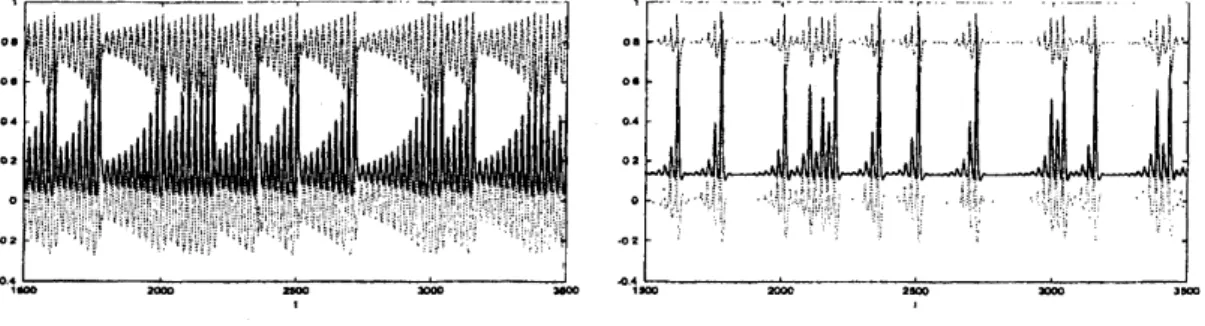
The time series after the transition is plotted in Fig. 1, where the
econ-omy
sustained bymore
positive fiscal policy looks stable for along timebut sometimes disturbed by the other country. The oscillations in two
countries
seem
to be synchronizedby the interaction inequation(8).More-over
it is observed in this figure that the business tides, whichseem
repeated $\mathrm{r}\mathrm{e}\mathrm{g}\mathrm{u}1\mathrm{a}\mathrm{r}1\mathrm{y}^{8}$, tend to become gradually larger and suddenly get $\epsilon \mathrm{I}\mathrm{t}$includesthegovernmentexpenditure$G=\delta Y+\mu(v^{*}-v)Y$.
$\epsilon \mathrm{I}\mathrm{t}$
is basedonSkott(1989).
$7\mathrm{F}\mathrm{o}\mathrm{r}$some
parametersettings, wehave derived qualitatively similar results.
$8\mathrm{I}\mathrm{t}$
isabout 23 yearsin length forourparametersetting.
smaller. We
can
view each trend from expansion to contraction asachar-acteristic cycle in each country. Hereafter
we
call the individual trendeconomic $regime.9$ There appear $\mathrm{f}\mathrm{o}\mathrm{u}\mathrm{r}\mathrm{t}\mathrm{e}\mathrm{e}\mathrm{n}1$ economic regirnes in Fig.1.
We notice they have different length. Fig.2 shows asequence of economic
regimes
as
regarding the labor share rate and the employment ratio incountry 1. The pattern consisting of them looks like atmmpet chain.
Fig. 1: Time seriesin country $1(\mathrm{l}\mathrm{e}\mathrm{f}\mathrm{t})$ andcountry $2(\mathrm{r}\mathrm{i}\mathrm{g}\mathrm{h}\mathrm{t})$
The solid line is atime series of the labor sharerate, the dashed linethe employment ratio,
and the dotted line theexpected rate of inflation respectively. The horizontal axismeans the
time. Inour parameter setting, the unit time approximately equals ayear.
Fig. 2: Trajectory like atreernpet chain
Acyclical growth path ofthe labor sharerate$u_{1}$ and the employment ratio $v_{1}$ isillustrated.
Besides the chaotic solution,
we
have found thirteen kinds of periodic$\mathrm{s}\mathrm{o}\mathrm{l}\mathrm{u}\mathrm{t}\mathrm{i}\mathrm{o}\mathrm{n}\mathrm{s}.12$
These
are
not stable, however,we presume
the economysuf-ficiently close such asolution
grows
along the trajectory for along time.In the literatures of mathematics and physics, they
are
called unstableperiodic orbits(UPOs), and there is
an
idea that unstable periodic orbits$9\mathrm{I}\mathrm{n}$
meteorology, the typical dynamicsarecalled weather$l\epsilon g|me$.
$10\mathrm{T}\mathrm{h}\mathrm{e}$last
$\mathrm{p}\mathrm{r}\mathrm{o}\mathrm{c}\infty \mathrm{s}$ofexPansionis not counted because of itsincomPletenae8.
llWeconsider the solution$X$is periodic if $||X(T)-X(0)||\leq 10^{-5}$,where$T$isthe period.
$12\mathrm{S}\mathrm{u}\mathrm{r}\mathrm{p}\mathrm{r}\mathrm{i}\mathrm{s}\mathrm{i}\mathrm{n}\mathrm{g}\mathrm{l}\mathrm{y}$we have observed every economic
regimes associatingevery unstableperiodicsolutions in the simulation(IshiyamaandSaiki(2003)).
densely
embedded13
in chaotic attractor would explain the properties ofthe chaotic solution. With regard to our case,
some
of periodic solutionsfound
are
drawn in Fig.3. While these orbits have different number of$whirls^{14}$, all of them look similar in shape to the chaotic attractor(Fig.3
left). Properties of the unstable periodic orbits and their relations with
the chaotic solution will be referred to in the next section. Here
we
notethat the economic welfare would be different among on those orbits
judg-ing from the $\mathrm{f}\mathrm{i}\mathrm{g}\mathrm{u}\mathrm{r}\mathrm{e}.15$
Fig. 3: Chaotic attractor and unstableperiodic orbits
The economyin each country moves clockwise oneach trajectory projected on u-vplane.
4The Relation between the Chaotic Solution and the Unstable
Periodic Solutions
This section aims at revealingthe relationship between the chaotic
attrac-tor and the unstable periodic orbits shown in the previous section.
First,
we
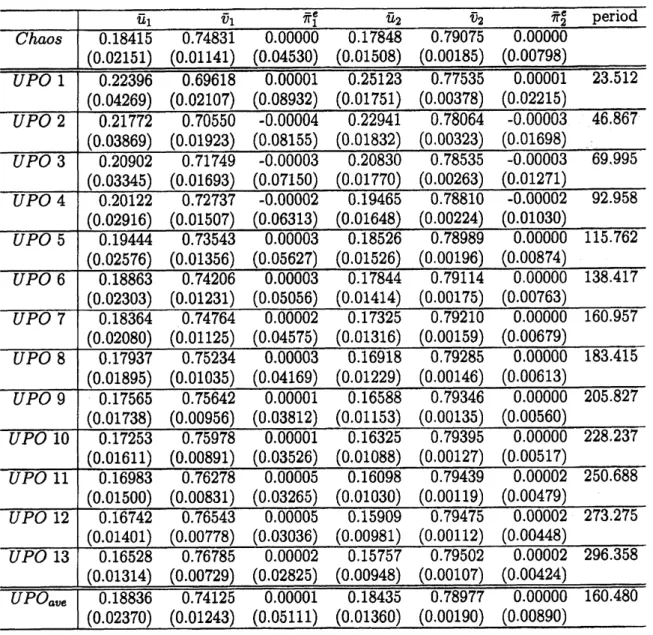
show Table 1, where the statistical data of the chaotic solutionand the unstable periodic solutions
are
listed. In the table, the data of$UPO_{ave}$ is calculated
as
below:$\overline{x}_{UPO_{av\mathrm{e}}}=\frac{\Sigma_{k=1}^{13}\overline{x}_{UPOk}}{13}$. (9)
The statistical data of $UPO7$ and $UPO_{ave}$ resemble that of Chaos well.
It implies that behaviors
on
unstable periodic orbits would be connected$13\mathrm{S}\mathrm{e}\mathrm{e}$
Kazantsev(1998).
$14\mathrm{W}\mathrm{e}$definethe unstable
periodic orbit with$n$whirlsas$UPOn$.
$16\mathrm{S}\mathrm{t}\mathrm{a}\mathrm{t}\mathrm{i}\mathrm{s}\mathrm{t}\mathrm{i}\mathrm{c}\mathrm{a}\mathrm{l}$
datapresentedinthenext section willanswerthis question.
with the chaotic fluctuation
over
along time. Now,we
will discuss thispoint further.
Table 1: Mean values of variables ofChaos and UPOs
The figures inparenthesesarethevariances correspondingto economic variablesof the system.
To
see
differences not appearing in low order statistics(mean andvari-ance), we illustrate histograms. Fig.4
upper
left shows three histogramscalculated from the movements of the labor share rate in country 1. The
first
one
is depicted through the long time movement enough to representthe statistics ofchaos, the second is $UPO7$, and the last
one
is $UPO_{ave}$.
We find the histogram of $UPO_{ave}$ approximates best that of chaos in the
case
of variable $u_{1}$.
In practice, regarding other variables,we
obtain thesimilar results.(See other histograms.) We
can
consider that the chaoticorbit will pass many times by every unstable periodic orbits in the chaotic
attractor, therefore the statistics ofthe chaotic solution and the unstable
periodic solutions
are
very similar.Fig. 4: Histograms ofChaos, $UPO7$, and $UPO_{ave}$
Another evidence
we
present to point out the similarity is Fig.5. TheLyapunov dimension calculated for
our
parameter settingare
plotted inthis figure. The Lyapunov dimensionofthe chaotic attractor is denoted by
the horizontal dashed line, and that ofeach unstable periodic orbit found
in the attractor corresponds to individual dot in the figure. All dots,
except for $UPO1$,
are
depictednear
the line. Particularly the unstableperiodic orbits with 9, 10 and 11 whirls have the similar properties to the
chaotic attractor in terms of the Lyapunov dimension. On the otherhand,
it
can
be considered the chaotic orbit seldom passes close the shortestperiodic orbit, and it
means
that the economicregime corresponding $UPO$$1$ is seldom
seen
in the chaotic fluctuation.16
$16\mathrm{T}\mathrm{h}\mathrm{e}$
relation between theperiodofthe unstableperiodicorbit andthesimilarityof the orbit to the chaotic attractorismeaningful, though it isnotdiscussed anymorein thispaper.
6
$\mathrm{C}\cap \mathrm{a}\mathrm{o}\mathrm{s}\cup \mathrm{P}\circ$ 4 5 $.\dot{rightarrow}3\not\geqq\Leftarrow\infty 4\simeq\Leftarrow$ $\varpi \mathrm{a}_{\mathrm{z}}\cong>$ $—–*——-\neq---*---\pm---\neq---*---\star---arrow---\wedge---*$ s— $-\lrcorner>$ $\cup \mathrm{P}\mathrm{O}1\mathrm{Q}$
$\cup \mathrm{P}\propto$ $\mathrm{U}\mathrm{P}\mathrm{O}3$ $\mathrm{U}\mathrm{P}\mathrm{O}4$ $\cup \mathrm{P}\mathrm{O}6$ $\mathrm{U}\mathrm{P}\mathrm{O}6$ $\cup \mathrm{P}\mathrm{O}7$ $\cup-\mathrm{O}8$ $\mathrm{U}\mathrm{P}\mathrm{O}9$ UPOI$0$ LiPOII $\mathrm{U}\mathrm{P}\mathrm{O}12$ $\cup \mathrm{P}\mathrm{O}13$
Fig. 5: Lyapunov dimension ofChaosand UPOs
From the physical point of view, it is well known there
are some
stabledimensions
as
regards unstable periodic orbits though they haveinstabil-ity. In fact, the stable directions
are
considerably abundant inour
system.These must be the
reasons
why typical dynamics of chaotic solutions existanalogous to the unstable periodic orbits in this study. Thus
our
modeldisplays the various economic regirnes related to unstable periodic orbits.
Now,
we
goon
withour
discussion from the proposition thatunsta-ble periodic orbits
concern
the economic regimes experiencedon
the longterm growth trajectory. To be argued
are
the effects of the variation ofeach parameter
on
the growth path where the economy should go. Forex-ample, the increase in public spending mayimprove the domestic business
cycles for the time being. Ifwe examine the variation and deformation of
unstable periodic orbits by the change in apolicy parameter,
we
can
un-derstand the effect
on
the growth pathmore
clearly. Because the unstableperiodicorbits have quite simple structure although they
are
qualitativelyand quantitatively similar to the chaotic orbits. Concerning this point,
we will discuss in detail in the next paper.
5Conclusions
We have given agrowth cycle system with international trade and shown
some
unstable periodic solutions found numerically in the chaoticattrac-tor. It is cleared that they explain atypical long
run
dynamics consistingof asequence of short
run
trade cycles and have the featurescorrespond-ing to the long
run
movements classified as the economic regimes on thechaotic growth path. In addition,
we
have shown that the statisticalproperties of the chaotic fluctuation in the model
are
approximated toaconsiderable extent by those ofthe unstable periodic orbits. It implies
unstable periodic solutions
can
be the keywords to understand the chaoticdynamics. From the above results, we ernphasize the importance and
use-fulness of unstable periodic solutions embedded in the chaotic attractor
as objects of studies of chaotic behavior. Above all, this point is
impor-tant when we discuss the impacts of the economic policy in the chaotic
situation. References
[1] Desai, M.
1973.
Growth Cycles and Inflation in aModel of the ClassStruggle, Joumal
of
Economic Theory, Vo1.6, pp.527-545.[2] Goodwin, R. M. 1967.
AGrowth
Cycle, in Socialism, Capitalism, andEconomic Growth, Essays Presented to Maurice Dobb, C. H. Feinstein
(ed.), Cambridge University Press, Cambridge, pp.54-58.
[3] Goodwin, R. M. 1990. Chaotic Economic Dynamics, Oxford
Univer-sity Press,
Oxford.
[4] Ishiyama, K. and Saiki, Y. 2003. Unstable Periodic Solutions
Embed-ded in aChaotic Economic Dynamics, preprint.
[5] Kato, S. and Yamada, M. 2002. Unstable Periodic Solutions
Embed-ded in aShell Model Turbulence, $prep_{7}\dot{\tau}nt$
.
[6] Kawahara, G. and Kida, S. 2001. Periodic Motion Embedded inPlane
Couette Turbulence: Regeneration Cycle and Burst, Jorrrnal
of
FluidMechanics, Vo1.449, pp.291-300.
[7] Kazantsev, E. 1998. Unstable Periodic Orbits and Attractor of the
Barotropic
Ocean
Model, Nonlinear Processes in Geophysics, Vo1.5,$\mathrm{p}\mathrm{p}.193- 208$
.
[8] Skott, P.
1989.
Effective Demand, Class Struggle, and CyclicalGrowth, International Economic Review, Vo1.30, NO.1, pp.231-247.
[9] Takamasu, A.
1995.
On the Effectiveness of Fiscal Policy in theGoodwin’s Growth Cycle Model, in Proceedings
of
the InternationalConference
on
Dynamical Systems and Chaos, N. Aoki, K. Shiraiwa,and Y. Takahashi (eds.), World Scientific Publishing, Singapore,
Vol.l, pp.433-436.
[10] Wolfstetter, E.
1982.
Fiscal Policy and the Classical GrowthCy-cle,
Zeitschrift
f\"ur
National\"okonomie/Journal
of
Economics, Vo1.42,N0.4, pp.375-393.
[11] Yoshida, H. and Asada, T. 2001. Dynamic Analysis of Policy Lag in
aKeynes-Goodwin Model: Stability, Instability, Cycles and Chaos,
preprint.
[12] Zoldi, S. M. and Greenside, H. S. 1998. Spatially Localized
Unsta-ble Periodic Orbits of aHigh-Dimensional Chaotic System, Physical
Revieev E, Vo1.57, N0.3, pp.2511-2514.