A refinement
technique
to
residual evaluation of
Computer
assisted proofs for Semilinear
elliptic
boundary
value
problems
早稲田大学基幹理工学研究科 高安 亮紀 (Akitoshi Takayasu)1
Graduate School ofFundamental Science and Engineering, Waseda University
早稲田大学 大石 進一 (Shin’ichi Oishi)2 Department of Applied Mathematics,
Faculty of
Science
and Engineering, Waseda University,CREST, JST
1
Introduction
Let $\mathbb{R}$ and $\mathbb{N}$ be sets of reals and natural numbers, respectively. Let
$\Omega$ be
a
boundedconvex
polygonaldomain in $\mathbb{R}^{m}$ with $m=2,3$. This article is concerned with the Dirichlet boundary value problem of the
semilinear elliptic equation:
$\{$
$-\nabla\cdot(a\nabla u)=f(u)$, in $\Omega$,
(1)
$u=0$, on$\partial\Omega$.
We have proposed a numerical verification method [1] with Takayuki Kubo at University of Tsukuba for
proving the existence of solutions to problem (1). One feature ofour method is that verification conditions
are
basedon Newton-Kantorovich
theorem. Although this formulation is applicable to higher order finiteelements, authors mainly treated the
case
of piecewise linear elements in the previouspaper
[1]. Usingpiecewise linearelements, numericalexperimentssometimesrequirefinemeshesto satisfysufficientconditions
ofNewton-Kantorovich theorem. Then,
our
verification method is failed to prove because of computationalcosts. For example, consider the following nonlinear elliptic equation
$\{\begin{array}{l}-\triangle u=u^{2}, in \Omega,(2)u=0, on \partial\Omega.\end{array}$
The sufficient condition of
Newton-Kantorovich
theorem is expressed by the condition$\alpha\omega\leqq\frac{1}{2}$,
where certain constants$\alpha$ and$\omega$
are
explained later. Our numerical experimentsarefailed to show$\alpha\omega\leqq 1/2$
by using piecewise linear finiteelements. In this article, we treat a problem ofovercoming such difficulties.
Some reformulation
are
needed to refine the residualestimation
by using higher order finite elements. Thesmoothingtechnique is modified for ourverification method.
In the following section, we briefly explain
our
computer assisted proof method. The refinement ofour
method is proposed in Section3. The smoothing method is introduced. In Section4, acomputationalresult
regarding (2) is presented. Our refined procedure prove the existence and local uniqueness of the exact
solution to (2).
2
Basic foundations
We would like to explain our computer assisted approach first for the following abstract problem:
Find$u\in V$ satisfying$\mathcal{F}u=0$, (3)
ltakitoshiOsuou.waseda.jp
with $\langle$V,$(\cdot,$$\cdot)_{V}\rangle$ denoting
a
Hilbert space with its inner product. We also define the dual space of$V$ as $V^{*}$.
Let$\mathcal{F}$ :$Varrow V^{*}$ denote
some
Fr\’echet differentiablemapping. Let $\hat{u}\in V$be
an
approximate solution to (3),and Fr\’echet derivative of$\mathcal{F}$at $\hat{u}$denotes $\mathcal{F}’(\hat{u})$ : $Varrow V^{*},$ $i.e$. satisfying
$\Vert \mathcal{F}(\hat{u}+\nu)-\mathcal{F}(\hat{u})-\mathcal{F}’(\hat{u})\nu\Vert_{V}$
.
$=o$$(||\iota$ノ$\Vert_{V}),$ $\Vert\nu\Vert_{V}arrow 0$.Assuming that we
can
know three constants $C_{i},$ $(i=1,2,3)$ , such that$\Vert \mathcal{F}’(\hat{u})^{-1}\Vert_{\mathcal{L}(V.V)}\leqq C_{1}$, (4)
i. e., $C_{1}$ bounds the inverse operatorof$\mathcal{F}’(\hat{u})$. $C_{2.h}$ bounds the residual of approximation:
$\Vert \mathcal{F}\hat{u}\Vert_{V}\cdot\leqq C_{2.h}$. (5)
$C_{3}$ denotes the Lipschitz constantof$\mathcal{F}’$, whichisrequired to be Lipschitz continuous on the
certain ball $D$,
$\Vert \mathcal{F}’(v)-\mathcal{F}’(w)\Vert_{C(V.V)}\leqq C_{3}\Vert v-w\Vert_{V}$, $\forall v.w\in D$. (6)
Our main task to computer assisted analysis is the calculation ofthese constants explicitly. In order
to prove the existence and local uniqueness of the exact solution in the neighborhood of $\hat{u}$, the following
Newton-Kantorovich theorem is applicable to (3). This form of Newton-Kantorovich theorem is called an
affine invariant form [2].
Theorem 1 (Newton-Kantorovich Theorem). Assuming that the Frechet dert,vative $\mathcal{F}’(\hat{u})$ is
nonsin-gular and
satisfies
$\Vert \mathcal{F}’(\hat{u})^{-1}\mathcal{F}\hat{u}\Vert_{V}\leqq\alpha$,
for
a certain positive $\alpha$. Then, let $D:=B(\hat{u}, 2\alpha)=\{v\in V:\Vert v-\hat{u}\Vert_{V}\leqq 2\alpha\}\subset V$ and assume thatfor
acertain positive$\omega$ and any $v,$$w\in D$, the following holds:
$\Vert \mathcal{F}’(\hat{u})^{-1}(\mathcal{F}’(v)-\mathcal{F}’(w))\Vert_{\mathcal{L}(V.V)}\leqq\omega\Vert v-w\Vert_{V}$.
If
$\alpha\omega\leqq 1/2$ holds, then there is a solution$u^{*}\in V$of
$\mathcal{F}u=0$ satisfying$\Vert u^{*}-\hat{u}\Vert_{V}\leqq\rho:=\frac{1-\sqrt{1-2\alpha\omega}}{\omega}$.
Furthermore, the solution$u^{*}$ is unique in the ball $B(\hat{u}, \rho)$
.
Since $\alpha\leqq C_{1}C_{2,h}$ and $\omega\leqq C_{1}C_{3}$ form (4)$-(6)$, the concrete computation of $C_{1},$ $C_{2,h}$ and $C_{3}$ yields
computer assisted proof of the existence and local uniqueness to the problem (3). Therefore, if $\alpha\omega\leqq$ $C_{1}^{2}C_{2}.{}_{h}C_{3}<1/2$ is obtainedbyverified computation, then the existence and local uniqueness ofthesolution
are proved numerically. Remarks
.
The above result does not require elliptic properties of the operator $\mathcal{F}’(\hat{u}),$ $i.e$. the existence andlocal uniqueness
can
be obtained in thecase
of the operator is indefinite. This caseoccurs
for severalapproximate solution. In such a case, the existence and local uniqueness cannot be obtained by the
$:_{analytic’}$ way.
.
Our computer assisted proof method requires the approximate solution of (3) in acertain finitedimen-sional subspace, such as the finite element subspace of $V$. It means that we can verify the solution
whenonehave the approximatesolution of (1) in the discrete subspace of$V$.
.
Another method of proving the existence and inclusion of the exact solution for semilinear ellipticproblems has been developed by M.T. Nakao and$bI$. Plum (See, $e.g$. $[3]$ and [4]). Their methods have
been demonstrated to be useful for the computer assisted proof. We don$t$reporton their methods in
more
detail here,2.1
Notations
Throughoutthisarticle,$L^{P}(\Omega)(p\in[1, oc))$ denotes the functional space of Lebesgue-measurable$p$ th
power-integrable functions. Especially, let
us
define $L^{2}$-inner product $(u, v)$ and $L^{2}$-norm
$\Vert u\Vert_{L^{2}}=\sqrt{(u,u)}$respec-tively. Let $H^{S}(\Omega)$ denote $L^{2}$-Sobolev space of order $s\in \mathbb{N}$ with the inner product $\langle u,$$v\rangle_{s}$. The $H^{s}$
-norm
isdefined by $\Vert u\Vert_{H^{s}}=\sqrt{\langle u,u\rangle_{s}}$. Let further define $H_{0}^{1}(\Omega)$ by $H_{0}^{1}(\Omega)=\{u\in H^{1}(\Omega) : u=0(x\in\partial\Omega)\}$ with
the inner product $(\nabla u, \nabla v)$ and the
norm
$\Vert u\Vert_{H_{0}^{1}}=\Vert\nabla u\Vert_{L^{2}}$. Here, $u=0$on
$\partial\Omega$ is the trace
sense.
Let $H^{-1}(\Omega)$ be the topological dual space of$H_{0}^{1}(\Omega)$, i.e., the space of linear continuous functionalson
$H_{0}^{1}(\Omega)$.Let $T\in H^{-1}(\Omega)$ and $u\in H_{0}^{1}(\Omega)$. We denote$Tu\in \mathbb{R}$
as
$<T,$ $u>$. Thenorm
of$T\in H^{-1}(\Omega)$ is definedas
$\Vert T\Vert_{H^{-1}}=\sup_{0\neq u\in H_{0}^{1}(\Omega)}\frac{|<T,u>|}{\Vert u||_{H_{0}^{1}}}$.
Let $L^{\infty}(\Omega)$ denote the essentially bounded functions with the
norm
$\Vert u\Vert_{x}=ess\sup_{x\in\Omega}|u(x)|$. For $u(x)\in$ $(L^{\infty}(\Omega))^{m}$, letus
define$|u(x)|_{E}=( \sum_{i=1}^{m}u_{i}(x)^{2})^{\frac{1}{2}}$
Assuming that $u^{h}=(u_{1}, \ldots, u_{n})$ is n-dimensional vector
on
$\mathbb{R}^{n}$, let $|u^{h}|_{l^{2}}$ bethe Euclideannorm:
$|u^{h}|_{l^{2}}=\sqrt{u_{1}^{2}+u_{2}^{2}++u_{n}^{2}}$
and the
norm
$\Vert\cdot\Vert_{2}$ denotes the spectralnorm
of matrices. Let $X$ and $Y$ be Banach spaces. The set ofbounded linearoperators is denoted by $\mathcal{L}(X, Y)$ with the operator norm
$\Vert \mathcal{T}\Vert_{C(X,Y)}=\sup_{0\neq u\in X}\frac{\Vert \mathcal{T}u\Vert\}’}{||u\Vert_{X}}$, $(\mathcal{T}\in \mathcal{L}(X, Y))$.
Here, $\Vert\cdot\Vert_{X}$ is the
norm
of$X$ and $\Vert\cdot\Vert\}’$ is thenorm
of$Y$. Furthermore, the embedding constant $C_{e.p}$gives $\Vert v\Vert_{L^{P}}\leqq C_{e,p}\Vert v\Vert_{H_{0}^{1}}$. Now we choose thespaces $V:=H_{0}^{1}(\Omega)$ and$V^{*}$ $:=H^{-1}(\Omega)(=\mathcal{L}(H_{0}^{1}, \mathbb{R}))$.
2.2
Weak formulation
Let $\Omega$ be a bounded
convex
polygonal domain in $\mathbb{R}^{m}$ with $m=2,3$ . Present authors havepresented withT. Kubo a method of
a
computer assisted proof for theDirichlet boundary valueproblem of the semilinearelliptic equation [1] of the form:
$\{$
$-\nabla\cdot(a\nabla u)=f(u)$, in $\Omega$,
(7)
$u=0$, on$\partial\Omega$,
where $a(x)$ is a smooth function
on
$\Omega\cup\partial\Omega$ with $a(x)\geqq a_{0}>0$ forsome
$a_{0}\in \mathbb{R}$. Here, $f$ : $Varrow L^{2}(\Omega)$ isassumed to be Fr\’echet differentiable. Forexample, the following function
$f(u)=-b\cdot\nabla u-cu+c_{2}u^{2}+c_{3}u^{3}+g$
with $b(x)\in(L^{\infty}(\Omega))^{m},$ $c,$$c_{2},$$c_{3}\in L^{\infty}(\Omega)$ and$g\in L^{2}(\Omega)$ satisfies this condition. Here, we will briefly review
our proposed method. For $u,$$v\in V$, we define a continuous bilinear form $A(u, v)$ as $A(u, v)=(a\nabla u, \nabla v)$.
Note that the bilinear form $A(u, v)$ is
an
inner product on $V$ and there exist positive constants $C_{a}$ and $c_{a}$satisfying
$c_{a}\Vert u\Vert_{V}\leqq\Vert u\Vert_{a}\leqq C_{a}\Vert u\Vert_{V}$ for $u\in V$, (8)
where $\Vert u\Vert_{a}=\sqrt{A(u,u)}$. In fact, we
can
choose$c_{a}=\sqrt{a_{0}}$and $C_{a}=\sqrt{\Vert a\Vert_{x}}$.Ifwe fix $u\in V$, then $A(u, \cdot)\in V^{*}$ isa linear functional. Thus, wecandefine anoperator $A:Varrow V^{*}$ by
$<Au,$$v>=A(u, v)$. Note that the bilinear form $A$ is coercive, $i.e$.
Then,for$v\in V$, Lax-Milgram’s theorem states the
existence
of the inverse of$A:Varrow V^{*}$ as$A^{-1}$ : $V^{*}arrow V$.Similarly, for $u,$$v\in V$ we
can
definea
nonlinear operator $\mathcal{N}$ : $Varrow V^{*}$ by $<\mathcal{N}u,$$v>=(f(u), v)$. A weak
form ofEq.(7) canbe transformed into
$Au=\mathcal{N}u$. (10)
We define the operator$\mathcal{F}$: $Varrow V^{*}$ by$\mathcal{F}u=(A-\mathcal{N})u$. Then, Eq.(10) can
be written
as
$\mathcal{F}u=0$. (11)
This is nothing but the abstract problem (3).
In order to apply Newton-Kantorovich theorem, the $Fr_{\acute{e}chet}$ derivative of $\mathcal{F}$ is needed. The Fr$\mathfrak{X}het$
differentiability of$\mathcal{F}$ is derived by that of
$f$. We define the Frechet derivative of$\mathcal{N}$ at $\hat{u}\in V$
, i. e., $\mathcal{N}’(\hat{u})$ : $Varrow V^{*}$ is given by $<$ Al”(\^u)u,$v>=(f’(\text{\^{u}})u, v)$. Here, $f’(\hat{u})$ : $Varrow L^{2}(0,1)$ is the Fr\’echet derivative of
$f$ : $Varrow L^{2}(0,1)$ at $\hat{u}$. Thus, for a given $u\in V$the Fr\’echet
derivative $\mathcal{F}’(u):Varrow V^{*}$ is defined
as
$\mathcal{F}’(u)=A-\mathcal{N}’(u)$. (12)
2.3
Finite element
approximation
Next we define the finite element approximation. Let $V_{h}$ denote
a
finite-dimensional space spanned bylinearlyindependent V-conformingfinite element basisfunctions dependingonthe mesh size $h,$ $(0<h<1)$.
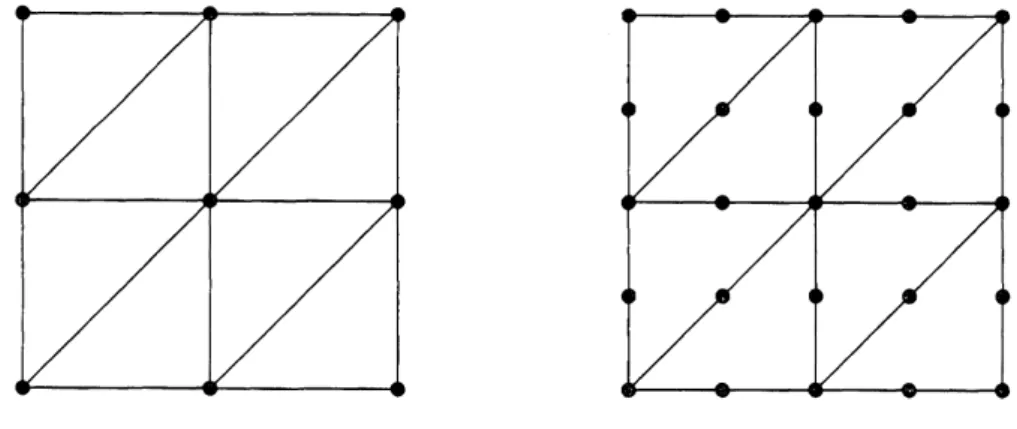
For the piecewise linear base functions $\phi_{i}^{l}$, we define $V_{h}^{l}=span\{\phi_{1}^{l}, \phi_{2}^{l}, \ldots, \phi_{N_{1}}^{l}\}\subset V$where
$N_{l}$ denotes the
number of node points in $\Omega\backslash \partial\Omega$. Onthe other hand, for piecewise quadratic base functions
$\phi_{i}^{q}$, we define
Figure 1: Piecewise linear $(N_{l}=1)$
&
quadratic elements $(N_{q}=9)$$V_{h}^{q}=$ span$\{\phi_{1}^{q}, \phi_{2}^{q}, \ldots, \phi_{N_{q}}^{q}\}\subset V$where $N_{q}$ denotes the number of node points in $\Omega\backslash \partial\Omega$ (See Figure 1). If
we
use
the piecewise linearor quadratic base functions, $V_{h}=V_{h}^{l}$ or $V_{h}=V_{h}^{q}$, respectively. In the following,by $\phi_{i}$
we
designate $\phi_{i}^{l}$or
$\phi_{i}^{q}$ accordingtothe base function being linearor
quadratic.The Ritz-projection $\mathcal{P}_{h}:Varrow V_{h}$ is defined by $(a(x)(\nabla u-\nabla(\mathcal{P}_{h}u)), \nabla v_{h})=0,$ $\forall v_{h}\in V_{h}$. For $u\in$
$V\cap H^{2}(\Omega)$ and its approximation $\mathcal{P}_{h}u\in V_{h}$, a priori
error
estimate is given as $\Vert u-\mathcal{P}_{h}u\Vert_{V}\leqq C_{0}(h)\Vert f(u)\Vert_{L^{2}}$.In case of $a(x)=1$, for the rectangular mesh, Nakao, Yamamoto and Kimura [5] have shown that
one
can take $C_{0}(h)=h/\pi$ and $h/2\pi$ for bilinear and biquadratic element, respectively. Kikuchi and Liu [6]
have proved that for $a(x)=1$ and for the linear and equilateral triangle mesh of the
convex
polygonaldomain, $C_{0}(h)$ can be taken as 0.$493h$. Now, we showhow to calculate $C_{0}(h)$ for the case of$a(x)\neq 1$. Let
$\Pi_{h}$ : $Varrow V_{h}$ be the orthogonal projection defined by $(\nabla u-\nabla(\Pi_{h}u), \nabla v_{h})=0$, $\forall v_{h}\in V_{h}$. For convex
polygonal domain, it is known that the following apriori errorestimate holds:
Assuming that
we
knowthe explicitformula
for$C(h),$ $e.g$. incase
of the linear and equilateral triangle mesh,one
can
take$C(h)=0.493h$as
mentioned above. From (9), $\mathcal{P}_{h}u$and $\Pi_{h}u\in V_{h}$, it follows$c_{a}^{2}\Vert u-\mathcal{P}_{h}u\Vert_{V}^{2}$ $\leqq$ $A(u-\mathcal{P}_{h}u, u-\Pi_{h}u)$
$\leqq$ $C_{a}^{2}\Vert u-\mathcal{P}_{h}u\Vert_{V}\Vert u-\Pi_{h}u\Vert_{V}$
$\leqq$ $C_{a}^{2}\Vert u-\mathcal{P}_{h}u\Vert_{V}C(h)\Vert\triangle u\Vert_{L^{2}}$.
Thus,
we
have$\Vert u-\mathcal{P}_{h}u\Vert_{V}\leqq(\frac{C_{a}}{c_{a}})^{2}C(h)\Vert\Delta u\Vert_{L^{2}}$. (13)
Put $-\nabla\cdot(a\nabla u)=g_{d}$. Then,
we
have$\Vert\triangle u\Vert_{L^{2}}$ $=$ $\Vert\frac{\nabla a\cdot\nabla u+g_{d}}{a}\Vert_{L^{2}}$
$\leqq$ $\frac{1}{a_{0}}(\Vert\nabla a\cdot\nabla u\Vert_{L^{2}}+\Vert g_{d}\Vert_{L^{2}})$
$\leqq$ $\frac{1}{a_{0}}(\Vert|\nabla a|_{E}\Vert_{\infty}\Vert\nabla u\Vert_{L^{2}}+\Vert g_{d}\Vert_{L^{2}})$.
Onthe otherhand, from (9),
we
have the following inequality$c_{a}^{2}\Vert\nabla u\Vert_{L^{2}}^{2}\leqq A(u, u)=(g_{d}, u)\leqq\Vert g_{d}\Vert_{L^{2}}\Vert u\Vert_{L^{2}}\leqq C_{e,2}\Vert g_{d}\Vert_{L^{2}}\Vert\nabla u\Vert_{L^{2}}$
.
Therefore, it turns out that
$\Vert\Delta u\Vert_{L^{2}}\leqq-$$a_{0}1( \frac{C_{e,2}}{c_{a}^{2}}\Vert|\nabla a|_{E}\Vert_{\infty}+1)\Vert g_{d}\Vert_{L^{2}}=C’\Vert g_{d}\Vert_{L^{2}}$. (14)
Finally, from (13) and (14), we
can
derive the formula for $C_{0}(h)$ in thecase
of$a(x)\neq 1$as
$C_{0}(h)=( \frac{C_{a}}{c_{a}})^{2}C(h)C’$.
2.4
Each
constants
By the notationofFr\’echet derivative (12), condition (4) turns out to be the inverse
norm
estimation:$\Vert(\mathcal{A}-\mathcal{N}’(\hat{u}))^{-1}\Vert_{\mathcal{L}(V,V)}\leqq C_{1}$.
In our method, this is estimated by the followingtheorem given by S. Oishi [7]. This theorem is based on
perturbation lemma oflinearoperators [8].
Theorem 2 (Oishi 1995). Let $\hat{u}\in V$ and$\mathcal{N}’(\hat{u})$ : $Varrow V^{*}$ be a linear compact operator. Let $V_{h}$ be a
finite
dimensional subspace
of
V. Let $\mathcal{P}_{h}:Varrow V_{h}$ be the Ritz-projection. Assuming that$\mathcal{P}_{h}\mathcal{A}^{-1}\mathcal{N}’(\hat{u}):Varrow V$is bounded and
satisfies
$\Vert P_{h}\mathcal{A}^{-1}\mathcal{N}’(\hat{u})\Vert c(\iota^{r}.v)\leqq K$,
the
difference
between$\mathcal{A}^{-1}\mathcal{N}’(\hat{u})$ and$\mathcal{P}_{h}\mathcal{A}^{-1}\mathcal{N}’(\hat{u})$ is bounded and enjoys$\Vert(\mathcal{A}^{-1}-\mathcal{P}_{n}\mathcal{A}^{-1})\mathcal{N}’(\hat{u})\Vert_{\mathcal{L}(V.V)}\leqq L$,
and the
finite
dimensional operator$\mathcal{P}_{h}(\mathcal{I}-\mathcal{A}^{-1}\mathcal{N}’(\hat{u}))|v_{h}$ : $V_{h}arrow V_{h}$ is invertible with$\Vert(\mathcal{P}_{h}(\mathcal{I}-\mathcal{A}^{-1}\mathcal{N}’(\hat{u}))|_{V_{h}})^{-1}\Vert_{\mathcal{L}(V.V)}\leqq$M.
Here, $P_{h}(\mathcal{I}-\mathcal{A}^{-1}\mathcal{N}’(\hat{u}))|v_{h}$ : $V_{h}arrow V_{h}$ isthe restriction
of
the operator$\mathcal{P}_{h}(\mathcal{I}-\mathcal{A}^{-1}\mathcal{N}’(\hat{u})):Varrow V_{h}$ on$V_{h}$.If
$(1+MK)L<1$, then the oPerator $\mathcal{A}-\mathcal{N}’(\hat{u})$ is also invertible and$\Vert \mathcal{F}’(\hat{u})^{-1}\Vert_{\mathcal{L}(V.V)}=\Vert(\mathcal{A}-\mathcal{N}’(\hat{u}))^{-1}\Vert_{\mathcal{L}(V.V)}\leqq\frac{1+\Lambda IK}{a_{0}(1-(1+\Lambda IK)L)}=:C_{1}$ .
Intheprevious paper [1],
we
have shown that the residual ofthe operatorequation (11) can be bounded by$\Vert \mathcal{F}\hat{u}\Vert_{V}\cdot=\Vert A\hat{u}-\mathcal{N}\hat{u}\Vert v*\leqq C_{a}^{2}(\Vert\hat{u}-\mathcal{P}_{h}A^{-1}\mathcal{N}(\hat{u})\Vert_{V}+C_{0}(h)\Vert f(\hat{u})\Vert_{L^{2}})=;C_{2.h}$. (15)
It is noted that the term $C_{0}(h)\Vert f(\hat{u})\Vert_{L^{2}}$ is included in this expression of $C_{2.h}$. Usually, since $C_{0}(h)$ is
proportional to$h,$ $C_{2.h}$ decreases onlyproportional to $h$ even ifweusesmaller $h$. Namely, if $\Vert f(\hat{u})\Vert_{L^{2}}$ term
becomes large, the condition of Newton-Kantorovich theorem $(\alpha\omega\leqq 1/2)$ might not besatisfied unlessfine
mesh is used. To
overcome
this, this article will present a refined method of evaluating the residual of theoperator equation (11). In the previous paper, we have also shown how to calculate the Lipschitz constant
$C_{3}$ defined through $C_{3};=C_{e},{}_{2}C_{L}$ where $C_{L}$ is the Lipschitz constant of$f’$.
3
Refinement for
residual
evaluation
Since the expression (15) of $C_{2,h}$ includes the term $C_{0}(h)\Vert f(\hat{u})\Vert_{L^{2}},$ $C_{2.h}$ is difficult to decrease lessthan 1
when the maximam value of$\hat{u}$becomes large. Ifwe use the piecewise linear finiteelement,
$C_{0}(h)$ is usually
decreasing$O(h)$. Thus, in order to satisfy the condition of Newton-Kantorovich theorem, $C_{1}^{2}C_{2},{}_{h}C_{3}\leqq 1/2$,
the mesh size $h$ should be taken sufficiently small such that $C_{0}(h)\Vert f(\hat{u})\Vert_{L^{2}}\ll 1$ holds. This
means
that$h$ should be taken very small. It
causes
a problem ofincreasing computational costs. In fact, we cannotsuccess
the verificationof the problem (2). In order to overcomesuch difficulties for verifying the solution,we usethe smoothing technique. It is a method of improving the accuracy of the residual norm estimation.
Here, elements of the finite dimensional subspace $V_{h}$ are assumed to be piecewise linear or quadratic
finite elements $(V_{h}^{l}$ or $V_{h}^{q})$. We define $N=\dim V_{h}$. Let $N_{b}$ be the number of grid points on the boundary
$\partial\Omega$. Let
$g_{i}(i=1,2, \ldots, N_{b})$ be grid points on $\partial\Omega$. Let further $\phi_{1}^{*},$
$\ldots,$
$\phi_{N_{b}}^{*}$ be piecewise linear
or
quadraticfinite element basses defined by
$\{\begin{array}{l}\phi_{i}^{*}(g_{i})=1, i=1, \ldots, N_{b},\phi_{i}^{*}(g_{j})=0, j\neq i.\end{array}$
Thus, $V_{h}^{*}\subset H^{1}(\Omega)$ is a finiteelement subspace defined by
$V_{h}^{*}=$span$\{\phi_{1}^{*}, \ldots, \phi_{N_{h}}^{*}, \phi_{1}, \ldots, \phi_{N}\}$.
Let$\nabla\hat{u}-\in V_{h}^{*}\cross V_{h}^{*}$ bethe vector function defined by
$(\nabla\hat{u}, v^{*})-=(\nabla\hat{u}, v^{*})$, $\forall v^{*}\in V_{h}^{*}\cross V_{h}^{*}$.
Namely it is
an
$L^{2}$-projection of$\nabla\hat{u}\in L^{2}(\Omega)\cross L^{2}(\Omega)$to$V_{h}^{*}\cross V_{h}^{*}$. Further, Aa $\in L^{2}(\Omega)$ is defined by
$\triangle\hat{u}=\nabla\cdot(a\nabla\hat{u})--$.
Then the following Green’s formula holds between
va
and $\triangle\hat{u}:-$$(a\nabla\hat{u}, \nabla v)-+(\triangle\hat{u}, v)=0-$, $\forall v\in V$. (16)
Hence, $\nabla\hat{u}-$
can
beseen as
an approximation of $\nabla u$. This statement is argued in [9]. Using this fact, wepresent a refined estimation. Let $v_{h}\in V_{h}$ be the Ritz-projection of$v\in V$, satisfying
$A(v-v_{h}, \phi_{h})=0$, $\phi_{h}\in V_{h}$.
From this, we have
$\Vert v-v_{h}\Vert_{L^{2}}\leqq C_{a}^{2}C_{0}(h)\Vert v-v_{h}\Vert_{V}$. (17)
This is nothing but Aubin-Nitsche’s trick. The orthogonality of the Ritz-projection and (8) yield
$\Vert v-v_{h}\Vert_{V}\leqq\frac{C_{a}}{c_{a}}\Vert v\Vert_{V}$ (18)
and
Using inequalities (18) and (19),
we
have$\Vert \mathcal{F}\hat{u}\Vert_{V}\cdot=\sup_{0\neq v\in V}\frac{|<A\hat{u}-\mathcal{N}\hat{u},v>|}{||v\Vert_{V}}$
$= \sup_{0\neq v\in V}\frac{|A(\hat{u},v)-(f(\hat{u}),v)|}{\Vert v\Vert_{V}}$
$= \sup_{0\neq v\in V}\frac{|A(\hat{u},v-v_{h})-(f(\hat{u}),v-v_{h})+A(\hat{u},v_{h})-(f(\hat{u}),v_{h})|}{\Vert v\Vert_{V}}$
$\leqq\sup_{0\neq t\in V}\frac{|A(\hat{u},v-v_{h})-(f(\hat{u}),v-v_{h})|}{\Vert v\Vert_{V}}+(\frac{C_{a}}{c_{a}})\sup_{0\neq v_{h}\in V_{h}}\frac{|A(\hat{u},v_{h})-(f(\hat{u}),v_{h})|}{||v_{h}||_{V}}$
.
(20)Inthe following,
we
show how to bound the second term of (20). Let $\epsilon_{i}$ be$\epsilon_{i}:=A(\hat{u}, \phi_{i})-(f(\hat{u}), \phi_{i})$, $(i=1, \ldots, N)$.
Since $v_{h}\in V_{h}$, we
can
express$v_{h}$as
$v_{h}= \sum_{i=1}^{N}c_{i}\phi_{i}$.
Let us put $c=(c_{1}, \ldots, c_{N})^{t}$ and $\epsilon=(\epsilon_{1}, \ldots, \epsilon_{N})^{t}$. Let further $D$ be $n\cross n$ matrix whose $(i, j)$-elements
are
given by $(a\nabla\phi_{j}, \nabla\phi_{i})$. Then, we have$( \frac{C_{a}}{c_{a}})\sup_{0\neq v_{h}\in V_{h}}\frac{|A(\hat{u},v_{h})-(f(\hat{u}),v_{h})|}{\Vert v_{h}||_{V}}\leqq\frac{C_{a}\sum_{i=1}^{N}c_{i}\epsilon_{i}}{c_{a}^{2\sqrt{c^{t}Dc}}}\leqq\frac{C_{a}|c|_{l^{2}}|\epsilon|_{l^{2}}}{c_{a}^{2}\sqrt{c^{t}Dc}}\leqq(\frac{C_{a}}{c_{a}^{2}})\Vert D^{-1}\Vert_{2}|\epsilon|_{l^{2}}=:C_{r}$. (21)
Finally, using
a
smoothing elementva
and inequalities (16)-(21),we
have$\Vert \mathcal{F}\hat{u}\Vert_{V}$
.
$\leqq$ $\sup_{0\neq v\in V}\frac{|(a(\nabla\hat{u}^{-}-\nabla\hat{u}),\nabla(v-v_{h}))+(a\nabla\hat{u},\nabla(v-v_{h}))-(f(\hat{u}),v-v_{h})|-}{||v\Vert_{V}}+C_{r}$ $\leqq$ $\frac{C_{a}^{3}}{c_{a}}(\Vert\nabla\hat{u}^{-}-\nabla\hat{u}$$\Vert$L2 $+$Co(ん川$\Delta$\^u$+$f(釧$|$
L2)
$+$C。$=:C_{R,h}$.One
can
replace$C_{2,h}$by$C_{R.h}$. For a “certain“good approximation, $\Vert\overline{\Delta}\hat{u}+f(\hat{u})\Vert_{L^{2}}$becomesrelativelysmallerthan $\Vert f(\hat{u})\Vert_{L^{2}}$ . Then, the condition $C_{1}^{2}C_{R}.{}_{h}C_{3}\leqq 1/2$ iseasier to be fulfilled. Table 1 shows quantities $C_{2,h}$
and $C_{R,h}$ in the
case
of the problem (2). Weuse
piecewise linear and quadratic basseson
an uniformtriangular mesh. In fact, smoothing techniquedoesn’t work drastically by piecewise linear finite elements.
On the other hand, in case ofpiecewisequadratic elements, $C_{R.h}$ becomes much less than $C_{2.h}$ ofpiecewise
linear elements.
Table 1: Comparing$C_{2.h}$ with $C_{R.h}$ by piecewise linear
&
quadratic elemets$\overline{\frac{Meshsize:\frac{1}{2^{\tau}}C_{2.h}(Linear)C_{R.h}(Linear)C_{R.h}(Quadratic)}{412.1l57.33930.6186}}$ 5 5.9337 3.4043 0.1585 6 2.9516 1.6335 0.0399 7 1.4740 0.7968 0.0108 8 0.7368 0.3921 0.0072
4
Computational
result
For
an
application ofour verification method, we consider the followingsemilinear Dirichet boundary valueproblem
on
$\Omega=(0,1)\cross(0,1)$:An approximate solution $\hat{u}$ is computed by the finite element method with piecewise linear and quadratic
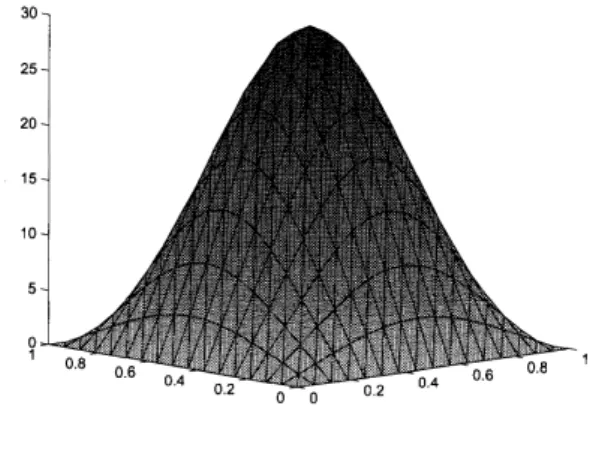
base functions. Figure 2 shows the shape of the approximate solution with piecewise linear elements. The
proposed computer assisted proof method is applied to this approximate solution. All computations are
1
Figure 2: Approximate solution $\hat{u}$, Mesh size $\frac{1}{16}$.
carried out on Windows Server 2008 Enterprise, Quad-Core AMD Opteron(tm) Processor S384, 2.70 GHz
with 128 GByte Memory by using MATLAB $2010a$withatoolbox for verified computations, INTLAB [10].
Obviously, the Fr\’echet derivative of $f(u)=u^{2}$ is given by $f’(u)=2u$. The calculated approximate
solution$\hat{u}$ is bounded
on
$\Omega$so
that $\hat{u}\in L^{\infty}(\Omega)$ in thiscase.
Therefore, for $\hat{u},$$v,$$w\in V$ it follows $K:= \frac{C_{e,2}}{a_{0}}\Vert f’(\hat{u})\Vert_{C(V.L^{2})}\leqq 2C_{e_{\rangle}2}^{2}\Vert\hat{u}\Vert_{\infty}$ ,
$L$ $:=C_{0}(h)\Vert f’(\hat{u})\Vert_{\mathcal{L}(V,L^{2})}\leqq 2C_{e},{}_{2}C_{0}(h)\Vert\hat{u}\Vert_{\infty}$
and let $D$ and $G$ be$n\cross n$ matrices whose $(i,j)$-elements aregiven by
$(\nabla\phi_{j}, \nabla\phi_{i})$ and $(\nabla\phi_{j}, \nabla\phi_{i})-(2\hat{u}\phi_{j}, \phi_{i})$,
respectively. Let alower triangular matrix $\hat{L}$
bethe Cholesky decomposition of$D$, i.e., $D=\hat{L}\hat{L}^{t}$.
$M:= \frac{C_{a}}{c_{a}}\Vert\hat{L}^{t}G^{-1}\hat{L}\Vert_{2}$.
Furthermore,
$\Vert f’(v)-f’(w)\Vert_{C(V.L^{2})}\leqq 2C_{e..4}^{2}\Vert v-w\Vert_{V}$ .
Thus, weput $C_{L}$ $:=2C_{e,4}^{2}$.
Using piecewiselinear finiteelements, ourverification is failto provetheexistence of the exact solution.
Table 2 shows the failure in
case
of piecewise linear elements. We cannot obtainan
improved resulteven
ifwe use smoothing technique. On the other hand, the drastic refinement is occurred by piecewise quadratic
elements. Incase of1/128,
our
computer assisted proof method yields$C_{1}=12.1493,$ $C_{R,h}=0.0108,$ $C_{3}=0.2252$.
Thus, wehave
$C_{1}^{2}C_{R},{}_{h}C_{3}<0.3549$.
Therefore,
our
method succeeded the verificationof the approximate solution. It turns out that thereexistsan exact solution in the ball $B=B(\hat{u}, \rho)$ with the radius
$\rho=1.687\cross 10^{-1}$.
By increasinggridpoints, guaranteed error boundsare improved. The improvement of the guaranteederror
is presented in Table 3. We use piecewise quadratic basses on
an
uniform triangular mesh to compute the verified result.Table 2: Verification Resultsby piecewise linear elements $\overline{\frac{Meshsize:\frac{1}{2^{x}}C_{1}C_{1}^{l}C_{2},{}_{h}C_{3}C_{1}^{l}C_{R}.{}_{h}C_{3}Verification}{5Fai1ed--Fai1ed}}$ 6 130.1 17535 9704 Failed 7 17.09
152.07
82.20
Failed8
11.93
37.007
19.70
Failed 9 10.42 14.1377.455
FailedTable 3: Verification Results by piecewise quadraticelements.
$\overline{Meshsi\prime ze:\frac{1}{2^{x}}C_{1}C_{R},{}_{h}C_{1}^{l}C_{R},{}_{h}C_{3}Error:\rho}$
$\overline{5}$
440.16120.15856910Failed 6 17.9291 0.0399 2.8885 Failed 7 12.1491 0.0108 0.3548 $1.687\cross 10^{-1}$ 8 10.5144 0.0072 0.1770 $8.286\cross 10^{-2}$References
[1] S. Oishi, A. Takayasu and T. Kubo, “Numerical Verification of Existence for Solutions to Dirichlet
Boundary Value Problems of Semilinear Elliptic Equations“, submitted for publication, March 2010.
[2] P. Deuflhard and G. Heindl, “Affine Invariant Convergence Theorems for Newton$s$ Method and
Ex-tensions to Related Methods”, SIAM Joumal on Numerical Analysis, vol.16, no.1, pp.1-10, February
1979.
[3] Y. Watanabe and M.T. Nakao, “Numerical verifications of solutions for nonlinear elliptic equations“,
Japan J. Indust. Appl. Math., 10, pp.165-178, 1993.
[4] M. Plum, “Computer assisted proofs for semilinear elliptic boundary value problems”, Japan J. Indust.
Appl. Math., 26, pp.419-442, 2009.
[5] M. T. Nakao, N. Yamamoto and S. Kimura, $\iota$
‘On best constant in the optimal
error
estimates for the$H_{0}^{1}$ -projection into piecewise polynomial spaces”, Joumal
of
Approximation Theory, 93, pp.491-500,1998.
[6] F. Kikuchi and X. Liu, “Estimation of interpolation error constants for thePO and Pl triangular finite
elements“, Computer Methods in Applied Mechanics and Engineering, 196, pp.3750-3758, 2007. [7] S.Oishi, “Numerical verificationofexistence andinclusion ofsolutions for nonlinearoperatorequations”,
Joumal
of
Computational and Applied Mathematics (JCAM), 60, pp.171-185, 1995.[S] K. Atkinson and W. Han, Theoretical Numerical Analysis, Springer, 2005.
[9] N. Yamamoto and M.T. Nakao, “Numerical verifications for solutions to elliptic equations using residual
equations with a higher order finite element“, Joumal
of
Computational and Applied Mathematics(JCAM), 60, pp.271-279, 1995.
[10] S.M. Rump, “INTLAB-INTerval LABoratory”, in Tibor Csendes, editor, Developments in Reliable