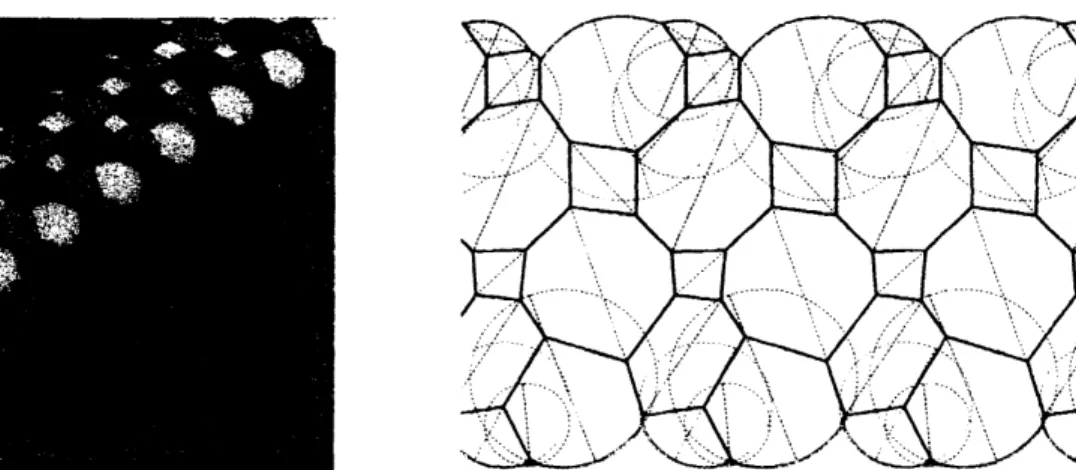
The side
parameter
for punctured torus
groups
秋吉宏尚
(HirotakaAkiyoshi)
近畿大学
(KinkiUniversity)
*1
Introduction
Let $T$ be the once-punctured torus. The Teichm\"uller space, $\mathcal{T}$, of $T$ with
Teichm\"uller distance $d_{q}$ is canonically isometric to the hyperbolic plane $\mathbb{H}^{2}$
.
A punctured torus group is
a
Kleiniangroup
which is freely generated bytwo elements with parabolic commutator. A marked punctured torus
group
is
a
faithful representation of $\pi_{1}(T)$ onto a punctured torusgroup.
For anymarked punctured torus group $\rho$, set $\Gamma_{\rho}=\rho(\pi_{1}(T))$
.
Then $M_{\rho}=\mathbb{H}^{3}/\Gamma_{\rho}$ ishomeomorphic to $T\cross \mathbb{R}$
.
Associated to each end (relative to the main cusp)of $M_{\rho}$, the end invariant, $\lambda^{\pm}(\rho)$, of
$\rho$ is defined to be the marked conformal
structure at infinity ifthe end is geometrically finite and the projective
mea-sured lamination at infinity ifthe
end
is geometrically infinite (seeSection
2).Let $\mathcal{P}$ be the space of conjugacy classes of
marked
punctured torusgroups
and set $\mathcal{E}=\overline{\mathbb{H}^{2}}\cross\overline{\mathbb{H}^{2}}-$diag$(\partial \mathbb{H}^{2})$
.
Itcan
be proved that the end invariant map$\lambda=(\lambda^{-}, \lambda^{+})$ : $\mathcal{P}arrow\overline{\mathbb{H}^{2}}\cross\overline{\mathbb{H}^{2}}-$diag$(\partial \mathbb{H}^{2})$ is
well-defined.
By Bers’simultane-ous
uniformization theorem, the restriction of $\lambda$ to the subspace $\mathcal{Q}\mathcal{F}\subset \mathcal{P}$ ofthe quasifuchsian representations for $T$ is
a
homeomorphism onto $\mathbb{H}^{2}\cross \mathbb{H}^{2}$.Minsky [9] proved that the end invariant map $\lambda=(\lambda^{-}, \lambda^{+})$ : $\mathcal{P}arrow \mathcal{E}$ is
bijective, and the inverse of the map is continuous. Moreover, it
was
provedthat $\mathcal{P}$ is equal to the closure of $\mathcal{Q}\mathcal{F}$
.
In contrast, Anderson and Canary [4]constructed such
a
sequence $\{\rho_{n}\}$ in $Q\mathcal{F}$ which converges in $\mathcal{P}$ whose image$\{\lambda(\rho_{n})\}$ under the end
invariant
map diverges in $\mathcal{E}$.
In the famous
unfinished
manuscript [7], Jorgensencharacterized
thecom-binatorial structure of the Ford domain of $\Gamma_{\rho}$ for $\rho\in Q\mathcal{F}$, where he
intro-duced
a
map $\nu=(\nu^{-}, \nu^{+})$ : $Q\mathcal{F}arrow \mathbb{H}^{2}\cross \mathbb{H}^{2}$,called
the side parameter, byusing the
combinatorial structure.
Though the complete proof isnot
writ-ten in his paper, it
can
be proved that the side parameter map is actuallya
homeomorphism (see [3] fora
complete proof). The side parametermap
can
be extended to $\nu$ : $\mathcal{P}arrow \mathcal{E}$ by applying Jorgensen’s geometric continuitymethod to the strong limits of quasifuchsian representations.
The main result ofthis paper is the comparison ofthe two maps $\lambda:\mathcal{P}arrow$
$\mathcal{E}$
and
$\nu$ : $\mathcal{P}arrow \mathcal{E}$ with thecommon
domain
andrange.
Theorem 1.1. The map $\nu$ : $\mathcal{P}arrow \mathcal{E}$ is bijective. Moreover, the composition
$\nu\circ\lambda^{-1}$ : $\mathcal{E}arrow \mathcal{E}$ is
a
homeomorphism.As
an
immediate consequence to Theorem 1.1, the Anderson-Canaryse-quence $\{\rho_{n}\}$ alsohas adivergent image $\{\nu(\rho_{n})\}$ in $\mathcal{E}$ underthe side parameter
map.
2
Punctured torus groups
Definition
2.1.Let
$\rho_{0}:\pi_{1}(T)arrow PSL(2,\mathbb{R})\subset PSL(2, \mathbb{C})$be
the holonomyrepresentation of
a
complete hyperbolic structureon
the puncturedtorus
offinite
area.
$\bullet$ A representation $\rho:\pi_{1}(T)arrow PSL(2, \mathbb{C})$ is
a
$quasiconf_{07}mal$deforma-tion of$\mu$) if there is
a
quasiconformal homeomorphism $w$ :$\hat{\mathbb{C}}arrow\hat{\mathbb{C}}$
such
that $\rho=wo\rho_{J}ow^{-1}$, i.e., $\rho(g)=wo\rho_{0}(g)ow^{-1}$ for any $g\in\pi_{1}(T)$.
$\bullet$ The quasifuchsian space $Q\mathcal{F}$of the punctured toms is the space of
con-jugacyclasses ofquasiconformal deformations of$\rho_{0}$
.
Weregard $Q\mathcal{F}$as
a
subspace
of
thespace
$\mathcal{X}$ of type-preserving $PSL(2,\mathbb{C})$-representationsof $\pi_{1}(T)$
.
$\bullet$ We denote the closure of $\mathcal{Q}\mathcal{F}$ in $\mathcal{X}$ by $\overline{\mathcal{Q}\mathcal{F}}$
.
Definition 2.2. $\bullet$ A marked punctured tortts group is
a
faithful
anddis-crete representation of$\pi_{1}(T)$ into $PSL(2, \mathbb{C})$ which sends the peripheral
elements to parabolics.
$\bullet$ The space of marked punctured torus groups, denoted by $\mathcal{P}$, is the
conjugacy classes of marked punctured torus
groups.
We regard $\mathcal{P}$as
a
subspace of X.Proposition 2.3. Let $\rho$ be
an
arbitrary elementof
$\mathcal{P}$
.
Then the quotientmanifold
$\mathbb{H}^{3}/{\rm Im}\rho$ is homeomorphic to the product space $T\cross(-1,1)$.
Thedomain
of
discontinuityof
the Kleiniangroup
${\rm Im}\rho$ is the disjoint unionof
two $({\rm Im}\rho)$-invariant subsets $\Omega^{\pm}$ which correspond to the “ends“ $e^{-}=T\cross$ $(-1, -1+\delta)$ and $e^{+}=T\cross(1-\delta, 1)$
of
$T\cross(-1,1)$ respectively, and each $\Omega^{\epsilon}$(i)
$T\Omega^{\epsilon}$ is homeomorphic to the open disk, and
$\Omega^{\epsilon}/{\rm Im}\rho$ is homeomorphic to
(ii) $\Omega^{\epsilon}$ is the countable union
of
open disks, and $\Omega^{\epsilon}/{\rm Im}\rho$ is homeomorphicto the $thi\dot{v}ce$-punctured sphere.
(iii) $\Omega^{e}$ is empty.
Deflnition 2.4. Theendsatisfying
one
of theconditions
(i) and (ii) ofPropo-sition
2.3
issaid
to be geometrically finite,and
one
satisfying the condition(iii) is said to be geometrically
infinite.
Definition 2.5. For every $\rho\in \mathcal{P}$, the end invariant $\lambda^{\epsilon}(\rho)$ of each end $e^{\epsilon}$ of
$\mathbb{H}^{3}/{\rm Im}\rho$ is defined to be
a
point of the Thurston compactification,canoni-cally
identified
with IHI, of the Teichm\"ullerspace
of $T$as
follows. Let $\Omega^{\epsilon}$be
the subset of the domain of discontinuity of ${\rm Im}\rho$ corresponding to the end
$e^{\epsilon}$
.
(i) If $\Omega^{\epsilon}$ is homeomorphic to the open disk, then $\lambda^{\epsilon}(\rho)\in \mathbb{H}^{2}$ is the marked
conformal structure
on
$T$ defined by $\Omega^{\epsilon}/{\rm Im}\rho$.(ii) If $\Omega^{\epsilon}$ is the countable union of open disks, then $\lambda^{\epsilon}(\rho)\in\partial \mathbb{H}^{2}$ is the
marked conformal structure
on
$T$ with nodes defined by $\Omega^{\epsilon}/{\rm Im}\rho$.
(iii) If $\Omega^{\epsilon}$ is empty, then there is
a
sequence of closed geodesics in $\mathbb{H}^{3}/{\rm Im}\rho$which exits
the end
$e^{\epsilon}$. $\lambda^{\epsilon}(\rho)\in\partial \mathbb{H}^{2}$ is defined to be the limit of thesequence.
Theorem 2.6 (Minsky [9]). The end invariant map $\lambda=(\lambda^{-}, \lambda^{+})$ : $\mathcal{P}arrow$
$\overline{\mathbb{H}^{2}}\cross\overline{\mathbb{H}^{2}}-$ diag
$(\partial \mathbb{H}^{2})$ is
a
bijection and its inverse isa
continuous map. Moreover, $\mathcal{P}$ is equal to $\overline{Q\mathcal{F}}$.3
Jorgensen
theory
In this section,
we
briefly review the work of Jorgensen [7]on
thecharac-terization
of combinatorialstructures
of punctured torusgroups.
(See [3]for
a
complete proofof Jorgensen’s resultsfor
quasifuchsian puncturedtorus
groups.)
Definition 3.1. For
a
Kleinian group $\Gamma$, let $\Gamma_{\infty}$ be the stabilizer of $\infty$ in $\Gamma$.
The Ford domain of $\Gamma$ in $\mathbb{C}$ (resp. $\mathbb{H}^{3}$), denoted by $P(\Gamma)$ (resp. $Ph(\Gamma)$), is
defined by
Figure 1: Ford domain of
a
generic quasifuchsian punctured torus groupHere, $E(\gamma)$ (resp. $Eh(\gamma)$) denotes the
exterior
of the isometric circle (resp.isometric hemisphere) of $\gamma$
.
Remark 3.2. The Ford domain $P(\Gamma)$ (resp. $Ph(\Gamma)$) is not a fundamental
domain for the action of $\Gamma$ on $\Omega(\Gamma)$ (resp. $\mathbb{H}^{3}$), whenever $\Gamma_{\infty}$ is
nontriv-ial, where $\Omega(\Gamma)$ is the domain of discontinuity of $\Gamma$ on which $\Gamma$ acts
dis-continuously. Even in the case, the intersection of the Ford domain and
a
fundamental domain for $\Gamma_{\infty}$ is actually a fundamental domain for $\Gamma$.
In what follows, for any $\rho\in \mathcal{P}$,
we
denote $P({\rm Im}\rho)$ $($resp. $Ph({\rm Im}\rho))$ by$P(\rho)$ (resp. $Ph(\rho)$) for simplicity.
Example
3.3.
The Ford domain ofa
generic quasifuchsian puncturedtorus
group looks like Figure 1. Its combinatorial structure is described by
us-ing the “side parameter” defined in Definition 3.10. The upper and lower
boundary components in the right figure define two spines of $T$
.
Byfollow-ing $\partial Ph(\rho)$ from the lower component to the upper,
one
finds the sequenceof Whitehead
moves
connecting the two spines (cf. [3]).Fix a framing $\{\alpha, \beta\}\subset H_{1}(T)$ and a peripheral element $K$ of $\pi_{1}(T)$
.
Definition 3.4. We call a pair ofelements, $(A, B)$, of $\pi_{1}(T)$
a
generator pairif $A$ and $B$ generates $\pi_{1}(T)$ and satisfies $ABA^{-1}B^{-1}=K$. For such
a
pair,$A$ (resp. $B$) is called
a
lefl
(resp. right) genemtor,or
simplya
generator.Remark 3.5. The situation may be
more
clear if we introduce the notionof elliptic genemtor triple, for which
we
need toextend
thegroup
$\pi_{1}(T)$ tothe fundamental
group
of the orbifold obtainedas
the quotient space of $T$by the hyperelliptic involution (cf. [3]).
One
can see
that every generator in the abovesense
has a simple closedFigure 2: Farey triangulation
Definition 3.6. For each generator $X$ which represents
an
element$p\alpha+q\beta\in$$H_{1}(T)$, the slope, $s(X)$, of $X$ is defined by $p/q\in\hat{\mathbb{Q}}$ $;=\mathbb{Q}\cup\{\infty\}$.
Definition
3.7.
The Farey triangulation of$\mathbb{H}^{2}$ isan
ideal triangulationcon-sisting of the ideal triangles $\{\gamma\sigma_{0}|\gamma\in PSL(2, \mathbb{Z})\}$, where $\sigma_{0}$ is the ideal
triangle with vertices $\infty,$$0,1\in\partial \mathbb{H}^{2}$ (Figure 2).
Lemma 3.8. The following holds.
1. For any genemtorpair $(A, B)$, the slopes
of
$A,$ AB and $B$ span an idealtriangle in the Farey triangulation.
2. For any ideal edge (resp. ideal triangle) $\sigma$ in the Farey triangulation,
there is a genemtorpair $(A, B)$ such that the slopes
of
$A$ and $B$ (resp.$A,$ AB and $B$) span $\sigma$
.
Theorem 3.9. For any $\rho\in \mathcal{Q}\mathcal{F},$ $P(\rho)\subset \mathbb{C}$ consists
of
precisely twocon-neet$ed$ components $P^{\pm}(\rho)$, where $P^{-}(\rho)$ (resp. $P^{+}(\rho)$) is the component which
is lower (resp. higher) than the other in $\mathbb{C}$. For each $\epsilon\in$ $\{-, +\},\cdot$ there is a
sequence $\{A_{j}^{\epsilon}\}$
of
genemtorsof
$\pi_{1}(T)$ such that$\partial P^{\epsilon}(\rho)$ is the unionof
circularedges $e_{j}^{\epsilon}(j\in \mathbb{Z})$ with the following property.
(i) For any $j,$ $k\in \mathbb{Z}_{1}$ it
follows
that $s(A_{j+3k}^{\epsilon})=s(A_{j}^{\epsilon})$, and the three slopes$s(A_{0}^{\epsilon}),$ $s(A_{1}^{\epsilon}),$ $s(A_{2}^{\epsilon})$ span
a
tniangle $\sigma^{\epsilon}$of
$\mathcal{D}$.
(ii) For any $j\in \mathbb{Z},$ $e_{j}^{\epsilon}$ is contained in $I(\rho(A_{j}^{\epsilon}))$
.
(iii)
If
we
denote by $\theta_{j}^{\epsilon}$ thehalf of
the angleof
$e_{j}^{\epsilon}$ in $I(\rho(A_{j}^{\epsilon}))$, thenDefinition 3.10 (side parameter). For any $\rho\in \mathcal{Q}\mathcal{F}$, we define the two
points $\nu^{\pm}(\rho)$ in $\mathbb{H}^{2}$
as
follows. For each $\epsilon\in$ $\{-, +\}$, let $\sigma^{\epsilon}$ be the trianglein
$\mathcal{D}$ determined by Theorem3.9.
Then $\nu^{\epsilon}(\rho)$ is the point in the triangle $\sigma^{\epsilon}$with barycentric coordinate $(\theta_{0}^{\epsilon}, \theta_{1}^{\epsilon}, \theta_{2}^{\epsilon})$. The point $\nu(\rho)=(\nu^{-}(\rho), \nu^{+}(\rho))\in$
$\mathbb{H}^{2}\cross \mathbb{H}^{2}$ is called the side pammeter of $\rho$
.
Theorem 3.11. (1) For any $\rho\in Q\mathcal{F}$, the combinatorial
structure
of
$Ph(\rho)$is described by using $\nu(\rho)$.
(2) The map $\nu$ : $Q\mathcal{F}arrow \mathbb{H}^{2}\cross \mathbb{H}^{2}$ is
a
homeomorphism.The following theorem gives
an
extension of the side parameter to $\mathcal{P}$.
(See [1] for
an
outline.)Theorem
3.12.
The map $\nu$ : $Q\mathcal{F}arrow \mathbb{H}^{2}\cross \mathbb{H}^{2}$ isextended
toa
map $\nu=$$(\nu^{-}, \nu^{+}):\mathcal{P}arrow\overline{\mathbb{H}^{2}}\cross\overline{\mathbb{H}^{2}}-$ diag$(\partial \mathbb{H}^{2})$ with the following property.
(1) For any $\rho\in \mathcal{P}$, the combinatorial structure
of
$Ph(\rho)$ is described by using$\nu(\rho)$.
(2) The map $\nu$ is suijective, and it is continuous in the strong topology
on
$\mathcal{P}$.
(3) For each $\epsilon=\pm,$ $\nu^{\epsilon}(\rho)\in\partial \mathbb{H}^{2}$
if
and onlyif
$\lambda^{\epsilon}(\rho)\in\partial \mathbb{H}^{2}$.
Moreover,under the mutually equivalent conditions, it
follows
that $\nu^{e}(\rho)=\lambda^{\epsilon}(\rho)$.
Since the fundamental
group
ofa
punctured torus bundle contains thefundamental group of the fiber surface
as
a
normal subgroup,we
obtain thefollowing corollary, which is first proved by Lackenby [8] with
a
topologicalargument.
Corollary 3.13. For any hyperbolic punctured torus bundle
over
the circle,the Ford domain
of
the imageof
the holonomy representationof
the completehyperbolic structure is dual to the “Jorgensen’s triangulation” (cf. $[ \theta\int)$.
4
Comparison
of
$\lambda$and
$\nu$In [2],
some
comparisons of the end invariant map $\lambda$ : $\mathcal{P}arrow \mathcal{E}$ and the sideparameter map $\nu$ : $\mathcal{P}arrow \mathcal{E}$ is given (see Theorems 4.2 and 4.3 below). In
order to givethe
statement
ofthe comparison,we
introduce a notationwhichNotation 4.1. (a) Let $H_{\infty}(O)$ be the horodisk in$\mathbb{H}^{2}$
with thefollowing
prop-erty: (i) The center of $H_{\infty}(O)$ is equal to $\infty$
.
(ii) The interiors of $H_{\infty}(O)$and $\gamma H_{\infty}(O)$
are
disjoint for any $\gamma\in PSL(2, \mathbb{Z})$ which does not stabilize$H_{\infty}(O)$
.
(iii)For
some
$\gamma\in PSL(2, \mathbb{Z})$ which does not stabilize $H_{\infty}(O)$, $H_{\infty}(O)$ and $\gamma H_{\infty}(O)$ intersect.(b) For any $t\in \mathbb{R}$,
we
definea
horodisk $H_{\infty}(t)$ by the following property: (i)The center of $H_{\infty}(t)$ is equal to $\infty$
.
(ii) The distance between $\partial H_{\infty}(O)$and $\partial H_{\infty}(t)$ is equal to $|t|$
.
(iii) If$t<0$, then $H_{\infty}(t)\subset H_{\infty}(O)$, otherwise$H_{\infty}(t)\supset H_{\infty}(0)$
.
(c) For any $s\in\hat{\mathbb{Q}}$, pick $\gamma\in PSL(2, \mathbb{Z})$
so
that $\gamma(\infty)=s$.
Then, for any$t\in \mathbb{R}$,
we
set $H_{s}(t)=\gamma H_{\infty}(t)$.
(d) For
any
$t\in \mathbb{R}$,we
set $\mathcal{H}(t)=\{H_{s}(t)|s\in\hat{\mathbb{Q}}\}$.
Theorem 4.2 ([2]). There
ezrzst
two universalconstants
$\delta_{a}\in \mathbb{R}$ and $\delta_{b}\geq 0$with the following property.
(i)
If
$\rho\in Q\mathcal{F}$satisfies
$\nu^{\epsilon}(\rho)\in H_{s}(\delta_{a})$for
some
$s\in\hat{\mathbb{Q}}$ and $\epsilon\in$ $\{-, +\}$,then the simple loop on $T$ with slope $s$ has the smallest extremal length
among the simple loops
on
$T$ with respect to theconformal
structure$\lambda^{\epsilon}(\rho)$
.
(ii)
If
$\rho\in Q\mathcal{F}$satisfies
$\nu^{\epsilon}(\rho)\not\in\cup \mathcal{H}(\delta_{a})$for
some
$\epsilon\in$ $\{-, +\}_{f}$ then thehyperbolic distance between $\nu^{\epsilon}(\rho)$ and $\lambda^{\epsilon}(\rho)$ is at most $\delta_{b}$,
We shall denote the Weil-Petersson distance
on
$\mathcal{T}$ by $d_{WP}$ and regard itas an
exotic distanceon
the hyperbolic plane $\mathbb{H}^{2}$.
By combining Theorem1.1 and Brock’s result [5, Theorem 1.1],
we
obtain the following theorem.Theorem 4.3 ([2]). There esists
a
positive number $\delta_{c}$ such thatfor
any $\rho\in$$\mathcal{Q}\mathcal{F}$ and
for
any $\epsilon\in$ $\{-, +\}$, the Weil-Petersson distance $d_{WP}(\nu^{\epsilon}(\rho), \lambda^{\epsilon}(\rho))$between the side pammeter and the end invariant
for
the $\epsilon$-side is boundedabove by $\delta_{c}$
.
We
can
obtain the following stronger Propositions4.4-4.6
by the $a\tau guarrow$ment of [2], which
are
essential
for the proof of Theorem 1.1.Proposition 4.4. For any $t\in \mathbb{R}_{f}$ there is $u=u(t)\in \mathbb{R}_{\wedge}with$ the following
property.
If
$\rho\in \mathcal{P}$satisfies
$\nu^{\epsilon}(\rho)\in H_{s}(u)$for
some
$s\in \mathbb{Q}$ and$\epsilon\in$ $\{-, +\}_{f}$
then $\lambda^{\epsilon}(\rho)\in H_{s}(t)$
.
Proposition 4.5. For any $t\in \mathbb{R}$, there is
$u=u(t)>0$
unth the followingProposition 4.6. For any $t\in \mathbb{R}$, there is $u=u(t)\in \mathbb{R}$ with the following
property.
If
$\rho\in \mathcal{P}$satisfies
$\lambda^{\epsilon}(\rho)\in H_{s}(u)$for
some
$s\in\hat{\mathbb{Q}}$ and$\epsilon\in$ $\{-, +\}$,
then $\nu^{\epsilon}(\rho)\in H_{s}(t)$.
5
Outline of the
proof
of
Main
Theorem
In what follows
we
denote the composition $\nu\circ\lambda^{-1}$ by $\Phi$.
We split the proofof Theorem 1.1 into the following 3 steps:
Step 1. The map $\Phi$ : $\mathcal{E}arrow \mathcal{E}$ is continuous.
Step 2. The map $\Phi$ : $\mathcal{E}arrow \mathcal{E}$ is injective.
Step 3. The map $\Phi$ : $\mathcal{E}arrow \mathcal{E}$ is
a
homeomorphism.5.1
Continuity
of
$\Phi$:
$\mathcal{E}arrow \mathcal{E}$Proposition 5.1. The map $\Phi$ : $\mathcal{E}arrow \mathcal{E}$ is continuous.
Let $\{\lambda_{n}\}$ be a sequence in $\mathcal{E}$ which converges to $\lambda_{\infty}\in \mathcal{E}$
.
We set $\lambda_{n}=$ $(\lambda_{\overline{n}}, \lambda_{n}^{+})(n\in \mathbb{N}),$ $\lambda_{\infty}=(\lambda_{\infty}^{-}, \lambda_{\infty}^{+}),$ $\nu_{n}=(\nu_{\overline{n}}, \nu_{n}^{+})=\Phi(\lambda_{n})$ and $\nu_{\infty}=$$(\nu_{\infty}^{-}, \nu_{\infty}^{+})=\Phi(\lambda_{\infty})$
.
In order to prove Proposition 5.1, we show that anysubsequence of $\{\nu_{n}\}$ contains a subsequence converging to some point in $\mathcal{E}$
which is independent of the choice of subsequence.
The following lemma is proved by using the Propositions
4.5
and4.6.
Lemma 5.2. Suppose that $\lambda_{\infty}^{\epsilon}\in\partial \mathbb{H}^{2}$. Then $\lim_{narrow\infty}\nu_{n}^{\epsilon}=\nu_{\infty}^{\epsilon}$
.
The following lemma is proved by using Propositions 4.4 and 4.5.
Lemma 5.3. Suppose that all$\lambda_{n}^{\epsilon}$ is contained in
$\mathbb{H}^{2}$ and that$\lambda_{\infty}^{\epsilon}\in \mathbb{H}^{2}$ . Then
there is a compact set in $\mathbb{H}^{2}$ containing all
$\nu_{n}^{\epsilon}$
.
Idea
of
the proofof
Proposition 5.1. By Lemma 5.2, thecase
whichessen-tially remains to prove is that
a
component of $\lambda_{\infty}$ is contained in $\mathbb{H}^{2}$ and theother is in $\partial \mathbb{H}^{2}$
.
In this case,we can
prove the continuity by using Lemma5.2
Injectivity
of
$\Phi$:
$\mathcal{E}arrow \mathcal{E}$First, by following the argument of [3, Chapter 9], we
can
prove the followingproposition.
Proposition
5.4.
For any $\lambda\in\hat{\mathbb{Q}}$, both$\Phi|_{\{\lambda\}\cross \mathbb{H}^{2}}$ : $\{\lambda\}\cross \mathbb{H}^{2}arrow \mathcal{E}$ and
$\Phi|_{\mathbb{H}^{2}x\{\lambda\}}$
:
$\mathbb{H}^{2}\cross\{\lambda\}arrow \mathcal{E}$are
injective.Proposition 5.5. The map $\Phi$ : $\mathcal{E}arrow \mathcal{E}$ is injective.
The proof of this proposition requires Proposition 5.6 below.
Proposition 5.6. Let $\lambda_{0}=(\lambda_{0}^{-}, \lambda_{0}^{+})$ be a parameter in $\mathcal{E}$ such that
one
of
$\lambda_{0}^{\pm}$ is contained in $\mathbb{H}^{2}$ and the other is in $\partial \mathbb{H}^{2}$
.
For any neighborhood $N$of
$\lambda_{0}$ in $\mathcal{E}_{f}$
the
image $\Phi(N)$ containsa
neighborhoodof
$\Phi(\lambda_{0})$ in$\partial \mathcal{E}$
.
The proof of this proposition
uses
an
argument similar to theone
of [3,Chapter 9], however, it also
uses
the theory of quasiconformal deformationof geometrically infinite representations due to Ahlfors-Bers-Sullivan.
Proof
of
Proposition5.5
using Proposition5.6. Recall
that themap $\lambda:\mathcal{P}arrow$ $\mathcal{E}$ is bijective. Pick any $\nu_{0}=(\nu_{0}^{-}, \nu_{0}^{+})\in \mathcal{E}$. If both $\nu_{0}^{\pm}$are
contained in$\mathbb{H}^{2}$,
then $\Phi^{-1}(\nu_{0})$ is
a
singleton because the restriction $\nu|_{Q\mathcal{F}}$ : $\mathcal{Q}\mathcal{F}arrow \mathbb{H}^{2}\cross \mathbb{H}^{2}$is bijective. If both $\nu_{0}^{\pm}$
are
contained in $\partial \mathbb{H}^{2}$, then $\Phi^{-1}(\nu_{0})$ is the singletonconsisting of $\nu_{0}$ by Theorem
3.12.
Suppose thatone
of$\nu_{0}^{\pm}$ is contained in $\mathbb{H}^{2}$
and the other is in $\hat{\mathbb{Q}}$
.
Weassume
that $\nu_{0}^{-}\in \mathbb{H}^{2}$.
Then $\Phi^{-1}(\nu_{0})$ iscontained
in $\mathbb{H}^{2}\cross\{\nu_{0}^{+}\}$ by Theorem 3.12. Thus $\Phi^{-1}(\nu_{0})$ is
a
singleton by Proposition5.4.
Finally, suppose that
one
of $\nu_{0}^{\pm}$ is contained inIHI2
and the other is in$\partial \mathbb{H}^{2}-\hat{\mathbb{Q}}$
.
Weassume
that $\nu_{0}^{-}\in \mathbb{H}^{2}$.
Supposemoreover
that $\Phi^{-1}(\nu_{0})$con-tains
distinct points $\lambda_{1}$ and $\lambda_{2}$.
Then both $\lambda_{1}$ and $\lambda_{2}$ satisfy the assumptionof Proposition
5.6
by Theorem 3.12. Since $\mathcal{E}$ is a Hausdorff space, thereare
disjoint open sets $N_{1}$ and $N_{2}$ containing $\lambda_{1}$ and $\lambda_{2}$ respectively. By
Propo-sition 5.6, each $\Phi(N_{1})$ and $\Phi(N_{2})$ contains
a
neighborhood of thecommon
point $\Phi(\lambda_{1})=\nu_{0}=\Phi(\lambda_{2})$ in $\partial(\mathcal{E})$
.
In particular, there is $\nu_{*}^{+}\in\hat{\mathbb{Q}}$ suchthat the point $(\nu_{0}^{-}, \nu_{*}^{+})$ is
contained
in theintersection
$\Phi(N_{1})\cap\Phi(N_{2})$.
Since
$N_{1}$
and
$N_{2}$are
disjoint, the inverse image of $(\nu_{0}^{-}, \nu_{*}^{+})$ contains at least twopoints. This is a contradiction.
5.3
$\Phi$:
$\mathcal{E}arrow \mathcal{E}$is
a
homeomorphism
Proposition 5.7. $\Phi$ : $\mathcal{E}arrow \mathcal{E}$ is
a
homeomorphism.Lemma 5.8.
Let $f$ : $Xarrow X$ be a continuous bijectionof
a
”topologicalspace” $X$ onto
itself.
Suppose that $f$satisfies
the following condition. Forany convergentsequence $\{x_{n}\}$ in$X_{f}$ there is
a
subsequence $\{x_{n_{j}}\}$ such that thesequence
$\{f^{-1}(x_{n_{j}})\}$converges
inX.
Then $f^{-1}$:
$Xarrow X$ is also continuous.This lemma is proved by
a
general argument.Lemma 5.9. For any convergent sequence $\{\nu_{n}\}$ in$\mathcal{E}$, there is
a
subsequence,denoted by the
same
symbol, such that the sequence $\{\lambda 0\nu^{-1}(\nu_{n})\}$ convergesin $\mathcal{E}$
.
This lemma is proved by using Propositions 4.4 and 4.5.
References
[1] H. Akiyoshi, “On the Ford domains of once-punctured torus groups”,
Hyperbolic spaces and related topics, RIMS, Kyoto, Kokyuroku 1104
(1999), 109-121.
[2] H. Akiyoshi, “End invariants and Jorgensen’s angle invariants of
punc-tured torus group”, Perspectives
of
Hyperbolic Spaces II, RIMS, Kyoto,Kokyuroku 1387 (2004),
59-69.
[3] H. Akiyoshi, M. Sakuma, M. Wada, and Y. Yamashita, “Punctured
torus
groups
and
2-bridge knotgroups
(I)”, LectureNotes
inMathe-matics,
1909.
Springer, Berlin, (2007).[4] J. Anderson and R. Canary, “Algebraic limits of Kleinian groups which
rearrange the pages of
a
book”, Invent. Math. 126 (1996),205-214.
[5] J. F. Brock, “The Weil-Petersson metric and volumes of 3-dimensional
hyperbolic convex cores”, J. Amer. Math. Soc. 16 (2003), no. 3,
495-535.
[6] W. Floyd and A. Hatcher, “Incompressible surfaces in punctured torus
bundles”, Topology Appl., 13 (1982),
263-282.
[7] T. Jorgensen,
“On
pairs of punctured tori”, in Kleinian Groups andHyperbolic 3-Manifolds, Y. Komori, V. Markovic
&C.
Series (Eds.),London Mathematical Society LectureNotes 299, Cambridge University
Press, (2003).
[8] M. Lackenby, “The canonical decomposition of once-punctured torus
[9] Y. Minsky, “The classification of $p\iota mctured$ torus groups”,
Ann.
of
Math., 149 (1999), $559\triangleleft 26$
.
Department of Science, Faculty
of Science
and Engineering, Kinki UniversityKowakae, Higashi-Osaka, Osaka 577-8502, Japan