Estimating
Age Replacement Policies with
a
Censored
Small
Sample
Data
林坂弘一郎
\dagger,
土肥 正\daggerKoichiro
Rinsaka
\daggerand Tadashi Dohi
$\dagger$\daggerDepartment ofInformation Engineering
Graduate Schoolof Engineering, Hiroshima University
1-4-1 Kagamiyama, Higashi-Hiroshim
a
739-8527 JapanE-mail:
{rinsaka,
dohi}@rel.
hiroshima-u.ac.jPAbstract–In thisarticle,weconsider the typical age replacementmodelsso astominimize the relevant
expected costs, and formulate the statistical estimation problems with the censored sample of failure timedata. Basedontheconceptof total timeonteststatistics,weshow thattheunderlying optimization
problemsaretranslatedtothe graphicalonesonthe data space. Next,weutilizeakerneldensityestimator
and improve thestatistical estimation algorithms in terms of convergence speed. Throughout simulation
experiments,the developed algorithm$\mathrm{s}$are usefulespecially for the small sample problem,and enableus
to estimate theoptimalagereplacementtimes withhigheraccuracy.
Keywords– Agereplacement,Totaltimeontest, Non-parametric estimation, Kaplan-Meierestimation,
Kerneldensityestimation, Statisticaloptimization
1.
Introduction
SinceBarlow and Proschan published their remarkable book [1],
a
number of optimal replacementmodelsunder uncertainty havebeendevelopedin theliterature, Forthe ordinaryagereplacement problems, Bergman
[2] and Bergman and Klefsj6 $[3, 4]$ developed the non-parametric estimation algorithms based
on
the totaltime ontest statistics toobtainthe optimalagereplacement times from the completesampleof failure time
data. Ifa lot of sample offailure time data
can
be obtained, then with probability 1, the estimate of theoptimalage replacement time basedon theiralgorithm asymptoticallyconverges
on
a
true optimalsolution.Hence, the non-parametric estimation algorithms
are
usefulto realizean
adaptive maintenance control Whenthe adaptive control is carried out, it is important to obtain moreaccurate solution in the situation where
onlyfewer failure data
are
obtained. Recently, Rinsaka and Dohi [5] proposed the non-parametric estimationalgorithm basedon the kernel density estimation [6-10] to improve the estimation accuracy of the opti mal
agereplacementtimes for age replacement problems witha complete
sm
small sample data.In many situations, however, it is difficult to collect all the failure time data, since it is necessary to
continue the experiment untilthe last item
on
testor
in service has failed. Under these circumstances, it isdesirable todiscontinuethe study prior to failure of all items in the sample. Then,
so ne
observations maybe censoredortrurcatedfrom th$\iota \mathrm{e}$right, referred to
as
right-censorship. Data ofthis typeare
called censoreddata. Reineke $e\ell$
at.
$[11, 12]$ proposed thenon-parametricestimation algorithm basedon
the Kaplan-Meierestimationto obtaintheoptimalage replacementtimes fromthecensored sample of failure $\mathrm{t}\mathrm{i}$
me
data.The aim of thispaperisto improve the estimationaccuracy ofthe optimalagereplacementtimes forage
replacement problems with acensored small sample data. More precisely, we propose the non-parametric
estimation algorithm based
on
thekerneldensity estimation$[13,14]$forsome
typicalagereplacementproblems.InSection 2, we formulate the expected costper unit timefor the ordinary agereplacement model and the
imperfect maintenancemodel. In section 3 and4,
we
formulatethe statistical estimation problems with thecensored sample offailuretimedata. Basedonthe conceptof total time
on
test statistics,we
show that theunderlying optimization problems
are
translated tothe graphicalones on
the data space. In section 5,we
utilize a $\mathrm{k}$
speed. Throngh outsimulationexperiments, the developed algorithms are useful especially for the censored
small sample problem, and enable
us
toestimate the optim alage replacemenlt times with higheraccuracy.2.
Age
Replacement
Problems
Under the agereplacement policy,
a
unit is replaced at failureorat age$T(>0)$ whicheveroccurs
first.Let $F$ and $R$ $=1-F$ denote the cumulative distribution function and the survival function ofthe time to
failure ofaunit. It is assumed that$F$iscontinuousand strictly increasing and that the
mean
$\mu=\int_{0}^{\infty}R(t)dt$is finite. Weassumethat the unitcanbe replaced at failure atacost$cf$$K(c>0, K>0)$ arld
a
preventivereplacementat cost $c$
.
Here, $K$can
be thoughtof as a consequence cost.Model 1: The first model is thle ordinary age replacement problem [1, 2], which consists in finding an
optimal ageT$=T^{*}$ minimizing the expected cost perunit time
$C(T)= \frac{(c+K)F(T)+cR(T)}{\int_{0}^{T}tdF(t)+TR(T)}=\frac{c+KF(T)}{\int_{0}^{T}R(t)dt}$. (1)
Model 2: The second model considersa
more
generalsituation that the preventive maintenance at$T$ isimperfect in
some sense
[3] Let $p(0\leq p\leq 1)$ denote the probability that the preventive maintenance isimperfect. Then the expected costper unit time$C_{\rho}(T)$ isgiven by
$C_{\rho}(T)$ $=$ $\frac{(c+K)F(T)+[c+p(c+K)]R(T)}{\int_{0}^{T}R(t)dt}$
$=$ $\frac{[K-p(c+K)]\mathrm{x}[F(T)+d(p)]}{\int_{0}^{T}R(t)dt}$, (2)
where
$d(p)= \frac{c/(c+K)+p}{K/(c+K)-p}$. (3)
3.
The TTT
Concept
To derive the optimalagereplacement timeonthe graph,wedefine the total time
on
test (TTT)transformarid the scaled TTTtransfor$\mathrm{m}$ $[15]$ for the lifetim $\mathrm{e}$ distributionfunction $F(t)$ by
$H^{-1}(u)= \int_{0}^{F^{-1}\langle u)}R$($t\rangle dt$ (4)
and
$\phi(u)=\frac{1}{\mu}\int_{0}^{F^{-1}\langle u)}R(t)dt$, (5)
respectively. Since $F(t)$ isanondecreasingfunction, there always exists its inverse function
$F^{-1}(u)= \inf$$\{t;F(t)\geq u\}$, $0\leq u\leq 1$. (6)
Ifthe expected costs per unit time given by Eq.(l) and Eq.(2)
are
rewritten in terms of the scaled $\mathrm{T}\mathrm{T}\mathrm{T}$transformof$F(t)$, the following result isobtained $[2, 3]$.
Theorem 1: Obtaining the optimal age replacement time which minimizes the expected cost per unit
time at Model i (i$=1,$2)
can
be reduced to the followingmaximizationproblem:where
$\eta_{1}=c/K$, $\eta_{2}=d(p)$. (8)
Theorem 1
can
be obtained by transformin$\mathrm{g}C(T)$ and$CP(T)$toafunction of$u$bymeans
of$u=F(t)$. If thelifetimedistribution$F(t)$ isknown,then the optimal agereplacement time
can
be obtained from Theorem 1by$T^{*}=F^{-1}(u^{*})$
.
Here, $u^{*}(0\leq u^{*}\leq 1)$is given by the$x$coordinate value$u^{*}$for the point of thecurve
withthe largest slopeamongthe line pieces drawn from the point $(-\eta_{i}, 0)$ $(-\mathrm{o}\mathrm{o}<-\eta_{i}<0)$ on atwo-dimensional
planetothe
curve
$(u, \phi(u))\in[0,1]\mathrm{x}[0, 1]$.4.
The Kaplan-Meier Estimator
Often in life testing, aswell
as
in operational situations, it is not possible toobserve the failuretime ofevery unit. Failure timedata often include
some
units that do not fail during their experiment period. Thedata
on
these unitsare said to be right-censored Let $X_{1}$, $X_{2\}}\cdots$, $X_{n}$ denote the true survival times of$n$units whicharecensoredonthe right bya sequence$U_{1}$, $U_{2}$,$\cdots$, $U_{n}$which in general maybe either constants
or
randomvariables.The observed right-censored data
are
denoted bythe pairs $(Y_{j}, 5\mathrm{j})$,$j=1$,$\cdots$,$n$,where$Y_{j}= \min\{X_{j}, U_{j}\}$, $\delta_{j}=\{$ 1if
$X_{j}\leq U_{\mathrm{j}}$,
0if$X_{j}>U_{l}$. (9)
Thus, it is known which observationsare times offailuredeath and which
ones are
censoredorloss times. Inthis paper, we
assume
that $U_{1}$,$\cdots$,$U_{r}$‘ constitute arandom sample from
a
distribution$G$ (which is usuallyunknown) and are independent of$X_{1}$,$\cdots$,$X_{n}$
.
That is, $(Y_{j}, \mathit{5}_{j})$, $j=1$,2,$\cdots$,$n$, is calleda
randomlyright-censoredsample.
Basedonthe censoredsample $(Y_{j}, \delta_{j})$, $j=1$,$\cdots,n$,
a
popularestimator of the survival probability is theKaplan-Meier estimator [16]
as
the nonparametric maximum likelihood estimator of$R(t)$. Let $(Y(\mathrm{J}), \delta(\mathrm{J}))$,$j=1$,$\cdots$,$n$,denote the ordered$Y_{\mathrm{J}}’ \mathrm{s}$alongwith thecorresponding$\delta_{j}’ \mathrm{s}$. The Kaplan-Meier estimator of$R$is
defined by
$\hat{R}_{\mathrm{K}\mathrm{M}\mathrm{E}}(t)=\{$
$1, \prod_{j=1}^{k-1}(\frac{n-j}{n-j+1})^{\delta_{(\mathrm{j})}}$
$0\leq t\leq Y_{(1\}}$,
$t\in(Y\{k-1)$,$Y_{(k)}]$, $k=2$,$\cdots$,$n$,
0, $t>Y_{(n)}$.
(10)
Let $s_{j}$denote the jump of
$\hat{R}_{\mathrm{K}\mathrm{M}\mathrm{E}}$ at
$Y_{\langle j)}$, that is,
$s_{\mathrm{J}}=\{$
$1-\hat{R}_{\mathrm{K}\mathrm{M}\mathrm{E}}(Y_{(2)})$, $j=1$,
$\hat{R}_{\mathrm{K}\mathrm{M}\mathrm{E}}(Y_{(j)})-\hat{R}_{\mathrm{K}\mathrm{M}\mathrm{E}}(Y(j+1))$, $j=2$,$\cdots$,$n-1$,
$\hat{R}_{\mathrm{K}\mathrm{M}\mathrm{E}}(Y_{(n)})$, $j=r\iota$.
(11)
Note that $s_{j}=0$if and only if$\delta_{j}=0$,$j<n$, that is, if$Y(j)$ isacensored observation.
Let $\chi_{1}$,$\chi_{2}$,$\cdots$,$\chi_{m}$ denotethe observed failure times and let $\mathrm{X}(\mathrm{i})\leq\chi_{(2)}\leq\cdots\leq \mathrm{X}(\mathrm{m})$ denote the order
statisticsof the $\chi_{j}$, where $m(\leq n)$ is thenumber of observed (uncensored) failures. Forrandomly censored
data, the TTT-plot
can
becan
be constructed using the Kaplan-Meier estimator by letting $u(j)=1$-$\hat{R}_{\mathrm{K}\mathrm{M}\mathrm{E}}(\chi\langle j))$, $j=1,2$,
$\cdots$,$m$,for the ordered failure time$j$and by estimating theTTT-transform with
$H_{\mathrm{K}\mathrm{M}\mathrm{E}}^{-1}(u(j))$ $=$ $\int_{0}^{\chi_{(j)}}\hat{R}_{\mathrm{K}\mathrm{M}\mathrm{E}}(t)dt$
$=$ $\sum_{k=1}^{j}(\chi_{(k)}-\chi_{\langle k-1\rangle})\hat{R}_{\mathrm{K}\mathrm{M}\mathrm{E}}(\chi_{(k-1)})$, $j=1,2$ ,$\cdot$
.
.,$mj$ $\chi_{(0)}=0$. (12)
The TTT-plot isobtained byplotting the coordinates
By connecting the points in a staircase pattern, the scaled TTT plot is obtained. Since the estimate
in Eq.(13) is
a
nonparametric estimate of $(u, \phi(u))$, $u\in[0, 1]$, the following theorem on the optimal agereplacement time is obtained by direct application of the result in Theorem 1 $[11, 12]$,
Theorem 2: Itisassumed that the randomly censoredfailuretime data $(Y_{j}, \delta_{j})$,$j=1$,$\cdots$,$n$
are
observedin Model $\mathrm{i}$ $(\mathrm{i}=1, 2)$. The nonparametric estimate
$\hat{T}$
of
an
optimal age replacement time minimizing theexpected cost per unit time is given by$\chi_{(j)}$
.
satisfying the following:$j^{*}= \{j|\max\frac{\hat{H}_{\mathrm{K}\mathrm{M}\mathrm{E}}^{-1}(u_{(j)})/\hat{H}_{\mathrm{K}\mathrm{M}\mathrm{E}}^{-1}(u_{n})}{u_{(j)}+\eta_{i}}0\leq j\leq n\}$
.
(14)5.
The
Kernel Density
Estimation
Inthis section,we proposethe kernel densityestimationtoobtain the optimal agereplacement time from
thlecensored small sample data. Supposethatthe true lifetimes$X_{1}$,$\cdots$,$X_{n}$ arethe nonnegative independent
identically distributed random variables with common unknown distribution function $F$ and the density
function $f$. Again,
we assume
that the right-censored datacan
be observed. Then we define the kerneldensityestimator $[13, 14]$ by
$f_{\mathrm{K}\mathrm{D}\mathrm{E}}^{\mathrm{A}}( \tau)=h^{-1}\sum_{\mathrm{i}=1}^{n}s_{j}\Phi(\frac{\tau-Y_{j}}{h})$ (15)
where, $s_{j}$ is given by Eq.(ll). The parameter $h(>0)$ is the window width, also called the smoothing
parameter
or
bandwidth. The function $\Phi$is calledthe kernel function which satisfies the condition$\int\mathrm{t})\mathrm{d}\mathrm{t}$$=1$, $\int t{t$)$dt=0$ and $\int t^{2}\Phi(t)dt=r^{2}\neq 0$. (16)
Usually, but not always, $\Phi$will be asymmetricprobability density function. In thispaper,the Epanechnikov
kernel function [10]
$\Phi(t)=\{$
$\frac{3}{4}(1-\frac{1}{5}t^{2})/\sqrt{5}$ for $|t|<\sqrt{5}$
0
otherwise(17)
is utilized to estimate the density functionof lifetime.
When
we
utilizethe kernel method, the problem of choosing how much to smooth isofcrucial importance.The maximum likelihood criterion for selecting the ideal value of$h$ for
a
given censored sample is feasiblefor$\hat{f}_{\mathrm{K}\mathrm{D}\mathrm{E}}$ but does not
seem
to be tractable,evenusing numerical method. Scott and Factor [17] consideredchoosingideal value of$t_{l}$which maximizes the likelihood
$L(h)= \prod_{i=1}^{n}[\hat{f}_{\mathrm{K}\mathrm{D}\mathrm{E}}(y_{i})]^{\delta_{1}}[\int_{y_{\mathrm{i}}}^{\infty}\hat{f}\kappa \mathrm{r})\mathrm{E}(x)dx]^{1-\delta_{1}}$ (18)
Obviously, by definition of $\hat{f}_{\mathrm{K}\mathrm{D}\mathrm{E}}$, the maximum of Eq.(18) is $+\infty$ at $h=0$
.
Padgett [14] considered thefollowing
modified
likelihood criterion:$\mathrm{m}\mathrm{a}\mathrm{x}h\geq 0$
$L_{1}(h)= \prod_{k=1}^{n}[\hat{f}_{nk}(y_{k})]^{\delta_{k}}[\int_{vk}^{\infty}\hat{f}_{nk}(x)dx]^{1-\delta_{k}}$ (19)
where,
$\hat{f}_{nk}(y_{k})=h^{-1}j\overline{\neq}k\sum_{\mathrm{j}-\mathrm{L}}^{n}s_{\mathrm{J}}\Phi$
Table 1. Censoringparameters and $s$-expected proportionofcensoring $q$
0.1
0.20.3
0.4 0.5$\frac{\nu \mathrm{S}2.9038.5023.6316.1211.55}{q0.60.70.80.9}$
$\nu$ 8.43 6.12 4.25 2.59
Now, define the scaled total timeontesttransform oftheestimator$\hat{F}_{\mathrm{K}\mathrm{D}\mathrm{E}}(?)=1-\hat{R}_{\mathrm{K}\mathrm{D}\mathrm{E}}(t)=f_{0}^{t}\hat{f}\mathrm{K}\mathrm{D}\mathrm{E}(s)ds$
of lifetim $\mathrm{e}$distribution by
$\phi \mathrm{K}\mathrm{D}\mathrm{E}(u)=\frac{1}{\hat{\mu}_{n}}\int_{0}^{\hat{F}_{\mathrm{K}\mathrm{D}\mathrm{F}r}^{-1}\langle u\rangle}\hat{R}_{\mathrm{K}\mathrm{D}\mathrm{E}}(t)dt$
, (22)
where,$\hat{\mu}_{n}$ is theestimate ofmean time tofailure (MTTF) and canbe estimated as
$\hat{\mu}_{n}=\int_{0}^{\infty}\hat{R}_{\mathrm{K}\mathrm{D}\mathrm{E}}(t)dt$. (22)
The followingtheoremonthe optimalagereplacement time is obtained by direct application of the result in
Theorem ].
Theorem 3: It is assumed that the randomly censored failure time data$(Y_{j}, \delta_{J})$,$j=1$,$\cdots$,$n$,
are
observedin Model $\mathrm{i}$
$(\mathrm{i}=1, 2)$. The nonparametric estimate $T\wedge$
of
an
optimal age replacement time minimizing theexpected cost perunit time1s givenby $T^{*}=\hat{F}_{\mathrm{K}\mathrm{D}\mathrm{E}}^{-1}(u^{*})$ satisfyingthe following:
$0 \leq u\leq 1\max\frac{\phi_{\mathrm{K}\mathrm{D}\mathrm{E}}\langle u)}{u+\eta_{i}}$. (23)
6.
Simulation Experiments
$t\geq 0$ (24)
Of our interest in this section is the investigation of asymptotic properties and convergence speed of
estimatorsproposed in previoussections. Suppose that thelifetimeoftheunit obeys the Weibulldistribution: $F(t)=1-R(t)=1- \exp[-(\frac{t}{\theta})^{\gamma}]$
We
assume
that the unit is tested and subject to random censoring generated by the exponential distributionwith
mean
$\nu$, and defined by the cumulativedistributionfunction$G(t)=1- \exp(-\frac{t}{\iota},)$ t $\geq 0$. (25)
The $s$-expected proportion of censoring, q, is given by [18]
q$= \int_{0}^{\infty}R(t\rangle dG(t\rangle$. (26)
In the following simulation experiments, the Weibull shape and scale parameters are fixed $7=2.0$ and
$\theta=10.0$
.
Table 1 shows the censoring parameters and corresponding$s$-expected proportion ofcensoring.
The other parameters
are fixed
$c=1$, $K=9$, $p=0.2$. Through the TTT transforrn, the optimal agereplacement times for Models 1 and 2canbederived
as
$T^{*}=$3.365and $T^{*}=$6.790, respectively.Let
us
consider theestimation
ofan
optimal agereplacement time minimizing the expected costperunittime when the random right-censoredfailuretimedata
are
already observed. It is assumedthatthe observeddata consist of30pseudorandomnumbersgeneratedffomthe
Weibull
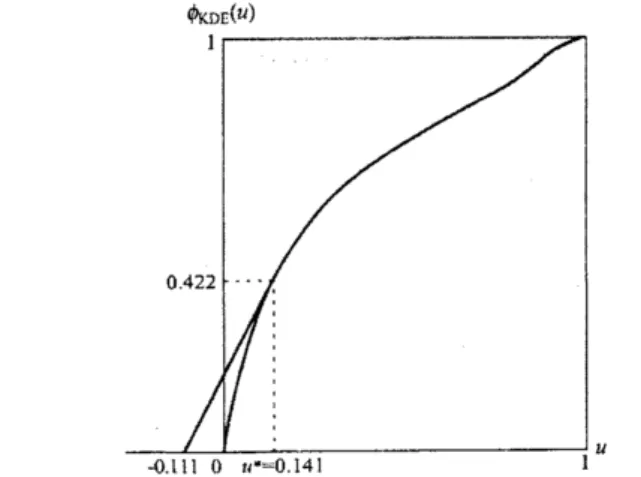
failuretimedistributionin Eq.(24) andFigure 1: Estimation ofthe optimalagereplacement time basedon the kernel density estimation (Model 1).
$q=0.2$
.
InFig.1,we
presentan
estimation example of the optimal agereplacement time in Model 1 basedon
thekernel densityestimationfrom 30 observedright-censoreddata,wherethe ideal smoothing parameter$h$ which maximizes the modified likelihood criterion in Eq.(19) is used. The point providing the steepest
slope among the line segments drawn from $(-\eta_{1},0)=$ -0.111 0) to the scaled TTT transform $\phi \mathrm{K}\mathrm{D}\mathrm{E}(u)$ is
$n’=$ 0.141. Hence,the optimal age replacementtime
can
be estimatedas
$T^{\mathrm{A}}*=$4.025.Next, let
us
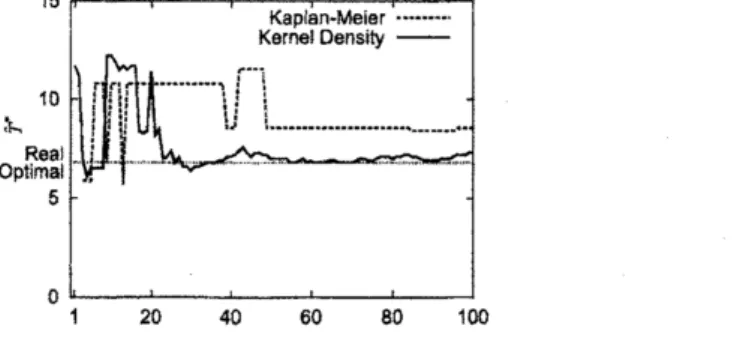
study the asymptotic behavior of two nonparametric estimation algorithms, namely, theTTT plot using the Kaplan-Meierestimationand the kernel densityestimation. MonteCarlosimulationsare
carriedout with pseudorandom
nrun
bersbasedon
the Weibull failuretime distribution and the exponentialcensoring timedistribution,inorder to investigate theconvergencetoward the real optimal solution. Figures
2 to 5 show the asymptotic behavior ofthe optimal age replacement time for Model 1 and 2, From these
figures, it is found that the resultsconverge tothe real optimal solutions when the number of failure time
datais close to30.
Figures6 to 9 show thle
mean
squareerror
of estimate of the optimal age replacement time, whichare
obtained
by carryingout the above Monte Carlo simulations100
times. When the sample size is extremelysmall, theestimation accuracy of the kernel density
estimation
is not always high. Once20
or moresampledata can be obtained, we
can
observe that the estimation accuracy of the optimal age replacement timne
can
be improved by introducing the kernel density estimation. From these results,we
conclude that thestatisticalalgorithm based
on
the kerneldensityestimationcan
berecommended
toestimate the optimal agereplacement time,especially for thecensored small sample problem.
7.
Concluding
Remarks
In this paper, we have considered the typical age replacement models
so as
to minimize the relevantexpected costs, and
formulated
thestatistical estimation problems with the censored sample of failure timedata. Based
on
the concept of total timeon
test statistics,we
haveshownthatthe underlyingoptimizationproblems were translated to the graphical
ones on
the data space. Next, we have utilizeda
kernel densityestimator and improve the statistical estimation algorithmsin terms of estimation accuracy. Through the
simulation experiments, it has been shown that the
estimation
accuracy of the kernel density estimationis higher than the Kaplan-Meier estimation, when the 20
or
more
sample datacan
be obtained. We haveadopted the approach ofmaximizing the modified
likelihood
criterion for the method of determining thesmoothing parameter. In the future effort, it would be interesting to improve the estim ation accuracy by
no.data
Figure2: Asymptotic behavior ofestimateof the optimalage replacement time (Model 1,q$=0.2$).
15 Kaplan-Meier– Kernel Density– 10 $\mathrm{a}_{-}$ $0_{\mathrm{P}^{\mathrm{t}\mathfrak{l}\mathfrak{m}\mathrm{a}1}}^{\mathrm{R}\epsilon \mathrm{a}}5$
$–\sim\dot{}_{*-\cdot m\cdot--\cdot d}’.-\cdot-\cdot-\neg.\mathrm{t}||:\ldots\dot{\lrcorner}:-;\backslash$ $|’\ldots-\cdots.$
.
0
1 20 40 60 80 $\{00$
nodata
Figure3: Asymptotic behavior ofestimateof the optimal age replacement time (Model 1,$q=0.4$).
nodata
Figure4: Asymptotic behavior ofestimate of the optimal age replacement time(Model 2, q$=0.2$).
$\mathrm{n}\mathrm{o}\Delta \mathrm{a}\mathrm{t}\mathrm{a}$
70
Kaplan-Meier $\mathrm{g}$
60 Kemel Density $-arrow-$
so
$\mathrm{b}$ $q)\mathrm{U}\mathrm{J}=4030$ $\prod_{\grave{|},\mathrm{i}_{\Pi}}|[mathring]_{/}$ 201’..
$\varpi_{\mathrm{r}\mathrm{J}_{\mathrm{D}}^{*}}^{1}.\tau_{1}$ 10%\\
$0_{0}$ 10 20 30 40 50 no.dataFigure6: Mean square
error
ofestimate of the optimalagereplacementtime (Model 1, $q=0.2$).$=\sigma)\mathrm{u}\rfloor$
no.data
Figure7: Mean square
error
ofesti nate of the optimalage replacement time (Model 1, q$=0.4$).70
Kaplan-Meier 0
60
’4
KernelDensity $-arrow-$ $50$$l_{\mathrm{d}}^{4d}|\infty^{\eta-}\mathrm{D}’--|\# 0!_{\Pi^{1}}\beta_{\mathrm{b}}^{\neq \mathrm{l}}$
$\sigma^{\mathrm{J}}\mathrm{u}_{\mathrm{J}}$
$40$ $\cdot \mathrm{o}$ $\mathrm{d}$ $e_{\phi^{\mathfrak{g}}}$
$\alpha^{\mathrm{R}}\mathrm{R}$ $\mathrm{E}$
$2030$
$\mathrm{m}_{3}$
$.-\iota_{\mathrm{h}\backslash _{\mathrm{q}^{-}}^{\mathrm{I}\mathrm{I}}}’\mathrm{r}^{\prime*}\backslash ’+\grave{\#}^{-}$
10
$0_{0}$
{0 20 30 40
so
nodata
Figure8: Mean square
error
ofestimateofthe optimalagereplacement time (Model 2,$q=0.2$).70 $\mathrm{K}\mathrm{a}\mathrm{p}|\mathrm{a}\mathrm{n}- \mathrm{M}\mathrm{e}\dot{|}\mathrm{e}\mathrm{r}$ $\mathrm{a}$
$6050$ $\Gamma‘.\mathrm{r}_{\backslash }J11$
.
KernelDensity $arrow-$
$\mathrm{t}D\mathrm{u}\mathrm{J}=4030$ $\backslash _{\mathrm{o}^{*\eta}}^{1}\mathrm{i}_{\mathrm{I}}\mathrm{D}\not\in P^{\mathfrak{g}}\mathrm{r}_{\mathrm{p}4_{1}^{\mathrm{f}\mathrm{f}\mathrm{i}^{\mathrm{F}^{\mathrm{o}\mathrm{e}_{\mathrm{E}}}}\mathrm{m}_{\mathrm{Q}}^{d+\mathrm{p}^{\mathrm{g}}}}}l_{)-}\mathrm{b}.\#\}9\mathrm{b}^{\mathrm{m}]}$
20 $\mathrm{r}\cdot[].’\iota_{-}^{-}-I\cdots\neg$
$0 0
0 40 20 30 40 50
no.data
REFERENCES
[1] R.EBarlowand F. Proschan, Mathematical Theory
of
Reliability, John Wiley&
Sons,New York, (1965).[2] B. Bergman,Onage replacement and thetotalti
me on
testconcept, Scandinavian Journalof
Statistics,6, PP. 161-168, (1979).
[3] B. Bergman and B. Klefsj6, A graphical method applicable to age-replacement problems, IEEE Trans.
Reliab.,R-31 (5), pp. 478-481, (1982).
[4] B. Bergman and B. Klefsj6, TTT transforms and age replacements withdiscountedcosts, NavalResearch
Logis tics Quarterly, 30, pp. 631-639, (1983).
[5] K. Rinsaka and T.Dohi,Estimatingagereplacement policieswith
a
small sampledata, Proc. 2005Inter-national Workshop
on
RecentAdvances in Stochastic OperationsResearch, Canmore, Canada, pp.219-226, 2005
[6] E. Parzen, On the estimation of
a
probability density function and themode, Annalsof
MathematicalStatistics, 33, pp. 1065-1076, (1962).
[7] M.Rosenblatt, Remarks
on some
nonparametricestimates ofadensity function, Annalsof
MathematicalStatistics, 27, PP. 832-837, (1956).
[8] T Cacoullos, Estimation of
a
multivariate density, Annalsof
the Instituteof
Statistical Mathematics,18, pp 178-189, (1966).
[9] B.W. Silverman, $Derk\mathit{9}\iota ty$ Estimation
for
Statistics and Data Analysis, Chapman and Hall, London,(1986).
[10|V.A. Epanechnikov, Nonparametric estimation of a multidimensional probability density, Theory
of
probability andits applications, 14, pp. 153-158, (1969).
[11] $\mathrm{D}.\mathrm{M}$. Reinke, $\mathrm{E}.\mathrm{A}$
.
Pohl and $\mathrm{W}.\mathrm{P}$. Murdock Jr, Survival analysis and maintenance policies for aseries
system, with highly censored data, Proc Annual Reliability and Maintainability Symposium, pp.
182-188, (1998).
[12] $\mathrm{D}.\mathrm{M}$.Reinke,$\mathrm{E}.\mathrm{A}$.Pohl and$\mathrm{W}.\mathrm{P}$
.
MurdockJr, Maintenance-policy cost-analysisfora
series systemwith
highly-censored data, IEEE Trans. Reliab., R-48(4), pp. 413-420, (1999)
[13] $\mathrm{D}.\mathrm{T}$. McNicholsand$\mathrm{W}.\mathrm{J}$
.
Padgett, Kerneldensity estimation under rando1ncensorship, Statistics Tech.
Rep.,
no.
74, University ofSouth Carolina, (1981).[14] $\mathrm{W}.\mathrm{J}$.Padgett, Nonparametric estimation of density and hazard rate
functionswhen samplesarecensored, in Handbook
of
Statistics, vol. 7 (Edited by$\mathrm{P}$R. Krishnaiah and$\mathrm{C}.\mathrm{R}$. Rao),pp.313-33, North-Holland,
New York, (1988)
[15] $\mathrm{R}.\mathrm{E}$. Barlow and R. Campo,
Total time
on
testprocesses and applications to failure data, inReliabil-ity and Fault Tree Analysis, ed. $\mathrm{R}.\mathrm{E}$. Barlow, J. Pussell and $\mathrm{N}.\mathrm{D}$, Singpurwalla, pp. 451-48, SIAM,
Philadelphia, (1975).
[16] $\mathrm{B}.\mathrm{L}$
.
Kaplan and P. Meier, Nonparametric estimation from incomplete observations, $J$ A$mer$, Statist.
Assoc., 53,pp. 457-481, (1958).
[17] $\mathrm{D}.\mathrm{W}$
.
Scott and $\mathrm{L}.\mathrm{E}$.
Factor, Monte Carlostudyof three data-based nonparametric probabilitydensity
estimators, J. Amer. Statist Assoc., 76, pp. 9-15, (1981).
[18] L. Leemis, Reliability: