Dirichlet form
approach
to infinite
interacting
L\’evy
processes
Syota Esaki
Faculty of Science,
Chiba university
1
Introduction
Let $\Phi$ : $\mathbb{R}^{d}arrow \mathbb{R}\cup\{\infty\}$ be
a
selfpotential, $\Psi$ : $\mathbb{R}^{d}\cross \mathbb{R}^{d}arrow \mathbb{R}\cup\{\infty\}$ bea
interaction pairpotential with $\Psi(x, y)=\Psi(y, x)$. We then consider ISDE (infinite dimensional stochastic
differential equation)
$dX_{j}(t)=dB_{j}(t)- \frac{1}{2}\nabla\Phi(X_{j}(t))-\frac{1}{2}\sum_{k:k\in \mathbb{Z},k\neq j}\nabla\Psi(X_{j}(t), X_{k}(t))dt, j\in \mathbb{N}$. (1)
Theexistence anduniquenessof solutions of ISDE (1) hasbeen studied in many researches.
The stochastice process $(X_{j}(t))_{j\in \mathbb{N}}$ describes a system of interacting Brownian motions
(IBM). On the other hand, IBM is constructed by using Dirichlet form technique [2, 5, 6].
For a local function $f$
on
$S$ the symmetricfunction $\tilde{f}$
such that
$f( \sum_{j\in \mathbb{N}}\delta_{s_{j}})=\tilde{f}((s_{j})_{j\in N})$
is associated. We call a local function $f$ is smooth if the associated function $\tilde{f}$
is smooth. We denote by $\mathscr{D}_{0}$
the set of all local smooth functions on S. We introduce a square field
on $\mathscr{D}\circ$ given by
$\mathbb{D}_{BM}[f, g](s)=\frac{1}{2}\sum_{i=1}^{\infty}\nabla_{i}\tilde{f}(s)\cdot\nabla_{i}\tilde{g}(s) , f, g\in \mathscr{D}\mathring{},$
where $\nabla_{i}=$ $( \frac{\partial}{\partial s_{i1}}, \ldots, \frac{\partial}{\partial s_{id}})$,
$s=(s_{j})_{j\in N}=(s_{j}^{1}, s_{j}^{2}, \ldots, s_{j}^{d})_{j\in \mathbb{N}},$
and a bilinear form $(\mathscr{E}_{BM}, \mathscr{D}_{\infty,BM})$ defined by
晩$M(f, g)=\int_{S}\mathbb{D}_{BM}[f, g](s)d\mu,$ $f,$$g\in \mathscr{D}_{\infty,BM},$
Under
some
assumptions, $(\mathscr{E}_{BM}, \mathscr{D}_{\infty,BM})$ is closable and itsclosure, denotedby $(\mathscr{E}_{BM}, \mathscr{D}_{BM})$,is
a
local, quasi-regular Dirichlet form. Therefore there isa
diffusion $(X_{BM}, \mathbb{P}_{s,BM})$associ-ated with $(\mathscr{E}_{BM}, \mathscr{D}_{BM})$
.
If $\mu$ is $(\Phi, \Psi)$-quasi-Gibbsmeasure
with smooth functions $\Phi$ and$\Psi$ then its $L^{2}$
-generator $L_{BM}$ is given by
$L_{BM}f( s)=\frac{1}{2}\sum_{i=1}^{\infty}\{\Delta_{i}\tilde{f}-\{(\nabla\Phi)(s_{i})+\sum_{j=1,j\neq i}^{\infty}(\nabla\Psi)(s_{i}, s_{j})\}\nabla_{i}\tilde{f}\},$
where $\Delta_{i}=(_{\partial}\partial^{2}=_{s_{i1}}, \ldots, \frac{\partial^{2}}{\partial_{\mathcal{S}_{id}}})$
.
In addition the ISDE associated with $(\mathscr{E}_{BM}, \mathscr{D}_{BM})$ isde-scribed by (1). We remark that although the logarithmic interaction potentials $\Psi(x, y)=$
$-\beta\log|x-y|$
are
unbounded at infinity, there exists quasi-Gibbs states associated withthem for $\beta=1$,2,4 and related IBMs
can
be constructed by the Dirichlet form approach[5, 6].
In
our
researchwe
discretize this interacting particle systems. Especially, in this paperwe
considerinfinite
particle systems in which each particle undergoesa
jump type L\’evyprocess with long range interaction.
Let $\mathbb{D}$ $]$ be the square field
on
$\mathring{\mathscr{D}}$defined by
$\mathbb{D}[f, g](s)=\frac{1}{2}\sum_{j=1}^{\infty}\int_{\mathbb{R}^{d}}\nabla_{j}^{y}\tilde{f}(s)\cdot\nabla_{j}^{y}\tilde{g}(s)p(|y-s_{j}|)dy, f, g\in \mathscr{D}_{o},$
where
$\nabla_{j}^{y}\tilde{f}(s)=\tilde{f}(\mathcal{S}_{1}, \ldots, \mathcal{S}_{j}-1, y, s_{j+1}, \ldots)-\tilde{f}(s)$.
Here $p:[0, \infty$) $arrow[0, \infty$) is a density of$a$ (finite or infinite) measure such that
$\int_{\pi}d(1\wedge|y|^{2})p(|y|)dy<\infty$. (2)
Then
we
introduce the bilinear form $(\mathscr{E}, \mathscr{D}_{\infty})$defined
by$\mathscr{E}(f, g)=$
ヨ
$\mathbb{D}[f, g](s)d\mu,$ $f,$$g\in \mathscr{D}_{\infty},$
$\mathscr{D}_{\infty}=\{f\in \mathscr{D}_{0};\mathscr{E}(f, f)<\infty, f\in L^{2}(S, \mu$
We show that under assumptions $(B.1)-(B.4)$ in addition to $(A.O)-(A.2)$ in section 2,
$(\mathscr{E}, \mathscr{D}_{\infty})$ is closable and its closure, denoted by $(\mathscr{E}, \mathscr{D})$, is
a
quasi-regular Dirichlet form.Therefore there is a special standard process $(X, \mathbb{P}_{s})$ associated with $(\mathscr{E}, \mathscr{D})$. These
as-sumptions
are
quite mild anda
system of interacting $\alpha$-stable processes $(\alpha\in(0,2))$satisfies them if $\alpha$ is greater than $\kappa$, the growth order of the density (the 1-correlation
function) of $\mu$. Since we consider the
case
that a jump rate density do not have theexpectation (e.g. the Cauchy process) we need to consider the influence of the number of
particles coming from far points and the long range interaction. In addition in the
case
that the density goes infinity at the infinity point, the parameter $\alpha$is restricted. However
in the
case even
if particlesmove
independently, infinite particlescan
concentrate ata
point. Suppose that $\mu$ is $a(\Phi, \Psi)$-quasi Gibbs
measure.
Let $\mu_{x}$ be the reduced Palmmea-sure defined by $\mu_{x}=\mu(\cdot-\delta_{x}|s(\{x\})\geq 1)$ for $x\in \mathbb{R}^{d},$ $\rho^{1}(x)$ be the 1-correlation function
of$\mu$ defined by $\int_{A}\rho^{1}(x)dx=\int_{S}s(A)d\mu$ for any bounded measurable subset
$A\subset \mathbb{R}^{d}$ and
for $x\in s$, where $s\backslash x=s-\delta_{x}$ and $d\mu_{y}/d\mu_{x}$ denote the Radon-Nikodym density of
$\mu_{y}$ for $\mu_{x}$. Then under the
some
assumptions its $L^{2}$-generator $L$ is given by$Lf( s)=\frac{1}{2}\sum_{j=1}^{\infty}\int_{S}\nabla_{j}^{y}\tilde{f}(s)c_{s\backslash s_{j}}(s_{j}, y)p(|y-s_{j}|)dy.$
According to the arguments in [3, 4] we can show that the associated labeled process
solves the following ISDE:
$X_{j}(t)=X_{j}(0)+ \frac{1}{2}\int_{0}^{t}\int_{\mathbb{R}^{d}}\int_{0}^{c_{X(s-)\backslash X_{j}(s-)}(X_{j}(s-),X_{j}(s-)+u)}uN_{p}($dsdudr),
for all $i\in \mathbb{N}$, where $X(t)=\sum_{i}\delta_{X_{i}(t)}$
and $N_{p}($dsdudr) is the Poisson point process
on
$[0, \infty)\cross \mathbb{R}^{d}\cross \mathbb{R}$ with intensity $dsp(|u|)dudr$
.
In forthcoming paper we construct the
ISDE associated bythe presentinfiniteparticle systems and discuss the uniqueness of the
solution of the ISDE. Our result is more interesting for a quasi-Gibbs state which is not
a Gibbs state. For example consider the Ginibre random point process $\mu_{gin}$, which is a
probability
measure on
the configuration space on $\mathbb{R}^{2}$with self potential $\Phi(x)=0$ and
interaction potential $\Psi(x, y)=-2\log|x-y|$. From Theorem 1.3 in Osada and Shirai [7]
we see that,$c_{s}(x, y)$ in (3) is written by
$c_{s\backslash x}(x, y)=1+ \lim_{rarrow\infty}\prod_{|s_{i}|<r}\frac{|y-s_{i}|^{2}}{|x-s_{i}|^{2}}.$
In addition
we
remark that wecan
not consider an Glauber dynamics by thesame
wayon the present paper. Of
course
ifwe take an invariantmeasure
$\mu$ from Gibbsmeasures
we
can
consider an equilibrium Glauber dynamics. Indeed to consider the dynamics weuse
the absolute continuity of the Palmmeasure
with respect to the Gibbsmeasure.
Inthis
case
$L^{2}$-generator $L_{Gla}$ of the equilibrium Glauber dynamics is given by
$L_{Gla}f( s)=\int_{S}(f(s\cdot x)-f(s))\rho(x)\frac{d\mu_{x}}{d\mu}(s)dx+\sum_{x\in\sup ps}(f(s\backslash x)-f(s))$.
Here we set $s\cdot x=s+\delta_{x}$ for $s\in S$ and $x\in \mathbb{R}^{d}$. However
for
an
quasi-Gibbsmeasure
in general the Palm
measure
is not absolute continuous with respect to the quasi-Gibbsmeasure
($e.g$. Ginibre random point field [7]). Hence in thesecase
an equilibriumGlauberdynamics for
a
quasi-Gibbsmeasure
is not well-defined.2
Setup and
main
result
Let $S$ be a closed set in $\mathbb{R}^{d}$
such that $0\in S$ and $\overline{S^{int}}=S$, where $S^{int}$
denote the interia of$S$
.
Let $S=${
$s=\sum_{i}\delta_{s_{i}};s(K)<\infty$ for all compact sets $K\subset S$},
where $\delta_{a}$ stands forthe delta
measure
at $a$. We endow $S$ with the vaguetopology. Then $S$ is a
Polish space.
We call $S$ the configuration space
over
$S$. We denote by $\mathscr{D}_{o}$ the set of all local smoothfunctions on S. For $f,$$g\in \mathscr{D}_{o}$ we set $\mathbb{D}[f, g]$ : $Sarrow \mathbb{R}$ by
where $p$ : $[0, \infty$) $arrow[0, \infty$) is
a
density of $a$ (finiteor
infinite)measure
satisfying
thecondition (2). We set
$\mathscr{E}(f, g)=\int_{S}\mathbb{D}[f, g](s)d\mu,$
$\mathscr{D}_{\infty}=\{f\in \mathscr{D}$
。$\cap L^{2}(S, \mu);\mathscr{E}(f, f)<\infty\}.$
Let $S_{r}=\{x\in S;|x|\leq r\}$. We introduce
some
assumptions as the following.There exist $k$-density function of
$\mu$ on $S_{r}$, denoted by
$\sigma_{r}^{k},$
(A. O) and $k$-correlation function, denoted by $\rho^{k}$, for all $k,$$r\in \mathbb{N}.$
$(\mathscr{E}, \mathscr{D}_{\infty})$ is closable
on
$L^{2}(S, \mu)$. (A.1)$\sigma_{r}^{k}\in L^{p}(S_{r}^{k}, dx)$ for all $k,$$r\in \mathbb{N}$with some $1<p\leq\infty$. (A.2)
By (A.1)
we
denote by $(\mathscr{E}, \mathscr{D})$ the closureof$((\mathscr{E}, \mathscr{D}_{\infty}),$$L^{2}(S,$$\mu$ In additionwe
introduceconditions $(B.1)-(B.4)$:
$\rho^{1}(x)=O(|x|^{\kappa})$
as
$|x|arrow\infty$ forsome
$\kappa\geq 0$. (B. 1)$p(r)=O(r^{-(d+\alpha)})$ as $rarrow\infty$ for
some
$\alpha>\kappa$. (B.2)$p(r)=O(r^{-(d+\beta)})$
as
$rarrow+0$ forsome
$0<\beta<2$.
(B.3)$\frac{Var[s(S_{r})]}{(\mathbb{E}[s(S_{r})])^{2}}=O(r^{-\delta})$ as $rarrow\infty$ for some $\delta>0$. (B.4)
Conditions $(B.1)-(B.3)$ relate to the jump rate and the growth rate of the density of
particles. Condition (B.4) isnecessary to control thefluctuationof the number of particles
in $S_{r}$. Moreover
we
remark that the LHS of (B.4) isrepresentedby the 1 and 2-correlationfunctions of $\mu$ by the following:
$\frac{Var[s(S_{r})]}{(\mathbb{E}[s(S_{r})])^{2}}=\frac{\int_{S_{r}}\rho^{1}(x)dx-\int_{S_{r}^{2}}(\rho^{1}(x_{1})\rho^{1}(x_{2})-\rho^{2}(x_{1},x_{2}))dx_{1}dx_{2}}{(\int_{S_{f}}\rho^{1}(x)dx)^{2}}.$
By the expression
we
can check that (B.4) holds if $\mu$ is the Poisson random point fieldwith respect to Lebesgue
measure
or $\mu$ isa
determinantal point field. Hence condition(B.4) is mild.
Now
we
statean our
main theorem:Theorem 1. Suppose that $(A. O)-(A.2)$, $(B. l)-(B.4)$ hold. Then $(\mathscr{E}, \mathscr{D})$ is a quasi-regular
Dirichlet
form
on $L^{2}(S, \mu)$.
Therefore
there exists a special standard process $\{\mathbb{P}_{s}\}_{s\in S}$as-sociated with $((\mathscr{E}, \mathscr{D}),$$L^{2}(S,$$\mu$ Moreover $\{\mathbb{P}_{s}\}_{s\in S}$ is reversible with invariant measure
$\mu.$
Remark 1. Condition (B.1) and (B.2) imply that
$\int_{S}\rho^{1}(x)p(x, A)dx<\infty$, (4)
for all compact subset $A$. The property (4) is necessary to construct the infinite particle
3
Sketch
of
proof
of Theorem 1
In this section we give the sketch of the proof of the quasi-regularity of $(\mathscr{E}, \mathscr{D})$. For the
reader’s convenience we give the definition of quasi-regular Dirichlet form. We refer to
Ma and R\"ockner [1] for detail and related notions. A symmetric Dirichlet form $(\mathscr{E}, \mathscr{D})$ on
$L^{2}(S, \mu)$ is called quasi-regular if $(\mathscr{E}, \mathscr{D})$ satisfies the following:
(Q.1) There exists
an
$\mathscr{E}$-nest consistingof compact sets.
(Q.2) Thereexists an $||\cdot||_{1}$-dense subset of$F$whose elements have$\mathscr{E}$
-continuous$\mu$-versions.
Here $||f||_{1}^{2}=\mathscr{E}(f, f)+||f||_{L^{2}(S,\mu)}^{2}.$
(Q.3) There exist$u_{n}\in \mathscr{D},$ $n\in \mathbb{N}$, having$\mathscr{E}$
-continuous$\mu$-versions$\tilde{u}_{n}$, andan$\mathscr{E}$
-exceptional set $N$ such that $\{\tilde{u}_{n}\}$ separates the points of$S-N.$
We
can
check (Q.2) and (Q.3) by the similar way used in [2]. Hence it is sufficient thatwe check (Q.1).
Lemma 1. Assume (B.4). Let $a_{n}=\{n2^{(d+\kappa)r}\}_{r\in N},$ $n\in \mathbb{N}$. Then we have $\mu(\bigcup_{n=1}^{\infty}S[a_{n}])=1.$
where $S[a]=\{s\in S;s(S_{2^{r}})\leq a_{r}$
for
all$r\}$for
$a=\{a_{r}\}_{r\in N}.$It is known that $S[a]$ is a compact set for all $a=\{a_{r}\}_{r\in N}$. Hence Lemma 1 says that
there exists a family of compact subsets whose union has probability one.
Here we introduce
a
function $\chi[a]$ defined by$\chi[a](s)=\rho\circ d_{a}(s) , d_{a}(s)=\sum_{r=1j}^{\infty}\sum_{\in J_{r_{\rangle}s}}\frac{(2^{7}-|s_{j}|)\wedge 2^{r-1}}{2^{r-1}a_{r}},$
where $(s_{j})_{j\in \mathbb{N}}$ is a sequence such that $|s_{j}|\leq|s_{j+1}|$ for all $j\in \mathbb{N},$ $s=\sum_{j}\delta_{S_{j}}$ and
$J_{r,s}=\{j;j>a_{r}, s_{j}\in S_{2^{r}}\}.$
$\rho$ : $\mathbb{R}arrow[0$, 1$]$ is the function defined by
$\rho(t)=\{\begin{array}{ll}1 if t<0,1-t if 0\leq t\leq 10 if 1<t,\end{array}$
(see Figure 1). Forthefunction$\chi[a]$
we
can see
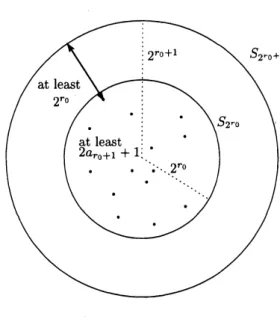
the followinglemmaby the straightforwardcalculation (see Figure 2).
Lemma 2. For any $a=\{a_{r}\}_{r\in \mathbb{N}}$ we have
$\chi[a](s)=\{\begin{array}{l}1if s\in S[a],0 if s\in S[2a_{+}]^{c},\end{array}$
Figure 1: $\rho(t)$
Figure 2: an example of a configuration in $S[2a_{+}]^{c}$
From lemma 2 we can call $\chi[a]$ a cut offfunction
on
$S[a].$The next lemma is
a
key lemma of the proof of Theorem 1. This lemma is proved bythe lemma 2 and
some
additional arguments.Lemma 3. Suppose $a_{n}=\{a_{n,r}\}_{r\in N}=\{n2^{(d+\kappa)r}\}_{r\in N}$
.
Let $a>\kappa,$ $0<\beta<2$. Then thereexists $C=C_{d,\alpha,\beta,\kappa}$ such that
$\int_{S}\mathbb{D}[\chi[a_{n}], \chi[a_{n}]](s)f^{2}(s)d\mu\leq C\int_{A(a_{\mathfrak{n}})}f^{2}(s)d\mu$
for
all $n\in \mathbb{N}$ and $f\in \mathscr{D}_{\infty}.$where we set $A(a)=S[2a_{+}+1]\backslash S[a-1]$
for
$a=\{a_{r}\}_{r\in \mathbb{N}},$ $2a_{+}+1=\{2a_{r+1}+1\}_{r\in N}$and $a-1=\{a_{r}-1\}_{r\in N}.$
FromLemma 1 and Lemma3 and
some
additional arguments, wecan
prove the followinglemma.
Lemma 4. For all $f\in \mathscr{D}_{\infty}$,
we
have$\chi[a_{n}]farrow f$ in $||\cdot||_{1}$ as $narrow\infty.$
From Lemma 4 and
some
additional arguments, wecan
check the condition (Q.1).4
Examples
We set that $\mu$ is the Dyson random point field or the Ginibre random point field. It is
known that these random point fields
are
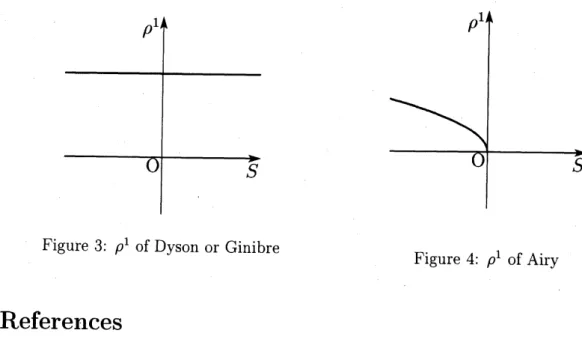
quasi-Gibbs measures, i.e. $(A.O)-(A.2)$ hold.For these random point fields we can see $\rho^{1}$ is a constant function. Then the assumption
(B.1) is satisfied for $\kappa=0$. Hence we
can
take $0<\alpha,$ $\gamma<2$. Therefore we can constructinteracting symmetric $\alpha$-stable processes for any $0<\alpha<2.$
On the other hand
we
set that $\mu$ is the Airy random point field. It is known that thepoint field we
can see
$\rho^{1}(x)=O(|x|^{1/2})./$as $xarrow-\infty$. Then the assumption (B.1) issatisfied for $\kappa=\frac{1}{2}$. Hence we
can
take $\frac{1}{2}<\alpha<2,$ $0<\gamma<2$. Therefore
we can
constructinteracting symmetric a-stable processes for any $\frac{1}{2}<\alpha<2.$
Figure 3: $\rho^{1}$
of Dyson or Ginibre
Figure 4: $\rho$ ofAiry
1
References
[1] Ma, Z.-M.,
R\"ockner,
M.: Introduction to the theory of (non-symmetric) Dirichletforms.
Springer-Verlag,
Berlin, 1992.[2] Osada, H.: Dirichlet form approach to infinitely dimensional Wiener processes with
singular interactions. Comm. Math. Phys., 176 (1996),
117-131.
[3] Osada, H.: Tagged particle processes and their non-explosion criteria. J. Math. Soc.
Japan, 62, No. 3,
867-894
(2010).[4] Osada, H.: Infinite dimensional stochastic differential equations related to random
matrices. Probab. Theory Related Fields 153, 471-509 (2012)
[5] Osada, H.: Interacting Brownian motions in infinite dimensions with logarithmic
interaction potentials. Ann. Probab. 41,
1-49
(2013)[6] Osada, H.: Interacting Brownian motions in infinite dimensions with logarithmic
interaction potentials II: Airy random point field. Stochastic Process. Appl. 123,
813-838
(2013)[7] Osada, H., Shirai, T.: Absolute continuity and singularity of Palm
measures
of theGinibre point process. $arXiv$:math.$PR/1406.3913.$
Department ofMathematics and Informatics, Faculty ofScience
Chiba University
Chiba
263-8522
JAPAN
$E$-mail address: