ENCOUNTERS WITH EXACT DIFFERENTIAL AND FORMULATIONS OF THE TWO-CONSTANT THEORY
- 118 YEARS BEFORE VORTEX MOTION
増田茂(首都大学東京大学院理学研究科博士後期課程数学専攻D4)
ABSTRACT. This year 2008isthe aniversaryof150years after Helmholtz’s famous paper on vortex$[19|$
in1858. Inthefluidmechanics, it$i\epsilon$an important concept to$anal\mu e$it, forexample in threevariables, for$udx+vdy+wdz$ to be satisfied withan exact $differ^{\backslash }\epsilon ntiability$ora complete differentiability. By
d’Alembert, Euler, Lagrange, Laplace, Cauchy, Poissonand Stokes succeeded itstheoreticalside. From
the geometrical point of view, Gauesand Riemann applied it. $Mor\infty ver$Helmholtz andW.Thomson
applied it to the$th\infty ry$ ofvorticity. ‘IbHelmholtz’svorticityequation, Bertrandcriticized but
Saint-Venantsided with him. Wewould liketoreport itfrom the$hi\epsilon tori\infty 1$ view offluid mechanicsaccording
toTable 4. On theother hand, theformulationsofthetwo-constant $th\infty ry$ in theeqmlibrium$/motion$
and ofthe Navier-Stokcsequations in the motion was deduced, which shwin Table2, 3. Wewould
liketo summarizefluidmechanics from thcmathematicalpointof view, of118 years beforeHelmholtz,
namely, sinceMaupertuis’ andClairaut’spaporsoncomplete differential[28], [6]in 1740.
1. From the observation of exact differential
to
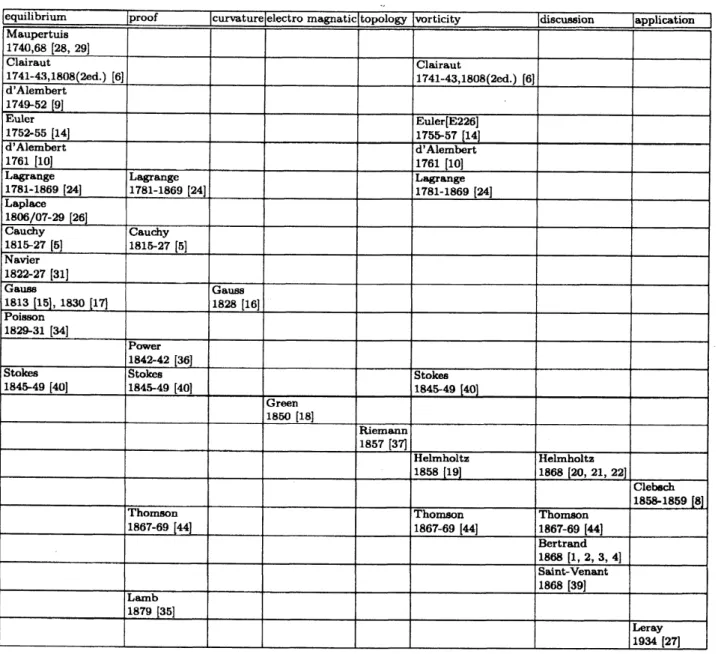
vortex 1.1. Introduction- the mathematical historic view of the exact differential.Therearetheories of equiliblium, applicationsand discussions aboutan exact differentiability of$udx+$
$vdy+wdz$ for the fluid mechanics. We show such a historical view in Table 4, inwhich the topics
are:
conditionof equilibriumoffluid,proofof theeternal continuityin timeand space of
an
exact differential.curvature, electro magnetic, topology, vorticity,discussion
on
Helmholtz’spapers,
other applications.Our motivationto study these theme is due to the article 73, the last
pages
ofPoisson [34, pp.1734$]$, in which he remarks that because the exact differelitial holds water in original time of motion, it
doesn’t follow that it alwaysholdswater in all othertime
interval.1
We would liketotellthemistakeof”Poisson’s conjecture” andthe fact that Navier-Stokes equations are formulated inthis stream through thesetopics.
1.2. Maupertuis’ principle ofminimum action.
P.L.Maupertuis’
paper
is famous by Pnncipleof
the minimum action, which is about geometrical optics. Maupertuis’ paperon
thelawof equilibriumwas
readbyl’Aca&’mie
Royale desSciences
deParis
in
1740.
Cen’estque danscesdemiers temps qu’on ad\’ecouvertuneloi donton nefauroit tropvanter
labeaut\’e&l’utilit\’e, c’estquedans toutsyst\^emedecorps\’elastiquesenmouvement,quiaggisent
les uns sur lesautres, la somme des produits de chaque masse par le quarr\’e desa vitesse, ce
qii’on appele la forcevive, demuereinalt\’erablement la m\’eme. $\cdot\cdot\cdot$
Soit unsyst\^eme de corps qui pesent, ou qui sont titrda vers descentres par des forces qui
$agi\propto nt$ chacunesurchacun,comme unepuissance $N$deleurs distancesauxcentres : pourque
tous ces corps demeurent en repos, il faut que la somme des produits de chaque masse, par
l’intensit\’edesaforce, &parla puissance$N+1$desadistanceaucentre desaforce(qu’onpeut
appellerlasommedesforces durapos) fasseun maximumou unminimum. [28, pp.47-48]
In the proof for above propositions, he concludes: forthe system in equilibrium, it tums into
$mfz^{n}dz+m’f’z^{\prime n}dz’+m’’f’’z^{J/n}dz’’=0$, (1)
Date:2008/12/16.
lMai
$\epsilon$ la d6mongtrationqu’on donne decettc proposition supposeque les vUeursde $u$.
$v,$ $w$, doivent satisfairenonseulmentaux$\text{\’{e}}’quation\epsilon$diff\’erenticllesdu mouvement, mais$en\infty re$\‘atoutes cellesquis’end6duisentenlesdiff6rentiant par
rapport
a
$t$;cequi n’apastoujourslieu\‘al‘egard dos expreuionsde$u,$ $t$” $w$,en$\epsilon 6ri\propto$d’exponentielles etdc sinusou coeinusdont lesposans etlesarcssont propotionnels autemps; et lademonstration 6tant alors en d\’efaut, il peutarriver que la
formule $udx+vdy+u$) $dz$soit$\iota mcdiR6rentielle$exacte\‘al’originedumouvement,et qu’ellenesoitplus$l$touteautre6poque.
TABLE 1. Theories, applicationsanddiscussionsabout anexactdifferentiability of$udx+$
$vdy+v\prime dz$for the fluid mechanics
where $m,$$m’,$ $m”$
are masses
and $f,$$f’,$$f”$are
forces. Hence the vaJue of$mfz^{n+1}dz+m’f’z^{\prime n+1}dz’+$$m”f”z^{\prime\prime n+1}dz’’$ is a maximum or a minimum. By the way, ifhomogeneous, we can substitute
$z,$$z’,$ $z”$
with $x,$ $y,$$z$ and$mf,$$m’f’,$$m”f”$with $P,$$Q,$ $R$then (1) becomes the equationby Euler citing Maupertuis
:
$dS=Pdx+Qdy+Rdz=0$.
1.3.
Clairaut’seffort
and $(,xact$diffirentfal.
Clairaut
uses
already $effor\cdot t$(response) and exactdiffirential
on
the hydrostatics in1740. Inhisthesis: $\tau u_{0}iie$de la figure de laterre, tike desprincipes de l’hydrostatique (Theoryofthefigure of
the earth,
come
komthe principle of the hydrostatics), he proposes exactdiffirential
earlier than Euler. Weshowhisdescr\’iptionsonly in twodimensions, although he descrives also in three dimensions.
\S 16
Sion
voulaitprdSentement faire usagedecettequantit\’e, pour trouver en termes finislavaleurdupoidsdu canal$ON$,ensupposantquelacourburedece canalf\^utdonn&par une\’equation entre$x$ et $y$, oncommencerait parfaire\’evanouir$y$ et$dy$ de $Pdy+Qdx$
:
cettediff\’erentiellen’ayantplus que des$x$ et $dx$, on int\’egrait enobservantde compl\’eterl’int\’egle, c’est-\‘a-dire d’ajouter laconstante n\’e($\backslash$.
$\zeta$’ssaire, afin que le poids f\^ut nul, lorsque
$x$serait \’egal \‘a$CG$ ;
on
ferait ensuite$X=CI$ , et l’onauraitlepoids total de$ON$. Maiscomme
l’equilibre dufluide
demandeque
lepoidsde$ON$ne
d\’ependepas de la courburede $OSN,$ $c’ aet-\grave{*}$dire de la vaJeur particuli\‘ere de
$y$
en
$x$, il faut donc que $Pdy+Qdx$puisse s’int\’egrer
sans
conna
$\hat{\iota}tre$ la vaJeur de $x$, c’est-itiedire qu’il faut que $Pdy+Qdx$soit une
diffi’rentielle
compihte, afin qu’il puisse$y$avoir6quilibredans le fluide. [6, \S 16, $p.35arrow 37]$.
Accordint to Clairaut, his paper onexact differential havebeen appearedin 1740
as
follows :\S 17
Lorsque les expressions des forces $P$ et $Q$ serontassez
compoe&s pour qu’onne
reconnaisse pas facilement si $Pdy+Qdx$ estune
difflrentielle
$\infty mpkte$, il faudrase
servierduthbor\’eme que$j$’aidonn\’edans
mon M\’emoire2
sur
laCalcul
$in\# M$c’est-adirqu’il faudra voir si $iFdP=\neq^{d_{y}}$
.
Toutes les fois que cette \’equationaura
lieu,on
sera
s\^urqu’il$y$
aura
$\ 1^{uihbre}$dans le fluide. [6, \S 17,p.37-38].Clairaut comments the exact
differential3
in hisfootnoteas
foilows:1.4. Euler’s study
on
the exact differential.He investigates the characters of the exact
.
d\’ifferential in the followingpapers.(E258) Principia
motus
fluidorum
(Principles of the motion offluids) [1752], (1756/57), 1761..
(E225) Prencspes $\phi n6mux$ de l’\’etat d’\’equilibre desfluides
[1753], (1755), 1757..
(E226) Principes $\phi r\not\in muxdu$ mouvement desfluides
$[1755|$, (1755), 1757..
(E227) Continuation des recherches sur $\iota uo|;_{e}du$mouvement desfluides
[1755], (1755), 1757..
(E375) Sectio pnma de statu aequnlibliifluidorum
(Section 1. On the state of equilibrium offluids) (1768), 1769.
.
(E396) Sectio secunda de prencipiis motusfluidorum
(Section2. On theprin$cipl\alpha$ of motion offluids) (1769),
1770.
where (E...) shows the$Enestr\ddot{v}m$Index and the following
years are:
.
year in [, commentedby C.Ttuesdell [45],.
yearin $()$, commentedby $Enest\dot{\mathfrak{n})}m$in Euleri Opera Omnia[14],.
publishedyears commented by $Enestr\ddot{v}m$in Eulere Opem Omnia$[14|$,respectively.
$2_{Voy}\{\}Z$lesM\’emo:re$\epsilon$del’Aca&mi$\epsilon$,$am6c$1740,page 294.
$3_{It}$ iscalled of the condition of thc exact
differentialasfollows. Nowinbrief,we treatonlytwovariables.
In the domain$K$of the plane$xy$,whcnthetwofunction$\varphi(x, y)\in C^{1}$ and$\psi(x, y)\in C^{1}$ aregiven,andwe suppose
$\varphi(x, y)dx+\psi(x, y)dy$ (2)
is the total dlfferential ofanarbitraryfunction$F(x)y)$, namely$dF=\varphi dx+\psi dy$
.
Henoe, $F_{x}=\varphi$, $F_{y}=\psi$.
Thenbythe assumptiom,weget$F_{xy}=\varphi_{y}$and $F_{yx}=\psi_{X}$, namely,
1.4.1. Development of the exact differential by Euler.
Euler investigate the exact differentia] in many parts, We show one of them as follows. In (E396),
Eulerquestions Problem34 :
\S 88.
Sicuiusque fluidi elementi ternae celeritates$u,$$v,$$wita$sint $c,ompatoratae$, utfor-mula$udx+vdy+wdz$integrationemadmittat,$a\epsilon quationem$,qua$pr\infty sio$fluidiexprimitur,
evolvere. (E396) [14, p.127].
$(Tkanslation)\Rightarrow$ Ifthe threeelements of the velocity ofanarbitraryflnid : $u,$$v$ and
$w$
are
equalto eachother and theformula: $udx+vdy+wdz$is integrable,thentoextract the equation, in which thepressure of flnid is expraesed.Euler solves hisproblem
ae
follows: $dI=udx+vdy+wdz+\Phi dt$, $U=t4(du\tau_{x})+v(du\tau_{y})+w(\gamma_{z})+(^{d}\tau_{t}^{u})\cdot$$\sqrt{y}du=\frac{dv}{u}$, $\frac{du}{dz}=\frac{dw}{dx}$, $Ttdu=Zd\Phi$
.
Namely: $U=u( \frac{du}{dx})+v(dv\varpi)+w(\frac{dw}{dx})+(^{d}\pi^{\Phi})$, $V=u( \frac{du}{dy})+$$v(dv \tau_{\vec{y}})+w(dw\tau_{y})+(\frac{d\Phi}{dy})$ , $W=u( \gamma_{z})+v(\frac{dv}{dz})+w(\frac{dw}{dz})+(\tau_{z})$
.
And now,we
postulate that theouter forces $P,$$Q,$$R$act such that : $\int(Pdx+Qdy+Rdz)=S$, and intheflnid element, weconsider the
preaqure
$=p$and the density$=q$,
then $zA^{d}S=2gdS-Udx-Vdy-Wdz$ ,in whichwe
assume
thetime $t$is constant, $dx(d\Phi\varpi)+dy(dT\otimes\dot{y})+d_{\tilde{k}}(d\Phi\tau_{z})q=d\Phi_{:}$ $Udx+Vdy+Wdz=udu+\tau rdv+ufdw+d\Phi$, When this formula is integlable, then $2g \int_{q}^{d_{1}}$
.
$=2gS- \frac{1}{2}(u^{3}+v^{2}+w^{2})-\Phi+f$ ; $t$, in which the $\Re uation$hasthe condition that the quantity$q_{1}\epsilon$ afunctionofonly$p$ ; $hom$another reason, if$th\dot{B}$equation have
the condition thatthe value is necaesaryto be positive,and $q$ is the function belonging to$p^{6}$then tb
quantityturnsinto$2gS- \frac{1}{2}(u^{2}+v^{2}+w^{2})-\Phi$
.
1.5. Lagrange’s velocity potential $\varphi$
.
LagrangecitesEuler’s style,however,uses
firstas
the velocitypotential : $\varphi$ whichis the symbol inthe modem convention.
\S 14. nous
supposerons de plus que les forces accd\’eratricae $P,$$Q,$$R$ du fluide soienttelles, que $Pdx+Qdy+Rdz$ soit
une
diff\’erentielle compl\‘ete; ce quia lieu,en
gdn\’eral,lorsquecesforcesviennentd’uneoude plusieurssttractionspropotionelles\‘adesfonctions
quelconques desdistances.
De cette manibre, si l’on fait
$dV=Pdx+Qdy+Rdz$
, la $6quation$ propos& \’etantdivis\’eepar$\Delta$
se
r\’eduira \‘acetteforme$( \frac{dp}{dt}+p\frac{dp}{dx}+q\frac{dp}{dy}+r\frac{dp}{dz})dx+(\frac{dq}{dt}+p\frac{dq}{dx}+q\frac{dq}{dy}+r\frac{dq}{dz})dy+(\frac{dr}{dt}+p\frac{dr}{dx}+q\frac{dr}{dy}+r\frac{dr}{dz})dz=dV-\frac{d\Pi}{\Delta}$
.
Ainsile premier membre decette\’equationdevra \^etreen
particulierune
diff\’erentiellecompl\‘eterelativement ti$x,$ $y,$$z$, puisque le seconden est
une.
Qu
on
retranche de part et d’autre la diff\’erentielle de $\frac{n^{a_{+q^{2}+r^{2}}}}{2}$ priserelativement \‘a$x,$ $y,$$z$, laquelleest $(p^{d} \oint_{x}+q_{dy}^{4}a+r^{d_{z}}\neq)dx+(p^{d}\not\leq+q^{d}\theta_{y}+r\yen_{z})dy+(p^{dr}\pi+q_{Ty}^{dr}+r_{Tz}^{dr})dz$;
on
aura,en ordonnantles termes,cette
transform& $\frac{dp}{dt}dx+\frac{dq}{dt}dy+\frac{dr}{dt}dz$$+$ $( \frac{dp}{dy}-\frac{dq}{dx})(qdx-pdy)+(\frac{dp}{dz}-\frac{dr}{dx})(rdx-pdz)+(\frac{dq}{dz}-\frac{dr}{dy})$(rdy-qdz)$=dV- \frac{d\Pi}{\Delta}-\frac{p^{2}+q^{2}+r^{2}}{2}$
.
Donc le primier membre de cette \’equation devra \^etre pareillementune
diff\’erentielleexacte.
\S 15.
li est visible que, si l’onsuppose que
la quantit\’e $pdx+qdy+rdz$ soit ellem\^eme la diff\’erentielle exacte d’une fonction quelconque $\varphi$ compos\’e de $x,$ $y,$$z$ et $t$
, on
aura
$p=\neq^{d_{x}}$, $q=\neq^{d_{y}}$, $r=a_{l}^{e}d$.
Donc $t_{t}^{d}=\tau_{t}^{2}d\#$, $g_{t}=H_{y}^{d^{2}}$, $T\iota dr=\#_{tz}^{d^{2}}$,
$f_{y}^{d}=$$\frac{d^{2}\varphi}{daedy}$, $g=_{\tau_{y}^{d^{2}}}ae$, ,$\cdot\cdot\cdot$ ,
Ainsi
1’6quationpr&6dente
deviendra parces
substitutions$\frac{d^{2}\varphi}{dtdx}dx+\frac{d^{2}\varphi}{dtdy}dy+\frac{d^{2}\varphi}{dtdz}dz=dV-\frac{d\Pi}{\Delta}-\frac{p^{2}+q^{2}+r^{2}}{2}$,
laquelle est \’evidement int\’egrable par raport\‘a$x,$$y,$$z$ ; de sorte qu’en int\’egrant, on
aura
$\frac{d}{}R=V-\int\frac{dI1}{\Delta}-\frac{p^{2}+q^{2}+r^{2}}{2}$ . [24, pp.710-711]
1.6.
Navier’s equation of fluid equilibrium.Navier deducesthe expressionsofforces ofthe molecular action whichisunder thestate ofmotion
as
follows $:6$
We considerthe twomolecules$M$ and$M’$
.
$x,$ $y,$$z$ arethevalues of the rectangular coordinates of$M$ and$x+\alpha,$$y+\beta.z+\gamma$
are
the values ofthe rectangular coordinates of$M’$.
The length ofa rayonemitt\’ingfrom $M$ : $\rho=\sqrt{\alpha^{2}+\beta^{2}+\gamma^{2}}$. The velocity ofthemolecule $M$
are
$u,$ $v,$ $w$ andthat of the molecules $M’$ are$\delta x+\frac{d\delta x}{dx}\alpha+\frac{d\delta x}{dy}\beta+\frac{d\delta x}{dz}\gamma’$, $\delta y+\frac{d\delta y}{dx}\alpha+\frac{d\delta y}{dy}\beta+\frac{d\delta y}{dz}\gamma$, $\delta z+\frac{d\delta z}{dx}\alpha+\frac{d\delta z}{dy}\beta+\frac{d\delta z}{dz}\gamma$ ,
where, $\alpha=\rho\cos\psi\cos\varphi$, $\beta=\rho\cos\psi\sin\varphi$, $\gamma=\rho\sin\psi$, (4)
$\delta\alpha=\frac{d\delta x}{dx}\alpha+\frac{d\delta x}{dy}\beta+\frac{rl\delta x}{dz}\gamma$, $\delta\beta=\frac{d\delta y}{dx}\alpha+\frac{d\delta y}{dy}\beta+\frac{d\delta y}{dz}\gamma$, $\delta\gamma=\frac{d\delta z}{dx}\alpha+\frac{d\delta z}{dy}\beta+\frac{d\delta z}{dz}\gamma$
.
$\delta\rho=\frac{\alpha\delta\alpha+\beta\delta\beta+\gamma\delta\gamma}{\rho}$
.
$\delta\rho=\frac{1}{\rho}(\frac{d\delta x}{dx}\alpha^{2}+\frac{d\delta x}{dy}\alpha\beta+\frac{d\delta x}{dz}\alpha\gamma+\frac{d\delta y}{dx}\alpha\beta+\frac{d\delta y}{dy}\beta^{2}+\frac{d\overline{6}y}{dz}\beta\gamma+\frac{d\delta z}{dx}\alpha\gamma+\frac{d\delta z}{dy}\beta\gamma+\frac{d\delta z}{dz}\gamma^{2})$
where $\frac{d\delta x}{dy}\alpha\beta+\frac{d\delta y}{dx}\alpha\beta=0$, $\frac{d\delta y}{dz}\beta\gamma+\frac{d\delta z}{dy}\beta\gamma=0$, $\frac{d\delta x}{dz}\alpha\gamma+\frac{d\delta z}{dx}\alpha\gamma=0$
.
Here, $f(\rho)$ is afunctiondepends on thedistance$\rho$ between $M$ and $M’$
.
We definethat $\psi$ is the angleoftherayon$\rho$ with its projection onthe $\alpha\beta$-plane and$\varphi$ is the anglewhichthis projectionforms withthe
$\alpha$ axis, and then
we
can
evaluate only the termsas
follows : $\lrcorner 8_{\beta}\omega(\pi\alpha^{2}+\#_{y}^{d\delta}\beta^{2}+\mathcal{T}zd\dot{\delta}z2\gamma)$.
ThenweevaJuatefinallythefollowing using the polar system (4)
8$\int_{0}^{\infty}d\rho\rho^{3}f(\rho)\int_{0}^{;}d\psi\int_{0^{T}}^{\pi}d\varphi(\frac{d\delta x}{dx}\cos^{3}\psi\cos^{2}\varphi+\frac{d\delta y}{dy}coe^{3}\psi\sin^{2}\varphi+\frac{d\delta z}{dz}\sin^{2}\psi$coe$\psi)$
.
Here, $\int_{0}^{\frac{\pi}{2}}d\psi cos’\psi=\frac{2}{3}$, $\int_{0^{I}}^{z}d\psi$)$\sin^{2}\psi$
coe
$\psi=\frac{1}{3}$, $\int_{0}^{\frac{\pi}{2}}d\varphi\cos^{2}\varphi=\int_{0}^{\frac{*}{2}}d\varphi\dot{a}n^{2}\varphi=\frac{\pi}{4}$,It turns into : $8_{7}^{\pi} \frac{2}{3}\int_{0}^{\infty}d\rho\rho^{3}f(\rho)(\pi+\#_{y}^{d\delta}+\tau_{z}d\delta z)$
.
Here for the brevity, $\frac{4\pi}{3}\int_{0}^{\infty}d\rho\rho^{3}f(\rho)\equiv p$,where, $p$ depends not on the distance $\rho$, but only on the coordinates of $x,$ $y,$$z$ which detemine the
situation of the molecule $M$. Hencewe get $p(d\delta x\pi+\mu_{y}^{d\delta}+\tau_{z}d\delta z)$
.
The equation desclibing condition ofequiliblium of thesystemis: $0= \iiint dxdydz[p(d\delta x\pi+-d\delta\Delta dy+^{d\delta z}\tau_{z})+P\delta x+Q\delta y+R\delta z]$
.
Bythe partial integrationwe
get$0=$ $\iiint dxdydz[(P-\frac{dp}{dx})\delta x+(Q-\frac{dp}{dy})\delta y+(R-\frac{dp}{dz})\delta z]$
$-$ $\int\int dydz(p’\delta_{J}’-p’’\delta x’’)-\int\int dxdz(p’\delta y’-p’’\delta y’’)-\int\int(lxdy(p’\delta z’-p’’\delta z’’)$ ,
1.6.1.
The indeterminate equations.Navier reduces the
.
indetemiinateequations forfluid equilibrium into twocases.
Exact differential$foI^{\cdot}$ the conditions ofthe equilibrium of the arbitrary, interiorpoint ofthe fluid, $\frac{dp}{dx}=P$, $\frac{dp}{dy}=Q$, $\frac{dp}{d_{\tilde{k}}}=R$, $dp=Pdx+Qdy+Rdz$, $p= \int(Pdx+Qdy+Rdz)+const$
.
Astheresult, Navier explainsexactdifferentialforthe conditions of fluid equilibrium
as
follows:formuleo\‘ulafonction
sous
lesigne$\int$ doit \^etren\’ec$\infty$sairementsusceptibled’uneink’gration exacte, pour que le fluide soumis \‘a l’action des forces
repr&ent6ae
par$P,$$Q,$$R$, puisse demeureren
\’equilibre. [31, p.396]..
Theboundaryconditiontosurface,Navier explains the mathematical method citing Lagrange[25, pp.221-223,
\S 29-30]
as
follows :regarding the conditions whichreact at the points of the surface of the fluid, if
we
substitute-dydz $arrow$ $ds^{2}\cos l$, $l$ : theangles bywhich thetangent planemakes
on
thesurface framewith the plane$yz$,
-dxdz $arrow$ $d\epsilon^{2}\cos m$, $m$ : samely, the angles with theplane$xz$
,
-dxdy $arrow$ $ds^{2}\cos n$, $n$ : samely, the angles with the plane$xy$,
$- \iint dydz,$$\iint dxdz,$ $\iint dxdi$
,
$arrow$ $Sds^{2}$Hence
we
getas
follows:$0=Sds^{2}[(p’\cos l’\delta x’-p’’\cos l^{l\prime}\delta x’’)+(p’\cos m’\delta y’-p’’\cos m’’\delta y’’)+(p’\cos n’\delta z’-p’’\cos n’’\delta z’’)]$, $0= \int(Pdx+Qdy+Rdz)+const$
.
We getthe differentialequation: $0=Pdx+Qdy+Rdz$
.
And among the variation$\delta x,$$\delta y,$$\delta z$,we
reduce the followmg relation : $0=\delta x\cos l+\delta y\cos m+\delta z\cos n$
.
Naviercites themoleculartheory by Laplace and chooses consistently repulsiveforce in Navier’s papers
[30, 31] as the function dependingon the distance between molecules, however,
N.Bowditch7
points outthat Laplacerethinks therepulsiontheory and changesit, in 1819: $\varphi(f)=A(f)-R(f)$, where $\varphi(f)$ :
a function depending
on
thedistance$f$ between themoleculars, $A( \int)$ : attractiveforce, $R(f)$ : repulsive force.1.7. Helmholtz’s vorticity equations.
1.7.1. Helmholltz’s deflnition ofirrotation.
Helmholtz
uses
Euler’s equations $(1_{H})$, because it is called that he had not known until then about Navier’s equations.$(1_{H})$ $\{\begin{array}{ll}x_{\pi^{d}\not\in=}^{1}-\tau_{t^{+u_{Tx}^{du}+v_{Ty}^{du}+w_{Tz}^{du}}}^{u}d, Y^{d_{y\mathcal{T}t}}-\frac{1}{h}\neq=^{dv}+u_{Tx}^{dv}+v\frac{dv}{dy}+w\frac{d_{J}}{dz}, \Rightarrow[Case]\end{array}$
$z^{1}-\pi^{d_{z\sqrt{t}}}\neq=^{dw}+u_{T\tilde{x}}^{dw}\sim+v_{Ty}^{dw}+?l)\tau_{z}^{w}d$,
$T_{x}T_{y}7^{\frac{w}{z}=0}dudvd$
.
(5)
We consider not only theforces$X,$$Y$ and$Z$ ofthe potential$V$ : $(1a_{H})$ $X= \frac{dV}{dx}$, $Y=T_{y}dV_{-},$ $Z= \frac{dV}{dz}$,
but alsomoreover, Geschutndigkitespotential $\varphi$ (velocitypotential), sothat :
$d\varphi$ $d\varphi$ $d\varphi$
$(1b_{H})$
$u=\overline{dx}$’ $v=\overline{dy}$’ $w=\overline{dz}$
.
(6)From theconigevativelawof(5) $(=1_{H})$ we get also$\Delta\varphi=0$
.
Helmholtzdoesnot mentionexplicitly about vollst\"andigen
Differentialien
(exactdifferential
or
complete differential), however$hom(6)$we
getas
follows: $($1$c_{H})$ $T_{1},Zdu_{\vee-}dv=0$, $\tau_{z}^{-}\tau_{y}dvdw=0$, $\pi^{-}\tau_{z}dwdu=$$0$, $\Rightarrow\nabla xu=0$
.
To study these three conditions $($1$c_{H})$, Helmholtz, consideringan
iifinitely small volume ofwater ina
time period $dt$, makes investigation comprehensively into the variation from the following three various.
motions :einerFortfUkung desWassertheilchens durchdenRaumhin,
$\circ$ einer Ausdehnung oder Zusammenziehungdes Theilchend nach drei Hauptdilationsrichtungen,
wobeieinjedes
aus
Wassergebildete rechtwinkligeParallelepipedon, daesen Seiten denHauptdila-tionsrichtungenparallelsind, rechtwinkeligbleibt, w\"ahrendseineSeiten
zwar
ihreL\"ange \"andem, aberihren fr\"uherenRichtungen parallel bleiben,.
einnerDrehungum
einebeliebig gerichtete tempor\"are Rotationsaxe, welche Drehung nach einem $bekankann$.nten
SatzeimmeralsResultantedreier Drehungenum
dieCoordinataxen angesehenwerden$\{\begin{array}{l}u\equiv A, Bdu\equiv a,\iota!\equiv B, \tau_{\check{y}}dv\underline{=}b.\end{array}$
$\tau_{y}dw=\frac{dv}{dz}\equiv\alpha$,
$\gamma_{z}du=iFdw\equiv\beta$
.
$\cdot\cdot\cdot$ exact differential condition$Z^{=}Tydvdu$ $\equiv\gamma$
$u’\equiv C$, $\sqrt{z}d_{VJ}\equiv C$, $\{$
When
we
considernow
a molecule with the coordinates : $x,$$y$ and $z$are
in infimtely small distancefrom$\overline{x},\tilde{y}$ and$\tilde{z}$, then
$\{\begin{array}{l}?l=A+a(x-\tilde{x})+\gamma(y-\overline{y})+\beta(z-\overline{z}),v=B+\gamma(x-\tilde{x})+b(\tilde{y}-y)+\alpha(z-\tilde{z}),w=C+\beta(x-\tilde{x})+\alpha(y-\overline{y})+c(z-\overline{z}),\end{array}$ $\Rightarrow\{\begin{array}{l}vvw\end{array}\}=\{\begin{array}{l}ABC\end{array}\}+\{\begin{array}{lll}a \gamma \beta\gamma -b \alpha\beta \alpha c\cdot\end{array}\}\{\begin{array}{l}x-\overline{x}y-\tilde{y}z-\tilde{z}\end{array}\}$ (7)
When
we
putヂ $=$ $A(x- \overline{x})+B(y-\tilde{y})+C(z-\overline{z})+\frac{1}{2}a(x-\tilde{x})^{2}+\frac{1}{2}b(\tilde{y}-y)^{2}+\frac{1}{2}c(z-\tilde{z})^{2}$ $+$ $\alpha(y-\overline{y})(z-\overline{z})+\beta(x-\tilde{x})$($z$一を)$+\gamma$$(x -\tilde{x})(y-\overline{y})$,
then $u=\not\leq^{d}$, $l$) $=a_{y}dg$, $w=\#^{d_{z}}$
.
Moreoverwhenwe
choicesuitable vaJue of coordinate$x_{1)}y_{1}$ and $z_{1}$atthemiddlepointof$\tilde{x},\tilde{y},\tilde{z}$: $\varphi=A_{1}x_{1}+B_{1}y_{1}+C_{1}z_{1}+\frac{1}{2}a_{1}x_{1^{2}}+\frac{1}{2}b_{1}y_{1^{2}}+\frac{1}{2}c_{1}z_{1^{2}}$, Thevalues ofvelocity
$u_{1},$$v_{1}$ and $y$)$1$, desolved into these
new
coordinate axisare
: $u_{1}=A_{1}+a_{1}x_{1}$, $v_{1}=B_{1}+b_{1}y_{1}$, $w_{1}=$$C_{1}+c_{1}z_{1}$
.
1.7.2. Helmholltz’s deductionofrotation in vorticity equations. -Helmholtz’sdecomposition. Next,
.
Helmholtzassumes
the conditionsof arotatory motionas
foUws :We consider the rotatory motion of
an
infinitely smallmass
ofwater ofthe point$\tilde{x},\tilde{y}$and $\tilde{z}$.
.
The rotationare
around the axison
a
pararellelwith the$x,y$ and $z$.
.
Themass
goes
throughthe point$\tilde{x},\tilde{y}$and $\tilde{z}$,
with the angles of the velocityare
$\xi,$$\eta$and $\zeta$.
We getthecomponentsof velocitywhich
are
broughtabout,on a
pararellelwiththe coordinateni$\epsilon$$x,$$y$and $z$
aoe as
follows :$\{\begin{array}{lll}0 (z-\tilde{z})\xi-(y-\tilde{y})\xi -(z-\tilde{z})\eta (0x-\overline{x})\eta (y-\tilde{y})\zeta -(x-\tilde{x})\zeta 0\end{array}\}\Rightarrow\{\begin{array}{lll}0 (y-\tilde{y})\zeta -(z-\tilde{z})\eta-(x-\tilde{x})\zeta 0 (z-\tilde{z})\xi(x-\tilde{x})\eta -(y-\overline{y})\xi 0\end{array}\}\Rightarrow[-\zeta 0\eta$$-\xi\sigma_{0}$ $-\eta 0\xi]\{\begin{array}{l}x-\tilde{x}y-\tilde{y}z-\overline{z}\end{array}\}$ (8)
Then
we
getthe responce tensor compoundingfrom (7) and (8) :$\{\begin{array}{lll}a \gamma /\gamma arrow b a\beta a t\cdot\end{array}\}+[-\zeta o_{7/}$ $-\xi\zeta 0$ $-\eta 0\xi]=[a(\gamma+\zeta)(\beta-\eta)(\gamma-\zeta)-b(\alpha+\xi.)(\beta+\eta)(\alpha-\xi)c]$
$\{\begin{array}{ll}u=A+a(x-\overline{x})+(\gamma+\zeta)(y-\tilde{y})+(\beta-\eta)(z-\overline{z}), v=B+(\gamma-\zeta)(x-\tilde{x})+b(\tilde{?/}-y)+(\alpha+\xi)(z-\tilde{z}), \Rightarrow[Matrix]=[Matrix]+[(\gamma-\zeta)-b(\alpha+\xi)a(\gamma+\zeta)(\beta-\eta)(\beta+\eta)(\alpha-\xi)c][Matrix]\end{array}$
$w=C+(\beta+\eta)(x-\tilde{x})+(a-\xi)(y-\tilde{y})+c(z-\tilde{z})$,
By differentiating$u,$$v$ and $w$with respectto $x,$$y$ and$z$ respectivelyand thenit turns outthe following
vorticityequations :
$\{\begin{array}{lll}(a\gamma+\zeta) (\beta-\eta) (\gamma-\zeta) (-b\alpha+\xi) (\beta+?|) (\alpha-\xi) c\end{array}\}$ $\Rightarrow$ $(2_{H})$ $\{\begin{array}{ll}\tau_{z}^{-}\tau_{\overline{\nu}^{=2\xi}’}dvdw \pi^{-}\tau_{z}^{=2\eta}dwdu, \Rightarrow \frac{1}{2}(\nabla xu)=[Matrix]\equiv W(9)\end{array}$
1.8. Thomson’s circulation theorem and the criterion of the irrotation
on
the completedifferential.
Thomson defines the Helmholtz-like velocity potential
as
follows : Thomson’spropositionswhichare
called Thomson’s circulation theorem
are as
follows:Prop 1.1. The hne-integral
of
the tangential component velocity round any dosedcurve
of
a movingfluid
remains constantthrough all time. [44, p.50]Prop 1.2. The
rate
of
augmentation, per unitof
time,of
the space integralof
the velocity along any terminatedarc of
thefluid
is equdto theexcess
of
the valueof
$\frac{1}{2}q^{2}-p$,at
theendtowardswhichtangentialveloc$ity$ is reckoned
as
positive, above its value at the other end. [44, p.50]He explains the condition of the complete differential
as
the criterion of the irrotationas
follows :\S 59(e).
The condition that $udx+vdy+wdz$ is a complete differential [proved above (\S 13) to be the criterion.
ofirrotational motion]means
simplyThat the
flow
[defined\S 60
$(a)$ ] is the same in alldifferent
mutually reconcilable linesfrom
one to anotherof
any twopoints in the fluid; orwhich is thesame
thing,.
That the circulation $[$\S 60
$(a)]$ iszero
mundevery
dosedcurve
capableof
being contmcted toa
pointwithout passing outof
a
portionof
thefluid
through which the criterion holds. [44, p.50] Hisdefinitions
are
as
follows :\S 60.
.
Definitions
and elementarypropositions.(a) The lineintegral of the tangental component velocity along any finite line, straight
or
curved, ina
moving fluid, is called theflow
in that line. If the line is endless (that is, if it forms aclosed curveorpolygon), theflow
iscalledcircu-lation. [44, p.51]
1.9. Disputes
on
Helmholtz’s paper.1.9.1. Bertrand’s criticism
on
Helmholtz’s deflnitionof rotation.Bertrand$[$l,2, 3,4$]$andSaint-Venant[39]discuss about Helmholtz’s theorem. Bertrand always critisizes
Helmholtz’s. Asthe decisive example ofthe motion alongtheolny z-axisBertrand says : $\xi=0,$ $\eta=0$ and$\zeta=\frac{1}{2}$
.
Supposons, parexemple,
en
adoptantla notationdeM. Helmholtz) $\ldots$ LesformulesdeM.Helmholtz
nous
donnent cependant, dans ce cas,$\xi=0,$ $\eta=0$ and$\zeta=\frac{1}{2}$,
etferaientcroire que chaque mol&ule
tourne
uniform\’ement autour d’unparall\‘ele \‘al’axe des $z$.
Un tel exemplen’est-il pasd\’ecisif? [2, p.268].
1.9.2. Helmholtz’s responces to Bertrand. Helmholtz responses to Bertrand
as
follows :Parlam\’ethoded&omposition choisie par moi,$j’ ai$ aussi fix\’e,
comme on
voit, lesens
dans lequel ilfaut prendrele termerotationdans
mon
M\’emoire.Nommous
$u,$$v,$ $w$ le composantes de la vitesse parall\‘elesaux
axes
des coordonn6es$x,$$y.z$
.
Alors le rdSultat demon
analyse prdliminaire, qui semble \^etre l’object de lacritique deM.Bertrand, estcelui-ci.
Si l’expression $(udx+vdy+wdz)$ est
une
diff\’erentielle exacte, il n’ya
pas derotation dans lapartiedufluidcorrespondant. Si cetteexpression n’estpas unediff\’erentielleexacte,il$y$arotation.
[20, p.136]
2. Proofs of the eternal continuity in time and
space
ofan
exact
differential2.1. Lagrange’s flrst proof.
At the firsttime,Lagrangeproves the exemity of time for the exact
differential
in 1781 anduses
$\varphi$ asthesymbolof thevelocity potential.
$\{\begin{array}{l}p=p’+p’’t+p’’’t^{2}+\cdot\cdot\cdot \dagger q=q’+q’’t+q’’’t^{2}+\cdots,\end{array}$ $\{\begin{array}{l}\alpha=\alpha’+\alpha’’t+\alpha’’’t^{2}+\cdots,\beta=\beta’+\beta’’t+\beta’’’t^{2}+\cdots,\end{array}$
where, $\{$
$Ad-\Delta d\equiv \mathfrak{a}$ , $dy$ $k$ $\overline{d}zd_{1-\frac{dr}{dz}}\equiv\beta$,
.
$\star^{d_{x}}d_{y^{-\star’}}’\equiv\alpha’$, $B’dd \overline{z}-\frac{dr’}{dz}\equiv\beta’$,.
$d”B_{---s_{-\equiv\alpha’’}}^{d’’}$,$\ovalbox{\tt\small REJECT}_{-}dz\tau_{y}dr\equiv\gamma$, $\Delta_{--}’ddx\tau_{y}dr’\equiv\gamma’$,
$d1d\overline{z}-\tau_{z}\equiv\beta’’$, $dV_{/}$ $drdx_{l}$
. .
. $*z-\prime\prime\tau_{y}dr^{\prime;}\equiv\gamma_{I}’’$ $\frac{dp}{dt}dx+\frac{dq}{dt}d_{t/}+\frac{dr}{dl}dz+\alpha(qdx-pdy)+\beta(rdx-pdz)+\gamma$($r$dy–qdz)Siibstituting the differential and order it with $res$pect to the powerof$t$, then it turns into :
$[$ $(p”dx+(1”d_{l/}+r’’dz)$ $+$ $\alpha’(q’dx-p’dy)+\beta’(r’dx-p’dz)+\gamma’(r’dy-q’dz)]$ $+$ $t[2(p”’dx+q”’dy+r”’dz)$ $+$ $\alpha’(q’’dx-p’’dy)+\beta’(r’’dx-p’’dz)+\gamma’(r’’dy-q’’dz)$ $+$ $a”(q’dx-p’dy)+\beta’’(r’dx-p’dz)+\gamma’’(r’dy-q’dz)]$ $+$ $t^{2}[3(p^{(4)}dx+q^{(4)}dy+r^{(4)}dz)$ $+$ $\alpha’(q’’’dx-p’’’dy)+\beta’(r’’’dx-p’’’dz)+\gamma’(r’’’dy-q’’’dz)$ $+$ $\alpha’’(q’’dx-p’’dy)+\beta’’(r’’dx-p’’dz)+\gamma’’(r’’dy-q’’dz)$ $+$ $\alpha’’’(q’dx-p’dy)+\beta’’’(r’dx-p’dz)+\gamma’’’(r’dy-q’dz)]$ $+$ (10) $=$ $\{(p’’dx+q’’dy+r’’dz)+2t(p’’’dx+q’’’dy+r’’’dz)+3t^{2}(p^{(4)}dx+q^{(4)}dy+r^{(4)}dz)+\cdots\}$ $+$ $(\alpha’+\alpha’’t+\alpha’’’t^{2}+\cdots)\{(q’dx-p’dy)+(q’’dx-p’’dy)t+(q’’’dx-p^{\prime l/}dy)t^{2}+\cdots\}$ $+$ $(\beta’+\beta^{r\prime\prime}t+\beta’’’t^{2}+\cdots)\{(r’dx-p’dz)+(r’’dx-p’’dz)t+(r’’’dx-p’’’dz)t^{2}+\cdots\}$ $+$ $(\gamma’+\gamma’’t+\gamma’’’t^{2}+\cdots)\{(r’dy-q’dz)+(r’’dx-q’’dz)t+(r’’’dx-q’’’dz)t^{2}+\cdots\}$ (11)
8 $b^{\backslash }or$ this value become
an
exact differential which is independenton
$t$, the temi of$t$ must becomean
exact differential. If
we suppose
that $p’dx+q’dy+r’dz$ bean
exact differential, then $\alpha’=\beta’,=\gamma’=0$.
Hence,
.
the first value of (10) which must be
an
exac
$\dagger$, differential t,urns into $P”!1x+q”dy+r”dz$.
Ifwe
suppose that$p”dx+q”dy+r”dz$ be
an
exactdifferential, then the conditions $\alpha’’=\beta’’=\gamma’’=0$are
necessary.
.
the secondvaJueled with$t$of(10)which must bean
exactdifferential willbe reduced to$2(p”’dx+$$q”’dy+r”’dz)$ , then it isnecessarythat $\alpha’’’=\beta’’’=\gamma’’’=0$
.
.
thethirdvalue led with$t^{2}$of (10) which must bean
exactdifferential will bereducedto$3(p^{(4)}dx+$$q^{(4)}dy+r^{(4)}dz)$, and thenitis necessarythat $\alpha^{(4)}=\beta^{(4)}=\gamma^{(4)}=0$
.
$\ldots.$.
Henceifwesuppose that $p’dx+q’dy+r’dz$ be an exactdifferential,
$p^{l/}dx+q’’dy+rdz$ , $p”’dx+q^{\prime\prime J}dy+r$ ”$\prime dz$
, $p^{(4)}dx+q^{(4)}dy+r^{(4)}dz$
.
.
.
,must be an exactdifferentlal, when the time$t$ is supposedtobe infinitesimally small.
$n$s’ensuit del\‘aque,sila quantit\’e: $pdx+qdy+rdz$est
une
difflrentielle
exactelorsque$t=0$, elle devra l’\^etreaussi lorsque $t$
aura une
value quelconque trbs-petit ; d’ou l’onpeut conclure,
en
g\’en\’etreral, que cette $quanti\not\in$ devra \^etre toujoursune
diff6rentielle
exacte, queUe que soit la valeur de $t$
.
Car puisqu’elle doit l’\^etre depuis $t=0$ jusqu’\‘a$t=\theta$ ( $\theta$ \’etant
une
quantit\’equelconque$donn6e$trbs-petit), si l’on$y$substitue partout $\theta+t’$ \‘alaplace de$t$, on prouvera de m\^eme qu’elle devra \^etre
une
difflrentielle
exactedepuis $l’=0$ jusqu’\‘a $t’=\theta$ par
cons&
$l^{}$ elle lesera
depuis $t=0$jusqu’\‘a $t=2\theta$ ; et$8_{Lagrange[24}$,\S 19,p.716-717]developed only (10), howeverafterwards, Power[36] applied inhisanotherproving, using
ainsi desuite.
Donc, en g\’en\’eral, comme l’origine des$t$estarbitraire, et qu’on peut prendre \’egalement
$t$ positifoun\’egatif, il s’ensuit quesi laquantit\’e : $pdx+qdy+rdz$ est
une diff\’erentielle
exac$te$ dans un instant quelconque, elle devra l’\^etre pour tous les autres instants. Par
$cons\acute{\alpha}$luent, s’il
$y$ a un seulimstant dans lequel ellene soit pas une
diff\’erentielle
exacte,ellenepourrajamaisl’\^etrependanttout lemouvement ;
car
siellel’\’etant dansun
autre instantquelconque. elle devrait l’\^etreaussidans le premier. $[24, \S 19, p.71\triangleright 717]$.Lagrange‘s claimis
as
follows:we
supposeatfirstf)agthesmallvalue and$t$intheintervaJof$0\leq t\leq\theta$.
Next,
we
substitute$t$ with $\theta+t’$, andmoving $t’$ inthe interval of$0\leq t’\leq\theta$ thenwe
get $0\leq t\leq 2\theta$.
We substitute$t$likcly and iteratively. Atlast,we
get that if it satisfiesthe exact differentialof$pdx+qdy+rdz$
at $t=0$, then also until $0\leq^{\forall}t\leq\infty$
.
2.2. Cauchy’s proof.
$(1_{C})$ $u_{0} \delta+\frac{\partial’q_{0}}{\theta a}=0$, $v_{0} \delta+\frac{\partial’q_{0}}{\partial b}=0$, $w_{0} \delta+\frac{\partial q_{0}}{\partial c}=0$
.
(12)From (12),
we
get:
$(3_{C})$ $\tau\#\partial u=\theta_{a}^{\partial v}$, $\not\simeq_{c}^{\partial u}=\tau_{a}^{\alpha}\partial w$, $\tau_{c}\partial v\mathfrak{g}=m^{\mathfrak{g}}\partial w$.
$\{\begin{array}{l}\mathcal{T}y^{-\tau_{x}^{=}\frac{1\prime}{S(\pm\theta\neq\overline{\prime}\star^{r}\partial bc)}}\partial u\partial v,[(\text{讐} - \text{砦} ) \text{霧} +(\text{讐} - \text{讐} ) \text{舘} +(\text{塾} -\tau\partial w\#) \tau_{a}\partial z],\frac{\partial w}{\tau_{x}\partial w\partial x}--\partial\partial=\tau_{z}^{u}=rightarrow[\}_{\text{\^{o}} u\partial}\underline{\partial}_{\frac{u}{7\partial b\#}\underline{\partial}v}\partial a-\tau_{a}^{l1\mathfrak{g}[Matrix]_{\partial w}^{\partial w}\partial u}\#_{a}^{8u}\sim a-g_{c}-\#_{c}[Matrix]_{\#_{c}z\#}^{\partial\partial w}H_{c}^{v}--\tau\#[Case]\end{array}$
where $S$ : the relative signofthepermutation of
$a,$$b,$ $c$
.
Stokesexplains Cauchy’s$S$as
follows:$S$ is a function of the differential coefficients of
$x,$$y$ and $z$ with respect to $a,$$b$ and
$c$, whichby the condition ofcontinuuity is shewnto be equal to $g\rho’\rho_{0}$ being the initial
densityabout the particlewhosedensityat the timeconsideredis $\rho$
.
Here, we canput : $\frac{1}{S(\pm\partial\neq a\star\frac{\prime)}{\prime J}4)}=1$
.
Stokes [40] evaluatesCauchy’ proofand developeshisown provingwith Lemma 2.1
as
follows :\S 11
.
.
.
Since $\sqrt adx$,&are
finite, (for to supposethem infinite would beequivalenttosupposing
a
discontinuity to exist in the field, ) it follows atonece
ffom thepreceding equations that if$\omega_{0}’=0,$ $\omega_{0}’’=0,$ $\omega_{0}’’’=0$, that is if$u_{0}da+v_{0}db+w_{0}dc$ bean
exactdifferential, either for the whole fluid
or
for any portion ofit, then shall$\omega’=0,$ $\omega’’=$ $0,$ $\omega’’’=0$, i.e. $udx+vdy+wdz$ will bean
exact differential, at anysubsequent time, either forthewholemass or
for the aboveportionofit.\S 12
It is not$hom$ seeing the smallestflawinM.Cauchy’s proofthat I proposeanew
one, but because it is wellto view thesubject in different lights, and because the proof
which I
am
about to give doesnotrequiresuch long equations. $\cdot\cdot\cdot$ [40, p.108]2.3. Stokes’ proof.
Stokes proposes his newproof, prising Power[36] and criticizing Newton[32], Lagrange[24], Cauchy[5] and Poisson[34]. By the way, Stokescite. Newton’sproposition XL, TheoremXIII.[32].
Si corpus cogente vi quacunque centripeta,moveatur utcunque, &corpus aliud recta ascendat vel desendat, sintque
eorum
velocitates in aliquo aequlium altitudinumcasu
aequales, velocitates
eorum
inomnibusaequalibus altitudinibus eruntaequales.$\Rightarrow$ If the body movingwith
an
arbitrary centripetal force,or
another bodies ascending straightforword or decending straightforword, it take the equal velocities at any
same
altitude in everywhere.Stokes says :
I confessI cannotseethat Newton in his Principia Lib.I, Prop. 40, has proved
more
than that ifthe velocities of the two bodies are equal increments of the distances areuntimately equal : at least something additional
seems
required to put the proof quiteout ofthe reach of objection.
He claims
a
lemma to provethat $udx+vdy+wdz$ will alwaysremainan
exactdifferential
intheinterval of finitetime. Stokes proposesthe lemmaas
follows :Lemma 2.1. (Stokoe)
If
$\omega_{1},$$\omega_{2},$$\cdots,$$\omega_{n}$ are $n$hnctions of
$t$, which $sat\dot{t}sh$ the$n$differential
equations$(25_{S})$ $\frac{d\omega_{1}}{dt}=P_{1}\omega_{1}+Q_{1}\omega_{2}\cdots+V_{1}\omega_{n}$, $\cdot\cdot\cdot$ , $\frac{d\omega_{n}}{dt}=P_{n}\omega_{1}+Q_{n}\omega_{2}\cdots+V_{n}\omega_{n}$,
where $P_{1},$ $Q_{1},$ $\cdots V_{n}$ may be
functions of
$t,$$\omega_{1},$$\cdots\omega_{n}$, andif
when$\omega_{1}=0,$ $\omega_{2}=0,$$\cdots,$$\omega_{\mathfrak{n}}=0$, noneof
the quantities $P_{1},$$\cdots,$$V_{n}$ is
infinite for
any vdueof
$t$flom
$0$ to$T$, andif
$\omega_{1},$$\cdots\omega_{n}$are
eachzero
when$t=0$, then shdleach
of
mese
quantities$rema|nzem$for
$dl$ vduesof
$t$ffvm
$0$ to $T$.We suppoee $\rho$to be afimctionof$p$ and $\overline{f}’\urcorner^{1}\partial$’namely, herewe$supp\propto e$the barotropicfluid, then
$(27_{S})$ $\frac{df(p)}{dx}=X-\frac{Du}{Dt}$, $\frac{df(p)}{dy}=Y-\frac{Dv}{Dt}$, $\frac{df(p)}{dz}=Z-\frac{Dw}{Dt}$,
Theforce$X,$$Y,$ $Z$ will herebe supposd to be such that $Xdx+Ydy+Zdzi\epsilon$
an exact
differential, this being the
case
for any forcae emanating from centers, and varyingas
any functions of the distances. Differentiating the first equation $(27_{S})$ with $r\infty pect$ to$y$, and the $s\infty ond$ with $r\alpha pect$ to $x$, subtracting, puttin$g$ for $Du/Dt$ and $Dv/Dt$ their
$valu\alpha$, adding and subtracting,$du/dz.dv/dz^{9}$ and employin$g$the notation of
Art.
2,we
obtain$(28_{S})$ $\{\begin{array}{l}\frac{D\omega’}{Dt}=-(\frac{dv}{dw}+\frac{d}{d}z1)\omega’+Z^{\omega’’}du+X^{\omega’’’}dv,\frac{\frac{D\cdot\prime\prime}{D\omega DtDt}\prime}{}=_{Tz}^{du}\omega^{J}+\frac{(ddv}{dz}\omega’’-=dudw_{-}\end{array}$
By treating thefirst andthrd, and then the$s\infty\backslash ,ond$and $th\dot{u}dof\propto 1^{uation}(27_{S})$inthe
same
manner,we
should obtain twomore
$\propto 1^{uations},$ $\cdots$ [$40,$p.lll]According to$Stok\infty$’explanation, ffom $(27_{S})$,
we
get :$\frac{D\omega’}{Dt}=\frac{D}{Dt}t\frac{1}{2}(\frac{dw}{dy}-\frac{dv}{dz})\}$ $=$ $-( \frac{d_{t^{1}}}{dy}+\frac{d.w}{dz})\{\frac{1}{2}(\frac{dw}{dy}-\frac{dv}{dz})\}+\frac{d\prime\iota 1}{dx}\{\frac{1}{2}(\frac{du}{dz}-\frac{dw}{dx})\}+\frac{dw}{dx}\{\frac{1}{2}(\frac{d_{1^{1}}}{dx}-\frac{du}{dy})\}$ $=$ $\frac{1}{2}[-(\frac{d\iota’}{dy}+\frac{d_{t1^{1}}}{dz})(\frac{du\}}{dy}-\frac{dv}{dz})+\frac{d_{t^{1}}}{dx}\frac{du}{dz}-\frac{dvdw}{dx^{2}}+\frac{du)dv}{dx^{2}}-\frac{d_{lA}}{dx}\frac{dw}{dy}]$ $=$ $\frac{1}{2}[-(\frac{dv}{dy}+\frac{dw}{dz})(\frac{du1}{dy}-\frac{dv}{dz})+\frac{du}{dx}\{\frac{dv}{dz}-\frac{dw}{dy}\}]$ $=$ $- \frac{1}{2}(\frac{du}{dx}+\frac{dv}{dy}+\frac{dw}{dz})(\frac{dw}{dy}-\frac{dv}{dz})$ $=$ $-\omega’divu$
.
Samely, $Ft\omega’’=-\omega’’$ divu, $\varpi_{t}D\omega’’’=-\omega’’’$
&v
$u$.
Thenwe can arrangebythearray:$(28_{S})$ $\Rightarrow$ $[ \frac{\frac{\frac{D\omega’}{D^{D1,}D\omega DtDt(\nu}}{/}}{}]=[-\tau_{y}^{v}u\nu+_{-}d_{z}*/uwd\frac{(dduTd}{dz}\frac{dv}{dz}-(z\pi+\tau_{du}^{\frac{w}{z})_{+}^{X}\frac{dw}{\tau_{y}dv)dy}}\pi dvdw$ $]\{\begin{array}{l}\omega^{/}\omega’’\omega’\end{array}\}\Rightarrow$ $\frac{DW}{Dt}=-Wdivu$, (13)
where, $\omega’=\frac{1}{2}(\frac{dw}{dy}-\frac{dv}{dz})$, $”’= \frac{1}{2}(\frac{du}{dz}-\frac{dw}{dx})$
.
$””= \frac{1}{2}(\frac{dv}{dx}-\frac{du}{dy})$, $W=(\omega’,\omega’’,\omega’’’)$ Now for points in the interior ofthemass
the differential coefficients $\mathcal{T}zdu,$$\cdots$ will notbe infinite,
on
acount of the continuityof themotion, andtherefore the three equationsjust obtained
are a
particularcase
of equations $(25_{S})$.
Stokes concludesas
follows:Ifthen$udx+vdy+wdz$ is
an
exactdifferential
for anyportion of thefluidwhen$t=0$,that is, if$\omega’,$$\omega’’$ and$\omega’’’$
are
eachzero
when $t=0$,
itfollows from thelemma ofthe lastarticlethat$\omega’,\omega^{;/}$ and$\omega’’’$willbezero for any valueof$t$, andtherefore$udx+vdy+udz$
will alwaysremain an exact
differential.
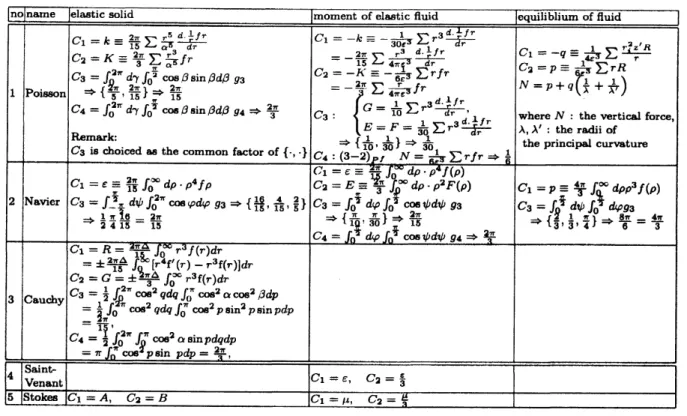
[40, p.lll].TABLE 2. $C_{1},$ $C_{2},$ $C_{3},$ $C_{4}$ : the constant of definitions and computing of totalmoment of
molecularactions byPoisson, Navier, Cauchy, Saint-Venant&Stokes
It is calledthat this problem issolved byStokes’ proof.
3.
Formulation
of the twoconstants
theoryin isotropic elasticity and Navier-Stokesequations
The partial differentialequationsofthe ela.stic solid or elastic fluid
are
exprested by usingoneor
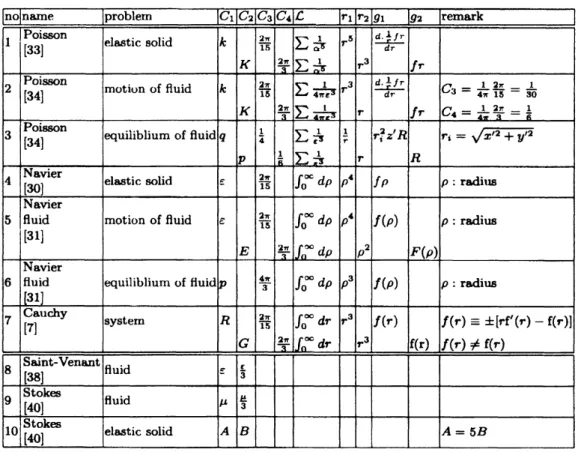
thepairof$C_{1}$ and$C_{2}$ such that :
.
in theelastic solid: $\delta t^{u}\partial_{T^{-}}^{2}(C_{1}^{Y}T_{1}+C_{2}T_{2})=f$,.
in theelastic fluid : $Tt\partial u-(C_{1}T_{1}+C_{2}T_{2})+\cdots=f$Here, $C_{1}$ and $C_{2}$
are
two coefficients, for example, $k$and $K$ by Poisson,or$\epsilon$ and $E$by Navier,or
$R$ and$G$by Cauchy, and whichareexpressedbytheinfiniteoperator$\mathcal{L}$$( \sum_{0}^{\infty}$
or
$\int_{0}^{\infty})$by personal principlesor
methods. $T_{1:}T_{2}\ldots$
.
are
thetensors or termsconsistingour
equations. Forexample,inmodem notationof the incompressible Navier-Stokes equations, the kinetic equation and the equation of continuity are
conventionally described
as
follows : $\tau_{\iota}^{-}\partial u\mu\Delta u+u\cdot\nabla u+\nabla p=f$, divu $=0$, in which $-\mu\Delta u$corresponds to $-(C_{1}^{Y}T_{1}+C_{2}^{Y}T_{2})$
.
Moreover, $C_{1}$ and $C_{2}$are
describedas
follows :$\{\begin{array}{l}C_{1}^{\gamma}\equiv \mathcal{L}r_{1}g_{1}S_{1},\{\end{array}$
$S_{1}= \int\int g_{3}arrow C_{3}$,
$C_{2}\equiv \mathcal{L}r_{2}g_{2}S_{2}$, $S_{2}= \int\int g_{4}arrow C_{4}$
,
$\Rightarrow$ $\{\begin{array}{l}C_{1}^{\gamma}=C_{3}\mathcal{L}r_{1}g_{1}=\frac{2\pi}{16}\mathcal{L}r_{1}g_{1},C_{2}=C_{4}\mathcal{L}r_{2}g_{2}=\frac{2\pi}{3}\mathcal{L}r_{2}g_{2}.\end{array}$
We show these parametersinTable 2, 3, andthe
case
of equilibrium isakoincluded in Table 3. In Table 4,we
showtensors and
equationsby Navier, Poisson,Saint-Venant
andStokes
influid.
RFFFRENCFS
[1] M.J.Bertrand, $Th6\alpha\grave{\epsilon}$me $relat*f$ au mouvement le plus $\phi n\ell ml$ d’unfluides, Acad\’emie des Sciences, Compte-rendus
hebdomadairea des $danc\epsilon\epsilon,$ $66$(1868) 1227-1230.
[2] M.J.Bertrand, Note relative \‘a la thboree des fluides. Repome ti la cmmunication $d\epsilon$ M.Helmholtz, $Acad6mied\infty$
Sciences, Compte-rendua hebdomadaires des$danc\epsilon\epsilon$,67(1868) 267-269.
[3] M.J.Bertrand, Observation nouvdles surun$Mbmo|re$de M. Helmholtz, Acad\’emie des Sciences, Comptc-rendus
TABLE 3. The expressionofthetotal moment ofmolecular actions by Poisson, Navier, Cauchy, Saint-Venant&Stokes
[4] M.J.Bertrand, $R6pons\epsilon$ \‘a lanote deM.Helmholtz, $A\infty d6mie$desSciences, Compte—du $h\epsilon WomaM\prime tl$ desdiances,
67(1868) 773775.
$[5|$ A.L.Cauchy, $M6mo|re$ sur la $\tau u_{me}$des Ondes, t815, Savants \’etrangers, 1(1827), 1 partie \S \S 3,4et 2partie \S \S 4,6. (
Remark: thlsisthesameas$M\text{\’{e}}_{mo}:re$surlaTuor$ed$es Ondes
a
lasurfaced’unfluidpesantd’un profondeur$|n\ fin|\epsilon$,(EuvresdeCauchy, 1882, seric (1), t. 1,5318. )
$[6|$ A.C.Clairaut, $TMo|\backslash ed\epsilon$ lafigure$d\epsilon$ la terre, $t|de$des$pr\tau ncipe\epsilon$de$l$‘hydrostatique, Paris, 1743,$\epsilon e\infty nd$ed. 1808.
$[\eta$ A.L.Cauchy, Sur l’6quilibre et lemouvement d’un
$\epsilon ys$thme de poents $mauri\epsilon ls$ sollicitlspar desforces $d’ aumctim$ou
dertEpulsion mehtuclle, Exercises dc Math\’ematique, 3(1828); (Euvrescompl\‘ete$\epsilon$ D’Augustin Cauchy(Ser. 2) 8(1890),
$227\sim 252$
.
[8] A.Clebech,\"Uberdie Integrotion der hydrodynmischenGleichung$e\backslash$Journalf\"urdie reine und angewandtc Mathematik,
56$($1859) 1-10.
$[$9$]$ d’Alembert, Essai d’une nouvelle $lMorie$dela$ds\dot{u}$tance desflusdes, Paris, 1752.Reprint 1996.
[10] d’Alembert, Remarquessur les Loix$du$mouvement des fluides, Opuscules mathematiques,Tome 1(1761) 137-168.$arrow$
http:$//gallica$
.
bnf.$fr/ark:/12148/bpt6k62394p$[11] O.Darrigol, Betweenhydrodynamics and $\epsilon lasticity$thwry : thefirst five births ofthe $Nav|er$-Stokes equation, Arch.
Hist. Exact Sci.,56(2002),9&150.
[12] O.Darrigol, Worlds of flow :ahut$0 v$ofhydrodynamica flom the$B$emoullu to Prandtl Oxford Univ.Press,2005.
$[$13$]$ L.Euler, $Pr nc\cdot p^{1}a$motusfluidonm,M\’emoires de$1’ A_{Ca}oemie$dos Science, Berlin, 6$($1756/7$)$, 1761, $L\infty nhardi$ Euleri
OperaOmnia. Editedby C.TrucsdellIII: CommentationesMechanicae. Volumenprius, $k12(1954),$$133\cdot 168$
.
(Latin)$[$14$]$ L.Eulcr, Sectio
$s$ecunda de principiia motusfluidmsm, E.396. $($17511755$)$, Acta AcademiaeImperiallsScientiarum
Petropolitensis, 6(17561757), 271-311(1761). Leonhardi EuleriOpera Omnia. Edited by C.Truesdell III : $Commenta_{\ulcorner}$
tionesMechanicae. Volumen posterius,2-1$S$(1955) 1-72,$7\theta- 163$. (Latin)
[15] C.F.Gauss, Thnia attractioms corporumsphaercndicorumelhpticorum homogeneorum. Methodonovatmctata,
Got-tingae, 1813, CartffidnchGauss Werke $V$,Gottingen,1867. (Wecanseetoday in: $uCarl$Prsedrech$Gaus\epsilon$ Werke $V$“,
$G\infty rg$ OlmsVerlag, Hildesheim, New York, 1973, 21&258. Also, Anzeigen eigner Abhandlung en, Gotrngische gelehrt
Anzeigen, 1927, “Werke VI”, 341-347.) (Latin)
[16] C.F.$Gau\epsilon\epsilon$, Duquuitiones qeneroles ciroa superficies curvaa, Gottingae, 1828, Carl Fhdrich Gatsss Werke VI,
Gottingen, 1867. (We cmsee today in: “Carl nidrich Gauss Werke VI”, $G\infty rg$ Olms$Ver|*$, Hildesheim, New
York, 1973,$219\cdot 258$
.
Also, Anzeigen eigner Abhandlungen, G\"otingischc gdehrt$Anz$eigen,1927, ”WerkeIV”, 341-347.)$[1\eta$ C.F.Gauss, $Pr\backslash nci\rho|agmerd:a$ thmae figume$flu*dmm$ instatu $a\eta uiliMi$, Gottingae, 1830, Carl $Pbd_{7C}h$ Gauis
Werke $V,$$G\dot{o}ttingen$,1867. (Wecan$\infty$today in :“Carl ffiednchGauss Werke $V$”,Georg$O$lmsVerlag, Hildeshcim,
New York, 1973,2&77. $A1\infty$, Anzeigen eigner Abhandlungen, $G\ddot{o}tingi\epsilon cheg\epsilon lehnAnz\alpha gen$, 1829, asabovein “Werke
$V$”,$287- 293.)$ (Latin)
$[$18$]$ G.$Gr\infty n$, An $e\epsilon saym$theapplicatimof$mal\lambda\epsilon mati\omega lanalys\cdot s$ tothe$lheo|;_{CS}$ of$electnc|ty$and$magnet_{1}s\pi\backslash$J. ffiine
Angew Mat.,$S9(1850)$7&89$(A1\epsilon o$we oen$s\infty$:EditcdbyN.M.Ferrers, MathematicalPapers ofthelatc$Geo\eta eGre\epsilon n$,
FellowofGondle and Caius College, Cambridge, Macmillan, 1871.)
[19] H.vonHelmholtz, $\ddot{U}be\tau Inteq|d\epsilon$ der hydrdynamuchen Gleichungen, welch, den $W\dot{*}rbelbewq\tau mgenentsm^{\phi}en$, J.
Reinc Angew. Math..85(1858) 25.55.
[20] H.von Helmholtz, Sur le mouvement $l\epsilon$ plui $\phi n6ml$ d’unfluide. Iuspome A $u\mathfrak{n}ecmmun|\omega t|mp\kappa aendente$ de
M.S.$Berlr\alpha nd,$$Acad6mie$doe Scienoes,$Compt\approx rendus$hebdom$u1\dot{u}r\infty d\epsilon ss\ell anc\alpha$, 67(1868), $221arrow 225,$ $a1\infty$inHerman
vonHelmholtz, $W;_{ssemchafl\downarrow ich\epsilon s}$ Abhundlungen, 1, 134-139. 1868. (We $u\epsilon e$beUowCRandWHA.)
[21] H.vonHelmholtz, Sur lemouvementdes$flu\prime d$. Deuaeme$kpons\epsilon$\‘aM.S.Bertrand,CR$67(1868)$, 754.57,$a1\infty$in WHA, 1, $14k144$
.
[22] H.vonHelmholtz, $R\ell pme$\‘ala$not\epsilon$de $Mon ieur$Bertmnd$du19\propto tob\tau e$, CR67(1868), $103t1035,$$a1\infty$in WHA, 1, 145.
[23] H.vonHelmholtz, $\ddot{U}berducont|nuirl|cheFh_{J}’sg|gkeit\ell bew\eta ungen$, CR67(1868), $103l1035,$ $*1\infty$inWHA, 1, $14\triangleright 157$. [24] J.L.Lagrange,M\’emo:resurla$tMo\prime iedu$mouvement$de\delta$fluides,(Euvre6deLagrange publiffipar$1\infty\epsilon oin\epsilon$deM.J.-A.
Serret, Vol. 41869,$69\Re 748$.$(Lu :22/nov/1781. )$
[25] J.L.Lagrange, $M6chaniqueanal|t|qu\epsilon$, Paris, 1788. (Quatri\‘eme$6ditiond’ apr\grave{e}s$ la ?}oisi\‘emefflition de 1833 publi\‘ee
parM.Bertrand, Joseph$Lou|\epsilon$de$Lag’ unge,$ $Oeuv’ tS$, publi\‘eesparlos$soin$deJ.-A.&rretet$Ga\epsilon tonD*rboux,$ $11/12$,
$G\infty rg$Olms Verlag,Hildesheim$\cdot$NewYork. 1973. )(J.Bertarndremarks thedifferences between the editions. )
$[\mathfrak{B}]P.S.Lapla\propto,$ Equiubriumof$flu|4$Celoetial$Mechani\alpha$,translated$\iota_{V}$N. Bowditch,Vol.I\S 4$\infty\cdot 95$
.
$[2\eta_{331- 418}.\iota::$
,[28] $T$,G.Maupertuis, $L_{0}:durpo\delta_{2}$ 1740. $(|29, IV. p.43- 64], B\epsilon print:G. Olm\epsilon,$$196\theta 74)$
.
[29] $T,G.Maupertui\epsilon,$ $o_{eu\prime ms;avoel’ Eh|lh}xamenpo\ell\circ p$qa $p$ e’
$\infty smolq\prime e,$ $Vol1-4$
.
G.Olmg. $(B\epsilon print)196\triangleright 74$.
[30] C.L.M.H.Navier, $M6moire$ $\epsilon ur$ $le\ell$ $l\dot{\alpha}\epsilon$ de $l6qu|libn$ et $du$ mouvement des $\infty r\mu$ soudu \’elastique$\iota$,
$M6moir\alpha$ dc $1’ A\infty demie$ doe Sien$\infty$ de $1’ Institute$ de $Fran\propto$, 7(1827), 37&393. $\langle$Lu : $14/mai/1821$
.
$)arrow$ $[31|C.L.M.H.Navier,M\text{\’{e}} moiresurle*lo|sdumouvement$$fluhttp://gallica.bnf.fr/ark:/12148/bpt6k32227,37\triangleright 393.|du,$des M\’emoire$\epsilon$do$1’ A\infty demied\infty$Sienco de$1’ In\epsilon tituted\epsilon$France, 6(1827), $38\propto uo$. $(Lu:18/mar/lS22. )arrow$ http;//gallica.bnf.fr/ark:/1214S/bpt6k3221x, $389arrow uo$
.
[32] I.Newton, Phdosophiae $natu’ d:*p\dot{n}ncipiamathemati\infty$, London, 1687. (Latin)
[33] S.D.$Pois\infty n,$$M6mo:re$sur$\iota B\varphi iiliht$etleMouvementdes$Corp\epsilon\ell lastiques,$ $M6moir\epsilon s$de$1’ Academie$royale$d\infty Sienc\infty$,
8(1829),357-570,$6\mathfrak{B}\cdot 27$. $(Lu:14/apr/1828. )arrow http://gallica.bnf.fr/ark:/1214S/bpt6k3223j$
[34] $S.D.Pois\infty n,$ M\’emo:n $\epsilon urle\epsilon$\’equatlons $\not\in$dml$\epsilon$s de$l’6quibltbr\mathfrak{r}$ et$du$mouvem$entd\epsilon scms\epsilon ol|dei6bt|qu\epsilon s$et$de\ell$
fluidu, (1829),J.$6\infty 1e$ Polytoch., 1$(1831),1-174. $(Lu :12/oct/1829. )$
[36] $H.L*mb,$ A $tr\infty tuem$the$ma\ell hemati\infty ltheo\eta$ofthemotim offlu:&,CambridgeUniv.$Pr\infty$, 1879.
[36] J.Power, Onthe truthof$lh\epsilon hyd,dynami\infty lth-$
.
that$|fudx+vdy+wdz$ be acomplete$d|fferent\cdot alu\dot{n}th\prime t\epsilon pect$to$x,$ $y,$$z$, at any $m\epsilon$ instnnt, itis always so,Cambridge$Philo\infty phioe1Tr-tiou,$ $7(1u2)$, (Part3),4u-464.
$[3\eta$ B.Riemann, $Lehr\iota\ddot{a}tzeaul$ der andysis$sit\dagger u$fiirdie $Theo|;_{e}$ derIntqmle$vmzw\dot{\alpha}gud\dot{n}genvoll*l\ddot{a}$ndigen
Diffenn-tidien, J. $Ii\epsilon ine$Angew. Math.,8$f$(1857) 106-110.
[38] A.J.C.B.de$S\iota in\triangleright Venant$, Note$bjo|ndre$au$M\text{\’{e}}’mo|re\epsilon ur$la dynamique$de\iota$fluidei. $(atm:t.),$$Acad\ell mie$doe$Scien\infty$,
$Comptes\sim dusheu_{omadare\ell}:du$$\iota$\’eance$\epsilon$, 17(1843),124(kl243. $(Lu :14/apr/18u. )$
$[39|$ A.J.C.B.dc Saint-Venant, Note$\infty mpumentaire$surle probkme$de\epsilon$
mouvemenu
que peuventmndn$le\epsilon d|versn:nl\epsilon$$d’unsolid\epsilon duc$tile au $d’unliqu:d\epsilon wnt\epsilon nu\epsilon$dans un vaie, pendant$sm$\’e$\omega$ulernent$\mu r$un $\alpha\dot{\urcorner}fice|n\beta\dot{n}eur,$Acad\’emi$\epsilon$,
$d\infty Scien\infty,$ $Compte- du\delta heu_{omadns}q|de\epsilon$dancei,$67(1868)$27&282.
$[40|$ G.G.Stokes, On thelhenies of$lheint\epsilon malfl\tau ctim$offlui&:nmotim, andofthe$e\varphi iilib\dot{n}um$andmotim ofelastic
solids, $18Jg$, (raed 1845), (Fromthe $?\backslash unsactions$ ofth$e$ Cambndge$Ph|losophi\infty lS\propto:ety$ VQl.VIII.p.287), $John\infty n$
$B\epsilon print$Corporation, Ncw York andLondon, 1966, $Malhemati\omega l$and$phyi|\infty l$papers 1, 1966,75-129, Cambridge.
[41] C.Ikuoedoll,$Note\epsilon mlhe$Hutoryofthegenerd$\eta uatiom$of$hydrdynamic\epsilon$,Amer.Math. Monffly$\emptyset 0(1953),$$445- 458$.
[42] $W.Thom\infty n,$$Note\epsilon m$hydrdynamtoe. Onthe
vu-v:va
ofa$liqu|d|n$motim,$Mathemati\infty$ ]and$phy\epsilon ical\triangleright peri$ (Ftomthe $7iansacttom$ of$th\epsilon$ Royd $S\infty*ety$ of $F_{\text{ノ}}d|nburgh$ 25(1869), $B\epsilon ad29/apr/1867),$ Cambridge: at the univ $prr$
6(1910) $107\sim 112$.
$[43|W.Thom\infty n$, Onvortae atow, $Mathemati\infty 1$ and $phy\epsilon i\infty 1$ papers (From the $\eta_{nn actims}$ of$lhe$ Royal $S\propto:ety$ of $Ed|nbu\eta h$ 26(1869)$K105$, Cambridge:at thcuniv$pr\infty 6\langle 1910)1- 12$
.
[44] $W.Thoni on$, On
vonex
$motior\backslash$ Mathemati$\infty 1$ and $phy\iota i\propto 1p*pers$ (Rom the $?$}$rn action*of$ the Royd$S\propto iety$ of$Bd|nbu\eta h2f\langle 1869)217- 260,$ $B\epsilon ad29/apr/1867)$, Cambridgo:attheuniv$pr\infty$6(1910) 1&66.
[45] $C.qku\infty dell$, The$rtional$fluid$m\propto han|c\epsilon$
.
$1687_{\vee}17\theta 5$. IntnAuctionto $Le\cdot or\lambda ud$ Eule’; $Op\epsilon\prime u\alpha_{nn}|a$.
$VolXIIse’\backslash \dot{\alpha}$$\epsilon ecundae$,Auctoritate etimpcnsis$societati\epsilon\epsilon cient:-naturaliumhelvcti\infty e,$$2-121964,10\cdot 126$
.
[46] C.$qku\infty dell,$ $Ed|tor’sint\cdot uuctim$ to Leonhard$Eul$eri $O\mu u\alpha nnia$ Vol.XIII$se’;_{e}j\epsilon ecundae_{\tau}$ ibid.,$a$.lS1955,9-105. Remark :