A
survey: 4-fold
symmetric quandle
invariants
of
3-manifolds
Eri Hatakenaka (Tokyo University of Agriculture and Technology) 1
Takefumi Nosaka (RIMS, Kyoto university) 2
Abstract
This report is asurvey of two papers [N2, HN]. The first paper [N2] introduces 4-fold symmetric
quandles. Forafinite 4-fold symmetricquandle, we construct the4-fold symmetrichomotopy
invari-ant of3-manifolds. We classify 4-fold symmetric quandles herein, investigate their properties and
explicitly determine the inner automorphism groups. We calculate the container of the 4-fold
sym-metric homotopy invariant. Wealsodiscuss 4-foldsymmetric quandlecocycleinvariantsandcoloring
polynomials.
Thesecond paper [HN] gives atopological interpretation of4-fold symmetric quandleinvariants.
We demonstrateaclose relation between a certaincoloringandahomomorphismfrom the
fundamen-talgroupofa3-manifold. Further,we showthat our4-fold symmetric quandle homotopy invariants
are at least as strong as Dijkgraaf-Witten invariants. Also, we reformulate the Chern-Simons
in-variant of$SL(2;\mathbb{C})$ as asymmetric quandle cocycle invariant via the extended Bloch group. Asan
application, for any odd$m$, the quandle homotopyinvariant of the dihedralquandle $R_{m}$ oflinksis
equivalent totheDijkgraaf-Witten invariant of$\mathbb{Z}/m\mathbb{Z}$ofthe double branched covering spaces, which
isageneralization of [H2].
1
Introduction
We review
some
invariants of links and of 3-manifolds using quandles. A quandle isa
set with a certain binary operation like
a
group. Quandlesare
adapted to the orientedlink theory.
For
unoriented linksa
symmetric quandle introduced by Kamada [Kam]is suitable.
Given a
quandle $X$, Fenn, Rourke andSanderson
[FRSI] defined the Rackspace. Further, for oriented links, they proposed a quandle homotopy invariant valued
in the group ring $\mathbb{Z}[\pi_{2}(BX)]$, where the space $BX$ is
a
certain modification of the Rackspace. The second author calculated$\pi_{2}(BX)$ for some quandles [Nl]. On the other hand,
quandle cocycle invariants of oriented links introduced by [CJKLS] are computable and practical. However, thier invariants are derived from the abovehomotopy invariant [FR]. In anotherdirection, the first author [H] reformulated certain Dijkgraaf-Witteninvariants
of 3-manifolds [DW]
as
quandle cocycle invariants. Tosee
this, she madeuse
of the factthat any 3-manifold
can
be presented bysome
4-fold irregular branched covering of $S^{3}$ alongsome
link.Our papers [N2, HN] generalize her reconstruction using symmetric quandles. Our
aim is to construct
an
invariant of 3-manifolds usinga
certain quandle, and further to research the invariant. It is known [Apo, BP] that isotopy classes of3-manifolds are in 1-1 correspondence with the set of links with “simple” monodromy representations onto $\mathfrak{S}_{4}$modulo some link
moves
(see Figure 2). Roughly speaking, we define a 4-fold symmetric$\overline{lE-mailaddress:hataken0cc.tuat.ac.jp}$
quandle and
an
invariant of 3-manifolds to be unchangeable under these linkmoves.
Although the idea behind the definitions seems very naive, we show some interesting phenomena and results of the quandle and the invariant.
Thisreport is organized as follows. In
\S 2
we preparesome
notation. In\S 3,
we define a4-fold symmetric quandle and introduce
a
4-fold symmetric quandle homotopy invariant.In
\S 5, we
classify 4-fold symmetric quandles. In \S 6, we note the inner automorphismgroup. In \S 7, we give a topological interpretation of 4-fold symmetric quandle
homo-topy invariants. In
\S 8,
we compare the 4-fold symmetric quandle homotopy invariantwith the Dijkgraaf-Witten invariant. In \S 9, we discuss 4-fold symmetric quandle cocycles
invariants. In
\S 10, we
presentsome
examples of 4-fold symmetric quandle cocycles.We
notea
relationbetween
these sectionsour
papers.For
more
detail of
\S 2,
3, 5, 6, 9,10, see the paper [N2]. On the other hand,
see
[HN] for \S 7, 8, 10 and 12.2
Review:
symmetric quandle
and
labeled
diagram
We review symmetric quandles and $X_{\rho}$-colorings introduced by Kamada [Kam]. A
sym-metric quandle is a triple of a set $X$, a binary operation $*$ on $X$ and an involution
$\rho$ : $Xarrow X$satisfying that for any$x,$ $y,$ $z\in X,$$x*x=x,$ $(x*y)*z=(x*z)*(y*z),$ $\rho(x*y)=$
$\rho(x)*y$, $(x*y)*\rho(y)=x$ (See also [KO]). For example, $S;=\{(ij)\in \mathfrak{S}_{4}\}$ with
$x*y:=y^{-1}xy$ and $\rho(x)=x$ is a symmetric quandle.
Let $D$ be an unoriented link diagram on $\mathbb{R}^{2}$. For a symmetric quandle
$(X, \rho)$, an
$X_{\rho}$-coloring of $D$ is a map $C$ :
{the
two orientations on arcs of$D$}
$arrow X$ satisfying(Xl) For the two orientations $\alpha_{1},$ $\alpha_{2}$ of the same arc as shown in Figure 1, the colors
satisfy $C(\alpha_{1})=\rho(C(\alpha_{2}))$. (Hence, we will later draw the only one color of the two).
(X2) At each crossing such asthe right hand side of Figure 1, the three orientations satisfy $C(\gamma)=C(\alpha)*C(\beta)$.
$C(\delta)=C(\alpha)*C(\gamma)$
$C(\alpha_{1})=\rho(C(\alpha_{2}))$ arcs at acroosing
Figure 1: The condition ofa symmetric coloring on semi-arcs and at each crossings
The conditions (XI)(X2) are well-definedby using the axioms of $(X, \rho)$. Let Col$X,\rho(D)$ $:=$
{
$X_{\rho}$-colorings of $D$}.
It is known [KO, Proposition 6.2] that for two diagrams $D_{1}$and $D_{2}$ related by Reidemeister moves, there exists a bijection between $Co1_{X,\rho}(D_{1})$ and
We
will interpret3-manifolds
3as
$S_{id}$-colorings.It
iswell-known that
any3-manifold
$M$
can
be obtained by a 4-fold irregularbranched covering space ofa
link $L\subset S^{3}$ with itsmonodoromy $\phi$ : $\pi_{1}(S^{3}\backslash L)arrow 6_{4}$
.
Remark that $\phi$is so-called ”simple”, i.e., $\phi$is surjectiveand sends each meridian of $L$ to a transposition in $\mathfrak{S}_{4}$
.
Let $D_{\phi}$ be a link diagram of $L$with the monodoromy $\phi$, which
we
call labeled diagmm. Then by Wirtinger presentation,we
regard $D_{\phi}$as an
$S_{id}$-coloring.It is known that MI and MII
moves
of labeled diagrams, shown in Figure 2, donot change the topological type of the covering space. Conversely, Apostolakis [Apo], Bobtcheva and Piergallini [BP] showed
Theorem 2.1. ($[Apo].$
A
specialcase
of
$[BP$, Theorem $3J$) Two4-fold
simple branchedcover
$ngs$of
$links\subset S^{3}$ represent thesame
3-manifold if
and onlyif
theirassociated labeled
diagmms can be related by a
finite
sequenceof
$MI,$ $MII$ and Reidemeistermoves on
$\mathbb{R}^{2}$.$(ij)$
$)$
$(ij)$ $(jk)$ $(ij)$ $(kl)$ $(ij)$ $(kl)$$)$
$(ij)$ $(kl)$Figure2: MI, II moves oflabeled diagrams
Throughout this survey, the symbols $1\leq i,j,$$k,$$l\leq 4$
mean
distinct indices.3
Definition: 4-fold symmetric
quandle homotopy
invariant
Hence, roughly speaking, if
we
can
finda
certainquandlewhosecoloringsare
unchangeableunder the MI and MII moves,
we
obtainan
invariant of 3-manifolds. Thenwe
introducesuch quandle
as
follows.Definition 3.1. A
4-fold
symmetric quandle is a triple $(X, p_{X}, \rho)$ satisfying(Fl) $(X, \rho)$ is
a
symmetric quandle.(F2) The map $p_{X}$ : $Xarrow S$ is
a
symmetric quandle epimorphism. For $(ij)\in S$, letus
denote the preimage $p_{X}^{-1}(ij)\subset X$ by $X_{ij}$ later.
(F3) For any $x_{ij}\in X_{ij}$ and $y_{jk}\in X_{jk}$, it satisfies $x_{ij}*y_{jk}=\rho(y_{jk})*x_{ij}$
.
(F4) For any $z_{ij}\in X_{ij}$ and $w_{kl}\in X_{kl}$, it satisfies $z_{ij}*w_{kl}=z_{\mathfrak{i}j}$.
For
a
4-fold symmetric quandle $(X, px, \rho)$, notice that the epimorphism $p_{X}$ : $Xarrow S$induces $(p_{X})_{*}:Co1_{X,\rho}(D)arrow Co1_{S,id}(D)$
.
For a labeled diagram $D_{\phi}\in Co1_{S,id}(D)$, wedenote the preimage $(p_{X})_{*}^{-1}(D_{\phi})$ by $Co1_{X,\rho}(D_{\phi})$. An element of $Co1_{X,\rho}(D_{\phi})$ is called an
$X_{\rho}$-coloring
of
$D_{\phi}$.
The followingproposition indicatesthat the axioms $(F3),$ $(F4)$ abovecorrespond to MI, MII-moves, respectively.
Proposition 3.2. Let $(X, p_{X}, \rho)$ be a
4-fold
symmetric quandle.If
two labeled diagmms$D_{\phi}$ and $D_{\phi}’$,are related by a
finite
sequenceof
$MI,$ $MII$ and Reidemeistermoves
on $\mathbb{R}^{2}$,then there is a bijection $Co1_{X,\rho}(D_{\phi})rightarrow^{11}Co1_{X,\rho}(D_{\phi}^{f},)$.
Proof.
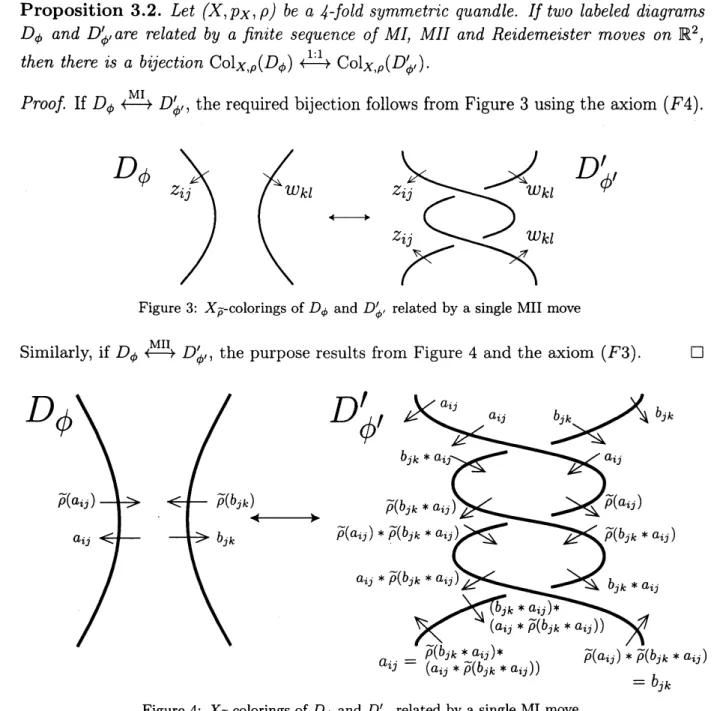
If $D_{\phi}D_{\phi}’\underline{MI},$, the required bijection follows from Figure3
usingthe axiom $(F4)$.
$D_{\phi}$ $D_{\phi’}^{1}$
Figure 3: $X$-colorings of$D_{\phi}$ and $D_{\phi}’$, related by asingle MII move
Similarly, if $D_{\phi}rightarrow D_{\phi}’MII,$, the purpose results from Figure 4 and the axiom $(F3)$
.
$\square$Figure 4: $X_{\tilde{\rho}}$-colorings of$D_{\phi}$ and $D_{\phi}’$, related by asingle MI move
In addition,
we
will equip the invariant $Co1_{X,\rho}(D_{\phi})$ witha
grading usingan
Abel group$\Pi_{2,\tilde{\rho}}^{4f}(X)$
as
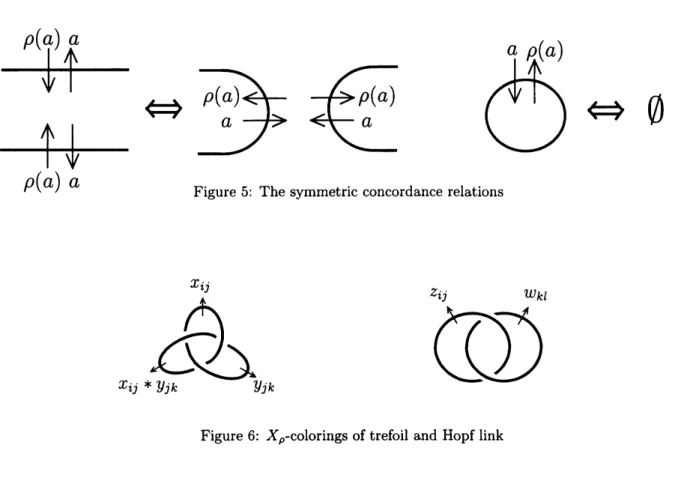
follows. $\Pi_{2,\rho}^{4f}(X)$ is a modification of Fenn, Rourke and Sanderson [FRSI]denotedby$\mathcal{D}(n, BX)$. $\Pi_{2,\rho}^{4f}(X)$isdefinedtobe the setofall$X_{\rho}$-coloringsof all diagrams in $\mathbb{R}^{2}$ subject to Reidemeister-I,II,III moves and symmetricconcordance relations as shown
6, where indicies $i,$$j,$$k,$$l$
run
over all distinct natural numbers of $\leq 4$ and$x_{ij},$$y_{jk},$$z_{ij},$$w_{kl}$
run over
$X_{ij},$ $X_{jk},$ $X_{ij},$ $X_{kl}$, respectively. The set $\Pi_{2,\rho}^{4f}(X)$ has a multiplication given by disjoint union which turns $\Pi_{2,\rho}^{4f}(X)$ intoan
Abel group. IFlrom the definition of $\Pi_{2,\rho}^{4f}(X)$we have a canonical map:
$\Xi_{X}^{4f}(D_{\phi}; \bullet)$ : Col$x_{\rho}(D_{\phi})arrow\Pi_{2,\rho}^{4f}(X)$, (1)
that is, $\Xi_{X}^{4f}(D; \bullet)$ maps an $X_{\rho}$-coloring $C$ to the canonical class $[C]\in\Pi_{2,\rho}^{4f}(X)$.
$\Leftrightarrow$ $\emptyset$
$\rho(a)a$
Figure 5: The symmetric concordance relations
$x_{ij}$
$z_{ij}$ $w_{kl}$
Figure6: $X_{\rho}$-colorings of trefoil and Hopf link
Definition 3.3. Let$X$ be
a
finite 4-foldsymmetric quandle. Let$D_{\phi}$ be alabeleddiagram.Then a
4-fold
symmetric quandle homotopy invariant of $D_{\phi}$ is the expression$\Xi_{X}^{4f}(D_{\phi}):=$ $\sum$ $\Xi_{X}^{4f}(D_{\phi 1}C)$ $\in \mathbb{Z}[\prod_{2,\rho}^{4f}(X)]$.
$C\in Co1_{X,\rho}(D_{\phi})$
Theorem 3.4. Let$D_{\phi}$ and$D_{\phi}’$, be labeled diagmms related by a
finite
sequencesof
$MI,$ $MII$and $Reideme\uparrow ster$
moves.
Fora
finite 4-fold
symmetric quandle $X,$ $\Xi_{X}^{4f}(D_{\phi})=\Xi_{X}^{4f}(D_{\phi}’,)\in$$\mathbb{Z}[\Pi_{2,\rho}^{4f}(X)]$
.
In particular,for
a
3-manifold
$M$ presented by $D_{\phi\rangle}$ the4-fold
symmetricquandle homotopy invariant $\Xi_{X}^{4f}(D_{\phi})\in \mathbb{Z}[\Pi_{2,\rho}^{4f}(X)]$ is an invariant
of
$M$.Therefore we often denote the invariant of a 3-manifold $M$ by $\Xi_{X}^{4f}(M)$.
$\Xi_{X}^{4f}(D_{\phi};C)=$ $=$ $)z_{ij}$
where we use concordance relations along the dashed lines in the second equalities. $\square$
4
Some
Questions
about 4-fold symmetric
quandle
Although
we have
obtainedan
invariant of 3-manifolds, the definitions of the 4-foldsym-metric quandle (homotopy invariant)
seem
teleological and abstract. Particularly, it is aproblem to explicitly determine what the container$\Pi_{2,\tilde{\rho}}^{4f}(X)$ is. So weposesomequestions:
$\bullet$ How broad is concretely the class of 4-fold symmetric quandles? (see
\S 5)
$\bullet$ How large is the container ofour
invariant? (see\S 6)
$\bullet$ Is
our
invariant related to other invariants? (see\S 8)
$\bullet$ How do
we
compute the 4-fold symmetric quandle homotopy invariants? (see\S 9)
$\bullet$ Do 4-fold symmetric quandle homotopy invariants have an application? (see\S 12)
From
now
on, we willanswer
these questions in turn.5
Classification
of 4-fold
symmetric
quandles
We consider a pair of a group $G$ and its central element $c\in G$ such that $c^{2}=e$. Such
a pair is called cored group. Given a cored group $(G, c)$, we give an example of 4-fold
symmetric quandles. Further,
we
classify 4-fold symmetric quandles (Theorem 5.2). Example 5.1. Fixa cored group $(G, c)$. Putting $T_{12}$ $:=\{(i, j)\in \mathbb{Z}^{2}|1\leq i, j\leq 4, i\neq j\}$,we define $\tilde{G}_{c}$ to be a quotient set
$G\cross T_{12}/\sim$, where the equivalent $\sim$ on $G\cross T_{12}$ is
defined by $(g, i, j)\sim(g^{-1}c, j, i)$, for any $(i, j)\in T_{12}$ and $g\in G$. Further, we equip $\overline{G}_{c}$
with
an
operation $*:\tilde{G}_{c}\cross\tilde{G}_{c}arrow\tilde{G}_{c}$ defined by Table 1 below. Define$\rho$ :
$\tilde{G}_{c}arrow\tilde{G}_{c}$ by $\rho(g, i, j)=(g\cdot c, i, j)$. Further, we remark a projection $p_{\tilde{G}_{c}}$ :
$\tilde{G}_{c}arrow S$ which sends $(g, i, j)$
Table 1: The binary operation $*$ in$G_{c}$. In eachline $i,j,$$k,$$l$ are all distinct. $t,$$t’\in T_{12}$.
Theorem 5.2. Let $(X, p_{X}, \rho)$ be
a
4-fold
symmetric quandle. Then there isa
cored group$(G, c)$ related to $X$ by
a
4-fold
symmetrec quandle isomorphism $\tilde{G}_{c}\cong X$.
Moreover, we show the following corollary (see [N2] for notation):
Corollary 5.3. The
functor
$\mathcal{T}$ which takes a cored gmup $(G, c)$ to $G_{c}$ givesa
categoryequivalence between the category
of
cored groups anda
categoryof
(based)4-fold
symmetric quandles. Moreover, the restmctionof
thefunctor
to the categoryof
groups $Grp$ induces the category equivalence between $Grp$ and a categoryof
(based)4-fold
symmetric quandleswith $\rho=id_{X}$
.
Then the results
can
be summarizedas
follows$(_{quandlesof\rho=id}4-fo1dsymmetric)\subset(\begin{array}{ll}4- fold symmetricquandles \end{array})\subset(\begin{array}{l}symmetricquandles\end{array})\subset($quandles $)$
$|1$? $|1$?
$($ groups $)$ $\subset$ $($ cored groups $)$
By the classification of Theorem 5.2, we mainly deal with quandles of the form $\tilde{G}_{c}$.
Lastly,
we
commentsome
properties of $\tilde{G}_{c}$.
Proposition 5.4. For any $x,$$y\in\tilde{G}_{CJ}$ there exist $a,$ $b\in\tilde{G}_{c}s.t$.
$(x*a)*b=y$
. Inparticular, $\tilde{G}_{c}$ is connected.
Proposition 5.5. The quandle $\tilde{G}_{c}$ is
of
type 4, i. e., $\forall_{x,y}\in\tilde{G}_{c},$ $(((x*y)*y)*y)*y=x$. Further, $G_{c}$ isof
type 2,if
and onlyif
$c=e$.6
Inner automorphism
group
Inn
$(\tilde{G}_{c})$Given a symmetric quandle $(X, \rho)$, for any $z\in X$, $(\bullet *z)$ : $Xarrow X$ is bijective by the
axioms of $(X, \rho)$. Then
we
denote by Inn(X)a
subgroup of $\mathfrak{S}_{|X|}$ generated by the rightactions $(\bullet *z)$. It is known [Joy] that any connected quandle $X$ is determined by the
inner automorphism group Inn(X).
Theorem 6.1. Let $(G, c)$ be
a
finite
cored group, and let $Z(G)$ be the centerof
G.
ThenInn$(\tilde{G}_{c})$ is isomorphic to a quotient group $I_{G,c}/Z_{G,c}$, where
$I_{G,c}= \{(x, y, z, w;\sigma)\in G^{4}\lambda \mathfrak{S}_{4}|c\frac{sgn(\sigma)-1}{2}xyzw\in[G, G]\}$,
$Z_{G,c}=\{(z, z, z, z;e)\in G^{4}x\mathfrak{S}_{4}|z^{4}\in[G, G], z\in Z(G)\}$
.
(2)This theorem have
some
corollaries: we estimate the container ofour invariant:Corollary 6.2.
Given a
finite
cored group $(G, c),$ $\Pi_{2,\tilde{\rho}}^{4f}(\tilde{G}_{c})$ isa
finite
Abel group whoseelements are annihilated by $2^{12}\cdot 3^{4}\cdot|G|^{12}\cdot|[G, G]|^{4}$
.
Corollary 6.3. When $(G, c)=(\mathbb{Z}/2\mathbb{Z}, 0),$ $\Pi_{2,\tilde{\rho}}^{4f}(\overline{G}_{c})\cong \mathbb{Z}/2\mathbb{Z}$ whose generator is presented
by the real projective space $\mathbb{R}P^{3}$
.
To prove these corollaries,
we use some
results in [Nl];we
viewa
perspective that$\Pi_{2,\rho}^{4f}(\tilde{G}_{c})$ is
a
quotient ofa
homotopy group $\pi_{2}(BX)$.
Further,
we
give another corollary of “second quandle homology groups” $H_{2}^{Q}(X;\mathbb{Z})($see[CJKLS] for the definition): following the covering theory of Eisermann [Eis2], for a
quandle$X$ oftype 2, $H_{2}^{Q}(X;\mathbb{Z})$ is computable from the presentation ofInn(X). Therefore
we obtain
Corollary 6.4. Given a
finite
group $G$, the second quandle homology $H_{2}^{Q}(\tilde{G}_{e};\mathbb{Z})$ is given$by$Ab$(T_{G,e}/Z_{G,e})$
.
Here $Z_{G,e}$ is given in (2), and$T_{G,e}=\{(x, x, z, w;\sigma)\in G^{4}\rangle\triangleleft \mathfrak{S}_{4}|x^{2}zw\in[G, G], \sigma\in\{e,$ (12)$(34)\}\}$, (3)
Consequently, if
we
know $[G, G]$ and $Z(G)$,we can
calculate $H_{2}^{Q}(\tilde{G}_{e};\mathbb{Z})$. For instance, Example 6.5. Let $G=\mathbb{Z}/m\mathbb{Z}$.
We decompose $m=2^{k}\cdot n$, where $n$ is odd.$H_{2}^{Q}(\tilde{G}_{e};\mathbb{Z})\cong\{\begin{array}{ll}\mathbb{Z}/n\mathbb{Z}\oplus \mathbb{Z}/2\mathbb{Z}, ( m:odd),\mathbb{Z}/2^{k-1}n\mathbb{Z}\oplus \mathbb{Z}/2\mathbb{Z}^{2}, (k=2\cdot n, or 4\cdot n),\mathbb{Z}/2^{k-1}n\mathbb{Z}\oplus(\mathbb{Z}/2\mathbb{Z})^{2}, (m=2^{k}\cdotn, k>2).\end{array}$
Example 6.6. Let $G$ be a perfect group: $G=[G, G]$. Then $H_{2}^{Q}(\tilde{G}_{e};\mathbb{Z})\cong \mathbb{Z}/2\mathbb{Z}$.
Example 6.7. Let $G$ be a quaternion group $Q_{8}$ of order 8. Then $H_{2}^{Q}(\tilde{G}_{e};\mathbb{Z})\cong(\mathbb{Z}/2\mathbb{Z})^{5}$.
7
$\tilde{G}_{c}$-colorings,
fundamental
quandle and class
of 3-manifold
7.1 $\tilde{G}_{c}$-colorings of
a
3-manifoldTheorem 7.1. Let $(G, c)$ be a cored group, and $D_{\phi}$ a labeled diagmm which presents a
3-manifold
M. Then there is a canonical bijection$Co1_{\tilde{G}_{c},\rho}(D_{\phi})\simeq G^{3}\cross Hom_{grp}(\pi_{1}(M), G)$ . (4)
This is
a
slight generalizationof
[$H$, Proposition 3.5]. Namely, restricting to thecase
$c=e$, the statement above is reduced to be the
same
with the proposition.As
a
result, fora
finite cored group $(G, c)$, the cardinally of $\tilde{G}_{c}$-colorings isa
classicalinvariant, and does not depend
on
the choice of central element $c\in G$. Hence, for a searchof
a new
invariant,our
next step is to study the group $\Pi_{2,\rho}^{4f}(\tilde{G}_{c})$ (see\S 9,
10,11).Incidentally,
we
givea
topological interpretation of colorings ofcore
quandles. Fora
group $G$, the
core
quandle QG is a set $G$ with a symmetric quandle operation of $g*h=$$hg^{-1}h$ and $\rho=id_{G}$
.
Corollary 7.2. Let$D$ be
a
link diagmmof
a link $L$, QGa core
quandleof
a group $G$, and$M_{L}$ the double branched covering space
of
L. Then the setof
the colorings $Co1_{Q_{G},id}(D)$ isin $a$ 1:1 correspondence with $G\cross Hom(\pi_{1}(M_{L}), G)$
.
Proof.
By definitionsa
subquandle $\{(g, 1,2)\in\tilde{G}_{c}|g\in G\}$ is isomorphic to $Q_{G}$.
More-over, we
can
regard $D$as a
labeled diagram whose allarcs
are
labeled by (12) $\in S$ shownas
Figure 7. Hence $G^{2}\cross Co1_{Q_{G},id}(D)\simeq Co1_{\tilde{G}_{c},id}(D_{\phi})^{Thm7.1}\simeq G^{3}\cross Hom_{grp}(\pi_{1}(M_{L}), G)$. $\square$$D$ $arrow$ – – – $-$ $O^{(23)}$ $D=$ $O(34)$ $-$ $=$
Figure 7: A labeled diagram$D_{\phi}$ from alink diagram $D$
.
7.2 A fundamental symmetric quandle of
a
3-manifoldWe introduce a fundamental quandle and a fundamental class of a 3-manifold. For this, given a link $L\subset S^{3}$, we recall the symmetric link quandle $SQ(L)$ introduced by Kamada
[Kam], which is, roughly speaking, the conjugacy class of$\pi_{1}(S^{3}\backslash L)$ including meridians
of $L$. Kamada showed a canonical bijection $Co1_{X,\rho}(D)\simeq Hom_{sQnd}(SQ(L), X)$. When
$X=S$, we can regard a labeled diagram $D_{\phi}$ as the associated quandle epimorphism
$\phi$ : $SQ(L)arrow S$
.
We consider the following relationson
$SQ(L)$:$R_{L}^{3,\phi}:=|x_{ij}*y_{jk}=\rho(y_{jk})*x_{ij}(x_{ij}\in\phi^{-1}(ij), y_{jk}\in\phi^{-1}(jk)).\rangle$
$R_{L}^{4,\phi}:=|z_{ij}*w_{kl}=z_{ij}$ $(z_{ij}\in\phi^{-1}(ij), w_{kl}\in\phi^{-1}(kl))\rangle$
Then, we consider the quotient symmetric quandle $SQ(L)/\langle R_{L}^{3,\phi},$$R_{L}^{4,\phi}\rangle$. It goes without
Corollary 7.3. For a
3-manifold
$M$ presented by a labeled diagmm $D_{\phi},\overline{G(M)}_{c(M)}\cong$$SQ(L)/\langle Rj_{L}^{\phi},$$R_{L}^{4,\phi}\rangle$
as a
quandle isomorphism. Here the cored group$(G(M), c(M))=$
$(\pi_{1}(M)\oplus \mathbb{Z}/2\mathbb{Z}, (e, 1))$
.
This immediately follows from Yoneda’s embedding. Anyway, we call the quandle
$SQ(L)/\langle R_{L}^{3,\phi},$$R_{L}^{4,\phi}\rangle$
a
fundamental
symmetric quandle of $M$.
We denote it by$SQ(M)$
.
Let us focus
on a
class of the natural transformations: by Yoneda’s lemma,we
havea
bijection
Nat$(Hom_{4sQnd}(SQ(M),\sim\bullet), \Pi_{2,\rho}^{4f}(\bullet\sim))\simeq\Pi_{2,\rho}^{4f}(SQ(M))$ ,
which sends $–\sim(D_{\phi};\dagger)$ to $\Xi_{SQ(M)}^{4f}(D_{\phi};id_{SQ(M)})$, where $id_{SQ(M)}$ is the identity map of
$SQ(M)$. We call $\Xi_{SQ(M)}^{4f}(D_{\phi};id_{SQ(M)})$ a
fundamental
class of $M$. By the naturality,we
thusreformulate
the 4-fold symmetric quandle homotopy invariant by$\Xi_{\tilde{G}_{c}}^{4f}(M)=\sum_{F\in Hom_{4sQnd(SQ(M),\tilde{G}_{c})}}F_{*}(\Xi_{SQ(M)}^{4f}(D_{\phi};id_{SQ(M)}))\in \mathbb{Z}[\Pi_{2,\rho}^{4f}(\tilde{G}_{c})]$ . (5)
In summary, the study of the 4-fold symmetric quandle homotopy invariant of $M$ is
a
research of $\Pi_{2,\rho}^{4f}(SQ(M))$ and of the fundamental class with using the relativity toward
other 4-fold symmetric quandles $\tilde{G}_{c}$.
8
Toward
Dijkgraaf-Witten
invariant
In [H], the second author reformulatedsome Dijkgraaf-Witten invariant [DW]
as
acocycleinvariant of $\tilde{G}_{e}$
.
However, herwork needs
a
certain condition of $G$.
For example, thereformulation does not hold for $G=\mathbb{Z}/6\mathbb{Z}$. To settle the condition, in [HN], we discuss
oriented bordism groups of $G$, and show that any Dijkgraaf-Witten invariant is derived
from the 4-fold symmetric homotopy invariant.
8.1 Preliminaries: Bordism Dijkgraaf-Witten invariant
Let $(G, c)$ be a cored group and let $n\in \mathbb{Z}$ be $\geq 3$. In this subsection, we make a
modification of Dijkgraaf-Witten invariant in the view of
an
oriented bordism group of$(G, c)$
.
We consider a pair of an n-manifold $M$ without boundary and a homomorphism $\pi_{1}(M)arrow G$.
Then aset $\Omega_{n}(G, c)$ isdefined to be the quotient of such pairs $(M,$ $\pi_{1}(M)arrow$ $G)$ subject to the following $(G, c)$-bordant equivalence. Such a pair $(M, f : \pi_{1}(M)arrow G)$is $(G, c)$-bordant, ifthere exists
an
$(n+1)$-manifold $W$, two homomorphisms $\overline{f}$ : $\pi_{1}(W)\oplus$$\mathbb{Z}/2\mathbb{Z}arrow G$ and $f;\pi_{1}(M)arrow \mathbb{Z}/2\mathbb{Z}$ such that $\overline{f}(e, 1)=c\in G$, the boundary is $\partial W=M$,
and $f=\overline{f}o((i_{M})_{*}\oplus f)$, where $i_{M}$ : $Marrow W$ is a natural inclusion. Further, $\Omega_{n}(G, c)$
has an Abel group structure by connected sum, that is,
where $f_{1}*f_{2}$ isthe free product of$f_{1}$ and $f_{2}$. The inverse element of $(M, f : \pi_{1}(M)arrow G)$
is $(-M, f : \pi_{1}(M)arrow G),$ $where-M$ stands for $M$ with the opposite orientation.
Then bordism Dijkgmaf-Witten invariant of
a
closed n-manifold $N$ is defined by$DW_{\Omega}^{G_{c}}(N):= \sum_{f\in Hom_{grp}(\pi_{1}(N),G)}[(N,$$f:\pi_{1}(N)arrow G)]\in \mathbb{Z}[\Omega_{n}(G, c)]$
.
(6)Remark 8.1. When $c=e$ , it easily
can
be verified that the group $\Omega_{n}(G, e)$ coincideswith the usual oriented bordism group ofthe Eilenberg-MacLane space $K(G;1)$, using the
obstruction theory and $\pi_{i}(K(G;1))\cong 0(i\geq 2)$ (cf. [Ati]). Moreover, if$n=3$ and $c=e$,
we can see $\Omega_{3}(G, e)\cong\Omega_{3}(K(G;1))\cong H_{3}(K(G;1);\mathbb{Z})$ by Atiyah-Hirzebruch spectral
sequence. Then, $DW_{\Omega}^{G_{c}}(M)$ is equivalent tothe original Dijkgraaf-Witten invariant [DW].
8.2 From $\Pi_{2,\rho}^{4f}(\tilde{G}_{c})$
to
the oriented bordism group $\Omega_{3}(G, c)$Returning into
our
quandle homotopy invariant,our
goal is to obtain an epimorphism$\Phi_{\Pi\Omega}$ : $\Pi_{2,\rho}^{4f}(\tilde{G}_{c})arrow\Omega_{3}(G, c)$, which implies that
our
4-fold symmetric quandle homotopyinvariant is at least
as
strong as the bordism Dijkgraaf-Witten invariant (Theorem 8.3).For this, the following is
a
key lemma:Lemma 8.2.
Assume
that two $\tilde{G}_{c}$-colorngs$C_{1}\in Co1_{\tilde{G}_{c},\rho}(D_{\phi})$ and $C_{2}\in Co1_{\tilde{G}_{c},\rho}(D_{\phi}^{f},)$
are
related by either Reidemeister moves, $MI,$ $MII$moves orsymmetric concordance relations.
Let $C_{i}$ present a
3-manifold
$M_{i}$ with $\pi_{1}(M_{i})arrow G$for
$i=1,2$. Then their connected sum$(-M_{1}\# M_{2}, \pi_{1}(M_{1}\# M_{2})arrow G)$ is $(G, c)$-concordant.
The proof is reduced to
a
construction ofa
4-manifold $W$ which bounds $-M_{1}\# M_{2}$.
Roughly, such $W$ is obtained from
a
4-fold branched covering ofa
saddle which boundsthe symmetric concordance relation in Figure 5.
Letusexplain Theorem8.3. Put
a
composite map $Co1_{\tilde{G}_{c},\rho}(D_{\phi})\simeq G^{3}\cross Hom_{grp}(\pi_{1}(M), G)$$projarrow Hom_{grp}(\pi_{1}(M), G)$, where the first map is the bijection in Theorem 7.1. Moreover, recall the definition of $\Pi_{2,\rho}^{4f}(\tilde{G}_{c})$
.
Then, by runningover
all $\tilde{G}_{c}$-coloring of all labeleddiagram and all homomorphism $f$ : $\pi_{1}(M)arrow G$ of all 3-manifolds, by Lemma 8.2, the
composite maps induce a map
$\Phi_{\Pi\Omega}:\Pi_{2,\rho}^{4f}(\tilde{G}_{c})arrow\Omega_{3}(G, c)$. (7)
By
a
certain presentation of the connectedsum
of labeled diagrams, the map isan
epi-morphism by construction. In conclusion, when $G$ is finite, we
see
Theorem 8.3. Let $(G, c)$ be
a
finite
cored gmup. There exists an epimorphism $\Phi_{\Pi\Omega}$ :$\Pi_{2,\rho}^{4f}(\tilde{G}_{c})arrow\Omega_{3}(G, c)$. Moreover, the bordism Dijkgmaf-Witten invariant is dertved $fmm$
the
4-fold
symmetric quandle homotopy invariant by thefomula
Conversely,
we
posea
problem.Problem 8.4. Are 4-fold symmetricquandle homotopy invariants of$(G, c)$ stronger than
Dijkgraaf-Witten invariants?
We suggest negative approaches to
answer
the question. Hence, ifwe
expect theequivalence of the two invariants, it suffices to show that the map (7) is isomorphic. Further, this would come down to a problemwhether any 4-manifold with boundariesis a
4-fold simple branched coveringbranchedover a locally fiat surface in a 4-ballor not. For
reference,
we
remark the result of Iori and Piergallini [IP], which says that any closed PL4-manifold
isa 5-fold
simplebranched
covering of$S^{4}$ branchedover a
locallyflat surface in $S^{4}$.
9
4-fold
symmetric quandle cocycle
invariant
However, it is difficult to directly calculate the 4-fold symmetric homotopy invariants
valued in $\Pi_{2,\rho}^{4f}(X)$, since so is the computation of $\Pi_{2,\rho}^{4f}(X)$
.
For the reduction of the invariant to a computable invariant, we introduce 4-fold symmetric quandle cocycles, modifying symmetric quandle cocycles introduced by Kamada and Oshiro [Kam, KO]. Inspired by them, we will define the 4-fold symmetric quandle cocycle invariant of3-manifolds. Further, we show that the symmetric cocycle invariants are derived from
4-fold symmetric homotopy invariants (Proposition 9.3).
Let us define the 4-fold symmetric quandle cocycle. For a 4-fold symmetric quandle
$(X, \rho)$, an $(X, \rho)$-set is aset $\Lambda$equipped with amap $*:\Lambda\cross Xarrow\Lambda$satisfying $(\lambda*x)*x’=$
$(\lambda*x’)*(x*x’)$ and $(\lambda*x)*\rho(x)=\lambda$ for any $\lambda\in\Lambda$ and
$x,$$x’\in X$. For an Abel group $A$
and an $(X, \rho)$-set $\Lambda$, a map $\theta$ : $\Lambda\cross X\cross Xarrow A$ is called a
4-fold
symmetric quandle 2-cocycle, if it satisfies the following five conditions:(Cl) $\forall(\lambda, x, y, z)\in\Lambda\cross X^{3}$,
$\theta(\lambda, y, z)^{-1}\cdot\theta(\lambda*x, y, z)\cdot\theta(\lambda, x, z)=\theta(\lambda*y, x*y, z)\cdot\theta(\lambda, x, y)\cdot\theta(\lambda*z, x*z, y*z)^{-1}$.
(C2) $\forall(\lambda, x)\in\Lambda\cross X,$ $\theta(\lambda, x, x)=1_{A}$.
(C3) $\forall(\lambda, x, y)\in\Lambda\cross X^{2},$ $\theta(\lambda, x, y)=\theta(\lambda*x, \rho(x), y)^{-1}$, $\theta(\lambda, x, y)=\theta(\lambda*y, x*y, \rho(y))^{-1}$
.
(C4) $\lambda\in\Lambda,$ $x_{ij}\in x_{ij,y_{jk}\in X_{jk}},$ $\theta(\lambda, x_{ij}, y_{jk})\cdot\theta(\lambda, y_{jk}, x_{ij}*y_{jk})\cdot\theta(\lambda, x_{ij}*y_{jk}, x_{ij})=1_{A}$.
(C5) $\lambda\in\Lambda,$ $z_{ij}\in X_{ij},$ $w_{kl}\in X_{kl},$ $\theta(\lambda, z_{ij}, w_{kl})\cdot\theta(\lambda, w_{kl}, z_{ij})=1_{A}$.
Remark 9.1. For a symmetric quandle $(X, \rho)$, ifthe map $\theta$ : $\Lambda\cross X^{2}arrow A$ satisfies (Cl)$\sim$
(C3), then $\theta$ is a symmetric quandle 2-cocycle introduced by Kamada and Oshiro [KO].
We prepare $X_{\Lambda}$-colorings. Let $D_{\phi}$ be a labeled diagram. An $X_{\Lambda}$-coloring
of
$D_{\phi}$ isdefined to be
an
$X_{\rho}$-coloring of $D_{\phi}$ withan
assignment of elements of $\Lambda$ to eachcomple-mentary regionsof $D$ such that, for each regions separated by the arc, the colors satisfies
the following figure.
$\Gamma\iota 1$
$\lambda*x=\lambda’$. $(\lambda, \lambda’\in\Lambda)$
Fix $\lambda_{0}\in\Lambda$
.
An $X_{\Lambda}$-coloring of $D_{\phi}$ is at $\lambda_{0}$, if this satisfies that the unbounded regioncontain the infinity point is assignedby$\lambda_{0}$
.
Denote by $Co1_{X_{\Lambda}}(D_{\phi})_{\lambda_{0}}$a
set of all$X_{\Lambda}$-coloringof $D_{\phi}$ at $\lambda_{0}$. We
can
obtain a bijection between $Co1_{X,\rho}(D_{\phi})$ and $Co1_{X_{\Lambda}}(D_{\phi})_{\lambda_{0}}$ (see [KO,Proposition 6.1]$)$
.
For a 4-fold symmetric quandle 2-cocycle $\theta$,
we
will provide $X_{\Lambda}$-colorings of $D$ at $\lambda_{0}$with
a
grading by $A$. Let $C$ be an $X_{\Lambda}$-coloring of $D$ at $\lambda_{0}$.
For a crossing $v$ of $C$, thereare
four complementary regions of $D$ around $v$.Choose one
of the four regions. If theregion is assigned by $\lambda\in\Lambda$, then the weight
of
$v$ is defined to be $\theta(\lambda, x, y)^{\epsilon}\in A$, where$x,$$y$ and the sign $\epsilon\in\{+1, -1\}$
are
determined by the orientations shownas
Figure 8.$\theta(\lambda, x, y)^{+1}$ $\theta(\lambda, x, y)^{-}$
Figure 8: Weight ofacrossing $v$
It is known [KO, Lemma 6.2] that the weight of any crossing does not depend
on
thechoice of four complementary regions and their orientations by (CI)(C2)(C3). Now we
give $\Phi_{\theta}(D;C)_{\lambda_{0}}\in A$ by the sum of the weights of all crossing of $D$
.
Then the sum can beconsidered as a map
$\Phi_{\theta}(D_{\phi};\bullet)_{\lambda_{0}}:Co1_{X_{\Lambda}}(D_{\phi})_{\lambda_{0}}arrow A$
.
(8)Definition 9.2. Let $X$ be
a
finite 4-fold symmetric quandle, let $\Lambda$ bean
$(X, \rho)$-set, andlet $D_{\phi}$ be a labeled diagram. Fix $\lambda_{0}\in\Lambda$
.
Fora
4-fold symmetric quandle 2-cocycle$\theta$, the
4-fold
symmetric quandle cocycle invariant of$D_{\phi}^{4}$ is $\Phi_{\theta}(D_{\phi})_{\lambda_{0}}=\sum_{C\in Co1_{X_{\Lambda}}(D_{\phi})_{\lambda_{0}}}\Phi_{\theta}(D_{\phi};C)_{\lambda_{0}}\in \mathbb{Z}[A]$.
$\overline{4IfX}$
transitivelyactson$\Lambda$,the value$\Phi_{\theta}(D_{\phi})_{\lambda_{0}}$does not depend of the choice of$\lambda_{0}$. Tobe precise, if$\lambda_{0},$$\lambda_{0}’$ arerelatedThis is a topological invariant of 3-manifolds, and is derived from the 4-fold quandle homotopy invariant
as
follows:Proposition 9.3. Let $(X, p_{X}, \rho)$ be a
finite 4-fold
symmetric quandle, and $\Lambda$ an (X,$\rho\gamma-$set. We
fix
a4-fold
symmetric quandle 2-cocycle $\theta\in$ Map$(\Lambda\cross X\cross X, A)$. Then thereexists
a
homomorphism $\mathcal{H}_{\theta}$ : $\Pi_{2,\tilde{\rho}}^{4f}(X)arrow A$ satisfying thatfor
any labeled diagram $D_{\phi}$,$\mathcal{H}_{\theta}(\Xi_{X}^{4f}(D_{\phi}))=\Phi_{\theta}(D_{\phi})_{\lambda_{0}}\in \mathbb{Z}[A]$ . (9)
In particular, $\Phi_{\theta}(D_{\phi})_{\lambda_{0}}$ is
a
topological invariantof
the3-manifold
$M$ presented by $D_{\phi}$.
Notice that the axioms $(C4)$ (resp. $(C5)$) means that weights of the $\tilde{G}_{c}$-colorings of
trefoils (resp. of Hopf link) are zero. This $\mathcal{H}_{\theta}$ is obtained from the maps (8) by running
over all $G_{c}$-colorings of all labeled diagrams.
Remark 9.4. By Theorem 6.1, if$A\otimes_{\mathbb{Z}}\mathbb{Z}/6|G|\mathbb{Z}\cong 0$, say$A=\mathbb{Q}$, then the4-foldsymmetric
quandle cocycle invariant of$\tilde{G}_{c}$ is trivial.
We give two examples of 4-fold symmetric quandle invariants. In \S 10, we first discuss
some 4-fold symmetric quandle invariants in the case where $\Lambda$ is a single point. The
secondexample is
a
reconstructionof the Chern-Simons invariant (see\S 10),
whichfollowsthe work of the first author [H].
10
4-fold
symmetric cocycles with the trivial
coefficient
In this section,
we assume
that $\Lambda$ is a single point and $c=e\in G$. We show that every4-fold symmetric quandle cocycle invariant ofsuch $\Lambda$ canbe computable without knowing
the presentation of the 4-fold symmetric cocycle (Theorem 10.1).
We briefly review the coloring polynomial of [Eisl]. Let $(X, x_{0})$ be a quandle oftype 2
withapoint. Assumethat the action ofInn(X) on$X$ istransitive. We let $Z(x_{0})\subset$ Inn(X)
be the stabilizer subgroup of $X\cap$ Inn(X). Let $K$ be a knot, $m_{K}$ a meridian of $K$, and
$l_{K}$ a longitude of $K$. Eisermann introduced the following invariant ofknots:
$\mathcal{P}_{x^{0}}^{x}(K):=$
$\sum_{x,\gamma\in Hom_{grp}^{m_{K,0}}(\pi_{1}(S^{3}\backslash K),Inn(X))}\gamma(l_{K})\in \mathbb{Z}[Inn(X)]$ , (10)
where $Hom_{grp}^{m_{K},x_{0}}$ $(\pi_{1}(S^{3}\backslash K)$,Inn$(X))$ stands for a set ofthe homomorphisms which sends
$m_{K}$ to $(\bullet *x_{0})\in$ Inn(X). It is shown that $\mathcal{P}_{x^{0}}^{x}(K)$ is the universal invariant among the
original quandle cocycle invariantofknots. Also, note that $l_{K}$lies in $[\pi_{1}(S^{3}\backslash K), \pi_{1}(S^{3}\backslash K)]$
and commutes with $m_{K}$
.
Hence, we may regard $\gamma(l_{K})\in Z(x_{0})\cap$ [Inn(X), Inn(X)].Next, we consider our 4-fold symmetric quandle $\tilde{G}_{e}$. For short, we denote $(e, (1,2))\in$ $\tilde{G}_{e}$by
$e_{12}$.When $G$isfinite, byTheorem 6.1, the above container $Z(e_{12})\cap[Inn(\tilde{G}_{e})$,Inn
$(\tilde{G}_{e})]$
Recall that $M$ is presented by
a
3-fold branched covering of a knot $K$ with themon-odromy $\phi$ : $\pi_{1}(S^{3}\backslash K)arrow 6_{4}$. For applying the coloring polynomials to labeled
dia-grams, we consider the $\mathbb{Z}/2\mathbb{Z}$-Abelinization $H_{G}:=$ Ab$(T_{G,e}/Z_{G,e})/2Ab(T_{G,e}/Z_{G,e})$, and let
$\pi_{H_{G}}:T_{G,e}/Z_{G,e}arrow H_{G}$ be the projection. Projecting (10)
on
$H_{G}$,we
define$P_{\tilde{G}_{e}}^{e_{12}}(D_{\phi}):= \sum_{\gamma\in Hom_{grp,\phi}^{m_{K},e_{12}}(\pi_{1}(S^{3}\backslash K),Inn(\tilde{G}_{e}))}\pi_{H}(\gamma(l_{K}))\in \mathbb{Z}[H_{G}]$
, (11)
where $Hom_{grp,\phi}^{m_{K},e_{12}}(\pi_{1}(S^{3}\backslash K)$,Inn$(\tilde{G}_{e}))$ stands for the preimage
of
$\phi$ via the naturalpro-jection $Hom_{grp}^{m_{K},e_{12}}$ $(\pi_{1}(S^{3}\backslash K)$, Inn$(\tilde{G}_{e}))arrow Hom_{grp}(\pi_{1}(S^{3}\backslash K), \mathfrak{S}_{4})$.
Theorem 10.1. Let $\tilde{G}_{e}$ and $H_{G}$ be
as
above. Let a3-manifold
$M$ be presented by a3-fold
bmnched covering
of
a knot $K$ with the monodmmy $\phi$ : $\pi_{1}(S^{3}\backslash K)arrow \mathfrak{S}_{4}$. Then thereexists
a
4-fold
symmetric 2-cocycle $\theta_{2\mathbb{Z}}$, such that the4-fold
symmetric cocycle $inva7nant$$\Phi_{\theta}(M)=|G|^{3}\cdot \mathcal{P}_{\tilde{G}_{e}}^{e_{12}}(D_{\phi})\in \mathbb{Z}[H_{2\mathbb{Z}}]$
.
In particular, the polynomial (11) isan
invariantof
M. Furthemore, any4-fold
symmetric cocycle invariantof
$\tilde{G}_{e}$ is derived$fmm\mathcal{P}_{\tilde{G}_{e}}^{e_{12}}(D_{\phi})$
.
In general, it is difficult to explicitly find a presentation of a quandle 2-cocycle.How-ever, Theorem 10.1 say that, when the coefficient is trivial, the 4-fold quandle cocycle
invariant
can
be computable without quandle 2-cocycle. Althoughwe
have obtainedan
easy calculation of the 4-fold symmetric quandle cocycle invariant, unfortunately the
au-thors have not been able to find examples of a non-trivial invariant.
Problem 10.2. Find an example of a non-trivia14-fold symmetric quandle cocycle in-variant which is stronger than Dijkgraaf-Witten invariant.
11
The
Chern-Simons
invariant
as a
cocycle
invariant
In this Section, we reformulate the Chern-Simons invariant of closed
3-manifolds
as a4-fold symmetric quandle cocycle invariant.
11.I Review: 4-fold symmetric 2-cocycle from normalized group 3-cocycle We review
some
4-fold symmetric quandle 2-cocycles introduced in [H] obtained from normalized group 3-cocycles. For a cored group $(G, c)$, we define amap $*:G^{4}\cross\tilde{G}_{c}arrow G^{4}$by
$(s_{1}, s_{2}, s_{3}, s_{4})*(g, 1,2)=(cgs_{2}, g^{-1}s_{1}, s_{3}, s_{4})$, $(s_{1}, s_{2}, s_{3}, s_{4})*(g, 1,3)=(cgs_{3}, s_{2}, g^{-1}s_{1}, s_{4})$, $(s_{1}, s_{2}, s_{3}, s_{4})*(g, 1,4)=(cgs_{4}, s_{2}, s_{3}, g^{-1}s_{1})$, $(s_{1}, s_{2}, s_{3}, s_{4})*(g, 2,3)=(s_{1}, cgs_{3}, g^{-1}s_{2}, s_{4})$, $(s_{1}, s_{2}, s_{3}, s_{4})*(g, 2,4)=(s_{1}, cgs_{4}, s_{3}, g^{-1}s_{2})$, $(s_{1}, s_{2}, s_{3}, s_{4})*(g, 3,4)=(s_{1}, s_{2}, cgs_{4}, g^{-1}s_{3})$,
where $g\in G$ and $(s_{1}, s_{2}, s_{3}, s_{4})\in G^{4}$
.
Then $G^{4}$ is a $(\tilde{G}_{c}, \rho)$-set viathe operation $*$.
A map $\theta$ : $G^{3}arrow A$ is a (strong) nomalized 3-cocycle, if for any
$x,$ $y,$ $z,$$w\in G$, it
satisfies
$\theta(y, z, w)\cdot\theta(xy, z, w)^{-1}\cdot\theta(x, yz, w)\cdot\theta(x, y, zw)^{-1}\cdot\theta(x, y, z)=1_{A}$
$\theta(e, x, y)=\theta(x, e, y)=\theta(x, y, e)=\theta(x, x^{-1}, y)=\theta(x, y^{-1}, y)=1_{A}$
.
For
a
normalized 3-cocycle $\theta$, we define a function$\mathcal{X}_{\theta}$ : $G^{4}\cross\tilde{G}_{e}\cross\tilde{G}_{e}arrow A$
as
follows:$\mathcal{X}_{\theta}((s_{1}, s_{2}, s_{3)}s_{4}), (g, i,j), (g’, i, j))$
$=\theta(g, g^{-1}g^{f}, g^{f-1}gs_{j})\cdot\theta(g’, g^{\prime-1}g, g^{-1}s_{i})\cdot\theta(g’g^{-1}g’, g^{;-1}g, s_{j})\cdot\theta(g’, g^{-1}g’, g^{;-1}s_{i})$ , $\mathcal{X}_{\theta}((s_{1}, s_{2}, s_{3}, s_{4}), (g, i,j), (g’, j, k))=\theta(g^{f-1}, g^{-1}, s_{i})^{-1}\cdot\theta(g^{;-1}, g^{-1}, gs_{j})$ ,
$\mathcal{X}_{\theta}((s_{1}, s_{2}, s_{3}, s_{4}), (g, i,j), (g’, k, l))=1$.
The function $\mathcal{X}_{\theta}$ is introduced in [$H$, Section 4.2], and the first author showed
Theorem 11.1. ($[H$, Proposition
4.1.
and Theorem 4.2.]) Fora
normalized 3-cocycle$\theta$, the resulting map
$\mathcal{X}_{\theta}$ : $G^{4}\cross\tilde{G}_{e}\cross\tilde{G}_{e}arrow A$ is a
4-fold
symmetric quandle 2-cocycle.Moreover, under the bijection $Co1_{\tilde{G}_{e},\rho}(D_{\phi})\simeq G^{3}\cross Hom(\pi_{1}(M), G)$ in Theorem 7.1,
for
$C_{f}\in Co1_{\tilde{G}_{e},\rho}(D_{\phi})$ corresponding with $f\in Hom(\pi_{1}(M), G)$, the
4-fold
cocycle invariant$\Phi_{\mathcal{X}_{\theta}}(D_{\phi};C_{f})=\langle[M],$ $f^{*}(\theta)\rangle\in A$. Here $[M]\in H_{3}(M;A)$ is the
fundamental
classof
$M$.This implies that Dijkgaaf-Witten invariant of normalized 3-cocycles
can
be reformu-lated as a 4-fold symmetric quandle cocycle invariant (see [H] for detail).11.2 Chern-Simons invariant
Let $G=SL(2;\mathbb{C})$. The Cheeger-Chem-Simons class is a map $\hat{C}_{2}$ : $G^{3}arrow \mathbb{C}/4\pi^{2}\mathbb{Z}$
introduced by [CS].
See
[DG], for the explicit presentation of $\hat{C}_{2}$ using the extendedBloch group [Neu]. It is known that $\hat{C}_{2}$ can be represented by
an
element of the groupcohomology $H^{3}(G;\mathbb{C}/4\pi^{2}\mathbb{Z})$. Chem-Simons invariantof$f$ : $\pi_{1}(M)arrow SL(2;\mathbb{C})$ is defined
by $\langle[M],$$f^{*}(\hat{C}_{2})\rangle\in \mathbb{C}/4\pi^{2}\mathbb{Z}$
.
Lemma 11.2. 6 $\cdot\hat{C}_{2}$ is a norvnalized 3-cocycle.
Therefore, combing this with Theorem 11.1, we immediately conclude Theorem 11.3. Let $G=SL(2;\mathbb{C})$. Let $\hat{C}_{2}$ be as above. Let
$\mathcal{X}_{6\hat{C}_{2}}$ :
$G^{4}\cross\tilde{G}_{e}\cross\tilde{G}_{e}arrow$
$\mathbb{C}/4\pi^{2}\mathbb{Z}$ be the resulting
4-fold
symmetric quandle 2-cocycle given by Theorem 11.1. For $f\in Hom(\pi_{1}(M), G)$,we
put the associated$\tilde{G}_{e}$-coloring$C_{f}\in Co1_{\tilde{G}_{e},\rho}(D_{\phi})$ by Theorem 7.1.
Then the
4-fold
cocycle invariant coincides with theChem-Simons
invariant multiplicatedRemark 11.4. Notice
an
inclusion $\mathbb{Z}/m\mathbb{Z}\cong H_{3}(\mathbb{Z}/m\mathbb{Z};\mathbb{Z})\mapsto H_{3}(SL(2;\mathbb{C});\mathbb{Z})$.
Ifwe
know the values of Dijkgraaf-Witten invariants of $G=\mathbb{Z}/6^{a}\mathbb{Z}$ for all $a\in N$, then
we can
easily make a recovery of the Chern-Simons invariant from the multiplication by 6.
We emphasize
an
advantageofTheorem 11.3. Followingthe description of[Neu, $Z$], forthe computation of the Chern-Simons invariant
we
have to choose a (flattened)triangu-lation of$M$
.
However, in general,a
triangulation of $M$are
composed of many simplicies,which make the computation the
Chern-Simons
invariant complicated.On the other hand, Theorem 11.3 says that if
we
knowa
labeled diagram of $M$ anda
$\tilde{G}_{e}$-coloring corresponding with$\pi_{1}(M)arrow G$, the formulationis to makethe Chern-Simons
invariant computable without using triangulation of $M$.
In general, for any 3-manifold $M$, it is not easy to find
a
labeled diagram of $M$. How-ever, ifwe
find a labeled diagram of $M$, it is easy to finda
$\tilde{G}_{c}$-coloring$C_{f}$ corresponding with $f$ : $\pi_{1}(M)arrow G$ by Theorem 7.1. We expect a good computer program for the
calculation of the Chern-Simons invariant of $f$ from labeled diagrams. It goes without
saying that a double branched covering of a link is precisely presented by a labeled
dia-gramsimilar to Figure 7. So, the Chern-Simon invariant ofthe double branched covering
would
be
easily computable.12
An
application:
a
generalization of [H2]
We give
an
application obtained from the 4-fold symmetric quandle homotopy invariant.Let $m$ be
an
odd number. To begin with, letus
roughly recalla
quandle homotopyinvariant of
a
dihedralquandle. A dihedml quandle$R_{m}$ oforder $m$is$\mathbb{Z}/m\mathbb{Z}$witha
quandleoperation given by
$x*y=2y-x$
. Note that the dihedral quandle $R_{m}$ is isomorphic to asubquandle $\{(g, (1,2))\in\tilde{G}_{e}|g\in G\}\subset\tilde{G}_{e}$, where $G=\mathbb{Z}/m\mathbb{Z}$
.
Further, for an orientedlink $L\subset S^{3}$, the second author studied “thequandle homotopy invariant” of$R_{m}$ denoted
by $\Xi_{R_{m}}(L)\in \mathbb{Z}[\pi_{2}(BR_{m})]$. (see [Nl] for
more
detail). He showed that if$m$ is prime, thenthe invariant is equivalent to “the quandle cocycle invariant” of “Mochizuki 3-cocycle
[Moc]“ (see, e.g., [Iwa] for the definition).
We give a topological interpretation of the invariant $\Xi_{R_{m}}(L)$ as follows.
Corollary 12.1. Let $m,$ $G$ and $L\subset S^{3}$ be as above. Let $M_{L}$ denote the double branched
covering space
of
$L$.
(i) We obtain an isomorphism $\pi_{2}(BR_{m})arrow\Omega_{3}(G)$ using the map (7). In particular, since
$\Omega_{3}(G, e)\cong H_{3}(G, \mathbb{Z})\cong \mathbb{Z}/m\mathbb{Z}$ (Remark 8.1), $\pi_{2}(BR_{m})\cong \mathbb{Z}/m\mathbb{Z}$
.
(ii) Further, the quandle homotopy invanant $\Xi_{R_{m}}(L)$ is equal to
a
scalar multipleof
theDijkgmaf-Witten invariant $DW_{\Omega}^{G_{c}}(M_{L})$ given in (6). Namely,
$\Xi_{R_{m}}(L)=m\cdot DW_{\Omega}^{G_{c}}(M_{L})\in \mathbb{Z}[\Omega_{3}(G, e)]\cong \mathbb{Z}[\mathbb{Z}/m\mathbb{Z}]$.
Remark 12.2. From the perspective of the quandle cocycle invariant of links, the first
of $L$ and the Dijkgraaf-Witten invariant of $M_{L}$. However, the her work needs a certain
condition of odd $m$.
Note that Corollary 12.1 drops the condition. Further, since the quandle homotopy invariant is the universal among quandle cocycle invariants, Corollary 12.1 is
a
general-ization of [H2].Recall that the quandle homotopy (cocycle) invariants are defined by combinatorial
methods. However, we give the quandle homotopy (coycle) invariant of $R_{m}$ a topological
meaning. In general, it is a problem for the future how topological interpretation the quandle cocycle invariant of any quandle has.
References
[Ati] M. F. Atiyah, Bordism and cobordism. Proc. Cambridge Philos. Soc. 57 (1961) 200-208.
[Apo] N. Apostolakis, On
4-fold
covenng moves, Algebr. Geom. Topol. 3 (2003), 117-145.[BP] I. Bobtcheva, R. Piergallini, Covervng moves and Kirby calculus, preprint at
http:$//dmi$.unicam. it/pierg/home/papers/index.html.
[CJKLS] J. S. Carter, D. Jelsovsky, S. Kamada, L. Langford, M. Saito, Quandle cohomology and
state-sum invart,ants
of
knottedcurves and surfaces, Trans. Amer. Math. Soc. 355 (2003) 3947-3989.[CS] S. S. Chern, J. Simons, Charactemsticforms and geometmc invamants, Ann. of Math. (2) 99 (1974)
48-69.
[DW] R. Dijkgraaf and E. Witten, Topological gauge theories and group cohomology, Comm. Math. Phys.
129 (1990), 393-429.
[DG] J. L. Dupont and Goette, The extended Bloch group and the Cheeger-Chem-Simons class. Geom.
Topol. 11 (2007), 1623-1635.
[DZ] J. L. Dupont and C. K. Zickert, A dilogarethm
formula for
the Cheeger-Chem-Simons class. Geom.Topol. 10 (2006), 1347-1372.
[Eisl] M. Eisermann, Knot coloureng polynomials, Pacific Journal of Mathematics 231 (2007), 305-336.
[Eis2] –, Quandle covenngs and their Galois correspondence, $arXiv:math/0612459$.
[FR] R. Fenn, C. Rourke, Racks and links in codimension two, J. Knot Theory Ramifications 1 (1992)
343-406.
[FRSI] R. Fenn, C. Rourke, B. Sanderson, Trunks and classifying spaces, Appl. Categ. Structures 3
(1995) 321-356.
[FRS2] –, The rack space, Trans. Amer. Math. Soc. 359 (2007) 701-740.
[H] E. Hatakenaka, Invanants
of 3-manifolds
derevedfrom
covenng presentations, to appear in Math.Proc. Camb. Phil. Soc.
[H2] –, On the Dijkgmaf- Witten invamant and the quandle cocycle invariant, in preperation.
[HN] E. Hatakenaka, T. Nosaka, A topological approach to
4-fold
symmetnec quandle invamants of[IK] A. Inoue, Y. Kabaya, Quandle homology and complex volume, in preparation.
[IP] M. Iori, R. Piergallini, 4-manifolds as covers
of
the 4-sphere bmnched over non-singular surfaces.Geom. Topol. 6 (2002), 393-401 (electronic).
[Iwa] M. Iwakiri, Quandle cocycle invariants
of
prentzel links, Hirosima Math. J. 36 (2006) 353-363.[Joy] D. Joyce, A classifyinginvariant
of
knots, the knot quandle, J. Pure Appl. Algebra 23(1982) 37-65.[Kam] S. Kamada, Quandles withgood involutions, their homologies and knot invariants, “in Intelligence
of Low Dimensional Topology 2006, Eds. J. S. Carter et. al.” 101-108. World Scientific Publishing
Co. (2007).
[KO] S. Kamada,K. Oshiro, Homology groups
of
symmetric quandles and cocycleinvariantsof
links andsurface-links, to appearin Trans. Amer. Math. Soc. arXiv:0902.4277vl.
[Moc] T. Mochizuki, Some calculations
of
cohomology groups of finite Alexander quandles, J.Pure Appl.Algebra 179 (2003) 287-330.
[Mon] J. M. Montesinos, A representation
of
closed, 0rientable3-manifolds
as3-fold
bmnched coveringsof
$S^{3}$, Bull. Amer. Math. Soc. 80 (1974), 845-846.[Neu] W. D. Neumann, Extended Bloch group and the Cheeger-Chem-Simons class, Geom. Topol. 8
(2004), 413-474 (electronic).
[Nl] T. Nosaka, On homotopy groups ofquandle spaces and the quandle homotopy invanant oflinks, in
preprint.
[N2] T. Nosaka,
4-fold
symmetric quandle $inva7\dot{n}ants$of
3-manifolds, in preperation.[Z] C. K. Zickert, The volume and Chem-Simons invariant