GEOMETRIC CAUCHY
PROBLEMS FOR SPACELIKE AND TIMELIKE CMCSURFACES
IN $\mathbb{R}^{2,1}$ DAVIDBRANDERABSTRACT. Wediscussrecentworkoftheauthorandcollaborators ongeneralizations of$Bj\ddot{o}rling$’s
classicalproblemto thecaseofconstantnon-zero meancurvaturesurfaces in$2+1$-dimensional
space-time. The aim istogive anoverview, and to poimoutthe similaritiesanddifferences between the
twocasesoftimelike and spacelikesurfaces. Applications to theconstructionofCMC surfaceswith
prescribed singularitiesarealsodescribed.
1.
INTRODUCTIONThis article discusses resultsof work of the author andcollaborators, [2], [5] and[6],
on
the gener-alizationofBj\"orling’s problem for minimalsurfacestothecase
ofconstantnon-zero mean
curvature(CMC) surfaces in the 3-dimensional Minkowski
space
$\mathbb{R}^{2,1}$.
The classical Bj\"orlingproblem is to
findthe minimal surfacein$\mathbb{R}^{3}$
whichcontains
a
prescribedcurve
with the surface tangent distributionprescribed along the
curve.
It hasa
uniquesolutionviaanalyticextensionbecause thedata is enoughtodetermine the(holomorphic)Weierstrass dataalongthe
curve.
The generalization ofthisproblemtoother surfaceclassesbesides minimal is sometimescalled the geometric Cauchy problem.
The problem has also been considered for
zero mean
curvaturesurfacesin $\mathbb{R}^{2,1}$, both spacelike[1]
andtimelike [7]. Thereis
a
substantial difference between the spacelike and timelike cases,as
theformeris
an
ellipticproblem and hasa
Weierstrass representation intermsofholomorphicdata,as
inthe
case
of minimal surfacesin $\mathbb{R}^{3}$,whilst thetimelike
case
is hyperbolicandhasa
d’Alemberttypesolutioninterms of twofunctionsof
one
variable each. Thetimelikecase
iscomplicatedbythe factthat there is
no
uniquesolutiontothe Bj\"orling problem if the initialcurve
ischaracteristic.All of the last comments also apply to the corresponding problems for constant
non-zero
mean
curvature surfaces. Moreover, the
non-zero
situation has the additional property that theWeier-strass/d’Alembert typerepresentations
are
now
in terms ofmaps
intoa
loopgroup
[9, 8], andob-taining the solutions from the data entails
a
loopgroup
decomposition (Iwasawaor
Birkhoff). Theloop
group
decomposition is reallyan
LU decomposition of infinite matrices, whichcan
easily beapproximated numerically, butcannotbewrittendownexplicitly,ingeneral. Therefore
some
workisnecessary
ingoing back and forth between the surface and the corresponding Weierstrass data.The Bj\"orling problem for non-minimal CMC surfaces in $\mathbb{R}^{3}$,
was
solved by the author and $J$
Dorfmeisterin [3]. Perhaps theessential pointofthe solutionis that, although the Iwasawa
decom-position cannotbe computedexplicitly for generalWeierstrass data,
one
hasconsiderable flexibilitythat theIwasawadecomposition is trivialalongtheinitial
curve
in question. This allowsone
towritedownexplicitly the Weierstrass data corresponding togiven Bj\"orling data along
a curve.
The exactsame
argumentcan
be usedto solvetheproblemforspacelike CMC surfacesin$\mathbb{R}^{2,1}$,so
thatproblemwas
essentiallysolvedbythe$\mathbb{R}^{3}$case.
Wediscuss thisbelowin Section2.
Thegeometric Cauchy problemfortimelike CMC surfaces
was
solved bythe author and MSvens-son
in[5]. Althoughthed’AlembeIt construction isratherdifferent from the Weierstrass constructionof the spacelikecase, the solutionofthe problem againdepends essentially
on
the factthatone can
choosed‘Alembertdata suchthat the loop
group
decomposition(Birkhoffin thiscase) is trivial alongthe
curve
in question. This is discussed in Section3.
Finally thereisthe singulargeometric Cauchy problem, whicharises naturally forCMC surfaces
in$\mathbb{R}^{2,1}$
.
Bothtimelike and spacelike CMC surfaces almost always havegenericsingularities. Most of
thesearise atpoints where the loop
group
decomposition hasa
middle term, andcannotbe avoidedingeneral. An analogous situation existsforminimal/maximal surfaces in$\mathbb{R}^{2,1}$,and the singularities
have beenstudied recently byvaniousauthors. In particular, the singular Bj\"orling problem, whichis
to findthe minimal/maximal surface with
a
prescribed singular curve, anda
further parallel vectorfield prescribed along the
curve
(in analogue with the Gauss map), has been studied by S-D Yang,YWKim,S-EKoh and HShinin [11]and[10].
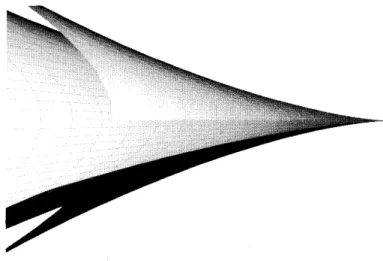
FIGURE 1. The singular geometnic Cauchy
construction
can
be used to produceCMC surfaces with arbitraly prescribed singular
curves.
The timelike CMC surface shown hasinfinitelymany
swallowtails alonga
cuspidal edge. The first fewcan
beseen
in this plot ofa
finite domain. The geometric Cauchy dataare
$s(v)=\sin(v)$,Thesingulargeometric Cauchy problemforspacelikeCMC surfaces issolvedbythe authorin [2]. The essential problem here isthat the$SU(1,1)$ framefor thesurface,whichis critical forsolvingthe
problemin the regularsituation of[3], blowsup
as
thesingularcurve
is approached. Theproblemissolved by multiplying all the
maps
bya
certainelement of theloopgroup,
whichmoves
all the dataintothe bigcell,thatistheset
on
whichtheIwasawadecomposition doesnothavea
middleterm. Itisthen possible to solve the problem with
a
new
“singularframe“ whicharises fromthis idea. Ananal-ogous
device isused to solve the problem for timelikeCMC surfacesinjointwork with M Svenssonin [6]. This will be discussed in Section4.
2. SPACELIKE CMC SURFACES
For explicit details of thefollowingdiscussion,thereader isreferred to[4] and[3].
2.1.
The generalizedWeierstrass representation. Theso
called$DPW$(Dorfmeister/Pedit/Wu [9]),or
generalized Weierstrass representation, for spacelike CMC surfaces is sketched below. We willdiscuss itlocallyforsimplicity.Let$U\subset \mathbb{C}^{2}$be
an open
set.$\bullet$ A conformalCMCimmersion
$f$
:
$Uarrow \mathbb{R}^{2,1}$ isrepresented byan
extendedfmme
$\hat{F}$:
$Uarrow\Lambda G$,where $G=SU(1,1)$, and$\Lambda G$isthe
group
oftwistedloopsin$G$.
.
The surface$f$is recoveredfrom $\hat{F}$bya
simple formula, called the Sym-Bobenkoformula,
whichisessentially of the form$\ovalbox{\tt\small REJECT}(\hat{F})=\lambda(\partial_{\lambda}\hat{F})\hat{F}^{-1}|_{\lambda=1}$
.
.
The extended frameischaracterizedl
among
smoothmaps
into$\Lambda G$by thefact thatitsMaurer-Cartan form$\hat{F}^{-1}d\hat{F}$
can
be written:$\hat{F}^{-1}d\hat{F}=A_{-1}\lambda^{-1}dz+\infty+\tau(A_{-1})\lambda d\overline{z}$,
where $\tau$ is the involution determiningthe real form$su(1,1)$ in $\epsilon 1(2,\mathbb{C})$, and $\alpha_{0}$ is
a
l-formwhich doesnotdependon$\lambda$
.
$\bullet$ Finally (and this is the DPW part of the construction), the extended frame
can
be obtainedfrom
a
holomorphicframe
$\hat{\Phi}$:
$Uarrow\Lambda G^{\mathbb{C}}$ bya
pointwiseIwasawadecomposition(2.1) $\hat{\Phi}=\hat{F}\hat{B}+$, $\hat{F}\in\Lambda G$, $\hat{B}+\in\Lambda^{+}G^{\mathbb{C}}$,
the last
group
denoting those loops in$SL(2,\mathbb{C})$whichcan
beholomorphicallyextendedtotheunitdisc.
$\bullet$ BycompaningtheMaurer-Cartanforms of$\hat{F}$and$\hat{\Phi}$
, andusingthat$\hat{B}+$has
a
Taylor expansionin $\lambda$, itis
easy
todeduce that$\hat{\Phi}$
mustbe holomorphic, and is
chamcterized
by itsMaurer-Cartan formbeing ofthe form
$\hat{\Phi}^{-1}d\hat{\Phi}=(\psi_{-1}\lambda^{-1}+\psi_{0}+O(\lambda))dz$
.
The holomorphic functions in the
matrices
$\psi_{i}$are
arbitrary, apartfroma
regularity conditionon one
of them. Thisis
the generalized Weierstmss representationfor(spacelike)CMC
sur-faces.
2.2.
Solution oftheBjorling problem. Now the idea thatisusedin[3]to solvethe Bj\"orling problem is actuallyvery
simple: The factor$\hat{F}\in\Lambda \mathscr{G}$in the decomposition2.1
is essentially unique. Sosuppose
that $\hat{\Phi}(zo)$ is already AG-valued, i.e. already takes values in the real form. At such
a
point,
theIwasawadecomposition(2.1)
is
trivial:$\mathfrak{H}(zo)=\hat{F}(zo)$
.
We
can use
thistoconstmcta
special holomorphicframe from the knowledge of$\hat{F}$along
a
curve
as
follows:
suppose we
know the value of$F$ alongsome curve
in $U$,say
$F(x+0.i)=\hat{F}_{0}(x)$ alongan
interval$J=U\cap \mathbb{R}$
.
Letus
set$\hat{\Phi}_{0}(x)=\hat{F}_{0}(x)$, $x\in J$
,
andthen extendthis holomorphicallyto
a
map
$\hat{\Phi}$:
$Varrow\Lambda G^{\mathbb{C}}$, fromsome open
subset$V$ containing $J$.
It tums outthat thiscan
be done, andmoreover
thismap
$\Phi$ has all the requiredproperties
ofa
holomorphicextendedRame for
a
CMC surface. Further,the corresponding extendedframe$F$agrees
with $fi_{0}(x)$ along $J$, because the Iwasawa decomposition is trivial along this
curve.
Thuswe
havesolvedthe Bj\"orlingproblem, providedthat
we
can
construct$\hat{F}_{0}(x)$along$J$fromthe Bj\"orlingdata. Ittums outthatthis
can
be doneina
fairly straightforwardmanner
(see [3]), andone
finally obtainsa
simple formulafor the holomorphic potential$\hat{\Phi}^{-1}d\hat{\Phi}$interms of the Bj\"orling data.
Using
a
uniquelocalcorrespondencebetweenWeierstrassdataandextendedframes,obtained viaa
normalized Birkhoff splitting, it isalso notdifficulttoshow that the Bj\"orling problemhasa
unique
solution.3. TIMELIKE CMC SURFACES
We tum
now
to the timelikecase.
The d’Alembertrepresentation
given in [8] differs from theWeierstrassrepresentation described in Section
2
as
follows:$\bullet$ The extended frame this time takes values in
a
subgroup of $\Lambda SL(2,\mathbb{C})$ consisting of loopswhich
are
in$G=SL(2,\mathbb{R})$ for real values of$\lambda$.
$\bullet$ TheMaurer-Cartanform oftheextendedframe$\hat{F}(x,y)$,where$x$and$y$
are
lightlike coordinatesfor$U\subset \mathbb{R}^{1,1}$,hasthe form
$\hat{F}^{-1}dfi=A_{1}\lambda$dr$+\infty+A_{-1}\lambda^{-1}dy$
.
$\bullet$ The extended frame$fi(x,y)$ is obtained from
a
pair
ofmaps
$\hat{X}(x)$ and$\hat{Y}(y)$,whereand thecoefficients $\psi_{i}^{X}$ and$\psi_{i}^{Y}$
are
essentially$arbitral\gamma$ functions.$\bullet$ $\hat{F}$
isobtained from$\hat{X}$ and$\hat{Y}$
byperforming
a
pointwiseBirkhoff
splitting (3.1) $\hat{X}^{-1}(x)\hat{Y}(y)=\hat{H}_{-}(x,y)\hat{H}_{+}(x,y)$,where$\hat{H}_{-}(x,y)\in\Lambda^{-}G$, and$\hat{H}_{+}(x,y)\in\Lambda^{+}G$
.
$2$Then
(3.2) $\hat{F}(x,y)=\hat{Y}(y)\hat{H}_{+}^{-1}(x,y)$
.
3.1.
Solution of the geometric Cauchy problem. Herewe
describe joint work with M Svenssonin [5]. As in the spacelike case, the essential idea is to contrive
a
situation where the (this timeBirkhoff)decomposition(3.1)istrivial along the
curve.
LookingattheirMaurer-Cartanforms,where the leadingtermsmust benon-vanishingfor regular surfaces,we
can see
that$\hat{X}(x)$ will havea
pole (in$\lambda$) at $\infty$ while $\hat{Y}(y)$ will havea
pole at $\lambda=0$.
Thus, the Birkhoff decomposition is unlikely tobe trivial unless
we
havesomethinglike$\hat{X}^{-1}(x)\hat{Y}(y)=$ constantin$\lambda$, andindeedwe
can
achieve this
along the
curve
$y=x$ifwe can
arrange,
for example, that$\hat{X}(v)=\hat{Y}(v)$
.
This leads to
a
solution to the geometric Cauchy problems along non-chamcteristic curves, i.e.curves
whichare never
tangent toa
nullcurve.
For sucha curve
in $\mathbb{R}^{1,1}$,
one
can
always (witha
possible changeoforientation)locally choose null coordinates $(x,y)$, such thatthecurve
isgiven
as
$u=0$inthecoordinates $u=(x-y)/2,$$v=(x+y)/2$
.
Suppose
one
can
construct, from the geometric Cauchydata, the extendedframe $\hat{F}(0,v)=\hat{F}_{0}(v)$for
a
timelikeCMC surfacealongthecurve
$x=y=v$, i.e. $u=0$.
(Ittums outthatone
can
dothis).Let
us now
set$\hat{X}(x)=\hat{F}_{0}(x)$, $\hat{Y}(y)=\hat{F}_{0}(y)$
.
Then it is
easy
tocheck that$\hat{X}$ and$\hat{Y}$have precisely the required form for the d’Alembertdata of
a
timelikeCMC surface, andthusgenerate such
a
surfaceusing thescheme outlined above. Along thecurve
$x=y=v$we
have $\hat{X}(x)=\hat{Y}(y)$,so
that, along thiscurve
the Birkhoff decompositionat (3.1)is just$I=I.I$,where$I$is theidentity matrix. Along this curve, the extended frame for the surface
so
constmctedisgivenby(3.2)
as
$\hat{F}(0,v)=\hat{Y}(v).I=\hat{F}_{0}(v)$
.
Thus the constmcted surface solves the geometric Cauchy problem. One
can
show, again usinga
normalizedBirkhoffdecomposition,thatthe solutionis unique.
Finally, the
case
that the initialcurve
is characteristic (null), is also treated in [5]. The solution is notunique, butwe
describe how to constmct all solutions. We do not treat initialcurves
whichbecome characteristicatisolated points.
$2_{The}$notation forthe last twogroupsis
notstnictly correcthere,bm inanycase$\Lambda^{-}G$consists ofloops which extend
4.
THE SINGULAR GEOMETRICCAUCHYPROBLEMThe solution of the singular geometric Cauchy problem, treated in [2] and [6] for, respectively,
spacelike andtimelike CMC surfaces is rathercomplicatedtodescribe. As mentioned in the
intro-duction, the extended frame$\hat{F}$
blows
up
as
sucha
curve
is approached. Therefore, itisclearthatthesolutions outlinedabovecannotbeapplied for such
a
curve.
We will notattempt to describe the solutionhere, butonly mention
a
critical ideaon
whichthesolution is built. Let
us
consider thecase
of spacelike surfaces. As described in Section 2, theextended frame$\beta$ (andhence
the surface)is obtainedfrom theholomorphic frame$\mathfrak{H}$
by
an
Iwasawadecomposition
$\hat{\Phi}=\hat{F}\hat{B}+\cdot$
When the
group is
non-compact,theIwasawadecomposition is onlywritten thisway
on
an open
densesubset ofthe loop
group,
calledthe bigcell. Therestof theloopgroup
isa
disjointunion$\bigcup_{i=1}^{\infty}\mathscr{P}_{\pm i}$ ofsubvarieties,of codimensionincreasingwith $|i|$
.
On $\mathscr{P}_{i}$theIwasawa decompositionreads
(4.1) $\hat{\Phi}=\hat{U}0*\hat{B}+$,
where$\hat{U}\in\Lambda G$andthemiddleterm
$c\theta$is
a
certain
unique specialelement.The essentialidea, first usedin [4],is
as
follows:suppose
that,atsome
point$zo$,we
have$\mathfrak{H}(zo)=oe$
.
(Thepossibleterms$\hat{U}(zo)$ and$\hat{B}_{+}(zo)$ in(4.1)do not affect thefollowing). Now set
$\hat{\Phi}_{\omega}=\hat{\Phi}\text{の_{}i}^{-1}$
.
Then$\Phi_{\omega}(zo)=I$,whichis inthebigcell. Thebigcellis
an open
set,so
$\mathfrak{H}_{co}(z)$takes valuesinthebigcell
on
a
neighbourhoodof$z0$.
Thus,around$z0$,one
hasan
Iwasawadecomposition$\hat{\Phi}_{\omega}=\hat{F}_{\omega}\hat{B}+\cdot$
This
was
usedtoanalyze thesurfaceas
$\mathscr{P}_{\pm 1}$ isencountered in [4], andit$mms$outthat finitesingu-larities
occur
only(andalways)at $\mathscr{P}_{1}$,and the surface always blowsup
at$g_{-1}.3$Nowthe
important,
andnotobvious, thingis
that ittums outthat ifwe
let$\hat{F}$denote theextended frame correspondingto$\mathfrak{H}$
,then,
on
the intersection of thesetswhere both$\hat{F}$and$\hat{F}_{\omega}$
are
defined,whichis
an
open
densesetinthedomain,we
have thatthe Sym-Bobenkoformulaagrees
for bothframes:$\ovalbox{\tt\small REJECT}(\hat{F}_{\omega})=\ovalbox{\tt\small REJECT}(\hat{F})$
.
This
means
that$\hat{F}_{\omega}$can
be regardedas
another kind of extended frame for the surface,which,howeveris
now
welldefined
atthe singularsetcorrespondingto$\hat{\Phi}^{-1}(\mathscr{P}_{1})$.
$3_{The}$higher ordersmallcells$p_{j}$,for$|j|>1$have notbeen analyzed, but wouldnotberelevanttogeneric singularities
FIGURE2. SpacelikeCMC surfaces with prescribed singularities. Left: swallowtail.
Right: cuspidal
cross
cap
This singularframe
was
usedbytheauthorin [2]tosolvethesingular Bj\"orling problem forspace-likeCMC surfaces. Itis notimmediately clear how to define the singularframe from the geometric Cauchy data, because the definition of$\hat{F}_{\omega}$ is notgeometric but rather
comes
algebraically from the
holomorphic framevia
an
Iwasawadecomposition. Findinga
way
to dothiswas a
majorissue inthiswork.
The solution ofthe geometric Cauchy problem for timelike CMC surfaces, also depends on the
idea of translatingthedataintothe$(Birkhof0$bigcell andworking with
a
$|$’singular“ frame. This will
appear
ina
forthcomingarticle,jointwith MSvensson[6].FIGURE3. Atimelike CMCsurfacewith
a
cuspidalcross
cap
singularity. GeometricFor both the timelike and spacelike cases, the singular
geometric
Cauchyconstmction is
usedtofind thegeneric singularities of the generalized surfacesdefinethere. In both cases, the
generic
non-degenerate singularities tum out tobecuspidal edges, swallowtailsandcuspidal
cross
caps.
5. NUMERICALIMPLEMENTATIONS
The solutionstoall ofthesegeometric Cauchy problems
can
be computed usingnumericalimple-mentations ofthe DPW method. The DPW method takes the $t\prime potentials’’,\hat{\Phi}^{-1}d\hat{\Phi}$forthe spacelike
case, and the
pair
$(\hat{X}^{-1}d\hat{X},\hat{Y}^{-1}df)$ for the timelike case, integrates these, performsa
Birkhoffor
Iwasawa decomposition and then applies the Sym-Bobenko formula. All of this
can
be implemented numerically. The essential pointnow
is thatour
solutions for the geometric Cauchy problem give formulaeforthesepotentialsdirectly from the geometryCauchydata,and hencecan
becomputed.FIGURE 4. The singular
curve
is alwaysa
nullcurve
for both timelike andspace-likeCMCsurfaces. For smooth timelikeCMC surfaces,
a
nullcurve
is characteristic.Howeverthis does not apply to singular
curves:
thecurve
isnot, in general, charac-teristic. If thesingularcurve
$is$characteristic, then thesingularityisalwaysa
straightline,and thegeometric Cauchy problemhasinfinitely
many
solutions. Twoexamplesare
shownhere.Theimages in this article
are
fromthe author’sownimplementation, writtenin Matlab. Thenon-characteristic singulargeometricCauchy problem
can
always be expressedas
the problem of finding$f(u,v)$ with
$f_{v}=s(-e0+\cos(\theta)e_{1}+\sin(\theta)e_{2})$
,
$f_{u}=t(-e_{0}+\cos(\theta)e_{1}+\sin(\theta)e_{2})$.
The DPW potentials
are
given in[6] interms ofthe functions$s(v),$$t(v)$ and$\theta’(v)$.
If all functionsare
$t$ vanishestofirstorder,
a
cuspidalcross
cap.
See Figures 1 and3.Examplesofcharacteristic singular
curves
are
giveninFigure4.REFERENCES
1. LJAl\’ias,RMBChaves,and PMira,Bjorlingproblem
for
maximalsurfaces
inLorentz-Minkowskispace, Math. Proc. Cambridge Philos. Soc.134(2003),289-316.2. DBrander,Singularities
of
spacelikeconstantmeancurvaturesurfacesinLorentz-Minkowski space,Math. Proc.Cam-bridge Philos. Soc.150(2011),527-556.
3. D Brander and JFDorfmeister,The Bjorling problemfornon-minimalconstantmeancurvaturesurfaces,Comm.Anal.
Geom.18(2010), 171-194.
4. DBrander,W Rossman,andNSchmitt,Holomorphicrepresentationofconstantmeancurvaturesurfacesin Minkowski
space: Consequencesofnon-compactnessin loopgroupmethods,Adv. Math.223(2010),949-986.
5. D Branderand M Svensson, The geometric Cauchy problemfor surfaces withLorentzian hamonic Gauss maps,
arXiv:1009.5661 [math.DG].
6. –,Timelikeconstantmeancurvaturesurfaceswith singularities,forthcoming.
7. RMBChaves,MPDussan,and M Magid, Bjorling problemfortimelikesurfacesin theLorentz-Minkowski space,J.
Math. Anal. Appl377(2011),481-494.
8. J Dorfmeister,J Inoguchi, andMToda, Weierstrass-typerepresentationoftimelike
surfaces
withconstantmeancurva-ture,Contemp.Math.308(2002),77-99,Amer.Math.Soc., Providence,RI.
9. J Dorfmeister, FPedit,and HWu, Weierstrasstype representationofhamonic neaps intosymmetricspaces, Comm. Anal.Geom.6(1998),633-668.
10. YWKim, S-E Koh, HShin, and S-D Yang, Spacelike maximal surfaces, timelike minimal surfaces, and Bjorling
representation fomulae, J.KoreanMath. Soc.48(2011), 1083-1100.
11. YWKim and SD Yang, Prescribing singularitiesofmaximalsurfacesviaasingular Bjorling representation fomula,
J.Geom. Phys.57(2007),2167-2177.
DEPARTMENT OF MATHEMATICS, MATEMATIKTORVET, BUILDING 303 S, TECHNICAL UNIVERSITY OF
DEN-MARK,DK-2800KGS. LYNGBY,DENMARK