西 南 交 通 大 学 学 报
第 54 卷 第 6 期
2019 年 12 月
JOURNAL OF SOUTHWEST JIAOTONG UNIVERSITY
Vol. 54 No. 6
Dec. 2019
ISSN: 0258-2724 DOI:10.35741/issn.0258-2724.54.6.23
Research ArticleGeotechnical Engineering
E
FFECT OF
S
ATURATION
L
EVELS ON
S
HEAR
S
TRENGTH AND
B
EARING
C
APACITY
P
ROPERTIES OF
S
OIL
T
YPES
饱和水平对土壤类型抗剪强度和承载力特性的影响
Mahmood D. Ahmed, Alaa D. Almurshedi, Hayder H. AlwanCollege of Engineering, University of Baghdad
Al-Jadriya, Karrada, Baghdad, Iraq, [email protected], [email protected],
Abstract
This study presents a comprehensive set of laboratory works for the examined soil layers extracted from Baghdad city (specifically from Alkadhimya, Alaitaifiya, and Alhurriya) to illustrate their engineering properties. The researchers have adopted the unified soil classification system for soil classification purposes. Also, the direct shear test was performed for soil samples with various degrees of saturation (0%, 25%, 50%, 75%, and 100%). The test results have shown a significant reduction in cohesion property with higher moisture content within soil samples. Also, a noticeable reduction in angle of internal friction value has occurred with such changes. Furthermore, it has been found that the bearing capacity of unsaturated soils ranged between 2000 and 3000 KPa, and about 500-700 KPa for the soaked soil samples.
Keywords:Degree of Saturation, Cohesion, Angle of Internal Friction, Bearing Capacity
摘要 这项研究针对从巴格达市(特别是从卡迪米亚,阿拉伊塔菲亚和仙女)提取的被检查土壤层 提出了一套全面的实验室工作,以说明其工程特性。 研究人员采用统一的土壤分类系统进行土壤 分类。 同样,对具有不同饱和度(0%,25%,50%,75% 和 100%)的土壤样品进行了直接剪 切试验。 测试结果表明,土壤样品中的水分含量较高时,内聚性显着降低。 而且,随着这种变化 ,内部摩擦值的角度已经显着减小。 此外,已经发现,非饱和土壤的承载力范围在 2000 至 3000 千帕之间,对于浸泡的土壤样品,其承载能力约为 500-700 千帕。 关键词: 饱和度,内聚力,内摩擦角,承载力
I. I
NTRODUCTIONIt is necessary to test the conditions of soil and its engineering properties for any project
before the project be constructed [1], [11]. And that is what any engineer and geologist does before any site construction work. Soil conditions
have a significant effect on the type of foundation, and gives a final decision to the engineer on how far the foundation should extend to [2]. Therefore, it is necessary to specify critical location of the undesirable soils for future treatments. Also, many geological projects require determination of soil behavior and capacity to resist surface movement due to construction work [3], [10]. For such conditions, it is necessary to simulate soil conditions for the future, when any undesirable external effects tend to reduce soil strength, and examine soil stability and movement [4]. Shear strength is considered to be a primary parameter that reflects soil strength.
It is necessary to determine property such as foundation analysis, earthworks, and slope stability works. It is well known that, when a soil is loaded, soil particles tend to paste to each other as well as they can – this property is called the cohesion. Soil shear strength can be determined on site (such as with the van shear test method) [5], or performed in the laboratory. In general, laboratory shear strength tests can be divided into two types: shear strength based on total stress, and shear strength based on the effective stress, as clarified in the next subsections [6].
A. Shear Strength Tests Based on Total Stress This type of test is also known as undrained shear strength. It is normally used to determine the shear strength property or failure envelope of undrained soil in terms of total stress (cohesion (c) and friction forces ().
B. Shear Strength Tests Based on Effective Stress
The effective shear strength is referred to as the drained shear strength test. It is normally defined by Moher-Coulomb failure equation. This type of laboratory test is used to achieve the effective shear strength property of the tested soils according to the failure surface in terms of the effective stress (summation of effective angle of internal friction strength (') and effective cohesion strength (c').
The shear strength test of soils is rather complex; they are divided into two types based on soil nature: granular (non-plastic) soils and cohesive (plastic) soils [7].
II. M
ETHODOLOGYA. Site Sampling
Three types of soils were collected from different locations in Baghdad city are; Alatafia (A), Alkadhumia (k), and Alhuria (H).
B. Sample Preparation
In Baghdad, most people are used to saving water in their own tanks due to a lack of general service most of the time. In this study, soil specimens have been taken during the boring process at depths ranging from 0.5-1 m. Since it is not easy to obtain samples in undistributed states, the samples were prepared with conditions that satisfied the dry unit weight utilizing the static compaction method. The obtained samples were saved in plastic bags to keep the soil moisture unchanged until it reached the laboratory of the soil mechanics. The samples were then tested to determine the dry unit weight and water content properties [2].
C. Testing Program
Soil classification tests were performed on the samples to determine their chemical and physical properties. The physical classification included testing samples to determine their specific gravity, dry density, and Atterberg limits, while the chemical classification included Ph value, gypsum content, total soluble salts, total sulphite content, and organic content. After determination of the soil properties for classification purposes, each soil type was tested in terms of their direct shear strength at different levels of saturation ranging from 0%-100% with 25% step increments.
III. R
ESULTS ANDD
ISCUSSION A. Soil Classification ResultsAs mentioned previously, soil classification gives the engineer the geotechnical behaviour of the soil that the project will be testing. The most common, well-known soil classification system is the unified soil classification system (USCS). Table 1 clarifies the classification of the soil samples according to the USCS system, where soil type A was sandy clay with an organic material, type H was sandy clay soil, and type L was silty soil.
Table 1.
Description of the soils layers
Alkadhumia Sandy clay with organic material
Alhuria Sandy clay
Alatafia Silty clay
B. Physical Soil Tests Results
The results of the physical test for different soil types (K, A, and H) are presented in Table 2. It is worth mentioning that the tests were performed according to the procedures outlined by Head [8].
Table 2.
Physical properties of the soils
Alatafia soil Alhuria soil Alkadhimia soil Properties 39 35 44 Liquid limit (%) 27 30 23 Plastic limit (%) 12 5 21 Plasticity index (%) 14.6 16.88 14.4 Dry unit weight (kN/m3) 16 18 16 Optimum moisture content (%) 18.6 19.6 19 Bulk density ( kN/m3) 2. 6 1 2.63 2.68 Specific gravity
C. Results of Soil Chemical Tests
The chemical properties test results for the three soil types are illustrated in Table 3. The tests were performed based on the standards that are mentioned in the table.
Table 3.
Chemical properties of the soil
Properties Alkadhimia soil Alatafia soil Alatafia soil Total soluble salts (T.S.S) 18 21.63 20.15 Total sulphates content SO3 (%) 4.45 3.3 4.2 pH 8.6 8.1 7.9 Organic content (%) 3.93 1.03 0.84 Gypsum content (%) 8.2 5.69 10.6
D. Shear Strength Test Results
The direct shear strength test was performed on the different soil types at various water content levels. The test was performed based on the procedure proposed by ASTM D-3080, using
60 mm x 60 mm x 20 mm dimensions for each soil specimen.
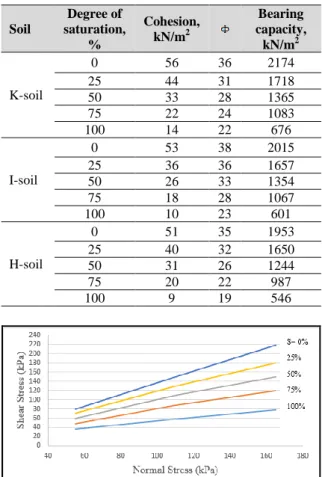
To determine the behaviour of soil shear strength parameters (c, ), the test was performed fifteen times for all soil samples. For each soil type, the test was performed 5 times according to the degree of saturation levels (0%, 25%, 50%, 75% and 100%). Table 4 clarifies a summary result for the test soil samples.
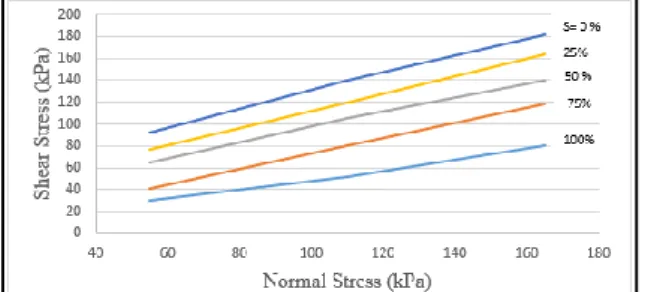
Figures 1, 2, and 3 illustrate the effect of shear strength on each type of tested soil with various degrees of saturation level. From the mentioned figures, it can be observed that unsaturated soil has shear strength higher than other samples those with different moisture levels. Also, a noticeable reduction in the angel of internal friction property has observed with higher moisture content levels. And that may backs to water effect which destructs bonding properties between soil particles.
Table 4.
Summary of the variation of degree of saturation level on soils cohesion, angle of internal friction, and bearing capacity Soil Degree of saturation, % Cohesion, kN/m2 Bearing capacity, kN/m2 K-soil 0 56 36 2174 25 44 31 1718 50 33 28 1365 75 22 24 1083 100 14 22 676 I-soil 0 53 38 2015 25 36 36 1657 50 26 33 1354 75 18 28 1067 100 10 23 601 H-soil 0 51 35 1953 25 40 32 1650 50 31 26 1244 75 20 22 987 100 9 19 546
Figure 1. Shear stress-normal stress relationship for Alkadhimia soil in different degrees of saturation
Figure 2. Shear stress-normal stress relationship for Alatafia soil in different degrees of saturation
Figure 3. Shear stress-normal stress relationship for Alhuria soil in different degrees of saturation
E. Results of Soil Bearing Capacity
As can be seen in the previous Table 4, the relation between soil shear strength and bearing capacity (shear strength) for various degree of saturation levels. It worth to be mentioned that the bearing capacity values were determined from Eq.1, as follows [9]:
qu = CNcScdc + qNqSqdq + 1/2BNSd (1)
where:
qu: Ultimate Bearing Capacity (kPa).
C: Cohesion Component of Strength, (kPa). Nc, Nq, N: Bearing Capacity Factors.
Sc, Sq, S: Shape Factors.
dc, dq , d: Depth Factors.
: Unit Weight (k N/m3
). q: Soil Pressure on Footing.
B: Width of separated square footing.
The same table clarifies a noticeable reduction in bearing capacity with higher percentages of saturation for all type of soils.
IV. C
ONCLUSIONBased on the previous results, the following conclusions can be drawn:
1. Soils particles cohesion Before soaking were ranged between 30-75 kPa, for all types of the tested soils.
2. The tested soils are semi solid to solid behaviour, and angle of internal friction of soils ranges between 32- 48 deg.
3. Soaking of soils reduced cohesion by approximately 2-3 folds, while the angle of internal friction exhibited marginal reduction
4. The tested soil bearing capacity property were varied between 2000 - 3000kPa.
5. At soaking state, The bearing capacity of the tested soils were ranged between 500-800kPa.