西 南 交 通 大 学 学 报
第 55 卷 第 1 期
2020年 2 月
JOURNAL OF SOUTHWEST JIAOTONG UNIVERSITY
Vol. 55 No. 1
Feb. 2020
ISSN: 0258-2724 DOI:10.35741/issn.0258-2724.55.1.42
Research article Mathematics
S
OLVING
P
ARTIAL
I
NTEGRO
-D
IFFERENTIAL
E
QUATIONS WITH
W
EAKLY
S
INGULAR
K
ERNEL
用弱奇异核解决部分积分微分方程
Amina Kassim HussainDepartment of Material Engineering, College of Engineering, Mustansiriyah University Baghdad, Iraq
[email protected], [email protected]
Abstract
Equations with a combination of integrals and derivatives are known as integro-differential equations. They are a combination of science and engineering. Many models are implemented with the help of integro-differential equations. Various techniques are available to solve integro-differential equations. In the present study, the Radial Basis Function and Adomain Decomposition Method-based numerical algorithms are used to solve a linear partial integro-differential equation with weakly singular kernel, which arises from viscoelasticity. In the discretization process, singular integrals were compared with the product trapezoidal method. Implementation of various radial basis functions was carried out. The proposed system was found to be useful and to provide reproducible results.
Keywords: Numerical Method, Decomposition Method, Weakly Singular Kernel, Product Trapezoidal Method
摘要 具有积分和导数组合的方程式称为积分微分方程式。它们是科学和工程学的结合。许多模型是 借助积分微分方程实现的。有多种技术可用于求解积分微分方程。在本研究中,基于径向基函数和基 于域名分解法的数值算法被用来解决由粘弹性引起的具有弱奇异核的线性偏积分微分方程。在离散化 过程中,将奇异积分与乘积梯形法进行了比较。实施了各种径向基函数。发现所提出的系统是有用的 并且提供可再现的结果。 关键词: 数值方法,分解方法,弱奇异核,乘积梯形法
I. I
NTRODUCTIONNowadays, various mathematical models lead to functional equations such as stochastic equations, ordinary, partial, linear, nonlinear, fractional, integral, and integro-differential equations. They have wide applications in many areas like astronomy, physics, geology, chemistry, dynamic systems, economics, population dynamics, biology, etc. Various solution topics and methods are available, such as integral solutions, numerical integrations, Dirac delta function, asymptotic, and exponential stability. The Euler method, finite differentiation method, integral transform, integrating factor, Crank Nicolson, Runge- kutta, finite element, finite volume, Galerkin, perturbation theory are a few of the solution methods used to solve various problems like those found in [1] and [2] below. Many problems lack standard solutions, like partial integro-differential equations. Analytically, it is difficult to solve the partial integro-differential equations. Hence, this is a reason to innovate numerical approximations of the solution. Here, the big challenge is to solve these types of problem numerically as well as analytically as they have different factors like nonlinearity non-local phenomena and multi-dimensionality, physical constraints, and other variables [17]. As discussed above, mathematical biology, fluid dynamics, viscoelasticity, engineering, financial mathematics, and other areas suffer from the same problems as partial integro-differential equations [3] and [4].
PIDE with weakly singular kernel is considered below in Eq. 1.
(1) where and it satisfies the bellows boundary and initial conditions.
These types of integro-differential equations occur in cases of phenomena like heat conduction in materials, viscoelasticity, and population dynamics. Many authors have found the numerical solution of PIDEs.
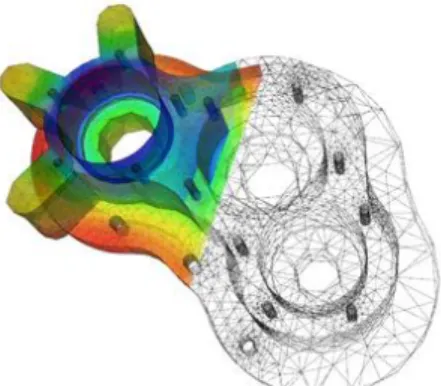
Figure 1. Concept of heat transfer
Figure 1 shows the example of heat transfer. It visualizes the heat transfer in a pump casing, which is solved with a heat equation. Here heat is generated in the internal part of the case and cools down at the boundary of the case with steady state temperature distribution.
Here, is the unknown function with the above initial and boundary conditions. is the Newtonian contribution to the viscosity.
In our paper we discuss a special case where 0, meaning non-Newtonian fluids. We focus on the problem in Eq. 2.
(2) In the present study, the basic concept is elaborated in Section II. It includes Numerical Methods, Partial Integro-Differential Equations (PIDE), a domain Decomposition Method, Radial Basis Functions (RBF), Finite Difference Method (FDM), Weakly Singular Kernel, and Product Trapezoidal Method. Then mathematical analysis was carried out with weakly singular PIDEs by RBF and Adomain decomposition methods.
II. B
ASICC
ONCEPTSA. Numerical Methods
In numerical methods, mathematical tools are designed to solve numerical problems. They are implemented with an appropriate convergence check in a programming language known as a numerical algorithm. Examples of numerical methods are: iterative, Newton–Raphson division, Newton's, Horner's, rate of convergence, Taylor series, Runge-Kutta, Laplace transform, Elzaki transform, double Elzaki transform linear, multistep, and Gear. They are used to solve real-time (i.e., dynamic) systems with assumptions made of the initial conditions [8], [10], [11].
B. Partial Integro-Differential Equations (PIDE) If we take the derivative with respect to one variable, then this type of integro-differential equation is known as ordinary. If the integro-differential equations that generally occur in mathematical physics or geology have derivatives with respect to different variables, then these types of equations are known as partial integro-differential equations. A functional equation that involves unknown function f(x) is named as an integro-differential equation (IDE) when it involves both integrals and derivatives of a function. An IDE is classified in various ways, which are shown below in Figure 2. Linear ordinary integro-differential equations are classified in two ways: Fredholm linear ordinary integro-differential equations, and Volterra linear ordinary integro-differential equations [6], [7], [13], [14], [15], [18].
Figure 2. IDEs classification
C. Decomposition Method
There are many procedures available to perform decomposition of the mean. In the design of the algorithm the main program is subdivided into sub-programs. There are various types of decomposition method: Adomain, domain, and Cholesky [9].
D. Radial Basis Functions (RBF)
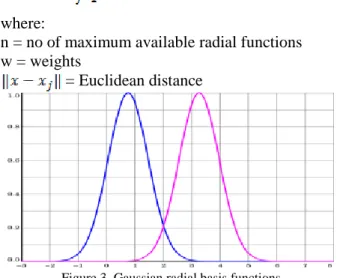
This is a real-value function. Its value is dependent on the distance from origin means
or where
is the origin or any center that is being considered during the distance calculation. The function that satisfies then becomes a radial function. Sometimes, the addition of a radial basis function is used for approximating given functions using a neural network. Radial basis function is used as a kernel in classification problems. It has a wide range of applications in the field of engineering. Gaussian, multiquadric quadratic
inverse, polyharmonic spline, and thin-plate spline are examples of radial basis functions [5].
RBFs are used to build up function approximations in the form of the equation shown below:
where:
n = no of maximum available radial functions w = weights
= Euclidean distance
Figure 3. Gaussian radial basis functions
E. Finite Difference Method (FDM)
This method is used to solve differential equations. The basic idea is to approximate a difference equation. In this matrix, algebraic technique is used to solve the problem [12]. F. Weakly Singular Kernel
Assume the integral operator H, which is defined by the kernel function K(x,y), by using the following formula
where u is part of a set of functions. The weak singularity of kernel K and its corresponding operator H may be different.
The clear understanding about Kernel K is given below in eq. (3)
(3) where c is a continuous function on [0, 1] [0, 1]. V is a lie between 0 to 1. This kernel satisfies the property which is noted below in equation (4) [16].
Iterated kernels have more certain bonding. For this, a weakly singular kernel is in the form of
where a lies between 0 to 1 i.e. . G. Product Trapezoidal Method
In case of numerical analysis, the trapezoidal rule is used for approximation of the definite integral. It is also known as the trapezium rule or trapezoid rule. This rule work by approximating the region or coverage under the graph having function f(x).
Figure 4. Function f(x) is approximated to linear function
It follows the following equation (5).
where
and
III. M
ATHEMATICALA
NALYSISIn this section we focus on the mathematical analysis of the Radial basis function and the Adomain decomposition method is used to solve the differential equation numerically. For this we choose
(6) A. RBF
Here, the basics of RBF are introduced. For function u interpolation is represented as:
where . Here it is a univariate function which is fixed. represents the
coefficients which are real in nature.
indicates the set of interpolation points which belong to .
The above equation is written as:
where various terms related to this term are:
and .
The interpolation condition is obtained by solving the linear system where A and U are defined as follows:
and .
Here we assumed the following weakly singular PIDE.
The boundary condition and initial condition are mentioned as:
is the exact solution.
Here, following is an exact solution for the discreate value of above problem
Assumed values for analysis purpose are , h = 0.001, T = 1 and N = 25.
B. Adomian Decomposition Method
G. Adomain proposed the Adomain decomposition method in Adomain [13], [15], [17]. Basically, it proposes to solve differential equations with the help of a recursive formula. Here we apply the Adomain decomposition method to find solutions of partial integro-differential equations. For this, we consider the following series:
Integrating both sides of the equation (10) with limits 0 to t. We get the below recursive relation:
For n = 1, 2, 3, 4, 5………. select the function .
For n = 1 we get,
For n = 2
IV. C
ONCLUSIONFrom the above observations we conclude that both of the methods are very good. The implemented algorithms for these methods work successfully. We can use these algorithms efficiently for solving partial integro-differential equations with a weakly singular kernel. These algorithms have advantages that are less time consuming. They work rapidly without discretizing the variables for numerical integration.
R
EFERENCES[1] BIAZAR, J. and ASADI, M.A. (2015)
FD-RBF for Partial Integro-Differential Equations
with a Weakly Singular Kernel. Applied and
Computational Mathematics, 4 (6), pp.
445-451.
[2] YOON, J., XIE, S., and HRYNKIV, V.
(2012) Two Numerical Algorithms for Solving
a Partial Integro-Differential Equation with a
Weakly Singular Kernel. Applications and
Applied Mathematics, 7 (1), pp. 133-141.
[3] SALMAN, Z.A.-N. (2006) Partial
Integro-Differential
Equations:
Classification
&
Solutions.
Available
from
https://iasj.net/iasj?func=fulltext&aId=44143.
[4] SAEID, A.B. and SHIVANIAN, E. (2009)Application of the Variational Iteration
Method for System of Nonlinear Volterra’s
Integro-Differential Equations. Mathematical
and Computational Applications, 14 (2), pp.
147-158.
[5] ASLEFALLAH, M. and SHIVANIAN, E.
(2014) A nonlinear partial integro-differential
equation arising in population dynamic via
radial basis functions and theta-method.
Journal of
Mathematics
and
Computer
Science, 13 (1), pp. 14-25.
[6] TARI, A. (2013) On the Existence
Uniqueness and Solution of the Nonlinear
Volterra Partial Integro-Differential Equations.
International Journal of Nonlinear Science, 16
(2), pp. 152-163.
[7] NIGATIE, Y. (2018) The Finite Difference
Methods for Parabolic Partial Differential
Equations.
Journal
of
Applied
&
Computational Mathematics, 7 (3), pp. 1-4.
[8] THORWE, J. and BHALEKAR, S. (2012)
Solving Partial Integro-Differential Equations
Using Laplace Transform Method. American
Journal of Computational and Applied
Mathematics, 2 (3), pp. 101-104.
[9] FORTIN, N., LEMIEUX, T., and FIRPO,
S.
(2010)
Decomposition
Methods
in
Economics. Cambridge: National Bureau of
Economic Research.
[10] KURTH, P. (2014) On a New Class of
Partial
Integro-Differential
Equations.
Konstanzer Schriften in Mathematik, 327.
Available
from
https://pdfs.semanticscholar.org/de6c/a17c5fda
73402f9ba5750dec3dfc9ac36c2e.pdf?_ga=2.2
6635069.1020841225.1583667860-1335596136.1560356921.
[11] GORE, J. and GORE, S. (2015) Solution
of Partial Integro-Differential Equations by
Using Laplace, Elzaki and Double Elzaki
Transform Methods. International Research
Journal of Engineering and Technology, 2 (3),
pp. 1825-1830.
[12] CAUSON, D.M. and MINGHAM, C.G.
(2010) Introductory finite difference methods
for
PDEs.
Manchester:
Department
of
Computing and Mathematics, Manchester
Metropolitan University.
[13] MAHGOB, M.A. (2015) Solution of
Partial
Integro-Differential
Equations
by
Double
Elzaki
Transform
Method.
Mathematical Theory and Modeling, 5 (5), pp.
61-65.
[14] GUPTA, A.R., AGGARWAL, S., and
AGRAWAL, D. (2018) Solution of Linear
Partial Integro-Differential Equations Using
Kamal Transform. International Journal of
Latest
Technology
in
Engineering,
Management & Applied Science, 7 (7), pp.
88-91.
[15] ANGURAJ, A. and RAVIKUMAR, K.
(2017) On Existence Results of Non-Linear
Stochastic
Partial
Integro-Differential
Equations. International Journal of Pure and
Applied Mathematics, 117 (11), pp. 417-427.
[16] VAINIKKO, G. (2006) Weakly Singular
Integral Equations. Lecture Notes. Tartu:
University of Tartu.
[17] AL-NASRAWY, H.H., AL-JUBORY,
A.K.O., and HUSSAINA, K.A. (2019) An
Efficient Algorithm for Solving
Integro-Differential Equation. Journal of Southwest
Jiaotong University, 54 (6). Available from
http://jsju.org/index.php/journal/article/view/4
53.
[18] HUSSAIN, A.K., RUSLI, N., FADHEL,