第 56 卷 第 1 期
2021 年 2 月
JOURNAL OF SOUTHWEST JIAOTONG UNIVERSITY
Vol. 56 No. 1
Feb. 2021
ISSN: 0258-2724 DOI:10.35741/issn.0258-2724.56.1.6
Research articleElectrical and Electronic Engineering
E
VALUATION OF
W
IND
S
PEED
P
OTENTIAL
U
SING
C
ORRELATION
C
OEFFICIENT
M
ODEL IN
M
EDAN
,
N
ORTH
S
UMATRA
,
I
NDONESIA
基于相关系数模型的印尼北部苏门答腊棉兰风速潜力评估
Suwarno
Department of Electrical Engineering, Muhammadiyah University of North Sumatra Medan, North Sumatra, Indonesia, [email protected]
Received: November 18, 2020 ▪ Review: December 23, 2020 ▪ Accepted: January 20, 2021:
This article is an open-access article distributed under the terms and conditions of the Creative Commons Attribution License (http://creativecommons.org/licenses/by/4.0)
Abstract
Medan is the capital city of North Sumatra Province, consisting of various tribes and a dense population that requires a large amount of electrical power. Energy demand continues to increase along with population and business growth, so that additional energy sources are needed; one of which is wind. An evaluation of the potential of wind energy sources is needed to determine the feasability of its use as an environmentally-friendly, renewable energy source without emissions.This paper aims to evaluate the potential wind speed in the city of Medan using the correlation coefficient (R2) model. The four application models proposed for the probability density function used are Normal Distribution, Lognormal, Weibull 2-parameters and Weibull 3-parameters. The analysis results show that the four models used are all potentially feasible options that can be used to evaluate the potential sources of wind energy in Medan. The potential of these models for use, ranked from most to least, are the Weibull 3-parameter Model, followed by the Lognormal, Normal Distribution and Weibull2-3-parameter. In addition to the analysis, the results of the Normal, Lognormal and Weibull Distribution tests are also presented.
Keywords: Wind Speed, Probability Density Function, Correlation Coefficient
摘要 棉兰是北苏门答腊省的省会城市,由各种部落组成,人口众多,需要大量电力。能源需求随 着人口和企业的增长而持续增长,因此需要更多的能源;风之一。需要评估风能的潜力,以确定 将其用作无排放的环保,可再生能源的可行性。本文旨在利用相关系数(R2)评估棉兰市的潜在 风速)模型。针对所使用的概率密度函数建议的四个应用模型是正态分布,对数正态,威布尔 2 参数和威布尔 3 参数。分析结果表明,使用的四个模型都是可以用来评估棉兰潜在风能来源的潜 在可行方案。这些模型的使用潜力(从最高到最低)依次是威布尔 3 参数模型,其次是对数正态 分布,正态分布和威布尔 2 参数。除了分析之外,还提供了正态,对数正态和威布尔分布检验的
结果。
关键词:风速,概率密度函数,相关系数
I. I
NTRODUCTIONRenewable energy sources began to grow in the early seventies due to the fossil energy crisis that hit the energy market at that time [1]. As the global demand for energy is growing rapidly, it is time to look for new and renewable energy sources to replace the dwindling fossil fuel supply [2], [3]. One alternative and renewable energy option is wind energy. To determine the potential of wind energy, an evaluation of the probability density function (PDF) is performed. The choice of PDF is very important in the evaluation of wind energy, because wind power is calculated as an explicit function of wind speed distribution parameters. Evaluation of the wind speed probability density function is performed using the four proposed models using the coefficient of determination (R2) in this study, and the data feasibility test uses the Kolmogorov–Smirnov test (K-S).
II. L
ITERATURER
EVIEWThe Weibull2-parameter distribution and the Rayleigh distribution are most commonly used in wind speed data analysis, especially for studies related to wind energy estimation [4], [5], [6], [7], [8]. The 2-parameter Weibull distribution is the most widely used distribution for wind speed characterization, and has a number of advantages for this purpose [9]. The Rayleigh distribution, the one-parameter distribution, and the two-parameter Weibull distribution are most often used in studies related to wind speed analysis [10], [11].
The 3-parameter Weibull model with
additional location parameters has been used in studies by Stewart and Essenwanger [12], and Tuller and Brett [9]. Generally, this model is
more suited to the Weibull3-parameter
distribution than the usual Weibull 2-parameter distribution. The model provides a better fit for wind speed data than some of the other distributions. Recently, other standard PDFs have been used to characterize wind speed distribution [13], [14], [15], [16]. The general model used was a mix of Weibull2-parameters with a single-cut normal distribution from the bottom with Weibull2-parameter distribution. The mixed model was found to be suitable for the bimodal wind regime [13].
This approach was adopted by Zhang et al. [17] in a multivariate framework, since the minimum threshold wind speed was required to be recorded by the anemometer and a wind speed of zero occurred frequently. However, for many distributions, including the Weibull2-parameter, a wind speed of zero was not taken into account correctly because the CDF of this distribution provided zero probability of observing a wind speed of zero of a given variable X. Of the various PDFs that show relative levels of fit with wind-speed data as samples, some statistics were used in studies related to wind-speed analysis. The coefficient of determination (R2) was most often used [8], [18], [19], [20], but chi-square test results [11], [21], [22], [23], Kolmogorov– Smirnov (KS) test results [9], [22], [24], [25], and root mean square error (RMSE) were also used [11], [24], [26], [27]. In most studies, a visual assessment of the attached PDF overlaid on the wind-speed data histogram was also performed [28], [29], [30]. R2 and RMSE were applied either to the theoretical cumulative probability, to the empirical cumulative probability (PP plot) [13], [31], [32], [33], or to the theoretical wind speed of the observed wind-speed quantile (QQ plot) [8], [11], [17]. These statistics were also sometimes calculated with wind-speed data in a frequency histogram [13], [31].
In addition to the analyses conducted on wind-speed distribution, several authors also evaluated the suitability of PDF in matching the power distribution obtained from the sample wind speed and in predicting energy output [8], [24], [27], [34]. In this case, PDF was first attached to the wind-speed data. Then, the theoretical power-density distribution was derived from the PDF adjusted for wind speed. Finally, the measure of relative level of fit was calculated using the theoretical wind-power density distribution and the estimated power distribution from the wind-speed sample. Analysis was performed on the cube of wind speed compared to wind power [4], [31].
III. D
ATAData on the climate of thecity of Medan was obtained from the Meteorological, Climatological, and Geophysical Agency (MCGA), which provides observations on average wind speed
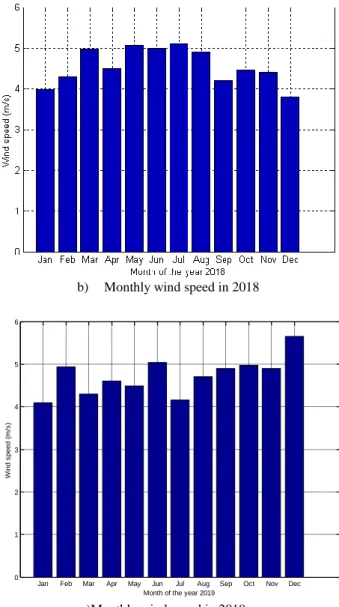
over a recorded 30-minute range; the location of the observations is shown in Figure 1.The monthly wind-speed characteristics of Medan are shown in Figure 2. We analyzed the average wind-speed data of three years, starting from 2017 until 2019. The wind-speed characteristics of those three years were of the same type as shown in Figure 3. The set of data obtained from these observations of average monthly wind speed, as well as short-term wind-speed measurements, were obtained from Sampali station and are available online.
Figure 1. Location of wind speed observation in Medan city
a) Monthly wind speed in 2017
b) Monthly wind speed in 2018
c)Monthly wind speed in 2019
Figure 2. Characteristics of wind speed in Medan city
IV. M
ETHODOLOGYA. Wind-Speed Distribution
The city of Medan is located in the equatorial region. It has a hot summer with temperatures around 23–33°C and humidity around 63%–82%, as shown in Figure 3. Medan makes up 26,510 hectares (265.10 km²), or 3.6%, of the total area of North Sumatra. Thus, compared to other cities/districts, Medan has a relatively small area with a relatively large population. Geographically, Medan is located at 3°30'-3°43” N latitude and 98°35'-98°44” E longitude. For this reason, the topography of Medan City tends to slope to the north at an altitude of 2.5–37.5 meters above sea level. It has a tropical rainforest climate with an indistinct dry season [33]. The city has wetter and drier months, with the driest (February) experiencing an average of about one-third as much precipitation as seen in the wettest month (October). The temperature in Medan averages around 27°C throughout the year. Wind speeds
Jan Feb Mar Apr May Jun Jul Aug Sep Oct Nov Dec
0 1 2 3 4 5 6 W in d s p e e d ( m /s )
are generally below 8 m/s for most of the year. Strong winds with an average speed exceeding 10 m/s overland occur due to weather systems, such as active surface troughs or storm lines.
Figure 3. Average weather in Medan city B. Probability Distribution
The probability distribution describes a set of variants as a replacement frequency. The cumulative probability is the probability of a random variable being equal to or less than a certain value. The probability density function (PDF) is the probability value of each event, while the cumulative density function (CDF) adds up the probability value to a certain event. The probability of occurrence of wind speed (v), parameters k, and c is fully positive. The form factor is the wide distribution of wind speed identification and determines the peak wind distribution in each region [35]. The scale factor is the identification of the abscissa scale of the wind distribution and the condition of most of the wind potentials in a location [20]. The identification of the distribution is more suitable using the Weibull three-parameter distribution (W3) when compared to W2 [36]. Wind speed can be modeled with the Weibull distribution and truncated normal distribution [37]. Using the distribution of W2, W3, generalized gamma, and Burr 4 parameters to describe the wind speed profile in Antakya, Turkey [38].
The determination of the PDF and CDF values is given as follows:
PDF Weibull distribution is k k x x k x f
exp ) ( 1 (1) PDF Normal Distribution is 2 2 2 ) ( exp 2 1 ) (
x x f (2) PDF log-normal distribution is
2 ) (log exp 2 1 ) ( 2 x x x f (3)Statistically based method of calculating multiple parameters from any data distribution, assuming that the parameter value giving the maximum value of the possible function is the most likely value. According to this method, the c and k parameters are calculated with the total data points indicated by N [39], [40].
1 1 1 1 1 ln ln
N v v v v k N i i N i k N i i k i (4) k N i k iv
N
c
1 11
(5)Wind speed data expressed by the MLM in the form of scale and shape parameters [24], [39], [41].
1 1 1 1 1 ) 0 ( ) ( ln ) ( ) ( ln
v f v f v v f v v f v v k N i i i N i i k N i i i k i (6) k i N i k i i f v f c 1 1 1
(7) C. Determination Coefficient (R2)The coefficient of determination (R2) is the ratio of the Regression Sum of Squares (SSR) to the Total Sum of Squares (SST), which gives little about regression variation. The SSR ratio to SST measures the proportion of the variable in Y, which is explained by the independent variable X in the regression model. The coefficient of determination (R2) is stated by:
SST SSR R2 (8) where:
n iy
iy
SSR
1 2
n i yi y SST 1 2
i
y is estimated by the regression line i
y
is the value in a sample
y is the mean value of a sample
V. R
ESULTS ANDD
ISCUSSIONFor the distribution test model in Figures 4, 5, and 6 for each model, the better fit for the three distribution test models is normal, log normal,
and Weibull distribution. The possible
comparison distribution method with the
correlation coefficient (R2) is shown in Figures 7, 8, 9, and10, respectively, for the normal distribution, lognormal distribution, Weibull 2 parameters, and Weibull 3 parameters.
Monthly wind speed data Figure 4. Normal distribution
Monthly wind speed data Figure 5. Lognormal distribution
Monthly wind speed data Figure 6. Weibull distribution
Based on the results of the wind speed distribution test given in Figures 4, 5, and 6 with the three distribution models for 2017–2019, it gives the same model, which tends to the right, to fit the expected distribution test model. The probability density function (PDF) for the four proposed models is shown in Figure 7 for normal distribution, Figure 8 for lognormal distribution, Figure 9 for Weibull distribution two parameters, and Figure 10 for Weibull distribution three parameters.
Wind speed (m/s) Figure 7. Normal distribution
Wind speed (m/s) Figure 8. Lognormal distribution
Wind speed (m/s) Figure 9. Weibull 2 parameters
Wind speed (m/s) Figure 10. Weibull 3 parameters
Based on the results of the distribution comparison with correlation coefficient (R2) test shown in Figures 7, 8, 9, and 10, each Normal distribution model, Lognormal, Weibull two parameters, and Weibull three parameters for 2017–2019 provide correlation coefficient values, as shown in Table 1 for each of the proposed models. The test results of four models, namely
Weibull two parameters, Weibull three
parameters, Normal, and Lognormal distribution, are shown in Table 1.
Table 1.
The test results of Weibull two parameters, Weibull three parameters, Normal, and Lognormal distribution No Distribution function
b
t
0T
x s Median 2R
1. Weibull 2-parameter 2.633 - 11.92504 - - - 0.8530 Weibull 3-parameter 0.99 5.232537 10.74797 - - - 0.9981 2. Normal - - - 10.579±1.505 5.1936 - 0.8790 3. Lognormal - - - - 1.5561 9.6572±0.056 0.9580In addition to evaluating the wind speed distribution test, the results of the monthly goodness-of-fit test using Kolmogorov-Smirnov (K-S) for three years were also given, as shown in Table 2.
Table 2.
The test statistic of data for 2017-2019
Monthly 2017 2018 2019 K-S K-S K-S January 0.957 0.957 0.650 February 0.697 0.760 0.587 Mart 0.616 0.591 1.065 April 0.966 1.101 0.942 May 0.542 0.640 0.718 Juni 0.919 0.884 0.668 July 0.950 0.921 0.772 August 0.831 0.860 1.151 September 0.581 0.612 0.693 October 0.757 0.887 0.720 November 0.755 0.878 0.622 December 0.832 0.851 0.878
Based on the test results in Table 2, the K-S test for each month and year shows a value greater than 0.05 (95%), which provides that the research data were normally distributed and deserves to be done as the data of this study.
VI. C
ONCLUSIONThe results of the analysis that have been carried out with the four distribution models proposed using the correlation coefficient (R2). In general, the four models provide the expected results. However, the best results are obtained
with the 3-parameter Weibull distribution model, which is then followed by lognormal, normal distribution, and Weibull 2 parameters. This is shown by the magnitude of the correlation coefficient, which is close to one (1) the best.
A
CKNOWLEDGMENTThe author would like to thank the Chief Editor for providing the opportunity to fill in this journal. The author also hopes that this manuscript can is accepted and published.