Pressure Effect on the Martensitic
Transformation and Magnetic Properties of
Mn_{2−x}Ni_{1+x}Ga
著者
MITSUI Yoshifuru, YOSHIMINE Yuki, Y. UMETSU
Rie, MATSUBAYASHI Kazuyuki, UWATOKO Yoshiya,
HIROI Masahiko, KOYAMA Keiichi
journal or
publication title
鹿児島大学理学部紀要=Reports of the Faculty of
Science, Kagoshima University
volume
48
page range
35-39
Pressure Effect on the Martensitic
Transformation and Magnetic Properties of
Mn_{2−x}Ni_{1+x}Ga
著者
MITSUI Yoshifuru, YOSHIMINE Yuki, Y. UMETSU
Rie, MATSUBAYASHI Kazuyuki, UWATOKO Yoshiya,
HIROI Masahiko, KOYAMA Keiichi
journal or
publication title
鹿児島大学理学部紀要=Reports of the Faculty of
Science, Kagoshima University
volume
48
page range
35-39
Rep. Fac. Sci., Kagoshima Univ., No. 48, pp. 35–39 (2015)
Pressure Effect on the Martensitic Transformation and Magnetic Properties of
Mn
2−xNi
1+xGa
Yoshifuru MITSUI1, Yuki YOSHIMINE1, Rie. Y. UMETSU2, Kazuyuki MATSUBAYASHI3, Yoshiya UWATOKO3,
Masahiko HIROI1, and Keiichi KOYAMA1
Abstract
The pressure effect on the magnetic properties of Mn-rich Heusler alloy Mn2−xNi1+xGa (x = 0.4 and 0.8) were investigated
in high pressures up to 1.0 GPa. The Ni concentration x dependence of the lattice parameter monotonically decreased, which were good agreement with Vegard’s law. Martensitic transformation temperatures for x = 0.4 and 0.8 slightly increased by 8 K and 9 K with applying pressures of 1.0 GPa, respectively. This behavior is explained by the difference of the cell volume between the martensitic phase and parent phase.
Keyword: Heusler alloy, High pressure, ferromagnetic shape memory alloy
1. Introduction
Ni-based Heusler alloy Ni2MnGa is known to be a ferromagnetic shape memory alloy [1–2]. Focusing on large
magnetic-field-induced strain, the actuators using thin films were proposed [3–4]. The martensitic transformation temperature TM of Ni2MnGa is reported to be ~ 200 K, and Curie temperature of parent phase was 380 K [1]. It has
been reported that the martensitic transformation temperatures and magnetic properties were widely controlled by substitution or off-stoichiometric compositions [5–9]. It is explained that the martensitic transformation temperature is influenced by the number of valence electrons per atom (e/a) [10].
On the other hand, one of the Mn-based Heusler alloy Mn2NiGa has a Curie temperature TC > 500 K and exhibits
the martensitic transformation temperature ~ 275 K [11], which is higher than Ni2MnGa. The crystal structure of
Mn2NiGa is determined to be the modified L21−type structure by the neutron diffraction [11]. Recent research for
Mn2+xNiGa1−x indicated that the magnetization decreased with increasing Mn composition [12].
The pressure is also known to be effective for the magnetic properties and martensitic transformation of Heusler alloys [13]. For example, martensitic temperature and Curie temperature of Ni-Mn-Ga alloy in stoichiometric composition and Ni-rich compositions decreased with an application of pressure [13,14]. Recently, the pressure-induced enhancement for the magneto-caloric effects was reported for Mn-rich composition Ni1.9Mn1.3Ga0.8 [15].
In this study, magnetic properties and martensitic transformation of Mn2−xNi1+xGa (0.2 < x < 0.8) were investigated.
The pressure effects on martensitic transformation temperature for x = 0.4 and 0.8 were investigated by the magnetization measurements in high pressure up to 1 GPa.
2. Experimental procedure
Mn2−xNi1+xGa (x = 0, 0.2, 0.4, 0.6, 0.8, 1.0) alloys were prepared by arc-melting for pure elements of Mn (3N), Ni
(4N), and Ga (4N) in argon atmosphere. The ingot was turned over and re-melted several times for homogeneity. The obtained ingots were annealed at 1098 K for 72 hours in vacuum quartz tube.
The crystal structures were evaluated by powder X-ray diffraction measurements. For removing the strain in pulverized sample, the heat treatments were performed at 1098 K for 1 min, and then quenched.
Magnetic properties were obtained by the superconducting quantum interference device (SQUID) magnetometer. A
1 Graduate School of Science and Engineering, Kagoshima University, 890-0065, Kagoshima, Kagoshima, Japan 2 Institute for Materials Research, Tohoku University, 980-8577, Sendai, Miyagi, Japan
3 Institute for Solid-State Physics, University of Tokyo, 277-8581, Kashiwa, Chiba, Japan Corresponding author: Yoshifuru Mitsui: [email protected]
36 Yoshifuru Mitsui, Yuki Yoshimine, Rie. Y. Umetsu, Kazuyuki Matsubayashi, Yoshiya Uwatoko, Masahiko Hiroi, and Keiichi Koyama hydrostatic pressure was applied by using the pressure cell for SQUID magnetometer. The magnetization measurements were performed in temperature ranging from 10 to 380 K and in magnetic fields up to 5 T. The hydrostatic pressure was applied for the sample from the ambient pressure to 1.0 GPa.
In order to evaluate the Curie temperature, thermomagnetization curves above room temperature were obtained by using vibrating sample magnetometer (VSM). The measurements were performed for 300 ≤ T ≤ 620 K at 0.1 T. The Curie temperature was determined by the dip of the dM/dT in the function of T.
3. Experimental Results and Discussions
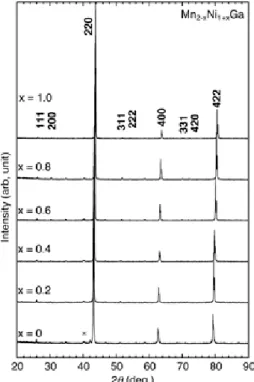
Figure 1 shows X-ray diffraction patterns for Mn2−xNi1+xGa. The diffraction peaks for all samples were indexed by
the cubic structure. Although the quite small diffraction peak derived to the impurities were observed for x = 0, all diffraction peaks were indexed by L21 structure. Fig.2 shows the substitution amount dependence of lattice parameter
a. Lattice constant monotonically decreases with an increase of x. The lattice constant for Mn2NiGa and Ni2MnGa at
room temperature were determined to be 5.91 Å and 5.83 Å, which is consistent with reported values [11,16,17]. It is
Figure 1. X-ray diffraction patterns for Mn2−xNi1+xGa. hkl denotes the Miller indeces. The cross denotes the diffraction peaks of
impurities.
Pressure Effect on the Martensitic Transformation and Magnetic Properties of Mn2−xNi1+xGa 37
found that the lattice parameter of Mn2−xNi1+xGa is good agreement with Vegard’s law.
Figure 3 gives the M-H curves for the samples at 10 K in the ambient pressure. With increasing x, the magnetization decreased. According to the first principle calculation for Mn-doped Ni2MnGa by Enkovaara, the decrease of magnetization
was explained by antiferromagnetic coupling of the magnetic moments between neighboring Mn atoms [18]. Figure 4 shows the typical thermomagnetization curves for the alloys for 10 ≤ T ≤ 380 K for x = 0.4 and 0.8 (a) and 300 ≤ T ≤ 650 K for 0 ≤ x ≤ 1.0 (b) in 0.1 T, using SQUID magnetometer and VSM, respectively. The rapid increase of magnetization due to the martensitic transformation was observed. The thermal hysteresis of the martensitic transformation was decreased with increasing x. As shown in Fig.4 (b), Curie temperature decreased with increasing
x. These behaviors were consistent with previous report by Liu et al [17].
Figure 5 shows the martensitic transformation temperatures (a) and Curie temperature (b) in the function of x. The martensitic transformation temperatures, namely, As: reverse transformation starting temperature, Af: reverse transformation
finishing temperature, Ms: martensitic transformation starting temperature, and Mf: martensitic transformation finishing
temperature, were defined by the intersection of the baseline and the rapid change of the magnetization. As and Af was
almost independent of x. Accoding to the phase diagram of Mn2−xNi1+xGa system, the martensitic transformation
temperatures shows parabola-like behavior in the function of x [17]. In this study, the transformation temperature for 0.2 ≤ x ≤ 0.8 was lower than those of x = 0 and x = 1.0. Thus, the behavior of As and Af obtained in this study is predicted
to be parabola-like. On the other hand, Ms and Mf increased with decreasing x, indicating the enhancement of hysteresis.
Curie temperature was decreased from 602 K for x = 0 to 381 K for x = 1.0, which is consistent with the previous report
Figure 3. M-H curve for the samples at 10 K at ambient pressure.
38 Yoshifuru Mitsui, Yuki Yoshimine, Rie. Y. Umetsu, Kazuyuki Matsubayashi, Yoshiya Uwatoko, Masahiko Hiroi, and Keiichi Koyama
[17].
Figure 6 presents the typical thermomagnetization curves for x = 0.4 (a) and x = 0.8 (b) in the ambient pressure and 1.0 GPa in 0.1 T. It is found that transformation temperatures slightly increased with an application of pressure. The average increment of the transformation temperatures were obtained to be 8 K for x = 0.4 and 9 K for x = 0.8. The pressure effect on martensitic transformation temperatures were due to the difference of volumes between martensitic and parent phase. According to the previous report by Brown et al., the volume of martensitic phase for Mn2NiGa is
within 2.6% smaller than that of parent phase. That is, martensitic phase is more stable than parent phase in high pressure, resulting the rise of transformation temperatures.
4. Conclusions
Pressure effect on martensitic transformation temperatures and magnetic properties on Mn2−xNi1+xGa were investigated.
The lattice parameter a in the function of concentration x was good agreement with Vegard’s law. With applying a pressure up to 1.0 GPa, martensitic transformation temperatures increased by 8 K for x = 0.4 and 9 K for x = 0.8. This is due to the smaller volume of martensitic phase than that of parent phase.
Acknowledgement
The magnetization measurements using SQUID magnetometer were performed at Center for Low Temperature Science, IMR, Tohoku University, and at ISSP, University of Tokyo. The magnetization measurements using VSM
Figure 5. Martensitic transformation temperatures (a) and Curie temperature (b) in the function of x.
Pressure Effect on the Martensitic Transformation and Magnetic Properties of Mn2−xNi1+xGa 39
were performed at Cooperative Research and Development Center for Advanced Materials, IMR, Tohoku University.
References:
1) P. J. Webster, K. R. A. Ziebeck, S. L. Town, and M. S. Peak, Philos. Mag. B 49, 295 (1984).
2) K. Ullako, J. H. Huang, C. Kanter, V. V. Kokorin, and R. C. O’Handley, Appl. Phys. Lett. 69, 1966 (1996). 3) M. Kohl, D. Brugger, M. Ohtsuka, and T. Takagi, Sens. Act. A 114, 445 (2004).
4) M. Kohl, B. Krevet, M. Ohtsuka, D. Brugger, and Y. Liu, Mater. Trans. 47, 639 (2006). 5) K. Yamaguchi, S. Ishida, and S. Asano, Mater. Trans., 43, 846 (2002).
6) V. V. Khovaylo, V. D. Buchelnikov, R. Kainuma, V. V. Koledov, M. Ohtsuka, V. G. Shavrov, T. Takagi, S. Taskaev, and A. N. Vasiliev, Phys. Rev. B, 72, 224408 (2005).
7) V. Sokolovskiy, V. Buchelnikov, K. Skokov, O. Gutfleisch, D. Karpenkov, Yu Koshkid’ko, H. Miki, I. Dubenko, N. Ali, S. Stadler, and V. Khovaylo, J. Appl. Phys. 114, 183913 (2013).
8) R. Y. Umetsu, H. Ando, S. Yamashita, K. Endo, H. Nishihara, R. Kainuma T. Kanomata, and K. R. A. Ziebeck, J. Alloy. Compd., 579, 521 (2013).
9) T. Kanomata, K. Endo, N. Kudo, R. Y. Umetsu, H. Nishihara, M. Kataoka, M. Nagasako, R. Kainuma, and Kurt R. A. Ziebeck, Metals 3, 114 (2013).
10) V. A. Chernenko, Scr. Mater. 40, 523 (1999).
11) P. J. Brown, T. Kanomata, K. Neumann, K. U. Neumann, B. Ouladdiaf, A. Sheikh, and K. R. A. Ziebeck, J. Phys.: Condens. Matter, 22, 506001 (2010).
12) J. Zhang, W. Cai, Z. Y. Gao, and J. H. Sui, Scr. Mater. 58, 798 (2008).
13) T. Kanomata, S. Kyuji, O. Nashima, F. Ono, T. Kaneko, and S. Endo, J. Alloy. Compd., 518, 19 (2012).
14) J. Karamad, F. Albertini, Z. Arnold, F. Casoli, L. Pareti, and A. Paoluzi, J. Magn. Magn. Mater., 290–291, 669 (2005).
15) F. Albertini, J. Karamad, Z. Arnold, L. Pareti, E. Villa, and L. Righi, J. Magn. Magn. Mater., 316, 364 (2007). 16) P. J. Brown, J. Crandle, T. Kanomata, M. Matsumoto, K-U. Neumann, B. Ouladdiaf, and K. R. A. Ziebeck, J.
Phys.: Condens. Matt., 14, 10159 (2002).
17) G. D. Liu, J. L. Chen, Z. H. Liu, X. F. Dai, G. H. Wu, B. Zhang, and X. X. Zhang, Appl. Phys. Lett., 87, 262504 (2005).