BENTHIC FAUNA IN THE NAGURA LAGOON AND
VICINITY, ISHIGAKI ISLAND, OKINAWA PREFECTURE,
JAPAN
著者
HIRATA Kunio
journal or
publication title
鹿児島大学理学部紀要. 地学・生物学
volume
24
page range
121-173
別言語のタイトル
沖縄県石垣島名蔵ラグーン内外の底生動物相
URL
http://hdl.handle.net/10232/5995
VICINITY, ISHIGAKI ISLAND, OKINAWA PREFECTURE,
JAPAN
著者
HIRATA Kunio
journal or
publication title
鹿児島大学理学部紀要. 地学・生物学
volume
24
page range
121-173
別言語のタイトル
沖縄県石垣島名蔵ラグーン内外の底生動物相
URL
http://hdl.handle.net/10232/00009988
鹿児島大学理学部紀要(地学・生物学)
No. 24, p. 12ト173, 1991.
BENTHIC FAUNA IN THE NAGURA LAGOON AND VICINITY,
ISHIGAKI ISLAND, OKINAWA PREFECTURE, JAPAN
Kunio Hirata
(Received September 10, 1991)
CONTENTS
ABSTRACT INTRODUCTION
TOPOGRAPHY OF THE RESEARCH AREA
MATERIALS AND METHODS
RESULTS
The Lagoon Tideland The Open Sea Tideland Sea-Grass Zone
DISCUSSION AND CONCLUSION
SUMMARY
REFERENCESFig. 1 LocationMap
Fig. 2 SamplingStations TABLES PLATES i -I < N l < N I < N l ( X i < N i < x i o a l - 1 1 I 1 1 T - I ( M f M t S r H ^ l ^ C O N O O r H (M co co ^ ^ ^ ^ ^ ^ ^ t -I t -I t -I t -I t -I t -I t -I t -I t -I t -I ABSTRACTBenthic fauna and their distribution in the Nagura River Estury and Vicinity were studied. One hundred and twenty five species of molluscs and thirty three species of Crustacea were collected , of which several species of bivalves, Geroina coaxans , Gafrarium tumida , Katelysia hiantina , Mactra maculata and others , and two species of Crustacea, Metapenaeus monoceros and Scilla serrata, were recommended as candidates of artificial breeding.
About the problem of Water-Land Interactive Systems, the influence of the Nagura River
and waste water from the Sugar Factory was discussed, and concluded that red soil from the pineapple farm along the Nagura River gave destructive effect on the benthic fauna, and waste water from the Sugar Factory, Ishigaki-Seitoh, gave nutritious bases to the proliferation of benthic fauna of the lagoon and vicinity, in contrast to the starch-factory of Kagoshima Prefecture, which gives severe destructive effect to the benthic animal of the river.
INTRODUCTION
In 1980, a comprehensive research project on the problem of Water-Land Interactive Systems was planned by the United Nations University. Professor lwakiri's team in Kagoshima University selected the Nagura Estuary and vicinity, Ishigaki Island, Okinawa Prefecture, as its research territory (Fig. 1). The purpose of the research was the scientific analysis of the following three subjects: 1. The Natural Environment of the Coastal Zone. 2. The Bio-ecological Features of the Coastal Zone. 3. The Socio-economic Aspects of the Use of Local Resources.
The purpose of the present study is to report on the molluscan and crustacean fauna, their distribution in the area, and to offer some basic data to the use of local resources.
TOPOGRAPHY OF THE RESEARCH AREA (Fig. 2)
Atthe mouth of the Nagura River, there is a lagoon which is divided from the open sea by a long sand bar. The sand bar is planted with Casuarina equisetifolia (Mokurnaoh) to prevent erosion. Along the east and south beach line of the lagoon, there is a mangrove swamp (Fig. 2). The lagoon is 1500 meters long and 500 meters wide. It is very shallow, and more than half of the lagoon floor becomes exposed at low tide. The open sea tideland is about 400 meters wide, extends about 700 meters northwest from the Nagura-Oh-hashi (Bridge) , and is 55 hectares in area. Outside this tideland, there is a wide sea-grass zone of shallow water, some 250-400 meters wide. The first research area of the present study was the langoon tideland, the second, the open sea tideland, and the third, the sea-grass zone.
MATERIALS AND METHODS
Two sampling methods the quadrat and the free were applied to collect molluscs and crustaceas. The size of each quadrat was 50 cm square. Soil was dug with a common shovel to a depth less than the length of the shovel blade. A handmade sieve of 4 mm mesh was used to separate the orgamisms from sediment. In the quadrat method, only living organisms were collected, while in the free method, both living and dead were gathered, most of them being picked up while walking around each station or from station to station, except in a few cases where living bivalves were dug out.
RESULTS
The results are described according to the sampling areas, i.e. the lagoon tidelands, the open sea tideland, and the sea-grass zone. Refer to Figure 2 for sampling site locations.
The Lagoon Tidelands (Tables 1 & 2)
Station U and Transect A
i ) Quadrat Sampling
St. U: At the northwestern corner of the tideland along the right bank of the Nagura River, just
inside the Nagura-oh-hashi , there is a patch of grass area, where Zoysia macrostachya (Oni-shiba)
grows. In front of this grass area, there is an Uca lactea zone, where a quadrat sampling was made.
This U. lactea zone extends for 350 meters along the right bank to St. B (Fig. 2).
BENTHIC FAUNA IN THE NAGURA LAGOON AND VICINITY, ISHIGAKI ISLAND 123
St. U: Uca lactea zone. Mollusca
PI. Fig. Individuals
Cerithidea rhizophorarum morchii Batillaria multiformis
Crustacea
Uca lactea lactea
Macrophthalmus convexus Scopimera globasa Mictyris longicarpus 23 26 < N I
1. Transect A: This was located at the most open part of the same tideland with St. U. Four stations were set along the transect (Fig. 2).
St. A-l was located five meters from the right bank, which was covered with waterside vegetation, Hibiscus tiliaefolium (Oh-hamabo) , Hernandra peltata (Hasunoha-giri) , Pongamia pinnata (Kuroyona) , Scaevola frutescens var. sericea (Kusa-tobera) , Pandanus boninensis (Adan) , and others. Near the station , small groups of young Rhizophora mucronata (Ohba-hirugi) were found growing, on the stem of which several Balanus albicostatus (Shirosuji-fujitsubo) , Cerithidea rhizophorarum morchii (itokake-henatari) (PI. Fig. 1) were found attached or climbing up (PI. Fig. 1, 2). The surface layer of the station was composed of sand and mud. However, the amount of mud was not great, the surface soil being light yellowish brown in color. A lot of coral gravel was contained in the layer deeper than 10 centimeters.
Concerning the shellfish populations at this station , Batillaria multiformis was dominant, being 40 in number. Of the crabs , Mictyris longicarpus (Minami-kometsuki-gani) was dominant in number , but Uca lactea (Hakusen-shiomanegi) is larger than the former, and these two species may be equivalent in biomass. This station was on the Uca zone extending from St. U to. St. B.
St. A-l: Scientific Name Mollusca
Theliostyla squamulata Littoraria scabra
Cerithidea rhizophorarum morchii Batillaria multiformis
Clypeomorus sp. Otopleura auriscati Pillucina pisidium Crustacea
Uca lactea lactea Scopimera globosa Mictyris longicarpus PI. Fig. Individuals ^ H 00 IN H N l 1 3 一 一 2 < N l ^ H ^ f O ^ H < 」 > 1 4 8 2 9 1
St. A-2 was located 25 meters from the right bank, in the midst of a small stream of shallow
●
water, less than a few centimeters in depth. The surface was sandy, and many small pebbles of quartzite were scattered about. Two rocks of quartzite were standing near this station, one was 1.5 m high and the other 1 m.
Of the gastropods, Clypeomorus sp. (Kanimorigai sp) (PI. Fig. 7) was dominant, Sermyla riqueti (Nejihida-kawanina) (PI... Fig. 6, insert) was second in number and Theliostyla squamulata (Maru-amaobune) third. But, Sermyla were so small that, in terms of weight, the Theliostyla were decisively second. No Crustacea was collected.
St. A-2: Scientific Name Mollusca Lunella coronata Theliostyla squamulata Clithon sowerbianus Sermyla riqueti Batillaria multiformis Clypeomorus sp. Plicarcularia bellula Psammotaea elongata Crustacea None PI. Fig. Individuals 一 I ^ > 0 0 t > I r ^ L O r -H ^ H O O ^ O L O i -I C 0 2
St. A-3 was located 100 meters from the right bank of the river and in the highest part of the tideland. The dominant species was Batillaria multiformis (pi. Fig. 8). Seven specimens ofPillucina (umenohanagai) (PI. Fig. 12) were collected. Of the crabs, one Scopimera globosa and one Mictyris
longicarpus were collected.
St. A-3: Scientific Name Mollusca Batillaria multiformis Clypeomorus sp. Pillucina pisidium Crustacea Scopimera globosa Mictyris longicarpus PI. Fig. Individuals 8 7 2 日H 6 1 7 9 ‖リ E:
St. A-4 was located at the tideland edge, 195 meters from the right bank, just along the main flow of the river. The tideland surface was light yellowish-brown in color. The surface layer, about 5 cm thick, was sandy and it then became muddy black. Coral gravel was scattered on the surface. Eighty percent of the surface in this quadrat was covered by the mossy red algae Gelidium pusillum
(Hai-tengusa) , and 678 bivalves Musculista senhousia (Hototogisugai) were found crowding amongst the fronds of the algae. This was the only station where this species of bivalve was found. Batillaria
■
BENTHIC FAUNA IN THE NAGURA LAGOON AND VICINITY, ISHIGAKI ISLAND .125
multiformis was second in number and Clypeomorus sp. , third. The crabs collected included only two specimens of Scopimera globosa.
St. A-4: Scientific Name Mollusca Sermyla riqueti Batillaria multiformis Clypeomorus sp. Musculista senhousia Pillucina pisidium Katelystα hiantina Psammotaea elongata Psammotaea minor Crustacea Scopimera globosa PI. Fig. Individuals C D 0 0 I S I < > d O 1 6 一 一 t -H t -H t -I O O C ^ t -H L O ^ 6 3 7 6
ii ) Free Sampling between Station U and Transect A
The muddy area in front of St. U was a good habitat for Laternula rostrata (Hirokuchi-sotohorigai) (PI. Fig. 15) , which bores perpendicularly to a depth of fifteen centimeters into the soil. Six specimens of this species and one of Katelysia hiantina (Yaeyama-sudare) (PI. Fig. 60) were gathered by one person shoveling for twenty minutes.
In a low wet line near St. A-2, covered with thin layer of water, Psammotaea elongata (Masuogai) lived in crowds. Thirty six specimens were collected by one person for twenty minutes. Most free sampling was made by gathering from the tideland surface walking around each stations, so that all the gastropod specimens freely sampled were living, while most of the bivalve, dead, except five species which were dugout from underground. In the following list, L means living and D, dead. Scientific Name Gastropoda: Lunella cormata Ritena undata Theliostyla squamulata Clithon sowerbianus Batillaria multiformis
Cerithidea rhizophorarum morchii Clypeomorus sp. Reishia clavigera Plicarcularia bellula PI. Fig. Individuals I 00 t-I t- I L. 5 L. 3 L. 43 L. 51 N I T ) N < r > ^ H < N I ^ H x + i ( X I ● ● ● ● ● _J _] _) >-J _J
● ) Bivalvia: Modiolus elongatus Gafrarium tumidum Katelystα hiantina Coecella chinensis Psammotaea elongata Psammotaea minor Asaphis dichotの托a Laternula rostrata
2. Transect B
1
Quadrat Sampling along Transect B
8 9 0 -4 5 6 一 一 l 5 1 q ^ hj a ^ l 一 3 5 ● ● D D 8 (XI <NJ CO
Sts. B-l, B-2, B-3, and B-4 were located on the small sandspit at the eastern end of the nghトside tideland. The sandspit is situated near the mouth of the Nagura River to the lagoon. There is a patch of grass area on the top of the sandspit, where Zoysia macrostachya (Oni-shiba) grows. Sts. B-l, B-2 and B-3 were located in frontofthis grass area, and St. B-4was, in backofit. St. B-l was located in the Uca lactea zone which occupies the higher sandy part of the sandspit, and St. B-3 in the Ucavocans zone which occupies the lower muddy part. Sts. B-2 and B-4 were areas where two species of Uca lived together.
Molluscs and crustaceas collected in these four stations were as follows:
St. B-l: Uca lactea zone Mollusca None Crustacea
Uca lactea lactea St. B-2: Uca vocans and lactea zone
Mollusca
Laternula rostrata Crustacea
Uca vocans vocans Uca lactea lactea St. B-3: Uca vocans zone
Mollusca None Crustacea
Uca vocans vocans Macrophthalmus convexus Laomedia astacina St. B-4: Uca vocans and lactea zone
Mollusca
Clithon sowerbianus
Cerithidea rhizophorarum morchii
PI. Fig. Individuals O 23 1 6 1 2 2 1 F : ll 2 7 7 6 1 3 1 2
BENTHIC FAUNA IN THE NAGURA LAGOON AND VICINITY, ISHIGAKI ISLAND 127
Psammotaea minor Laternula rostrata Crustacea
Uca vocans vocans Uca lactea lactea
ii ) Free Sampling around Transect B
The narrow area lower than the Uca vocans zone, which was muddy and covered with a thin layer
of water, was a habitat for a kind of cerith, Clypeの托orus coralium (Koge-tsunobue) (PI. Fig. 5) , where eighty four adults were collected by free sampling by one person for five minutes.In the main flow from the Nagura River, in front of this tideland between St. A and B, many young shrimps ofMetapenaeus monoceros (Yoshi-ebi) * were found in groups , and thirteen individuals
were collected by free sampling by one person for a few minutes.
3. River Beach Stations
Along the Nagura River proper two points were checked, Sts. R-l and R-2.
St. R-l was located on the first small river beach (13 m X 50 m) along the right bank, 450 meters upstream from St. B. Mud deposition was observed in a very restricted area at the downstream end of the beach. Uca lactea was found living in a narrow area, 1 m X 2 m, just upstream of the muddy area. The station was located in the Uca zone. No mud was seen to the depth of the shovel during sampling in this station. No shellfish were observed on the beach.
St. R-2 was located on the second beach (20 m X 73 m) , situated along the left bank, 250 meters upstream from St. B. Half of this beach was covered with green algae, Monostroma nitidum
(Hitoe-gusa) **, growing on the tiny gravel which was found covering the area. Fauna in the quadrat consisted of only three individuals of a tiny crab , Ilyoplaxpusillus (Chigo-gani). No shellfish were observed on the beach.
St. R-l: Uca lactea zone. Mollusca None Crustacea
Uca lactea lactea Ilyoplax pusillus St. R- 2 ¥ Ilypolax pusillus zone.
Mollusca None Crustacea
Ilyoplax pusillus
PI. Fig. Individuals O
Identification thanks to Prof. Dr. T. Saisho, Kagoshima University. Identification thanks to Prof. Emer. Dr. T. Tanaka, Kagoshima University.
4. Transect C
i ) Quadrat Sampling along Transect C
Four stations were located along transect C on the lefトside tideland of the Nagura River (Fig. 2).
St. Ol was located just outside the mangal. The station was not very muddy.
The count of molluscan fauna was poor , only two species being collected , Batillaria multiformis (14 individuals) and Pillitcina pisidium (4) (PI. Fig. 8 & 12)
Two species of Brachyura were collected, Scopimera globosa (l) and Mictyris longicarpus minamトkometsuki一gani) (6).
St. C-2 was located 60 meters away from St. C-l, at the highest part of the tideland. The surface layer, less than 10 cm thick, was sandy and light yellowish-brown in color. The deeper layer was black and muddy. The dominant molluscan species was Batillaria multiformis (31) , and the dominant Crustacean, Scopimera globosa (7).
St. 03 was located 100 meters away from St. 02, along the main flow of the Nagura River.
The surface layer was sandy, and attained a thickness of 10 cm, being the thickest among all the stations in the lagoon. This station was a habitat for Psammotaea minor, as seen in the following list.The only Crustacea collected was Scopimera globosa (4).
St. 04 was located 35 meters away from St. 03, in the branch flow from the south, where the
water was 20 cm deep, and an aquatic phanerogamous plant, Zostera nana (Ko-amamo) , grew. The number of molluscan fauna was the highest in this transect, eight species being collected, of which Clypeomorus sp. (PI. Fig. 7) was dominant, 181 specimens being collected.No Crustacea was collected.
Fauna along transect C St. C-l Scientific Name Mollusca Batillaria multiformis Pillucina pisidiurn Crustacea Scopimera globosa Mictyris longicarpus St. C-2 Mollusca Batillaria multiformis Clypeomorus sp. Pillucina pisidium Coecella chinensis Psammotaea minor Crustacea Scopimera globosa Mictyris longicarpus PI. Fig. Individuals 1 6 00 N (M i l H 一 一 H H (M CD LH 3 7 4
BENTHIC FAUNA IN THE NAGURA LAGOON AND VICINITY, ISHIGAKI ISLAND St. C-3 St. C-4 Mollusca Pillucina pisidium Katelystα hiantina Psammotaea minor Crustacea Scopimera globosa
Mollusca
Sermyla riqueti ● I Batillaria multiformis Clypeomorus sp. Plicarcularia bellula Pillucina pisidium Gafrarium tumida Katelysもα hiantina Psammotaea minor 2 0 -1 6 ^ D 0 0 t - I ( M O 5 O I 1 5 6 3 1 7 5 2 4 M O H W C O ( M H W LO <NI OO <NI l 129Psammotaea minor in St. O3 is a target in shellfish gathering at low tide by the inhabitants, but
it has no market value.
5. Transect D
i ) Quadrat Sampling along Transect D
The line was located across the southern part of the lagoon from the sand bar to the mud flat around the mangal (Fig. 2). This tideland was not as high as at A and C, most of the eastern two-thirds being underwater, crossed by two waste-water flows from the sugar factory, Ishigaki Seitoh, entering the lagoon at the eastern corner of this area (Fig. 2). At the highest part, near St. D-2, Mictyris longicarpus (Minami-kometsuki-gani) zone was observed in good development.
Fauna Along Transect D
St. D-l: Scientific Name Mollusca Clithon sowerbianus Sermyla riqueti Pillucina pisidium Psammotaea minor Crustacea Scopimera globosa PI. Fig. Individuals 6 12 a> t>- c^ co 5 1
St. D-2: Mollusca Theliostyla squamulata Clithon sowerbianus Sermyla riqueti Batillaria zonahs Batillana multiformis Pillucina pisidium Psammotaea minor Crustacea Macrophthalmus convexus St. D-3: Mollusca Clithon sowerbianus Sermyla nqueti Batillaria multiformis Crustacea Macrophthalmus convexus St. D-4: Mollusca Clithon sowerbianus Sermyla nqueti Batillaria multtformis Psammotaea minor Crustacea
Uca vocans vocans Macrophthalmus convexus St. D-5: With 4 mm mesh net.
Mollusca
Sermyla nqueti Geloina coaxans Crustacea
Macrophthalmus convexus St. D-6: With 1.6 mm mesh net.
Mollusca Clithon sowerbianus Sermyla riqueti Geloina coaxans Crustacea None I ¥ I D ¥ C O < S ¥ ¥ 日日 c r > o o < 」 ) 2 一 6 8 -1 6 2 2 26
CO <NI LO ^H H O^ C」>
5 4 < r > w co co ^ 2 1 9 1 1 1645 1 0
BENTHIC FAUNA IN THE NAGURA LAGOON AND VICINITY, ISHIGAKI ISLAND 131
specimens were collected from 50 cm square by sieving with 4 mm mesh net, which was used generally in the present surveys. But, the snail is of small size, the two largest specimens collected
●
measuring 15 × 5.2 mm and 14 × 6.0 mm. And itwas thoughtthat many smaller specimens might have been lostthrough the net. So, an additional samplingwas carried out atSt. D-6 in the same area with St. D-5, using a 1.6 mm mesh net. The result wa・s conspicuous as shown in the above table, fifteen times more specimens being collected.
Sermyla riqueti was found widely distributed all over the surveyed area from the lagoon to the open sea tideland and farther to the sea-grass zone; and its home habitat was ascertained to be the
area around Sts. D-5 and D-6, where 1645 specimens being collected in a quadrat.
The waste water from the sugar factory, Ishigaki Seitoh, flows in front of Sts. D-5 and D-6 (Fig. 1). The flow is about 15 meters wide and 20 centimeters deep at low tide. On the bed of the flow, no Sermyla could be seen. But the snail lived in high population density in the zones about twenty meters wide on both sides of the flow. The density diminished towards the mangal, and no Sermyla could be seen in the mangal.
ii ) Free Sampling in and outside the Mangal near Station D-6
In the Manual: The soil was not so muddy as around Sts. D-5 and D-6; one's foot did not sink. There were soil mounds about 30 cm wide and about 15 cm high (PI. Fig. 18). A kind of crab belonging to Subf. Sesarminae, Sarmatium crassum (Mizote-ashihara-gani) (PI. Fig. 19) , lived in the labyrinth of tunnels under the mound. Nine specimens of the crab and three of the mangal bivalve Geloinacoaxans (Pi. Fig. 13) were gathered by one person for an hour. These two species of animals were the principal inhabitants of the Nagura mangal. The evidence of fauna was very poor.
Specimens collected by one person in an hour are as follows.
In the Mangal near St. D-6 Mollusca Cassidula nucleus Geloina coaxans Crustacea Sesarmops sp. (Young) Sarmatium crassum PI. Fig. Individuals
Along the Margin of the Mangal, in and outside it: A kind of mudskipper , Periophthalmus vulgaris (Minamトtobi-haze) was found. This fish lives in a perpendicular tubular pore, five to ten centimeters wide, with the edge projecting a few centimeters high (PI. Fig. 22). It skips around on the mud flat very actively at low tide.
In addition, in a very wide area in and outside the mangal, a kind of blue crab, Scylla serrata (Nokogiri-gazami) (PI. Fig. 24) was found. This is the largest species amongJapanese blue crabs, attaining 20 cm in carapace width, and is the one most sought after at low tide by the inhabitants because of its high commercial value. But, its population density is very low, only one specimen
●
collected in this area; Baptozius vinosus (Kumadori-ohgi-gani) (PI. Fig. 25) and Cardisoma carnifex (Minami-oka-gani) * (PI. Fig. 27). The former is not used as foodstuff, as its toxicity is suspected, belonging to the family Xanthidae. Of the latter species, one specimen was found by Prof. Dr. H. Tagawa and Mr. E. Suzuki, present team members, in the mangal near the land, and its photograph
(PI. Fig. 27) was available by their courtesy.
Outside the Mangal: There was a Clype抑orus coralium (Koge-tsunobue, PI. Fig. 5) zone a few meters wide, just outside the mangal. This zone was also the main habitat of the mangal bivalve Geloina. The quantity of fauna in this zone was very high. Specimens collected by two person for thirty minutes were as follows:
Outside the Mangal near St. D-6. Mollusca Theliostyla squamulata Clithon sowerbianus Batillaria zonalis βatillaria multiformis Clypeomorus coralium Geloina coaxans Geloina proximo, Psammotaea minor Merisca diaphana Crustacea Macrophthalmus pacificans (L. means living and D., dead)
PI. Fig. Individuals 一 O O L O C O ^ f I < 」 > l 1 1 31 L. 3 L. 42 D. 1 L. 33 7 3 C M t > - r -I t -H H ● ● ● ● ● h J -) _ ) H -3 h J L. 1
A deformed specimen of Cerithidea rhizophorarumrnorchii* * was found near St. D-1 (PI. Fig. 9). The reason for its deformation is not clear.
The Open Sea Tideland
The tideland outside the sand bar is 300-400 meters wide and 55 hectares in area, extending towards the northwest about 700 meters along the outflow of the Nagura River (Fig. 2). On the outer half of the tideland, there grow two species of delicate sea-grasses, Halodule pinifolia (Matsuba-umijigusa) and H. uninervis (Umijigusa). A halodule zone becomes exposed at low tide, whereas the real sea-grass zone which expands in the next outer area does not become exposed even at the springtide. This zone develops well in the Nagura area, including six species of larger types of sea-grasses like Cymodocea serrulata (Ryukyu-amano) , C. rotundata (Beni-amamo) , and others. In addition, there grow many species of algae , including Cladosiphon okamuranus (Okinawa-mozuku) , Acetabularia ryukyuensis (Kasa-nori) and others (T. Katsumata, 1982). Further, there live many species of benthic animals.
Identification thanks to Late Prof. Dr. Tune SAKAI, Tokyo University of Education. Identification thanks to Dr. T. HABE, President of Malacological Society of Japan
BENTHIC FAUNA IN THE NAGURA LAGOON AND VICINITY, ISHIGAKI ISLAND 133
Quadrat and free samplings were made in these areas, in order to determine the fauna and the distribution of Mollusca and Crustacea.
) Quadrat Sampling in the Open Sea Tideland
St. E-l was located 70 meters from the Nagura-oh-hashi. This area was brackish, as was the area inside the bridge. The surface layer, a few centimeters thick, was sandy and light yellowish brown in color, with small coral gravel scattered on it. On the underside of the gravel, Lunella coronata (Kangiku-gai) lived. The deeper layer was black with mud. The dominant species was
Clypeomorus sp. (PI. Fig. 7) , 127 individuals being collected in the quadrat.
St. E-l: Scientific Name Mollusca Lunella coronata Theliostyla squamulata Batillaria multiformis Clypeomorus sp. Pillucina pisidium Katelystα hiantina PI. Fig. Individuals 0 0 I N ( M O 1 6 ^ H H O t > - ^ h < N I l 1 2 i l H
St. E-2 was located 150 meters from St. E-l towards the W.S.W. The sandy surface layer was
a few cm thick and light yellow brown in color. Coral gravel was scattered on the surface. The deeper layer was black with mud. This is the central area for shell-fishing at low tide, the principal catch being two species of bivalves, Katelysia hiantina (Yaeyama-sudare) (PI. Fig. 60) , and Gafrarium tumida (Arasuii-kemangai) (PI. Fig. 59). The area has been dug again and again by many inhabitants, and the sampling was poor, only three young Katelysia being collected in the quadrat, and no Gafrarium.
According to catch number, Pillucina pisidium was the dominant species. But this bivalve is very small, beingless than 8 mm across (PI. Fig. 12) , and itwould be improper to call this species dominant. However, there were no other prolific species in this quadrat.
St. E-2: Scientific Name Mollusca Lunella coronata Theliostyla squamulata Plicarcularia bellula Syrnola sp. Anodontia edentula Pillucina pisidium Fragum loochooanum Montacutona (?) sp. Katelys甘α hiantina PI. Fig. Individuals ー 一 L O O < > C I I 4 5 1 0 0 8 6 L O I O ( M ( M ( M O O C O C V I C O
St. E-3 was located 350 meters from St. E-2 towards the W.S.W. , justoutside the tideland, at
the inner margin of the sea-grass zone. The surface layer was sandy, but the deeper layer, muddy. The dominant species was Tellinella staurella (Hime-nikko-gai) (PI. Fig. 65) , having 21 individuals in the quadrat. The Molluscan fauna was very rich.
St. E-3: Scientific Name Mollusca Liotinaria peroni Euplica versicolor Pinna muricata Anodontia edentula Pitar pellucidum Semele carnicolor Tellinella staurella PI. Fig. Individuals i O i o t > - i 4 5 5 1 2 i -I O i -I C O i -I t > - i -i
St. F-l was located 300 meters from St. E-l towards the N.W. , alongthe river outflow. The
station was situated in the delicate sea-grass Halodule pinifolia (Matsuba-umijigusa) zone, which
was about 100 meters wide. The surface layer a few centimeters thick was compact sand, but the
deeper part was black with mud. Molluscan fauna was scarce, only two species being collected. One
of these two, Anodontia edendula, consisted only of juvenile forms.
St. F-l: Scientific Name Mollusca
Anodontia edentula Tellinella staurella
PI. Fig. Individuals
St. F-2 was located 150 meters from St. F-l towards the W.S.W. , in the Halodule pinifolia
zone. The surface layer was compact, but the deeper layer was black with mud. In this zone, there were some massive eroded coral stumps (PI. Fig. 66) , which were crowded with Chama iostoma
(Kanetsuke-zaru) (PI. Fig. 67) , Clypeomorus bifasciatus (Kasuri-kanimori) (PI. Fig. 68) , and others (PI. Fig. 69-79) about which details will be mentioned later. Nine species were collected in the quadrat, but only in small quantities, and the quadrat had no dominant species.
St. F-2: Scientific Name Mollusca
Lunella coronata
Clypeamorus bifasciatus? Clypeomorus trailli kikaiensis Clypeomorus sp. Euplica versicolor Milda ventricosa PI. Fig. Individuals 68 10 t -I < -f i -H O d < N J H
BENTHIC FAUNA IN THE NAGURA LAGOON AND VICINITY, ISHIGAKI ISLAND Semele carnicolor Loxoglypta transcalpta Tellinella staurella 2 2 2 135
St. F-3 was located 150 meters from St. F-2, towards the W.S.W. , at the inner part of the
sea-grass Cymodocea zone. The station was under water. The bivalve Tellinella staurella (PI. Fig. 65) was dominant, seven specimens being retrieved.
St. F-3: Scientific Name Mollusca Chama iostoma Bonartemis histrio Semele carnicolor Quadrans garadia Tellinella staurella PI. Fig. Individuals 67 52 63 65 T-I 1-I *-I
t>-St. G was located 350 meters from t>-St. F-l towards the N.W., just outside the tip of the
tideland, at the inner margin of the sea-grass zone, the surface layer, a few centimeters thick, was sandy, but the deeper layer was muddy. Quadrans garadia was dominant.
St. G: Scientific Name Mollusca Canarium urceum Euplica versicolor Niotha albescens Quadrans garadia PI. Fig. Individuals 35 63 ^ H ^ ^ H O
-St. H-l was located 400 meters from -St. E-3 towards the south, just outside the tideland, atthe inner margin of the sea-grass zone. The station was under water. The surface layer, a few centimeters thick, was sandy, but the deeper layer, muddy. In number, Euplica versicolor was dominant, 9 specimens havingbeen collected, but this species is so small that it would be improper to call it dominant. The dominant species, therfore, may be said to be either Modiolus plumescens (Ryukyu-hibarigai) (PI. Fig. 47) or Anodontia edentula (PI. Fig. 50). Specimens of the latter species were all young.
St. H-l: Scientific Name Mollusca
Clypeomorus trailli kikaiensis Euplica versicolor Modiolus plumescens Andontia edentula PI. Fig. Individuals 47 50 O i C O t >
-Pillucina striata Fragum loochooanum Tellinella staurella 2 1 1
St. H-2 was located 500 meters from St. H-l towards the S.E., in the delicate sea-grass Halodulepinifolia zone, just in front of the outflow from Nagura-Ko-Bashi. The bed included a lot of coral gravel and its deeper layer was not as black as in the other stations, however it had a strong mud smell. Pillucina pisidium (PI. Fig. 12) was dominant. Though this bivalve is very small, smaller than 8 mm, 69 specimens were collected in the quadrat.
St. H-2: Scientific Name Mollusca Canarium urceum Plicarcularia bellula Pillucina pisidium Fragurn loochooanum Quadrans garadia PI. Fig. Individuals 35 12 63 r -I 1 -I C D O t -6 1
ii ) Free Sampling in the Open Sea Tideland
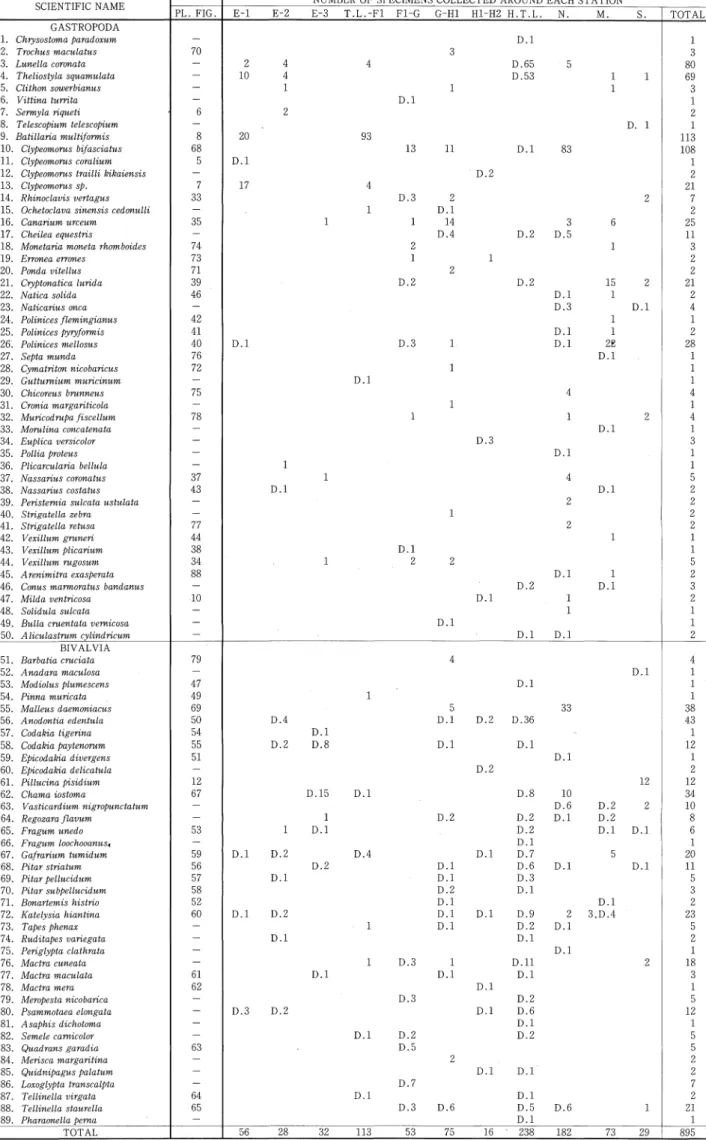
Collect′ed specimens comprise 50 species of gastropods and 39 species of bivalves, which are
listed in Table 4.
Near St. E-l , Theliostyla squamulata , Batillaria multiformis , and Clypeomorus sp. were collected in large numbers, just as in the quadrat sampling at St. E-l. These species like brackish circumstances. Ninety three specimens oi Batillaria multiformis were collected at the tideline near St. E-l.
Six species of moon shells were collected , of which two species , Cryptonatica lurida and Polinices mellosus, were numerous (Table 4). These two species were found in two different habitats, the former near the beach and the latter away from it, but both in the low and wet areas.
The abraded coral masses which are left in the outer part of the tideland were covered with the adhesive bivalve, Charna iostoma, among which Clypeomorus bifasciatus and others were found in large numbers. Seventeen species were collected here, all typical to rocky shores, as shown in the following list (PI. Fig. 66).
Scientific Name Trochus maculatus Lunella coronata Clypeomorus bifasciatus Monetaria maneta rhomboides Erronea errones Panda vitellus PI. Fig. Individuals 00 ^ CO C D t > - ! > - t > -3 5 83 3 2 2
BENTHIC FAUNA IN THE NAGURA LAGOON AND VICINITY, ISHIGAKI ISLAND
Cymatriton nicobaricus Chicoreus brunneus Crania margariticola Muricodrupa fiscellum Peristernia sulcata ustulata
Strigatella zebra Strigatella retusa Milda ventricosa Barbatia cruciata Malleus daemoniacus Chama iostoma 1 8 1 7 N O Oi Oi N l > - ^ H l > - C D < 」 > H (M H ^ (M (M W H ^ OO ^ 3 3 137
Sea-Grass
The sea-grass zone outside the open sea tideland is 250-400 meters in width and 75 hectares in area, of which the northern two-thirds was the research area. Seven species of sea-grasses and 98 species of algae were recorded in this zone by T. Katsumata (1981) , of which two species of the sea-grasses , Cymodocea serrulata (Ryukyu-amamo) and C. rotundata (Beni-amamo) and two species of the algae , Acetabularia ryukyuensis (Kasanori) and Cladosiphon okamuranus (Okinawa-mozuku)
were conspicuous. This zone is always under water, even in the spring tide.
Six stations were checked in this zone, two each in three transects, the northern, the middle, and the southern (Fig. 2). The samplingwas made by sievingten shovelfuls of soil dug up in place of making a quadrat sampling at each station.
i ) Station Sampling in the Sea-Grass Zone
St. SG-1 , in the northern transect, was located 100 meters south ofSt. G and 50 meters from the inner margin of the sea-grass zone. It was 20 centimeters deep. Sixteen species and forty-nine individual molluscs and one species and one individual Crustacea were collected. Tellinella staurella was dominant. The species collected are shown in the following list.
St. SG-1 Scientific Name Gastropoda
Iwakawatrochus urbanus Ethminolia stearnsii Smaragdia rangiana puella Sermyla riqueti
Batillaria multiformis Naticarius onca Euplica versicolor Niotha albescens
Conus marmoratus bandanus
PI. Fig. Individuals 6 8 3
D. 2
D. 1
5 3 1 9 1 1Bivalvia Modiolus plumescens Modiolus elongatus Anodmtia edentula Tapes phenax Semele carnicolor Quadrans garadia Tellinella staurella Brachyura Etisus electro, t^ 00 O I 4 4 5 t 3 5 6 6 87 C O C O C O r: 1
St. SG-2 was located 250 meters from St. SG-1 to the N.W. and 150 meters from the outer
margin of the sea-grass zone. It was 45 centimeters deep. Seven species and nine individual molluscs, and four species and four individual Crustacea were collected. Quadrans garadia and Tellinella staurella were dominant, though only two of each were gathered. The species collected are shown in the following list.
St. SG-2 Scientific Name Gastropoda Ischnocerithium rostratum Naticarius onca Euplica versicolor Dauciconus vitulinus Bivalvia Glycymeris reevei Quadrans garadia Tellinella staurella Macrura Pseudosquilla ciliata Brachyura Menaethius monoceros Thalamita admete Etisus electra PI. Fig. Individuals H P H り 3 5 6 6 1 2 2 日日 目口
St. SG-3 was located 50 meters from St. E-3 to the south and 50 meters from the inner margin of the sea-grass zone. It was 20 centimeters deep. Fifteen species and thirty individual molluscs, and three species and three individual Crustacea were collected. Anodontia edentula was dominant, and Quadrans garadia, subdominant. The species collected are shown in the following list.
BENTHIC FAUNA IN THE NAGURA LAGOON AND VICINITY, ISHIGAKI ISLAND 139
St. SG-3 Scientific Name Gastropoda
Iwakawatrochus urbanus Smaragdia rangiana puella Indomitrella hirundo Euplica versicolor A renimitra exasperata Otopleura auriscati Bivalvia Modiolus elmgatus Pinna muricata Anodontia edentula Codakia paytenorum Glycydonta marica Mactra maculata Meropesta nicobarica Quadrans garadia Tellinella staurella Macrura Upogebia sp. Brachyura Gomeza bicornis Etisus electra PI. Fig. Individuals 8 1 8 1 0 0 O i O L O ^ ^ L O I f i l - 3 5 6 6 6 2 1 2 ● D ● HU r -H L O C s ] i -I t -I t -H ^ H C s J
St. SG-4 was located more than 100 meters from St. SG-3 to the west and less than 100 meters from the outer margin of the sea-grass zone. It was 45 centimeters deep. Six species and 36 individuals of molluscs, and one species and one individual of Crustacea were collected. The fauna was simple, but individual numbers were high. Tellinella staurella was dominant, and Anodontia edentula, subdominant. Euplica versicolor is of small size and quite inconspicuous. The species collected are shown in the following list.
St. SG-4 Scientific Name Gastropoda Canarium urceum Euplica versicolor A liculastrum cylindricum Bivalvia Anodontia edentula Pillucina striata Tellinella staurella Brachyura Etisus electra PI. Fig. Individuals 1 9 1 9 1 5 1
St. SG-5 was located 400 meters from Nagura-ko-hashi to the west and 50 meters from the inner margin of the sea-grass zone. It was 20 centimeters deep. Fifteen species and 121 individual molluscs and two species and two individual crustaceas were collected. Tellinella staurella was dominant, and Anodontia edentula, subdominant. Sermyla riqueti and Euplica versicolor were of small size and inconspicuous, though their individual numbers were high. The species collected are shown in the following list.
St. SG- Scientific Name Gastropoda
Iwakawatrochus urbanus Sermyla riqueti
Clypeomorus trailli kikaiensis Natica solida Naticarius onca Muricodrupa fiscellum Euplica versicolor Nassarius costatus Cylindrobulla sp. Bivalvia Barbatia cruciata Anodontia edentula Pitar pellucidum Semele carnicolor Tellinella staurella Macoma incongrua Brachyura Menaethius monoceros Typhlocarcinops canaliculata PI. Fig. Individuals 2 59
D. 4
1 1 2 5 1 1 日H 9 0 7 7 5 5 5 6 6 1 D 削り 1 ^ H C O r -1 ( X I l > - t -I 1 1St. SG-6 was located 220 meters from St. SG-5 to the west and 100 meters from the outer margin of the sea-grass zone. It was 45 centimeters deep. Ten species and 47 individual molluscs and one species and one individual crustancea were collected. Tellinella staurella was dominant, and no subdominant species was found. The species collected are shown in the following list.
St. SG- Scientific Name Gastropoda Iwakawatrochus urbanus Euplica versicolor Cylindrobulla sp. Acteocina coarctata PI. Fig. Individuals 8 1 1
D. 1
BENTHIC FAUNA IN THE NAGURA LAGOON AND VICINITY, ISHIGAKI ISLAND Bivalvia Modiolus plumescens Modiolus elongatus Anodontia edentula Pillucina striata Semele carnicolor Tellinella staurella Brachyura Etisus electra C- 00 O I 4 4 5 一 5 6 87 c o c o o o 2 141
ii ) Free Sampling in the Sea-Grass Zone
Near St. SG-1 , the followingspecies of molluscs and crustaceas were collected by free sampling.
Scientific Name Gastropoda Naticarius onca Arenimitra exasperata Milda ventricosa Bivalvia Anodontia edentula Vasticardium nigropunctatum Quadrans garadia Tellinella staurella Brachyura Matuta lunaris Thalamita stimpsoni Portunus pelagicus Portunus cf. argentatus PI. Fig. Individuals 1 1 1 50 63 65 81 82 i-I H CO CD l i I t -H i I t 1
DISCUSSION AND CONCLUSION
l. Mollusca: Out of one hundred and twenty five species, only six were principal targets of the inhabitants in shellfish gathering at low tide; in the lagoon four species, Geloina coaxans, Geloina proximo,, Psammotaea elmgata, and Psammotaea minor; and on the open sea tideland two species,
Gafrarium tumida and Katelysia hiantina.
Geloins live in and around the mangal. They were most frequently collected just outside the forest near Sts. D-5 and D-6 (Fig. 2) , together with a kind of cerith Clypeomorus coralium (PI. fig. 5).
Psammotaea elmgata was found in abundance in a low wet line near St. A-2, and Psammotaea
minor in St. 03, a sandy part. These two species may be said to belongto the secondline targets for
Gafrarium (PI. Fig. 59) and Katelysia (PI. Fig. 60) are the most valued species in the Nagura tidelands and most of them live in the open sea tideland, where many inhabitants dig again and again to collect them, so that their population density is not great.
If molluscan culture is planned in this area, three likely candidates are Geloina coaxans, Gafrarium tumida, and Katelysia hiantina. In addition, there are other bivalves which might have value as candidates: Anadara maculosa , Pinna muricata , Vasticardium nigropunctatum , Regozara flavum , Pitar striatum , Tapes phenax , Mactra maculata , Mactra mem , Meropesta nicobarica , Asaphis dichotoma , and Tellinella staurella. Which of these should be selected must be decided by considering
their taste and the degree of difficulty in culturing them.
Tellinella staurella (PI. Fig. 65) is the dominant species in the sea-grass zone outside the open sea tideland. It lives in a very high population density. It may have some relation with its taste that this bivalve is left in such a high population density.
2. Other molluscs which have no value as human foodstuffs are, nevertheless, important as members of the natural food chain in this area, espescially the brackish water mud snail Sermyla riqueti (Nejihida-kawanina) (PI. Fig. 6). This small snail lives most abundantly on the mud flat around the mangal near St. D-6, where 1645 snails were collected in a 50 cm square by sievingwith a 1.6 mm mesh net. This small snail seems to be a kind of mud feeder. It lives all over the area surveyed, as far as the sea-grass zone which seems to be covered with pure sea water at high tide. 3. In front of Sts. D-5 and D-6, there flows the waste water from the sugar factory Ishigaki Seitoh Co. , Ltd. Sermyls lrve on both sides of the flow most abundantly. Their population density diminishes towards the mangal, and they do not live in the mangal itself. Sermyls are not always connected with the mangal, but with the mud.
4. Amongthe molluscs, the large sized clam Geloina (PI. Fig. 13, 14) lives in the mud flat in and around the mangal, and is a valued target of the shell gatherers at low tide. In the Nagura mangal, no such large sized mud-whelks as Telescopium and Terebralia were found, though these are common in tropical mangals, but Clypeomorus coralium (PI. Fig. 5) was thought to be what corresponds to these large sized tropical species. An abraded shell of Telescopium telescopium was collected in the open sea tideland, but no living individual was seen.
5. In the tideland situated near the mouth of the lagoon, alongthe right side of the main flow of the Nagura River, an area which is rather sandy and harder than the Sermyla area, the following molluscs were common: Clypeomorus sp. (PI. Fig. 7) , Batillaria multiformis (PI. Fig. 8) , Clithan sowerbianus , Theliostyla squamulata , Musculista senhousia , Psammotaea elongata , Psammotaea minor , and Laternula rostrata (PI. Fig. 15).
6. Mud was distributed all over the studied area, except in the Nagura River proper. It was abundantly deposited even in the sea-grass zone outside the open sea tideland. Mud was most deeply deposited in the D-5 and D-6 areas of the lagoon (Fig. 2) , atthe eastern corner of which waste water from the sugar factory, Ishigaki Seitoh, flows in.
The waste drain from Ishigaki Seitoh (Fig. 2) is about 70 centimeters wide. The waste water was about 25 centimeters deep, flowing with fairly good speed. It was translucent, slightly turbid, with yellow tints, and sometimes had a sweet odor. After reaching the lagoon, the flow expands its width and reduces its speed.
BENTHIC FAUNA IN THE NAGURA LAGOON AND VICINITY, ISHIGAKI ISLAND 143
The present writer (1975) reported an example of severe pollution by organic waste from starch factories on the rivers around Shibushi Bay, Kagoshima Prefecture, which destroyed the river snail Semisalcospira libertina and other benthic animals5).
The waste water from Ishigaki Seitoh was not so heavily polluted as that from the starch factories. Organic pollution is not always harmful. The existence of a proper amount of organic substances, represented by mud accumulation in this case, is rather necessary to the life of various benthic organisms , helping to account for the fact that there 125 species of shell bearing molluscs and
32 species of crustaceas were collected during the present surveys. The good development of the sea-grass zone outside the open sea tideland seems also to have been due to a proper accumulation of mud. Thus pollution due to the waste water from Ishigaki Seitoh was seen to be mild, and was thought to have had rather positive effects on the flora and fauna of the Nagura Estuary and vicinity. But, it is always necessary to try to avoid heavy pollution.
7. Concerning the River Nagura-gawa, there were two kinds of contamination in the past, the first by the waste matter casted from a pineapple canning factory and the second by the red soil
●
transported from the pineapple farms along the river.
●
The pineapple canning factory was established in 1955 and was in operation till 1972, when the financial support which had been given to the pineapple cultivation by government was stopped.
●
Accordingto the present study, no trace of this kind of contamination was observed, both at Sts. R-1 and R-2 no mud deposition being seen to the depth of shovel blade.
It is necessary for the pineapple farms to scrape off the surface soil every three years in order to keep their productivity, and then considerable amount of soil is transported by rain and this causes terrible damage to the benthic fauna downstream. About this kind of damage due to soil deposition, there are some other reports: Okinawa Prefecture (1978) reported on the destructive effect of red soil outflow on the coastal fishing ground2) , K. Yamazato (1978) made an experimental observation on the effect of red soil on the life of scleractinian corals13) , K. Hirata (1980) reported on two cases where severe damage was given to the coral reefs in Amami-Oshima by red soil deposition ; , and A. Shinagawa et al. (1981) referred to this problem from the pedological standpointll)
No mollusca was found living in two river beaches examined in the Nagura river. And this added one more case where destructive effect of the red soil may suspected against the life of benthic organisms downstream.
8. Crustacea: There is a well developed Uca lactea zone along the right bank of the Nagura Estuary, atthe high level of the tideland for about 350 meters, atthe eastern end of which, where the Nagura River flows into the lagoon, there is a very restricted area of Uca vocans (Fig. 1, B). U. vocans lives in a lower and more deeply muddy zone than U. lactea. The former has red chelates in contrast to the white of the latter (PI. Figs. 21 & 23). In general, this tideland was diagnosed to be healthy.
Eight species of Macrurs and twenty five species of Brachyurs were recorded during the present surveys, of which only two species, Metapenaeus monoceros and Scylla serrata (PI. Fig. 24) , may be thought of as candidates for culture. The blue crab Scylla serrata is the most valued take in the gatheringat low tide in the area. It burrows in the mud flat in and around the mangal and grows to the size of twenty centimeters in carapace width. This is the largest species of the Japanese Portunidae.
Sarmatium crassum (PI. Fig. 19) is a mangal crab smaller than 2.5 centimeters in carapace width, dark violet in color. It has athick body and is nearly cubic. Itis said to be a rare species in Japan and was reported by Tune Sakai in 1973 for the first time as having been found in the Fukid0-gawa, Ishigaki Island and Shirahama, Iriomote Island }, but it is not rare in the Nagura mangal, where it burrows labyrinths underground in the mangrove forest and makes mounds, very large in comparison with its body size. The mound is usually about thirty centimeters across and sometimes attains sixty centimeters (PI. Fig. 18). Nine specimens were collected by one person for an hour in the mangal near St. D-6.
9. Dominant species of Mollusca and Crustacea in all quadrats are shown in Tables 5 & 6.
SUMMARY
l. Molluscan and Crustacean fauna and their distribution in the Nagura River Estuary and vicinity were described. The sampling area was divided into three sub-areas: the lagoon tidelands, the open sea tideland, and the sea-grass zone.
2. Collection of specimens was made by two methods, quadrat samplingand the free; the size of each quadrat was 50 cm square, and the sieve mesh was 4 mm in general, but 1.6 mm in a single quadrat in a Sermyla area.
3. One hundred and twenty five species of molluscs were recorded, of which only six were target species in shell-fish gathering at low tide by the inhabitants: Geloina coaxans , Geloina proximo, , Psammotaea elongata , Psammotaea minor, Gafrarium tumida , and Katelysia hiantina. Three out of six species were recommended as candidates for artificial culture: Geloina coaxans , Gafrarium tumida ,
and Katelystα hiantina.
/
4. Out of 125 species of molluscs, eleven additional species were picked up as candidates.
Which of these should be selected must be decided by comparison of their taste and by the degree of
difficulty they present in culture.5. Thirty three species of Crustacea were recorded, of which two were recommended as candidates for artificial culture, Metapenaeus mmoceros and Scylla serrata.
The blue crab Scylla serrata lives in holes in and around the mangal and is the take with the highest price in this area. But, its population density was not so high, only one small specimen of 62 mm in carapace width being found during the present survey.
7. The dark violet crab Sa仰atium crassum was added to Scylla serrata as a species of mangalI
crab. It lives in labyrinth tunnels under the mound in the mangal. The fauna of benthic animals as a whole was very poor in the mangal.
An Uca zone has developed well alongthe north bank of the lagoon for about 350 meters from the prefectural road to the mouth of the Nagura River. From this fact and also from the rich molluscan fauna observed, this tideland was diagnosed to be very healthy.
9. Outside the open sea tideland, there is a wide sea-grass zone. In the present study, ten stations were checked in this zone , and Tellinella staurella was found to be dominant in eight stations , while Quadrans garadia and Anodotia edentula were each dominant in a single station.
10. About the Nagura River proper, two kinds of pollution were discussed, and it was concluded that no trace of pollution due to a pineapple canning factory, which was under operation
BENTHIC FAUNA IN THE NAGURA LAGOON AND VICINITY, ISHIGAKI ISLAND 145 from 1955 to 1972, was discovered by the present study, no mud deposition having been seen in the Nagura River proper except in a very restricted area, but proof of destructive effect of red soil against benthic organi・sms was discussed to be certain, no living shellfish having been found in two river beaches studied.
11. Mud was distributed all over the studied area, from the lagoon to the seagrass zone, except in the Nagura River proper. Most of it seemed to be derived from the waste water discharged from the sugar factory Ishigaki Seitoh. The pollution due to this waste water was mild and was inferred to have been rather useful in making the fauna rich in this area. But it is always necessary to try to avoid heavy pollution.
∫
REFERENCES
1 ) Chapman, V. J. 1977. Wet Coastal Formations of Indo-Malasia and Papua-New Guinea. Ecosystems of the World Amsterdam, Oxford, New York.
2) Dep. Agriculture, Forestry, and Fishery, Okinawa Pref. 1978. Research on Destructive Effect of Red Soil Outflow on the Coastal Fishing Area, (in Japanese) , Okinawa Pref.
3) Habe, T. 1977. Bivalvia and Scaphopoda. (in Japanese) , Hokuryukan, Tokyo.
4) Higo, S. 1973. A Catalogue of Molluscan Fauna of the Japanese Islands and the Adjacent Area, (in Japanese) , Biol. Soc. Nagasaki Pref.
5 ) Hirata, K. 1976. IH. Molluscs and River Insects. In Ecological Studies on Land and Rivers around Shibushi Bay, Kagoshima Prefecture, pp 4ト76. (in Japanese) , Locality Development Consultant.
6 ) Hirata, K. 1980. Destruction of Coral Reefs by Acanthasterplanet in Amami Marine Parks, Kagoshima Prefecture. (in Japanese) , Nature Conservation Society, Kagoshima Pref.
7) Kuroda, T. 1960. A Catalogue of Molluscan Fauna of the Okinawa Islands, (in Japanese) , University of the Ryukyus.
> ) Muragoshi, M. 1978. Experimental Observation on the Effect of Deposition of Red Soil to the Scleractinean Corals and Reef Clam Tridacna crocea. (in Japanese) , Okinawa Prefectural Fisheries Experimental Station. 9 ) Nishihira, M. 1975. Intertidal zone of Yaeyama. (in Japanese) , Section of Nature Conservation, Okinawa Pref. 10) Sakai, T. 1976. Crabs of Japan and the Adjacent Seas. Kodansha, Tokyo.
ll) Shinagawa, A. , T. C. Katayama and T. Higashi. 1981. Land Development Works and Soil Erosion in Okinawa Prefecture. The Interim Report of the Management of Island Resources in Okinawa Prefecture, Japan. (Edited by S. Iwakiri) , Unpublished.
12) Tagawa, H. 1982. Ecology of Mangroves and Mangals. (1) , (inJapanese) , Aquabiology (Kaiyo to Seibutsu) No. 19.
13) Yamazato, K. 1978. Influence of Suspended Red Soil to the Coral Reefs, (inJapanese) , River Section, Okinawa General Bureau, Okinawa Developmental Agency.
S. KOREA
i::1/I
二 二 「
; 蝣
蝣
JAPANCHm
( Tokyo 弧>¥s ^Kagoshima ● CHINA. sEA NANSEIIS. .8OKINAWA f Naha
Itoman MiyakopAC汀IC OCEAN
レ
′
/
/
工
k
S
i
FunakoshiP.&
/
030 ー
ノ
f
∫
∫
一一
CL r¥r⊥
■
Nagura Bay
J
Na gura R .(
a'
f
rxram a TTiel並
Ish ig
.■
■
■
、
Yaeyam a Fish ,
-】一
▲
▲A■
■
ノ
○
′二
ゝ
0■
/
Iriomote 工¥Hosoza
♂
ql
一
akiP.
v
Ishigaki P.
il Tonoshiro P,
y
/
i 工S.
Coop.
123-40- 123-50- 124* 124-10-Fig. 1. A Location Map of the Study Area (Shaded) (Modified from Yaeyama Fisheries
Cooperative 1982). The Water area inside the line surrounding Yaeyama Islands is the
specified fishing area with the Common Fishery Right grated to the Yaeyama Fisheries Cooperative.BENTHIC FAUNA IN THE NAGURA LAGOON AND VICINITY, ISHIGAKI ISLAND 147
8 j e n b s u i o q c * J
< 「→ ⊂⊃ t、 「■→ 寸 T 1 ▼- 1 ぐつ N N T→ OO CSI H (X I CYつ くエ〉 ⊂⊃ 「 → CY? CO ぐつ CYつ くX ) ▼→ 卜、 N く■D ←→ ⊂) ←→ C¥] i- l ぐつ <N ] CO 寸 ▼→ 卜、 Ln r→ TIl Tl l ぐ′⊃ <N ] (X I CO ○○ の CYつ 寸 丁■→ q つ ぐ′つ の CY, く■D I ⊂⊃ LO -⊂〕 寸 ■ 「 → Ln 寸 く■C 〉 I-→ LO T■→ I-■一一 N ぐ√) ぐ√) ▼■■■→ I.■→ 寸 の く■D CYつ 「 → の 卜、 寸 く■D ▼■■■→ 卜、 I.→ ▼■■■→ 「→ Lrつ ⊂ ) N 「 ■→ ぐ′つ -⊂ 】 丁■→ T 1 く■D N ⊂⊃ ▼■■■→ N -Q ぐ√:> <N 3 LO i- l T一一→ in 寸 「■→ ○○ T→ I の 卜、 N く■D ■ぐ′つ 寸 卜、 寸 卜、 ○○ Q LO 丁■■→ 寸 CY? ⊂> 1■→ N q ⊃ N 「→ Ln N CVつ 「→ 【、 LD N N q ⊃ Ln ⊂> ● U ぐ′つ ● U N I U Ln N ∞ 丁■→ 「 → ▼→ CO CT> N LT > く■D N q ⊃ LJつ ▼■■■→ -U N ● 〔¥ ▼ー→ -ォ 「オ I 0 3 CO . `ヨ N ● ロコ ▼■■■→ -`=q 寸 寸 「■1 †→ N r → ▼■→ ▼→ ^ 寸 T-→ N OO N 「→ Ln 寸 T-→ q ⊃ CYつ Cつ 寸 く■D ▼■■→ ト ト、 ▼■■■→ 一一→ N in N CO 【、 ○○ ⊂⊃ ■「■→ く■D 「■→ ▼一一1 「→ LO ■ < くエ〉 ぐ√⊃ 卜、く■D ○○〔、 CO ● < く■D 「→ の 亡、 「→ 「■→ くX ) N の q ⊃ ⊂> ▼■■■→ N I < ▼■■■→ -i- I LO ▼一一→ 寸 ○○ 寸 ⊂> 「→ ぐ√) N 「→ N N r → 寸 くつ 寸 Tl→ LJつ q ⊃ ○○ の N 卜、 の < Tl→ 寸 「■→ :⊃ LO .CO 寸 ▼→ ▼■■→ N くJ⊃ ▼■→ ● u ト■-→ f cu ● J P → ● 一 一 寸 <」 > rH I ∞ ト 一 コ l 3 3 a > o I I I 巴 式 C O 謁 l - l J < d ←→ ⊂) ← 一
B]
s
<
Z
U
ト
■
■
■
→
u*
ト
→
←
a
〔
ロ
ト
■
→
U
∽
‥
…
▼
Se
ど
Q
S
e
e
弓■
鳶層鼻音昔選書■
■
一
.i
葛篭
<
< s
言●
S
ー
「Q
∼
竃
竜
一
、〕
く
つ
s
岩層喜
●
套8
巨
竜
首
遵
葛
●
草
書
等
亨
音
室
昔
< 竃的
書
手
喜
喜
対
∼
qJe
享
圭
子
rH <N ] CO 寸 Ln W ト ∞ の ヨ コ (X I●C O●寸●Ln●く■ロ●ト-●○○●の●⊂⊃● 「 -→● N ●C Yつ●寸● Ln●く■D●卜-● ▼- H i- I r → T→ ▼一一1 ▼■→ ▼-■→ 「 → N N (x i o a c s i <> a cs i <N i p U B p p T J L U O O 碧 q e j n g e j s j 9 q ; i n s u o p e i S b u q 台 U 8 M X i e S u i j c i u i B s l e j p e n f ) i 8 j q e xBENTHIC FAUNA IN THE NAGURA LAGOON AND VICINITY, ISHIGAKI ISLAND 149
Table 2. Free Sampling in the Nagura Lagoon Tidelands.
SC IE N T IF IC N A M E PL . F IG . T R A N S E C T S
G A ST R O P O D A
3
A B D M A N G A L T O T A L
1 . R itena undata 3 4 7
2 . T heliostyla squam u lata - 9 18 27
3 . C lithon sow erbian us - 46 56 102
4 . D ostia violacea - 1 1
5 . S erm yla riqu eti 6 1 1
6 . C erithidea rhizop horarum m orchii 1 17 1 18
I
7 . B atillaria zα托alts - D ●2 2
B atillari a m u ltiform is 8 3 3
9 . C lypeom orus coraliu m 5 84 237 321
10. C lypeom orus sp. 7 1 ■1
ll. P licarcu laria bellu la
ォ 3 4 7 12. Cassidu la n ucleus 1 1 B IV A L V IA 13. R egozara flavum 53 D ●1 1 14. G eloina coaxan s 13 14 3 17 15. G eloiれa proxim o, 14 2 2
16. G afrari um tum idk m 59 D ●4 4
17. K atelysia hian tin a 60 D .5L .2 7
18. Coecella chinensis - D ●1 1
19. P sam m otaea elong ata - 38 38
20. P sam m otaea m in or - D .3 4 21. A saphis dichotom a I -D ●1 1 22. M erisca diaphana 16 1 1 23. L aternula rostrata 15 6 6 M A C R U R A
24. M etapen aeus m on oceros - 13 13
B R A C H Y U R A
25. Scylla serrata 24 1 1
26. B ap toziu s vinosus 25 1 1
27. M acroph thalm u s paciflean s 31 1 1
28. S esarm ops sp . 32 4 4
29. Cardisom a carnifex 27 1 1
30. S arm atium crassum 19 9 9
G A ST R O P O D A
1. Iw a kaw a trochu s u rbanu s - D .4 17
2 . E th m in nlia stearnsii - D ■2 2
3 . L iotina ria peron i - 1 1
4 . L un M a cnron ata - 4 5 1 10
b. T h eliosty la squ am u la ta - 11 5 16
6 . Sm arag dia ran g ian a p uella ー D .I D .I 2
7 . S erm y la riqu eti 6 5 59 6 4
8 . B a tillaria m u ltiform is 8 10 3 13
9 . Ischn oceri thium rostratu m - D ●1 1
10 . C lypeom oru s bifa scia tu s 68 1 1
ll . C lypeom oru s tra illi kikaien sis - D .4 6
12 . C lypeom oru s sp . 7 1 27 1 29 13 . C a na riu m urceu m 3 5 1 1 1 3 14 . N atica snlida 4 6 1 1 15 . N atica riu s on ca - 1 1 1 3 16 . M uricod ru pa fiscellum 7 8 2 2 17 . In d am itrella hiru n do - D ■1 1 18 . E u plica versicolor - 10 15 6 2
19 . P lirarcu la ria bellu la ー 2 1 3
20 . N assariu s costa tu s 4 3 1 1
21 . N ioth a a lbescen s - 4 1 5
22 . A ren im itra ex asperata 8 8 1 1
23 . D au ciccm u s vitu lin u s 3 6 1 1
24 . C m u s m arm ora tu s ban dan u s - 1 1
25 . M ild a ven tricosa 1 0 1 1
26 . O top leu ra a ゐrisca ti l l 1 .D .2 3
27 . S yrnola ( ? ) sp . 4 5 2 2
28 . A licu las trum cy lind ricu m - 1 1
29 . C y lin d robu lla sp . - l l 2
30 . A cteocin a coa rctata - D ●1 1
B IV A L V IA
31 . B arbatia cru ciata 7 9 1 1
32 . G lycym eri s reevei - 1 1
33 . M odiolu s plu m escens 4 7 3 1 1 5
34 . M odiolu s elon g atu s 4 8 1 1 1 3
35 . P in n a m u ri ca ta 4 9 l l 2
36 . A n ndon tia ed en tu la 5 0 1 2 13 55
37 . C od akia pay ten orum 5 5 2 2
38 . Pillu cin a stri a ta - 2 1 3 6
39 . P illu cin a pisidiu m 1 2 69 8 1
40 . C ha m a iostom a 6 7 1 1
41 . F rag u m loochooanu m - 10 14
42 . M on tacu ton af?) sp. 8 0 2 2
43 . P itar p ellu cid um 5 7 l l 2
44 . B on artem is h istrio 5 2 1 1
4 5 . K a telysia hian tin a 6 0 2 3 5
4 6 . T apes ph en ax - 1 ■1
4 7 . G lycyd m ta m a rica - 1 1
8 . M actra m a cu la ta 6 1 1 1
49 . M erop esta n icobarica - 1 1
50 . Sem ele carnicolor - 7 2 1 1 2 1 14
51 . Q u ad ran s g aradia 6 3 1 7 1 3 2 4 18
52 . Q u idn ipa gu s pa latam - 1 1
53 . L oxog lyp ta tran sca lp ta - 2 2
54 . T ellin ella sta urella 6 5 2 1 13 \ 1 5 17 28 11 1
5 5. M a com a in cong ru a 16 D ●1 1
M A C R U R A
56 . U p og ebia sp. - 1 1
57 . P seu dosquilla ciliata - 1 1
B R A C H Y U R A
58 . M pM a ethiu s m on oceros - 1 1
59 . G om eza bicornis 8 6 1■ 1
60 . T h alam ita ad m ete - 1 1
61 ■\E tisu s electra 8 7 I l l 3 7
62 . Typ h locarcin ops can alicu la ta 8 3 1 1
T O T A L 15 8 31 44 15 14 1 1 1 6 2 4 8 3 50 13 3 3 3 7 122 50 7 01
Table 4. Free Sampling in the Nagura Open Sea Tideland.
S C IE N T IF IC N A M E N U M B E R O F SP E C IM E N S C O L L E C T E D A R O U N D E A C H S T A T IO N
P L . F IG . E - l E - 2 E - 3 T .L .-F 1 F l -G G -H l H :卜H 2 H .T .L . N . M . S . T O T A L G A S T R O P O D A
1 . C hrysostom a p ara doxum - D ■1 1
2 . T rnchu s m acu la tu s 70 3 3
3 . L u nella coron a ta - D .6 5 80
4 . T h eliostyla squam u lata
- 10 D .53 69
5 . C lith on sow erbianu s
- 1 1 1 3
6 . V ittin a tu rri ta
- D ●1 1
7 . S erm y la riqu eti 6 2 2
8 . T elescop ium telescop iu m --- D ● 1 1
9 . B a tilla ri a m u ltif orm is 8 20 9 3 113
10 . C ly peom oru s bifascia tu s 68 13 1 1 D .I 83 108
l l. C lyp eom oru s cora lium 5 D ●1 1
12 . C lyp eom oru s trailli kikaiensis --■■■■-ll■ll ノD ●2 2
13 . C lyp eom oru s sp . 7 17 21
14 . R hinoclavis vertag u s 33 D .3 7
1 5. O ch atoc.lav a sin ensis ced on u lli - D .I 2
16 . C an arium u rceu加 35 14 25
17 . C h eilea equestri s - D .4 D .2 D .5 ll
18 . M cm ata ria m on eta rhom boid es 74 2 1 3
19 . E rrrm ea arron es 73 l l 2
20 . P an da vitellu s 71 2 2
2 1. C ryptm atica lurid a 3 9 D .2 D .2 15 21
、22 . N a tica solid a 4 6 D .I 2
23 . N a ticari u s on ca - D .3 D .I 4
24 . P olin ices flem in gianu s 4 2 1 ■1
2 5. P olin ices py ryform is 4 1 D .I 2
26 . P olin ices m ellosu s 40 D .I D .3 D .I 2 2 28
27 . Septa m u n da 76 D ●1 1
28 . Cym atriton nico ba ricu s 72 1 1
29 . G u ttu rniu m m u ri cinu m - ■ D ●1 1
30 . C hicoreu s bru nn eu s 75 ■4 4
3 1. C rania m arg ariticola - 1 1
32 . M u ricod ru pa fiscellu m 78 1 1 2 4
33 . M oru lin a con ca ten a ta - D ●1 1
34 . E up lica versicolor - D ●3 3
35 . P ollia proteu s - D ●1 1
36 . P lica rcu lari a bellu la - 1 1
37 . N a ssa riu s corona tu s 3 7 1 4 5
38 . N a ssa riu s costatu s 4 3 D .I D .I 2
39 . Pp.ris.tp.m ia su lcata u stu lata - 2 2
40 . S trig a tella zebra - 1 2
4 1. S tri g a tella retu sa 77 2 2
42 . V exillu m grun eri 4 4 1 1
43 . V exillum plicari um 38 D ●1 1
44 . V exillum ru g osu n 34 1 2 2 5
45 . A renim itra exaspera ta 8 8 D .I 2
46 . C anu s m a rm ora tu s ban d anu s - D .2 D .I 3
47 . M ild a ven tricosa ■10 D .I 2
S olidu la su lca ta - 1 1
4 9. R u lla r.ru en ta ta vernicosa ー D ■1 1
5 0. A licu lastru m cylin d ricu m - D .I D .I 2
R TV A T/V TA
5 1. B arba tia cru cia ta 79 4 4
52 . A n a da ra m acu losa - D ●1 1
53 . M odiolu s plu m escen s 4 7 D ●1 1
54 . Pin n a m uricata 4 9 1 1
55 . M a lleu s d aem oniacus 6 9 5 33 38
56 . A n od on tia eden tu la 50 D .4 D .I D .2 D .36 43
5 7. C oda kia tig erin a 54 D ●1 1
58 . C oda kia pay ten oru m 55 D .2 D .S D .I D .I 12
5 9. Ep icoda kia diverg en s 51 D ●1 1
60 . Ep icoda kia delicatu la - D ●2 2
6 1. P illu cin a pisid ium 12 1 2 12
6 2. C h am a iostom a 67 D .15 D .I D .fc 10 34
6 3. V asticardium nig ropu n ctatu m - D .6 D .2 10
6 4 . R eg oza ra flavu n - D .2 D .2 D .I D .2
6 5. F rag um un ed o 53 D .I D .2 D .I D .I 6
6 6. F rag um looch ooan u sA --lll--ll D ●1 1
6 7. G afra ri u m tum idu m 59 D .I D .2 D .4 D .I D .7 20
P ita r stri a tu m 56 D .2 D .I D .6 D .I D .I ll
6 9. P ita r pellu cidu m 57 D .I D .I D .3 5
7 0. P ita r su bpellucid u m 58 D .2 D .I 3
7 1. B m a rtem is histrio 52 D .I D .I 2
7 2. K a tely sia h ian tin a 60 D .I D .2 D .I D .I D .9 3 .D .4 23
7 3. T ap es p hen ax - D .I D .2 D .I 5
74 . R u ditapes varieg ata - D .I D .I 2
7 5. P erig ly pta cla thra ta - D ●1 1
7 6. M a ntra ru n eata - D .3 D .l l 18
7 7. M a ctra m acu lata 61 D .I D .I D .I 3
7 8. M a rtra m era 62 D ●1 1
7 9. M eropesta n icobarica - D .3 D .2 5
0. P sam m otaea elon ga ta - D .3 D .2 D .I D .6 12
8 1. A saph is d ichotom a - D ●1 1
8 2. S em ele carnicolor - D .I D .2 D .2 5
8 3. Q u a dran s sa ra dia 63 D ●5 5
8 4. M eri sca m a rg aritina - 2 2
8 5. Q u id n ip ag u s p ala tu m - D .I D .I 2
L oxog lyp ta tran sca lp ta - D ●7 7
8 7. T ellin ella virg a ta 64 D .I D .I 2
T ellin ella stau rella 65 D .3 D .6 D .5 D .6 21
9. P ha ra on ella perna - D ●1 1
Table 5. Dominant Species of Mollusca and Crustacea in All Quadrats in The Lagoon Tidelands.