Implementation and Evaluation of Front-End Protocol
of Network Game Infrastructure
LATE Abran Kra Florence
†Shinji Kono
☆,††We have proposed a Network Game Infrastructure using Agent system. This system has two kinds of network protocols, front-end protocol and inter-agent protocol. We describe an implementation of the front-end protocol which connects user game machine such as PlaySta-tion 2 or Gameboy advance and an agent in the closet agent in the Internet. The front-end protocol contains Agent Packet, Game List and Object Table.
In order to evaluate the performance of the front-end protocols, the turnaround time be-tween Agent and Playstion 2, the number of transmission of playstation 2 for agent packets, the number of reception of playstation 2 for agent packets should be measured.
1. Introduction
Agent systems are emerging as a potential solu-tion to the problem of constructing flexible network game software such as Network Game Infrastruc-ture. A characteristic of such systems is that whole system behaviour patterns emerge from the com-bination of many details in many agents, in some-times intricate ways. The Network Game Infras-tructure has two kinds of network protocols, Front-End Protocol and Inter-agent Protocol.
This paper introduces a Front-End Proto-col which connnects user game machine such as Playstation 2 or Gameboy advance and an agent in the closet agent in the internet. The Front-End Protocol contains Agent Packet, Game List and Object Table.
In the following section, we first describe the Front-End Protocol, present the Target Applica-tion, describe the outline of PlayStation 2, and present the Simulation results. We conclude in the last section.
† Interdisciplinary Information Engineering, Graduate
School of Engineering and Science, University of the Ryukyus.
☆ 琉球大学工学部情報工学科
Information Engineering, University of the Ryukyus.
†† 科学技術振興事業団さきがけ研究 21(機能と構成)
PRESTO, Japan Science and Technology Corporation.
2. Front-End Protocol
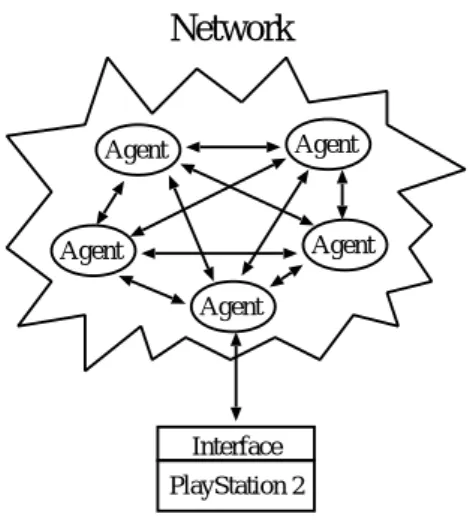
Network
Agent Agent Agent Agent Agent PlayStation 2 Interface図 1 Communication system using Agent
Front-End Protocol is an interface between the Agent system and the game machine. It contains Agent Packet, Game List and Object Table.
2.1 Agent Packet
Agent Packet is for communication in agent sys-tem. It is consists of:
informa-tion of the packet such as
total_size //size of the packet ID //id from the sender
of packet game_id //game ID
These items of information, are used with the basic section of the system such as sending and receiving of the packet and the routing of Net-work Manager.
• Packet Tag attaches semantically in Object Data. It contains:
data_size //size of object object_type //type of object object_id //ID of object
offset //offset value regarding object
command //appointment of processing for this packet
• Object Data is the data of object such as 3D object and texture. Object Data must be the character string of the ASCII cord/code. En-code to the text data and deEn-code routine must be prepared from the binary data. You can set the Agent Packet to the way of the data format which is originally the text format of XML.
2.2 Game List
Game List is used for the information interchange of agent and the game presentation. Below is an ex-ample of Game List from the shooting game: shooting ./game_data/shooting shooting-ver3 dummy1 ./game_data/dummy1 dummy1
dummy2 ./game_data/dummy2 dummy2-debug
2.3 Object Table
Object Table manages the object in agent sys-tem. It contains:
id //object table ID
object_type //type of object which is registered to this table attribute //variable for various
attribute flags
void *object //pointer to actual data of object
3. Target Application
For our research, we chosed shooting game as a model for the implementation and evaluation of this agent system. The game was implemented in
3D space and 2D space. The Torus network was adopted as a network topology. A torus network is a grid network with boundary connections as shown in Fig.2. The boundary connections decrease inter-nodal distances and eliminate edge effects. The regularity of torus networks enables development of simple routing schemes.
o,3 0,o o,1 1,0 1,1 1,2 1,3 2,0 2,1 2,2 2,3 3,0 3,1 3,2 3,3 0,2 図 2 Torus Network
3.1 3D object and 2D image data
2D image data must be the character string of the ASCII cord/code. Encode to the text data and decode routine must be prepared from the binary data.
We use LightWave:3D modeling tool to model the 3D object. The Light Wave file(.lwo) can not be use on Playstation 2, we need to convert this file to the convernient file by using a converting script which was developed at this laboratory. The data of Light Wave format are converted with the Perl script.
3.2 Compilation method of 3D object
Considering the expandability of data represen-tation and the fact that it is utilized with various architecture, The XML format is used to express the 3D object data.
In the following is an example of 3D object which is expressed with XML.
<?xml version="1.0" encoding="EUC"?> <OBJECT-3D name="box_tex">
<surface name="Default" size="36" prim="Triangle"> <coordinate>
1.45000004768372, 1.10000002384186, -1.29999995231628 -1.47500002384186, 1.10000002384186,
-1.29999995231628 -1.47500002384186, -1.10000002384186, -1.29999995231628 <Abbreviation> </coordinate> <normal> -0, 0, 1 -0, 0, 1 -0, 0, 1 <Abbreviation> </normal> <color> 200.0, 200.0, 200.0, 127.0 200.0, 200.0, 200.0, 127.0 200.0, 200.0, 200.0, 127.0 <abbreviation> </color> <texture name="CowMask.tga"> 1, 0 0, 0 0, 1 <Abbreviation> </texture> </surface> </OBJECT-3D>
3D object is formed from polygon, polygon is made from plural apexes. Information of each apex, is the most fundamental information of 3D object. The basic data which is necessary in order to ex-press apex is, coordinate and normal vector, color and texture coordinate.
Information of these apexes is collected to every surface. The various special effects which are ad-ministered to the surface of 3D object are done at this surface unit. Depending, it made even with XML to collect at the surface unit.
3.3 Sketch of the application
Portal Manager does the reception processing of Agent which sends connection request newly. There are two types in connection request.
• From Agent to Agent, participation demand for Agent network
• From the game machine to Agent, the connec-tion demands to Agent in order to begin the game.
In each case, connection is done with the procedure shows below.
( 1 ) Agent: receive a request for certification ( 2 ) Agent: when certification succeed, Agent
gives the game list
( 3 ) Requester: choose the game which it would like to participate from game list, and return the Id to agent.
( 4 ) Rquester: from the Id which is return, agent sends the data of 3D object, the texture and all data necessary for that game to requester. ( 5 ) Requester: after receiving all game data,
game start is declared to agent. reference Fig.3.
Playstation 2 Portal Manager Network Manager Game Manager
Connect Accept Certification Admit(Game List) Game ID Game Data Game Start
PS2’s data & Game ID
Commands
Game Over
Start up Game or Add New Player
Game Start Commands Ack Game Over Ack Close Connection
図 3 Entire flow of Agent system
Portal Manager does the reception processing of Agent, describes the socket and delivres the infor-mation of requester to Network Manager. After that leaves proccessing.
The packet sent from requester is received by Net-work Manager.
Network Manager manages the network topology of each game, does the routing of packet communica-tion.
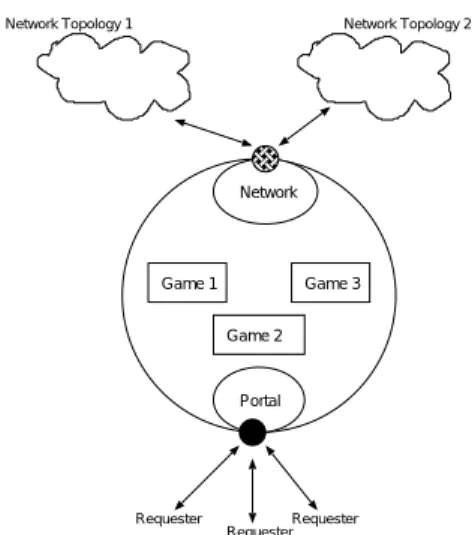
Game Manager is the core of game. It actualizes the game. The physical simulation of 3D object is done in Game Manager. reference Fig. 4.
4. PlayStation 2 System Overview Here we explain the structure of the playstation 2 : the Emotion Engine (EE). We have to look at the Emotion Engine in the context of the overall design of the PS2 because, the PS2 is in a slightly
Portal Network Game 2 Game 1 Game 3 Requester RequesterRequester
Network Topology 1 Network Topology 2
図 4 Entire image of Agent
different situation. The PS2’s designers designed hardware whose main purpose is to run one type of application extremely well: the 3D game. Sure, the PS2 can run web browsers, mail clients, and other types of software, but that’s all secondary. The main thing the PS2 does is 3D gaming, which means generating the kind of immersive sound and vision that places you in a virtual world. Nearly all of the PS2’s hardware is dedicated to providing some specific portion of that audiovisual gaming experience.
Let’s take a look at the main parts of the PS2.
RDRAM Emotion Engine I/O Processor SDRAM Graphics Synthesizer Sound Processor PCMCIA Interface OS ROM DVD IEEE 1394 USB(X2) Controller Digital RGB Analog RGB Digital L/R Analog L/R 図 5 Constitution of PlayStation 2
In the above picture, you can see that there are four main parts to the device. Let’s look at the one at a time. The I/O Processor (IOP) handles all
USB, FireWire, and game controller traffic. When you’re playing a game on the PS2, the IOP takes your controller input and sends it to the Emotion Engine so that the Emotion Engine can update the state of the game world appropriately. The Emo-tion Engine is the heart of the PS2, and the part that really makes it unique. The Emotion Engine handles two primary types of calculations and one secondary type:
• Geometry calculations: transforms, transla-tions, etc.
• Behavior/World simulation: enemy AI, lating the friction between two objects, calcu-lating the height of a wave on a pond, etc. • Misc. functions: program control,
housekeep-ing, etc.
The Emotion Engine’s job is to produce display lists (sequences of rendering commands) to send to the Graphics Synthesizer. The Graphics Synthe-sizer is sort of a souped-up video accelerator. It does all the standard video acceleration functions, and its job is to render the display lists that the EE sends it. Finally, the Sound Processor is the ”soundcard” of the PS2. It lets you do 3D digital sound using AC-3 and DTS.
5. Simulation results
In this section, we first evaluate the performance of the front-end protocols, and then compare it with Linda which is a communication protocol us-ing Centralize Server.
5.1 Evaluation of Front-End Protocol
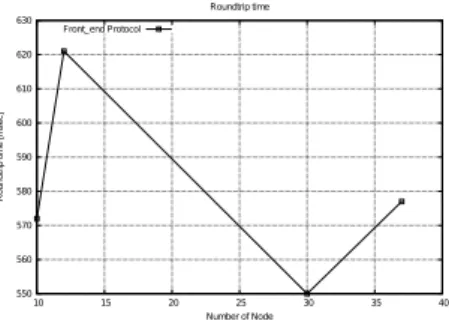
The Agent was simulated with the communica-tion protocol of Agent.
1e+06 1.1e+06 1.2e+06 1.3e+06 1.4e+06 1.5e+06 1.6e+06 1.7e+06 10 15 20 25 30 35 40 throughput [Byte/sec] Number of Node throughput time Front_end Protocol
図 6 Throughput time between PlayStaion 2 and Agent packets
550 560 570 580 590 600 610 620 630 10 15 20 25 30 35 40
Roundtrip time [msec]
Number of Node Roundtrip time Front_end Protocol
図 7 Response time between PlayStation 2 and Agent packets
5.2 Comparison with centralize server
Linda server was used as a general Centralize Server. Linda is the system which communicates due to the fact that each client reads and writes those where ID and Data which are called the tup-ple in the server have become set. The access to the data which is stored in the server is done by appointing ID of the tupple. Figure 8 bellow shows the response time between playstation 2 and Linda server.
By comparing the round-trip time of agent sys-tem with the round-trip time in Linda, we see that the response time from the agent system is defi-nitely slow. 2 4 6 8 10 12 14 16 PS2 0 5 10 15 20 25 30 35 40 45 50 times 0.02 0.04 0.06 0.08 0.1 0.12 0.14 sec
図 8 Round-trip time between Linda PlayStation 2
6. Related works
The techniques for massivelly online game server have been matured from 90’s. There are some commercial scalable and seamless massivelly online game middlewares. Some of them adopt agent sys-tem, but it is limited on separated and subsidiary traffics for voice chatting or multimedia streaming. There are several more recent approches that
apply agent system to massivelly online game. But there still exists probality of catastrophic failures in, and neither of them argues on the network ad-dress translation and restrict wider accesses to a massivelly online game.
7. conclusion
In this paper, we presented a front-end agent pro-tocol for network game. Unlike traditional client-server, our network game infrastructure utilizes high power client machines as local game servers enabling users game machine to play game through agent communication protocol, and thus reduces significantly the outgoing traffic from a central game server. Since outgoing traffic is much larger than incomming traffic for massivelly online game publishers, our scheme will help them to design games in larger scale.
References
[1] UNIX network programming,
ohmic corporation, ISBN 4-274-07778-0 [2] Sean Walton, Linux socket programming,
Pearson Education and ISBN 4-89471-467-1 [3] SHINJI Kono, Sadoyama Akira,
Japanese software scientific meeting, 19th conference dissertation collection September, Proposition of network game framework on PlayStation 2Linux, 2002
[4] SHINJI Kono,
Proposition of parallel game object system of PS2 direction, SwoPP 2001, July, 2001 [5] Sadoyama Akira, SHINJI Kono,
Autonomous construction of large scale network game infrastructure, Master thesis, 2003.
[6] Jon ”Hanibal”, A Technical Overview of the Emotion Engine, http://arstechnica.com /reviews/1q00/playstation2/ee-1.html [7] Kyoung chul KIM,Ikjun YEOM,
HYMS: A Hybrid MMOG Server Architecture