
グローバル・リーダーシップ・コンピテンシーの学習メカニズムに関する探索的研究
9
0
0
全文
(2) Benton, C. et al.. challenges and problems, which they had never experienced before, that provided them with the opportunity to learn new GLCs. The authors propose that such breakthrough experiences can give insights into a new model for learning global leadership competencies. This paper, describes the in-depth interviews and a 12-country quantitative research conducted by GHRD that focus on the challenges that global business managers face during their overseas assignments, the GLCs needed to resolve these challenges, and the mechanism by which the necessary competencies were learned. Based on the findings of the study, GHRD is now developing multicountry case studies of global managers, as well as a simulation tool which will allow users to measure their competency levels against successful global managers.. 2. Literature Review Learning Theory From the field of educational psychology, meta-cognitive theory has been attracting attention as a means for analyzing the mechanisms used for learning appropriate action in a changing environment. As the theory incorporates selfreflection and action foresight, it can be used to provide practical insights in how one can actively participate in one’s own learning process. Meta-cognitive theory involves taking conscious control of one’s own learning, that is, the planning/monitoring of progress, the correction of errors, the evaluation of the effectiveness of learning strategies and the adjustment of learning behaviors and strategies [1]. Meta-cognitive theory is closely related to learning mechanisms in a practical manner. Three basic processes of meta-cognitive theory that can be readily applied in the real world have been defined [2, 3]. These are 1) developing a plan of action, 2) monitoring progress of the action and behavior, and 3) making changes when necessary and evaluating results for future reference. The first process refers to devising a plan of action to implement or resolve a situation (e.g., to create new work processes to foster exchange of knowledge between headquarters and its foreign subsidiaries); the second, to observe and track progress of the action (e.g., to check and analyze how effectively the new work processes have led to knowledge exchange); lastly, to devise a new plan of action if the results are not satisfactory (e.g., to implement modifications and adjustments, such as a system for providing incentives, exchanging values and creating mutual understanding, if necessary).. 6. The authors suggest that meta-cognitive theory can be used to analyze global managers’ learning processes as they struggle through novel situations in an unknown environment to gain an understanding of how they can monitor the progress of their normal cognitive schemata, and learn competencies to make changes accordingly. If new insights are learned through such reflection and contingent behavior is successful, these can now become part of a manager’s repertoire of competencies. Such meta-level learning is particularly important in this age of globalization as the differing cultural, societal and business contexts require constant evaluation of new ways of thinking and behavior. For instance, it cannot be guaranteed that a high performer from North America will perform equally well when transferred to a new region such as Asia, Europe or the Middle East. The difference in job content, and organizational, social and cultural norms will require the high performer to adjust her worldview as well as her behavior by monitoring actions and performance within the context of the new environment. Accordingly, in such situations, the author proposes that cross-cultural incidents can be a “breakthrough opportunity” for global managers to monitor their own progress and to adopt new strategies and values in order to respond to the new environment. The double-loop and single-loop theory of learning proposed by Argyris and Sch¨on [4, 5] is a practical model that proposes the concept of monitoring and making changes at a higher cognitive level, rather than at the level of normal routines. Single-loop learning is concerned primarily with effectiveness; it is associated with how best to achieve existing goals and objectives. Borkowski, et al. [2] state that single-loop learning is operating within an existing solution plan, and rules are conducted in a routine manner through monitoring one’s own behavior. It can be defined as the “routine loop” of accomplishing regular duties and experiencing routine. This state involves monitoring and feedback that enables the detection and correction of existing errors to improve and change routine behavior. On the other hand, double-loop learning explains action that adapts new ideas and behavior that differ from the routine and status quo [4, 5], which is necessary in the uncertain, novel and rapidly changing context of global business. This is accomplished by embracing change through learning achieved at the level of rules, insights and principles, or learning that results in changes at the level of values and variables that govern behavior and routine [6]. Fig. 1 is a representation of the double-loop and single-loop learning. 横幹 第 9 巻 第 1 号.
(3) An Exploratory Study on the Learning Mechanism of Global Leadership Competencies. Fig. 1: Double-loop, single-loop learning adapted from Argyris and Sch¨on on [4, 5]. their own national as well as organizational culture, no matter what their educational or ethnical background is, what functional area their job description represents, or what organization they come from.” This paper, which focuses on leaders and managers of global business, adopts this definition. Nagai [10] investigated the usage and effectiveness of global leadership competencies across seven Asian countries, and found both commonalities and differences. We build on these to investigate if and how such competencies differ across countries and culture, and how these competencies can be nurtured.. 3. Methodology model. As shown in Fig. 1 above, governing variables, which are the values, knowledge, mindset and status quo that influence behavior, affect an individual’s action, which leads to a result. In the case of single-loop learning, an individual then reviews the achieved result and adjusts any further action accordingly. However, these adjustments and actions are in-line with the current scheme of the governing variables, and thus cannot achieve any significant breakthrough differing from the norm. In the case of double-loop learning, an individual reviews the result and realizes that current schemes and values are not appropriate for the situation. Conscious change at the level of governing variables can then lead to actions that break from the current state of affairs, and consequently result in achievements – including profit levels, products or new ideas – beyond those of the past. Leadership Competencies Managerial competence first received wide attention after appearing in “Planning and the Executive Development Program” [7]. Competencies have since been defined as the ability or set of behaviors and skills necessary to successfully perform a job. Although with a certain degree of variation, countless number of previous studies have identified dozens of competencies including strategic thinking, commitment to success, passion, vision and communication skills. In this age of global markets, research has recognized that new types of competencies are needed for managing the diversity and complexity of operations and businesses that span across national borders [8]. Jokinen [9] defines global leadership competencies as “those universal qualities that enable individuals to perform their job outside. The research presented in this paper is positioned as an exploratory investigation that studies the effect of the unique challenges of global business on the learning of GLCs (Global Leadership Competencies). The authors focus on what they refer to as critical incidents, which are defined as non-routine events that are beyond the normal course of business and that have the potential to greatly affect the outcome of the business in question: for example, a misunderstanding with a vital customer caused by differences in culture and business practices that undermine the business relationship, or differences in the perception of acceptable labor practices that threaten company-employee relations and hence business continuity. The first phase of the survey comprised in-depth interviews of 12 global managers in Asia and Japan that investigated the effect critical instances had on the learning of GLCs, and was conducted between December 2009 and March 2010. The survey adopted critical incident research methodology to focus on a specific event that interviewees faced during international business assignments. Critical incident technique is an exploratory qualitative approach to research that generates a comprehensive and detailed description of a content domain. It consists of asking eyewitness observers for factual accounts of behaviors (incidents) that significantly contribute to a specified outcome [11]. A semi-structured survey was prepared comprising the following four questions: 1) critical incidents faced by respondents and the associated competencies used for resolution; 2) the learning process used (single or doubleloop learning) for problem solving; 3) the monitoring of the problem-solving process; and 4) the reviewing of the problem-solving process and associated competencies. In order to identify competencies associated with each. Oukan Vol.9, No.1. 7.
(4) Benton, C. et al.. 4. Results. Table 1: Categorization of GLCs Search. Plan. Do. Learn. S1. Cultural Sensitivity S2. Problem Identification S3. Flexibility. P1. Vision P2. Adaptability P3. Identification of Talent P4. Communication P5. Decision making. D1. Managing Diversity D2. Managing Change D3. Risk Management D4. Tactfulness. L1: Encourage Learning L2: Result Orientation. Note: Modified from Nagai [10]. step of the single-double loop learning process, a total of 14 global leadership competencies were adapted from Nagai [10] and categorized into the four steps that constitute a monitoring cycle: Search (3 items), Plan (5 items), Do (4 items) and Learn (2 items) (refer to Table 1). In the second stage of the research, a quantitative web survey was conducted in 12 countries in Japan, Asia and Europe (China, France, Germany, Japan, Korea, Indonesia, Norway, Russia, Taiwan, Thailand, Turkey, U.K.) between 2011 and 2012. Target respondents were middle managers or above working in the manufacturing industry with significant international business experience over the last three years. A total of 907 valid responses were received. Based on further literature review and building on the in-depth interviews, 55 global leadership competencies were identified and categorized into Search (9 items), Plan (12 items), Do (12 items), Learn (9 items), and Leadership Qualities (13 items). The major items investigated in the quantitative (questionnaire) survey were as follows: • Previous training undertaken. Based on the findings of the interviews, the competencies identified were qualitatively confirmed into the Search, Plan, Do and Learn stages. The comments given by the respondents with regards to their experience in handling the critical instance are described below. a. Search step All of the interviewed global managers had faced various critical incidents during international business assignments. Many of these incidents involved differing styles of conducting business between the global managers and their local staff, as well as between corporate headquarters and its local subsidiary. In such situations, managers tried to identify the problem by being culturally sensitive (Cultural Sensitivity, S1). A Japanese respondent acknowledged that the differences in business and cultural context was the base of the problem, rather than criticize the host country from an ethnocentric point of view. “As for the incident, the things which worked in the context of the Japanese business model didn’t work the same way overseas (S1).” A Turk respondent also perceived that entering the Middle East market required a paradigm shift and a new marketing strategy that was centered on the host country’s culture. “Trial and error for market expansion in the Middle East was a totally new challenge (S1) in business globalization.” A French respondent identified the problem (S2) of conflict between the Japanese expatriate manager and local staff by sensing the difference in cultural values (S1).. • Type of critical incident • Background of critical incident resolution • Behavior, method and monitoring of critical incident during the resolution process. “Conflict between Japanese and local engineers (in terms of their approach to solving technological problems) was very significant (S2).” In all three cases, the managers faced critical incidents due to cultural differences in working styles between home and host countries, where the single-loop learning was not effective for problem resolution. However, sensitivity to the cultural background appears to have enabled them to search new methods for solution planning.. • GLCs used for critical incident resolution • Degree of critical incident resolution • Effect of critical incident in terms of emotional, cognitive and behavioral changes. 8. 4.1 Phase 1: Qualitative In-Depth Interview Survey. b. Plan step. 横幹 第 9 巻 第 1 号.
(5) An Exploratory Study on the Learning Mechanism of Global Leadership Competencies. In the Plan step, global managers experienced breakthroughs events that led to double-loop learning opportunities for finding new solutions to problems. These experiences were not always pleasant, and were mostly stressful because of their novelty; however, a small change became an opportunity for discovery of new ideas for solution. A Japanese respondent clearly stated that his breakthrough experience was caused by pressure. However, he realized that setting his sights on solving a bigger target (Vision, P1) gave him new ideas for problem solving. “It (breakthrough) was pulled by the pressure for solving a bigger target (P1).” On the other hand, another Japanese respondent suggested that just a word in daily conversation with a family member led to a breakthrough for developing a new solution plan, showing that Communication (P4) with various people can be a key competency at the Plan stage. “I realized that developing reliable human relations is far more important than anything else for continued business success by hearing such a suggestion from my wife (P4).” Adaptability (P2) to a new environment through the consideration of local values and new ways of thinking that can catalyze breakthrough promoted deviation from single-loop solution planning. “It seemed like the incident was an opportunity for a breakthrough when I realized that what is common sense in Japan was impossible to use (P2) in the context of the local business.” As we can see, demonstrating Vision (P1), Adaptability (P2) and Communication (P4) were important for realizing breakthrough at the Plan stage. These three competencies helped global managers understand the different cultural contexts and were closely related to breakthrough. c. Do step Based on the breakthrough experience in the Plan stage, respondents tried new problem-solving behavior. In this step, many proactively implemented new actions while monitoring their success. A Turk respondent, who was a local manager reporting to a German expatriate, experienced cross-cultural conflict in the beginning. He patiently tried to gain autonomy from his German headquarters by incrementally showing evidence that achievements can be made through local staff’s continuous efforts. After a series of successes, the local manager’s. Tactfulness (D4) led to his promotion to general manager of the Turkish subsidiary. “I succeeded in acquiring European certification through the efforts of only Turkish employees. This was achieved by gradually gaining the trust of the main office (D4) in Germany, and promoting autonomy through the growth of sales performance.” A French respondent also had problems in resolving the cross-cultural communication conflict between Japanese and French engineers. However, she tried to find a resolution by changing behavior patterns (Managing Change, D2). “I attempted to find new working relationships (D2) with the Japanese headquarters to empower local engineers.” A Japanese respondent had tried to impose his own perspectives on the local staff, but modified his behavior through reflecting on his own cultural biases and adopting a more culturally diverse point of view (Managing Diversity, D1). “Understanding one’s own cultural biases and the cultural context of the local market through fieldwork, research and hypotheses testing is very important (D1).” The above three interviews depict the importance of reflection to modify managerial behavior tactfully and in a transformational manner when faced with difficulty in implementing original plans. d. Learn step Through the above three steps, double-loop learning led to the resolution of the critical incidents. The Learn stage is the final step in this process in which newly acquired knowledge and skills will be then embedded into the next cycle of single or double-loop learning. A Japanese respondent reflected on past learning during a troubling experience in the Learn Stage. He encouraged learning from experience (L1) to manage critical incidents. “In fact, I was able to adapt to the environment in New York through reflection on a past troublesome experience (Encourage Learning, L1).” A Japanese respondent, who had intensive experience working overseas, stated that learning through experience was a routine strategy for developing new ideas and competencies to solve challenges (L1).. Oukan Vol.9, No.1. 9.
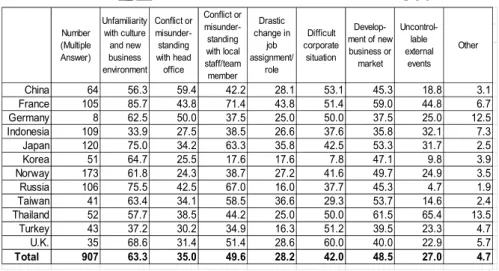
(6) Benton, C. et al.. Table 2: Critical incidents experienced multiple answers (%). “I learn new ideas every time (L1) I experience a challenging issues.” A Japanese respondent suggested that the synergistic effects of integrating two or more competencies promote double-loop learning (L1). “Competencies seem to be more effective when used in combination. It is useful to be aware of the importance of customizing competency learning (L1) from several experiences.” Lastly, the importance of introspection for double-loop learning was mentioned by a Japanese respondent. “I learned that it is essential to check more than twice before taking actions (L2), and to confirm plans with local staff to ensure the validity of the plans.” The above statements show that successful global managers introspectively evaluated their strategies and behaviors to deal with critical incidents by viewing these as an opportunity to learn new competencies.. 4.2 Phase 2: Quantitative Web-Survey This section describes the findings of the web-survey conducted in 12 countries in Asia and Europe. Critical Incidents Experienced As shown in Table 2, all respondents from each of the countries experienced multiple critical incidents. The most experienced types of critical incidents were “Unfamiliarity with culture and new business environment (63.3%),” “Conflict or misunderstanding with local staff/team member (49.6%),” and “Development of new business or market (48.5%).”. 10. Fig. 2: Critical incident resolution. Both the first and second most experienced types of incidents involve dealing with new cultures and new situations, which confirms the difficulty of working in international business situations. Japanese business managers appeared to have greater difficulty dealing with a multi-cultural and unfamiliar environment, with 75% and 63.3% reporting experiencing these first and second most experienced types of critical incidents, respectively. These figures are greater than the average for respondents from all countries surveyed by 10%. Critical Incident Resolution Fig. 2 shows the degree to which the critical incident experience by respondents were resolved based on a 5-point scale, with 5 being “complete resolution” and 1 being “no resolution at all.” As shown, the average resolution score was 3.7, which represents a state between “somewhat re-. 横幹 第 9 巻 第 1 号.
(7) An Exploratory Study on the Learning Mechanism of Global Leadership Competencies. Table 3: Change caused by the critical incident. Table 4: GLCs that impacted critical incident resolution. solved” and “mainly resolved,” but falling below “complete resolution.” Japanese managers had a slightly less resolution average of 3.6. This implies that as most critical incidents are not completely resolved, global business managers must flexibility make adjustments to achieve the best possible outcome. Effects of the Critical Incidents With regards to the effect the critical incidents had on global business managers, respondents were asked to rate the degree to which the experience caused any emotional, cognitive or behavioral change. Emotional change refers to the change the stimulus of the critical incident had on emotions, attitude or values; cognitive change to any change in understanding of the new environment; and behavior change to any change in actions or reactions to the new situation. As shown in Table 3, the average rating of change was 3.4 for both emotional and cognitive change, and 3.7 for behavioral change (5-point scale with 1 reflecting no change at all, and 5 being a significant degree of change), showing that critical incidents have impact on global managers. Respondents of most countries, excluding Japan and Korea, experienced greater change in behavior than in emotion or cognition. We can infer that managers readily changed their behavior and actions to more quickly adapt to the new environment and culture they faced. In contrast, Japanese respondents experienced the greatest degree of change in emotions and the lowest degree of change in behavior. It appears that even though the critical incidents caused changes in emotions and cognition, these were not translated into behavioral change. Possibly, the relatively strong centralized control and the emphasis on consensus building of Japanese companies make it difficult for Japanese managers to autonomously take new actions.. GLCs used for Critical Incident Resolution Using data mining of all questions in the web-survey, the structure of a decision tree that best measured critical incident resolution was developed. Variables included were as follows. •. Dependent variable: Critical incident resolution level (5-point scale). •. Independent variables: - Usage of global leadership competencies - Type and characteristics of critical incident, country of occurrence - Profile of respondents (age, education, position, length of employment, nationality) - Leadership, language, and cross-cultural training received - Changes brought upon by the critical incidents (changes in work processes, organization, strategy, decision-making, communication, emotions, cognition, and behavior). Table 4 shows the GLCs that had the most impact on critical incident resolution in the decision tree for all respondents. In the Search stage, a long-term focus, as well as the tackling of current issues, is shown to be necessary when trying to search or understand the problem. In the Plan. Oukan Vol.9, No.1. 11.
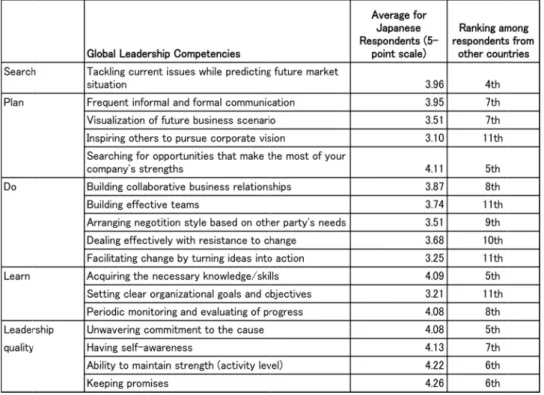
(8) Benton, C. et al.. Table 5: Japanese respondents’ GLC scores. stage, communication with team members and partners, and the consideration of business strength and the future were important. In the Do stage, building teams and partnerships, and facilitating action were vital competencies. In the Learn stage, acquiring knowledge and skills while setting goals and monitoring progress were key competencies. In terms of overall leadership quality, having unwavering commitment to the cause and promises made while keeping one’s strength and being self-aware were characteristics of successful managers. Table 5 shows the average score for Japanese managers for the above GLCs that impacted critical incident resolution (5-point scale, with 5 being very important and 1 being not important at all). As shown, Japanese respondents tended to have low scores for most GLCs, with the highest ranking being 4th out of respondents from all the 12 countries for “Tackling currents issues while predicting future market situation.” On the other hand, they ranked 10th or 11th for “Inspiring others to pursue corporate vision,” “Building effective teams,” “Dealing effectively with resistance to change,” and “Setting clear organizational goals and objectives,” clearly slowly they had difficulty dealing with local team members.. 12. 5. Conclusion This study investigated the effect critical incidents had on the learning of global leadership competencies though in-depth interviews and a multi-national web-survey. We found that all global managers faced critical incidents in their international assignments that had the potential to significantly affect their business. Although managers faced various types of incidents, the most common type were related to difficulties caused by differences in culture and dealing with new situations in a new environment. This confirms that need for global managers and leaders to acquire the unique skills and competencies necessary to succeed in global business. The results of the interview survey suggested that through double-loop learning, global mangers could learn new GLCs while managing the critical incidents they faced. Japanese managers in particular had difficulty in handling new cultures and environments and in developing relationships with the local staff. The fact that Japanese managers had the least amount of leadership training overall, and the second to the least amount of language training (second to U.K. managers who are mainly native speakers of English, the language most used in international business) can be inferred to be contributing factors to the inability to work across cultures. Furthermore, Japanese. 横幹 第 9 巻 第 1 号.
(9) An Exploratory Study on the Learning Mechanism of Global Leadership Competencies. managers were the least likely to make behavioral changes based on their experiences and learnings. Accordingly, Japanese companies, who are recognizing the need for global leadership, need to make a full commitment to the training and development of these leaders of international business, and to foster flexibility and adaptability within their organizational culture. In the next phase of the research, GHRD is developing case studies of global managers who have successful managed critical situations, and a business simulation tool – which uses the data collected –, that allows users to measure their own global leadership competency levels.. [9] T. Jokinen: “Global leadership competencies: a review and discussion,” J. of European Industrial Training, Vol.29, Issue 3, pp. 199-216, 2005. [10] H. Nagai: “Development of Future Asian Global Leaders: Vision, Framework, and Implications for APO Member Countries,” Asian Productivity Organization, 2008. [11] L. K. Woolsey: “The Critical Incident Technique: An Innovative Qualitative Method of Research,” Canadian J. of Counseling, Vol.20, No.4, pp. 242-254, 1986.. キャロライン・ベントン 1994 年筑波大学大学院経営・政策科学研究科修士課 程経営システム科学専攻修了.1997 年東京工業大学 大学院理工学研究科博士後期課程修了.博士(学術). 筑波大学ビジネスサイエンス系教授を経て,2013 年 4 月同大学副学長.. 参考文献 [1] D. S. Ridley, P. A. Schultz, R. S. Glanz, and C. E. Weinstein: “Self-regulated learning: the interactive influences of metacognitive awareness and goals setting,” J. of Experimental Education, Vol.60, pp. 293-306, 1992. [2] J. G. Borkowski, L. K. S. Chan, and N. Muthukrishna: “A Process-oriented Model of Metacognition: Links between Motivation and Executive Functioning,” G. Schraw and J. Impara, (Ed.), Issues in the Measurement of Metacognition, pp. 1-41, Lincoln, NB: University of Nebraska Press, 2000. [3] W. Winn and D. Snyder: “Cognitive perspectives in psychology,” D. H. Jonassen, (Ed.), Handbook of research for educational communications and technology, pp. 112-142, New York: Simon & Schuster MacMillan, 1996. [4] C. Argyris and D. A. Sch¨on: “Organizational Learning: A Theory of Action Perspective,” Reading, MA: AddisonWesley, 1978. [5] C. Argyris and D. A. Sch¨on: “Organizational Learning II: Theory, Method, and Practice,” Reading, MA: AddisonWesley, 1996. [6] C. Argyris: “Overcoming Organizational Defenses,” Needham Heights, MA: Allyn and Bacon, 1990. [7] C. C. Lundberg: “Planning the Executive Development Program,” California Management Review, Vol.15, No.1, pp. 115, Fall 1972. [8] R. E. Boyatzis: “Competencies in the 21st century,” J. of Management Development, Vol.27,Issue 1, pp. 5-12, 2008.. 永井 裕久 1994 年慶應義塾大学商学研究科博士課程単位取得 退学,1995 年 慶應義塾大学 博士 (商学),1994 年∼ 1998 年専修大学経営学部専任講師・助教授を経て, 1998 年より筑波大学大学院(経営システム科学専攻 助教授・教授,2015 年より国際経営プロフェッショ ナル専攻教授).専門は組織行動論,グローバルリー ダーシップ・人材開発論.. 椿 広計 1982 年東京大学工学系研究科修士課程修了.同年, 同計数工学科助手.87 年慶應義塾大学数理科学科講 師,88 年工学博士,97 年筑波大学社会工学系助教授, 00 年教授,ビジネス科学研究科教授を経て 07 年統 計数理研究所教授,応用統計研究に従事.. 木野 泰伸. Oukan Vol.9, No.1. 1990 年日本アイ・ビー・エム株式会社入社.金融, 報道,製造業等のシステム開発プロジェクトに参画. 2005 年筑波大学大学院ビジネス科学研究科助教授, 現在准教授,博士(システムズ・マネジメント),日 本品質管理学会,プロジェクトマネジメント学会,情 報処理学会会員.. 13.
(10)
図
![Fig. 1: Double-loop, single-loop learning adapted from Argyris and Sch¨on on [4, 5]](https://thumb-ap.123doks.com/thumbv2/123deta/8389017.1301329/3.892.78.422.89.302/fig-double-loop-single-loop-learning-adapted-argyris.webp)


+2
関連したドキュメント
Keywords: continuous time random walk, Brownian motion, collision time, skew Young tableaux, tandem queue.. AMS 2000 Subject Classification: Primary:
This paper is devoted to the investigation of the global asymptotic stability properties of switched systems subject to internal constant point delays, while the matrices defining
n , 1) maps the space of all homogeneous elements of degree n of an arbitrary free associative algebra onto its subspace of homogeneous Lie elements of degree n. A second
This paper presents an investigation into the mechanics of this specific problem and develops an analytical approach that accounts for the effects of geometrical and material data on
The object of this paper is the uniqueness for a d -dimensional Fokker-Planck type equation with inhomogeneous (possibly degenerated) measurable not necessarily bounded
In the paper we derive rational solutions for the lattice potential modified Korteweg–de Vries equation, and Q2, Q1(δ), H3(δ), H2 and H1 in the Adler–Bobenko–Suris list.. B¨
While conducting an experiment regarding fetal move- ments as a result of Pulsed Wave Doppler (PWD) ultrasound, [8] we encountered the severe artifacts in the acquired image2.
Wro ´nski’s construction replaced by phase semantic completion. ASubL3, Crakow 06/11/06
