
東北海道釧路炭田の古第三系石炭層の花粉分析学的、層位学的研究、別保層とその花粉分析(第一報)
10
0
0
全文
(2) Vol. 8, No. 1 Journal of Hokkaido Gakugei University (Section B) Aug., 1957. Palynological and Stratigraphical Studies on the Paleogene Coals in the Kushiro Coal Field, Eastern Hokkaido Geology of the Beppo Formation and its Pollenanalysis (Part I) Yoshio OKAXAK): Institute of Geology, Kushiro Branch, Hokkaido Gakugei University. W?^ : WtmMWKWv^^'SKf9vKW?'W^ n^'^w-^o WW^^VKWW (^-w. PREFACE In the Kushiro coal field the stratigraphy of the Urahoro group (Eocene-oligocene) was already established by Dr. Y. Sasa in 1940 and 1953. Besides, the paleontology, especially of both the plants and molluscus was studied by him in detail except for one formation—the lowest Beppo formation which contains no macroscopic fossils. Some papers of the palynological study on coal have been presented in Japan, especially Tokunaga (1955-56) has reported and described about one hundred types of pollen and spare from some coal seams in the Ishikari coal field in central Hokkaido.. The writer (1952) has already reported a pollenanalysis of the Harutori coal in the Kushiro coal field, giving no description or plates of their pollens. He also performed a pollen analysis on coal as well as field surveying. In this paper the geology of the Beppo formation of the same group as in the previous work is briefly described and the paleontological characteristics are clarified, based on pollen analytical method. The writer wishes to state his sincere gratitude and hearty thanks to prof. Dr. Y. Sasa of Hokkaido University, under whose direction this work was made.. GEOLOGY The paleogene Urahoro group in the Kushiro coal field is divided into six formations as follows :. Shakubetsu formation (coal bearing). Oligocene Eocene. Urahoro group. Shitakara formation (marine) Yubeteu formation (coal bearing) Tenneru formation (red conglomerate) Harutori formation (coal bearing) Beppo formation (black conglomerate). Unconformity Cretaceous _ 91 —.
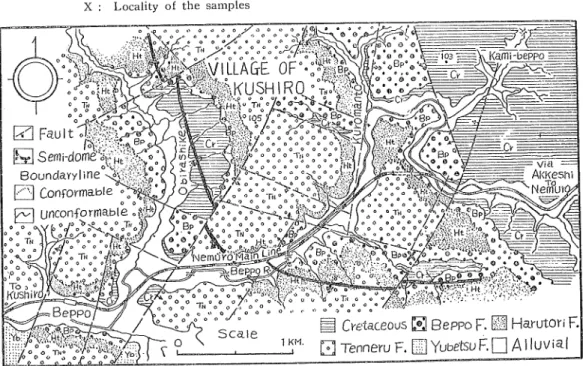
(3) Polynological and Stratigraphical Studies on the Paleogene Coals in the Kushiro Coal Field.. Of these only the Beppo formation is discussed in the present paper and the rest is omitted. Type area The Beppo formation is widely distributed, typically near the Beppo railroad station, the Nemuro main line, which is situated about 8 kilometers to east of the city of Kushiro. The formation crops out in the type area more or less discontinuously in the cuts along the Beppo river and the Kuromanto and Obirashike streams (see Fig. 1). Fig. 1 Geological map of the type Beppo CBWO area "ear Kushiro, eastern Hokkaido X : Locality of the samples. =tp3 ^s\\ l<ami-beppo^=^. fUM\ LLA&E'. ,KUSHI. Boundayyline Conyormable Unconformable. Crefaceous Kj Beppo R Isi Haruton F.. Tenneru F. H] Yubetsu F.C] A I luvial The Beppo formation—the basal conglomerate covers unconformably the slightly wavy erosion surface of the Cretaceous beds and in lithological nature an abrupt change is observable between these two complexes ; the latter consists of dark-grey-coloured compact silty beds (and is largely found at the eastern extremity of the map. The thickness is at least 100 meters here). There is a slight difference in dip and strike which occur here. This unconformity is found at many places in the type area. Litholog-y and structure The formation is mainly composed of conglomerate with obscure stratification, intercalated coa se sand.stone and locally thin coal seam. The rock, characterized as what we call "Kuro-dama (black pebbles in English) or " a black conglomerate , in which the pebbles are mainly of Pre-Cretaceous origin, namely state, dark grey sandstone, variable quartzite, schalstein, often with sandstone and mudstone of Cretaceous origin and igneous rocks accompanied, and set in a sandy cement. They are 1—20 centimeters, commonly 5—10 centimeters in diameter and are generally rounded or subrounded in shape. The thickness varies very much from 1 to 150 meters. —,92 —.
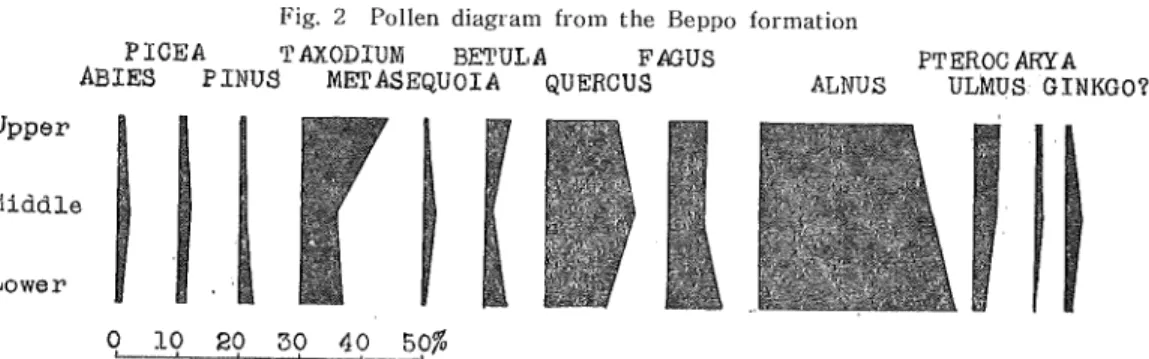
(4) Yoshio Okazakl The structure at the locality is a semi-dome, ranging from north to east, and it is not more than 15 degrees in the amount of dip. The faults which occured in the area have two systems ; one is a majority and has a north-westerly tendency, the other a minor, nearly at right angle to this direction. Consequently the formation is discontineously mapped as shown in Fig. 1. The geology of the other younger formations of the same group will be discussed in future.. POLLEN ANALYSIS Samples The locality of the samples from the Beppo formation is as shown in Fig. 1. These three coal samples were collected at about 10 centimeters' intervals from the seam, 18 centimeters in thickness. They were macerated by means of the Schultze solution and alkali solvent, as described in the previous paper. Results The results obtained are shown in the following table and pollen diagram (Fig. 2). Fig. 2 Pollen diagram from the Beppo formation. PIGEA TAXODIUM BETULA FAGUS PTEROGAKYA ABIES PINUS METASEQUOIA QUERCUS ALWUS ULMUS GINKGO? Upper Middle Lower. 0 10 SO 30 40 The pollen grains were mostly flattened and did not regain their round shape after maceration, and so some of these were not identified with their genera because of the above stated reason, and destruction and other reasons. Thus, more than 37 types of pollen and spare were found from the formation. Most of them were pollens of forest trees (arboreal pollen), while grasses or field vegetation (non-arboreal pollen) remained only small both in amount and in number. Discussion Of these pollens and spares, the extinct genera found in the present Japanese flora are five in number—Taxodium, Metasequoia, Carya, Cunninghamia? and.Ginkgo?. Futhermore, the extinct seven genera in Hokkaido are as follows ; Tsuga, Larix, Sciadopitys(?), Zelkowa, Fagus, Castanea and Platanus ?, although Fagus is found also in southern Hokkaido. From the pollen diagram, deciduous trees such as Alnus, Quercus and Fagus are relatively abundant throughout, especially Alnus dominant, while conifers such as Abies, Picea, Firms, Metasequoia, Larix, Tsuga etc, remain small in amount, except for Taxodium, — 93 —.
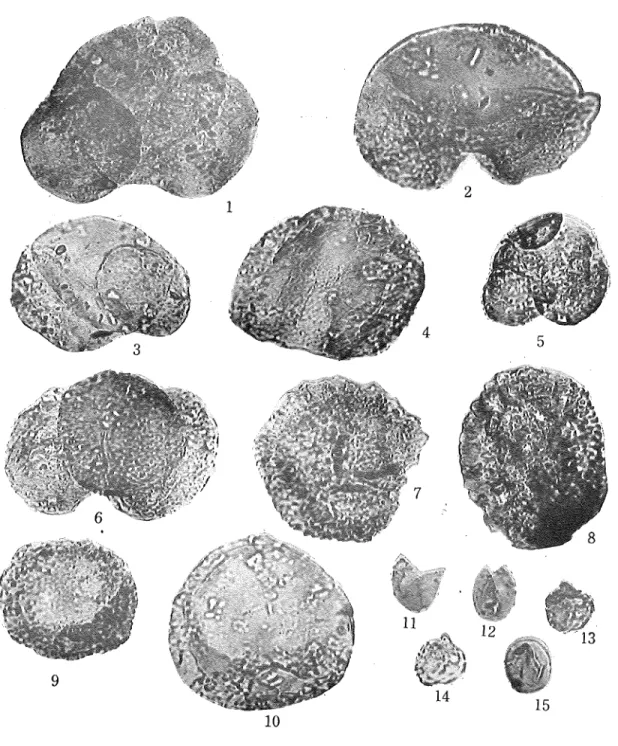
(5) Palynological and Stratigraphical Studies on the Paleogene Coals in the Kushiro Coal P"ield. Tabl. Samples Pollen type. upper. Pollen frequencies. middle. lower. from the Beppo formation. Samples! :>ollen type. upper. middle. 0.5. Abies. 0.6. 1.5. 1.1. Pterocarya. 0.6. Picea. 0.8. 2.1. 1.4. Corylus. 0.2. Pinus. 0.4. 0.9. 2.4. Ilex. 0.6. 13.8. 5.8. 7.1. Zelkova. 0.6. 0.9. 1.9. 0.3. Carya. 0.8. 0.2. 0.2. 0.3. Magnolia. 0.2. 0.6. G ink go ?. 0.6. 2.6. Tilia. 0.6. Taxodium Metasequoia. 0.2. Larix. Sciadopitys ?. 0.4 0.2. Cupressaea ? Cunninghamia ? Betula. 0.5 0.4. Tsuga 0.2. 0.6. Ericacea. 0.5 0.3. 0.5. 0.8 0.3. Platanus ? 0.8. lower. 0.6. 0.6. 3.8. 0.9. 3.3. Cyperaceae. 1,9. 0.2. 0.5. 12.0. 12.6. 10.6. Gramineae. 7.2. 4.5. 5.2. Fagus. 5.7. 5.4. 7.9. Equisetum. Alnus. 26.5. 29.5. 34.0. Lycopodiaceae. 0.2. 1.2. 0.8. Inapertulatae*. 1.1. 1.5. Monocolpatae*. 0.8. 1.3. 1.3. 6.5. 4.3. Quercus. Salix. 0.9 0.5 0.8. Fraxinus. 0.3. 1.2. Carpinus. 1.3. 0.4. 0.5. Tricolpatae*. 6.0. 0.4. 0.8. Tricolporatae*. 0.6. 0.4. 0.5. 3.2. 2.2. Indiscriminated. 8.2. 10.9. 4.3. Castanea Ulmus. 3.0. * Artificial classification proposed by Faegri & Iversen (1950) and Erdtman (1954) which is relatively abundant. Other broad leaved trees remain more or less discontineously in low percentage. From these facts, we find an interesting fact that the floral constitution shows a marked difference from the present one of forest sequence where the seam was deposited and that the constitution shown in the seam is similar to that of the deciduous forest zone in central Honshu (Mainland of Japan) of the present day. Description of the characteristic types The character of the fossil pollen and spares are briefly described and they are illustrated in the following plates. Abies, Picea and Pinus type There are vesiculate with two wing bladders, and distinguished by their size and paterns of grains respectively.. Abies : length of entire grains ( bladders included) 108 to 145.2,^. (Pl. I, Fig. 1) Picea : 66.6 to 128.9/-i (Pl. I , Figs. 2—3—4) Pinus : 65 to 69.5/-< (Pl. I , Figs. 5—6) Taxodium type (Pl. I, Figs. 11—12) Grains spheroidal, approximately 29—30/-< in diameter. Most of the grains are ruptured into halves, but join at the base, exine nearly psilate, Metasequoia type (Pl. I , Figs. 13—14—15) Grains spheroidal, 22.2 to 26.7/-< in diameter, provided with a single germ pore, — 94 —.
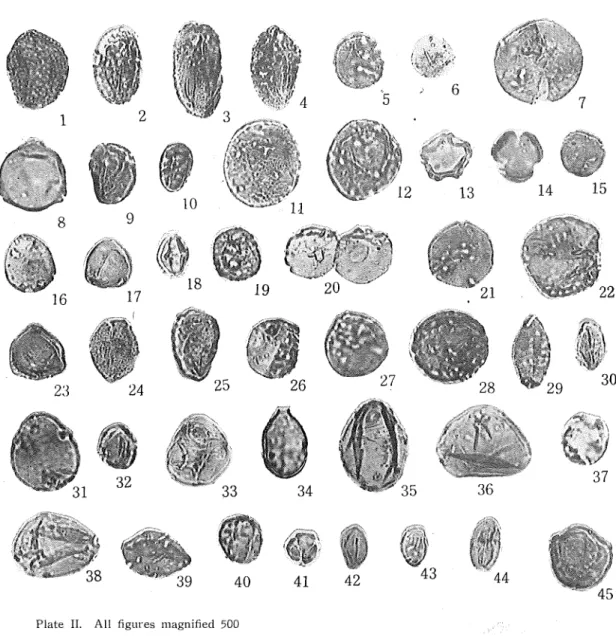
(6) Yoshio Okazaki consisting of a conical projection which somewhat bends to the side.. Larix type (Pl. I , Fig. 10) Grains spheroidal, 73.9 to 93.3/.< in diameter. Exine comparatively thin, with no flecks. Sciadopitys ? type (Pl. B , Figs. 1—2—3—4) Grains monocolpate, approximately spheroidal. Exine thick, with coarse reticulategranules or rounded warts. Size 26.7 by 48.8^(. Tsuga type (Pl. I , Figs. 7—8—9) Grains spheroidal, 72.5 to 88.8/.< in diameter. It is encircled by a marginal fringe or wing. The types shown in Figs. 8 & 9 have a resemblance to Tsuga canadensis, and that shown in Fig. 7 to T. diversifolia. Cupressacea ? type (Pl. I , Figs. 5—6) Grains spheroidal, 28—37.5/.t in diameter. Exine thin, nearly smooth, usually rupturing.. Cunninghamia ? type (Pl. H , Fig. 7) Grains spheroidal, ranging from 36 to 44.3/-< in diameter. Ektexine flecked with somewhat coarse granules.. Betula type (Pl. I, Fig. 8) Grains spheroidal, provided with three projected pores, ranging from 21 to 32.6/( in diameter. Quercus type (Pl. j, Figs. 9—10) Grains spheroidal in polar view, subprolate in equatorial view. Three furrows sharply defined, with no pores. Texture granular. Size 13.4 by 31.1/-t.. Fagus type (Pl. ][, Figs. 11—12) Grains spheroidal, tricolporate. 26 to 42.8/-< in diameter. Each furrow proportionately short with a distinct germ pore. Exine coarser granules.. Salix type (Pl. I, Fig. 14) Smaller grains, spheroidal, 17.2 to 25.7/< in diameter. Tricolporate. Reticular texture.. Fraxinus type (Pl. H , Fig. 15) Grains subspheroidal, 20 to 2i/.i in diameter. Exine more reticular than Salix. Carpinus type (Pl. H , Figs. 16—17) Grains similar in shape to Betula, but they are more rounded, three pores somewhat smaller and the exine thinner. 22.2 to 39.9/.< in diameter.. Castanea type (Pl. I, Fig. 18) Small grains more or less spheroidal, tricolporate. 12 to 17.8/-< in diameter. Exine nearly smooth, provided with three pores.. Ulmus Type (Pl. K , Figs. 19—20) Grains suboblate, size 28.1 to 35.5/-< in diameter. Germ pores mostly six. Exine with a marked undulation. Pterocarya type (Pl. I, Figs. 21—22) Grains more or less similar to those of Carya, subspheroidal in polar view, much flattened, germ pores six-seven, one at each angle of the grains. Diameter 29.6 to 54.6/-(.. Corylus type (Pl. ][, Fig. 23) 95 —.
(7) Palynological and Stratigraphical Studies on the Paleogene Coals in the Kushiro Coal Field.. Grains, in polar view rounded triangular, diameter 22.2 to 26.7,u.. Ilex type (Pl. H , Fig. 24) Grains spheroidal or suboblate, 19.2 by 32.6/-<. Their patterns remarkable flecked with very coarse granules.. Zelkova type (Pl. I, Fig. 25) Grains of somewhat similar type to that of Ulmus. They are, however, more coarsely folded and the exine is thinner. In polar view more or less square or pentagonal according to the number of pores.. Carya type (Pl. ], Fig. 26) Grains approximately spheroidal, 32 to 51.7/.( in diameter. Germ pores three or four, equally placed in a circle. Exine thick, nearly smooth. Magnolia type (Pl. H , Figs. 27—28) Grains spheroidal or suboblate, exine thin, coarse undulation or reticulate, their pattern gradually disappearing near the margins of the thinner exine-furrow. Diameter 26.7 to 29.6/.(.. Ginkgo ? type (Pl. K , Figs. 29—30) Grains oblate to suboblate, monocolpate. Size 32.6 by 17.8,u. Exine finely but distinctively flecked with the grannies.. Tilia type (Pl. ]I , Fig. 31) Grains suboblate ?, flattened. Three furrows, pitlike depressions enclosing circular pores are a marked feature, about 37 p. in diameter.. Platanus ? type (Pl. U , Fig. 32) Grains spheroidal, tricolpate, approximately 24,u in diameter. Exine distinctively reticulate.. Ericaceae type (Pl. H, Fig. 33) Pollen grains united in tetrads. Diameter of the tetrads approximately 34,u. Cyperaceae type (Pl. H , Fig. 34) More or less rounded triangular grains, provided with poor or no pores. Size 28 by 40/.(. In the Plates, Carex type is illustrated.. Gramineae type (Pl. ]I, Fig. 35) Grains spheroidal, has a single pore, surrounded by a thickened rim. 22 to 34/j in diameter.. Equisetum type (pl. ]1, Fig. 36) Spares spheroidal, about 46/.< in diameter. Exine smooth, monocolpate. Lycopodiaceae type (Pl. U , Fig. 37) Spares, trilet, rounded-triangular, size about 30/.<. The surface coarse reticulate. Inap. poll. type CP1. II > Fig. 38) Grains spheroidal, diameter about 47/.(. Exine smooth, similar to Equisetum. Monocolpat. poll. type GP1. II , Fig. 39) Approximately spheroiclal, size of grains 32.6/-t. Exine psilate, with a defined furrow. Tricolpatae type (Pl. ]\,. Figs. 40—41—42—43—44). - 96 -.
(8) Yoshio Okazaki Grains suboblate to spheroidal, diameter 17.8 to 22.7/.f. A small type with defined furrows and a nearly smooth exine.. Tricolporatae type (Pl. j , Fig. 45) Grains suboblate to spheroidal, size 17.8 to 29.6/(. Exine psilate, germ pores unclear.. SUMMARY In this paper, the Beppo formation, which is the lowest one of the Urahoro group (Faleogene) in the Kushiro coal field, Hokkaido was studied in the type area geologicaHy and palynologically. The formation is characterized as a black-coloured conglomerate with thickness of 1—150 meters and rests unconformably on the Cretaceous beds. The geological map of the Beppo formation in the area is given in Fig. 1. Three samples for pollenanalysis were taken from a thin coal seam which is locally presen^ in the formation. They were macerated with the Schultze solution and alkali solvent. The results obtained are as shown in Table and Fig. 2. More than 37 types of pollen and spare were recognized and they are illustrated in the following plates. Most of these are pollen of forest trees, and of the nearest living equivalents, of them five genera are the extinct ones found in the present flora of Japan, seven in that of Hokkaido. Thus, we may infer that the community shown in the seam is similar to that of the present one at the deciduous forest zone in Honshu (Mainland of Japan.).. LITERATURE CITED 1) Erdtman, G. : An Introduction to Pollen Analysis, Chronica Botanica Bk. Co. U. S. A., 1954 2) Faegri, K. & Iversen, J. : Text book of the modern pollen analysis, Enjyar Munjusgaard, Denmark,. 1950. 3) Iroanishi, K. & Kira, T. : Biological geography (in Jap.), New geography Lee., vol. 4, 1953 4) Manum, S. : Pollen og sparer i tertiaere kull fra Vestspitsbergen, Meddel. Nr. 79, Norsk Polarinstitut. 1954 5) Nakamura, J : Fossil pollen in the Nahari lignite, Rep. Kochi Univ., vol. 1, No. 2, 1951 6) Okazaki, Y. : Pollen analytical studie of the Tertiary coal seams in the Kushiro coal field, Hokkaido Cin Jap.), Jour. .Tap. Assoc. Miner. Petr. Econ. Geol., vol. 36. No. 3, 1952 7) Sasa, Y. : Stratigraphy of the Tertiary deposits in the Kushiro coal field and a critical review of the opinions expressed (in Jap.), Tour. Hokkaido Coalmin. Assoc. No. 307-308, 1940 8) : Kushiro coal field, (in Jap.), Description of Hokkaido coal field, No. 2 Jao. Coal min. Assoc. Hokkaido Branch, 1953 9) To1<unaga. S. : Pollenanalyses of the Known Coal Seams in the Bibai Area, Sorachi District, Ishikari Coal Field, Hokkaido (in Jap.), Bull. Geol. Surv. Jap., vol. 6, No. 9, 1955 10) : Pollenanalyses of Some Coal Seams in the Akabira Area, IshikariCoal Field, Hokkaido (in Jap.), Bull. Geol. Surv. Jap., vol. 7, No. 3, 1953 11) Yamazaki, T : Pollen and Spare Grains from the Saghalien Forests, (in Jap.) Bull. Kyoto Univ. Forests, No. 5, 1933. 97 -.
(9) Plate I. All figures magnified 500 K,Fign' rT.type Fi8s- 2~3~4 : picea type ^s 5-6 ; p— ^pe Fig, ^ ^ .p,. Fig. 10 : Larix type ^. , ^ ., ^^ ^s '^';^^^ M^I19;Zsuga type ;s. i.5-14-15 : Metasequoia type.
(10) 40. 41. Plate II. All figures magnified 500 Pigs. 1-2-3-4 .. Sciadopitys ? type Figs. 5-6 : Cupressacea ? type Fig. 7 : Cunninghamia ? type Fig. 8 : Betuta type. Figs. 9-10 : Quercus type Figs. 11-12 : Fagus type Fig. 13 : Alnus. type Fig. 14 : Salix type Castenea type Figs. 19-20 : Fig. 24 : Ilex type Fig. 25 Figs. 29-30 : Ginkgo ? tpey type Pig. 34 : Carex type. Fig. 15 : Fraxinus type Figs. 16-17 : Carpinus type Fig. 18 : Ulmus type Figs. 21-22 : Pterocarya type Fig. 23 : Corylus type : Zelkova type Fig. 26 : Carya type Figs. 27-28 : Magnolia type Fig. 31 : Tilia type Pig. 32 : Platanus ? type Fig. 33 : Ericacea Fig. 35 : Gramineae type Fig. 36 : Equisetum type. Lycopodiaceae type Fig. 38 : Inap. poll. type Fig. 39 : Monocolpat. poll. type 42-43-44 : Tricolpat. poll. type Fig. 45 ; Iricolporat. poll. type. Fig. 37 : Figs. 40-41-.
(11)
図
関連したドキュメント
The edges terminating in a correspond to the generators, i.e., the south-west cor- ners of the respective Ferrers diagram, whereas the edges originating in a correspond to the
東北大学大学院医学系研究科の運動学分野門間陽樹講師、早稲田大学の川上
第7層 第6層 第5層 第4層 第3層 第2層 第1層 無線端末 電力SM 特例計量器.
第四系更新統の段丘堆積物及び第 四系完新統の沖積層で構成されて おり、富岡層の下位には古第三系.
ボー リング コ アから約50cm間隔で︐試料をサン プリング 珪藻化石の同定→ 古水環境の指標(海水 / 汽水 / 淡水). 花粉化石の同定
古安田層 ・炉心孔の PS 検層結果に基づく平均値 西山層 ・炉心孔の PS 検層結果に基づく平均値 椎谷層 ・炉心孔の
★西村圭織 出生率低下の要因分析とその対策 学生結婚 によるシュミレーション. ★田代沙季
(Yc) 、有楽町層砂質土層(Ys) 、埋没段丘堆積層(Bts)、東京層第一粘土層上部層(Tcu) 、東京
