
Studies in English and American Literature, No. 49, March 2014
©2014 by the Engish Literary Society of Japan Women’s University
Multifunctionality of the Japanese Simile Marker Mitaina: Its Evolution to an Interactional
Modal Particle
Hiroko Takanashi
Key words: mitaina; represented discourse; dramatization; image; feeling; interac- tional modal particle.
1. Introduction
Th is paper examines the multifunctionality of the Japanese simile marker mitaina
1in contemporary spoken Japanese. Th e functional distribution across the synchronic versatile uses of mitaina suggests an evolutionary path of gram- maticization. Th e fundamental function of mitaina is to connect one entity to another by their resemblance. Some mitaina constructions have other func- tions such as exemplifi cation, portraying images, obscuring, and speculation.
I argue that on the basis of these functions that, with the exception of specula- tion, mitaina has come to be grammaticized as an interactional modal particle to mark the performative activity. Such a performative activity is represented in what is called “represented discourse,” the utterance highly expressive in presenting the speaker’s images and feelings, and simultaneously appealing to the interlocutor’s empathy and involvement. Additionally, when mitaina takes the form mitai da-ttari shite, not marking a represented discourse but a noun phrase, it also functions as an interactional modal particle and marks the speaker’s playful stance, that is, the idea represented in the preceding noun phrase is meant to be “not real.” Th is function as a play-stance index is also observed in the [Represented Discourse + mitaina] construction, but not al- ways, which suggests that it has not been exclusively grammaticized as a play- stance index and relies upon the speech participants’ mutual negotiation in the meaning-making process, with the aid of a series of contextualization cues.
Th e structure of this paper is as follows: Section 2 provides an overview of
the semantic properties of mitaina, as well as socio-historical accounts for its present-day use. Section 3 briefl y explains the data for this study and its meth- odology. Section 4 illustrates the data analysis, paying attention to the distri- bution in terms of the morphosyntactic environment and its functions. Sec- tion 5 provides concluding remarks.
2. An Overview of Mitaina in Contemporary Japanese
2.1. Th e semantic properties of mitaina
It has been assumed that mitaina is originally a simile marker that compares the resemblance between two entities in appearance or manner (Daijirin sec- ond ed., 1995, Maeda 2004, Maynard 2005, Nitta 2009). In other words, two entities are approximated but not identifi ed as the same. Th e original mitaina construction is [A + mitaina + B] (‘B that resembles A’)], in which the entity B is the main referent. In its simplest case, both A and B are noun phrases and mitaina together with the preceding noun phrase A modifi es the noun phrase B. Th is function of showing the resemblance is extended from its use in the pre-nominal form mitaina to the adverbial form mitaini and the predicate form mitaida.
In addition to resemblance, Daijirin (second ed., 1995) lists three other semantic properties of mitaina: to mark exemplifi cation, an uncertain quote, and an uncertain/indirect/speculated statement. Mitaina and mitaini can fol- low a noun phrase for showing exemplifi cation. A hearsay verb iu (‘to say’) often co-occurs with mitaina after an uncertain quote. Th e predicate form of mitaida and its conjugated forms can be added as an auxiliary verb at the end of an utterance to show the speaker’s modality of uncertainty/indirectness/
speculation towards the proposition.
Mitaina with the last semantic property mentioned above marks epistemic modality, and more specifi cally, the evidential modality. Epistemic modality
“concerns the degree of speaker commitment for the information conveyed”
(Iwasaki 2013: 297), and mitaina marks the speaker’s lack of evidentiality as
to the certainty of the proposition. Iwasaki (2013) states that mitai covers the
range of other auxiliary forms yoo and rashii on the continuum of evidential-
ity (yoo is high and rashii is low, including hearsay), on which Nitta (2009)
comments that mitaida is closer to yooda than to rashii. Th at is, the speaker has access to recognition of the proposition, but not to the full extent. Th is ex- plains the link between the evidential function of mitaina and the base- resem- blance function of mitaina: namely, that the speculation is based on the speaker’s own recognition of the proposition for evidence to a certain degree.
Th erefore, the functions of showing the resemblance of two entities and their approximation are maintained throughout the remaining pages, with some illustrations that those functions are maximally weakened for the use of evi- dential modality.
2.2. Socio-historical accounts of mitaina
Mitaina originally emerged as a contracted form of mita yooda (‘it seems as if (I) see
〜’), in which mita is the past-fi nite form of miru (‘to see’) and yooda is an evidential auxiliary verb. Th is form appeared in the mid-Meiji period and has been in use since that time (Daijirin second ed., 1995). Mitaina is regu- larly used in the form of mitaina, mitaini, or mitaida (and its conjugated forms), and its syntactic position is after noun phrases, stems of nominal ad- jectives, or the fi nite-forms of conjugated verbs. Its newly developed form of the stem only (= mitai), with or without the following interactional particle such as yo, sa, and ne, is characterized as usage by women and children (Daiji- rin second ed., 1995).
Mitaina is a colloquial expression of yoona, which marks resemblance and likelihood (Maynard, 1990). In addition, Nitta (2009) and Iwasaki (2013) are in agreement in their claim that mitai (or mitaida) is a colloquial expression of yoo (or yooda) and rashii. Nitta (2009) further claims that mitaida, as an evi- dential modality marker, is semantically closer to yooda (higher in evidential- ity) than to rashii (lower in evidentiality).
As described above, the colloquial trait of mitaina explains why women and
children were the fi rst to start using the non-standard form, mitai, because as
social minorities, they were seen less in the public sphere than men. Th us, it is
speculated that the use of mitai spread among women and children at home
and in other informal situations where colloquial language was mainly spo-
ken. Th e frequent co-occurrence of interactional particles such as yo, sa, and
ne, after mitai off ers more evidence that its use was promoted in private social
life where the context could be more emotive and interactive.
Yet a more recent use of mitaina has been reported (Satake 1995, 1997, Koyano 2004, Maeda 2004, Takanashi 2004, Maynard 2005, Hoshino 2008, Ishiguro 2013), which resembles the use of mitai by women and children as described above in terms of its syntactic slot — and it occurs at the end of an utterance. However, there is a morphosyntactic diff erence between the two cases. Th e use of mitai as characterized by women and children takes the predicate form; that is, there is no morphosyntactically required grammatical element afterwards, which does not make it look awkward. In contrast, the recent use of mitaina is a pre-nominal form that morphosyntactically requires a noun phrase to follow. Th e utterance-fi nal use of the pre-nominal form mi- taina gives the impression that the utterance is incomplete, deviating from standard grammar.
From a historical point of view, the use of utterance-fi nal mitaina started in the early 1990s (Satake 1995, Maynard 2005).
2Although users of the utter- ance-fi nal mitaina construction are primarily young people (Satake 1995, 1997, Maeda 2004, Maynard 2005, Hoshino 2008), adults today are also using it (Satake 1995, Maeda 2004, Maynard 2005). Interestingly, Maynard (2005) points out that among young people, adolescent girls are frequent users of utterance-fi nal mitaina, which is consistent with the fact that women and children often employ utterance-fi nal mitai as a predicate form. Th is gen- der and age preference suggests that young females are playing an initiative role in creating the new language use in Japanese society.
3Scholars agree that the function of this new use of utterance-fi nal mitaina
serves to mitigate the utterance tone by avoiding making a direct statement
(Satake 1995, 1997, Koyano 2004, Maeda 2004, Maynard 2005, Hoshino
2008). However, there are negative and positive accounts with regard to the
cause of this phenomenon. Th e negative account views the new usage as a
defensive strategy; speakers who use this utterance-fi nal mitaina construction,
particularly young people, show their objective point of view towards their
own utterance preceding mitaina, thus not actually committing to what they
are saying, which is attributed to a lack of confi dence (Satake 1995, 1997,
Koyano 2004, Maeda 2004, Maynard 2005, Hoshino 2008). On the other
hand, the positive account views the usage as a strategy to actively promote the
sharing of direct feelings among the participants as well as enhancing their sense of solidarity (Maeda 2004, Maynard 2005, Hoshino 2008). Maeda (2004), Takanashi (2004), Maynard (2005), and Hoshino (2008) further re- port that utterance-fi nal mitaina is sometimes used for a playful purpose. In Takanashi (2004), I argue that utterance-fi nal mitaina, originated from a simile marker, functions as one of the primary play-stance indexes in the play frame (as opposed to the secondary play-stance indexes that can appear in the proximate stages around the play frame), and serves to demonstrate the speaker’s playful stance towards both the stance object and the ongoing speech activity. I further argue that it typically fi lls the second slot of the syntactic structure of [Playful Speech + Primary Play-Stance Index], with other primary play-stance indexes being -tte/-toka (quotative-based), -tari (conjoining mor- pheme-based), and their variations or the combinatory confi gurations across sources such as -tte kanji, -toka itte, -ttari shite, -toka i-ttari shite, and -mitaida- ttari shite. Although they do not occur exclusively in the play frame, these confi gurations were found to abound in the play frame. Additionally, they are often used almost interchangeably to fi ll the second slot of this construction, which suggests that they are all grammaticized as a single grammatical catego- ry to mark the playful stance. In that study, I focused on the use of mitaina and other primary play-stance indexes within the play frame. In this paper, I intend to fi ll the gap by illustrating all uses of mitaina in one entire conversa- tion to compare their functions in diff erent constructions.
3. Data and Methodology
Th e data are drawn from a naturally occurring conversation, “CALORIES,”
between two female friends (Aki and Machiko)
4in their twenties, which took place in a restaurant in Tokyo while they were having dinner. Th e conversation lasted 78 minutes and 11 seconds, and the linguistic form of mitaina and its variations (mitai, mitaini, and mitaida, with the last one in diff erent conju- gated forms) were all extracted for examination. Th e recorded conversation was transcribed by the author following the transcription conventions in Du Bois (2006), the updated version of the original proposed in Du Bois et al.
(1993). Th e gloss and free English translation are provided below the text line
in examples. See the Appendix at the end of this paper for transcription sym-
bols and gloss notations.
4. Data Analysis
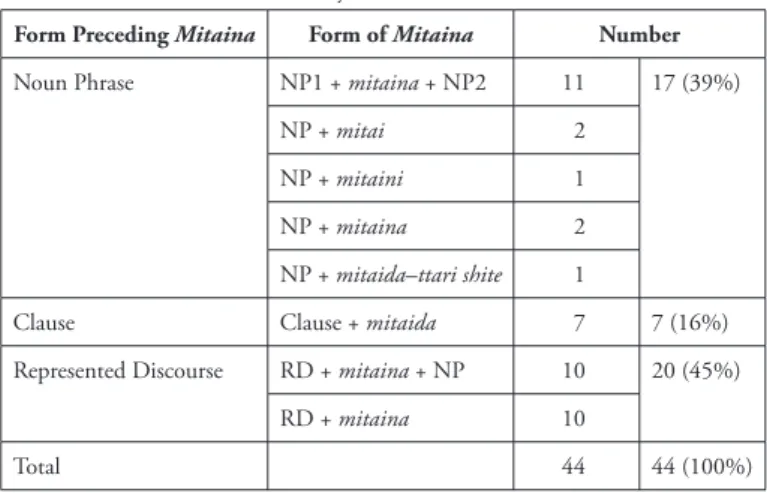
A total of 44 tokens of mitaina and its variations were observed throughout the conversational data. Table 1 shows the distribution of mitaina in terms of form. Th e leftmost column indicates the three types of form that precede mitaina and its variations: (1) noun phrase, (2) clause, and (3) represented discourse.
Th e second column from the left indicates the sub-types of the mitaina con- struction, considering the following syntactic environment (either utterance- fi nal or followed by other morphosyntactic elements except for interactional particles). Th e number of occurrences is presented to the right of the forms.
Th e tokens of mitaina following a represented discourse counted 20, the largest number of the three forms, constituting about 45% of all occurrences.
Th e second was mitaina after a noun phrase (17 tokens and about 39%), and the least was 7 for mitaida after a clause (about 16%). Utterance-fi nal mitaina (including the case with an interactional particle such as ne) was found either after a noun phrase (2 tokens) or after a represented discourse (10 tokens).
Th is overview demonstrates the frequent use of utterance-fi nal mitaina after a represented discourse. Close examination of each type of mitaina will be dis- cussed next in an attempt to explore its functions.
Table 1. Distribution of Mitaina by Form
Form Preceding Mitaina Form of Mitaina Number
Noun Phrase NP1 + mitaina + NP2 11 17 (39%)
NP + mitai 2
NP + mitaini 1
NP + mitaina 2
NP + mitaida–ttari shite 1
Clause Clause + mitaida 7 7 (16%)
Represented Discourse RD + mitaina + NP 10 20 (45%)
RD + mitaina 10
Total 44 44 (100%)
4.1. Noun phrase + mitaina
Table 2 illustrates the distribution of the [Noun Phrase + mitaina] con- struction in reference to each function.
4.1.1. NP1 + mitaina + NP2
Out of 17 tokens of the [Noun Phrase + mitaina] construction, about 65%
(11 tokens) were used most basically to connect two noun phrases. Mitaina in this [NP1 + mitaina + NP2] construction grammatically functions as part of a modifi er together with the preceding noun (= NP1), and the modifi ed noun (= NP2) comes immediately afterwards. Th is type of mitaina basically func-
Table 2. Distribution of the [NP + Mitaina] Construction by Sub-Form and Function Form of Mit-
aina
Sub-Form n. n. Grammatical Category
Function
NP1 + mitaina + NP2
NP1+mitaina+ko 1 11 Pre-nominal modifi er
Resemblance / Image
NP1+mitaina+hito 2 Resemblance / Image
NP1+mitaina+mono 6 Resemblance / Image /
Exemplifi cation / Ob- scuring
NP1+mitaina+kanji 2 Resemblance / Image /
Exemplifi cation / Ob- scuring
NP + mitai 2 Predicate Resemblance / Image
NP + mitaini 1 Adverbial Resemblance / Image /
Exemplifi cation
NP + mitaina 2 (Pre-nominal /
Interactional modal particle)
Resemblance / Image / Exemplifi cation / Ob- scuring
NP + mitaida-ttari shite 1 Predicate / In- teractional modal particle
Resemblance / Image / Exemplifi cation / Ob- scuring / Play
Total 17
tions as a simile marker, referring to NP2 in reference to NP1 that possesses a resembling property to NP2. In example (1) below, Machiko’s utterance line 881, otokonoko mitaina ko (‘the girl who is/was like a boy’), shows this con- struction: NP2 is ko (‘girl’) who is compared to and approximated to NP1, otokonoko (‘boy’), by virtue of the resemblance.
(1) 880 Machiko; =☺#ano ☺hito ☺wa?.
that person TOP
‘What about that person?’
→ 881
..
☺moo ☺hitori @no @otokonokoother one.person LK boy
☺mitaina ☺ko.
MITAINA girl
‘The other one who is/was like a boy.’
A similar use is found in (2), uttered by Aki, 31 lines after Machiko’s previous use of mitaina.
(2) 912 Aki; moo hitori nanka, other one.person HESI
→
913 otoko mitaina hito inakatta kke.
man MITAINA person there.is:PST Q
‘Wasn’t there another person who was like a man?’
Otoko mitaina hito (‘the person who is/was like a man’) in line 913 refers to the same person Machiko referred to in line 881 in (1). Yet another example refer- ring to the same person is otokonoko mitaina hito (‘the person who is/was like a boy’) in (3).
(3) 940 Machiko; ☺otokonoko ☺
mita@ina ☺hito ☺da ☺ yo.boy MITAINA person COP IP
‘(She) is/was the one who is/was like a boy.’
In the above three examples, the referent the speech participants are trying to identify stays the same. In this case, the referent person is a mutual acquain- tance from the same university department the girls graduated from. Because they are not exactly sure who is being talked about, they are negotiating the identifi cation of the referent through her description. Indeed, there is more description than just “a person like a boy” in the surrounding utterances. Th e nouns that fi ll the NP2 slot are ko (‘child/girl’) and hito (‘person’), which are both concrete nouns for “human.” Mitaina’s original function as a simile marker to connect two noun phrases by their resemblance is maintained, but as stated above, the emergence of the descriptive function to deliver the image that helps the other interlocutor identify the referent is observed.
Other nouns that fi ll the NP2 slot are mono (‘thing’) and kanji (‘feeling’). A touch of the abstracting trait observed for the nouns ko and hito becomes more salient for mono and kanji. Similar to ko and hito, mono originally stood for a physical object, but its use has been extended to include abstract con- cepts; that is, to describe the image of a thing or situation and to frame the description as an example among other possible ones. Th is in turn obscures the statement because describing something as an example can be regarded as making an indirect statement. For this reason, the functions of “exemplifi ca- tion” and “obscuring” are added to the functions of showing “resemblance”
and expressing “image.” See (4) as an example.
(4) 369 Machiko;
☺seezu ☺wa ☺nanka ☺`nare ☺mitainadrawing TOP HESI experience MITAINA
☺no ☺aru ☺kedo.NMZ there.is but
‘(The skill of ) drawing (can be improved) by something like experience.’
In nare mitaina no (‘something like experience’), no (‘thing’) in the NP2 slot is considered to be originally mono, but has developed as a nominalizer. Th is form of mitaina no (‘something like 〜’) was also found in another example, kigae-kata mitaina no (‘something like how to change costumes’).
None of the six instances of mono in the [NP1 + mitaina + NP2] construc-
tion retain the full mono form; fi ve of them take the form of nominalizer no and one takes an even more reduced form of n as in (5).
(5) 396 Machiko; .. sono naratta tokoro `no kako-mon `o, that learned part LK past-question ACC
→
397 shukudai
mitain de deru.
home.work MITAINA NMZ as assign
‘The past questions for the part we learned are assigned as something like homework.’
In (5), Machiko is explaining the learning system at the special school she at- tended to prepare for a national exam. She says that at the end of each class, past questions from actual exams were assigned as “something like homework”
(shukudai mitai n). Here, n is the reduced form of no, which is already reduced from mono. Moreover, the preceding mitai is the reduced form of mitaina. Th e repetition of the voiced nasal alveolar [n] in the last two syllables of mitaina n, together with another alveolar [d] immediately afterwards, seems to have con- tributed to this phonological deletion of one [n], resulting in dropping [na] of mitaina. Note, however, that it is still a pre-nominal modifi er, and therefore, its underlying form is mitaina.
Th is phenomenon of phonological reduction from mitaina to mitai was seen in three other examples, where the modifi ed noun mono takes the re- duced form no, as in (6), (7), and (8) shown below:
(6) 655 Aki; (H) rooka mitai no ga atte:, hall MITAINA NMZ NOM there.is
‘(When you open the front door), there is something like a hall.’
(7) 670 Aki; ribingu
mitaino ga atte:, living.room MITAINA NMZ NOM there.is
‘There is something like a living room.’
(8) 3671 Aki; (H) shi-yakusho
mitaino,
city-office MITAINA NMZ
‘Something like a city hall,’
In (6) and (7), Aki is describing the fl oor plan of her friend’s apartment to Machiko, who has not been there before. Aki is trying to help Machiko visual- ize the place by explaining “there is something like a hall” and “something like a living room” at the positions she describes within the fl oor plan. In (8), on the other hand, Aki is talking about a metropolitan city hall in New York City.
Because she does not know exactly what it is called in English, she describes it in reference to its Japanese equivalent offi ce building, shi-yakusho (‘city hall’).
In all of the above cases, the [Noun Phrase + mitaina + mono] construction (although no and n are used instead of mono, and mitaina is sometimes pho- nologically reduced to mitai), the basic function of mitaina as a simile marker, namely, showing resemblance between the two entities upon comparison, as well as the expressive function of portraying the image for description (as seen for the cases of ko (‘child/girl’) and hito (‘person’)) are maintained. In addition, the generalizing and abstracting nature of mono (‘thing’) seems to have added the exemplifying and obscuring functions. Th us, Aki in (6) describes one area in her friend’s apartment as rooka mitai no (‘something like a hall’), not know- ing exactly what to call it. She says “hall” as an option, which can be replaced by some other name. In this way, she refrains from making a straightforward statement and obscures her expression, not only because she is not confi dent enough to directly call it “a hall,” but also because her main objective is not to name it correctly, but to give her interlocutor a general picture of what it looks like to share the same image.
Th e point of sharing the images and building the common ground for the ongoing conversation becomes more signifi cant when the NP2 takes the noun kanji (‘feeling’) in the [NP1 + mitaina + NP2] construction. Th ere were two cases of kanji in this construction, both of which appear in each conjugated form. See (9) as one such example.
(9) 2735 Aki; yuujoo shutsuen mitaina kanji na n
friendship appearance MITAINA feeling COP NMZ
da kedo.
COP but
‘It’s something like a guest appearance.’
In (9), kanji (‘feeling’) in the NP2 slot does not play the role of a referent anymore; instead it only conveys the “feelings” or images of the situation. Th e situation being described is an actor’s guest appearance in a fi lm. As in the case of mono, the speaker does not know exactly what his appearance in the fi lm is technically called, but she describes it as yuujoo shutsuen (‘guest appearance’) as an example among other possible names. Accordingly, the functions are basically the same as the case of mono, but there is a slight diff erence that, due to the nature of kanji, which means an abstract concept of “feeling,” the de- gree of abstraction increases. As a result, the function to describe the images and feelings increases as well, making its referential meaning almost empty.
4.1.2. NP + mitai
So far, we have seen mitaina and its variations linking two noun phrases.
Now we turn to cases that do not take a following noun phrase. First, I will show the case of utterance-fi nal mitai. Th ere are two such instances, one of which is illustrated in (10).
(10) 959 Machiko; .. yamashitasan,
Yamashita-san
→
960 hontoni otokonoko
mitai,indeed boy MITAINA
‘Yamashita-san is/was indeed like a boy.’
Machiko is talking about the same person in (1), (2), and (3), as described
earlier. Th is use is considered to be a special case of mitaina in its predicate
form, which usually appears as mitaida, and in which the subject is presented
beforehand, as presented here in line 959. As noted in Daijirin (second ed.,
1995), this is the non-standard use of mitaida with the stem only, often used
by women and children. Th ese factors of female gender and younger age are
in accordance with the speakers’ gender and age in this example. Th e semantic
functions are showing resemblance and portraying the image.
4.1.3. NP + mitaini
Th ere is one instance of mitaini, an adverbial form of mitaina, which modifi es a clause, as shown in (11). Aki is talking about not having to speak English at her working place. Immediately preceding this passage, she ex- presses the fact that she is aware of the need to study English but fi nds it dif- fi cult to become motivated because she does not have occasion to use it in her everyday life.
(11)
→ 2842 Aki;daigaku
mitainisa,
university MITAINA IP
2843 ` nanka no,
something LK
2844 `shiken ga aru toka ja`nai exam NOM there.is or.anything COP:NEG
kara sa:,
because IP
‘Because (our current situation) is not something like we have some kind of exams like (in the days back) at the university.’
In line 2842, mitaini describes her current situation in which there is no exam or anything of the like that forces her to study English. Th is situation is in contrast to her college days when she had to study English for an exam to pass the course. Th e semantic function is to show resemblance, although it is ne- gated to give a counter example in this case, and exemplifi cation, because the situation at the university is just an example, among other possible situations that would force her to study English. By giving an example, she is capable of delivering the situational image she has in mind to her interlocutor.
4.1.4. NP + mitaina
Th ere is an intriguing construction [Noun Phrase + mitaina] without a fol-
lowing noun phrase despite the fact that mitaina is a pre-nominal form, and
therefore morphosyntactically requires another noun phrase to follow. Unlike the utterance-fi nal mitaina that follows a represented discourse, which will be presented in Section 4.3.2, the utterance-fi nal mitaina after a noun phrase does not seem to be fully grammaticized as an interactional modal particle.
Examples (12) and (13) illustrate this type.
Before the passage shown in (12), Aki has been talking about a troublesome client at her workplace who bothers her with his/her aggressive attitude. She refers to the client in line 3226, then becomes tongue-tied in line 3227, as indicated by the truncation symbol “—,” not being able to fi nd the suitable words to describe him/her, when Machiko overlaps and off ers a description of the person on the basis of her inference.
(12) 3226 Aki; sekkee jimusho no hito na n da
design office LK person COP NMZ COP
kedo:,
but
3227 de[mo nanka] —
but HESI
‘Yeah, (s/he) works for an architectural design firm, but somehow—’
→
3228 Machiko; [# nanimo waka]ttenai ashisutanto
mitaina.nothing know: NEG assistant MITAINA
‘(S/he) is someone like an assistant who knows nothing.’
Nanimo wakattenai ashisutanto mitaina (‘(that person) is someone like an as-
sistant who knows nothing’) can be understood as a modifi er to the absent
referent that should then follow.
5Th e fact that Machiko infers what Aki wants
to say and expresses it for her suggests that mitaina here functions as exempli-
fying and obscuring this client as “someone whose role resembles that of an
assistant.” Machiko’s primary purpose rests on conveying the image of the role
of the client rather than an accurate identifi cation of the role. Viewed in this
way, the interpretation that this mitaina somehow functions as an interac- tional modal particle is possible, because, although vague, it invites the inter- locutor to participate in co-constructing the common ground for the referent identifi cation through sharing the image of the referent. Indeed, I consider this construction to be in the still-evolving process of its grammaticization to an interactional particle.
Th e other example of this construction, (13), also has a person as a referent for the missing noun phrase.
(13) 3036 Aki; kachoo: toka, section.manager and.so.on
3037 buchoo kyuu:,
general.manager level
(1 line omitted)
→
3039 Aki; mitaina ne.
MITAINA IP
‘(Those with) the rank of section manager, general manager, or something like that, are (trying to get the certificate).’
In explaining what rank of employee obtains the certifi cate of superintendent at her workplace, Aki says kachoo: toka, buchookyuu:, mitaina ne (‘(Th ose who have) the rank of section manager, general manager, or something like that, are (trying to obtain the certifi cate)’). As in (12), it can be considered that a noun such as hito (‘person’) is omitted after mitaina, but the interactional function to appeal to the image rather than conveying the referential meaning cannot be denied, which is further strengthened by the use of the following interactional particle ne that invites the interlocutor to share the content of the utterance.
4.1.5. NP + mitaida-ttari shite
Th e last type of mitaina that follows a noun phrase is a special type of mit-
aina in its predicate form. In Section 4.1.2, we discussed the predicate form of
mitaina with the stem only (= mitai). However, the predicate form we see here
takes the full predicate form mitaida followed by -ttari shite (‘for all we know’), in which -ttari is a conjoining morpheme and shite is a non-fi nite form of the verb suru (‘to do’). Satake (1995, 1997) claims that -ttari shite obscures the statement by expressing it in a circumlocutional way and that -ttari shite some- times presents a statement in a joking manner. In Takanashi (2004), I pre- sented the latter point in the discussion of a play-stance index. I argued that -ttari shite, a play-stance index based on the conjoining morpheme -ttari, oc- curs utterance-fi nally and serves as a framing device for a playful speech event.
Another play-stance index that includes -ttari shite is mitaida-ttari shite, which, as well as -ttari shite, has come to be grammaticized as a fi xed expres- sion for indexing a play stance. -Ttari shite points out an unexpected potenti- ality (Daijirin second ed., 1995), which matches the nature of play as a hypo- thetical fantasy world that is incongruent with the real world.
(14)
㱺 76 Machiko; … `zenzen ajinot.at.all taste
naka–ttari shite.
there.is:NEG–for.all.we.know
‘For all we know/Like/What if, (each dish at this restaurant) has absolutely no taste.’
(3 lines omitted)
→
80 Aki; byooin-shoku
mitaida–ttari shite.hospital-meal MITAINA–for.all.we.know
‘For all we know/Like/What if, it tastes like hospital food.’
In (14), both -ttari shite and mitaida-ttari shite are seen in the same context in which the speech participants are mocking the dishes of the restaurant.
Machiko starts to play in line 76, saying zenzen aji naka-ttari shite (‘What if
(each dish) has absolutely no taste’), exaggerating the fact that the restaurant’s
dishes are very low in calories. Joining Machiko’s playful and mocking stance
towards the dishes, Aki says in line 80 that byooin-shoku mitaida–ttari shite
(‘What if it tastes like hospital food’). “Having no taste” and “tasting like hos-
pital food” are aligned as equivalent in meaning because hospital food is ste-
reotyped as tasteless. Both are imagined playful speeches and in this sense, both -ttari shite and mitaida-ttari shite can be interpreted as belonging to the same grammatical category of interactional modal particle, and more specifi - cally, play-stance index (Takanashi 2004). What diff erentiates the form is the element that precedes mitaina; -ttari shite follows a predicate (an adjective nai (‘there is no’) in this case), whereas mitaida-ttari shite follows a noun (byooin- shoku (‘hospital meal’) in this case). Functionally, the meanings of showing the resemblance of the stance object to the description, exemplifi cation, portray- ing the image, and obscuring are maintained. In addition, mitaida-ttari shite as well as -ttari shite has gained a new function of showing playfulness.
4.2. Clause + mitaida
Now we turn to the auxiliary use of mitaina following a clause. As we can see in Table 3, only 7 tokens out of 44 were found for this use. Th is construc- tion of [Clause + mitaida] can take either the form of stem-only mitai utter- ance-fi nally or with each conjugated form. In both cases, it appears in the predicate form, or, more precisely, as a modal auxiliary verb that indicates the speaker’s speculation towards the content of the proposition.
Table 3. Distribution of the [Clause + Mitaida] Construction by Sub-form and Function Form of Mitaina Sub-Form n. Grammatical Category Function Clause + mitaida Clause + mitai
(utterance-fi nal)
3 Predicate
(Modal auxiliary verb)
Speculation
Clause + mitaida (conjugated)
4
Total 7
Example (15) shows the utterance-fi nal use of mitaida in its form of stem only. In this context, Machiko is asking Aki if Non-chan, their mutual friend, is doing well with her job.
(15) 1017 Machiko; nonchan,
Non-chan
1018 doo na no?.
how COP NMZ
‘How is Non-chan doing?’
(2 lines omitted)
1021 Aki; nonchan wa ne:,
Non-chan TOP IP
‘She is,’
1022 Machiko; .. chanto yatteru_(/yatten/) no?,
properly do IP
1023 kaisha.
company
‘Is she doing OK with her company?’
(4 lines omitted)
→
1028 Aki; yatteru mitai.
do MITAINA
‘She seems to be doing OK.’
Although Machiko has not seen Non-chan lately, Aki has, and accordingly, she has some new information. Aki marks her remarks with the evidential modal auxiliary verb mitai after the verb yatteru (‘be doing (OK)’) in line 1028. Here, the apparent linguistic element that precedes mitai is only the verb, but we consider it as a clause with the absent subject, Non-chan. Th is modal auxiliary verb mitai can be translated into English as “it seems to me
〜,” whereby Aki expresses her lack of certainty and subjective speculation
because her judgment is made based on the information she gathered from the talk with Non-chan.
Example (16) also demonstrates the [Clause + mitaida] construction, this time with the conjugated form of the auxiliary verb mitaida. Th e passage starts three lines after the end of (15) and describes the same person.
(16) 1032 Aki; boonasu wa,
bonus TOP
→
1033 nakatta
mitaida kedo.there.is:NEG:PST MITAINA but
‘It seems that (she) didn’t get any bonus, though.’
Previously in (15), Machiko asked Aki about the current situation of Non- chan’s job because she knew that Non-chan’s company was not doing well fi - nancially. Aki answers that “she seems to be doing OK” in (15), and now in (16), she adds a new piece of information, boonasu wa nakatta mitaida kedo (‘it seems that she didn’t get any bonus, though’). Th is use of evidential modal- ity mitaida is semantically close to hearsay marking. According to Iwasaki (2013), when mitai covers the evidential area on the continuum from direct to indirect, the latter endpoint is hearsay, which lacks the speaker’s direct ac- cess to the recognition of the proposition. Here, Aki is reporting to Machiko what she heard from Non-chan.
In all seven instances of the [Clause + mitaida] construction, mitaida (the form is either stem mitai or in conjugation) is used as an evidential modal auxiliary verb that indicates the speaker’s speculation retrieved from her indi- rectly accessible knowledge. Indeed, all the examples for this construction have a proposition concerning a third person or an event/situation, which is neither within the speaker’s nor the addressee’s territory of information. Th is factor seems to have promoted the obscuring function to evolve to a new func- tion of speculation, and once it is grammaticized, other functions of showing resemblance, exemplifi cation, and portraying an image are all weakened to the point they are not recognizable any more.
4.3. Represented discourse + mitaina
Th e most frequent use of mitaina in my data is found in the [Represented Discourse + mitaina] construction. Mitaina in this construction is grammati- cally characterized as an interactional modal particle, which is concerned with the speaker’s attitude towards the hearer in interaction. Th is construction is further divided into two sub-types, with or without a following noun phrase.
Both sub-types were observed to have the new interactional function of dra-
matization and the speaker’s direct vivid expression of strong feelings and
images to the hearer, in addition to the functions we have seen so far, with the
exception of speculation. Th e function of conveying an image, which is con- comitant with the function of showing resemblance, seems to have been rein- forced in the new function of dramatization that greatly concerns the image through its vivid description and strong emotional commitment. Viewed as such, the proposition framed by mitaina, which is manifested in a represented discourse in this construction, is not of much importance; instead of the ac- curacy of the proposition, the images and feelings expressed in the represented discourse are foregrounded.
Th is grammaticized interactional use of mitaina owes a great deal to the nature of represented discourse. Represented discourse is the term Oropeza- Escobar (2011) uses to refer to the phenomenon also called “constructed dia- logue” (Tannen 1995, 2007/1989), “direct reported speech” (e.g., Oropeza- Escobar 2013), or more generally, “direct speech” or “quotation.” Although direct reported speech often enacts someone’s past speech, typically of a third person, the intrinsic nature of reported speech involves taking a diff erent stance from the original speaker’s. In this sense, reported speech is construct- ed, no matter how precisely reproduced. When constructed, reported speech represents the current reporting speaker’s stance and voice. In line with the claim by Tannen (1995, 2007/1989) that constructed dialogue creates in- volvement among speech participants, Oropeza (2011) asserts that represent- ed discourse in her Mexican-Spanish conversational data is used as an involve- ment strategy. She further points out the theatrical character of represented discourse due to its dramatic presentation, which is in accordance with Mayes’
(1990) analysis that spoken English quotations have a performative character that dramatizes events. In the following analysis, I will demonstrate the inter- actional function of mitaina that frames the preceding represented discourse as the dramatization of the speaker’s own images and feelings, which appeal to the interlocutor to share such emotive, as opposed to referential, dimensions of her speech.
Table 4 summarizes the [Represented Discourse + mitaina] construction with its sub-forms and functions. Th e distribution shows the clear half-and- half occurrences for each [Represented Discourse + mitaina + Noun Phrase]
construction and [Represented Discourse + mitaina (utterance-fi nal)] con-
struction: Out of the total 20 tokens, there are 10 tokens for each construc-
tion.
4.3.1. RD + mitaina + NP
First, I will show the analysis of the [Represented Discourse + mitaina + Noun Phrase] construction. In all 10 examples of this construction, mitaina takes the pre-nominal form, morphosyntactically modifying the following noun phrase. Nevertheless, it can be construed that this use of mitaina has developed as an interactional modal particle to signal that the preceding rep- resented discourse is created by the speaker’s own voice to convey her great deal of involvement, and moreover, to invite the interlocutor to share the same images and feelings.
Th ree diff erent noun phrases, hito (‘person’), koto (‘thing’), and kanji (‘feel- ing’) were observed to follow mitaina in this construction in my data. In each of the following examples, the beginning and ending of represented discourse are indicated by a set of symbols for quoted voice quality, “<Q>” and “</Q>.”
Th e shift of voice quality is recognized in represented discourse even though the degree of the shift diff ers in each case. Example (17) shows the case that takes hito (‘person’) as a noun phrase after the represented discourse and mit- aina. Prior to this context, Aki has been telling Machiko that several women at her workplace got married this year.
Table 4. Distribution of the [RD + Mitaina] Construction by Sub-Form and Function Form of Mitaina Sub-Form n. n. Grammatical
Category
Function
RD + mitaina + NP RD + mitaina + hito 1 10 Pre-nominal / Interactional modal particle
Resemblance / Image / Exemplifi cation / Obscuring / Feel- ings / Dramatiza- tion / (Play) RD + mitaina + koto 3
RD + mitaina + kanji 6
RD + mitaina 10 Interactional
modal particle
Total 20
(17)
→1290 Aki; (1.0) <Q> moo_(/mo/) zettai madamada shinai
EMPH never yet do:NEG
yo </Q>
mitainahito ga:,
IP MITAINA person NOM
1291 .. moo kekkonshiteru.
already be.married
‘(My senior colleague, about whom I think) something like “she will never get married anytime soon,” is already married.’
Hito (‘person’) in line 1290 refers to Aki’s senior colleague, and the preceding represented discourse mo zettai madamada shinai yo (‘she will never get mar- ried anytime soon’) exemplifi es what Aki feels about her colleague, leaving room for other possible wordings that can express her feelings. In this respect, we see here the functions of exemplifi cation and obscuring.
It is not realistic to think that Aki actually said these words either to her colleague or to herself. In this sense, this represented discourse is not a re- ported speech of a past experience. It is still a description of the person (hito) but expressed in a direct manner, diff erentiating the voice from the one that is embedded in the current context. Th is phenomenon is equivalent to what Maynard (2005) calls “inserted speech,” which manifests as the speaker’s
“multiple dialogized voices” and contributes to the “rich expressivity of lan- guage” (840). We have already seen in 4.1.1. the construction of mitaina be- fore hito (‘person’), in which mitaina appears after a noun phrase. In that case, mitaina functions as a simile marker to show the resemblance between the ideas represented in the two noun phrases before and after. Contrastively, mitaina after a represented discourse in this case has less of that function, whereas the function to convey images and feelings through dramatization is enhanced.
Mitaina after a represented discourse can take koto (‘thing’) as a modifi ed
noun. Th ree instances of this sub-form in my data enact the past speech of a
third person to which the addressee does not have access. Moreover, all three
instances co-occurred with the hearsay verb iu (‘to say’), which explains that
even though represented discourse is creative in nature, the reporting nature of a third person’s past speech largely remains in this sub-construction. Th e following are two such examples. Aki is reporting to Machiko what the woman being talked about said on TV in (18), and what a client told her in (19).
(18) 4579 Aki; (H) <Q> atashi mo soo yattekimashita </Q>
I too so have.been.doing
→
mitaina
koto itteite_(/yuttete/) sa.
MITAINA thing say IP
‘(She) was saying something like, “I myself have been doing that”.’
(19) 3316 Aki; <Q> ` nande,
why
3317 mae made yokatta noni </Q>, before till be.fine:PST though
(1 line omitted)
→ 3319 Aki; mitaina
koto iwaretemo sa,
MITAINA thing say:PASS IP
‘(I don’t know what to say) when (the client) says something like, “Why (isn’t it OK anymore? It) was OK before”.’
Th e noun kanji (‘feeling’) also follows the [Represented Discourse + mitai-
na] construction. Th is sub-form was seen as often as 6 out of 10 instances of
the [Represented Discourse + mitaina + Noun Phrase] construction. All ex-
amples of mitaina with kanji (‘feeling’) occur with a represented discourse that
expresses the speaker’s own feelings or descriptive images towards the topic
being discussed. Th e original abstract and emotive meaning of kanji is tied
together with one of mitaina’s functions that conveys the image. Consequent-
ly, mitaina kanji as a set has come to be grammaticized as an interactional
modal particle.
(20) 402 Machiko; ... kotoshi no tesuto de:,
this.year LK exam with
→
403 <Q> kako-mon dake ja dame da </Q>
past-question only P no.good COP
mitainakanji ni_(/n/) natta #no.
MITAINA feeling to become:PST IP
‘This year’s exam has changed to something that gives me the impression like, “It’s not enough to prepare with only the past questions”.’
In (20), kako-mon dake ja dame da (‘It’s not enough to prepare with only the past questions’) directly expresses Machiko’s impressions about the national exam she took. Th is represented discourse is regarded as not reporting what she said to herself, but being improvised at this moment of her utterance.
Example (21) shows an additional intriguing point in a similar vein. Th is sequence takes place shortly prior to (19). Machiko asks Aki if she has any client who stays at her offi ce for consultation for too long and will not leave.
To that question, Aki answers “yes” and expresses how she feels about such a client by the use of onomatopoeia dandandan in line 3139.
(21) 3136 Machiko; ☺ na`kanaka_(/nak`kanaka/)
not.easily
☺
kaera[nai]_(/kaen[nai/)]
leave:NEG
[
2 ☺hito ☺ toka ☺ iru]?.
person and.the.like there.is
‘Do you have any client who won’t leave for quite a long time, and the like?
3137 Aki; [☺soo_(/so/)].
yes
‘Yes.’
3138 [
2 ☺dakara_(/daka/),
so
→
3139 <Q>
☺#dan]danda:n </Q>
ONOMAT
☺mitai@na
kanji @ na @ n —
MITAINA feeling COP NMZ
3140 @ na @ n ☺ da ☺ kedo.
COP NMZ COP so
‘So, I’m like, “Go away! (imitating the sound of hitting the office desk)”.’
Aki’s utterance dandandan does not take the grammatical form of clause, but represents her feelings through the imagined act she would do in the situation being described. In the story of her past experience, Aki obviously shows her frustration towards such a client who stays long and keeps annoying her. In such a situation, she feels like banging the offi ce desk, dandandan (this ono- matopoeia presumably represents the sound of banging the desk three times in succession), in front of the client, which she never did and never will do as long as she wants to keep her current job. Th is example demonstrates a highly imaginative case of represented discourse. Since Japanese onomatopoeia is a rich resource for expressing images and feelings, using it in represented dis- course doubles the eff ects of dramatization. In addition, the creation of such a hypothetical world that derives from the real world gives mitaina a play func- tion. Notice the abundant smiling and laughing voice quality throughout the passage, as indicated by the symbols “☺” (smiling voice quality) and “@”
(laughing voice quality) before words (or syllables, if they occur in the middle of a word). Th ese are prosodic features that often index a playful stance (Takanashi 2004).
4.3.2. RD + mitaina
Th ere are ten instances of the [Represented Discourse + mitaina] construc-
tion that occur utterance-fi nally. Since no noun phrase occurs afterwards de-
spite that it is a pre-nominal form, mitaina in this construction can be re-
garded as having been more fi rmly grammaticized as an interactional modal particle than mitaina in the [Represented Discourse + mitaina + Noun Phrase]
construction. It shows that the speaker’s preceding represented discourse should be interpreted as a dramatization of her feelings and images. In my data, the voice of the represented discourse in this construction was either of a fi rst person, a second person, or a third person. Regardless of the person whose voice is represented, the speaker takes the liberty to creatively enact the situation in the represented discourse.
Th e following example (22) is a sequence right after (17) that we saw be- fore. Having said that her colleague who she thought will never get married anytime soon is already married, Aki started to describe the person in (17).
Here, it is not likely that the represented discourse kodomo moosugu umareru shi (‘I’m going to have a baby soon’) was actually uttered by the colleague be- cause the utterance ending shi gives a slightly abrupt impression, and therefore not suitable to be used among colleagues. Instead, it is more natural to think that Aki is expressing her surprised feelings in the represented discourse.
(22) 1292 shikamo,
moreover
→
1293 <Q> kodomo moosugu umareru shi </Q> mitaina.
child soon be.born and MITAINA
‘Moreover, she’s like, “(I got married, and) I’m going to have a baby soon”.’
Another example is (23), which occurs immediately after (19). Recall that in (19), Aki was telling Machiko that she did not know what to say when her client complains about the change of the law. Immediately after in (23), Ma- chiko takes over Aki’s stance and speaks for her, saying datte, kawatten da mo:n (‘because it’s changed’), as if talking to Aki’s client.
(23) 3320 Machiko; <Q> @ datte,
because
3321
☺kawatteru ☺n_(/kawatten/) [☺da
change NMZ COP
☺
mo:n </Q>, P
3322 Aki; (H) [<Q> kawatta n da
change:PST NMZ COP
mon </Q>].
P
‘Because it’s changed.’
→
3323 Machiko;
☺mitaina] @@@MITAINA
‘(You’re like), “Because it’s changed”.’
Th is represented discourse is clearly Machiko’s creative performance because fi rst, she was not present when Aki was dealing with her client, and conse- quently would not know what Aki actually said to her client. Second, the drastically colloquial speech style is employed; datte (‘because’) and mon (rea- soning particle) are extremely casual lexical choices that would never be used with clients in public service. Here, the lengthening of the vowel in mon fur- ther indicates her assertiveness and emotional commitment to what she says.
Th ird, the content of the represented discourse (“it’s changed because it’s changed”) is tautological and does not show logical reasoning, making fun of the client. Moreover, notice that the last part of Machiko’s represented dis- course “da mon” in line 3321 is overlapped by Aki’s almost identical repre- sented discourse without mitaina in line 3322. Although Aki’s represented discourse expresses her inner feelings in contrast to what she would say to her client in the hypothetical and playful world as Machiko did, the occurrence of these two represented discourses with the same idea across the speakers clearly indicates that the opposed stance towards the client is equally taken by the two speech participants.
All of the represented discourses that have been presented so far entail the
issue of voice. Here voice is not physical as in “voice quality,” but refers to the
matter of who is speaking (Bakhtin 1981, Bauman 2004, among others). In (23), for example, Machiko’s represented discourse is distinguished from the surrounding discourse not only by the shift of physical voice quality (from her own natural voice quality to enacting someone else’s), but also by the shift of voice, as in overlapping her own ironic voice onto Aki’s voice. Such a merging of voice is linguistically characterized by the style of the represented discourse as explained earlier and revealed by mitaina.
Th ere are two other points to note that are mutually dependent: 1) the abundant prosodic features of smiling and laughing-voice quality as well as paralinguistic cues of laughter in Machiko’s utterances index the speaker’s light state of mind in performing a play, and 2) the play function is not exclu- sive to the [Represented Discourse + mitaina] construction. In fact, whether the ongoing speech activity is a play or not is negotiated between the speech participants, resorting to the “contextualization cues” (Gumperz 1992). Such contextualization cues include prosodic features such as laughing and smiling- voice quality, and quote-voice quality (slight change in voice quality in repre- sented discourse), as well as the content of the represented discourse and speech style shift.
Th e last example (24) also shows the use of mitaina for play. Prior to this passage, Machiko has been talking about how her company is encouraging the employees to take early retirement because of the economic diffi culties due to the recession. Th e represented discourse in line 3907 is supposed to represent the company’s attitude, loaded with Machiko’s ironic tone of voice.
(24) 3907 Machiko; <Q>
☺ima ☺ nara ☺ o-toku </Q>,
now COP:COND HON-bargain
→
3908
☺ mitaina.MITAINA
‘It’s like, “It’s a bonus buy now”.’
Machiko’s represented discourse ima nara o-toku (‘It’s a bonus buy now’), fol-
lowed by mitaina in the next line of 3908, altogether constitutes the syntactic
pattern of [Represented Discourse + mitaina]. Machiko’s voice shift is linguis-
tically characterized by the style in the represented discourse, ending with the nominal o-toku (‘a bonus buy’) without any modality marker afterwards, which gives an impression as if it were a catch phrase of a campaign to call for early retirees. In addition, the use of honorifi c in the noun phrase o-toku (‘a bonus buy’) conveys the image that it is addressed to customers in an adver- tisement. What should be emphasized here is that Machiko directly portrays a third person’s voice in represented discourse and then adds mitaina to display that the preceding represented discourse was not exactly her own voice. In other words, by adding mitaina, she reveals her stance that she has just played a performance and is now back to herself. Th e use of such [Represented Dis- course + mitaina] construction has the eff ect of portraying the voice of the represented agent directly (as it takes the form of direct speech) and vividly, so that images and feelings toward the subject are delivered to the interlocutor in a straightforward manner. As in (23), the smiling “physical” voice quality serves as a contextualization cue for a playful speech, just like the speech style in the represented discourse. Machiko’s state of mind is non-serious and play- ful, and the content of her represented discourse seems to be freely created by her for the purpose of enjoyment based on the facts the speech participants have been talking about.
5. Conclusion
Th is paper has provided an overview of the multifunctionality of mitaina in its synchronic use in Japanese conversation. Morphosyntactically, mitaina was found to occur either after a noun phrase (about 39%), clause (about 16%), or represented discourse (about 45%).
Th e [Noun Phrase + mitaina] construction has fi ve sub-forms, according to
what element mitaina takes afterwards. Th e fi rst sub-form takes another noun
phrase after mitaina, and the diff erence in the degree of abstractness in terms
of the nature of the noun phrase was observed; the degree of abstractness in-
creases in the order of ko (‘child/girl’) or hito (‘person’), mono (‘thing’) (the
reduced forms of no and n are actually used), and kanji (‘feeling’). For ko and
hito, mitaina mainly functions to show the resemblance between the two
noun phrases that occur before and after, with the concomitant-descriptive
function to express the image of the referent. In contrast, for mono and kanji,
the referential meaning of the noun phrase is obscured, and the noun phrase that precedes mitaina is given as an example to describe the “thing” (mono) or
“feelings” (kanji).
Th e second sub-form takes the construction [Noun Phrase + mitai] in which the stem of mitaina plays the syntactic role of predicate. Its function is the simple one that shows resemblance between the subject topic of the utter- ance and the noun phrase that precedes mitaina, with the concomitant func- tion to portray its image. Th is is the non-standard form used mainly by women and children (Daijirin second ed., 1995) although it may have spread beyond those social categories.
Th e third sub-form [Noun Phrase + mitaini] takes the adverbial form mit- aini, modifying the following predicate, and it functions to show resemblance and images by mentioning the idea of the noun phrase for the purpose of ex- emplifi cation.
Th e fourth sub-form [Noun Phrase + mitaina] takes the pre-nominal form mitaina, but diff ers from the fi rst sub-form in that the noun phrase that is supposed to follow is not present. It seems to have two overlapping gram- matical functions; one as a pre-nominal modifi er with the omission of the noun phrase it actually modifi es, and the other as an interactional modal particle. Nonetheless, the latter function does not seem to be working in its full sense at this stage of grammaticization because it is basically the same as the fi rst sub-form. Th e diff erence lies in the omission of the following noun phrase, which creates an impression that something is missing, and which in turn invites the conversational partner’s inference to identify what is missing.
In the process of such inference, the speaker relies on the image provided by the noun phrase that precedes mitaina. Th is mechanism is of great importance in fully understanding the grammaticized mitaina in the [Represented Dis- course + mitaina] construction.
Th e fi fth sub-form is [Noun Phrase + mitaida-ttari shite], which was found
in one usage instance in my data, and it functions as a play-stance index based
on other functions of showing resemblance, exemplifi cation, and portraying
images. -Ttari shite (‘for all we know’) is a combination of -ttari (a conjoining
morpheme) and shite (a non-fi nite form of the verb suru (‘to do’)). When used
together with mitaina, as mitaida-ttari shite, its obscuring nature (Satake
1995, 1997) is reinforced by the similar nature inherent in mitaina, resulting in the grammaticization of this form as a play-stance index.
In the second construction [Clause + mitaida], mitaida exclusively func- tions as an evidential modal auxiliary verb and can have diff erent conjugated forms. It has been fully grammaticized to present the speaker’s speculation towards the proposition of the preceding clause. Other functions of mitaina, such as showing resemblance and images, have been maximally weakened, and consequently are no longer present.
It was found that among its versatile uses, the [Represented Discourse + mitaina] construction occurred most frequently in my data (about 45%).
Mitaina in this construction has gained a new grammatical function as an interactional modal particle. Furthermore, the [Represented Discourse + mit- aina] construction can be divided into two categories: the one followed by a noun phrase (hito, koto, and kanji in my data), and the other that occurs ut- terance-fi nally (except for the case that takes an interactional particle such as ne). In the fi rst category, the noun koto (‘thing’) after mitaina co-occurred with the hearsay verb iu (‘to say’), reporting what a third person had actually said despite wording that may not be exactly the same. Th is use retains the pri- mary function of reported speech, i.e., quoting other person’s words, while at the same time having the performative function of represented discourse as in the case that takes mitaina and hito (‘person’) afterwards. However, we can say that its performative function is weaker as well as that its reporting function is stronger compared to other uses.
6As many as six instances of the [Represented Discourse + mitaina + kanji]
construction were seen in my data. Th e original meaning of kanji (‘feeling’)
seems to have foregrounded mitaina’s expressive function to convey the im-
ages. As a result, mitaina kanji as a set has been grammaticized as an interac-
tional modal particle and has also gained the new function of delivering im-
ages and feelings vividly dramatized in the preceding represented discourse. As
an example of showing such intense feelings and involvement, I have shown
the case with the use of onomatopoeia. Th is function of dramatization by
delivering the speaker’s images and feelings directly is seen throughout the
examples of the [Represented Discourse + mitaina] construction, but is par-
ticularly salient when used utterance-fi nally as well as in the form of mitaina
kanji. Mitaina in the utterance-fi nal [Represented Discourse + mitaina] con- struction is also grammaticized as an interactional modal particle; its main function is to share the images and feelings of the speaker and to appeal to the interlocutor’s involvement.
As has been illustrated above, among the versatile uses of mitaina, the con- struction [Noun Phrase + mitaina] hints at the emergence of the new interac- tional function, whereas the construction [Represented Discourse + mitaina]
shows the grammaticization of that function. In my data, this grammaticized mitaina, particularly when occurring utterance-fi nally, is observed to be used for active involvement in interaction by presenting the speaker’s direct impres- sions and appealing to the interlocutor’s empathy. As for the function of show- ing the speaker’s play stance, the construction [Noun Phrase + mitaida–ttari shite] is grammaticized as a play-stance index.
7Although the [Represented Discourse + mitaina] construction does not have the exclusive function of showing the speaker’s play stance, some instances are used in playful speech events. Mitaina has been reported to be used in playful or joking contexts (Maeda 2004, Takanashi 2004, Maynard 2005, Hoshino 2008), and therefore we can assume that it is indeed a new function. However, we should note that the ultimate judgment of whether it marks a playful speech or not depends on the overall contextualizing or framing process, in which contextualization cues play a major role in the speech participants’ negotiation of what kind of speech activity they are engaged in.
Lastly, I would like to suggest four issues for further study. First, because
this study dealt with only one conversation, more data will be needed to see if
its fi ndings hold true in general. Second, the range of the discourse genre is
worth exploring. Th e discourse genre we saw was a private and casual conver-
sation between close friends. Mitaina has been reported to occur in the col-
loquial language, but its use may have spread to public conversation to some
extent, as I have heard it in conversations in the media. Th ird, other social
factors of the speech participants should be considered. Th e speakers in this
study were relatively young (in their twenties) females, which accords with
previous studies that claim its use primarily among the youth, and particu-
larly females. To investigate whether it is used by people in other generations
and male gender would be of interest. Fourth, the use of mitaina should be
compared with other forms that function in a similar way. I have demon- strated that mitaina can be combined with kanji (‘feeling’) and -ttari shite (conjoining morpheme + the non-fi nite form of suru (‘to do’)) when function- ing as an interactional modal particle as a set. Th ese other sources in conjunc- tion with other quotatives such as -tte (as in -tte kanji) and toka (as in toka i-ttari shite), which also occur utterance-fi nally as interactional modal parti- cles, need to be studied in comparison with mitaina in search of a larger sys- tem of quote, voice, performance, and constitution of social life.
Notes
1 Th e term mitaina is adopted in this paper to encompass all its variations in form;
e.g., mitaini, mitaida, mitai, unless otherwise indicated.
2 Although this use of mitaina is observed in the speech of actor Kiyoshi Atsumi (1928–1996) before 1990s, it was comedian Takaaki Ishibashi who spread the use around that time via his series of TV show by imitating script writer Kiyoshi Tamai’s way of speaking (Matsumoto 2010, cited in Ishiguro 2013).
3 Adolescent girls in Macaulay’s (2001) study are also innovative users of Scottish English “like” as a quotative to introduce a represented discourse.
4 Personal names in the data transcription are replaced with pseudonyms for the protection of the speakers’ identity.
5 In such a view, this may be a case of zero anaphora whose antecedent is hito (‘per- son’) in line 3226.
6 We need more data to see if this observation holds true in other utterances that do not take hearsay verbs.
7 Not a single form of the [Represented Discourse + mitaida-ttari shite] construc- tion was found in my data.
References
Bakhtin, Mikhail M. (edited by Michael Holquist, translated by Caryl Emerson and Michael Holquist) (1981) Th e dialogic imagination: Four essays. Austin, TX: Univer- sity of Texas Press.
Bauman, Richard (2004) A world of others’ words: Cross-cultural perspectives on intertex- tuality. Malden, MA: Blackwell.
Daijirin (second edition) (1995) Akira Matsumura (ed.). Tokyo: Sanseido.
Du Bois, John W. (2006) Transcription convention updates. Retrieved from http://
www.linguistics.ucsb.edu/projects/transcription/A05updates.pdf.
Du Bois, John W., Stephan Schuetze-Coburn, Susanna Cumming, and Danae Paolino (1993) Outline of discourse transcription. In: Jane A. Edwards and Martin D. Lam-
![Table 2 illustrates the distribution of the [Noun Phrase + mitaina] con- con-struction in reference to each function.](https://thumb-ap.123doks.com/thumbv2/123deta/6508367.2158757/7.629.97.545.331.795/table-illustrates-distribution-phrase-mitaina-struction-reference-function.webp)
![Table 3. Distribution of the [Clause + Mitaida] Construction by Sub-form and Function Form of Mitaina Sub-Form n](https://thumb-ap.123doks.com/thumbv2/123deta/6508367.2158757/17.629.99.548.500.645/table-distribution-clause-mitaida-construction-function-form-mitaina.webp)
![Table 4. Distribution of the [RD + Mitaina] Construction by Sub-Form and Function Form of Mitaina Sub-Form n](https://thumb-ap.123doks.com/thumbv2/123deta/6508367.2158757/21.629.99.545.101.313/table-distribution-mitaina-construction-form-function-form-mitaina.webp)
