Title
‘I Must Be Going’の意味
Author(s)
寺田, 正義
Citation
聖学院大学論叢, 2: 183-197
URL
http://serve.seigakuin-univ.ac.jp/reps/modules/xoonips/detail.php?item_i d=1123
Rights
聖学院学術情報発信システム : SERVE
SEigakuin Repository for academic archiVETHE MEAN1NG OF ' 1 MUST BE G01NG フ*
Masayoshi TERADA
1 MUST BE GOING'
の意味
寺 田 正 義
Ota (1972)および安井(1989)によれば,法の助動詞のうちmustとhavetoを例外として,
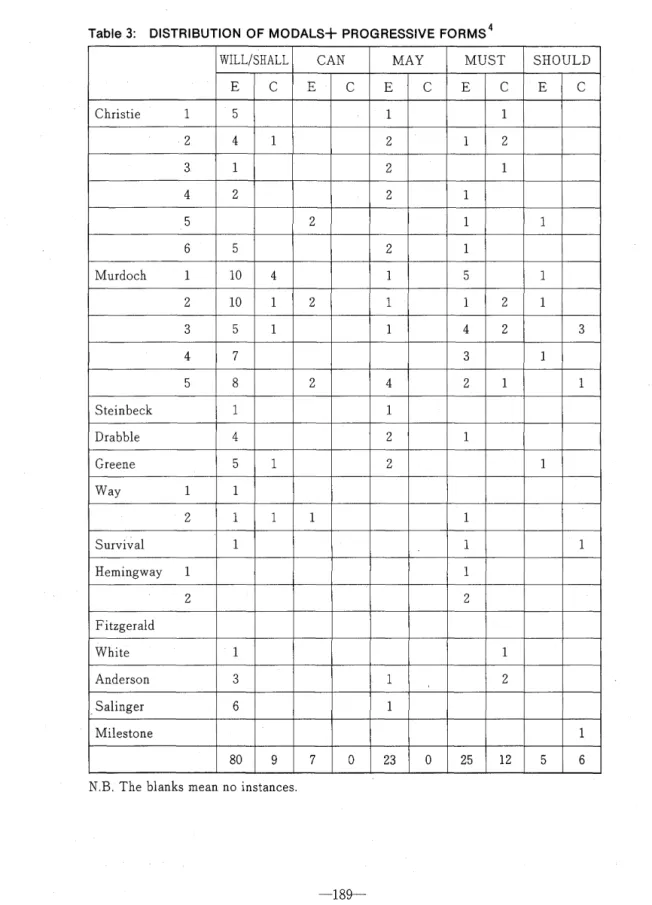
認識様態的意味を持つもののみが進行形と共起が可能であるというO ところが,実際の用例を小説 を中心にあたってみると,知的意味を持つ法の助動詞との共起とみられる例もかなりあるO これら は1must be goingが示す意味と平行的に丁寧さを表すときに使用されることが多いように思われ るoOtaが示したYoumust be going.はmustの意味が強いために,文法的には可能であるが,容 認度はかなり低いものであり,そのかわりに You have to/ should be going.のほうが使われやす い。法の助動詞と進行形との共起の現象は,意味論を越えて語用論的視点で検討を加える必要があ ろうO
1. This study tries to clarify the meanings of the modals with progressive forms. This syntactic combination is, so to speak, a melting pot, because we must discuss the relationship among the modals and tense and aspect. The discussion will be focused on the meaning of must followed by progressive forms, as is shown in the title of this paper. 1 assume that the 'must+ progressive forms' combination has a symbolic meaning of this study.
It seems that modals have not been discussed as extensively as tense and aspect. The rela‑ tionship among the modals and tense and aspect, therefore, seems to have been treated only by a small number of scholars. The scarcity shows that a great difficulty is lying in wait for us. Among the few studies to which considerable labor was clearly devoted, 1 was greatly enlight‑ ened by the two studies: Ota (1972) and Yasui (1989). It is interesting that two distinguished
J apanese scholars have directed their energies to the common topic. In my opinion, this coinci‑ dence implies that this kind of work demands exhaustiveness, which is the tradition of their Key words; Modals, Progressive Forms, Epistemic, Cognitive, Politeness.
THE MEAN1NG OF '1 MUST BE G01NG'
alma mater, and that there are signs that more attention has come to be paid to semantics This study consists of three parts. In the second chapter, we will chiefly survey Ota (1972) and Yasui (1989) and make the point at issue clear. In the third chapter, the numerical distribu‑ tion of the modals followed by progressive forms will be presented. For this purpose, 24 books were analyzed. The sources appear in the end of this paper. In the fourth chapter, the meaning of must followed by progressive forms will be discussed.
2. Both Ota (1972) and Yasui (1989) treat the subject of modals extensively. If we try to summarize the whole content, it will obscure the point at issue. Therefore, 1 will pick out and summarize the description which will be closely related to the possibility of the cooccurrence of modals and progressive forms
2
. 1 .
It is generally accepted that each of the modals has two basic meanings: one epistemic and the other cognitive.1 Ota chiefly treats five modals will, can, may, must and should. The meanings of them he shows are as follows.Table 1: MEANINGS OF MODALS
W1LL CAN MAY MUST SHOULD supposltlOn possi bili ty possi bili ty certalllty reasonable A prediction logical convlctlOn
pro babili ty necessrty
volition abi
1 i
ty permlsslOn reqU1rement obligation B habitualness capability dutylllslstence permlsslOn
Ota also shows a sample of the paraphrases of each modal‑2(E stands for epistemic' and C stands for cognitive') .
(1) WILL E 1 suppose that S 1 predict that S
I t
is probable that SC agree to, be willing to, insist upon CAN E
I t
is possible that SC be able to, be permitted to 1 t is possi ble for... to M A Y E
I t
is possi ble that SC be permitted to
‑184‑
THE MEAN1NG OF '1 MUST BE G01NG' MUST E It is certain that S
I t
is necessarily the case that S C be required to, have toIt is necessary for...to
SHOULD E There is enough reason to assume that S C be obliged to, ought to
Concerning this paraphrasing, Ota says in the footnote (p.44)
…
if the above interpretation is adopted, you will notice that the fundamental difference between the epistemic and the cogni‑ tive modals is that the paraphrases of the former contain that‑S with finite verbs, while the para‑ phrases of the latter contain infinitives. This may give rise to an important problem, but 1 don't have enough preparation to discuss it here." It seems to me that this remark really implies a very important problem. Here it is sufficient to say that infinitives" are closely related to futurity."The typical distinction between an epistemic modal and a cognitive modal is that the former can be followed both by a perfect infinitive and by a progressive form, while the latter is not followed by either of them.
Ota says that epistemic modals can be followed by a perfect infinitive with the full range of tense possi bili ties.
(2) a. He may/cannot/must/will have come by now.
b. He may/cannot/must/will have come yesterday.
C. He may/cannot/must/will have come by then.
Ota gives some exceptional examples of cognitive must (and have to) followed by a perfect infinitive, saying that they are either generic statements where no specific time elements are in‑ volved or in the case of specific statements they refer to potential, future events, and not to some specific past events. Two examples from Ota will suffice for the present.
(3) a. In order to use a word properly, one must have acquired the underlying concepts. b. You must/have to have completed the work by next April.
Ota says progressive forms following modals eliminate the potential cognitive meanings of the modals.
(4) a. He may/must/can't/won't travel now. (cognitive) b. He may/must/can't/won't be trave1ing now. (epistemic)
Here again, Ota adds that cognitive must/ haveωcan behave differently from the other modals. And his remarks have much to do with the following discussion. He says as follows.
Cogniti ve must and haveωcan be used with progressive forms, and in these cases time
THE MEAN1NG OF '1 MUST BE G01NG'
factor is the center of attention; that is, attention is focused upon the necessity of the im‑ mediacy of the action rather than upon the necessity of the action itself. This can be de‑ duced from the meaning of the progressive form, which is, according to Joos
( 1
964a) ,temporary validity of the predication'
Ota says that the following sentences have different meanings
(5) a. You must/have to be going. (= Your going is required to take place immediately or very soon.)
b. You must/have to go. (= Your going is required, but the time of going can be any time. )
Here Ota only gives the examples with the second person you as subject. He says without any explanation that 'He must be going' is ambiguous. More importantly, he gives no examples with the first person 1 as subject; that is,
(6) a. I must/have to be going. b. I must/have to go.
These will be discussed at greater length in Chapter 3.
According to Ota, epistemic will can express supposition about an event irrespective of its time of occurrence, but be going to can refer only to a future event. Therefore, he adds, be goingω
coincides with will only when the latter indicates prediction or supposition about a future event As a result of the summarization, we can get a picture of the relationship between the modals, including semi ‑auxiliaries, and the progressive forms. See Table 2.
Table 2: SUMMARY OF THE RELATIONSHIP BETWEEN THE MODALS AND THE PROGRES‑
SIVE FORMS
be able to have to
c c
progressive I + I一 1+1一 1+1+ I + I一 1+1一 │ 一 +
E
一
+
N.B. 1. 1n the case of cognitive must/ have to
,
attention is focused upon the necessity of the immediacy of the action.2. 1n the case of be going to, it indicates prediction or supposition about a future event.
be going to
2.2. Yasui