Collaboration between a University and Local Communities : A Case of Shizuoka University
著者 Hizume Kazuyuki
journal or
publication title
静岡大学法政研究
volume 23
number 3‑4
page range 212‑202
year 2019‑04‑30
出版者 静岡大学人文社会科学部
URL http://doi.org/10.14945/00026666
Kazuyuki Hizume
Introduction
This paper focuses on the relationship between a University and Local Communities working on solving various regional problems, and is based on the experiences of Japanʼs Shizuoka University.
First, I discuss the challenges faced by local governments in Japan. Re- cently, the major challenges faced by Japanese society are aging and a declining birthrate. In Japan, an elderly person is defi ned as an individual aged over 65 years. The percentage of elderly people is said to be the “ag- ing rate”, namely “koureika ritsu”, and has increased to 26% of Japanʼs total population. The birthrate was the lowest in 2005, 1.26. And it was 1.43 in 2013.
The increasing number of aging people and declining birthrate have a major impact on the economic situation of Japan as a whole and its re- gional areas. In other words, because the production age population (aged 15 to 64 years) is decreasing, there is a shortage of workers.
論 説
Collaboration between a University and Local Communities
― A Case of Shizuoka University ―
11
This paper is based on my PowerPoint slides presented at the International Workshop
on “Engaged Scholarship and Smart Social Governance” which was held at National
Chengchi University (Taiwan) on December 14 and 15, 2018.
Therefore, Japan, in 2019, is experiencing a serious workers shortage.
Moreover, the increase in the number of elderly people also increases the pension and medical expenses, which has had a substantial influence on Japanʼs fi scal defi cit.
Next, regarding this phenomenon, I discuss the challenges faced by Japanʼs local governments. Currently, the most substantial problem is that the eco- nomic disparity between Tokyo and medium and small sized cities across Japan. The economy and the population have concentrated in Tokyo, and the migration from the local cities to Tokyo is particularly large. The num- ber of cases where high school graduates from local cities went to college in Tokyo, did not return to their hometowns, and continued living in Tokyo to get married and have a family is increasing.
This migration from local cities directly affects the regional economy, causing a vicious circle where migration leads to a shrinking regional economy and thus additional migration and a shrinking population. There- fore, the critical concern in todayʼs Japanese society is how to strengthen regional economies.
Table 1 shows the number of Japanese cities by population as of Oct 1, 2015. The Japanese local government system is a two-tier system: prefectures and municipalities. For example, I reside in Shizuoka Prefecture and also I reside in Shizuoka city, the capital city of Shizuoka Prefecture.
The population of Shizuoka Prefecture is approximately 3,670,000, mak- ing it the 10th most populated prefecture in Japan. There are 35 cities and towns in Shizuoka Prefecture. The population of Shizuoka city is approxi- mately 690,000 people.
Next, I consider the problems faced by Japan. I examine how the Japa-
nese central government is attempting to respond to these problems.
After 2012, the second Abe administration began. The core policy in the Abe administration was “regional revitalization”. The central government and local governments have formulated comprehensive strategies aimed at
“regional revitalization” and are promoting this concept.
One of the agencies in the Japanese central government is the Ministry of Education, Culture, Sports, Science and Technology (MEXT). MEXT, the agency responsible for overall educational policy in Japan. It controls the national university corporations to which I belong, and also grants subsidies to Japanese universities (including national university corporations and private universities) that manage regional issues to advance “regional revitalization”; these programs are called the Center of Community (COC) and the Center of Community plus (COC+) program. These two programs are almost the same. Basically, the local universities collaborate with local governments and companies to create local employment, and promote
Population Prefectures Population Cities Special
Wards Population Towns
& Villages Over 10
million 1 Over 1
million 11 Over 50,000 4
Over 5
million 8 Over
500,000 16 7 Over 40,000 16
Over than 3
million 1 Over
300,000 44 6 Over 30,000 48
Over than 2
million 9 Over
200,000 43 7 Over 20,000 95
over than 1
million 21 Over
100,000 152 2 Over 10,000 278
Under 1
million 7 Over 50,000 265 1 Over 5,000 241
Over 30,000 177 Over 1,000 218
Under
30,000 82 Under 1,000 28
Total 47 Total 790 23 Total 928
Table 1. Local Governments by Population
as of October 1, 2015(CLAIR P4)
programs to develop the regional economy.
Shizuoka University was adopted by MEXT for the COC + program in 2015. Figure 1 is a map, and Shizuoka Prefecture is located in almost the center of Japan. Shizuoka city is located at in the center of Shizuoka Pre- fecture. Additionally, Shizuoka city is between Tokyo and Nagoya. By using the Shinkansen, the duration of a trip between the two cities is an hour.
Therefore, approximately 70% of high school graduates in Shizuoka Pre- fecture go to Tokyo or Nagoya to attend universities or fi nd employment.
The proximity between these two big cities may result in an irresistible lure for young people.
Outline of the COC+ Program
In this section, I introduce the COC + program at Shizuoka University.
Currently, 42 universities in Japan have been adapted into the COC + programs. The period during which this subsidy is issued is fi ve years (2015
―2019), and 2019 is the fi nal year. MEXT seems to consider that a program continues even when the program ends.
The outline of the COC+ program at Shizuoka University is as follows:
⑴ train human resources to support the future of Shizuoka Prefecture; ⑵ increase the proportion of student getting employment in Shizuoka Prefec- ture (i.e., increase the proportion by 10% to 50%); and ⑶ create a new industry. The system to promote such a program is as follows.
Shizuoka University has created an organization to promote the COC+
program, but the keyword is collaboration, i.e., a framework in which
various organizations cooperate to realize common goals. As of 2018, the
institutions in the region cooperating with Shizuoka University were as
Figure 1 . Japan, Shizuoka and Shizuoka University
follows: 7 educational institutions (e.g., other universities), 56 regional enterprises (e.g., banks), and all 35 cities and towns in Shizuoka Prefecture.
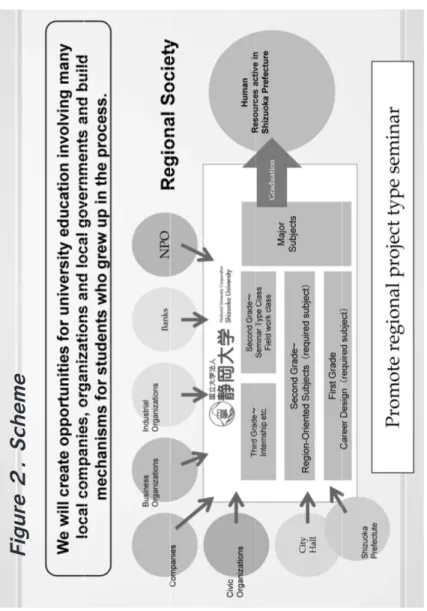
The Shizuoka COC+ Collaboration Council has been established to regu- larly evaluate the promotion situation. ( Figure 2 )
Figure 2 . Scheme
Contents of the COC+ program at Shizuoka University
In this section, I discuss a concreate program at Shizuoka University. The University introduced “region-oriented subjects” in the curriculum of the university to provide the information about the region. Then, to foster hu- man resources active in the region, a degree program was launched within the “School of Regional Development (SRD)” in 2016. Approximately 150 students have chosen this degree program. When freshmen enter in 2019, SRD is completed until the fourth grade.
The aforementioned “region-oriented subjects” are for all the students at Shizuoka University. Further, the university is implementing a seminar called the “regional collaboration project” that applies problem-based learning.
Figure 2 shows the educational system in cooperation with the area sur- rounding Shizuoka University. In the fi rst year, the subject of career design is a compulsory subject and opportunities are provided for students to consider their future professions. In the second year, students take “region- oriented subjects”. In the third year, internships are required. Additionally, students are required to participate in seminars and fieldwork starting in the second year. In addition to those subjects, students graduate after learn- ing the main subjects of their choice. To develop these programs, a system has been established that cooperates with various local authorities such as Shizuoka Prefecture and 35 municipalities, NPOs, private enterprises, re- gional fi nancial institutions and economic organizations.
“School of Regional Development” at Shizuoka University
In this section, I introduce the “School of Regional Development (SRD)”,
an educational program at Shizuoka University. Each year 50 students en- ter this program. The curriculum has basic subjects and applied subjects, as well as seminars and fi eld work as compulsory subjects. The character- istics of fi eld work are as follows:
First, the students participate in the same field and perform the same field work for 3 years from the first to the third years. Second, a team of fi eld workers is organized beyond the specialty. There are fi ve courses on SRD, but students enrolled in those courses intersect and perform field work.
Third, students participate in the same fi eld for several years to fi eld work to contribute to solving regional problems.
Figure 3 shows the basic policy of team formation in the fi eld work. The five courses are as follows and are completed in the following sequence:
regional management course, regional environment and disaster prevention course, sports promotion course, art management course, and community involvement course. The team formation of fi eldwork is performed so that the number of students on a team is even. Notably, this policy is the most diffi cult task.
Figure 4 shows the area of field work currently being implemented.
Recently, fi eld work has been carried out in 13 areas inside Shizuoka Pre- fecture. The fi eld work areas are divided into three categories: seven urban areas
2, four rural areas
3, and two coastal areas
4.
2
The main problem in urban area is the decline of shopping districts. Students and the local people are starting various eff orts regarding how to activate shopping districts.
We are also considering what types of initiatives are required to enhance the appeal of urban areas.
3
The main problems are a declining population and an increasing aging population.
Although Sakuma area once fl ourished in forestry, there are now areas where aging has progressed and it is becoming diffi cult for joint eff orts in local communities.
Therefore, students and people in the community are working together to discuss what
is needed to revitalize the declining area.
4