December2010
Economics Society of Nagasaki University
How Can Incumbent Manufacturing Firms Design and Implement e-service ?
: A case study on a heavy machinery manufacturing firm
Nobuhiko Nishimura
How Can Incumbent Manufacturing Firms Design and Implement e-service ?
: A case study on a heavy machinery manufacturing firm
Nobuhiko Nishimura
Abstract
In recent years, although many incumbent manufacturers are seek- ing sources of revenue from service using web technology(e-service), many such firms have failed to succeed. In this study, three major per- spectives relating to service business are reviewed, followed by an in- depth case study on a new e-service business design and implementation initiative at a heavy machinery manufacturing firm to examine the ap- plicability of these perspectives and to discuss the implications. It is thus confirmed that profitable e-services can be designed based on stra- tegic fitting to capability and position already built by the firm in its con- ventional business, with repeat prototyping to elicit potential customers' requirements. The resulting e-service system makes the service offering complementary to and dependent upon products the firm manufactures to raise the entry barrier against competitors. Furthermore, back office improvements are considered to be essential to implement e-services, especially for firms having complex and lengthy supply chains such as in the heavy machinery industry. Key success factors in the context of back office improvements are discussed.
Keywords:service science, B2B, e-commerce
Manufacturing firms tend to seek ways of adding the value in the form of services that will improve their bottom lines after their products start to become commodities
(Reinartz and Ulaga
). Heavy machineries industries, for example the design and construction of thermal and nuclear electric pow- er plants or oil refinery plants, have been conventionally viewed as high-tech industries founded on substantial research and development investment and the accumulation of various kinds of knowledge and skill. However, the com- moditization of formerly high-tech products has proceeded in recent years due to the entry of emerging countries into these industries using simulation technologies, computer aided design
(CAD
)and computer aided manufac- turing
(CAM
)applications with much lower investment than the original technologies, which were developed through large scale and extensive ex- periments and demonstration tests executed in laboratories, and with global procurement of special equipment.
As the profitability of these industries is increasingly eroded due to con- vergent rivalry, incumbent manufacturers are seeking appropriate responses. One solution is production in emerging countries to compete on the basis of cost by establishing manufacturing facilities, and
/or alliance with or merger and acquisition of manufacturers in emerging countries.
Another solution is to add value in the form of services applied to products or installations in operation. It should be noted that after-sales service is also facing the competition with independent service providers
(ISPs
)as the commoditization proceeds, in spite of efforts to erect barriers to entry through long term service agreements
(LTSAs
).
Manufacturers are thus attempting to mix products with services in an effort to boost revenue, as presented by Shanker et al. Hybrid solutions or hybrid offerings
−products and services combined into innovative offerings
−
can help manufacturers guard against entry by the ISPs. A highly success-
ful example of this approach, albeit in an unrelated industry, is Apple's product, the iPod, and related services in the form of the iTunes music store.
For Apple and many other companies, hybrid solutions have spurred growth and helped reverse market-share or profit decline. While the promise of hybrid solutions is attractive, it is also easy to them wrong. Analysts have categorized these solutions into four segments based on two underling characteristics, a
)complementarity, or the degree to which the value to the customer increases when the product and the service are used together, and b
)independence of the service to the product. However, little has been men- tioned about how to design appropriate hybrid solutions in specific indus- tries.
From a strategic perspective, Hax and Wilde have proposed the Delta Model as a new approach to strategy development for incumbent manufac- turers launching e-business initiatives. They proposed four contributes,
The Triangle
(a new set of strategic options
), The Adaptive Process
(linking strategy and expectation
), The Metrics
(aligning aggregate and granular metrics to strategy
), and Experimentation and Feedback
(ex- perimenting in business transformation and monitoring performance
). On the other hand, Porter reported that his strategic positioning theory con- tinues to have great relevance to management in the internet era. In either case, although the authors argue for the application of strategic management to the design of e-business, few studies have been carried out to illustrate how incumbent manufacturers can actually launch e-business initiatives
(Phan et al.
).
The aim of the study presented here is to examine the key success fac-
tors for the design and implementation of hybrid solutions using internet
technology through an in-depth case study of an e-service initiative in a
heavy machinery manufacturing firm.
E-BUSINESS STRATEGIES AND FRAMEWORKS
Conventional After-Sales Business
The heavy machinery manufacturing industry, such as fossil
/nuclear power plant or oil refinery plant manufacturers, was selected for study, as there are few works on e-business in this industry taking a long term per- spective. The typical after sales service in this industry has been composed of the repair or replacement of components or parts that are likely to fail in near future due to aging, or modification of hardware or software to improve plant efficiency or capacity. Although the value to the customer is the prediction of damaged components or parts based on the knowledge and ex- perience of damage mechanisms, or else suitable modification proposals that meet the customer's potential requirements, the profit is not obtained from the service but from selling products. Namely, the cost of the service is retrieved from payments for products that are repaired, replaced, or upgrad- ed.
Previously, in the interest of plant reliability, customers exclusively con- tracted such work to the original equipment manufacturers
(OEMs
). As there this involved little or no competition, OEMs had the benefit of highly profitable businesses. Recently, however, companies engaged solely in after- market services have entered the industry. These are known as ISPs, or in- dependent service providers. They independently produce various kinds of parts that the OEMs have traditionally manufactured, using reverse en- gineering technology
(a method of producing items by means of precise 3D dimensional measurement of existing items and then evolving the measured data to the design drawing of CAD data
).
After receiving an after-sales service proposal from the OEM, plant
owners now typically make the inquiries about parts not only to the OEM
but also to ISPs. The more intense the competition, the lower the profits the OEMs can obtain from the after-sales service business. Consequently, OEMs have been trying to raise barriers to prevent ISPs from entering the market by means of long term service agreements with customers, requiring exclu- sive OEM parts supply in exchange for availability assurance by the OEM.
As the commoditization of plant equipment has progressed, and as customer experience and knowledge of operation and maintenance has developed, long term service agreements have been attracting fewer customers in this segment of the industry
(Polhemus,
2004). Incumbent companies are thus striving to build new service models in order to safeguard sustainable profits.
Delta Model
The Delta Model, proposed by Hax and Wilde, encompasses a set of frameworks and methodologies to help managers in the articulation and im- plementation of effective corporate and business strategies in response to the emergence of the internet. The technologies surrounding e-business and e-commerce have made available some new and powerful tools that allow completely different business approaches to become feasible. Hax and Wilde proposed three sets of strategic positioning:
Best Productpositioning, Total
Customer Solutionpositioning, and
System Lock-Inpositioning.
Best Product
positioning, i.e., classical positioning, aims for competitive
advantage based on the inherent characteristics of the product itself. Typical
inherent characteristics are price advantage or differentiation introducing u-
nique product features that the customer values and for which a premium
can be commanded. The price advantage is obtained by the firm's capability
to reduce the cost in its internal supply chain. In the internet era, this kind of
capability is imitated by means of best practice and benchmarking activities by competitors. As the low cost strategy also aims to deliver standardized products to mass customers, competition converges and industry profitabili- ty is reduced. In short, product differentiation is quite difficult in a commodi- ty industry or market. When the product becomes a commodity,
Best Productpositioning can hardly be expected to offer sustainable competitive advan- tage to the firm.
Total Customer Solution
positioning is a complete reversal from the
Best Productapproach. Instead of commoditizing customers, the firm seeks an in- timate and deep customer understanding and a relationship that allows the firm to develop value propositions that bond to each individual customer. In- stead of developing and marketing standardized and isolated products, the firm seeks to provide a coherent composition of products and services aimed at enhancing the customer's ability to create unique economic value. Instead of concentrating inwardly on the firm's own supply chain, the firm seeks to develop an integrated supply chain that links the firm with key suppliers and customers. Instead of focusing on competitors and imitating them, the firm redefines the ways to capture and serve the customer by putting together an overall set of corporate capabilities.
The System Lock-In
strategic positioning has the widest scope, and the
complementor assumes a key role in the value chain. A complementor is
a firm that engages in the delivery of products and services that enhance the
firm's own product and service portfolio. The prototypical example is
Microsoft and Intel, a magic set of complementors during the latter part of
the 20th century, which resulted in one of the most successful business ven-
tures ever. A company that achieves systems lock-in can exercise an enor-
mous amount of power. A
System Lock-Inposition is not always possible, however. One possible view, although not explicitly mentioned, is that the firm should transform its strategic positioning from
Best Productto
Total Customer Solutionas its products transform into commodities, and then watch for an opportunity to obtain
System Lock-Inthrough deep insights into the value chain.
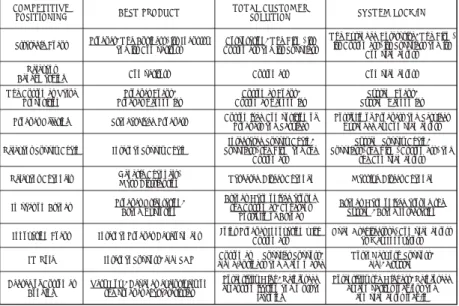
Delta Model characteristics of strategic positioning are listed in Table 1.
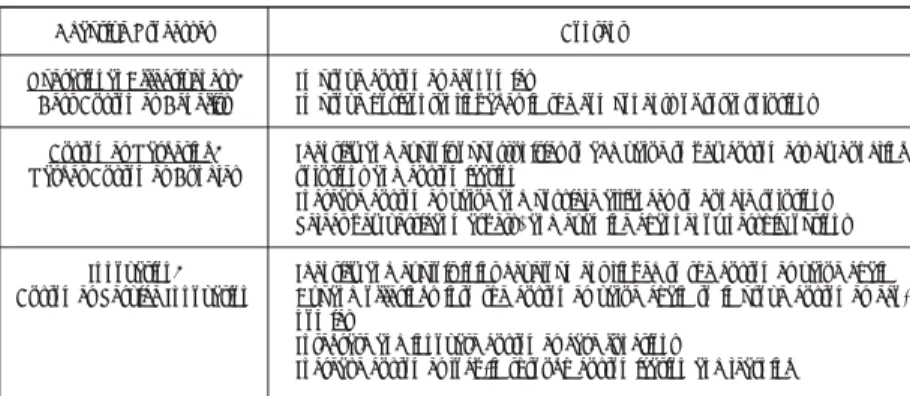
The execution processes required to achieve each strategic positioning are termed adaptive processes , three of which are defined in the model: Oper- ation Effectiveness, Customer Targeting and Innovation. Table 2 shows the list of the adaptive processes to obtain the
Total Customer Solutionposi- tion.
Table 1. Characteristics of Strategic Positioning in the Delta Model
COMPETITIVE
POSITIONING BEST PRODUCT TOTAL CUSTOMER
SOLUTION SYSTEM LOCK-IN
Strategic Focus Product: The Business, its Industry and its Competitors
Corporation: The Firm, its Customers and its Suppliers
The Extended Enterprise: The Firm, its Customers, its Suppliers and its
Complementors Relevant
Benchmarking Competitors Customers Complementors
The Customer Value Proposition
Product Focus:
Product Economics
Customer Focus:
Customer Economics
System Focus:
System Economics Product Offering Standardized Products Customized Composition of
Products and Services
Portfolio of Products and Services Extended by Complementors Relevant Supply Chain Internal Supply Chain
Integrated Supply Chain:
Suppliers, the Firm and the Customers
System Supply Chain:
Suppliers, the Firm, Customers, and the Complementors Relevant Channels Generic Channels,
Mass Distribution Targeted Direct Channel Massive Direct Channel Impact on Brands Product Orientation:
Brand Explosion
Brands Harmonized around the Customer: Coherent
Portfolio of Brands
Brands Harmonized around the System: Brand Integration Innovation Focus Internal Product Development Joint Product Innovation with
Customers
Open Architecture, Complementors as Key Innovators IT Role Internal Support: e.g. SAP Customer & Supplier Support:
e.g. e-business and e commerce
Total Network Support:
e.g.: e-system Degree of Customer
Bonding
Very Low: Depends exclusively on the product characteristics
Potentially High: Reinforced by customization and mutual
learning
Potentially the Highest: Reinforced by competitor lock-out and
complementor lock-in
Table 2. Role of Adaptive Processes in Supporting Total Customer Solution Positioning
Adaptive Processes Content
Operational Effectiveness:
Best Customer Benefits
åImprove customer economics
åImprove horizontal linkages in the components of total solutions Customer Targeting:
Target Customer Bundles
åIdentify and exploit opportunities to add value to key customers by bundling solutions and customization
åIncrease customer value and possible alliances to bundle solutions åSelect key vertical markets, and examine channel ownership options Innovation:
Customer Service Innovation
åIdentify and exploit joint development linked to the customer value chain åExpand offerings into the customer value chain to improve customer eco-
nomics
åIntegrate and innovate customer care functions
åIncrease customer lock-in through customization and learning
Experimentation is the key for the responsible undertaking of major business transformation. Particularly when the firm wants to move from one strategic option to another,
(say from
Best Productto
Total Customer Solu- tion), one is forced to enter unknown territory, without a full understanding of the preferred path to follow. The way to resolve this challenge is to design a careful set of experiments aimed at collecting more thorough knowledge prior to committing to a full-scale organizational effort. The firm should select critical customers who are not necessarily the most important, profita- ble or biggest customers. These are customers friendly to the firm, willing to participate in joint activity that might generate significant mutual benefits, and whose business portfolios would provide valid lessons transferable sub- sequently to the entire customer community.
The final issue is feedback. After the firm has done all of the ex-
perimentation, it will need to modify the selected course of action and the
consequent strategic agenda to allow for unexpected changes in the basic
hypothesis. Thus the firm needs feedback. Performance must be measured,
monitored and followed up, while sufficient flexibility must be built into the
management system, organizational structures and resources in order to al- low for the proper changes to be made.
Hybrid Offering of Products and Service
In the Delta model, the transformation of the firm's strategic positioning from
Best Productto
Total Customer Solutionmeans the expansion of its offering from products to compositions of products and services . However the Delta model does not describe the way to design the composite offering.
Shanker et al. termed the composition of products and services as a hybrid solution or hybrid offering . They indicated that many manufacturers, aiming at a hybrid solution to boost revenue through a product,
(e.g., iPod
)and a service
(e.g., iTunes Music Store
), failed to properly improve revenue because of insufficient knowledge of the hybrid characteristics. They proposed two underlying characteristics to determine how customers will value and use an offering. The first is complementarity, or the degree to which the value to the customer increases when the product and the service are used together. The iPod and iTunes, for instance, are highly complementary. The other is independence. Some goods and services are highly dependent and therefore must be bundled together. Other products and services are relatively independent. A power plant will function whether or not the customer purchases a long term service agreement.
Products and services that are highly independent are traditionally sold separately.
Viewing products and services through the lens of complementarity and
independence, Shanker et al. proposed four categories of hybrid solutions as
shown in Figure 1. Developing hybrid solutions can be challenging because
various combinations may have potential. A hybrid solution is most likely to
yield sustainable returns if the dependence between the product and the service can be increased and if the solution is scalable. In evaluating options, companies should keep in mind four rules related to differentiation, scalabili- ty, pricing, and branding.
Rule 1: Look for points of differentiation in product and service markets.
Rule 2: Scope the service and scale the product.
Rule 3: Assess the revenue and profit potentials of various hybrids.
Rule 4: Invest in the brand.
Peace-mind bundle åFor customers looking for the as-
surance from the company.
åL e v e r a g e a s t r o n g p r o d u c t brand.
Flexible bundle åSuitable for complex products
and serices.
One-stop bundle åNo additional value in itself;
rather, customers are attracted by reliabitiy of services and shop- ping convenience.
Multi-benefit bundle åThe products and services are in-
separable
Low High
Complementarity
Figure 1. Four Categories of Hybrid Solutions Independercy LowHigh
This analysis supports a multi-benefit bundle if revenue potential for the product or service is high but the purchase cycles of the product and the service are far apart.
Strategy and the Internet
As Shanker et al. have discussed, the dependency of the products and
services is a critical factor to boost revenue using a hybrid solution. The in- ternet is considered as a potential technology to increase the dependency.
However, Porter has warmed that it can be dangerous for firms to approach the internet as a new strategic activity.
He notes that the internet is not always positive: it tends to alter indus- try structures in ways that dampen overall profitability, and it has a leveling effect on business practices, reducing the ability of any company to establish an operational advantage that can be sustained. Internet technology provides buyers with easier access to information about products and suppliers, thus bolstering buyer bargaining power. Furthermore, the internet mitigates the need for such things as an established sales force or access to existing chan- nels, reducing barriers to entry. By enabling new approaches to meeting needs and performing functions, it creates new substitutes. Because it is an open system, companies have more difficulty maintaining proprietary offer- ings, thus intensifying the rivalry among competitors.
Porter suggests that the key question is not whether to deploy internet technology-companies have no choice if they want to stay competitive-but how to deploy it. As the average profitability of the industry tends to be lo- wered by the Internet, the way forward for less profitable average firms is the acquisition of a sustainable competitive advantage by operating at a low- er cost, by commanding premium prices, or by doing both. These advan- tages can be achieved in two ways, operational effectiveness and strategic positioning.
The nature of internet applications makes it difficult to sustain opera-
tional effectiveness, due to easy imitation of the best practices of a given
firm's operational excellence. As it becomes harder to sustain operational
advantages, Porter points to the strategic positioning as becoming more im-
portant. He proposes six principles of strategic positioning as follows:
①
It must start with the right goal: superior long-term return on invest- ment.
②
A company's strategy must enable it to deliver a value proposition, or set of benefits, different from those that competitors offer.
③
Strategy needs to be reflected in a distinctive value chain.
④
Robust strategies involve tradeoffs. A firm must abandon or forego some product features, services, or activities in order to be unique at others.
⑤
Strategy defines how all the elements of what a company does fit together. A strategy involves making choices throughout the value chain that are interdependent; all a company's activities must be mutually reinforcing.
⑥
Strategy involves continuity of direction.
The value chain is the key to considering the strategy of the internet chain-the set of activities through which a product or service is created and delivered to customers. Because every activity in a firm's value chain in- volves the creation, processing, and communication of information, informa- tion technology has a pervasive influence on the value chain. He states that the internet should be used as a complement to strengthen the strategic positioning that the firm has already obtained, and that the firm should care- fully design new composites of virtual and physical activities which could not be offered before the internet emerged.
In this study the above-mentioned perspectives on services and the in-
ternet are considered based on an e-business initiative designed and im-
plemented in a heavy machinery manufacturing firm, so as to propose a new
or modified perspective on strategy for the implementation of services with
internet or e-service aspects.
CASE STUDY
Background and Method
The firm examined is a Japanese manufacturer of large-scale machinery and equipment, with the specific e-business implementation project consist- ing of after-sales service in a SBU focused on thermal electric power plants.
In the thermal electric power plant industry, Japanese manufacturers deve- loped advanced power plants having the highest efficiencies and the lowest environmental loads in the
1990s, and maintained top shares in the global market. In the
2000s, it was no longer possible to rapidly improve efficiency due to various technical and economic issues. Meanwhile, the global market has shifted sharply from the industrialized countries
(where the demand for electricity has essentially been saturated, and where coal cannot be easily used in new installations as a result of global warming and environmental is- sues
)to emerging countries. As a result, intense rivalry has developed with Korean and Chinese manufacturers who have accumulated technologies from Japan, and the profitability and share of the Japanese manufacturers thus dropped precipitously in
2000s.
The Japanese firms have made efforts to expand after-sales service for
customers who already own plants. In recent years, then, the after-sales
service business has bolstered the bottom line of the SBU in contrast to the
minimal profit of new power plant construction business. Most of the after-
sales service has consisted of replacement or repair of parts deteriorated
during long-term plant operation. Although the value proposition to cus-
tomers is to apply engineering analysis and non-destructive testing so as to
identify the parts which have deteriorated and may impact the availability of
the plant, the actual cost of this analytical and testing activity is added to the
sales prices of the replaced or repaired parts. The premium of the replace- ment and repair price has traditionally been paid by customers in exchange for the reliability of activities executed by the OEMs, who have dominated the market.
Recently, firms that offer replacement or repair services to the plant owner independent of the OEM have entered the market. These indepen- dent service providers, or ISPs, typically utilize reverse engineering
(Sarkar and Menq
), by which the precise dimensions of an actual object are meas- ured using laser technology and computer aided design
(CAD
), drawings are made from the measurement results, and parts are produced
(i.e., co- pied
)using computer aided manufacturing
(CAM
)systems. Given that ISPs need not maintain a large-scale factory or a substantive research and de- velopment division, they can provide the replacement and repair work at considerably lower prices to plant owners. While plant owners have tradi- tionally paid a premium for the reliability offered by OEMs, ISP product reliability has been improving. Accordingly, plant owners are now request- ing proposals from ISPs as well as from OEMs for the replacement and repair work, i.e., work that was originally specified in OEM proposals based on detailed analysis and non-destructive testing. Predictably, the resulting competition has negatively affected profitability.
As OEM firms have suffered a battering of the after-sales service
profits resulting from convergent rivalry with IPSs, the OEMs have been
forced to consider alternative approaches. In the context of the current case,
the company's chief executive ordered a company-wide initiative for the
reconstruction of the service business, integrating the internet and
/or e-ser-
vices. The author of the present study, an ex-manager of the service de-
velopment section of the firm's research and development center, was asked
by the executive to lead the e-service component of the initiative.
This case study was carried out based on the author's experience ac- cumulated during the execution of the initiative, interviews with persons related to the initiative, and relevant internal materials. The initiative was led without the benefit of the managerial insights concerning e-business rev- iewed in the foregoing section. In the present study, the managerial perspec- tives on e-business detailed in the following section were examined through comparison with the case study, followed by discussion of the key success factors for e-business, especially as relating to the incumbent heavy machinery manufacturer examined.
Design of Strategic Positioning
The e-service initiative was carried out as a part of a larger company- wide initiative involving around a dozen SBUs in the company. The chief de- velopment officer for the larger initiative was the executive deputy president of the firm.
The original e-service concept envisioned by the thermal power plant SBU was the implementation of an e-commerce internet system handling spare parts for customers. The SBU had experienced failure of the launch of an e-commerce system several years previously. The original implementa- tion team managers attributed the failure to 1
)un-modified conventional processes
(requiring human intervention in the SBU's internal supply chain using various documentation procedures and approval processes in several sections of the SBU
)resulting from a lack of cross sectional development and implementation processes, and 2
)the fact that customers were forced to input procurement details into the system, even though they had previous- ly been ordering using their own procurement systems.
Based on this failure experience of the e-commerce system, the new de-
velopment team started with a pilot initiative targeting just a few customers.
Although this process was mentioned in the Delta Model, the model de- velopers placed it after completion of system design. In the case study reported here, the development team placed this aspect at the very begin- ning of the system design process, mainly because of their poor knowledge of customer procurement processes. In the Delta Model, they would have been able to obtain detailed knowledge of customer economics based on the iteration process of prototyping for targeted customers.
Two target customers were selected, one being an in-house energy sup- plier in newly constructed oil refinery plant in the Middle East, and the other being an independent electric power producer in South East Asia. These particular customers were chosen for the following reasons: 1
)They were presumed to feel less secure in terms of support from the OEM due to their distant locations from Japan, 2
)they had less knowledge of plant operations and maintenance, and 3
)their managerial systems had not been rigidly es- tablished, since they had just started their respective business operations.
The launch of a standard type e-commerce system for the supply of spare parts could not improve profitability, given that prices would still be in competition with the ISPs. Furthermore, as indicated in the failure of the previously launched e-commerce system, system requirements might incon- venience customers having their own business systems in place. The team thus focused on their own strategic position that had already been estab- lished. This process is coincident with Porter's perspective of not using the internet to cannibalize the existing strategic positioning, but using it instead to complement the strategic positioning already in place.
The project team thought that the applicable strategic positioning con-
sisted of detailed maintenance-related knowledge of the plant components
designed by the firm. They therefore proposed to the targeted customers a
prototype system to recommend parts requiring inspection as a function of
operating hours, and to order parts easily from the recommended parts list.
Especially the customer in Middle East, who owned nine power boilers and eight steam turbines, was anxious about proper execution of one to four year periodic maintenance programs for the various components depending on their reliability or condition. Through discussion with the customer, the project team decided to add maintenance scheduling and recording functions into the revised prototype system.
The project team had provisionally decided to use the QR code system, a two-dimensional bar code developed by Denso Corp. of Japan, which has achieved worldwide popularity. QR codes would be attached to the parts being delivered, to facilitate receiving inspection at customer sites. The data of the QR code attached to the delivery was read by a portable QR code reader, transferred to the e-service system, reconciled with the order sheet data upon delivery, and confirmed by the OEM firm for invoicing. The cus- tomers were interested in the QR code system and asked to use it for their own stock management. The project team accordingly added a stock management function for customers' warehouses using the QR code system.
This function is now receiving favorable responses from customers, and is expected to contribute to higher entry barriers against ISPs.
This process is quite similar to the joint innovation with customers as described in the adaptive processes of the Delta Model. However, cus- tomers' potential needs are not necessarily obvious unless the originating firm supplies relevant ideas in a prototype system. Therefore, it is consi- dered that early prototyping is indispensable for service innovation with cus- tomers.
Moreover, according to Porter's perspective, innovation using the inter-
net should be based on existing strategic positioning or the superior compe-
tence of the firm as viewed by customers. In the case under consideration,
the project team clearly defined this competence as consisting of main- tenance technology and knowledge, and targeted the customers for which this competence was presumed to be the most effective. Before this system was launched, the relevant competence could not be sold customers directly because the service proposing the optimal maintenance scheduling to cus- tomers was independent and non-complemental to the product required for the maintenance. As Shanker et al. pointed out, this combination of service and product is a Peace-of-Mind Bundle as shown in Table 3. The bundle is effective for customers seeking assurance from the company and for the company to leverage its strong product brand. Shanker et al. suggested that the company should transfer to a Multi-Benefit Bundle if revenue poten- tial for the product or service is high but the purchase cycles of the product and the service are far apart. This bundle features low independence and high complementarity between service and product. The new internet sys- tem linked the service to products, transferred the bundle from Peace-of- Mind to Multi-Benefit, and substantially raised the switching cost.
Given that the system was designed jointly with customers as shown in the Adaptive Processes of the Delta Model
(see Table 2
), it was not im- plemented as an e-commerce internet site but rather as a plant management support system which included inventory management for the customer's warehouse, maintenance scheduling, and records management within the customer's value chain.
Design and Implementation of E-business
(1) Problems in the Business Process
The SBU examined has a suitable work flow for producing power plants
worth USD several hundred million, one by one. Each plant is designed and
constructed as a one-of-a-kind installation according to specific customer re- quirements, and the ratios of sharing and parts standardization in and among different plants are low. The business process involved in manufacturing such large-scale machinery is quite complex, and the supply chain extends across several sections.
At the same time, approval with paper documents by each section and sub-section manager is needed for procurement of consumables ranging in value from USD
100to one million, and the required slips prepared by the various sections in the supply chain reaches
30or more for each procure- ment. There is a complicated legacy system for procurement, which has been in effect for more than ten years with repeated minor and major modifi- cations.
The magnitude of the process and of the data base has increased to the extent that trouble can occur in the supply chain. There is a unique ID code system composed of more than one hundred characters to identify the cate- gory of part, material, size, manufacturer and other attributes. However, as nobody inputs the precise ID code for each instance of procurement, the procurement record cannot be used as a database. In addition, the same in- formation such as order number or name of customer must be input in- efficiently several times in the various sections at different steps in the wor- kflow.
(2) Launch of Project Team and Top Manager's Commitment
It was essential to improve the procurement and delivery processes in
the back office system in order to make the e-service system a success. A
cross-sectional project team was therefore ordered by the chief development
officer
(CDO
), who was also the leader of the previously failed e-commerce
system. The project team was composed of members from the product sales
division, the service sales division, the design division, the procurement divi- sion, the distribution division, the information system division and technical headquarters. As was evident from an interview with the CDO, he clearly recognized that a key success factor of the e-service system was the han- dling of back office processes, while a key success factor in this handling ap- proach was the empowerment of the cross-functional team and the top manager's commitment based on his previous experience of failure.
The importance of the top manager's commitment to IT initiatives has also been reported by Brown et al., by McAfee, and by McDermott. Most top managers have also recognized the importance, and the problem is generally considered to be the substantivity of their commitment. In con- crete terms, most managers are committed at the beginning of the initiative, but this commitment tends to weaken over the course of development. The CDO led a weekly meeting to follow up on progress and to identify any managerial problems, also organizing the monthly division managers' confer- ence to ensure the detailed cooperation items requested for the e-service in- itiative.
(3) Business Process Analysis
The project team started with the business work flow analysis of the current state. They corrected and analyzed documents and data recorded in the legacy system, addressing the entire process from customers' estimate requests to the correction of bills for actual orders of spare parts. As a result, it was found that 38 slips were prepared in each section in the process from parts estimate requests to the collection of bills, and that it took from one month to several months for the whole process to be completed.
A dedicated worker was stationed in each section solely for the input
work to the legacy data system necessary for preparing these slips in each
order. As noted above, the data record could not be leveraged as a database, so corresponding data sheets were originally created in each section separately for repeat orders from customers. Accordingly, they searched for the data record from their own data sheets to retype it into the legacy system for each order of spare parts.
An example of processing a spare parts order for a certain pump is shown. The customer identifies the needed part from the design drawing provided by the manufacturer. As there is no ID number stated for minor parts in the drawings provided, the customer requests an estimate for the outlet gasket of pump number aaa of drawing number zzz . The designated worker in the corresponding design section locates the detailed drawing to determine the ID code of the part
(s
)from the information in the customer's inquiry, and identifies the part ID number given by the pump vendor. Since the dimensions, weight and material used must be input into the legacy sys- tem, the worker prepares the inquiry sheet to the pump vendor for the infor- mation and dispatches it after approval by the section manager. These ac- tions are almost all performed manually. When the customer requests another estimate for the same parts, the worker must basically carry out the same process again. To circumvent such time-consuming processes, workers made their own datasheets of information of the parts ordered by each cus- tomer.
The process timing of each task was analyzed quantitatively, revealing
that the most time was consumed in queues for worker and section manager
approvals. The net working time was confirmed to be less than ten percent
of total process time.
(4) Solutions
While the power plant itself is designed and manufactured individually according to the customer's specific needs, many of the same types of equip- ment, such as valves, pumps, and heat exchangers, are installed into differ- ent plants. Such equipment is procured via lump sum purchases from ven- dors when manufacturing a new power plant. On the other hand, many parts needed for maintenance are smaller components, such as gaskets, gears, bearings, and impellers. There are no design drawings or ID codes for these parts from the plant manufacturer.
The main problems in the back office were a
)that the procurement process involving parts for the maintenance of existing power plants had to be carried out according to the same procurement process as much more ex- pensive equipment required for the manufacturing of new power plants, and b
)that there were no unique ID codes for minor components of equipment supplied by vendors.
The project team then conferred with the information system division and management control division as to whether the supply chains for new power plants and for after-sale service could not be separately undertaken.
These divisions disapproved the proposal because of the possible confusion resulting from a dual procurement process. The project team then decided to assemble a Bill of Materials
(BOM
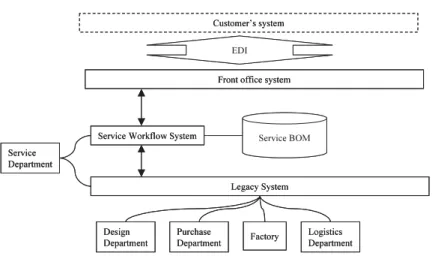
)database exclusively for service parts and link it to the legacy system through a service workflow arrangement, so that e-service system back office processes could be highly automated without re-constructing the legacy system and its workflow.
The system configuration of the e-service system is illustrated in Figure 2.
Figure 2. E-service System Configuration
The next problem to be solved was the data interaction between cus- tomers' systems and e-service system. Various applications were installed to serve as customers' management systems. As Medjahed has noted, there are several types of business-to-business
(B2B
)interaction technologies. The project team started the interaction with basic electronic data interchange
(EDI
). The collaborative business process was discussed thoroughly and es- tablished with customers. Data was initially translated into CSV file format by means of mapper software. The translated CSV file was then read as the input data for the corresponding system of the other company. Using this method, the data translating process should be determined on a customer- by-customer basis. Currently, XML based interaction is under development.
When this is completed, seamless data interaction can be achieved with cus-
tomers running different maintenance applications, and will also help the
OEM to raise barriers to entry against ISPs.
DISCUSSION AND IMPLICATIONS
The e-service system that was developed corresponds to the transition of strategic positioning from
Best Productto
Total Customer Solutionin the Delta Model. Here, examining an important aspect that the Delta Model does not describe, is the section that considers the actual transition of this strategic positioning.
Traditionally, the design division and the technological development di- vision had a central role for new product development activity. Focusing on the differentiation of their products according to
Best Productstrategic positioning, these divisions have comparatively low capability in terms of in- sight into individualized customer's potential needs. In contrast, the e-ser- vice development was led by the service sales division and service technolo- gy division. Having high sensitivity to customer economics, these divisions had perceived a sense of crisis that the
Best Productstrategic positioning was no longer effective in their market. It is thus considered to crucial that the division having high sensitivity to customer economics and market circum- stances leads the development project to transfer the strategic positioning from
Best Product to Total Customer Solutionand organizes the cross func- tional team. Durability of the top manager's commitment is also a top priori- ty in making the project a success.
The Delta Model argues that the transition of strategic positioning from
Best Product to Total Customer Solution and then to System Lock-In is
highly important when products become a commodity. However the model
developers do not touch upon the methodology to support the transition. One
of the most important things in this context is considered to be the full lever-
aging of the firm's existing source or competence to sustain the strategic
positioning by applying it to the potential needs of customers. A solution that
considers only customers' needs, imitated easily by competitors, can hardly be expected to contribute towards sustainable strategic positioning. This is coincident with Porter's perspective of Internet as Complement with the internet being leveraged to strengthen the positioning resulting from raising the entry barrier.
The needs elicited explicitly from the customer are easily obtained not only by the firm but also by its competitors. It is important, then, to obtain potential needs of which even the customers themselves are hardly aware.
Given that the solution
(s
)potentially provided by a specific service is difficult for customers to imagine using oral or documented proposals, rapid and repetitive prototyping is considered to be effective in identifying con- cealed and
/or potential needs of customers, especially in the case of internet service offerings.
Moreover, it is necessary to restructure the back office system to achieve the agility that customers expect of e-business. In particular, the business work flow of the enterprise that manufactures and sells a product that requires several years from the order to the delivery of goods
(such as the heavy machinery industry
)is tedious, and complex. However, construct- ing a business flow parallel to the conventional work flow can be counter- productive, and requires time in any case. It is thought to be an adequate so- lution, then, to automate tasks by constructing a BOM database and service workflow system, interfacing them with the legacy system without recon- structing the legacy system.
It is considered to be essential to interact thoroughly with customer's
managerial information system, in order to facilitate the customer's economy
according to
Total Customer Solutionpositioning. In the case study the inter-
action based on the EDI level was adopted. The interaction at the middle-
ware level and workflow level could result in deeper linkage and understand-
ing of the customer's economy. Building trust with customers is needed to achieve deeper interaction, so as to rigidly raise entry barriers against com- petitors.
In this study the effort to improve the interaction with suppliers is not mentioned. The improvement of interaction with suppliers is essential to achieve agility in the e-service system. A system using public cloud comput- ing is currently under development, and the results will be presented in the near future.
CONCLUSIONS
As commoditization and convergent competition with emerging coun- tries has become increasingly evident in manufacturing industries, incum- bent manufacturers are seeking ways to obtain revenue from service activi- ties, a quest in which firms do not always succeed. This study was to evalu- ate the key success factors to design and implement service initiatives through a detailed case study of the launch of a service system utilizing the internet
(e-service
)in a firm in the heavy machinery industry, referring to the Delta Model of Hax and Wilde, the Hybrid Offering of Shanker et al., and the perspective of Porter on the internet.
It is concluded that key success factors to design a profitable service in- clude tightening of the relation between service and product using the inter- net, innovation leveraging existing strategic positioning of the incumbent firm, and rapid and repetitive prototyping of the system to elicit customers' potential needs.
It is also concluded that a key success factor in the implementation of a
service initiative consists of execution of back office agility improvement ac-
tivity by a cross-functional team led by service division sensitive to the cus-
tomer's economy and supported by the top manager's durable commitment.
In an industry having a long and complex manufacturing work flow such as the heavy machinery industry, the improvement of agility is essential in ob- taining customers' satisfaction. An agile work flow can be achieved so as to automate various activities in the conventional workflow using service BOM and work flow management systems, without modifying the legacy system.
REFERENCES
Brown, Susan A., Norman L. Chervany and Bryan A. Reinicke, (2007), What Matters When Introducing New Information Technology,Communications of the ACM,Vol.50,
No.9,91‑96
Denso Corporation,http://www.qrcode.com/index-e.html
Hax, Arnoldo and Dean Wilde II,(2001), The Delta Model−Discovering New Sources of Profitability in a Networked Economy.,European Management Journal,Vol.9,No.4,
379‑391
McAfee, Andrew,(2006), Mastering the Three Worlds of Information Technology.,Har- vard Business Review,Nov.2006,141‑149
McDermott, Richard,(1999), Why Information Technology Inspired But Cannot Deliver Knowledge Management.California Management Review; Summer99, Vol.41Issue4,
103‑117
Medjahed, Brahim, BoualemBenatallah, Athman Bouguettaya, AnneH.H. Ngu and Ahmed K Elmagarmid,(2003), Business-to-business interactions: issues and enabling technol- ogies,The VLDB Journal, Vol.12,No.1,59‑85
Phan, Dien D.(2003), E-business development for competitive advantages: a case study, In- formation and Management., Vol.40,581‑590
Polhemus, Scott A.,(2004), Cost Reduction Strategies for Gas Turbine LTSAs.,Power En- gineering, August2004,48‑50
Porter, Michael,(2001), Strategy and the Internet.,Harvard Business Review, March2001,
62‑78
Ratnasingam, Pauline,(2005), Trust in inter-organizational exchanges: a case study in busi- ness to business electronic commerce,Decision Support System, Vol.39,525‑544 Reinartz, Werner and Wolfgang Ulaga,(2008), How to Sell Services More Profitably.,Har-
vard Business Review, May2008,90‑96
Ribbers, Piet and Koen Mills,(2008), The role of IT Strategies, Architectures and Services in the Development of Network Economies,Information Technology for Development, Vol.14,No.3,179‑183
Sahaym, Arvin H. Kevin Steensma and Melissa A Schilling,(2007), The Influence of Infor- mation Technology on the Use of Loosely Coupled Organizational Firms: An Industry Level Analysis.,Organization Science, Vol.18,No.5,865‑880
Sarkar, B., and C.-H. Menq,(1990), Smooth-surface approximation and reverse engineer- ing,Computer-Aided Design, Vol.23,No.9,623‑628
Shanker Venkatesh, Leonard L. Berry and Thomas Dotzel,(2009), A Practical Guide to Combining Products and Services.,Harvard Business Review, November2009,95‑99 Tang, Nelson H.K., Prabhaker R. Yasa and Paul L. Forrester,(2004), An application of the
Delta Model and BPR in transforming electronic business−the case of a food in- gredients company in UK.,Information Systems Journal, Vol.14,111‑130
Voelpel, Sven C., Malte Dous and Thomas H. Davenport(2005), Five steps to creating a global knowledge-sharing system: Siemens's Sharenet.,Academy of Management Execu- tive, Vol.19,No.2,9‑23.