1
Geology, mineralogy, and sulfur isotopic studies of proximal volcanic products at the Tangkuban
Parahu Volcano, Indonesia.
Syahreza Saidina Angkasa
Submitted for partial fulfillment of the requirements of doctoral degree
Department of Earth Resource Science Faculty of International Resource Science
Akita University
May 2019
2
© Syahreza Saidina Angkasa, 2019 Supervisor: Prof. Tsukasa Ohba
All right reserved. The thesis has never been submitted for a degree.
3
Abstract
Tangkuban Parahu volcano is one of the most active volcanoes in West Java, Indonesia, although most of the recent eruptions were relatively mild (e.g., 2013 eruption).
However, there is still little information from the volcanic products in the proximal area. Here, we provide new documentation from the proximal volcanic succession, including tephra-stratigraphy, componentry analysis, and petrography of volcanic products. Detailed mapping of the proximal area shows that the volcanic products are predominantly composed of an alternation fine-clay and coarse ash, lapilli tuff, and pyroclastic breccia within 10 tephra units. Componentry of ash particles revealed the presence of five components, which associated with hydrothermally altered lithics, oxidized lithics, coherent crystalline lithics, magmatic juvenile and free crystal in entire eruptive products. These indicate that the subvolcanic hydrothermal system has been developed since the Holocene and associated with a continual introduction of magmatic intrusion. Petrographic observation shows the hydrothermal minerals of quartz or silica accompanied by alunite and kaolinite, which represents acidic alteration within the crater-conduit. The presence of the silicified zone indicates that the subvolcanic hydrothermal system plays an essential role as a cap-rock of pressurized gas and steam at depth (200-500 m), whereas magmatic injection caused the vapor plume expansion.
Our observation concluded that the proximal volcanic succession captured the evidence of coupled phreatic and phreatomagmatic activities during the latest development of Mt. Tangkuban Parahu.
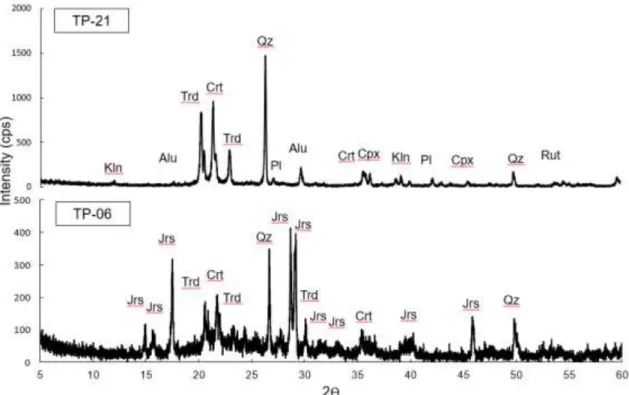
In order to understand the subvolcanic hydrothermal system condition, we carried out the mineralogy and sulfur isotopic signature of volcanic products from the proximal area of Tangkuban Parahu volcano. X-ray diffraction analysis reveals the majority of the hydrothermal mineral constituent. Silica polymorph (quartz, cristobalite, and tridymite) and alunite are dominant, whereas kaolinite randomly presents in some stratigraphic sections. Jarosite and goethite are abundant in the upper section of composite stratigraphy. The temporal mineralogical changing could reflect the depth of explosion or hydrothermal alteration development below the active craters, where
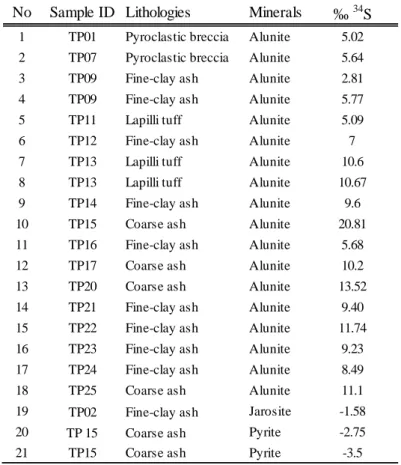
4 some jarosite and possibly represent highly oxidized conditions after the emplacement process. From petrographic observation, hydrothermally altered lithics consist of two primary ash particle types; 1) partly altered magmatic glass and 2) selectively to pervasively altered ash fraction. The later ash particles comprise four types hydrothermal mineral assemblages along with two evidence of hydrothermal veinlet feeders. Hydrothermal mineral assemblages are opal, opal + cristobalite + alunite ± kaolinite, quartz + alunite ± kaolinite, and oxidation of alunite + jarosite, whereas the veinlets are silica+alunite-kaolinite-goethite±APS and quartz-pyrite. The accessory minerals (pyrite, chalcopyrite, and enargite) also present in many ash particles. These alteration assemblages are classified as acid-sulfate alteration and argillic alteration, which mostly present at near-surface of geothermal field in calc- alkaline stratovolcanoes. Their presence also possibly rooted in high-temperature magmatic-vapor zone underneath the volcano.
5
Acknowledgments
The author would like to thank, first of all, to Allah SWT the Most Gracious and Merciful for allowing finishing the doctoral course at Faculty International Resource Science, Akita University. I want to say thanks to my supervisor Prof. Tsukasa Ohba and all professors and staff at Akita University, for their enormous support during the study period.
All petrology and volcanology group members and technical assistant in 2016-2019;
for their help and discussion.
Japanese Mobunkagakusho scholarship and New Frontier Leading Program are acknowledged to give full financial support for this project. This project also supported by JSPS Kakenhi; project no. #17K01319 and #15K01245.
Tangkuban Parahu volcano observatory staff (CVGHM) and the Natural Resource Conservation Center (BKSDA, for their assistance in providing logistics and sampling permits during fieldwork.
Faculty members and staff at Universitas Padjadjaran are thanked for providing assistance travel permits of the analyzed samples in this thesis. All Indonesian students and residences in Akita City, for their help and assistance.
Syahrul Syah and Rizky Amanda are thanked for financial and moral supports, which cannot be elaborate only with a single sentence or whole thesis.
Most special appreciation for my best partner, Adiis Retna Utara, who always supports me, especially during the “mental” thesis period. For Omar Salahaddin Angkasa and Syadia Nura Angkasa, happy to see both of you are growing up so well! Now, we are going back home to Indonesia, then three of you can do what you want! I will support everything for three of you in the future!
Lastly, if you (person or/and institution) have not mentioned and feel that you should be acknowledged for this project, then consider yourself acknowledged.
6
Chapter 1 Introduction
1.1. Project outline
This thesis aims to evaluate the potential role of volcanic products from the phreatic and phreatomagmatic eruptions that commonly contain hydrothermally altered lithics by implementing field and laboratory techniques. The observations are beneficial for providing new volcanological records in volcano-stratigraphy, mineralogy, and sulfur isotope. The data in this thesis was collected from a selected stratovolcano within Sunda volcanic arc, Indonesia, namely Tangkuban Parahu volcano. The volcano has been very active during the last ten years, but there is still little information, explaining the volcanic activity from pre-historic and modern eruptive products. Therefore, the thesis can give a profound contribution to better understand the volcanic unrest in the past, which may deliver the necessary knowledge for future hazard evaluation.
This chapter summarises the motivation, aim, and structure of the project. The general structure of this thesis is based on two central chapters assessing the field and laboratory works. In the second chapter, the field and some of the laboratory works (i.e., tephra stratigraphy, stereoscopic, and petrographic observations) are presented as the general basis of geological understanding, and possible eruption process and history. For the third chapter, it will exclusively deliberate the mineralogy, textural variation, and sulfur isotopic signatures from hydrothermally altered lithics to get a new insight into the condition of the sub-volcanic hydrothermal system throughout the time. Additionally, the geological setting of the Sunda volcanic arc is summarized in this chapter. For more specific geological information of Tangkuban Parahu will be described in the next two chapters, which depends on the context of discussions on each chapter.
1.1.1. Project motivation I – field-based approach
The primary interest of this thesis is to evaluate the mineralogy of volcanic products.
However, it is difficult to connect the mineralogy and sulfur isotope results with the available tephra stratigraphy due to insufficient information from the field observation
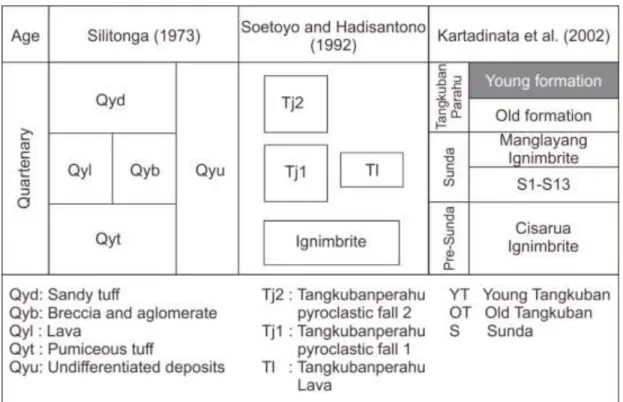
7 at the summit crater vicinity. In many previous works, they mostly only introduced brief documentation of stratigraphy (Fig. 1.1) and geological condition at the proximal area (e.g., Stehn, 1929; Silitonga, 1973; Hadisantono et al. 1989; Sutoyo and Hadisantono, 1990). In this context, the presence, significance, and importance of the Tangkuban Parahu proximal volcanic products are still understudied.
Figure 1.1 Summary of Tangkuban Parahu stratigraphic development from the 1970s to 2002.
A most recent study from Kartadinata et al. (2002) and Kartadinata (2005) (Fig. 1.1 and Fig 1.2) has put an effort to characterize the volcanic products from old (Pliocene- Pleistocene) and young (Holocene) volcanic events. Moreover, Kartadinata et al.
(2002) revealed the eruption history for youngest evolution stage of Tangkuban Parahu volcano (Kartadinata et al., 2002; Nasution et al., 2004). The results provided a significant development of Tangkuban Parahu volcano-stratigraphy (Fig 1.1). The volcanic succession comprises two main formations of Old and Young Tangkuban Parahu (OTP and YTP, respectively). OTP Formation (c. 0.1 Ma; Sunardi and Kimura, 1998) was relatively well-studied in Kartadinata et al. (2002) and (2005). Both previous works showed new data of radiocarbon dating, isopach map, and volume estimation from the Old Tangkuban Parahu volcanic products. For YTP Formation, they are mostly provided only brief information on the volcanic products, although the YTP
8 volcanic products are essential for decoding the recent volcanic activity outputs (e.g., phreatic and phreatomagmatic eruptions). Consequently, fieldwork was conducted to re-observe some outcrops and provide the new stratigraphy from YTP Formation, which mainly situated in the proximal area (see chapter 2).
Figure 1.2 The tephra-stratigraphy of Young Tangkuban Parahu formation from the previous research (Kartadinata et al., 2002). The composite tephra succession is ~7 meters in thickness, which mostly comprises the volcanic products from phreatic events younger than 10.000 BP.
1.1.2. Project motivation II – mineralogy and sulfur isotope-based approaches
Mineralogy, textural variation, and sulfur isotopic approaches were motivated by limited documentation of the characteristics of volcanic products from phreatic or hydrothermal and phreatomagmatic or magmatic-hydrothermal eruptions (Brownee and Lawless, 2001). Both eruptions are relatively small and not so attractive to
9 research. Therefore, it still provides many research questions that can be addressed, specifically in Indonesia. The volcanic products from both eruptions (phreatic and phreatomagmatic) predominantly contain hydrothermally altered lithics (e.g., Nairn et al., 1979), which can be used to estimate the sub-volcanic hydrothermal system below the active craters (Ohba and Kitade et al., 2005). Moreover, mineralogical based observation can give critical information to characterize the sub-volcanic hydrothermal system because the sealing capacity of pressurized fluid below the crater mostly provided by clayey layers or other hydrothermal mineral zonation (e.g., Wright et al., 1985; Pellerin et al., 1996).
In chapter 3, mineralogy and sulfur isotope were carried out from the volcanic products to understand better the condition of Tangkuban Parahu during the pre-historical era (i.e., phreatic and phreatomagmatic events). The focus was chosen to characterize the hydrothermally altered lithics, which is the most abundant component (e.g., volcanic rocks and magmatic juvenile; see chapter 2) in the volcanic products. The hydrothermally altered lithics are still fresh due to less intensity of weathering process and fewer vegetations at the summit of the volcano. In addition, The presence of hydrothermally altered lithics in all volcanic products allowing us to understand the temporal changing of the hydrothermal system within crater-conduit (Ohba and Kitade, 2005; Takahashi et al., 2016) from a material science perspective (Ohba and Nakagawa, 2002; Ohba and Kitade, 2005; Minami et al., 2016).
1.2. Project aims and objectives
The aims and objectives of this project are:
1. To document detail tephra-stratigraphy (e.g., lithological, volcanic facies, internal and external structure).
2. To document mineralogy, textural variation and sulfur isotope from the volcanic products.
3. To better understand the eruption process, mechanism and dynamic from the studied stratigraphy
4. To constraint condition of the subvolcanic hydrothermal system and its role during the eruption process, including zonation and overprinting relationship
10 Those aims can be achieved by several methods that will describe on methodology section in two central chapters (chapter 2 and 3).
1.3. Geological framework
The following section provides an overview of the geological setting from the studied area. This section intention is to give a brief introduction about the regional context since the Tangkuban Parahu volcano is a part of the volcanic chain within the larger Sunda volcanic arc.
1.3.1. Sunda volcanic arc
Sunda volcanic arc is located along the convergent margin of Indo-Australian and Eurasian plates with 6-7 cm/yr (centimeter/year) of movement speed (Fig. 1.3A). The Indo-Australian plate has been continuously subducted to the Eurasian plate since ca.
45 Ma (Tregoning et al., 1994; Hall, 2002) at South-East Asia region. Subducted slab beneath Sumatra is oblique, while the slab beneath the Java Island is steepened (ca.
60⁰) to the northward dipping trend (Fig 1.3B) with Benioff zones at a depth of ca. 100 km (Whitford, 1979; Curray 1989).
The active volcanic system distributed throughout Western Indonesia (Sumatra and Java) and the Andaman Islands (Hall and Smyth, 2008) contributes a ~80% of total active volcanoes within the Indonesia archipelago (Fig. 1.2A). Petrology of volcanic rocks (i.e., lava) was extensively studied starting from the late 1970s from Pleistocene to recent volcanism (e.g., Whitford, 1975; Nicholls et al., 1980; Wheller et al., 1987;
Edwards et al., 1990; Gasparon et al., 1994; Gertisser and Keller, 2003; Handley et al., 2006) with most comprehensive range of geochemical affinity from any other volcanic arcs or orogenic settings (Wheller et al., 1987). The extrusive rocks are range from tholeiitic to high-alkaline leucitic, although most of the volcanic rocks are predominantly fall into calc-alkaline basaltic-andesite and andesite (Nicholls and Whitford 1976; Handley, 2006).
11
1.3.2. Volcanoes in West Java
Many of active and extinct volcanoes in West Java province are still poorly studied, as a result in this section will only provide information from relatively well-characterized volcanoes. West Java Province hosts nine active volcanoes, which has been continuously erupting in the last 10.000 years. The volcanoes divided into two division of volcanic chains (front and rear arc; e.g., Sendjadja et al., 2009).
Front arc volcanoes include Cikuray, Papandayan, Galunggung, Guntur, Patuha and Papadayan, whereas the rear arc (behind the front) volcanoes consist of Ciremai, Tampomas, and Tangkuban Parahu (Fig 1.3C). Two distinct of front arc volcanoes were provided by Dempsey, 2013 from elemental ratios against SiO2 content of lava and some pyroclastic rocks. Galungung, Cikuray and Guntur tholeiitic generally contain rocks with lower SiO2 display minor enrichment of K2O, Rb, Th, and Rb/Sr. In contrast, Papandayan, Patahu and Guntur calc-alkaline contain very few volcanic rocks with < 55 wt% SiO2 and more enriched in K2O, Rb, Th, and Rb/Sr. Both classifications were postulated to be contaminated by upper-crust material (i.e., Sundaland Siliciclastics and overlying basement) (Gertiser and Keller, 2003; Handley, 2006;
Sendjadja et al., 2009; Handley et al., 2011; Dempsey, 2013), although this is still poorly understood.
Gede volcano was excluded from those classifications, although it is also classified as a front-arc volcano in many local articles (see CVGHM, 2016). The volcano is relatively dormant in modern times but had violent eruptions in the pre-historical era.
Recent general petrological documentation from Belousov et al. (2015) shows the majority of volcanic rocks fall into andesite and basaltic-andesite classification, with a variation of high-alumina basalts that represent typical volcanic rock at the subduction zone (Winter, 2001). Moreover, the dacitic composition also occurs from the 1200 years BP pyroclastic density current (Beulosov et al., 2015).
The rear arc margin, specifically for Tangkuban Parahu volcano, the volcanic rocks (i.e., lava; pyroclastic rock) are divided into two types of volcanic products; 1) volcanic rocks related with Sunda volcano, so-called the Sunda volcanic, and 2) volcanic rocks related with the Tangkuban Parahu volcano. Lavas are basalt to dacite (SiO2 contents,
12 51-63 wt%) in composition (Sunardi and Kimura, 1998), which also falls into tholeiitic and calc-alkaline suites and covers the medium-K to high-K suites (Sunardi and Kimura 1998). Calc-alkaline volcanic rocks are mostly consistent with R-type (reverse- zoning), whereas the tholeiite suite lava corresponds well with the N-type (normal zoning) from Sakuyama (1979 and 1981) classification.
Figure 1.3 Map showing the tectonic of Indonesia archipelago as a result of Indo-Australian subduction to the Eurasian plate. A) The ring of fire (volcanoes) is widespread from the west (Sumatra) to East (Timor and Sulawesi). The blue square is showing the location of the Tangkuban Parahu volcano part of the Sunda Volcanic Complex (SVC). B) Subduction slab profiles underneath the West Java Province from Widiyantoro et al. (2011) and modified after Dempsey (2013). C) Detail location of volcanoes at West Java consisting of front arc volcano (e.g., Guntur, Galunggung) as well as the rear margin of a volcanic chain (e.g., Tangkuban Parahu).
13
1.4. Outline of the thesis
The thesis includes detailed field observation and laboratory works (componentry, mineralogy, petrography, and sulfur isotope) of the proximal volcanic succession at the Tangkuban Parahu Volcano. The outline of this thesis;
Chapter 1: Introduction, including project outline and motivation, geological setting of Sunda volcanic arc together with the general information of volcanoes in West Java province, and thesis outline.
Chapter 2: It consists of a general geological understanding of Tangkuban Parahu volcano. This chapter provides the proximal tephra stratigraphy, componentry analysis, and petrography of proximal volcanic products.
Chapter 3: Mineralogy and sulfur isotope studies of Tangkuban Parahu volcanic products. This chapter exclusively deliberates mineralogical variations from the hydrothermally altered lithics, including the sulfur isotopic values from sulfate and sulfide minerals.
Appendices: The appendices include the stratigraphic comparison with the previous study and mineral chemistry of selected minerals in volcanic products.
14
Chapter 2.
Tephra-stratigraphy and ash componentry studies of
volcanic products at proximal at Tangkuban Parahu volcano, Indonesia: an insight to Holocene volcanic activity.
2.1. Introduction
The phreatic or hydrothermal eruption is a typical volcanic event associated with the rapid release of a confined pocket of pressurized flashing water and steam below the crater in many stratovolcanoes worldwide (e.g., Wohletz and Heiken, 1992; Brownee and Lawless, 2001). In some cases, phreatic eruption is related to the heated hydrous- rich zone (e.g., aquifer, subvolcanic hydrothermal system) by a magmatic intrusion, which leads to vapor expansion, and the boiling of pore fluid and hydrous minerals (Brownee and Lawless, 2001; Jamveit et al., 2004; Lowernstern et al., 2018). The significance of phreatic eruption is that the explosion occurs unexpectedly, thus may cause a lethal proximal hazard due to the absence of precursory signals from geophysical and geochemical monitoring (Barberi, 1992; Marini, 1996). The most recent dramatic example is the 2014 eruption of Mt. Ontake, Japan, with a total of 63 people dead or missing (Sanno et al., 2015; Oikawa et al., 2016).
Phreatic deposits are mostly identified from field observation, presented as white and yellow color tephra succession with a range of grain size from ash to block fragment (Maeno et al., 2016; Oikawa et al., 2018). There are also an increasing number of studies using componentry analysis of volcanic products to classify phreatic explosion from phreatomagmatic eruption (e.g., Suzuki et al., 2013; Pardo et al., 2013; Alvarado et al., 2016). Additionally, phreatic and phreatomagmatic eruptive products contain hydrothermally altered lithic fragments, which have particular importance as they provide direct evidence for the subvolcanic hydrothermal conditions within the crater- conduit (e.g., Ohba and Kitade, 2005; Ohba et al., 2007). Consequently, careful observation of ash particles may give a valuable constraint on the process and an important role of the subvolcanic hydrothermal system leading to a volcanic eruption (Ohba and Kitade., 2005; Ohba et al., 2007; Minami et al., 2016). More detailed
15 observation on hydrothermally altered lithic fragments will be provided in the next chapter 3.
At Tangkuban Parahu volcano, an exotic surface manifestation within the active craters has become an attraction for many locals and international tourists to visit and stay in the vicinity of the volcano. Therefore, even a small-scale eruption can cause inevitable casualties for society and infrastructures. Nineteen explosions were reported from 1829 to 2004, and the last eruption occurred in 2013 (CVGM report, 2016). However, it was not clear whether those volcanic activities were purely phreatic or phreatomagmatic.
Moreover, it is challenging to recognize the historical and pre-historical tephra succession due to scarce documentation of the volcanic products (e.g., Silitonga, 1973;
Kusumadinata, 1979; Koesoemadinata 1992; Soetoyo and Hadisantono, 1992; Sunardi and Kimura, 1998; Kartadinata et al., 2002). Therefore, this study aims to document the detailed tephra stratigraphy and composition of the volcanic products at Mt.
Tangkuban Parahu, Indonesia.
The main focus was on the tephra succession at the proximal area, which captured the eruption history and mechanism in the past. Specifically, we aim to answer several research questions that can be tested from detailed fieldwork, ash componentry, and petrographic analyses, as follow; 1) What is the nature of proximal stratigraphy of the Tangkuban Parahu volcano? 2) What was the role of the subvolcanic hydrothermal system in the past? 3) Does magmatic intrusion contribute to a volcanic eruption?
2.2. Terminology
Subvolcanic hydrothermal systems are an active hydrothermal system underneath the volcanic edifice of stratovolcano (Ohba and Kitade, 2005).
Volcanic products are ejected material from all types of volcanic eruptions (i.e., plinian, phreatic, phreatomagmatic). They contain a wide range of type of lithics and pyroclasts (i.e., scoria and pumice).
Volcanic ash is the smallest fragment of the volcanic products (<2 mm in diameter).
16 Figure 1. Photographs are showing the Mt. Tangkuban Parahu, Indonesia. A) A shield-like morphology of the stratovolcano (2084 meter above sea level-masl) developed within the prominent arcuate caldera wall of Mt. Sunda. (Photograph from N. Kartadinata). B) The volcano displays an extensive surface manifestation of the active hydrothermal system at several summit craters, C) as well as the parasitic craters (Domas, Jarian) at SE side of the summit. Moreover, most of the proximal deposits were derived from eruptions close to the Ratu crater, similar to the most recent 2013 eruption crater.
2.3. Overview of the Tangkuban Parahu Volcano
The Tangkuban Parahu is a shield-like stratovolcano (Fig. 1A) and a part of the Sunda Volcanic Complex (SVC), which includes the extinct Sunda and Burangrang volcanoes. The volcano develops at the rear volcanic chain of Sunda volcanic arc, as a result of continuous subduction of the Indo-Australia plate below Eurasian Plate with a speed of 6-7 cm/yr (Fig.2A) (Tregoning et al., 1994; Hall, 2002).
The volcanic activity of Mt. Tangkuban Parahu (Fig. 2B) has been divided into three main episodes: 1) pre-Sunda caldera, 2) Sunda caldera, and 3) Tangkuban Parahu (Van Bemmelen, 1949; Kartadinata et al., 2002; Nasution et al., 2004) (Fig. 2C). The onset of the Pre-Sunda Caldera episode is still poorly understood. It began either Gelasian (Van Bemmelen, 1949) or Calabrian of ca. 1.105 Ma (Sunardi and Kimura, 1998). The Pre-Sunda Caldera deposit comprises a series of pyroclastic rocks and lava flows
17 (Batunyusun lava formation) that unconformably overlie the Neogene sedimentary rocks (Subang Formation) (Fig. 2C). The volcanic activity was terminated at 0.56-0.5 Ma (Sunardi and Kimura 1998), by the emplacement of caldera-forming Cisarua Ignimbrite (Kartadinata, 2005), which was then overlain by the Sunda volcanic group (Sutoyo and Hadisantono, 1992) from the Sunda caldera episode at 0.21-0.1 Ma (Kartadinata, 2005) (Fig. 3C). The volcanic products of Sunda episode comprise a lahar deposit, lava flow, and pyroclastic rocks, including a large volume of Manglayang Ignimbrite deposit. Most of the eruptive products are widely distributed on the south- northeast of the prominent arcuate caldera wall.
The Tangkuban Parahu episode began at 0.09 Ma (Kartadinata et al., 2002). It was mainly characterized by an explosive eruption associated with the magmatic, phreatomagmatic and phreatic activity, as well as the effusive eruption of basaltic lava at 0.04 Ma (Sunardi and Kimura, 1998). The Old Tangkuban Parahu formation comprises 30 tephra layers of pumice and scoria flow, that is associated with accretionary lapilli. These include nine major Plinian eruption periods (Kartadinata et al., 2002), which were assumed to erupt from Upas and Badak craters, although it remains poorly understood. During the Holocene epoch, the volcanic activity is thought to be dominated by phreatic-explosions, which erupted from the separate craters (e.g., Ecoma, Ratu, Siluman, Baru, Jarian) (Fig. 1B and 1C). According to the brief description of Kartadinata et al. (2002), the Holocene volcanic products consist of interbedded sandy to clayey ash, altered ejecta, and base surge deposits.
Furthermore, recent surface expression of the volcano displays a massive hydrothermal activity within the summit craters (e.g., Ratu, Baru, Domas) (Fig 1B and 1C) by the persistence of solfataric and fumarole activity at a temperature of 90-100⁰ C (Suryo, 1981 and 1985).
18 Figure 2. (A) Map shows the location of the Mt. Tangkuban Parahu, Indonesia, within the Sunda volcanic arc. (B) Geological map of the Mt. Tangkuban Parahu. The volcano is covered by a volcanic succession of explosive magmatic and phreatomagmatic eruptions from the Old Tangkuban Parahu Formation, whereas the younger volcanic products extend only ~1 kilometer from the summit. (C) Simplified stratigraphic overview of the studied area. The volcanic succession from the Pre-Sunda and Sunda Caldera episodes are based on a compilation from Bemmelen (1949), Sutoyo and Hadisantono (1992), and, Sunardi and Kimura (1998). The Tangkuban Parahu episode was compiled in conjunction with a brief description of Kartadinata et al. (2002), Kartadinata (2005) and Nasution et al. (2004). Thickness is not to scale. For this study, we focused on the Holocene volcanic activities younger than 10.000 BP.
19 Figure 3. Geological map of the proximal area of Tangkuban Parahu volcano displaying the observed locations and lithological distribution of proximal volcanic products
2.4. Methodology 2.4.1. Fieldwork
Field observation was focusing on macroscopic volcanic facies (e.g., Mcphie et al., 2003), sorting, and grain size to diagnose the emplacement process of the volcanic products (e.g., Cas and Wright 1988). The tephra succession is correlated based on the similarity of characteristics in each tephra layer, together with the presence of unconsolidated very-fine grain layer of paleosols (Miyabuchi, 2015).
2.4.2. Radiocarbon dating
Charred-wood and charcoal were collected from two tephra layers at the crater rim (location 5 and 6) for radiocarbon dating. These are used to provide the absolute age of those selected volcanic products. Both samples were handpicked in the field and placed into an aluminum foil container. Sample treatment of Acid-Alkali-Acid (AAA) and the
20 measurement of 14C concentration with Accelerator Mass Spectrometer (AMS) were undertaken at Beta Analytic Laboratory. Moreover, the 14C ages were calibrated using IntCal13 (Reimer, 2013).
2.4.3. Sample preparation and analytical techniques
A total of 25 volcanic products were sampled during the fieldwork with 50-100 grams in weight. Samples were entirely hand-sieved under wet condition into different mesh sizes (-2 ≤ 𝜙 ≤ 4.5). Each fraction was bathed with distilled water and cleaned by an ultrasonic cleaner. These steps were repeated several times to clean the finer ash particles from coated clay and dust. Moreover, Cleaned ash fractions were dried with an oven at a temperature of 40 ℃ for 12 hours.
Componentry analysis was carried out to classify the ash component and distinguish the phreatic explosion from the phreatomagmatic eruption based on components, whereas the petrography observation on some thin sections was performed to validate the component determination under a binocular microscope. For componentry analysis, the coarse (1 ≤ 𝜙 ≤ 2) and fine (3 ≤ 𝜙 ≤ 4) ash fractions were observed under a binocular microscope. The component of ash fraction was counted with a total of 1400-2000 grains to provide an adequate ash particle distribution. Volcanic ash was classified into several different types of components, according to their physical appearances (e.g., color, alteration, volcanic texture; Ohba et al., 2007; Suzuki et al., 2013; Pardo et al., 2013; Alvarado et al., 2018).
Petrography of ash particles (1 ≤ 𝜙 ≤ 2 and 3 ≤ 𝜙 ≤ 4) was studied using an optical and electron microscopes at the Faculty of International Resource Science, Akita University, with a scanning electron microscope (SEM, JSM-IT300, JEOL) equipped with an energy dispersive spectrometer (EDS, INCA X-act, Oxford Instrument).
Microprobe analysis of minerals was carried out with an accelerating voltage of 15kV, a probe current of 2.2 nA, a working distance of 10 mm, and a counting time of 30-80s, using cobalt for the standard.
21
2.5. Results
2.5.1. Proximal tephra-stratigraphy
In the proximal area, the volcanic succession consists of some mappable tephra units (Fig. 3). Good outcrop exposures are located at the summit crater rim and towards the southern sector of the volcano within the radius of 0.5-1.5 km. For this study, a total of 29 locations (Fig. 3) were observed. These include re-observation of some locations that had been observed by Kartadinata et al. (2002) in the past. The tephra succession has a total thickness of ~4 m for the entire units. The lithologies are composed of fine- clay and coarse ashes, lapilli tuff, and pyroclastic breccia. They mostly show a massive structure, although some of the tephra units display sedimentary structures (i.e., cross stratification, dune bedform). The comparison with the previous work provided in supplementary I, whereas composite stratigraphy is shown in Fig. 6.
Unit 1
Unit 1 is the lowest stratigraphic unit in this study, consisting of three tephra layers (layers 1A, 1B, and 1C). Exposure of this unit is limited to loc.1 and loc. 16 with a thickness of ~20 cm (Fig. 4A). Layer 1A is white to yellow fine-clay ash. It almost contains no lithic fragments. Layer 1B is grey coarse ash and 5-10 cm in thickness (Fig.
4A). It displays a linear fabric of glassy fragments on a scale of <1 mm, which is characteristics from other tephra units. Layer 1C is white to brown fine-clay ash. It contains considerably high concentration (>20%) of lithic fragments. Moreover, lithics are wholly composed of angular to rounded altered fragments (<10 cm in diameter).
Unit 2
Unit 2 consists of two tephra layers (layer 2A and 2B) of fine-clay ash, which was observed at loc. 1, 16, and 18. Both layers are different in color, as well as the degree of grain cohesion. Layer 2A shows white to brown with slightly loose fraction due to abundant embedded altered lithic fragments (<1 cm in diameter), whereas the layer 2B displays white in color, dense, and less abundant altered lithic fragments (<5 cm in
22 diameter). The contact of these layers is obscure and appears as a normal grading structure (loc. 1) (Fig. 4C).
Unit 3
Unit 3 is yellow to red volcanic products, comprising three main tephra layers (3A, 3B, and 3C). Layer 3A is matrix-supported fine-clay ash. This layer contains block-sized altered and vesiculated lava fragments. The size of fragments decreases significantly towards the distal area (loc. 9 to loc. 4). Layer 3B is stratified dark-brown coarse ash, which occurs as a dune bedform along with local planar stratified laminae. Each layer has a thickness of 5-20 cm with a total of ~1 m for entire succession. The deposit is predominantly distributed on the crater rim and significantly decreased in thickness towards the southern sector (10-20 cm in thickness). Layer 3C is yellow fine-clay ash.
This layer rarely contains block-sized fragments.
Unit 4
Unit 4 is the thickest unit in the proximal area. It is composed of fine-clay ash, coarse, and lapilli tuff lithologies, which can separate into six tephra layers (loc. 17, and Fig 4D and 4F). Evidence of dormancy is absent from the unit, indicating a single emplacement period with a total thickness of ~1.5 m at the crater rim (loc. 17).
Layer 4A is massive fine-clay ash, which rarely contains lapilli-sized altered fragments.
Layer 4B is grey coarse ash and contains charcoal fragments. 14C dating from a charcoal fragment yielded 982-904 cal BP (probability of 90.4%; see in Table 1.). Both layers 4A and 4B are predominantly widespread throughout the southern sector within the radius of ~1 km. Layer 4C is massive white to yellow fine-clay ash. It is characterized by relatively poorly sorting and a slightly loose fraction due to abundant of altered lithics. Layer 4D is composed of an alternation of coarse ash (>5 cm in thickness) and fine-clay ash laminae (Fig. 4F). It hosts lithic blocks (>10 cm in diameter), which makes up 1% proportion for the entire layer. Layer 4E is massive fine-clay ash, which is mostly encrusted by oxidation. Layer 4F is a composite layer of stratified lapilli tuff, which is situated at the uppermost of Unit 4. Lapilli tuff layers display sedimentary structure, such as planar bedding along with local low-angle cross-stratification and the
23 thickness range from 2 to 8 cm. It is interesting to note that layers 4D and 4F contain scoria fragments (5-15 cm in diameter), which frequently occur as a sag structure and represent the impact of ballistic during the eruption.
Table 1. Summary of radiocarbon dating from charred-wood and charcoal in volcanic products.
Unit 5
Unit 5 consists of two tephra layers (layer 5A and 5B). Lithology is matrix-supported fine-clay ash, which has similar characteristics to Unit 2. This unit is a typical volcanic product in the proximal area (Fig. 4C). Both layers contain lapilli-sized fragments, although they are limited in layer 5A than layer 5B.
Unit 6
Unit 6 comprises three tephra layers (layers 6A, 6B, and 6C). Layer 6A is the fine-clay ash matrix with altered lithics (>1 cm in diameter). It shows a white to yellow in color and structurally massive. Layer 6B is finely-laminated coarse ash. The thickness varies from 5 to 30 cm. Layer 6C is white to yellow pyroclastic breccia.
Unit 7
Unit 7 consists of massive pyroclastic breccia with a thickness of 2-3 m. It is abundant in clasts, up to 40 cm in diameter (Fig 4G, 5A, and 5B). Clasts are heterolithic, consisting of hydrothermally altered, vesiculated lava and rare scoria fragments within a clay-size matrix. The fragment concentration is higher (25-50%) at the base of the deposit, whereas the upper portion of the layer shows a lower fragment proportion (Fig.
5A and 5B).
Sample ID Samples Tephra unit δ13C Layer (‰)
TPCW-01 Carbonized Unit 8 -26 111.44 0.42 pMC 1993 - 1998 cal AD (89.8%)
wood Layer 8A 1957 - 1958 cal AD (-5.6%)
TPCH-02 Charcoal Unit 4 -23.3 1020 30 982 -904 cal BP (90.3%)
Layer 4B 856-830 cal BP (4.1%)
809 -803 cal BP (0.3%) 1042-1038 cal BP (0.7%)
Cal 14C age Con. 14C age (yr BP)
24 .
Figure 4. Detailed tephra-stratigraphy and correlation of eight selected sections at the crater rim (Ratu and Upas) and southern flank of the summit crater. Each section exhibits a variety of volcanic units, which is separated by the presence of very thin weathered, loose and organic- rich soil layers. The stratigraphy is divided into 10 tephra units, although there are still several uncorrelated tephra-layers. The units are predominantly composed of fine-clay ash with lapilli- sized fragments, coarse ash, lapilli tuff, and pyroclastic breccia containing hydrothermally altered lithic clasts.
25 Figure 5. Photographs showing the examples of tephra outcrops in the proximal area. A) Irregular contact between coarse and fine-clay ash in Unit 1 (Layers 1A and 1B), B) as well as in Unit 2 and 3. C) Several tephra layers (Unit 2 to 6) occurs on the western flank. D) Unit 4 is composed of an alternation of coarse ash and fine-clay ash (layer 4D), fine-clay ash (Layer 4E), and stratified coarse ash (layer 4F). E ) The detailed photograph displays the fine-clay ash laminae along with coarse ash layers (Layer 4D), F) which includes sag structure of scoria in Unit 4. G) Coarse ash occurs as a lenticular structure in between of fine-clay ash of Unit 6.
26 Figure 6. Continued from Fig. 5. A) Photograph showing the pyroclastic breccia of Unit 7. B) In Unit 7, clasts are abundant and heterolithic, which mainly concentrated at the top and base of Unit 7. C) photograph shows the tephra layer of Unit 8, consisting of fine-clay ash and lapilli tuff. D) detailed photograph shows a laminated structure of fine-clay ash in Layer 8A. E) Unit 8 to 10 are separated by very thin paleosols (1-3 cm in thickness).
27 Unit 6
Unit 6 comprises three tephra layers (layers 6A, 6B, and 6C). Layer 6A is the fine-clay ash matrix with altered lithics (>1 cm in diameter). It shows a white to yellow in color and structurally massive. Layer 6B is finely-laminated coarse ash. The thickness varies from 5 to 30 cm. Layer 6C is white to yellow pyroclastic breccia.
Unit 8
Unit 8 consists of four tephra layers (layers 8A, 8B, 8C, and 8D). The lithology is an alternation of fine-clay ash and lapilli tuff (Fig 5C and 5D). All layers occur as a local mantle bedding at loc. 18 with 10 to 30 cm in thickness. Layer 8A is finely-laminated (<1 cm in thickness) fine clay ash with white to red color (Fig. C and D). Layer 8B is yellow to brown lapilli tuff, which appears as a lenticular structure between layers 8A and 8B. The charred-wood from layer 8B yielded 111±0.42 pMC of modern carbon concentration, which corresponded to calibrated age of post-1950 AD. Layer 8C comprises laminated fine clay ash, whereas the layer 8D is lapilli tuff, containing subangular-shape altered lithics.
Unit 9
Unit 9 is massive fine-clay ash (Fig. 5E). This layer was observed only at loc. 16, which is situated in-between recognizable brownish paleosols. Unit 9 has a thickness of ~10 cm at the loc. 16.
Unit 10
Unit 10 is the youngest volcanic unit observed in this study. The lithology is massive white to grey pyroclastic breccia. Thickness ranges from 0.5 to 1 m (Fig. 5E). It is predominantly distributed only at the summit, which is similar to Unit 7 and Unit 9. It is clast supported and wholly composed of hydrothermally altered lithic fragments with fine-clay ash as a matrix. The lithic fragments vary in size (10-20 cm in diameter), showing an angular to subrounded clasts shape.
28 Figure 7. A) Composite tephra-stratigraphy of proximal deposits from three sections (loc.
16, 17 and 18), including sampled horizons of the 27 samples. B) Photographs are showing the examples of volcanic ash from the volcanic product, comprising hydrothermally altered lithics, coherent crystalline lithics (e.g., lava, hypabyssal rocks), oxidized lithics, free crystal (e.g., quartz, pyroxene, quartz), and magmatic juvenile (e.g., scoria, glass). All components are observed under the binocular microscope based on physical appearances (e.g., Ohba et al., 2007; Suzuki et al., 2013).
29 Table 2. Summary of componentry analysis from 25 volcanic products.
Sample ID Tephra Lithologies Magmatic Oxidised Free Total
unit White Yellow Phyric Aphyric juvenile crystal counting
TP-01 Unit 10 Pyroclastic breccia 809 348 9 311 0 119 243 1839
TP-02 Unit 9 Fine-clay ash 150 179 6 44 0 174 1280 1833
TP-04 Unit 8 Lapilli tuff 1200 662 3 87 45 10 78 2085
TP-05 Fine-clay ash 347 202 8 42 0 267 889 1755
TP-06 Fine-clay ash 336 10 9 3 18 786 320 1482
TP-07 Unit 7 Pyroclastic breccia 757 1107 0 18 30 22 24 1958
TP-09 Unit 6 Fine-clay ash 708 674 12 288 60 100 40 1882
TP-10 Unit 4 Lapilli tuff 760 237 35 195 714 0 320 2261
TP-11 Lapilli tuff 358 402 10 347 650 79 130 1976
TP-12 Fine-clay ash 730 296 8 254 780 64 96 2228
TP-13 Lapilli tuff 1034 446 10 110 380 37 80 2097
TP-14 Fine-clay ash 760 237 35 195 714 0 320 2261
TP-15 Coarse ash 800 208 10 220 572 46 76 1932
TP-16 Fine-clay ash 659 311 14 60 714 98 320 2176
TP-17 Coarse ash 407 402 14 116 609 80 145 1773
TP-18 Fine-clay ash 810 768 15 104 44 212 38 1991
TP-19 Unit 3 Fine-clay ash 708 674 12 288 60 100 40 1882
TP-20 Coarse ash 934 664 12 95 170 10 80 1965
TP-21 Fine-clay ash 1020 760 2 28 20 198 98 2126
TP-22 Unit 2 Fine-clay ash 1200 662 3 87 45 10 78 2085
TP-23 Fine-clay ash 765 929 4 264 0 94 22 2078
TP-24 Unit 1 Fine-clay ash 869 817 17 185 0 58 54 2000
TP-25 Coarse ash 587 173 6 351 650 79 130 1976
TP-26 Fine-clay ash 530 689 2 105 567 81 172 2146
TP-27 Fine-clay ash 902 476 16 330 67 143 69 2003
Hydrothermally altered Coherent crystalline
30 Figure 8. Diagram showing the results of componentry analysis with the total n=1400-2000 ash particles.
2.5.2. Componentry analysis
Componentry classification
The schematic section with sampling horizons and microscopic binocular photographs of the ash particles are shown in Fig. 6. Ash particles were divided into five type components;
1) hydrothermally altered lithics, 2) oxidized lithics, 3) coherent crystalline lithics, 4) magmatic juvenile, and 5) free crystal. Ash components are further described based on characteristics from binocular microscope observation.
1. Hydrothermally altered lithics are present as white and yellow blocky fragments.
They mostly appear with vitreous and earthy luster, respectively.
2. Oxidized lithics are coated by brown to red stain (i.e., coherent crystalline;
magmatic glass).
31 3. Coherent crystalline lithics display coherent rock textures (i.e., phyric; aphyric) with earthy luster. They are possibly derived from several types of coherent rock (i.e., extrusive and intrusive rocks).
4. Magmatic juvenile displays a vitreous luster with green and black color, consisting of vesiculated and dense glass particles. This component occurs as subangular- angular fragments and smooth surface of the glass, together with substantially low vesicle textures (Fig. 6, TP-15 and TP-25).
5. Free crystals are isolated minerals. For instance, the pyroxene grains appear as greenish orthorhombic crystal morphology, whereas plagioclase grains occurs as transparent and prismatic crystal. Quartz is present as a subangular to subrounded, equant, and transparent crystals.
Componentry distribution
The distribution of ash component from the analyzed samples are shown in Table. 2 and Fig. 7. All samples contain the five components (i.e., hydrothermally altered lithics, oxidized lithics, coherent crystalline lithics, magmatic juveniles, and free crystals). The components in the samples vary significantly in proportion. This proportion clearly reflects a complex fragmentation process during the eruptive events. In the samples, hydrothermally altered lithics are present within all samples and have a broad range of proportion (18%-93%) compare to the other components. The coherent crystalline lithics show a rather small proportion (<20%), although the components present in all analyzed samples. Oxidized and free crystal components generally display low proportions (<20%) in Unit 1 to 7. However, their abundance shows anomalies in Unit 8 and Unit 10, which exceeds to higher percentages (>25%). Lastly, the presence of magmatic juvenile is fluctuative, ranging from 5% to 40 % in proportion. The magmatic juvenile prominently displays a higher proportion in some samples from Unit 1, Unit 4, and Unit 6; whereas in other units their proportions are less (>5%).
2.5.3. Ash petrography: magmatic and hydrothermal minerals
We carried out petrographic observation of the ash to specify the mineralogy, focusing on two mineral groups: 1) magmatic minerals and 2) hydrothermal minerals. More detailed
32 mineralogy and petrography of the ash particles will be published in a separate article, exclusively for the hydrothermally altered lithics.
Magmatic minerals mostly occur in magmatic juvenile, coherent crystalline, and free crystal components. The magmatic juvenile comprises glassy groundmass and microlite crystals together with vesiculation textures, whereas coherent crystalline components show a volcanic rock texture of porphyritic to pilotaxitic (Fig. 9C and 9D). Magmatic minerals in magmatic juvenile and coherent crystalline lithics mostly share similar mineral assemblages. It comprises quartz, plagioclase, augite, ilmenite, rutile, and pigeonite (Fig.
9A, 9C, and 9D). Even though, some of the analyzed coherent crystalline lithics have sanidine occurring in interstitial of quartz as the dominant mineralogical assemblages.
They also contain xenocrystic subhedral-euhedral biotite crystals (>50 µm) together with euhedral plagioclase and quartz crystals (Fig. 9D). Quartz crystals in the coherent crystalline components are an igneous origin (Fig. 9B), which is characterized by euhedral and equant shape, containing single-phase inclusion of melt or glass (Fig. 9F).
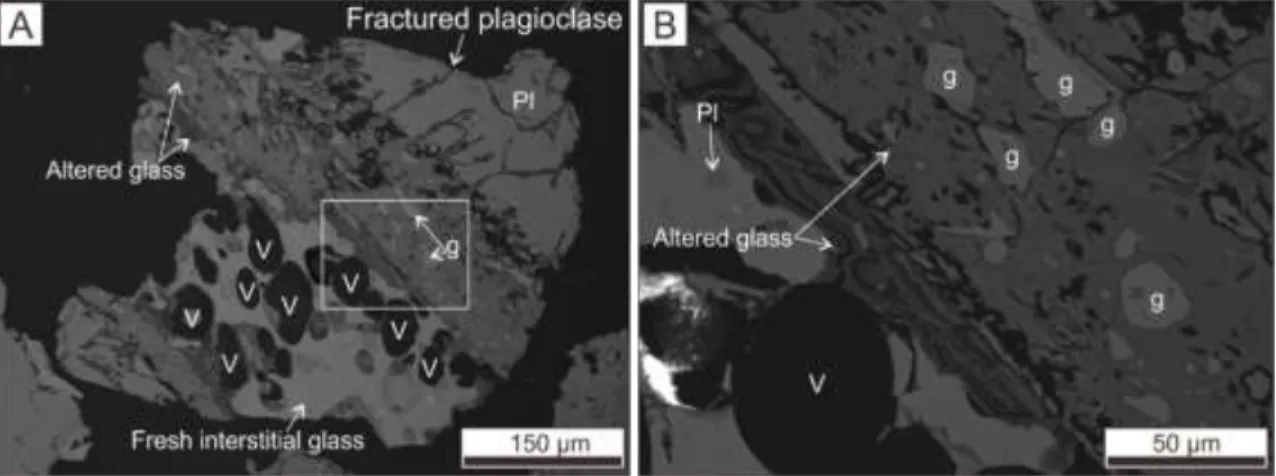
Hydrothermal minerals are composed of an association of silica (possibly quartz), alunite, and kaolinite, together with accessory minerals of TiO2 and pyrite. Association of silica and alunite are abundant (Fig. 8E). Some of the silica minerals were determined by using an optical microscope as a quartz crystal. Here, quartz crystals are the hydrothermal origin, which shows a mosaic-texture (Fig. 8F), consisting of interlocked euhedral-equant shape quartz crystals (<10 µm in diameter). Alunite crystals occur as euhedral to subhedral, and equant to elongated lath (5-20 µm in length) crystals along with oscillatory zoning texture suggested from BSE image. Pristine kaolinite mostly occurs as very-fine crystal (<1 µm) and commonly mixed with silica minerals. Accessory minerals are mostly anhedral (<5 µm in diameter) and disseminating on the surface of quartz-dominated ash particles.
33 Figure 9. Photomicrograph and backscattered images showing the petrography of ash fractions.
A) A BSE image is showing the magmatic juvenile fragment with vesicular texture, consisting of orthopyroxene bearing glass inclusion, plagioclase, augite and ilmenite within the andesitic glass.
B) Magmatic juvenile fragments are predominantly present accompanying the mosaic- hydrothermal quartz. C) The pilotaxitic texture of coherent crystalline lithics consists of lath- shaped plagioclase, subhedral-euhedral augite, and ilmenite. D) A BSE image is showing the porphyritic texture of coherent crystalline lithics, consisting of plagioclase, quartz, clinopyroxene, and xenocryst of biotite. E) Hydrothermally altered lithics are predominantly comprised of silica, alunite, kaolinite, and anatase. F) Coexistence magmatic-quartz with mosaic-hydrothermal quartz from the TP-05 sample, the free-crystal rich tephra layers. Abbreviation; Aug: augite, Alu: alunite, Bt: biotite, Cpx: clinopyroxene, Kao; kaolinite, M-Qzt: magmatic-quartz, H-Qzt: hydrothermal- quartz, Pl plagioclase, Si: silica (unidentified polymorph).
34
2.6. Discussion
2.6.1. Nature of proximal tephra-stratigraphy
The vast majority of volcanic successions at the proximal area of Tangkuban Parahu volcano consists of an alternation of fine-clay and coarse ashes, lapilli tuff, and pyroclastic breccia. Massive fine-clay ash appears to be dominant in all volcanic products. In some units, the fine-clay ash alternated with coarse ash. They predominantly show the irregular contact together with finely-laminated structure, wherein some locations show as lenticular structures. Their emplacement is mostly associated with the lapilli to block- sized lithic fragments (e.g., pyroclastic breccia; upper composite stratigraphy). Their concentration decreases toward to distal area (<1.5 km) (i.e., Unit 2, Unit 3), which is very common for the volcanic products from the low-explosive intensity (e.g., Maeno et al., 2016; Oikawa, 2018). However, it is still challenging to understand their emplacement process (e.g., fall-out, flow) due to the limited observed locations and mostly closed the sourced-vent (Ratu crater). Unit 3 and Unit 4 show very distinct sedimentary structures.
Unit 3 display a prominent dune-bedform structure at the crater rim, whereas Unit 4 displays a planar and low-angle cross-stratification of lapilli tuff. Both units indicate that they were emplaced as a pyroclastic base surge. In Unit 4, sagging structure by scoria fragments suggests that the volcanic product was deposited under wet-condition (Cas and Wright, 1987).
Overall, the nature of proximal volcanic succession suggests that the past eruptions are predominantly composed of an intensive explosive eruption, which is associated with phreatic and phreatomagmatic events. These results are mostly consistent with the previous observation at Tangkuban Parahu volcano (Kartadinata et al., 2002).
2.6.2. Role of the hydrothermal system
Hydrothermally altered lithics are present in all volcanic products, which were suggested from componentry analysis. It indicated that the hydrothermal system has been very active in the pre-historical time. From petrography, the hydrothermally altered fragments contain silica and alunite as a dominant hydrothermal mineral, indicating advanced argillic alteration is (Arribas, 1995; Hedequist and Taran, 2013) extensively present at the crater-
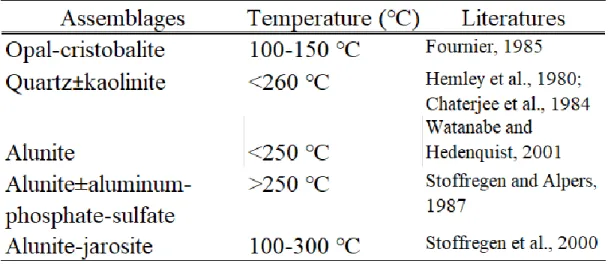
35 conduit. This is similar to surface hydrothermal zonation at active craters (Syahidan et al., 2005). Silica (quartz), alunite, and kaolinite are precipitated from acidic vapor (e.g., SO2/H2; HCL/NaCl) under a low-pressure condition, which encountered the country rock and produced extreme alteration effectively by hydrolysis reaction. The process reflects a range of formation temperature from 100 to 300 ℃ (Arribas, 1995), which present near- surface and surface of mature stratovolcano edifice (e.g., Hedenquist and Taran, 2013).
Advanced argillic alteration is predominantly accompanied by an enormous amount of residual silica precipitation (Hedenquist and White, 1992). One of the most notable observations on components (Fig. 7) is that hydrothermally altered lithics are abundant in Unit 1 to 7, whereas they partly replaced by abundant free crystals of hydrothermal quartz in Unit 8 and 10. This observation indicates extensive silicification at the crater conduit before the eruptions, which provides a capacity to cap or isolate the steam or gasses produced by the hydrothermal activity. If build-pressure of hydrothermal fluid overcomes the yield strength of the caprock, failure of overburden rock leads to the sudden decompression, which results in an explosive phreatic eruption. Therefore, the volcanic products contain abundant fragments derived from the caprock (e.g., silicified rock).
2.6.3. Magmatic contribution
The magmatic juvenile is observed from the componentry analysis. Cashman and Hobblit (2011) suggested that even a small proportion of magmatic juvenile can indicate the presence of a shallow intrusion. Therefore, the contribution of magmatic intrusion should also be considered for the volcanic eruptions of studied tephra stratigraphy. The magmatic juvenile is considerably present in many samples and shows a prominent proportion in Unit 1 and Unit 4. This indicates the periodic introduction of magmatic intrusion to the shallow volcanic edifices. The hydrothermally altered lithics also occur together with the magmatic juvenile, indicating fragmentation of altered country rocks during the volcanic eruption. Most of the magmatic juvenile fragments mostly are present as a dense fragment together with a smooth glass surface, suggesting magma-water interaction (Heiken and Wohletz,1985). Moreover, the presence of vesiculation texture on the magmatic juvenile indicates volatile release, which happens during the ascent of magmatic intrusion (e.g., Alvarado et al., 2015) and is also responsible for the overpressurized condition at the
36 crater-conduit due to vapor plume expansion below the crater (e.g., Henley and Berger, 2011).
2.7. Conclusion
This study presented the field observations on the proximal tephra stratigraphy, componentry analysis and petrography of volcanic product from Mt. Tangkuban Parahu.
The following are concluded based on the observation;
1. Volcanic products at proximal area consist of 10 tephra units, comprising fine-clay and coarse ash, lapilli tuff, and pyroclastic breccia. Their presence indicates the intense explosive eruption in the past, which is mostly distributed close to the summit craters.
2. The volcanic products are composed of hydrothermally altered lithics, oxidized lithics, coherent crystalline lithics, magmatic juvenile, and free crystal, indicating a complex process during the eruption process, involving fragmentation of country rock (hydrothermally altered zonation) and contribution of magmatic intrusions.
3. The hydrothermal fluid affects the system of crater-conduit and precipitates silica or quartz, alunite, and kaolinite. Abundant silicified lithics and quartz crystals imply a significant role of silicified cap rock before sudden decompression of hydrothermal fluid.
4. The presence of magmatic juvenile in many tephra layers indicates the periodic introduction of magmatic intrusion into the shallow of volcanic edifices. The intrusion might have changed the condition of the hydrothermal system due to degassing from magma, resulting in vapor plume expansion.
5. The phreatic explosion appears to be a dominant eruption type for the entire volcanic products at the proximal area, although a few pulses of phreatomagmatic eruptions also observed from field and componentry observation, which is recorded from unit 1 and 4 (ca. 982-904 cal BP).
37
Chapter 3
Exploring the hydrothermally altered lithics: mineralogical and sulfur isotopic studies of proximal volcanic product at Tangkuban Parahu volcano, Indonesia.
3.1. Introduction
Phreatic (hydrothermal) and phreatomagmatic eruptions are common volcanic events in the subduction-related volcanoes (Wohletz and Heiken, 1992; Brownee and Lawless, 2002). Both eruptions have relatively mild explosivity (VEI 1- VEI 3), but it can lead to the severe proximal hazard (Breard et al., 2014; Fitzgerald et al., 2014). The phreatic eruption is associated with seismic shock (Yamomoto et al., 1999) induced catastrophic failure of overburden rock in the crater conduit, which followed by sudden decompression hydrothermal fluid (Ohba et al., 2007, Oikawa et al., 2018). On the other hand, the phreatomagmatic eruption is predominantly related to magma-water interaction at a depth of volcanic edifices (Wohletz and Heiken, 1992) and commonly also associated with the interaction of magmatic intrusion with a hydrothermal system, so-called magmatic- hydrothermal eruption (Brownee and Lawless, 2002). Both eruptions commonly termed as hydro-volcanic eruption (Ohba and Kitade, 2005). One of the beauties from both eruptions is that the eruption ejected lithic fragments, which were altered in composition caused by circulated hydrothermal fluid below the crater (Ohba and Kitade 2005, Mazot et al., 2008, Minami et al., 2016). Their presence provides an opportunity to understand the temporal change of sub-volcanic hydrothermal system condition within the crater- conduit (Ohba and Kitade 2005; Minami et al., 2016; Imura et al., 2018), which is commonly difficult to characterize from the pattern of surface alteration.
Tangkuban Parahu volcano is one the active volcano in West Java, Indonesia. Tangkuban Parahu hydrothermal system is characterized by fumarolic and solfataric vents at the summit craters (Domas, Ratu, Baru), as well as hot springs and steam-heated pools within the volcano vicinity (Ciater, Batugede, Kancah, Maribaya) (Nasution et al., 2004, Saputra and Suryantini, 2015). To date, these phenomena were accompanied by episodes vertical ground displacement (in 1982, 1986) at the summit, which commonly followed by volcanic eruptions (i.e., 1983 phreatic eruptions) (Dvorak, 1990; CVGHM, 2016). Most
38 of the previous studies mostly focused on the geochemistry of fumaroles and water from the active craters (e.g., Nasution et al., 2004; Saputra and Suryantini; 2015) with little mineralogical information. The available mineralogical documentation (e.g., Syahidan et al., 2016) only provides a partial view of its enigmatic hydrothermal system at the surface of active craters. In this context, many aspects are still understudied to understand the condition of the subvolcanic hydrothermal system, specifically from the proximal volcanic products.
In this chapter, the focus was given in petrographic observation of ash particles from selected volcanic products with 125 µm, 250 µm, and 500 µm in diameters, including their mineralogical and textural variation within a single ash particle. The hydrothermal mineral assemblages and overprinting relationship (e.g., veinlets, alteration type) were described based on our understanding of the fossil or active geothermal system worldwide (e.g., Hedenquist and Henley, 1987; Arribas, 1995; Sillitoe, 2010; Hedenquist and Taran, 2013), where the hydrothermal assemblages commonly occurs as zonation of hydrothermal minerals beneath volcanic edifice of subduction-related stratovolcanoes (e.g., Kusakabe et al., 1984; Minami et al., 2016). For instance, the advanced argillic alteration is mainly consisting of quartz, alunite, and kaolinite (e.g., Arribas, 1995;
Hedequist and Taran, 2013). Additionally, the sulfur isotope is used to constrain the formation of sulfate and sulfide minerals. The results are to address several questions, as follows; What is the hydrothermal alteration style at the crater-conduit? How is the hydrothermal alteration zonation developed at the crater conduit? What is the implication for a phreatic eruption?
3.2. Tangkuban Parahu
Tangkuban Parahu volcano is a 2080 masl (meter above sea level) basaltic-andesite stratovolcano and a part of Sunda Volcanic Complex (Bemellen, 1949; Sutoyo and Hadisantono, 1992) (Fig. 1A). The volcano had been very active in the past ten years (2013 eruptions). The volcano hosts many extinct craters (Putih, Badak, Upas) and active craters (Ratu, Baru, Domas) (CVGHM, 2016) (Fig. 1B). However, the presence of craters is still poorly understood, whether it was formed by phreatic, phreatomagmatic, and magmatic activities.
39 The pre-historical volcanic activities are mainly composed of explosive eruptions (Kartadinata et al., 2002; Kartadinata 2005) (magmatic, phreatomagmatic, and phreatic eruptions) together with several effusive eruptions (Sutoyo and Hadisantono, 1990).
Sunardi and Kimura (1998) reported that the maximum age from basaltic lava flows c.a.
0.18 Ma, which marked the earliest construction of Tangkuban Parahu volcanic edifice (Bemmelen, 1949). Tangkuban parahu volcanic products are composed of typical of subducted-stratovolcano volcanic rocks, range from basaltic to andesitic affinity (Sjarifudin et al., 1984). Sunardi and Kimura (1998) show that volcanic rock consists of two types volcanic suites of calc-alkaline and tholeiitic in composition. Mineralogical observation from lava flows revealed magma mixing and mingling processes (Sunardi and Kimura, 1998). However, petrological studies of volcanic products are still very limited in Tangkuban Parahu (e.g., Sriwana, 1985); thus, the composition of volcanic products relatively remains poorly understood.
Furthermore, Holocene volcanic products are still understudied, in the sense of the eruption process as well as the petrological characteristics of volcanic products. The eruptive product comprises fine and coarse ashes interbedded with base surge deposits.
Volcanic product components consist of hydrothermally altered lithics, coherent crystalline lithics, oxidized lithics, magmatic juveniles, and free isolated crystals. It was assumed that the volcanic activity is composed of a series of the phreatic eruption (Kartadina et al., 2002).
3.2.1. Hydrothermal system
Recent surface expression of Tangkuban Parahu volcano consists of active fumaroles and solfataras (Ratu, Baru, Domas) with a temperature of 90-100 ℃ (Sriwarna, 1984; Saputra and Suryantini, 2015). In the past, the temperature of fumaroles was recorded higher than 300 ℃ in 1952, 1961, and 1969 (Suryo, 1981 and 1985). Surface hydrothermal alteration (Fig. 2B) consists of silica dominated alteration (cristobalite and tridymite) together with pyrite and sulfur (Syahidan et al., 2015), which covered the area of ~20.000 m2 (Fig. 1B;
photograph of active crater Fig. 1C and 1D) at the summit of the volcano. A series of phreatic events in 1929, 1961, 1969, 1971, 1983, 1986, 1992, 2004, and 2013 (Kusumadinata, 1976) are also proved the potential role of the hydrothermal system in