University Students Attitudes toward Varieties of English
三 浦 幸 子
MIURA Sachiko
ABSTRACT
This paper examines Japanese university students attitudes toward six varieties of English in the Inner Circle and Outer Circle countries. As English has become widely spread as a world lingua franca, in real social situations it is exclusively used for interactions between non-native speakers more than among native speakers or between native and non-native speakers. Accordingly, more attention has been paid to the recognition and acceptance of varieties of English other than standard English such as RP (Received Pronunciation) or GA (General American). In Japan, English is taught as a foreign language and not officially used outside classrooms, and learners are usually exposed to the limited varieties mentioned above and tend to see the goal as native-like competence. This study attempts to reveal how Japanese university students view different varieties of English and how well they recognize the role of English as a lingua franca. The results of statistical analyses show the subjects in this study perceived RP and GA as more preferable and comprehensible than the other varieties and did not seem to understand what is meant by a world lingua franca. It also tries to investigate how their language attitudes affect their anxiety in speaking English.
Considering the findings, some pedagogical implications are suggested when designing a course in order to provide learners with more world-wide views about English.
INTRODUCTION
The last three decades have seen the wide dispersion of English as an international or global language. Crystal (2003) estimates a grand total of 1.5 billion speakers;
approximately 750 million first- and second-language speakers, and an equivalent number of speakers of English as a foreign language. In reality, the population of English users in the Outer and the Expanding Circles1 has been drastically increasing, while that of the Inner Circle has been on decline (Graddol, 1999: 61). Smith (2004) describes the current situation as follows:
Nonnative users far outnumber native users. It is estimated that 8% of the world s population are native English speakers but that approximately 25% (including native speakers) are fluent users of English. It is interesting to note that Asia, not North America, is already the continent with the largest number of fluent users of English.
都留文科大学研究紀要 第70集 (2009年10月) The Tsuru University Review,No.70 (October, 2009)
Thus, it is realistic to say that English is now used not only for communication among native speakers or between native and non-native speakers, but also for interactions between non-native speakers with different linguistic and cultural backgrounds. Reflected by such changes in global and social contexts, many sociolinguists have been stressing the important role English plays as a lingua franca,2 questioning the social status of English, and claiming the rights of users of English outside the Inner Circle (Crystal, 2003; Graddol, 1999; Jenkins, 2003, 2007; Kachru, 1992a; McKay, 2002). That is, English is shared by everyone who has used it or learned it and they have the right to use it in the way they want (Crystal, ibid.: 2-3). Under such circumstances, more and more researchers have shown interest in attitudes toward varieties of English and recognition of non-native norms. This is because, as Berns says (1990: 65), the results of these studies affect approaches to language teaching as well as the choice of a model for learners, and it is required to accept the established varieties of English.
Japan is one of the Expanding Circle countries, where English is taught as a school subject. If English plays the principal role as a world lingua franca, it is reasonable to predict that Japanese learners will face opportunities to communicate in English with not only native speakers but also non-native speakers in real-world contexts in the future. In other words, they will be exposed to different varieties of English. In fact, this prediction seems to be taken into account by the curriculum guidelines announced by the Japanese Ministry of Education for its secondary level foreign language courses. In regard to teaching materials, the guideline states:
c) Materials that are useful in deepening from a broad perspective, heightening students awareness of being Japanese citizens living in
a and cultivating a spirit of (Hirata,
2008: 173, by Miura)
Although one of the objectives is to have English classes serve as a window to other parts of world under the term international, some researchers point out that Japanese learners hold a distinctly western-centered view (Matsuda, 2002) and in many places non-native English is not always perceived positively by the Japanese (Matsuura, 1995: 77).
Consequently, they call for presenting different varieties of English, including non-native varieties, in English classes and raising awareness of accepting these differences. I mostly agree with their opinions, but feel it is not practical to generalize the goals for all the levels.
Rather, I think it is necessary to set a shift of different steps from more language focused learning to a more sociolinguistic focused one according to learners proficiency or achievement level. As Torikai (2004) proposes, more attention need be paid to functional, strategic and sociolinguistic aspects of communication at university. Thus, in this study, I would like to focus on university students attitudes toward different varieties and to discuss what needs to be considered when designing a course to provide learners with
more world-wide views about English and promote international understanding.
REVIEW OF LANGUAGE ATTITUDE STUDIES
Language attitudes research is not a new field as Giles and Billings (2004) point out;
it dates back to a study in the 1930s. Since that time, numerous studies have investigated how people evaluate social groups in terms of their linguistic varieties, for example, people s attitudes toward certain native regional varieties or non-native varieties.3 Through looking at general and accented-related socio-psychological literature in the field of language attitudes research, Jenkins (2007: 83) makes the point that [w]hat is evident from these and many similar examples is that non-native accents are discriminated against by native speakers, and that the accent bar segregating native speakers and non-native speakers of English is still firmly in place.
In regard to language attitudes research toward English as a lingua franca, it is only a decade or so since earlier studies on attitudes of people in the Expanding Circle appeared. Especially, regarding Japanese people s attitudes, only a few studies have been carried out to my knowledge. A study conducted by Matsuura (1994) investigated Japanese college students attitudes toward American English and non- native varieties of English. The results of their study revealed that the subjects showed more positive reactions toward the American accent than they did toward the non-native accents. Their quantitative study assumed that subjects familiarity with and preference for certain varieties affected their reaction. In other words, those who were relatively familiar with North American English and preferred American and British English tended to give favorable ratings to the American accent, while they gave relatively negative reactions to the non-native accents, which were unfamiliar to them. In another study (Chiba & Matsuura, 1995), prospective Japanese teachers attitudes toward native and non-native varieties were compared with those of their American counterparts. The results showed that both Japanese and American subjects reacted more favorably to native speakers of English, but Japanese subjects were more strongly inclined to native speakers and showed considerably less acceptance of non-native varieties. In conclusion, the authors stated that Japanese prospective teachers in their study thought that native speaker English was the target and they were somewhat naive to the ideology of EIL (p. 10) despite the fact that they perceived English as an international language.
This paradox can be explained by the results of Matsuda s qualitative case study of Japanese secondary school students attitudes toward English. The findings of her study indicated that the subjects preferred American English and British English to the Outer Circle varieties and held a noticeably western-centered view: they viewed the terms foreign countries and abroad as synonymous with the West (Matsuda, 2002: 436).
Similarly, several studies conducted in other Expanding Circle countries have pointed out that the respondents preference for American English (GA) and British English (RP) and their connecting the status of English as an international language with the goal of learning
to become native-like (Chinese in Forde, 1995; Brazilians in Friedrich, 2000; Argentines in Friedrich, 2003; and Koreans in Shim, 1994). All these researchers have questioned the misconceptions and unrealistic expectations of their respondents who might have believed that attaining native-like proficiency would lead to being a member of the international community, and called for more realistic future goals, i.e., interactions with other non-native speakers.
Furthermore, some researchers state that learners native speaker oriented view affects not only their negative attitudes toward non-native varieties but also their anxiety in speaking English. For example, Honna (1995) views a desire for being native-like, especially American-like, as an unrealistic goal of learning English, stating:
despite the global spread of English as a language for wider communication, Japanese people still believe that English is the property of the USA and Britain.
They are ashamed if they do not speak English the way native speakers do. Given an Anglophile goal as their guiding light, Japanese students of English not only cannot accept their limited proficiency as natural and inevitable, but also look down on non-native varieties of English used by Asian and African speakers. …. By virtue of perfectionism, Japanese tend to hesitate to interact with English speakers until, as they often are heard to say, they develop complete proficiency in the language. Fears of making mistakes often prevent them even from using the phrases and expressions they are learning currently. (p. 144)
Indeed, it is often said that Japanese learners are likely to hesitate to speak in English classrooms. I myself have often heard some students say they are too afraid of making mistakes or not being understood when speaking with native speakers, and that struck me that it would be interesting to investigate how learners language attitudes affect their anxiety in speaking English.
STUDY
The hypotheses addressed in the study are as follows;
1) The subjects will view American or British English more positively than the other varieties of English.
2) Subjects who perceive English as a world language will be more tolerant of Asian varieties of English.
3) Subjects who have preference for American or British English will be more anxious about speaking in English.
Method 1. Subjects
A total number of 56 Japanese university students (37 females and 19 males), who
took the course of Language and Culture in 2008 at the university with which the present author is affiliated, participated in this experiment. Forty-six of them were majoring in English and the other 10 were majoring in comparative culture. All of the subjects had received six years of English education in junior and senior high schools in Japan as one of their school subjects. The questionnaire reveals that none of them had had an experience of either going abroad or staying abroad longer than a month.
Initially, 60 students were involved in this experiment, but four of them were excluded because of their experience of studying or staying abroad for longer than a year. This is because this study attempts to investigate the language attitudes of students who have had the limited exposure to varieties of English except the ones that are familiar to them in English classes at school.
2. Speakers
Six recorded speech extracts spoken by as many different speakers were used in this study; British English (Near RP), North American English (Midwestern/ typical GA), Australian English, Scottish English, Indian English and Singaporean English. These six varieties were chosen because they were divided into three groups: (1) Group 1: the world s two prestige varieties of English (Jenkins, 2003: 22), (2) Group 2: two other varieties of Inner Circle contexts, which are relatively unfamiliar to Japanese students, and (3) Group 3: two varieties of Outer Circle contexts. The speech samples were collected from the compact discs attached to English Journal (2003),4 and none of them had been heard before the experiment by any of the subjects in this study. All of the speakers are regarded as educated adults who have chances to interact with others in English. The details of each sample are as follows:
(1) Group 1: the world s two prestige varieties of English
a) British English spoken by a 27-year-old female speaker, who is from Somerset and is now living in London. Having a master s degree in history and post- graduate qualifications in law, she works as a trainee solicitor. Although her speech includes phonetic features of modern RP such as [] instead of [ e e ] and [ c
:] in poor , she holds some typical features of RP pronunciation such as unsounded r after vowels and [:] in fast . Her accent is regarded as typical Near RP, and this variety is called Near RP in this study to differentiate it from the Scottish variety.
b) American English spoken by a 25-year-old male actor from California. His accent is based on typical GA, including [k:r]. He speaks very fast, especially when using colloquial expressions.
(2) Group 2: two less familiar Inner Circle varieties
c) Australian English spoken by a 24-year-old male designer from a small town near Melbourne. He pronounces [ei] in wait and painting very close to [ai], [a:nts]
in aunt, and [ka:] in car.
d) Scottish English spoken by a 35-year-old male speaker from a small town between Glasgow and Edinburgh. Having studied architecture at university, he works for a firm of healthcare architects. His speech represents many features of Scottish accent such as strong [r] after vowels (e.g. first, better, poor), unsounded [t]
(e.g. get out, wait, better, bonnet), [o:] in road, and [e:] in came.
(3) Group 3: two Outer Circle varieties
e) Indian English spoken by a 47-year-old male speaker from Punjab, India. He graduated from Punjab Agricultural University with a B. Tech in agricultural engineering, and now works for Mitsui New Delhi. His speech represents typical features of the Indian variety; it is flat, without stress, and with pauses unrelated to meanings. Also, he pronounces [r] accompanied with [t], [d],[l],[s], and [z].
f ) Singaporean English spoken by a 24-year-old female investment analyst working in a Japanese brokerage firm in Singapore. She was born and raised in Singapore and graduated from a local university with a bachelor degree in Accounting. Her pronunciation shows the influence of the Chinese language. For example, she speaks in a rather syllable-timed way, does not pronounce either consonants at the end of words or sentences or [r] after vowels (e.g. car, motor, first).
3. Materials 3. 1. Passage
Each speaker read the same English passage presented below, except that the speakers of Near RP and the Scottish variety used the term bonnet instead of
hood, and the speaker of the Australian variety did not utter trailer.
On Sunday, when my aunt s car motor died, we ended up having to first get out fast and roll it to the side of the road and wait until someone came for help. For lack of anything better to do, we played UNO on the hood [bonnet] of our poor car until an old man driving a semi [-trailer] stopped for us.
3. 2. Questionnaire A5
Six adjectives were displayed in bi-polar rating scales to elicit the subjects impressions of each speaker s English. The adjectives include ones which judge speech quality ( clear - unclear, with accent - without accent, fluent - not fluent ), those which indicate performance aspect (i.e. careful -- careless ), and friendly -- unfriendly which show solidarity. Also, comprehensible - not comprehensible were included to examine how understandable the subjects perceive each variety.
3. 3. Questionnaire B
A seven-point rating scale (1 = strongly disagree -- 7 = strongly agree) was used to survey the subjects ideas about English learning, the role of English, and anxiety in
speaking English. Initially, 11 statements were presented to the subjects, but after the factor analyses, eight of them were used in the study. They are shown in Table 3.
4. Procedures
The experiment was carried out at the beginning of the Fall Semester of 2008, and in the very first class of the course so that the subjects would choose the answers without background of the study. First of all, the subjects were asked to listen to the tape and indicate their impressions of each speaker by choosing the most appropriate point for each adjective on the Questionnaire A. In order to avoid confusion, I played a sample speech and explained all the adjectives and the procedure in Japanese before playing the first speaker. The tape recorder was stopped after each speaker so that the subjects had enough time to rate each speaker individually. The subjects were also asked to answer Questionnaire B and lastly to write about their background information:
their experience of going abroad and people they have communicated with in English.
5. Data Analysis and Results
One-way analysis of variance (ANOVA) indicated that there was a significant difference in the reactions of university students toward the six varieties of English in terms of perceived comprehensibility (df = 2/108, F = 28.05, p<.01), and the post hoc test (Ryan s method) revealed that the differences lied between Group 1 and 2 (df = 2/108, t = 7.013, p<.05), and between Group 1 and 3 (df = 2/108, t = 7.01, p<.05). No significant difference was found between Group 2 and 3 (df = 2/108, t = 1.46, n.s.).
More precisely, there is a significant difference between Near RP and all the other varieties (p<.001), and between American English and the two Asian varieties.
Statistically, no significant difference is seen among the rest of the varieties. Table 1 indicates the mean score and standard deviation of the scores for the six varieties of English, and Figure 1 represents the profile of the ratings for 3 groups of varieties regarding perceived comprehensibility. This profile shows that the subjects perceived Near RP and American English as being far more understandable than the other varieties, while there seems to be little difference between Group 2 (Australian English and Scottish English) and Group 3 (Indian English and Singaporean English).
Table 1: The mean score and standard deviation of each rating for perceived comprehensibility
F (5, 270) = 28.05, p<.05
Note. = 56
Figure 1: Profile of ratings for perceived comprehensibility
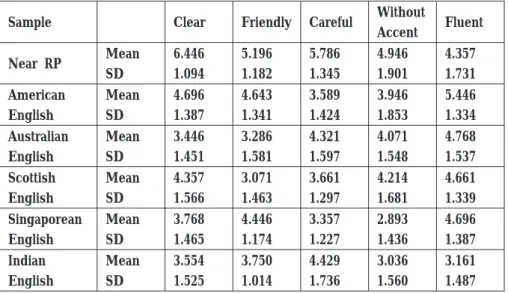
Two way analysis of variance (ANOVA) was used to compare the impressions of the subjects on each adjective. The result showed that there was a significant difference among the varieties (df = 5/275, F = 56.01, <.01 ). Table 2 indicates the mean scores of ratings for the adjectives and Figure 2 represents the profile of impression for the varieties of English. Overall, the subjects seemed to show more positive reactions toward Near RP and American English. The post hoc test (Ryan s method) was conducted to examine differences in each adjective factor. The result showed that there was a significant difference between Group 1 (Near RP and American English) and the other groups of varieties in terms of clarity (p<.01) and friendliness (p<.05). A significant difference was also found in without accent between Near RP and all the other varieties (p<.01), while no significant difference was found between American English and Group 2 (Australian and Scottish varieties). Regarding two adjective factors, i.e., carefulness and fluency , the subjects seemed to react toward Near RP differently from American English. Near RP was rated significantly more careful than any other variety (p<.01), but American English was not. On the contrary, American English was ranked significantly less careful than Australian and Indian varieties (p<.01). However, American English was evaluated as significantly more fluent than any other varieties (<.05), while there was no significant difference between Near RP and the other groups of varieties.
Samples Mean SD
Group 1: Near RP Group 1: American E Group 2: Scottish E Group 2: Australian E Group 3: Singaporean E Group 3: Indian E
6.125 4.339 4.107 3.839 3.536 3.456
1.322 (p<.05) 1.456 1.448 1.449 1.388 1.476
Table 2: The mean score of each rating for each adjective
Note. = 56
Figure 2: Profile of ratings for adjectives
Factor analyses and Pearson Correlation Coefficients were used to investigate how the subjects perception of English affects their attitudes toward each variety and their anxiety in speaking English. Table 3 demonstrates the rotated factor patterns. The results indicate that three factors underlie the scales used in Questionnaire B. To reveal the relationships between the scores for the varieties in Questionnaire A and each factor, correlation coefficients were calculated as shown in Table 4 and 5.
Sample Clear Friendly Careful Without
Accent Fluent
Near RP Mean
SD
6.446 1.094
5.196 1.182
5.786 1.345
4.946 1.901
4.357 1.731 American
English
Mean SD
4.696 1.387
4.643 1.341
3.589 1.424
3.946 1.853
5.446 1.334 Australian
English
Mean SD
3.446 1.451
3.286 1.581
4.321 1.597
4.071 1.548
4.768 1.537 Scottish
English
Mean SD
4.357 1.566
3.071 1.463
3.661 1.297
4.214 1.681
4.661 1.339 Singaporean
English
Mean SD
3.768 1.465
4.446 1.174
3.357 1.227
2.893 1.436
4.696 1.387 Indian
English
Mean SD
3.554 1.525
3.750 1.014
4.429 1.736
3.036 1.560
3.161 1.487
Table 3: Factor analysis on Questionnaire B [factor loading: > 0.4]
Table 4: Pearson Correlation Coefficients between factors and Asian varieties
Table 5: Pearson Correlation Coefficients between factors and Group 1 varieties
As shown in Table 4, statistically, no correlations were seen between any of the factors and Asian varieties. On the contrary, there was a weak correlation between Factor 1 (Interests in different people, culture, and perspectives) and Group 1 varieties, that is, Near RP and American English. Also, these two native varieties were correlated with Factor 2 (Preference for American / British language, people, and culture), but no correlation was found with Factor 3 (Anxiety in speaking English).
6. Discussion
As I had expected, overall, the subjects responded more positively to Near PR and American English, and the result confirms what the previous language attitudes studies on Expanding Circle countries showed (Matsuura 1994, Shim, 1994, Forde, 1995,
Mean SD
Factor 1: Interests in different people, culture, and perspectives 3 ) I study English in order to understand different cultures
and viewpoints all over the world.
5 ) As long as it is intelligible, accented English is acceptable.
8 ) I want to communicate with people from many different countries.
Factor 2: Preference for American / British language, people, and culture
2 ) I envy those who can pronounce English like an American or British person.
10) English should be used as a world lingua franca.
7 ) I study English in order to understand cultures and viewpoints in English-speaking countries.
Factor 3: Anxiety in speaking English
1 )I hesitate to speak in English until I m quite sure of what to say.
9 ) I m afraid of making mistakes when speaking in English.
4.839
5.518 5.625
4.268
6.054 4.839
4.839
4.821
1.593
1.414 1.602
1.742
1.494 1.535
1.837
1.850
Factor 1 Factor 2 Factor 3
0.0138 0.0226 0.1689
Factor 1 Factor 2 Factor 3
0.3687 < .01
0.3791 < .01
0.0402
Friedrich, 2000, 2003, Matsuda, 2002). Especially, significant differences seen between these two native varieties and the other varieties regarding comprehensibility and clarity imply that the respondents perceived these standard varieties to be clearer and more understandable. It is reasonable to explain that the respondents familiarity with these varieties affect their rating of comprehensibility and speech quality, and confirm the results of the previous studies mentioned above: the more familiar they feel with these varieties, the more easy they feel them to understand. As Japan is one of the Expanding Circle countries, they normally do not have an opportunity to use English to interact with speakers from the Outer and other Expanding Circle countries. In fact, what they wrote in the last part of questionnaire B revealed that their exposure is very limited to interactions with ALTs (assistant language teachers) mostly from the Inner Circle countries such as the English, Americans, Canadians and Australians.
However, a closer look at the results makes this interpretation more complicated. First, the respondents subjective rating of comprehensibility does not precisely show how well they understood what each speaker actually said. In this study, Near RP was rated far more positively than American English although the latter is more familiar to the subjects since it is the major variety used in audio taped materials as instructional model in junior and senior high school in Japan. This contradicts the assumption Friedrich (2000) made:
the greater the exposure, the more intelligible the variety (p. 218). In fact, American English was viewed as the most fluent but the second least careful. Similar findings can be seen in the Australian variety. It was viewed as less accented and more fluent, but neither as comprehensible as Near RP nor significantly more comprehensible than the Asian varieties. This implies the subjects the speaker with Near RP, who speaks more slowly, articulates the sounds clearer with less assimilation, but could not fully understand what the speakers with American and Australian varieties said. Second, the rating on with / without accent in this study indicated that the subjects probably distinguished native speakers from non-native speakers. Also, they viewed Singaporean and Indian varieties as more friendly than Australian and Scottish varieties. It is inconsistent with the finding of Chiba, (1995), which revealed Japanese respondents considered non-native varieties relatively unfriendly. Friendliness is a factor indicating solidarity, and it is quite judicious since these two varieties have similar phonetic features to English spoken by Japanese speakers. However, these varieties were viewed rather negatively in other factors. Some earlier studies on language attitudes (Starks & Paltridge, 1994, Benson, 1991, Dalton-Puffer 1997) state that respondents tend to react less positively toward their local variety although they find it easier to understand. The result in this study could be the case in point, and implies that the subjects perceive non-native varieties negatively despite the fact that they understood the message. In short, familiarity seemed to be a factor affecting higher perceived comprehensibility but the subjects perception of each variety tended to be influenced by vocal features such as clarity and fluency as Matsuura
suggested (1999: 49). Accordingly, such perception might lead to bias toward the varieties, i.e., more positive reactions to the native speakers. To my regret, however, since the present study was carried out based only on the respondents subjective judgment, it is not judicious to draw a conclusion until further studies which test the subjects actual intelligibility are carried out as done in the study of Matsuura(1999).
This study was conducted under the assumption that subjects who perceived English to be a world language would be more tolerant of Asian varieties of English. However, the obtained results did not present strong evidence to support this assumption. The ratings of two Asian varieties did not correlate positively with the subjects wider view on English for communication with many different people other than native speakers.
Neither were they negatively correlated with the subjects preference for American or British language, people, and culture. On the contrary, weak correlation was found between these factors and Group 1, i.e., Near RR and American English. Needless to say, the subjects preference for these varieties seemed to affect their positive ratings for adjectives in Questionnaire A, but a more noticeable point is that the subjects interests in different people, culture, and perspectives are also related to their ratings of these prestige native varieties. Furthermore, although the subjects strongly believed that English should be used as a world lingua franca (Mean: 6.054, SD: 1.494), this view seems to be correlated with their preference for Anglicized language and culture. Two points could be made to explain this tendency. First, the subjects in this study are not sufficiently aware of the existence of different varieties of English and the rights of those users in real situations. They may have recognized that accented English is acceptable if it is intelligible (Mean: 5.518, SD: 1.414), but they were not tolerant enough to perceive two Asian varieties as comprehensible or preferable as other varieties. Again, it may be due to their unfamiliarity with those varieties and also to a lack of sensibility to the notion of English as a lingua franca. In other words, as Chiba (1995) say, they did not seem to have background knowledge about varieties and ELF. Second, the subjects in this study may have a mistaken perception of world lingua franca. The findings imply that they view understanding different cultures and viewpoints all over the world as synonymous with understanding cultures and viewpoints in English-speaking countries. This confirms the results found in the previous studies (Friedrich, 2000, 2003, and Matsuda, 2002), and calls for more careful instructional consideration in teaching English as a lingua franca, which truly refers to a language of communication among non-native speakers.
Regarding the third hypothesis, i.e., the relationship between the subjects preference for American or British English and their anxiety in speaking English, statistically analyzed data did not show any evidence to support this. However, mean scores of two anxiety factors were rather high (Mean: 4.839, SD: 1.837, Mean: 4.821, SD: 1.850), further
research is necessary to examine this relationship. The subjects used in this study were English or comparative culture majors, who were rather eager to interact with others in English. With those who major in other fields such as science, economics and commerce, different findings might have appeared.
CONCLUSION AND IMPLICATIONS
The results show Japanese university students participating in this study view American English and Near RP, which are thought to be standard models in Japanese English classrooms, more positively than the other varieties. Also, it is assumed that the subjects view of the role of English as a lingua franca refers only to communicating with people in the Inner Circle countries. If the goal of learning English for university students is to improve their communicative competence for international communication in real situations, the following points need be considered when designing a course.
First, learners need be given more opportunities for exposure to different varieties of English; not only of the Inner Circle but also of the Outer Circle and other Expanding Circle countries. I believe that it is essential to increase exposure in listening.6 As Masuda (2003) points out, teachers can introduce varieties of English by showing movies and video clips of speakers with different varieties. Another way is to invite international visitors from the Outer and other Expanding countries to give special lectures so that learners can recognize the established varieties existing in reality.
Furthermore, it is beneficial for learners to participate in oversea programs where they have chances to interact with other non-native learners. In fact, one of the four subjects who were excluded from this study wrote very interesting comments. She went to Australia and had a chance to talk with other non-native speakers. At first she found it was more difficult to interact with them than with native speakers, but soon she got used to it. She finally remarked that it was wonderful to understand each other although they did not share the same native language. I believe it is necessary to promote similar experiences both within and outside the university.
Second, careful instructional consideration is needed to provide more world-wide views about English as a lingua franca and to raise learners awareness of the ideology of world Englishes. A course syllabus need include not only world Englishes but also the historical background of the English language; how the English language was born, how it has changed, how it has spread, how and why many different varieties have appeared, and why it is seen as a world lingua franca. It would be interesting to carry out research on changes in learners attitudes by comparing before and after a course as Yoshikawa (2005) did.
Also, further research is required on language attitudes toward several different non- native varieties, and on the relationship between attitudes and motivational or cognitive factors.
Notes
1 . Kachru (1992b) presented the current sociolinguistic profile of English in three concentric circles. The Inner Circle refers to the countries where English is the first native language such as USA, UK. The Outer Circle represents the non-native varieties in the regions where English is used as an official or second language such as India, Singapore, and the Expanding Circle includes the regions where English is taught as a school subject.
2 . According to Jenkins (2007), a lingua franca is a term that essentially refers to a contact language used among people who do not share a first language, and is commonly understood to mean a second(or subsequent)language of its speakers (p. 1), and unlike EFL (English as a Foreign Language), which targets communication between its native and non-native speakers, it is a language of communication among non-native speakers.
3 . For more details, see Jenkins (2007) who provides an overview of general and accented-related socio-psychological literature in the field of language attitudes research (Chapter 3) and previous research into ELF attitudes (Chapter 4).
4 . The six speakers speeches were extracted from three issues (October, November, and December, 2003) of English Journal published by ALC, and more detailed phonetic explanation for each speaker was given by Professor Naoki Ogawa at Seitoku University.
5 . The questionnaire used for this study is available from the author.
6 . In my opinion, model materials for speaking need be separated from listening materials in terms of mutual intelligibility. One example can be seen in the instruction for Sound Check in World Trek II (Asaba, 2007: 113). When introducing a typical feature of the American English; the sound of [t] between vowels found in and so on. It says Listen to the sounds of the underlined words or phrases, and intentionally avoids letting learners repeat them.
Acknowledgment
I appreciate all the respondents for providing the data, and Eloise Pearson Hamatani for her valuable comments on an earlier draft.
References
Asaba, R., Allum, P., Sasabe, N., Shiozawa, T., Miura, S., & Mochizuki, M. (2007).
Tokyo: Kirihara Shoten.
Benson, M. L. (1991). Attitudes and motivation towards English. A survey of Japanese freshmen. Vol. 22, No. 1, pp. 34-48.
Berns, M. (2005). Expanding on the Expanding Circle: Where do WE go from here?
Vol. 24, No. 1, pp. 69-83.
Block, D. & Cameron, D. (Eds.) (2002). London:
Routledge.
Bolton, K. (2005). Where WE stands: approaches, issues, and debate in world
Englishes. Vol. 24, No. 1, pp. 85-93.
Canagarajah, A. S. (1999). Oxford:
Oxford University Press.
Chiba, R., Matsuura, H. (1995). Japanese Prospective Teachers Attitudes Toward Native and Non-native English. 26, pp. 1-11.
Chiba, R., Matsuura, H., & Yamamoto, A., (1995). Japanese attitudes toward English accents. Vol. 14, No. 1, pp. 77-86.
Crismore, A., Ngeow, K. Y., & Soo, K. (1996). Attitudes toward English in Malaysia.
Vol. 15, No. 3, pp. 319-335.
Crystal, D. (2003). (2nd ed.). Cambridge: Cambridge
University Press.
Dalton-Puffer, C., Kaltenboeck, G., & Smit, U. (1997). Learner Attitudes and L2 Pronunciation in Austria. Vol. 16, No. 1, pp. 115-128.
Forde, K. (1995). A Study of Learner Attitudes towards Accents of English.
!" # $ "% ! No.1, pp.59-76.
Friedrich, P. (2000). English in Brazil: functions and attitudes.Vol. 19, No. 2, pp. 215-223.
Friedrich, P. (2003). English in Argentina: attitudes of MBA students.
Vol. 22, No. 2, pp. 173-184.
Graddol, D. (1999). The decline of the native speaker. In Graddol, D. & Meinhof, U. H.,
(Eds.) &$ &13 ( pp. 57-68).
Graddol, D. & Swann, J. (Eds.) (1994). $ Clevedon: BAAL/
Multilingual Matters.
Graddol, D. & Meinhof, U. H., (Eds.) (1999). &
$ &13. The English Company (UK) Ltd.
Giles, H. & Billings, A. C. (2004). Assessing Language Attitudes: Speaker Evaluation Studies. In Davis, A. & Elder, C. (Eds.), %' (pp.
187-209). MA: Blackwell Publishing.
Hirai, Y.(Ed.) (2008).%%( % ""% %%% )
'("'&("(* +Tokyo: Meiji-Tosho.
Hiraga, (2005). British attitudes towards six varieties of English in the USA and Britain.
Vol. 24, No.3, pp. 289-308.
Honna, N. (1995). English in Japanese society -- language within language. '
,,-$16 (1,2), pp. 45-62.
Honna, N. (1999).. & ) +Tokyo: ALC Shinsho.
Jenkins, J. (1998). Which pronunciation norms and models for English as an International Language? 52/ 2: pp. 119-126.
Jenkins, J. (2002). A Sociologically Based, Empirically Researched Pronunciation Syllabus for English as an International Language. 23/ 1: pp. 83-103.
Jenkins, J. (2003). London: Routledge.
Jenkins, J. (2006). Current Perspectives on Teaching World Englishes and English as a Lingua Franca. Vol. 40, No. 1, pp. 157-234.
Jenkins, J. (2007). Oxford: Oxford
University Press.
Kachru, B. B. (Ed.)(1992a). (2nd ed.). Urbana: University of Illinois Press.
Kachru, B. B. (Ed.) (1992b). Teaching World Englishes. In Kachru, B.B. (Ed.) (2nd ed.)( pp. 355-362). Urbana: University of Illinois Press.
Kubota,R. (2002). The impact of globalization on language teaching in Japan. In Block, D. &
Cameron,D.(Eds.)(pp.13-28),London : Routledge.
Matsuura, H., Chiba, R., & Yamamoto, A. (1994). Japanese College Students Attitudes Towards Non-Native Varieties of English. In Graddol, D. & Swann, J. (Eds.),
(pp. 52-61). Clevedon: BAAL/ Multilingual Matters.
Matsuura, H., Chiba, R., & Fujieda, M. (1999). Intelligibility and comprehensibility of American and Irish Englishes. Vol. 18, No. 1, pp. 49-67.
Matsuda, A. (2002). International understanding through teaching World Englishes.
Vol. 21, No. 3, pp. 436-440.
Matsuda, A. (2003). The ownership of English in Japanese secondary schools.
Vol. 22, No. 4, pp. 483-496.
Matsuda, A. (2003). Incorporating World Englishes in teaching English as an International Language. Vol. 37, pp. 719-729.
McKay, S. (2002). Oxford: Oxford
University Press.
Morrison, R. & White, M. (2005). Nurturing global listeners: increasing familiarity and appreciation for world Englishes. Vol. 24, No. 3, pp. 361-370.
Munro, M., Derwing, T. M., & Morton, S. L. (2006). The Mutual Intelligibility of L2 Speech. 28, pp. 111-131.
Ogawa, N. (2003). Comparing World Englishes. ! No. 10, 11, 12.
Sakai, S., & D Angelo, J. F. (2005). A Vision for world Englishes in the Expanding Circle. Vol. 24, No. 3, pp. 323-327.
Shim, R. J. (1994). Englishized Korean: structure, status and attitudes.
Vol. 13, No. 2, pp. 225-244.
Smith, E. L. (2004, December). " !# "Paper presented as a special lecture at Waseda University, Tokyo, Japan.
Starks, D., & Paltridge, B. (1994). Varieties of English and the EFL classroom: a New Zealand case study. $%! Vol. 2, pp. 69-77.
Torikai, K. (2004). Daigaku Kaikaku no Tetsugaku [Attitude towards university reform].
&'Vol. 53, No. 4, pp. 8-11.
Yano,Y.(2001).World Englishes in 2000 and beyond. Vol.20, No.2, pp.119-131.
Yoshikawa, H. (2005). Recognition of world Englishes: changes in Chukyo University students attitudes. World Englishes, Vol. 24, No. 3, pp. 351-360.