* 東洋英和女学院大学大学院 国際協力研究科 国際協力専攻 修士課程 2013年9月修了生
M.A. in Social Sciences, Department of International Cooperation, The Graduate School of Toyo Eiwa University, September 2013
The Pilot Refugee Resettlement Program in Japan:
What Is Needed for the Successful Integration of Resettled Refugees?
YAMASHITA Natsuki
*山下 奈津季
要旨:
2010年より日本政府は難民キャンプから5年間30人ずつミャンマー難民を受け入れる第三国定住 難民プログラムを開始。しかし、このプログラムは社会統合など様々な問題に直面している。本論 文は日本における第三国定住難民の地域社会統合には何が必要かを難民と支援員のインタビューを 中心に調査したものである。本研究では、日本の社会統合において重要な8つの要素を明らかにし、
第三国定住難民の今後の効果的支援の策定に寄与する。
キーワード :第三国定住難民、社会統合、質的研究
Keywords : The pilot refugee resettlement program in Japan, Successful Integration, Qualitative Research
Chapter 1: Introduction
In 2010, the Japanese government launched a five-year resettlement program1 to accept 30 Myanmar2 refugees each year from a Myanmar refugee camp in Thailand (Cabinet Secretar- iat, 2013). Since Japan has long been interna- tionally noted as a country reluctant to accept refugees, this decision pleasantly surprised the international community.
The first group of resettlement refugees, five families comprising 27 Karen refugees, arrived in September and October 2010. The second group, four families comprising 18 Karen refu- gees, arrived on October 29, 2011 (Cabinet Sec- retariat, 2013).
The first group of resettled refugees par- ticipated in a 180-day Settlement Support Program, organized by the Refugee Assistance Headquarters (RHQ) in Tokyo. The refugees completed the program in March 2011, and then two families consisting of 12 refugees moved to Togane-shi, Chiba prefecture, where the parents began working on a leafy vegetable farm. The other three families, 15 refugees, settled in Suzuka-shi, Mie prefecture, and work on a mushroom farm (Cabinet Secretariat, 2013).
The second group of resettled refugees completed the Settlement Support Program on March 2, 2012, and all four families moved to Misato-shi, Saitama prefecture. The hus- bands from all four families began working at a shoe-making factory in Tokyo, while the wives work for a linen supply service. Local govern- ment and non-governmental organizations (NGOs) provide support, such as Japanese language classes for the families (Cabinet Sec- retariat, 2013).
However, a year after the first group moved to Chiba, they faced difficulties integrating into their new lives. The adults quit their jobs at
the leafy vegetable farm citing low salary and harsh working conditions (Nakagawa & Furuta, 2011). Other than their jobs, they complained about an insufficient integration support sys- tem and anxiety about their futures, especially their children’s futures (Watanebe, 2011). They felt insecure because they sensed gaps between what they had heard about Japan and the Jap- anese resettlement program and their actual experience (Nakagawa & Furuta, 2011). After quitting leafy vegetable farming, the families moved to Tokyo. Both the husband and wife from one family obtained jobs there, while only the husband from the other family is working (Fujisaki, 2012a).
In the third year of the pilot program (2012), three families comprising 16 refugees partici- pated in a pre-departure orientation program.
However, all of them declined resettlement in Japan, citing insecurity about life there (Fruta, 2012). As the forth group, four families com- prising 18 refugees, and as the fifth group, five families comprising 23 refugees came to Japan.
In addition, the Japanese government has decided to continue the program to accept 30 Myanmar refugees every year, from Malaysia.
(Ministry of Foreigh Affairs of Japan, 2014).
As the conditions described above indicate, refugees face difficulties with social integration under the Japanese resettlement program. This paper aims to improve the current resettlement program by examining the reasons behind these difficulties and suggesting solutions on the basis of perspectives of the refugees and their support providers.
At the present time, this study is the only study that focuses on the perspective of the resettled refugees, both the first and second groups, as well as of their service providers through interviews and participant observa- tions. This reveals an anthropological macro
perspective that is necessary to improve the integration support system for resettled refu- gees in Japan.
Section 2: Purpose and Hypothesis
This study primarily determines the require- ments for the social integration of the resettled refugees in local communities within Japan.
There appear to be significant differences between the support provided to the two fam- ilies of the first group in Tokyo and the second group in Misato, which cause the gap in the degree of social integration. This paper investi- gates the causes of these differences. To exam- ine this hypothesis, the analysis must consider the perspectives of the resettlement refugees and their support providers. In addition, exam- ining this hypothesis might lead to findings
that enable the improvement of Japan’s support system for the resettlement program.
Section 3: Methodology
This study employs a qualitative research method based on personal interviews and liter- ature reviews.
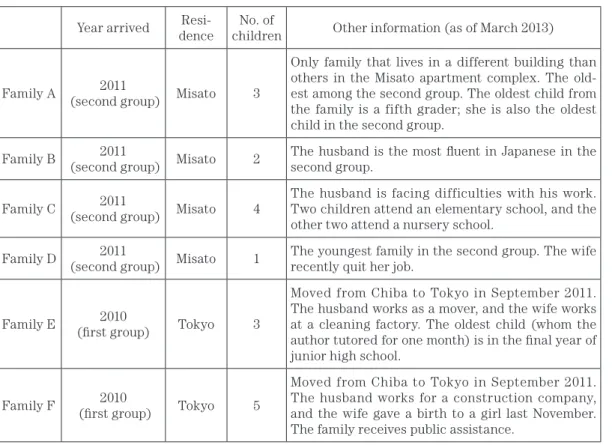
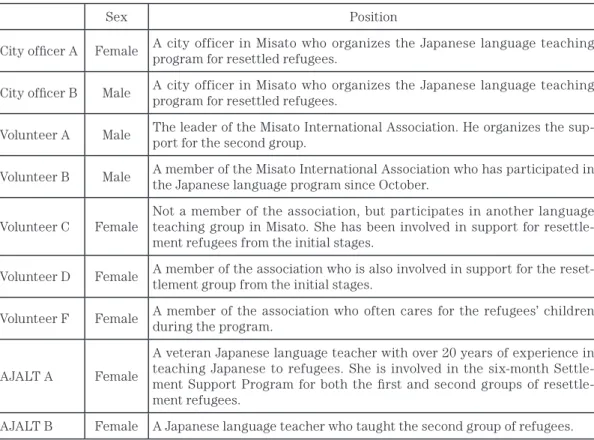
The author interviewed the resettled refu- gees in Tokyo and Misato, researchers, NGO workers, Japanese teachers, and other Myan- mar refugees. In addition, the author partic- ipated in a Japanese language program with the second group of resettled refugees and tutored a high school student living in Tokyo. A majority of the interviews were conducted from November 2012 to March 2013. A list of the main interviewees is displayed in Tables 1 and 2:
Table 1. Resettled refugees
Year arrived Resi-dence
No. of
children Other information (as of March 2013)
Family A 2011
(second group) Misato 3
Only family that lives in a different building than others in the Misato apartment complex. The old- est among the second group. The oldest child from the family is a fifth grader; she is also the oldest child in the second group.
Family B 2011
(second group) Misato 2 The husband is the most fluent in Japanese in the second group.
Family C 2011
(second group) Misato 4
The husband is facing difficulties with his work.
Two children attend an elementary school, and the other two attend a nursery school.
Family D 2011
(second group) Misato 1 The youngest family in the second group. The wife recently quit her job.
Family E 2010
(first group) Tokyo 3
Moved from Chiba to Tokyo in September 2011.
The husband works as a mover, and the wife works at a cleaning factory. The oldest child (whom the author tutored for one month) is in the final year of junior high school.
Family F 2010
(first group) Tokyo 5
Moved from Chiba to Tokyo in September 2011.
The husband works for a construction company, and the wife gave a birth to a girl last November.
The family receives public assistance.
Table 2. Support providers
Sex Position
City officer A Female A city officer in Misato who organizes the Japanese language teaching program for resettled refugees.
City officer B Male A city officer in Misato who organizes the Japanese language teaching program for resettled refugees.
Volunteer A Male The leader of the Misato International Association. He organizes the sup- port for the second group.
Volunteer B Male A member of the Misato International Association who has participated in the Japanese language program since October.
Volunteer C Female
Not a member of the association, but participates in another language teaching group in Misato. She has been involved in support for resettle- ment refugees from the initial stages.
Volunteer D Female A member of the association who is also involved in support for the reset- tlement group from the initial stages.
Volunteer F Female A member of the association who often cares for the refugees’ children during the program.
AJALT A Female
A veteran Japanese language teacher with over 20 years of experience in teaching Japanese to refugees. She is involved in the six-month Settle- ment Support Program for both the first and second groups of resettle- ment refugees.
AJALT B Female A Japanese language teacher who taught the second group of refugees.
The author visited Myanmar refugee camps in Thailand (Mae La and Umpiem Mai camps) in August 2011 and interviewed Japanese NGO workers in the camps and Myanmar refugees.
Further, reviewing the “Refugee Resettle- ment: An International Handbook to Guide Reception and Integration” by UNHCR as well as literature related to social integration is an important part of this thesis.
Section 4: Theoretical Framework
To examine the research questions, the author selected “social integration” as the theo- retical framework. This paper especially focus- es on Ager and Strang’s (2004) “Indicators of Integration” to avoid a discussion regarding the
length of the refugees’ stay in Japan as well as to establish a common understanding and clear evaluation of integration. The Indicator of Inte- gration enables researchers and policy makers to have a common understanding as well as to assist them with the planning and evaluation of services for refugees (Ager & Strang, 2004).
The indicator is especially useful when com- paring the first and second groups of resettle- ment refugees in Japan, because there is a one- year gap between them.
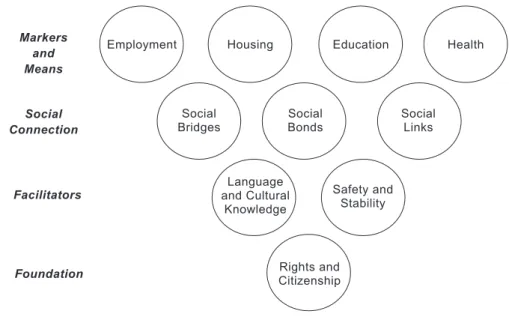
According to Ager and Strang, there are ten domains grouped under four headings in the Indicator of Integrations Framework, as shown in the chart below (Ager & Strang, 2004, p. 3).
Markers Meansand
Social Connection
Facilitators
Foundation
Employment
Social
Bridges Social
Bonds Social
Links
Safety and Stability
Rights and Citizenship Language
and Cultural Knowledge
Housing Education Health
Figure 1: The Indicators of Integration Framework <Source: Ager and Strang, 2004, p.3>
“Means and markers” contains four domains:
“Employment,” “Housing,” “Education,” and
“Health.” These represent major areas of attain- ment that are widely recognized as critical factors in the integration process and can be considered the “public face” of integration (Ager & Strang, 2004, p. 3). They clearly serve as potential means to support integration (Ager
& Strang, 2008, p. 169).
“Social connections” stresses the impor- tance of relationships to the understanding of the integration process (Ager & Strang, 2004, p. 3). It consists of “Social bridges” between members of other communities, such as the relationship between refugees and their host communities; “Social bonds,” which are con- nections within a community, such as co-eth- nic or co-religious bonds; and “Social links,”
which comprise links with the structure of the state, for instance, government services (Ager
& Strang, 2004, p. 4; Ager & Strang, 2008, pp.
178-181).
There are two domains within “Facilitators,”
which are crucial in the integration process.
They are “Language and cultural knowledge”
and “Safety and stability” (Ager & Strang, 2004, p. 4).
“Rights and citizenships” is the only domain within “Foundation.” It represents the basis upon which expectations and obligations for integration are established (Ager & Strang, 2004, p. 4).
All the domains are interrelated, and each domain may influence the others. In addition, the domains do not exhibit a clear “process”
of integration (Ager & Strang, 2004, p. 4), nor do they suggest a hierarchy of their rela- tive importance (Ager & Strang, 2004, p. 12).
Moreover, domains and categories can be inde- pendently chosen depending on the focus and conditions of each study (Ager & Strang, 2004, p. 10).
Chapter 2: Provided Support
This chapter explains how the Japanese gov- ernment organizes the support program forresettled refugees.
A pre-departure program is organized for the resettled refugees in the Mae La camp. The program introduces Japanese lifestyle, culture, and language. It is administrated by IOM and implemented by AJALT.3
After the refugees arrive in Japan, the half- year resettlement program begins. During the program, all the refugees live in one apart- ment in Tokyo, with one room for each family, provided by the Japanese government. The program consists of approximately 430 hours of Japanese language trainings and 90 hours of guidance on Japanese life and vocational sup- port programs (RHQ). The program facilitates refugees’ integration into Japanese society and self-sustainable living in Japan (MOFA, 2012b).
After the half-year program, the refugees move to a place where they make their own liv- ing. For six months after moving from Tokyo, local integration support is provided, primarily by RHQ.
Chapter 3: Research Findings
This chapter examines the social integration of the resettled refugees using the indicators pro- posed by Ager and Strang.Section 1: Means and Markers Employment
-Misato
Four husbands in Misato work at a shoe-mak- ing factory in Tokyo. They work six days a week, and on most days, they leave their hous- es at 6 am and return at approximately 9 pm.
During the busy season, they work until mid- night. It takes one and a half hours for them to commute to work by train from Misato Station.
Although all four husbands stated, “The work is hard and difficult,” they also expressed positive feelings about the job, especially with
regard to their coworkers and bosses as well as being employed, and they demonstrated high motivation for their job during the interview.
Their comments also show contentment with the freedom to choose their jobs
The wives of three families work at a lin- en-cleaning factory in Misato. They work in shifts, and they work almost all Sundays, even though that is the only day off for their hus- bands. Some of the husbands express their disappointment to have less time to spend with their family, while they spent most of the time together when they were in the camp.
According to the husbands, all their wives face difficulties in working because they have never worked before. The wife from Family D also worked with them, but she quit her job at the end of 2012 because it was too difficult to maintain both the job and the household.
-Tokyo
The two husbands living in Tokyo are also employed. The husband from Family E works for a moving company, and the husband from Family F works for a wrecking company. The husband from Family E commented, “It is not really difficult because I work only about three hours a day.” The husband from Family E works five days a week and has most weekends off.
The husband from Family F works more, occa- sionally even on Sundays.
Of the two wives in Tokyo, the wife from Family E works with the wives in Misato. She noted, “Working is hard. I don’t feel like doing anything on my day off.” The wife from Family F does not work because she gave birth last November. Accordingly, Family F receives pub- lic assistance because of their low income.
All the husbands are employed and indicated satisfaction with their jobs during the inter- views. The husbands’ comments exemplify
their contentment with their employment and with the freedom to choose their jobs. In addi- tion, four wives among the six are employed.
The wives struggle more than their husbands because they have not worked previously, and they must maintain both their job and the household. Except in Family F, all the wives earn income.
While the Japanese selection criteria prefer those “who would be able to earn their own living,” Family F receives public assistance because of their low income. From the Japa- nese government’s perspective, this is a barrier to their social integration.
In addition, a relevant source4 informed the author that all the husbands in Misato quit their jobs in May 2013. As in the case of the ref- ugees in Tokyo, who previously lived in Chiba and who quit their jobs at the leafy vegetable farm because of the difficult working condi- tions, the work ethics of Myanmar refugees from the camps may differ from those of main- stream Japanese society. The refugees find it difficult to adapt to the Japanese working culture, which takes working hard and long for granted, as they were not allowed to work for long periods of time in the camps.
Housing -Misato
The four families in Misato live in Misato Danchi (Misato apartment complex). Each apartment has two rooms, in addition to a kitchen and dining room. Three families live in the same building, but Family A lives in a dif- ferent building because there was no vacancy in the same building. The husband from Family A commented, “I feel sad about being a little away from the other families, because they are like my own family.”
While the families are satisfied with their
housing in terms of the size and condition of the rooms, the parents as well as the children are having a stressful time adapting to Japa- nese cultural and situational differences, such as the difference in housing. They received requests from the residents beneath their room to prevent their children from running or jumping in the apartment. In addition, the wives faced difficulties in learning local rules, such as those regarding garbage disposal.
Moreover, when the refugees moved into the apartments, their neighbors were not informed that resettled refugees were moving in.
-Tokyo
The situation of the two families in Tokyo is different. Both the families live in an apart- ment with two rooms, but both complain about the size. In particular, the oldest child from Family E expressed dissatisfaction with his living condition, especially lack of his private room.
The children from Family F also complained about the size of their apartment room.
The families differ in their satisfaction with their housing situations, particularly with regard to size. The refugees in Misato were satisfied with the size of their residence, while those in Tokyo complained about the size of their room. In addition, the refugees in Misato enjoyed their proximity to the other resettled refugees. This also facilitates local integration, because it enables mutual assistance among the refugees.
Education
Education is especially important for the resettled refugees in Japan as they undergo social integration. Both children and parents of refugees express their expectations for better education, which they hard to have a
chance while they are in the camps, during the interviews. These statements also show the refugees’ desire and their joy at being able to receive better education.
-Misato
All the school-aged children attend school, and the you n ger ch i ldren attend nurser y school. All the parents in Misato were grateful for this situation.
There are five school-age children between the first and fifth grades among the Misato ref- ugees. Their elementary school provides extra classes, which teach Japanese and lessons that are supplementary to the primary subjects.
The parents of the four families in Misato have been taking Japanese lessons conducted by volunteers from the local community. The city collaborated with AJALT to provide pro- fessional Japanese language lectures for the refugees. AJALT B, who has been teaching the second group of resettlement refugees since the initial six-month program, noted that their Japanese is improving. However, the lectures are conducted on Sunday, which is usually not a holiday for the wives. Thus, the wives have fewer opportunities to study Japanese.
-Tokyo
The two children from Family E attend extra classes. The oldest child attends extra classes at school, as it provides Japanese language les- sons for the first year and supplementary sup- port for primary subjects in the second year.
The second oldest child from Family E, who is in the fifth grade, attends Japanese language lessons conducted by a local community volun- teer group.
The parents from the two families in Tokyo, on the other hand, have not received Japa- nese language support since they completed
the initial six-month program. AJALT B, who helps with the Japanese improvement tests that occur approximately every two months, observed that, unlike the parents in Misato, the Japanese of the parents in Tokyo has not signif- icantly improved.
-Common problems
Despite the efforts of the schools, there exist problems related to education for the refugee children.
A serious problem is the children’s pre-pro- gram level of education. The education in the camp considerably differs from that in Japan.
According to AJALT A, education in the camp focuses on language, especially on speaking.
The junior high school student from Fam- ily E appears to be doing well at school. He showed the author his report card, which indi- cates that his school work is highly evaluated.
However, the level is not sufficient for the Jap- anese high school entrance exams. Despite his hard work and support from the school and vol- unteer groups, he failed the entrance exam of his preferred high school, which requires only a basic understanding of junior high school Japa- nese.
Another important problem is, the children’s ages. The oldest child from Family E began his junior year of junior high school at age 17. This exceptional measure was taken considering the level of education he received in the camp. The same measure was taken for the oldest child from Family A. Although she was at the age of a typical sixth grader, the school assigned her to the fifth grade. This special care is impor- tant because it provides extra time for the students to reaffirm previous learned matter before moving to higher education. However, it also makes integration into their school classes more difficult. In Japanese culture, age is often
a factor in making friends, especially for ado- lescents.
Also the high cost of education presents a problem. The refugees’ parents worry about the cost of their children’s education.
Education is the key factor in social integra- tion, especially for the resettled refugees in Japan. One of their primary reasons for partic- ipating in Japan’s resettlement program is bet- ter education for their children.
The importance of special care for resettled children is also discussed in UNHCR’s hand- book for a successful resettlement program (UNHCR, 2010a, pp. 259-276). It explains that most refugee children and youngsters need intensive and targeted support to assist them in adjusting to the new school system and to redress the effects of disrupted education as well as intellectual and development delay (UNHCR, 2010a, p. 266).
All the parents showed satisfaction with the situation of their children’s education. Never- theless, the children have highlighted several problems: the large gap between the level of education in Japan and that in the camp, the placement of some children in grades not matching with their age and the high cost of education in Japan.
Health -Misato
No one from the second group of resettlement refugees reported health problems. Support providers from the local community assist them with hospital visits when required.
-Tokyo
With help from Japan Association for Refugees (JAR) Family F has access to health servic- es. JAR especially helped when the wife from Family F required access to health services
when she was pregnant.
The wife from Family E has been suffering from headaches induced by glaucoma. She asked JAR to take her a hospital but they have never did.
In fact, on the day I interviewed her, she independently found an interpreter to take her to a hospital. The oldest child from Family E mentioned that other Karen refugees occasion- ally help them with hospital visits.
Most of the resettled refugees do not have health problems and have access to health services, except the wife from Family E, who faced difficulties in accessing health services owing to the lack of support.
Section 2: Social Connection Social bonds
Social bonds are the connections within a com- munity that are defined by, for example, ethnic, national, or religious identity (Ager & Strang, 2004, p. 4). Without this sense of identification with a particular ethnic, religious, or geograph- ical community, integration risks becoming assimilation. This domain assesses the bonds that support the sense of belonging (Ager &
Strang, 2004, p. 19).
All the resettled refugees have connections with other Karen refugees and other ethnic groups of Myanmar refugees. They are invited to every event held by Karen refugee com- munities, such as New Year events and Karen festivals. Further, the resettlement refugees exchange phone numbers with other Karen refugees and consult them when in need of assistance. The oldest child from Family E mentioned that his mother often calls the vice-chairperson of the Karen National League in Japan when she needs help.
-Misato
In addition to the connections with Myanmar refugees in Japan, wives in Misato have strong connections with each other. They spend most of their time together; go to work together; and after they finish, pick up their children from nursery school. They help each other and share information about what they need for daily life in Japan, such as what their children need for elementary school. However, their togetherness is a concern, as it results in fewer opportunities to interact with Japanese mothers.
-Tokyo
Connections among the resettled refugees were observed during the research. Especially, the refugee families living in Tokyo frequently visit each other. The second child from Family E said that she visits the other family in Tokyo almost every weekend. In addition, the two families occasionally visit Misato, and vice versa.
The oldest child from Family E engages in religious worship and attends church almost every Sunday. He has thus formed many con- nections within a Christianity community, which has helped him learn the Japanese lan- guage and culture.
Furthermore, the refugees in Tokyo main- tain frequent contact with Myanmar refugees other than the resettled refugees. A Myanmar refugee woman, who has been in Japan for about 20 years, helped the husbands from Fam- ilies E and F find jobs and apartments when they moved from Chiba.
All the refugees interact with the Myanmar refugee community in Japan; these interac- tions contribute toward their social integration into Japanese society. In addition, the resettled refugees, especially the wives in Misato, have strong connections with each other; this may
impede social integration. Further, religious worship increases the level of integration for the oldest child from Family E.
Social bridges
The depth of involvement with the host com- munity widely differs between the refugees in Tokyo and Misato, and it significantly affects the social integration of the resettled refugees.
-Misato
The refugees in Misato have strong connec- tions with the local community. Support pro- viders in Misato continue to support the ref- ugees even after the government’s initial six- month support period.
Support providers in Misato have a strong support system, which has developed over its long history as an international city. Misato has a large number of foreign residents, especially inside the Misato residence complex, where the population of 17,259 people includes 5% for- eigners, primarily from East or Southeast Asia5 (City of Misato, 2012).
According to an officer of the city of Misato, Volunteer A, a board member of the Misato International Association, volunteered to sup- port the resettled refugees after he learned that they needed support.6 From June 2012, three months after the refugees moved to Misa- to, the official Japanese language and living support have been offered every Sunday, owing to the budget provided by MOFA. More than five support providers, who have been teaching Japanese languages in the Misato residence complex, participate in each session. Moreover, some of them take care of the refugees’ chil- dren by reading picture books, playing, and helping with the homework of the elementary school students. Another four support provid- ers conduct Japanese language lessons for the
parents.7 They often visit the refugees’ rooms to ensure that they are not inconvenienced by their commute to class. However, this support program ended in September 2012.
A fter the govern ment support program ended, the support providers voluntary pro- vided support to the refugees every alternate Sunday. Thus, the active involvement of the local community appears to be very effective.
The refugees have learned not only general information about Japan but also local informa- tion and rules from the support providers. The support providers, who are mostly women with families, possess abundant information regard- ing local life, such as where to shop, local rules, and information about schools.
However, while teaching Japanese to the ref- ugees, the support providers realized that more professional lessons were required because they felt that teaching Myanmar refuges is more difficult than other foreigners. Therefore, they asked the city hall of Misato.
The city hall of Misato accepted the request.
The municipality requested the central govern- ment to expand the budget, and Japanese lan- guage support resumed from October 15 with the cooperation of AJALT. City officer A said that the program was included in the budget for the “Japanese Language Education Program for ‘Foreigners as Residents in Japan’” of the Agency for Cultural Affairs. The program was announced to the general public in response to the volunteers’ opinions that the refugees need to communicate with a wider range of people.
The participants primarily consist of Japanese language teaching volunteers in Misato, but also include some non-experienced Japanese teaching volunteers.8
The positive participation of the refugees was also observed. Most refugees participate in AJALT’s Japanese program, held from October
to March, as long as their work schedule allows it. They talk to the support providers, even after classes end, and ask many questions dur- ing and after the classes.
A mutual intimacy is developing between the support providers and refugees. The husband from Family D stated, “They [the volunteers]
are like mothers in Japan. They care about me and my family and help us a lot.” The trust in Volunteer A is especially remarkable; he plays a central role in the support in Misato
An RHQ staff member, who understands Karen, has been deeply involved in the refugee support. She has been supporting the reset- tled refugees from the beginning and visits them almost daily to help address their daily life issues, such as reading letters from school.
When asked about whom they turn to when they are in trouble, all the refugees responded with her name and Volunteer A. However, RHQ terminated her involvement in the support in Misato. Many local volunteers expressed their disappointment and confusion regarding the sudden dismissal, especially on such short notice.
-Tokyo
The parents among the refugees who live in Tokyo have few social bridges. The only con- nections they have are with a supporter from JAR. Their children, on the other hand, have built connections with Japanese communities.
For example, the youngest child from Family E has friends in her elementary school. She said that she prefers going out with her friends from school as compared with other refugees’
children. During the author’s visit to the family apartment, her friends arrived and asked her to go out. The middle child from Family E attends Japanese language lessons outside the school, which are conducted by the local community.
T he cond itions of socia l br id ges d i ffer between the refugees in Misato and Tokyo. The local support providers in Misato have provided continuous support to the refugees even after the initial six-month official support program ended. This helps the refugees gain access to Japanese language training. In addition, it provides them knowledge about living in Japan and a sense of belonging to the local commu- nity. The parents in Tokyo, on the other hand, have few interactions outside their ethnic com- munity, while their children have deeper inter- actions with their Japanese friends. Thus, seg- regation of the parents in Tokyo was observed.
Social links
Social links represent connections with institu- tions (Ager & Strang, 2004, p. 4).
-Misato
The refugees in Misato have connections with the local government. Volunteer A serves as a mediator between the local government and refugees. As mentioned in the section on social bridges, the Japanese language program by AJALT was made available due to his request.
In addition, the local government actively sup- ports the refugees. Two officers were always involved during the Japanese language pro- gram that began in October 2012. The officers shared not only official information about the refugees but also personal information such as the children’s performance in school. During the program, they revealed their worries about the refugee children, as mentioned in the Edu- cation section.
-Tokyo
The resettlement refugees in Tokyo do not have many social links. Neither RHQ nor gov- ernments at any level have been involved with
the refugees in Tokyo since they moved from Chiba.
The refugees in Misato and Tokyo have dif- ferent depths in the domain of social links. In Misato, Volunteer A, a local supporter, is the link between the refugees and the local gov- ernment. Moreover, the local government has become deeply involved in the integration of the refugees. However, unlike the refugees in Misato, those in Tokyo do not have connections with any institutions. Thus, in this domain, too, their segregation is observed.
Section 3: Facilities
Language and cultural knowledge
These skills facilitate social connections, both with other communities and with state and vol- untary agencies. Cultural knowledge includes practical information required for daily life, such as that regarding transport, utilities, and benefits, as well as customs and expectations.
In addition, the domain should reflect measures of the community’s knowledge of the cultural background of refugees (Ager & Strang, 2004, p. 21).
-Misato
The refugees in Misato gain language and cul- tural knowledge from local support providers as well from the AJALT language program. The support providers also provide local informa- tion required for daily life, such as that regard- ing where to shop and transport. Moreover, the refugees demonstrate a desire to learn Japanese language and culture. During the language programs, they asked many questions concerning language and culture.
-Tokyo
According to AJALT A, the refugee parents living in Tokyo have not significantly improved
their knowledge of Japanese language and culture. AJALT conducts a test approximately bimonthly to assess the refugees’ language level. During this study, the author had many opportunities to talk to the refugees. They appear to have less Japanese language compe- tency as compared with the second group of resettlement refugees. In contrast, their chil- dren learn Japanese language and culture in school. Accordingly, the youngest child from Family E noted that she finds Japanese consid- erably easier in daily conversation.
Safety and stability
Community safety is a common concern among refugees and within the broader communi- ties in which they live. Racial harassment and crime erodes confidence, constrains social con- nection, and distorts cultural knowledge (Ager
& Strang, 2004, p. 22).
As many refugees noted the kindness of most people in Japan, they appear to have had no experiences that threaten their safety and stability.
Section 4: Foundation
The resettlement refugees are given refu- gee status, and they are informed that they will be granted permanent residency in Japan, although they do not know the timeframe for this. Thus, Rights and citizenship informs them
of the relevant details.
This chapter reviews the findings regard- ing the situation of the resettlement refugees in Japan using Ager and Strang’s Indicator of Integration Framework. Overall, the local com- munity of Misato has a more desirable situation of support as compared with Tokyo. While the refugees in Tokyo, especially parents, show indications of marginalization, those in Misato show indications of integration into the local community.
Chapter 4: Analysis
As discussed in previous chapters, the reset- tled refugees in Misato demonstrate more indications of social integration as compared with those in Tokyo. Reviewing the differences between these groups suggests the require- ments for the successful integration of the resettled refugees.
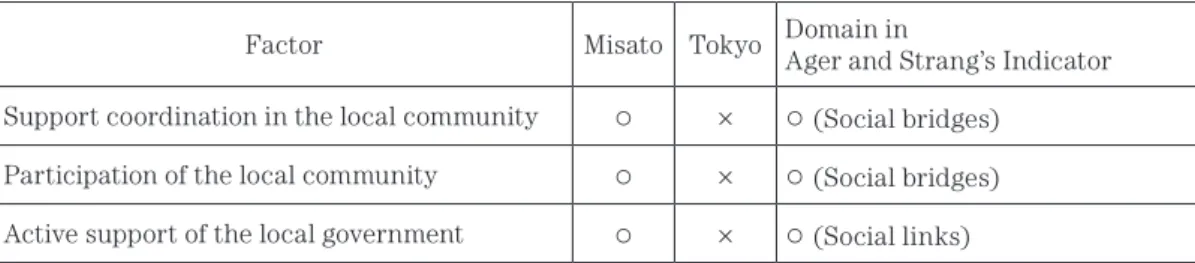
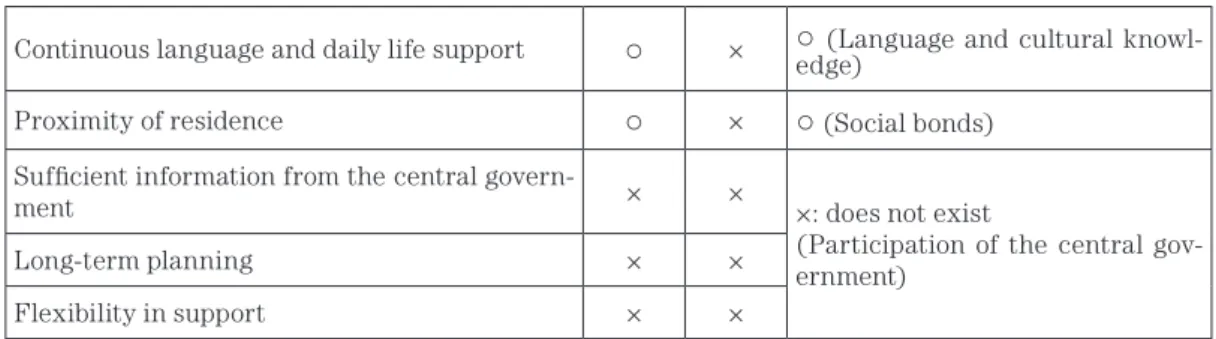
The differences concentrate on the domains of Social bridges, Social links, Social bonds, and Language and cultural knowledge. Particu- larly, five factors within the domains indicate significant differences. In addition, this study identifies three critical factors for successful integration, which are not present in the ref- ugee support in Misato or Tokyo, nor are they covered by Ager and Strang’s The Indicators of Integration Framework. The following chart summarizes these factors:
Table 4: Factors necessary for successful social integration in Japan
Factor Misato Tokyo Domain in
Ager and Strang’s Indicator Support coordination in the local community
○
×○
(Social bridges)Participation of the local community
○
×○
(Social bridges) Active support of the local government○
×○
(Social links)Continuous language and daily life support
○
×○
(Language and cultural knowl- edge)Proximity of residence
○
×○
(Social bonds)Sufficient information from the central govern-
ment × ×
×: does not exist
(Participation of the central gov- ernment)
Long-term planning × ×
Flexibility in support × ×
Section 1: Five Factors Necessary for Suc- cessful Social Integration in Japan
The findings indicate differences between the situations of the refugees in Misato and those
in Tokyo. These differences are primarily observed in the domains Social bridges, Social bonds, Social links, and Language and cultural knowledge of Ager and Strang’s The Indicators of Integration Framework, reproduced below:
Markers Meansand
Social Connection
Facilitators
Foundation
Employment
Social
Bridges Social
Bonds Social
Links
Safety and Stability
Rights and Citizenship Language
and Cultural Knowledge
Housing Education Health
Figure 1: The Indicators of Integration Framework
<Source: Ager and Strang, 2004, p.3 and developed by the author>
These differences, particularly the following five factors within four domains of Ager and Strang’s model, influence the refugees’ degrees of integration:
1. Support coordination in the local community 2. Participation of the local community 3. Active support of the local government
4. Continuous language training and daily life support
5. Proximity of residence
Support coordination in the local community A major difference between the resettled refu- gees in Tokyo and those in Misato is the exist- ence of a support coordinator.
In Misato, refugee support is coordinated through the leadership of Volunteer A. He asks local support providers for their support, and he arranges meetings with these support pro- viders to discuss the requirements for the refu- gee support and to assign roles to each support provider. Moreover, he plays a central role as a mediator between the refugees and organiza- tions such as the local government of Misato and the employers of the refugees. These activ- ities facilitate sustainable support for the refu- gees.
However, in Tokyo, the absence of a support coordinator causes confusion in the refugee support. During the study, confusion among the refugees was observed, which was caused by the involvement of too many support provid- ers. For example, two NGOs and a junior high school supported the oldest child from Family E for his high school entrance examination. All the organizations advised him differently about what to do for the exams and provided him dif- ferent texts and homework. This confused him, and he felt overwhelmed by the homework he was assigned.
As the above example suggests, the refugee support system needs a leader to organize sup- port activities. Especially, as the refugees live longer in Japan, various problems will occur, and various groups will need to participate to address these problems. Therefore, a coordi- nator is needed to organize support activities.
The existence of a local leader is also noted in the UNHCR’s handbook on resettlement as an important factor influencing the selection of specific placement communities and the place- ment of resettled refugees (UNHCR, 2010a, p.
61).
Participation of the local community
For successful local integration, local com- munity participation is necessary. During the study, the refugees asked supporters and the author questions regarding their daily lives, revealing that they need help and advice for daily living, and that they need someone to whom they can easily ask questions within close proximity.
In addition, local people possess certain very important information (e.g., which health care services to use, local rules, and school-related information), which can only be obtained from them.
Furthermore, most support providers for the refugees are volunteers. Local people who live nearby and can easily participate are more suitable as volunteers for long-term support.
In the handbook on integration, UNHCR highlights the importance of the local commu- nity for successful integration. The handbook describes that building community capacity for equitable partnership in refugee reception and integration involves all sectors of the communi- ty (UNHCR, 2010a, p. 13).
Active participation of the local government Another important difference between the sit- uation of the refugees in Misato and those in Tokyo is the degree of participation of the local government.
In Misato, city officers comprehend and share information regarding the situations of the refugees with the leader, Volunteer A, and other supporters to provide necessary support for the resettled refugees. For example, Volun- teer A realized that the refugee parents needed professional Japanese language lessons and requested funding from the city of Misato. The
city office negotiated with the central govern- ment, thus leading to the creation of the Japa- nese language program for the parents. In addi- tion, city officers who frequently participated in the Japanese language program and took care of the children during the lesson share infor- mation about the refugee children with other supporters. They realized that the children needed educational support and discussed the situation with AJALT, including their possible role as the local government.
Active participation of the local government is necessary to supplement what volunteers are unable to do, such as provide a budget and for- mal education.
Continuous language training and daily life support
Continuous language training and daily life support (e.g., reading a letter from school) are also necessary for the social integration of the resettled refugees in Japan. AJALT teachers, who have experience in teaching non-na- tive Japanese speakers, including refugees, often mentioned the difficulties of teaching the resettled refugees in Japan. According to the teachers, the resettled refugees in Japan require more time to learn Japanese.
The refugees in Misato have been receiving regular language and daily life support from local support providers. They indicated that they experienced fewer problems than before in their daily lives owing to the language train- ing and daily life support. This suggests the importance of continuous language and daily life support for the refugees.
The “traditional resettlement countries”9 conduct long-term language trai n i ng and explain the importance of language training for the integration of the refugees. Further- more, the UNHCR handbook recommends an
enriched long-term language training program (3–5years) (UNHCR, 2010a, p. 131)
Proximity of residence
To effectively support the refugees, a certain proximity of residence is necessary. The ref- ugees in Misato live physically close to each other, allowing supporters and the local gov- ernment to gather them in one place to provide support. Further, the refugees can share local information, help each other, and prevent social isolation.
Proximity of residence helps the local com- munity to provide support to the resettled ref- ugees. In the case of Misato, most support pro- viders live in or near Misato Danchi. They have easy access to the refugees’ residence, allowing them to make daily visits for support activities.
Furthermore, the Japanese language program by AJALT is conducted at a community center inside Misato Danchi; therefore, the refugees and support providers can easily meet in one place.
Proximity of residence is also important for the resettled refugees. During the interview, the refugees in Misato mentioned the advantag- es of living close to each other: they can help each other and share information about living in Japan. Especially, the mothers of the four families help each other and share information about their children. Not only the refugees in Misato but also those in Tokyo often visit each other. Thus, to prevent isolation and facilitate mutual help, living close to each other is impor- tant.
According to an RHQ staff member, the residences of the refugees are determined considering the distance to their workplaces.10 However, it is also necessary to choose a com- munity, such as Misato, that has a large number of foreign residents and a basic support system
for them. Furthermore, selecting a local com- munity that is willing to accept the resettled refugees is also important. The importance of choosing an accepting community is also spec- ified in the UNHCR’s resettlement handbook.
The handbook explains factors influencing the selection of specific placement communities and the placement of resettled refugees. The factors include partnership potential, such as the existence of NGOs, local service agencies, and civic or religious organization, to serve as partners in supporting newly arrived refugees (UNHCR, 2010a, p. 61).
Section 2: Additional Important Domain for Successful Integration in Japan
The four domains are necessary to facilitate local integration of resettled refugees. How- ever, one important domain for integration in Japan is not present in Ager and Strang’s model: participation of the central government.
Especially, the following factors derived from the absence of the central government’s partic- ipation makes local integration in Japan diffi- cult.
1. Absence of information from the central gov- ernment
2. Absence of long-term planning 3. Absence of flexibility in support
T h i s sect ion a n a ly zes t hese factor s a nd explains their importance to the successful integration of resettled refugees in Japan.
Absence of information from the central gov- ernment
Many support providers stated their frustra- tion at the lack of information provided by the central government, especially in preparation for accepting refugees. They commented that if the Japanese government provided sufficient information, they would be able to provide sig-
nificantly better support to the resettled refu- gees.
Volunteer A mentioned that he was asked to support the refugees by the Japanese govern- ment in March 2011. However, the government did not provide sufficient information about the refugees, such as their family situation and educational level. Volunteer A faced many difficulties, such as how to cope with the refu- gees’ low competency in Japanese. In addition, he complained that the central government did not inform him of the budget for training courses for “foreigners as residents in Japan”
until he inquired through the city of Misato.
The AJALT teachers also faced difficulties in preparing for the Japanese language program for the resettled refugees. They complained that the Japanese government informed them that the refugees were fully educated and had English language competency. However, the refugees who arrived did not match this description. Therefore, the teachers had to reconsider the program they had prepared.
They stated that if given accurate information, they could have prepared a considerably better program.
As the above examples indicate, the lack of sufficient information from the government caused confusion in the support activities. To provide more effective support to the refugees and to help support providers in accepting the resettled refugees, the government needs to provide accurate and detailed information for the service providers.
Absence of long-term planning
Thus far, the central government has only planned a short-term support program for the resettled refugees. The Japanese government only budgets for an initial half-year program, half-year local support, and an extra Japanese
language program in Misato.
Both the volunteers and refugees in Misato are frustrated because no official support pro- gram has been budgeted after the Japanese language program ended in March 2013. The support providers in Misato voluntarily contin- ued to support the refugees, but the refugees require professional training that the volun- teers cannot provide. Moreover, the refugees demonstrate an eagerness to further learn the Japanese language culture.
Refugee Resettlement: An International Handbook to Guide Reception and Integration refers to a planned 3–5 years long-term lan- guage support program (UNHCR, 2010a, p.
131). Especially for the resettled refugees in Japan who require more time for learning, a short-term language program is insufficient.
Absence of flexibility in support
Absence of flexibility in the support program prevents the swift social integration of reset- tled refugees.
As mentioned in the research findings, an RHQ staff member played a key role in sup- porting the refugees in Misato. However, RHQ dismissed her in February 2013 because she was overcommitted to the program, which was considered inappropriate under the RHQ’s pol- icy.11 Her sudden departure confused not only the refugees but also the other local support providers.
Furthermore, according to the rules of the Agency for Cultural Affairs, only parents are eligible for the Japanese language program in Misato, which is managed by AJALT. Children are not allowed to participate, even though they too need to learn Japanese, and they need to be cared for by someone during the lessons.
The central government enforces these rules on the support providers without considering
the needs of the refugees.
The absence of these three factors hinders the integration of the resettled refugees in Japan. The factors, which are necessary for social integration, must be addressed by the central government of Japan. Therefore, active participation of the central government is important to the Japanese model of integra- tion into a local community. This domain is not included in Ager and Strang’s Indicators of Integration.
Conclusion
This study examined the requirements for the successful integration of resettled refugees to improve Japan’s resettlement program.
Based on interviews with the resettled ref- ugees in Tokyo and Misato and their support providers, the degrees of integration between the refugees in Misato and those in Tokyo are found to be different. The refugees in Misato demonstrate better integration compared with those in Tokyo. These differences are gener- ated by the different support provided to the refugees.
This study revealed five factors that exist in the support provided in Misato but not in Tokyo. First, it was found that the coordination of support is important to avoid overlapped support, which confuses the refugees. Second, participation of the local community is impor- tant to provide daily support. Third, active support of the local government is important to cover support that cannot be provided by vol- unteers (e.g., education and budget). Fourth, continuous language training and daily life support enhance integration into Japanese society. Finally, proximity of residence allows refugees to provide mutual assistance and share information as well as allows support providers to provide efficient support.
Furthermore, the study identified three critical factors for successful integration that do not exist in the support provided to the refugees in Misato or Tokyo. Moreover, these factors are not covered by Ager and Strang’s The Indicators of Integration Framework. First, an absence of information prevents service pro- viders from providing efficient support to the resettled refugees. Second, long-term planning is important for successful integration. This is also stressed by the UNHCR’s handbook on resettlement. Third, absence of flexibility in support hampers the swift social integration of refugees. The central government should not enforce the existing rules without considering necessary exceptions for the refugees.
It is important to improve the Japanese resettlement program and make it comparable with other countries’ programs—especially that of Finland, which is considerably similar to Japan. In Finland, supporting municipalities are determined before the arrival of the reset- tled refugees, who directly settle into these predetermined municipalities. The program is flexible and creates an integration plan for each refugee, which considers their potential for integration and needs. The integration support continues for three years and includes lan- guage studies, vocational training, and acqui- sition of knowledge and abilities required to integrate into Finnish society. Even after three years, Finnish language learning assistance is provided by the municipalities. Other tradition- al resettlement countries also offer medium- or long-term support programs to resettled refugees after the refugees have settled in their local host community. In addition, many organ- izations, which are primarily support providers to the resettled refugees, such as municipali- ties, local communities, and/or NGOs, cooper- ate to provide support.
Upon closer examination of the above facts, the author su g gests that the fol low i n g is required for the successful integration of the resettled refugees in Japan: First, the Japanese government should determine where the refu- gees settle on the basis of the support provided rather than the workplace. It should select a community that maintains certain proximity among the refugees. Furthermore, the commu- nity should be able to provide support in the form of a leader and support providers. Second, the support system after the refugees settle into their municipality needs to be strength- ened. In addition, the network among the central government, accepting municipalities, support providers, and the resettled refugees needs to be developed, along with flexibility in support and medium- to long-term planned support.
However, there are notable limitations to the study. First, its results were derived from a limited sample of interviews; the resettled refugees in Japan are limited to 45 people. In addition, there was limited access to the wives in Misato and the parents in Tokyo. Second, there were certain difficulties during the inter- views. The author did not use a translator for three reasons: (1) the refugees disliked the formal interviews, (2) the Karen refugees had limited translating skills, and (3) some Karen translators had personal problems with the resettled refugees. The author interviewed the resettled refugees in Japanese, but their low Japanese language competency was an obstacle to communication. In addition, the interviews were primarily conducted during and after the Japanese language support program. There- fore, what they could and would say might have been limited.
Future studies should develop a Japanese version of Ager and Strang’s The Indicator of
Integration Framework. This study utilizes their Indicators of Integration as the theoreti- cal framework. However, there is one important domain for social integration in Japan that is not included in this model: participation of the central government. As explained in Section 2 of Chapter 4, this domain is important for suc- cessful integration in Japan. Therefore, a Japa- nese version of Indicator of Integration must be developed and studied.
1 The term “resettlement program” refers to reset- tling refugees from one state to another under the auspices of UNHCR.
2 The author refers to the Union of Myanmar as Myanmar in this paper, following the usage of terms in UNHCR’s official publication.
3 Association for Japanese-Language Training
4 The author interviewed Takizawa on May 18, 2013.
5 In Misato, 77% of the foreign residents are East or Southeast Asian (calculated by the author) (City of Misato, 2012).
6 Author interview with City officer A.
7 Author interview with Volunteer D.
8 Author interview with Officer A.
9 According to UNHCR, this includes Australia, Canada, New Zealand, the Netherlands, Den- mark, Finland, Norway, and Sweden, and the United States (UNHCR, 2012b).
10 Author interview of the staff member on Decem- ber 13, 2012.
11 The author interviewed her on March 3, 2013.
References
Abe, Y. (2010). Evaluating Japan’s Refugee Policy And Settlement Services-Lessons from Multi- culturalism in Canada and Australia. Tokyo:
Waseda University.
A gency for Cultural A ffairs. (2012). Heisei 23 do ‘Seikatusya Toshite no Gakokujin’ no Tameno Nihongo Kyoiku Zigyo. Retrieved
May 24, 2012, from Agency for Cultural Affairs:
http://www.bunka.go.jp/kokugo_nihongo/kyoui- ku/seikatsusya/h23/pdf/h23_yousei_tokyo_07.
Ager, A., & Strang, A. (2004). Indicator of Integra- tion final report. London: Home Office Immi- gration Research and Statisitics Service.
Ager, A., & Strang, A. (2008). Understanding Inte- gration: A Conceprual Framework. Journal Refugee Studies Vo.21, No. 2, 166-91.
AJALT. (2012, Apr 12). The Japanese Language Pro- gram. (N. Yamashita, Interviewer)
Bosswick, W., & Friedrich, H. (2006). Integrations of mi grant s : Co ntr ibuti o n of l ocal an d regional authorities. Dublin: European Foun- dation for the Improvement of Living and Work- ing Conditions.
Cabinet Secretariat. (2012, Oct). Dai5kai Daisanko- ku Teijyu ni Kansuru Dai3kai Yusikisyakai- gi Giziroku. Retrieved Oct 12, 2012, from Cabinet Secretariat: http://www.cas.go.jp/jp/
seisaku/nanmin/yusikishakaigi/dai3/dai3.html Cabinet Secretariat. (2012). Nanmin Taisaku Ren-
raku Tyosei Kaigi. Retrieved Nov 4, 2012, from Cabinet Secretariat: http://www.cas.go.jp/jp/
seisaku/nanmin/index.html
Cabinet Secretariat. (2012a, Dec 5). Dai7kai Dai- sankoku Teizyunikansuru Yuusikisya Kaigi.
Retrieved June 22, 2013, from Cabinet Secre- tariat: http://www.cas.go.jp/jp/seisaku/nanmin/
yusikishakaigi/dai7/dai7.html
Cabinet Secretariat. (2013, Mar 8). Daisankokuteiju ni Yoru Nammin no Ukeire Jigyo no Genjo to Kongo no Housin ni Tuite. Retrieved June 22, 2013, from Cabinet Secretariat: http://www.cas.
go.jp/jp/seisaku/nanmin/120329housin.html Castles, S., Korac, M., Ellie, V., & Vertovec, S. (2002).
Integration: Mapping the Field. Ox ford:
Report of a Project carried out by the Univer- sity of Oxford Center for Migration and policy Research and Refugee Studies Center conduct- ed by the Home Office Immigaration Research and Stateistics Service(IRSS).
City of Misato. (2012, Nov 1). Tyoumeibetu Setaisu oyobi Zinko. Retrieved Nov 5, 2012, from City of Misato Official Website: http://www.city.misa- to.lg.jp/dd.aspx?menuid=1167
Commision of the European Communities. (1990).
P OL ICI E S ON I M M IGR AT ION A N D T H E SOCIAL INTEGRATION OF MIGRANTS in the European Community. Brussels: Commision of the European Communities.
Fruta, D. (2012, Sep 26). Myanmar Nanmin Teizyu wo Zitai. Asahi News Paper, p. 10.
Fujisaki, M. (2012, Jan 17). Anzyu wo Motomete:
Daisankoku Teizyu no Genba de 2 -Ziritudekiru Shien wo Mosaku-. Asahi Shinbun (Evening Edition), p. 2.
Fujisaki, M. (2012a, Jan 18). Anjyu wo Motomete -Daisankoku Teizyu no Genba de- 3; Kurusi- kutemo Kazokuto Tomoni. Asahi Newspaper (Evening Edition), p. 2.
Fuzisaki, M. (2012b, Jan 16). Anjyu wo Motomete -Daisankoku Teizyu no Genba de- 1; Hakugai no Kyoufu Sukoshi Kieta. Asahi Shibun (the evenign edition), p. 2.
Iguchi, T. (2001). Gaikokuzin Roudousya no Shin- zidai. Tokyo: Chikuma Shoten.
IOM. (2008). Nihon ni Okeru Vietnum Nanmin Tei zyu sya (Zyosei) ni Tuit e n o Teki ou Ch osa. Tok yo : ht t p : / / w w w.iomjapa n.org / archives /v ietnamese_refugee_ adaptation_
report.pdf.
IOM. (2012, Oct 03). Monthly statistics of IOM Assisted Departures from Thailand, Jul 2012 (English). Retrieved Oct 03, 2012, from Docu- ment Derails: http://203.155.51.53/iomthailand/
index.php?option=com_docman&task= doc_
details&gid=102&Itemid=48
IOM. (2012a). IOM Teisyutu Siryou (The Infor- mation from IOM). Retrieved Aug 21, 2012, from Dai2kai Daisankokuteizyu Ni Kansuru Yusikisya Kaigi (The Second Resettlement Experts Meeting): http://www.cas.go.jp/jp/sei- saku/nanmin/yusikishakaigi/dai2/siryou4.pdf Masami, I. (2011, Mar 10). Pilot project’s first
refugees oriented. Retrieved Aug 23, 2012, from The Japan Times Online: http://w w w.
japantimes.co.jp/text/nn20110310a5.html Miyajima, K. (2010, Aug 27). “Ikinaosu Tame ni
Nihon he”Daisankoku Teijyu Dai1zin Myanmar- zin Kazoku . Asahi News Paper, p. 37.
MOFA. (2011, Feb 25). Press Conference by Min- ister for Foreign Af fairs Seiji Maehara.
Retrieved Nov 4, 2012, from Ministry of For- eign Affairs of Japan: http://www.mofa.go.jp/
announce/fm_press/2011/2/0225_01.html MOFA. (2012a, Jun 6). Syogaikokuniokeru Dai-
sankokuteizyuniyoru NanminnoUkeireno Gaiyo. Retrieved Jun 22, 2013, from Dai2kai Daisankokuteizyunikansuru Yusikisyakaigi:
http://www.cas.go.jp/jp/seisaku/nanmin/yusik- ishakaigi/dai2/siryou3.pdf
MOFA. (2012b, Ju ly). Jigyoban go 208 Hei sei 24nen Gyoseijigyo review sheet (Gaimusyo).
Retrieved August 23, 2012, from Gyoseijigyo review: http://w w w.mofa.go.jp /mofaj /annai/
yosa n _ kessa n / ka nsh i _ kou r itsu ka /g yosei _ review/h24/h23jigyo/pdfs/208.pdf
MOFA and MOJ. (2012). Senkou Tejyun Oyobi Kouhou Katsudo ni Kansuru Homusyo oyobi Gaimusyou Teisyutu Siryo(Report of cChoos- ing process and PR by MOFA and MOJ).
Retrieved Aug 21, 2012, from Dai2kai Daisanko- kuteizy u Ni Kansuru Yusikisya Kaigi (The Second Resettlement Experts Meeting): http://
www.cas.go.jp/jp/seisaku/nanmin/yusikishakai- gi/dai2/dai2.html
MOJ. (2013, Mar 19). Heisei 24 ni Okeru Nanmin Ninteisya Suu ni Tuite. Retrieved May 22, 201, from Ministry of Justice: http://www.moj.
go.jp/nyuukokukanri/kouhou/nyuukokukan- ri03_00094.html
Nakagawa, R., & Furuta, D. (2011, Sep 29). Myanmar Nanmin Toianzyu: Nihon ni Najomezu “Shigoto- naku Seikatuhi Fuan”. Asahi News Paper, p. 37.
OECD. (2012). Inter national Migration Out- look 2012. Retrieved Nov 9, 2012, from OECD Publishing: http://w w w.keepeek.com / Digi- tal-Asset-Management/oecd/social-issues-mi- gration-health/international-migration-out- look-2012_migr_outlook-2012-en
Ono, T. (Performer). (2012, Oct 24). The current situations of Thai Myanmar refugee’s camps.
Tokyo, Japan.
Oshige, M. (2011, Aug 6). Myanmar refugees in Japan find adjusting to new life difficult.
Retrieved Nov 5, 2012, from Daily Yom iuri Online: http://www.yomiuri.co.jp/dy/national/
T110805006342.htm
Public Relations Office Government of Japan. (2012,
Jan). Nihon De Ziritu Wo Mezasu Daisanko- kuteizyuunannminn Ni Rikai To Shien Wo.
Retrieved Aug 21, 2012, from Oyakudati Zyou- hou: http://www.gov-online.go.jp/useful/arti- cle/201201/5.html
RHQ. (2012, Apr). Zigyou (Service). Retrieved Aug 11, 2012, from RHQ: http://www.rhq.gr.jp/japa- nese/profile/business.htm
RHQ. (n.d.). RHQ. Retrieved Aug 23, 2012, from http://www.rhq.gr.jp/index.htm
Ryan, G. W., & Bernard, R. H. (2000). Data Shori to Bunseki Houhou. In K. N. Denzin, & L. Y. Lin- coln (Eds.), Sitsuteki Kenkyu Handbook (M.
Hirayama, T. Otani, & I. Ito, Trans., pp. 165- 190). Kyoto: Kitaoji Shobo.
SVA. (n.d.). Nanmin Camp Hassei no Haikei.
Retrieved Aug 20, 2012, from SVA: http://sva.
or.jp/myanmar/bg/
Takizawa, S. (2011). Refugees and Human Security -A Research Note on the Japanese Refugee Pol- icy-. Bulletin of Toyoeiwa Graduate School, 21-40.
Takizawa, S. (2012). Pilot Resettlement Program in Japan -From Thai refugee camp to metropol- itan Tokyo-. forthcoming.
Takizawa, S. (2013). The Japanese pilot resettle- ment programme: Identifying constrains to domestic integration of refugees from Burma. forthcoming.
TBC. (2012). A brief history of the Thailand Burma Border Situation. Retrieved Aug 3, 2012, from TBC: http://www.tbbc.org/camps/
history.htm
TBC. (2013, March). Burmese Border Displaced Persons: March 2013. Retrieved May 21, 2013, from TBC’s camp population figures: http://
www.tbbc.org/camps/2013-03-mar-map-tbc-un- hcr.pdf
UNHCR. (2001, Apr). ‘Resettlement: A tool for international protection, a durable solu- tion and a means of responsibility sharing’, Paper presented to the International Con- ference for the Reception and Integration of Resettled Refugees. Retrieved Aug 28, 2012, from UNHCR: http://www.unhcr.org/refworld/
pdfid/4bd93ea42.pdf
UNHCR. (2010, Oct 1). Refugee Resettlement: An
International Handbook to Guide Reception and Integration. Tokyo Shibuyaku: UNHCR Japan.
UNHCR. (2010a, Oct 1). Refugee Resettlement: An International Handbook to Guide Reception and Integration. Tokyo Shibuyaku: UNHCR Japan.
UNHCR. (2010b, Oct). Thai (Myanmar Nanmin).
Retrieved Aug 20, 2012, from UHCR Saishin News: http://w w w.japanforunhcr.org/act/a_
asia_thai_01.html
UNHCR. (2011a). UNHCR Resettlement Handbook:
Country Chapter-Finland. Retrieved Oct 12, 2012, from UNHCR Resettlement Handbook:
http://www.unhcr.org/3c5e57f07.html
UNHCR. (2012, Apr). Frequently Asked Quetions about Resettlement. Retrieved Nov 8, 2012, from UNHCR: http://www.unhcr.org/4ac0873d6.
html
UNHCR. (2012a, Jan). 2012 Regional Operations Profile - East Asia and the Pacific. Retrieved Oct 23, 2012, from UNHCR: http://www.unhcr.
org/cgi-bin/texis/vtx/page?page=49e488196 UNHCR. (2012b, Apr). Frequently Asked Quetions
about Resettlement. Retrieved Nov 8, 2012, from UNHCR: http://www.unhcr.org/4ac0873d6.
html
UNHCR. (2012c, Jun 6). Global Trends Report:
800,000 new refugees in 2011, highest this century. Retrieved Nov 9, 2012, from UNHCR:
http://unhcr.org/4fd9e6266.html
Wat a neb e, S. (2 011, S ep 2 6). Mo u s iir e Sy o.
Retrieved Nov 4, 2012, from http://www.jlnr.jp/
statements/20110926_mofa.pdf
Yamada, H. (2007). Nihon no Nanmin Ukeire no Tameno Watashitachi no 51 no Teigen. In H.
Yamada, Nihon no Nanmin Ukeire Kako Gen- zai Mirai (pp. 14-45). Tokyo: Tokyo Founda- tion.