Axiomatic Approach to Nucleolus in Common Cost Allocation
Masaaki Aoki *
INTRODUCTION
The nucleolus is a cooperative game solutions proposed by Schmeidler[1969]. While the nucleolus has desirable properties as an allocation scheme, I) researchers have not applied the nucleolus to common cost allocation compared with Shapley value.2) One primary reason is that it is difficult to represent the nucleolus by some axioms.
If we can describe some axioms for the allocation scheme, users of the common service can understand the properties of this allocation scheme through the axioms. If they admit that the axioms have desirable properties, they will accept this allocation scheme.
Recently, some game theorists propose the axioms for the nucleolus. The purpose of this article is to examine the meaning of the nucleolus axioms in common cost allocation based on the results in game theory. If we can give meaningful interpretations to the axioms for the nucleolus, the nucleolus may be an allocation scheme for common cost allocation.
In Section 1, we clarify the significance of the axiomatic approach to common cost allocation. In Section 2, we describe the model for common cost allocation and define the notations and cooperative game solutions necessary for our later analysis. We denote the numerical an example based on this model.
In Section 3, we describe the axioms proposed by Potters[199IJ, Snijders[1995], and Sobolev[1995] and classify these axioms under two groups. One group corresponds to the axioms that are common to three studies and the other group corresponds to the axioms peculiar to each study. The former has important implications when we examine the nucleolus axiom. We examine the former axioms in Section 4 and the later axioms in Section 5. We will use numerical examples as much as possible in our analysis because users of the service do not accept the nucleolus as an allocation scheme if we fail to explain the meanings of the axioms with the concrete examples.
In the last section, we summarize the axioms of the nucleolus. We refer to the some
1 ) See Aoki[ 1996al and Aoki[ 1996bl as to the desirable properties of the nucleolus. Aoki[ 1996al examines the significance of the nucleous in common cost allocation by supposing the bargaining processes for allocating common cost. Aoki[ 1996bl examines the properties of the various nucleoli derived from the nucleolus in common cost allocation.
2 ) See Aoki[ 1996dl.
* Aomori Public College
unsolved problems that we should investigate in the future.
1. The Axiomatic approach to Common Cost Allocation
We consider the implications that an allocation scheme is necessary and sufficient for a set of axioms in common cost allocation. It means that an allocation scheme satisfies the properties presented by a set of axioms and an allocation scheme is uniquely determined by these axioms.
When the allocation scheme is characterized by the axioms, we can see the properties of the allocation scheme without examining the allocation formula itself. Therefore, if we interpret the axioms as the desirable properties that the allocation scheme should have, we can regard the resulting allocation scheme as the desirable one.
As the nucleolus is a solution of a series of linear programming problems,3) we cannot represent the nucleolus by the simple formula generally.4) This means that it is difficult for us to infer the meanings of the nucleolus from its formula directly. So we should investigate the axioms of the nucleolus and give them some meaningful interpretations in order that the nucleolus is widely accepted as the common cost allocation scheme.
We review the past studies in which the axiomatic approach is used in common cost allocation. As Shapley value is an axiomatic solution, many researchers have tried to apply Shapley to common cost allocation in the past.S) We summarize these reasons as follows .
• Shapley value is specified by three axioms.6)
• It is easy to understand Shapley value axioms intuitively.
When we characterize the allocation scheme by the axioms, it is desirable that the number of the axioms is small. Because the player of the common cost allocation game cannot understand the meaning of the axioms fully if there exist many axioms. This means that players of the game do not accept the allocation scheme even if the allocation scheme has desirable properties.
The axioms themselves are mathematical expressions. So, it is necessary to represent the axioms with plain expressions when we apply the nucleolus to common cost allocation.
If we fail to give such interpretations to players of the game, they will not admit the
3 ) See Kohlberg[ 1972].
4) We can obtain the formula of the nucleolus in some special cases. See Littlechild[1974], Suzuki and Nakayama[ 1976], and Legros[ 1986l.
5 ) Aoki[ 1996d] surveys the past studies in which cooperative game solutions are applied to common cost allocation. It says that Shapley value is the main interest of the past researchers.
6) If we include the existence of "carrier" as an axioms, Shapley value is specified four axioms. See Shapley[ 1953] and Owen[ 1995] as the to Shapley axioms.
allocation scheme as desirable one in common cost allocation. It is convenient for our analysis that the axioms themselves are simple and easy to understand.
We do not refer to the axioms of Shapley value here since it is not our purpose. We only mention that there are many studies in which Shapley value allocation is examined in terms of its axioms. This fact suggests that the axiomatic approach to common cost allocation is significant.
The nucleolus is derived from the idea that the maximum excess is minimized. The excess is dissatisfaction of the coalition with the allocation.7) The nucleolus is different from Shapley value, which is derived from axioms originally, in this point. It seems that it is difficult to represent the nucleolus by a set of axioms. Recently, Potters [ 1991], Snijders [1995], and Sobolev[1995] propose a set of axioms for the nucleolus in the field of the game theory.8) We examine the nucleolus axioms in common cost allocation using the results of the above articles.
The purpose of the article is to interpret the nucleolus axioms in common cost allocation.
We should explain the axioms concretely in our analysis. We use numerical examples to achieve this purpose. We proceed our analysis with the following steps.
Step 1: We construct the numerical example corresponding to the axiom. But we do not construct examples if the meaning of the axiom is evident.
Step 2: We confirm that the nucleolus satisfies the properties described by the axiom using numerical examples.
Step 3: We examine the meanings of the axiom considering the results of Step 2.
In Step 1, we verify the validity of the nucleolus axioms in our model. If we cannot construct the relevant numerical example, it means that the axiom is meaningless but has significant meanings mathematically in our model.
Step 2 is the process in which we confirm the obvious fact since game theorists have already proven that the nucleolus satisfies the axioms. But this step is necessary to our analysis because the nucleolus axioms are mathematical ones and it is difficult to interpret these axioms directly. In Step 3, we examine the nucleolus axioms considering the implications of the numerical examples in Step 2
7 ) We define the excess in the next section.
8 ) Peleg[ 1986], Maschler and Tijs[ 1992], and Orshan[ 1993] also propose the axioms for the prekernel, the nucleolus, and the prenucleolus. As Peleg[ 1986] treats the axioms of the prekernel, we do not examine it here. The axioms proposed by Maschler and Tijs[ 1992] are too mathematical, so we do not examine their axioms here. Since Orshan[ 1993] extends the axioms for the prenucleolus, we do not refer it here.
See Aoki[ 1996a] as to the prekernel and see the next section as to the prenucleolus.
2. Model and Definitions
2.1. Model
As we examine the nucleolus axioms, we formulate common cost allocation as the characteristic function form game. So, we proceed our analysis using the model proposed in Aoki[ 1997] Y)
N is the set of the players. We call N a grand coalition. As the players are rational decision makers, the game players in common cost allocation are the managers of divisions or departments in a firm. It is assumed implicitly that every player prefers to lower allocated cost. The subset of N is referred to as a coalition. It is supposed that coalitions can make decisions regarding the acquisition and utilization of the service. For example, players can decide whether they get the necessary service internally or externally. It is assumed that a coalition makes its decision as if it were one player.
q is the demand of the service, so qi is the player i's demand of the service. C(q) is the cost function of the service. When C(q) is a concave function, we can estimate the characteristic function as the maximin value of the benefit arising from the joint acquisition of the service. The cost function C(q) includes the information about the cost of the external service when there are some external vendors providing the necessary service in the market.
A characteristic function is a mapping 2n-dimensional space into the real number R. The value of the characteristic function v(S) is the worth that a coalition Scan receive.IO ) It is rational to assume that the assumption of transferable utilities is satisfied in common cost allocation. II) It is convenient to define the characteristic function as the cost saving game in common cost allocation. We will proceed our analysis with the following characteristic function.
v(0) = 0
v(S) = L C(q/,) - C( L q/,)
iES iES
YSCN (1)
Let <t> (ERn) be an arbitrary cooperative game solution and <t> i (v) be player i's value of the game, namely, the allocated amount of benefit to player i. We may refer to <t> as the solution concept in the later section. As the characteristic function in (1) is O-normalized, v( {i })=O( Y i EN). Let Yi be the allocated cost to player i. We can represent the relationship between Yi and <t> i (v).
9 ) Aoki[ 1997] specifies the situations where we can estimate the characteristic function in common cost allocation,
10) See Owen[ 1995](p,213) as to the definition of the characteristic function,
11) See Aoki[ 1996b](ppA-S) as to the validity of transferable utility assumption in common cost allocation,
Y· = C(q.) - <t> .(v)
I I I (2)
(2) says that the allocated cost to player i ( Yi ) is automatically determined if we get the value of the game (<t> i (v». We will often refer to the value of the game in the successive analysis. It should be noted that specifying <t> i (v) is equivalent to specifying Yi.
When the cost function is a concave function, the characteristic function defined in (1) become a convex game. 12) A convex game is a class of the game proposed by Shapley[1971 J.
The definition of the convex game is : \3)
v(S) + v(T):::;;: v(S n T) + v(S U T) VSCN (3)
(3) is equivalent to (4).14) This formula gives us interpretation for a convex game.
v(S U { i} ) - v(S) :::;;: v( T U {i} ) - v( T) ViEN and V SCTCN- {d (4)
It is clear that (4) means the scale of economy. We will examine the case where there is some cost saving from the joint acquisition of the service.
We will use the following notation instead of the summation for abbreviation. x is a n- dimensional vector.
xes)
=L
x·iES I
VSCN (5)
2.2. The Nucleolus
We define the notations and the nucleolus necessary to our later analysis. The pre- imputation of the game v is defined as:
Definition 1 : Pre-imputation
X(v):= {xERnlx(N) = v(N)} (6)
The pre-imputation means that all the cost saving is allocated to the players. Namely, the total amount of common cost is allocated to players. We define the imputation set using Definition 1.
12) See Aoki[ 1997](p.19).
13) Shapley[1971](p.12).
14) Shapley[ 1971 ](p.13).
Definition 2 : Imputation
I(v) := {xEX(v)1 xi2 v({i}) for all iEN}
Xi ~ v ({ i}) in the above definition is equivalent to Xi ~ 0 in our model. It means that the allocated cost to each player Yi is not larger than the individual cost C(q).
The excess e(S,x) is the dissatisfaction of coalition S with the allocation X and defined as follows. IS)
Definition 3 : Excess
e(S,x) := v(S) - xeS) YSCN (8)
B (x)( E R21l) is the vector whose element is e(S,x)( Y SCN). The elements e(S,x) are arranged in decreasing order in B (x). We can define the nucleolus using (7) and (8).
Definition 4 : Nucleolus
Nu(v) = Nu(v,/(v» := {xE/(v)1 B(x)-::3 B(y) for all y E I( v)} (9)
The notation -::3 is an operator that compares any two vectors by the lexicographic order. 16) The above definition says that the nucleolus is the lexicographic minimum allocation in the imputation set. Hence, we cannot define the nucleolus if the imputation set is empty. 17) As there exists the imputation set in our model, we can always define the nucleolus. IS)
It is hard to conceive that players accept the allocation other than the imputation in common cost allocation. Because it means that each player has to pay more than its individual cost of the service. We focus on the allocation in the imputation set in the later analysis. We refer to the set of all games as G and refer to the set in which imputation set is not empty as IG.
15) See Aoki[ 1996a](p.6) as to the meaning of the excess.
16) See Aoki[ 1996a](p.11) as to the lexicographical order.
17) We can define the prenucleolus instead of the nucleolus when the imputation set is empty. The prenucleolus PN (v) of the game v is defined as :
PN(v):=PN(v,X(v»={xEX(v)IHCd::j O(d for all y EOX(v)l
18) The convex game always has the core. As the core is the subset of the imputation, the imputation set is not empty when the core exists.
2.3. Numerical Example
We proceed our analysis using 4-person game examples. The following cost function is assumed in our numerical example.
( 40q C(q) = 20q + 300
10q + 600
o :::::: q < IS IS::::::q<30 30:::::: q
It is clear that the above cost function is concave. Let q be the vector whose elements is the service demand of each player. When q=(lS,20,2S,30), we obtain the following characteristic function using (1).
Example 1
vl({ I}) = vl({2}) = vl({3}) = vl({4}) = 0
vl({l,2}) = 3S0 vl({l,3}) = 400 v1({l,4}) = 4S0
vl({2,3}) = 4S0 vl({2,4}) = SOO vl({3,4}) = SSO
vl({ 1,2,3}) = 900 vl({ 1,2,4}) = 9S0 vl({ 1,3,4}) = 1,000 vl({2,3,4}) = 1,0SO
vl({l,2,3,4}) = I,SOO
It is clear that the characteristic function in Example 1 is a convex game from (3) and (4).
We will use the numerical example derived from the above cost function in the later analysis. Namely, we construct our example by changing the service demand vector q. This has significant meaning in our analysis. If we cannot make the relevant examples to the axiom with the above procedure, it means that we cannot interpret the axiom appropriately in common cost allocation.
3. The Axiomatic Approach to the Nucleolus
We describe the axioms proposed in Potters[1991], Snijders[199S], and Sobolev[l99SJ.
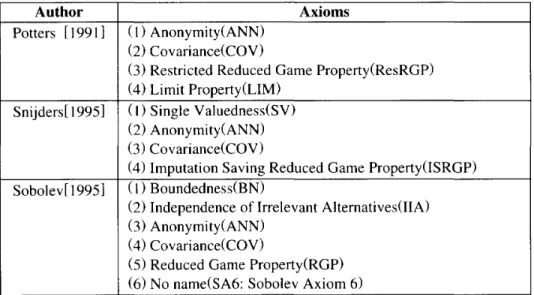
Potters[1991] proposes four axioms, Snijders[ 1995] proposes four axioms, and Sobolev [199S] proposes six axioms. These axioms are summarized as Table 1.19)
19) Sobolev[ 19951 does not give the name to his 6th axiom. We refer to this axiom as SA6.
Author Axioms Potters [1991] (1) Anonymity(ANN)
(2) Covariance(COV)
(3) Restricted Reduced Game Property(ResRGP) (4) Limit Property(LIM)
Snijders[ 1995] (1) Single Valuedness(SV) (2) Anonymity(ANN) (3) Covariance(COV)
(4) Imputation Saving Reduced Game PropertyOSRGP) Sobolev[ 1995] (1) Boundedness(BN)
(2) Independence of Irrelevant AlternativesOIA) (3) Anonymity(ANN)
(4) Covariance(COV)
(5) Reduced Game Property(RGP) (6) No name(SA6: Sobolev Axiom 6)
Table 1 : Axioms for the Nucleolus
We classify the above axioms under two groups. The axioms common to three studies are in the first group and the other axioms are in the second group.
CD Axioms in common - Anonymity(ANN) - Covariance(COV)
- Reduced Game Property(RGP), Restricted Reduced Game Property(ResRGP), Imputation Saving Reduced Game Property(ISRGP)
CD Other axioms
- Single Valuedness(SV) - Limit Property(LIM) - Boundedness(BN)
- Independence of Irrelevant Alternatives(IIA) - Sobolev Axiom 6(SA6)
We examine these two types of axioms in Section 4 and 5 respectively. It seems that the axioms in the first group are important when we interpret the nucleolus axioms in common cost allocation. The axioms in the second group have mathematical and technical implications.
4. The Axioms in Com mom
4.1. Anonymity(ANN)
Definition 5 : Anonymity(ANNPO)
<P(v lr ) = <P(v)lr for all games v E IGandallpermutations 7[ ofN.
Consider the following permutation 7[ to show that the nucleolus satisfies ANN.
7[ (1)=2 7[ (2)=3 7[ (3)=4 7[ (4)=1
The characteristic function v2 is derived from the above permutation. Namely, v2(S)=vl ( 7[ S).
Example 2
i( {I }) = i( {2}) = v2( { 3}) = v2( { 4}) = 0
v2( {2,3}) = 350 i( {2,4}) = 400 v2( {2, I}) = 450 v2( {3,4}) = 450 v2({ 3, 1 }) = 500
i(
{4,1 }) = 550 v2( {2,3,4}) = 900 v2
( {2,3,1 }) = 950 i( {2,4, 1 }) = 1,000 v2( {3,4,1 }) = 1,050 v2( { 1,2,3,4}) = 1,500
The permutation 7[ relates the players in Example 1 to the players in Example 2. For example, player 1 in Example 1 plays the same role as the player 2 in Example 2.
The nucleolus in Example 1 is Nu(vl)=(300,350,400,450) and the nucleolus in Example 2 is Nu(v 2)=(450,300,350,400). Since Nu(v1)1 = NU(V 2)2,Nu(VI)2 = NU(V 2)3,Nu(VI)3 = NU(V2)4,Nu(VI)4 = Nu(v2),21l it is clear that the nucleolus satisfies ANN.
ANN axiom requires that the solution concept is not dependent on the player's name. In other words, this axiom says that the allocation to each player should be determined by the characteristic function only.
We suppose that only the cost information is available in common cost allocation and the cost information is transformed into the characteristic function. Hence, we regard ANN axiom as desirable one in common cost allocation.
20) See Potters[ 1991 ](p.371), Snijders[ 1995](p.190), and Sobolev[ 1995](p.16). Strictly speaking, ANN in Sobolev[ 19951 is different from Definition 4. Because Sobolev[ 19951 assumes the boundedness, which is defined later. See Sobolev[ 1995](p.116) as to the definition of his ANN.
21) Nu (v k)i is the i th element of the vector Nu (v k).
4.2. Covariance( cavy
We can define COY as follows.
Definition 6 : Covariance( cavj22)
<1> ( A v + deS)) = A <1> (v) + d for all A > 0 and all d ERn.
The games v and A v+d(S) are strategically equivalent. COY says that the value of the game v is identical to the value of the game A v+d(S). Namely, one allocation is transformed into the other allocation by the transformation specifying the strategical equivalence. Consider the case where the total cost is decreased by 20% in Example 1. The resulting cost function is:
( 32q C'(q) = 16q + 240
8q + 480
0-::;, q < 15 15 -::;,q<30 30 -::;,q
The relationship between C(q) and C'(q) is depicted in Figure 1.
Cost
o
Figure 1 : C(q) and C'(q)
We can estimate the characteristic function v3 from C'(q).
22) See Potters[1991](p.371), Snijders[1995](p.190), and Sobolev[1995](p.16).
q
Example 3
v3( {l }) = v3( {2}) = v3( {3}) = v3({ 4}) = 0
v3( {l,2}) = 280 v\ {l,3}) = 320 v3( {l,4}) = 360 v3( {2,3}) = 360 v\ {2,4}) = 400 v\ {3,4}) = 440
v3( { 1,2,3}) = 720 v\ { 1,2,4}) = 760 v3( { 1,3,4}) = 800 v3( {2,3,4}) = 840 v3( { 1,2,3,4}) = 1,200
The nucleolus in Example 3 is Nu( v3)=(240,280,320,360). It is clear that Nu( v3)=
0.8Nu(vl).
We consider the implication of dE Rn in Definition 7. We suppose that every player receives the fixed subsidy. For example, consider the case where every player gets 10 subsidy, i.e., d=(IO,lO,lO,lO).23) The characteristic function in this case is v4.
Example 4
v 4( { 1 })= v 4( {2} )=v 4( {3 } )=v 4( {4})= 1 0
v4({ 1,2})=300 v4({I,3})=340 v4({ 1,4})=380 v\ {2,3 })=380 v4( {2,4 })=420 v4( {3,4 })=460
v4( { 1,2,3} )=750 v4( { 1,2,4} )=790 v4( { 1,3,4} )=830 v4( {2,3,4} )=870 v4({ 1,2,3,4})=1,240
The nucleolus in Example 4 is Nu( v4)=(250,290,330,370). It means that Nu( v4)=
Nu( v3)+d=0.8Nu( vi )+d. We can understand that the nucleolus satisfies COY from the Example 3 and 4.
The analysis of Example 3 and 4 implies the following requirement of COY.
• When the total cost of the service changes at constant rate, the allocated amount to players changes at the same rate.
e The constant subsidy to each player is reflected in the allocated amount directly.
In our model, the first requirement means that the variation in the total cost of the service is proportional to the variation in the allocated cost. We look into the allocated cost in Example 1 and 3. The allocated cost in Example 1 is y(vl)=(300,350,400,450) and the allocated cost in Example 3 is y(v3)=(240,280,320,360).24) It is clear that y(v3)= 0.8y(vl).25) If the players of the common cost allocation game regard the linear relationship between the variation in the total cost and the variation in the allocated cost as natural rule, the first
23) We can choose the vector d arbitrarily. There is no need to make all the elemnts equal.
24) Y (v k )( E R" ) is the allocated cost in the game v k.
25) See Appendix 1 as to the mathematical proof.
requirement is desirable in common cost allocation. We examine the numerical examples in which the total cost of the service decreases but our discussion applies to the case where the total cost of the service increases.
We consider the allocated cost in Example 4 to interpret the second requirement concretely. As y(v4)=(230,270,310,350), y(v4)=y(v3)-d=0.8y(vl)-d.26) We see that every player receives 10 subsidy in Example 5.
The second requirement says that we can determine the amount of the subsidy to the service users arbitrarily. If we want to incorporate the subsidy into the allocation scheme, this requirement is useful and necessary. We examine the case where the users of the service receive subsidy but the results obtained here applies to the case where some fixed amount is charged to users of the service in common cost allocation.
We conclude from the above analysis that COY axiom is desirable and the players of the common cost allocation game are likely to accept this axiom in common cost.
4.3. Reduced Game Property and its Derivatives
As we can obtain ResRGP and ISRGP by changing the condition in the definition of RGP, we examine RGP first. We have to define the reduced game to discuss RGP. The reduced game with respect to coalition T( eN) and the pre-imputation x is defined as:
Definition 7 : Reduced Game27)
vT,x (S) =
I
:ax{ v(SU Q) - x(Q) I QCN-T)v(N) - x(N - T)
ifS = 0
if SeT, S -:j= T, 0 ifS= T
For example, suppose that x=Nu(v l)=(300,350,400,450) and T={ 1,2,3}. We obtain the reduced game v5=vlll,2,3),x by Definition 8.
Example 5
v5({I})=0 v5({2})=50 v5({3}) = 100
v5( { 1,2}) = 500 v5( { 1,3}) = 550 v5({ 2,3}) = 600
vSC { 1,2,3 }) = 1,050
From the Example 5, we can see that coalition T={ 1,2,3}, which is the subset of N, plays a sub-game under the assumption that player 4 receives x4=450. If the players in coalition T
26) See Appendix 1 as to the mathematical proof.
27) See Potters[ 1991 ](p.368), Snijders[ 1995](p.190), and Sobolev[ 1995](p.16).
are not satisfied with allocation x and the players in coalition N - T are satisfied with allocation x, the player in coalition T may play such a sub-game without N - T.
We define RGP as:
Definition 8 : Reduced Game Property( RGP )28)
If <P (v)
=
x, then xlT=
<P (vT,) for every game v and coalition T.XIT is the restriction of x to coalition T. We compute the nucleolus in Example 5 to show that the nucleolus satisfies RGP. The nucleolus in Example 5 is Nu(v5)=(300,350,400).
Since Nu(v5)i=Nu(vl)/i=I,2,3), the nucleolus satisfies RGP in our model.
We compare the nucleolus with Shapley value, which does not have RGP, to consider the implication of RGP. Shapley value in Example 1 is Sh(vl)=(325.00,358.34,391.66,425.00).
Suppose that player 4 is not satisfied with Sh(vl). Player 4 may propose a sub-game whose players are T={ 2,3,4}. The reduced game in this case is v6=vl {2,3,4l,Sh(v')'
Example 6
v6({2}) = 25 v6({3}) = 75 v6({4}) = 125
v6( {2,3}) = 575 v6( {2,4}) = 625 v6( {3,4}) = 675 v6({2,3,4}) = 1,175
Shapley value in Example 6 is Sh(v6)=(341.67,391.66,441.66). While player 4 may be satisfied with She v6), player 2 will have dissatisfaction with She v6). So, player 2 may propose a new sub-game whose players are { 1,2,3 }. Some players continue to propose such sub-games as long as Shapley value is used as the allocation scheme. As a result, players cannot obtain a stable solution. This analysis applies to the allocation scheme that does not have RGP. But we can get a stable allocation in this case if we use the nucleolus as the allocation scheme.
The above analysis tells us the implication of RGP in common cost allocation. RGP is necessary to obtain a stable solution in the case where player can play sub-games.
ResRGP is defined as:
Definition 9 : Restricted Reduced Game Property( ResRGP )29) If <P (v)
=
x and xlT E I(vT ), , then <p(vT ) ,=
xiT'Definition 8 requires that XIT belongs to the imputation of the reduced game vT,x' As mentioned in the previous section, our model is a convex game. The core is not empty in the convex game. As the core has RGP30) and the nucleolus is in the core whenever the
28) See Sobolev[ 1995](p.16).
29) See Potters[ 1991 ](p.371).
30) See Peleg[ 1986](p.190).
core exists, the following relationship holds.3l)
From the above relationship, XIT always belongs to I(vT, x> in our model. This means that our models satisfies ResRGP.
The condition XIT E I( vT, x> in Definition 9 is necessary to assure that the imputation set exists in the reduced game. As this condition always holds in our model, we can interpret ResRGP as the same as RGP in our model.
It is necessary to explain the imputation saving reduced game to define ISRGP.
Definition 10 : Imputation Saving Reduced Game32)
v(N) -x(N - T) for S = T
vT,/S)
min {Xi' v(U})}
o
for lsi> 1, SCT, S 1= T, (I)
forS=U}, ITI>1 for S
=
(I)The above definition also defines the reduced game but the condition regarding S= {i} is not in Definition 8. We can define ISRGP using Definition 10.
Definition 11 : Imputation Saving Reduced Game Property( ISRGP )33)
Ifx E ¢(v), then xlT E ¢(vT,)for all v E IG and all T C N,T1= 0.
The condition vT)S)=min {Xi, v( U} )} (for S= Ii}, 1 T I> 1) is necessary to assure that the reduced game has its imputation set. Since ¢ (v) Z 0, vT, xC {i } )=0 in our model. We can see that ISRGP has the same meaning as RGP in our model.
Potters[ 1991] and Snijders[ 1995] propose ResRGP and ISRGP instead of RGP respectively. The above discussion tells us that ResRGP and ISRGP have the same meaning as RGP in our model. So we do not give any special interpretations to ResRGP and ISRGP here. But it should be noted that we cannot give ResRGP and ISRGP such interpretations in general.
31) Core (v) is the core of the game vand is defined as follows:
Core (v):={xEX(v) I x (S) ~ v (S) V seN}
32) See Snijders[ 1995](p.190).
33) See Snijders[ 1995](p.190).
5. Other Axioms
5.1. Single Valuedness(SV)
Snijders[I995] proposes Sv. We define SV as:
Definition 12 : Single Valuedness( SVJ34) 1<t>(v)l=lforall v E IG.
As the nucleolus is uniquely determined, it is clear that the nucleolus has Sv. It is natural to require that the allocation scheme should have Sv. Because the allocation scheme is meaningless if it gives us two distinct solutions in common cost allocation.
5.2. Limit Property(LIM)
Potters [I 991] proposes LIM. It is necessary to define game Uo before we define LIM.35)
uo(S) =
I
0 for S =f. 0, N 1 for S = 0, NWe uses the game Uo to construct the game v - suo. This game implies that the constant s is deducted from v(S)(S=i= N,fJ). LIM is defined using uo.
Definition 13 : Limit Property(LIM)36)
For every game vEG there exists a real numberE(v) such that <t>(v-so) is independent on s for s ~ E(V) and if this constant vector (<t> *(v» is an element of the imputation set I( v), then <t> (v)= <t> *( v).
We suppose that s= - 300 and v7=v' - suo to show that the nucleolus satisfies LIM. The characteristic function v7 is:
Example 7
v 7 ( {1 }) = v \ {2}) = v7 ( { 3 }) = v \ { 4}) = 300 v \ { 1,2}) = 650 v 7 ( { 1,3}) = 700 v \ { 1,4}) = 750 v\{2,3}) = 750 v\{2,4}) = 800 /({3,4}) = 850
v\{1,2,3}) = 1,200 v\{1,2,4}) = 1,250 v7({1,3,4}) = 1,300 v\{2,3,4}) = 1,350
v\
{1 ,2,3,4}) = 1,50034) See Snijders[1995](p.190).
35) See Potters[ 1991 ](p.367).
36) See Potters[1991](pp.370-371).
The nucleolus of the game v7 is Nu(v7)=(300,350,400,450). It is clear Nu(v7)=Nu(vl ).
When we compute the nucleolus of the game vi + 200uo(s= - 200), we get the same nucleolus as Nu(vl). We see that the nucleolus is independent on s for s ~ - 300 from Example 7.:.7)
Next, suppose that s= - 350 and v'K=vl - SUo. The nucleolus of the game v8 is Nu( v8)
=(300,350,400,450). It is clear that Nu(v'K)=Nu(vl). But Nu(v8) is not in l(v8) since v'll, {i} =350. Hence, we see that E( v) in Definition 13 is - 300 and the nucleolus satisfies LIM.
Unfortunately, it is difficult to interpret LIM in common cost allocation. We can summarize the reasons as follows .
• It is hard to give some meaningful interpretations to deducting the constant s from v(S)(S *- N,0) .
• When the game v - SUo is not always a convex game, we cannot construct any examples from the concave cost function C(q).
If we construct a game in which an additive function like deS) is deducted from v, it is possible to interpret this axiom meaningfully. But LIM requires that the constant amount is deducted from v(S)(S *- N, 0) uniformly. The size of the coalition is not considered in this operation. The size of the coalition is important in our formulation because our game is convex. Hence, it is difficult to interpret the meaning of the game v - SUo in our model.
It is clear that Example 7 is not a convex game.3'K) In general, it is not always true that the game v - SUo is a convex game. It means that we cannot construct the relevant example to LIM in our model.
5.3. Boundedness{ BN)
BN is proposed by Sobolev[ 1995]. We define BN as follows:
Definition 14 : Boundedness(BN)3Y) a :S: cP ( v ,a) :S: A ( v ,a)
The vector a( E RIl) is the lower bound of the solution concept and satisfies v(N) ~a(N).
As Sobolev[l995] defines the solution concept on the pair (v,a), he uses CP(v,a) instead of cP (v) as the solution concept. Ai is the element of the vector A (v ,a)( E RIl) and its element is Ai=v(N) - v(N - u}).
Sobolev[ 1995] discusses the nucleolus axioms generally by admitting the value of
37) The nucleolus is a continuous function of the characteristic function(Schmeidler[ 19691.p.1165).
38) v({lll>d(I.23Al) -V«(23Al).
39) Sobolev[ 1995](p.16).
ai = - 00 and Ai=oo. But we regard the lower bound ai as v( {iD since I( v) always exists in our model.
Ai is the maximum amount that player i can request when the core exists and the allocation is in the core.40) As the nucleolus is in the core when the core is not empty, Nu( v) ~ A (v ,a). From the above discussion, we can see that the nucleolus satisfies BN when ai=v( {i}). We can easily check this fact by Example 1.
It is concluded that the axiom BN specifies the range of the allocation in which the lower bound relates to the imputation set and the upper bound relates to the core. We cannot find any positive reason to refuse the allocation in the imputation or the core when the imputation or the core exists. We regard BN as desirable property in common cost allocation.
S.4. Independence of Irrelevance Alternatives(IIA) Sobolev[199S] proposes IIA. We define IIA as:
Definition 15 : Independence of Irrelevance Alternatives(IIA)41)
Let (v,a) and (v,a') belongs to G'.1f a ~ a' ~ <P (v,a), then <P (v,a)= <P (v,a).
G' is the set of the pair (v,a) in the above definition. We consider the Example 8 to check whether the nucleolus satisfies IIA or not.
Example 8
v9( {1 }) = 300 v9( {2 D = 3S0 v9( {3}) = 400 v9( {4 D = 4S0 v9( { 1,2}) = 3S0 v9( {1,3}) = 400 v9( {1,4}) = 4S0
v9( {2,3 D = 4S0 v9( {2,4}) = SOO v9( {3,4 D = SSO
v9( {1 ,2,3}) = 900 v9( {1 ,2,4}) = 9S0 v9( {1 ,3,4 D = 1,000 v9( {2,3,4}) = 1,0SO v9( {1 ,2,3,4}) = I,SOO
We obtain the above example by replacing v(U})(i=1,2,3,4) in Example 1 with a'=C300,3S0,400,4S0). It is clear that a ~ a'. Since the nucleolus of the Example 8 is Nu(v9)=(300,3S0,400,4S0), Nu(v9)=Nu(v!). It means that the nucleolus has the property IIA.
We cannot construct the meaningful example relevant to IIA. Because we cannot make our characteristic function v( { i} »0 as v( { i} )=0 in our model. It means that we cannot interpret IIA meaningfully in our model.
40) See Appendix 2.
41) Sobolev[ 1995](p.16).
5.5. Sobolev Axiom 6(SA6) We define SA6 as:
Definition 16 : Sobolev Axiom 6(SA6)42)
Let (v,a) and (u,b) be two games from G' with the same player set N. Let CP(v,a)
= cP (u,b )=0, w(S)=max { v(S),u(S)} for every coalition Sand ci=max {ai,bi } for all iEN. If(w,c) is a game (w,c)EG', then F(w,c)=O.
We see that the nucleolus satisfies SA6 if we suppose v(S)=O and u(S)=O in our model.
But we cannot construct any meaningful numerical examples to these characteristic function in our model.
Concluding Remarks
We are not able to give rational explanations to LIM, IIA, and SA6 in the previous section. LIM is propose in Potters [ 1991] and IIA and SA6 are proposed in Sobolev[ 1995].
This fact denotes that the axioms proposed by Snijders[ 1995] is useful and suggestive in our model. We summarize the axioms in Snijders[ 1995] here.
Axiom 1 : The allocation scheme has a unique solution.
Axiom 2 : The allocation is determined by the value of characteristic function.
Axiom 3: Suppose that there are two strategically equivalent games. The allocation in one game is related to the allocation in the other game by the transformation specifying the strategic equivalence.
Axiom 4: Even if the players play the sub-game given some allocation, the resulting allocation is unchanged.
The implication of Axiom 1 is clear. We assume that we can formulate the common cost allocation as a characteristic function form game. Namely, we assume that the characteristic function contain all the information necessary to common cost allocation. It is natural to assume Axiom 2 in our model.
Axiom 3 requires that the variation in the allocation is proportional to the variation in the total cost and the fixed subsidy or charge to players is reflected in the allocation directly. If players of common cost allocation prefer to the linear relationship between the total cost of the service and the allocated cost, Axiom 3 is desirable.43)
Axiom 3 also says that we can include the fixed subsidy or charge into the allocation
42) Sobolev[1995](p.20).
scheme arbitrarily. If such a scheme is necessary in common cost allocation, Axiom 3 is desirable.
Axiom 4 requires that the sub-game, which is a reduced game, is played in common cost allocation. Whether the players accept Axiom 4 or not depends on the validity of the reduced game in common cost allocation. If there is a situation where the allocation is determined by the iterative bargaining processes and players refer to the results of the previous bargaining, the reduced game has significance in common cost allocation.
It seems that Axiom 4 is more problematic than Axiom 1, Axiom 2, and Axiom 3 in our model. This suggests that we should investigate the meanings of the reduced game property in common cost allocation. If we can specify the situations where all players accept the reduced game willingly, the nucleolus will be a popular allocation scheme in common cost allocation.
Our analysis in this article is under the assumption that the cost function of the service is concave and the resulting game is a convex game. In other words, the scale of economy works effectively in our model.Therefore, our results obtained here applies only to the case where the above assumption is valid. Our results may be limited in this sense.
This suggests that we have to examine the implications of the nucleolus axioms in more general situation. Though we cannot give meaningful interpretations to LIM, IIA, and SA6 in this article, their implications may be clear in the course our future study.
Recei ved: September 17,1996
43) Aoki[ 1996cl examines the situations where the allocation scheme based on the allocation basis is justified.