1
Title:
Malic enzyme 1 is a potential marker of combined hepatocellular-cholangiocarcinoma, subtypes with stem-cell features, intermediate-cell type.
Running title:
New IHC marker for intermediate cell carcinoma
Authors:
Yutaro Mihara, MD
1, Jun Akiba, MD, PhD
1,2, Sachiko Ogasawara, PhD
1, Reiichiro Kondo, MD, PhD
1, Hiroto Fukushima, MSc
3, Hiraku Itadani, PhD
3, Hitoshi Obara, MPH
4, Tatsuyuki Kakuma, PhD
4, Hironori Kusano, MD, PhD
1, Yoshiki Naito, MD, PhD
1,2, Koji Okuda, MD, PhD
5, Osamu Nakashima, MD, PhD
6, and Hirohisa Yano, MD, PhD
1.
Institutions:
1
Department of Pathology, Kurume University School of Medicine, Kurume, Japan.
2
Department of Diagnostic Pathology, Kurume University Hospital, Kurume, Japan.
3
Discovery and Preclinical Research Division, Taiho Pharmaceutical Co., Ltd, Tsukuba, Japan.
4
Department of Biostatistics Center, Kurume University, Kurume, Japan.
5
Division of Hepatobiliary and Pancreatic Surgery, Department of Surgery, Kurume University School of Medicine, Kurume, Japan.
6
Department of Clinical Laboratory Medicine, Kurume University Hospital, Kurume, Japan.
Corresponding author: Yutaro Mihara, MD
2
Department of Pathology, Kurume University School of Medicine, 67 Asahi-machi, Kurume, 830-0011, JAPAN.
Tel: +81-942-31-7546, Fax: +81-942-32-0905, E-mail: [email protected]
Conflict of Interest: No authors have any conflict of interest to disclose in this manuscript.
Financial support: This work was supported in part by JSPS Grant-in-Aid for Scientific
Research(C)(JP18K07032).
3
Abstract
Aim: Combined hepatocellular-cholangiocarcinoma, subtypes with stem-cell features, intermediate-cell subtype (INT) shows various histological appearances and may be misdiagnosed as intrahepatic cholangiocarcinoma (iCCA). In the present study, we aimed to identify specific histological diagnostic markers of INT.
Methods: We extracted RNA from FFPE sections of 6 INT, 5 iCCA, and 5 hepatocellular carcinoma (HCC) cases and compared gene expression between INT, iCCA, and HCC by microarray analysis. We then conducted immunohistochemical (IHC) staining of potential key molecules identified by microarray analysis, the conventional hepatocytic marker, hepatocyte paraffin (HepPar)-1, and the cholangiocytic markers, keratin (K) 7 and K19, on 35 INT, 25 iCCA, and 60 HCC cases.
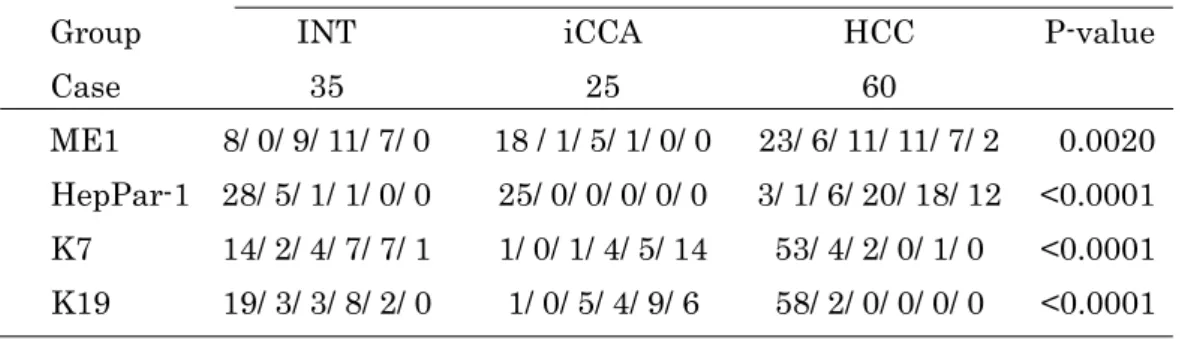
Results: Microarray analysis suggested that malic enzyme 1 (ME1) was significantly upregulated in INT. IHC analysis revealed that the positive rates of ME1 in INT, iCCA, and HCC were 77.1% (27/35), 28.0% (7/25), and 61.7% (37/60), respectively. Analysis of classification and regression trees based on IHC scores indicated that HepPar-1 could be a good candidate for discriminating HCC from the others with high sensitivity (93.3%) and high specificity (96.7%). A multiple logistic regression model and ROC curve analysis based on the IHC scores of ME1, K7, and K19 generated a composite score that can discriminate between INT and iCCA. Using this composite score, INT could be discriminated from iCCA with high sensitivity (88.6%) and high specificity (88.0%).
Conclusions: We propose that ME1 is a useful diagnostic marker of INT when used in combination with other hepatocytic and cholangiocytic markers.
Key words: combined hepatocellular-cholangiocarcinoma, intermediate cell carcinoma,
stem cell feature, malic enzyme 1, microarray analysis, immunohistochemical analysis
4
INTRODUCTION
In the 2010 World Health Organization (WHO) classification
1-3, primary liver carcinoma (PLC) is divided into hepatocellular carcinoma (HCC), intrahepatic cholangiocarcinoma (iCCA), and combined hepatocellular-cholangiocarcinoma (CHC).
CHC is relatively rare, comprising < 1% of all PLCs
2. Furthermore, CHC is classified into classical type and subtypes with stem-cell features including the typical subtype, intermediate-cell subtype, and cholangiolocellular subtype
2. However, it is currently known that these “stem-cell” phenotypes may be detected in various forms of PLC, and that there is still room for consideration in the current WHO classification
4,5. Transitional features from HCC to iCCA and intermediate features between HCC and iCCA are often observed in CHC. These findings suggest that CHCs are derived from hepatic progenitor cells. Previous studies revealed that hepatic progenitor cells and biliary tree stem/progenitor cells do exist in the smallest and most peripheral branches of the biliary tree (e.g., the ductules and canals of Hering) and in the peribiliary glands of normal bile ducts and in mucosal crypts of the gallbladder, respectively
6,7.
According to the most recent paper regarding the terminology for PLC
8, the usual CHC subtype with stem-cell features, intermediate-cell subtype was redefined as
“intermediate cell carcinoma (INT)”. The tumor cells of INT may be cuboidal to oval-shaped, with pale pink cytoplasm, and may form various structures such as strands, trabeculae, and solid nests. Elongated, ill-defined gland-like structure may also be present. Usually, mucin production is absent, and marked desmoplastic or acellular hyalinized stroma are observed. Even though immunohistochemical stains provide supplementary evidence, INT cells express both hepatocytic and cholangiocytic markers to various degrees
8,9. Furthermore, INT may be combined with HCC, iCCA, and other stem-cell feature subtypes
8.
Previous studies have revealed that stem-cell features are related to poor prognosis
10,
5
and INT cells showed high proliferation activity
5. These findings suggest that accurate identification of the INT component is necessary for its clinical management. Akiba et al previously demonstrated that arginase-1 and keratin (K) 8 are useful for the pathological diagnosis of INT
11. However, no specific markers of INT have been established yet.
In this study, to identify a specific marker of INT, we examined the gene expression of INT by microarray analysis using formalin-fixed paraffin-embedded (FFPE) samples
12, and subsequently examined the protein expression of potential key molecules identified in the microarray analysis by immunohistochemistry.
MATERIALS AND METHODS Microarray analysis
For RNA extraction, FFPE blocks from 6 INT cases, 5 iCCA cases, and 5 HCC cases were used. All these tumors consisted only of single histological component, i.e. “pure type”. Two serial sections of 7 µm thickness were obtained from FFPE blocks using a Leica RM2245 microtome (Leica Microsystem K.K., Tokyo, Japan), with an RNase-free water-treated blade. For each sample, one section was stained with hematoxylin and eosin (HE) whereas another section was used for extracting RNA. Referencing the previous mentioned HE-stain section, proper regions of cancerous and non-cancerous tissue were identified and separately scraped using blade treated with RNAase-free water.
For microarray analysis using Affymetrix GeneChip® Human X3P Array (Affymetrix,
Santa Clara, CA, USA), RNA from each sample was isolated, amplified, hybridized and
labeled in accordance with manufacturer’s instructions for Arcturus® Paradise® PLUS
Reagent System (Life Technologies, Grand Island, NY, USA) and GeneChip® 3′ IVT
Express Reagent kit (Affymetrix). The extracted RNA was measured using Nanodrop®
6
ND 1000 (Thermo Fisher Scientific, Waltham, MA, USA). The CEL files were processed using the affy package of R to obtain signal intensity values by RNA and present/absent calls by MAS5
12.
Patients
In this study, we evaluated surgically resected liver tissues obtained from patients who underwent hepatectomy for PLC at Kurume University Hospital between 2000 and 2015. Relapse cases and cases with preoperative treatments, including both locoregional therapies (e.g. radiofrequency ablation and transcatheter arterial embolization) and systemic therapies (e.g. chemotherapy and molecular target drugs), were excluded.
Thus, we found 35 INT cases and 25 pure type iCCA cases, including the aforementioned 6 INT cases and 5 iCCA cases that could be evaluated by microarray analysis. However, there were over 800 pure type HCC cases between 2000 and 2015, and we randomly selected 60 cases from this population using a random number table.
Among 25 iCCA cases, 6 and 19 cases were diagnosed as well- and moderately-differentiated, respectively. Among the 60 HCC cases, 7, 50, and 3 cases were diagnosed as well-, moderately-, and poorly-differentiated, respectively.
Histology
Liver specimens were fixed in 10% buffered formalin, followed by paraffin embedding.
We cut consecutive 4-µm-thick sections and stained them with HE.
Pathological diagnosis was performed according to the 2010 WHO classification of tumours of the Digestive System
1-3, which provides a detailed description of the histological appearance of INT. Representative photomicrographs of INT are shown in Figures 1a-c. According to the recent paper by Brunt et al
8, PLC purely comprised of
“intermediate cells” referred to as INT. They also described that all PLCs have been
7
reported to occur alone or in combination with one another. Therefore, we included the INT cases combined other component(s) in this study and defined these cases as
“combined type”. Although 13 INT cases were combined type (11 cases with HCC, 1 case with iCCA and HCC, another 1 case with CHC stem-cell features, typical subtype), the INT components were predominant (>50%) in these cases.
The degree of fibrosis in the noncancerous liver tissue was assessed as follows: F0, no fibrosis; F1, fibrous portal expansion; F2, bridging fibrosis; F3, bridging fibrosis with lobular distortion (pre-cirrhosis); and F4, liver cirrhosis, according to the New Inuyama classification
14.
Immunohistochemical analysis
We performed immunohistochemical (IHC) analysis on paraffin-embedded sections of the aforementioned INT, iCCA, and HCC cases using the following antibodies: Malic enzyme 1 (ME1) monoclonal antibody (316, dilution 1:2000, Thermo Fisher Scientific, Rockford, USA), hepatocyte paraffin (HepPar)-1 monoclonal antibody (OCH1E5, 1:100, Dako, Glostrup, Denmark), K7 monoclonal antibody (OV-TL 12/30, 1:100, Dako), and K19 monoclonal antibody (RCK108, 1:50, Dako). IHC was performed using the Ventana Benchmark system (Ventana Automated Systems Tucson, Arizona, USA).
In ME1 staining, the sinusoidal Kupffer cells and macrophages were strongly stained but other inflammatory cells were not. In addition, periportal and perivenular non-cancerous hepatocytes and portal cholangioles showed weak to moderate staining.
Therefore, we used sinusoidal Kupffer cells and macrophages as the internal positive controls (Figure 1d). Positive controls of other antibodies were defined as follows:
HepPar-1, normal hepatocytes; K7 and K19, normal biliary epithelial cells. The
expression of these molecules was mainly observed in the cytoplasm. We defined cells
with the same intensity as the positive control as “positive cells”.
8
The percentage of positive cells in tumors was scored as follows: score 0, no positive cell; score 1, positive cells < 1%; score 2, 1 ≤ positive cells < 10%; score 3, 10 ≤ positive cells < 33.3%; score 4, 33.3 ≤ positive cells < 66.7%; and score 5, 66.7% ≤ positive cells. In cases of combined type INT as described above, we only evaluated the INT component.
The histological diagnoses of each tumor were made by three pathologist (YM, JA, and HY) thorough careful conference. IHC analyses were evaluated by two pathologists (YM and RK) independently, and IHC scores were almost accorded between them. In the cases with discordance, the scores were decided thorough discussion.
Statistical analysis
The microarray analysis results were subjected to statistical analyses using R packages
15, and p < 0.01 was regarded as statistically significant. In addition, the correlation between gene expression obtained from microarray analysis and immunohistochemical score was examined using polyserial correlation.
The association between clinicopathological parameters and histological diagnosis was examined by ANOVA, Fisher’s exact test, and Log rank test depending on the type of data.
Specific ability of ME1, HepPar-1, K7, and K19 to discriminate three groups was examined by following statistical procedures. Because of asymmetrical associations between disease groups and four biomarkers, classification and regression trees (CART)
16