Visual secret sharing schemes encrypting multiple images
Manami Sasaki and Yodai Watanabe Member, IEEE
Abstract —The aim of this work is to maximize the range of the access control of visual secret sharing (VSS) schemes encrypting multiple images. First, the formulation of access structures for a single secret is generalized to that for multiple secrets. This generalization is maximal in the sense that the generalized for- mulation makes no restrictions on access structures; in particular, it includes the existing ones as special cases. Next, a sufficient condition to be satisfied by the encryption of VSS schemes realizing an access structure for multiple secrets of the most general form is introduced, and two constructions of VSS schemes with encryption satisfying this condition are provided. Each of the two constructions has its advantage against the other; one is more general and can generate VSS schemes with strictly better contrast and pixel expansion than the other, while the other has a straightforward implementation. Moreover, for threshold access structures, the pixel expansions of VSS schemes generated by the latter construction are estimated and turn out to be the same as those of the existing schemes called the threshold multiple-secret visual cryptographic schemes (MVCS). Finally, the optimality of the former construction is examined, giving that there exist access structures for which it generates no optimal VSS schemes.
Index Terms—Visual secret sharing, General access structures, Multiple secrets, Information-theoretic security
I. I NTRODUCTION
The secret sharing (SS) scheme is a cryptosystem which encrypts a secret into multiple shares so that any qualified combination of shares can reconstruct the secret, while any forbidden combination of shares reveals no information about the secret. Here, the sets of the qualified combinations and the forbidden combinations are called a qualified set and a forbidden set, respectively, and the pair of the qualified and forbidden sets is called an access structure. A typical example of SS schemes is the ( k, n )-threshold SS scheme [4], [17], in which a secret is encrypted into n shares so that any k or more shares can reconstruct the secret, while any k − 1 or less shares leak no information about the secret.
In contrast to the ordinary cryptosystems, there exist SS schemes whose decryption can be performed by humans without any numerical computations. The visual secret sharing (VSS) scheme [15] is an example of such SS schemes. This scheme encrypts a visual secret into visual shares so that humans can visually reconstruct the secret with their eyes by superposing a qualified combination of visual shares each printed on a transparency. One of the applications in which
Manuscript received ; revised . A preliminary version of this paper was presented at ICASSP 2014, Florence, Italy, May 2014 [16]. This work was supported in part by JSPS Grants-in-Aid for Young Scientists (B) No.
21700021 and for Scientific Research (C) No. 15K00020.
The authors are with the Department of Computer Science and Engineer- ing, University of Aizu, Aizu-Wakamatsu City, Fukushima 9658580, Japan ([email protected]).
VSS schemes are essential is for the authentication by a human recipient without any trusted communication channels. More precisely, the problem here is to authenticate a message from an informant to a human recipient through an insecure channel which is under full control of an adversary. This arises, for example, in the interactions between a human and an electronic device without screen such as a smartcard. It is hard to provide a solution to this problem without assuming a secure channel, 1 and the authentication based on VSS schemes, called the visual authentication [14], has been the only secure solution so far.
A. Related works
The SS scheme encrypting multiple secrets can trivially be realized by a collection of multiple SS schemes each encrypting each secret. Therefore, this work considers the VSS scheme encrypting multiple secrets in which each participant receives a single visual share and any qualified combination of participants for each visual secret can reconstruct the secret by superposing their visual shares. 2 So far there have been proposed the following VSS schemes encrypting multiple secrets: extended visual cryptographic schemes (EVCS) [1], visual secret sharing schemes for plural secret images (VSS- q-PI) [13] and threshold multiple-secret visual cryptographic schemes (MVCS) [21]. Here, EVCS assumes an access struc- ture such that all but one of its qualified sets consist of (the combination of) a single share, VSS-q-PI an access structure whose forbidden sets are identical for all secrets 3 (although its qualified sets can be arbitrary) and MVCS a threshold access structure (for details, see (3a)–(3c) in section III-A). This work provides the formulation and constructions of VSS schemes realizing a general access structure for multiple secrets without any restrictions. Table I summarizes the existing works as well as this work, where the classification is based on only the range of their access control. 4
It should be stated that there has been proposed another type of VSS schemes encrypting multiple images in which additional operations in the decryption, such as the rotation of shares with multiple relative angles, are introduced (see
1
In using a smartcard for payment, for instance, one is supposed to trust the place of sale to show the correct price charged to the smartcard; in other words, it is assumed that the price is announced from an informant (smartcard) to a human recipient through a secure channel.
2
This work considers only monochrome images. For VSS schemes encrypt- ing color images, see e.g. [8], [13], [23].
3
It should be noted that VSS- q -PI can encrypt color images.
4
From this point of view, (k, n) -visual cryptographic schemes with mean-
ingful shares ( (k, n) -VCS-MS) [18] and region incrementing visual crypto-
graphic schemes (RIVCS) [24] are special cases of EVCS and MVCS, respec-
tively, and fully incrementing visual cryptography (FIVC) [7] is equivalent to
MVCS.
TABLE I
C
OMPARISON AMONG THE EXISTING WORKS AND THIS WORKVSS scheme Restriction on access structure
EVCS [1] All but one of the qualified sets have to consist of (the combination of) a single share
VSS- q -PI [13] Forbidden sets have to be identical for all secrets MVCS [21] An access structure has to be of threshold type This work No restrictions
e.g. [19], [20], [26]). In VSS schemes of this type, different operations correspond to different secret images, while in the VSS schemes in Table I, different combinations of shares correspond to different secret images. Therefore, from a point of view of the access control, which is the goal of the secret sharing, the former schemes can be reduced to a single VSS scheme encrypting a single secret (into which multiple secret images are connected), while there exist no such simple reductions for the latter ones even for the simplest access structures. 5 This is a major difference between the former and the latter schemes.
B. Our contributions
The aim of this work is to maximize the range of the access control of VSS schemes encrypting multiple images. As a first step, the preliminary version [16] maximally generalized the formulations of access structures and VSS schemes for multiple secrets, and then provided a construction of VSS schemes of the most general form. This paper provides further developments of this generalization described below. 6 First, this paper justifies the above construction in a more general framework. More precisely, this paper introduces a more general construction (Construction 11) which includes the previous one as a special case. In particular, this inclusion is strict in the sense that the former (Construction 11) can generate VSS schemes with strictly better contrast and pixel expansion than the latter, which is demonstrated by the last two examples in section III-C. Then, this paper proves that for any given access structure of the most general form, the former indeed generates a VSS scheme realizing the access structure (in Theorem 12), and also the latter is a special case of the former (in Corollary 14); this completes the justification of the latter (previous) construction, which was not given in [16].
Here, to describe the former construction, this paper has introduced two notions (Definitions 7 and 10), which, together with the proofs to characterize and justify the construction (Lemma 9 and Theorem 12), reveal a sufficient condition to be satisfied by the encryption of VSS schemes for multiple secrets. Moreover, it is demonstrated that for threshold access structures, the latter construction generates VSS schemes with the same pixel expansion as ( k, n, s ) -MVCS and ( k, n, s, R ) - MVCS [21] (in section III-D). 7 Finally, the optimality of the
5
A perfect access structure Γ
2=
(A
iQ, A
iF)
2i=1
on {s
1, s
2} for two secrets with A
1Q= {{s
1}, {s
1, s
2}} and A
2Q= {{s
2}, {s
1, s
2}} (see Definition 4 for this notation) is an example of such access structures.
6
All of these are contributions of this paper relative to the preliminary version [16].
7
It should be noted that our constructions are not restricted to threshold access structures, but can apply to arbitrary ones.
former (more general) construction is examined, giving that there exist access structures for which it generates no optimal VSS schemes (in section III-E).
II. P RELIMINARIES
In this section, we provide definitions and notations that will be used later. For details of definitions in information theory and secret sharing, see e.g. [2], [9], [22].
A. Basic definitions and notations
For n ∈ N, let [ n ] denote the set of natural numbers less than or equal to n; i.e. [ n ] = {k ∈ N|k ≤ n}. The power set of a set S is denoted by 2
S; i.e. 2
S= {a|a ⊆ S}. For a subset A of a power set partially ordered by inclusion, let A
0 denote the set of the minimal elements of A with respect to this order; i.e.
A
0 = {a ∈ A|∀a
∈ A ( a
⊂ a )}
(where we have used the symbol ⊂ to represent the strict inclusion). For an ordered set S = { s 1 , s 2 , · · · , s n }, the order of s i in S is denoted by ord
S( s i ) ; i.e. ord
S( s i ) = i.
For random variables X and Y over the same domain, we write X = Y if X and Y are equal almost surely (i.e.
Pr[ X = Y ] = 1 ), and X ∼ Y if X and Y have the same probability distribution. For a set S, let S U denote a probabilistic function which outputs an element of S according to the uniform distribution over S.
For x ∈ {0 , 1} n , b ∈ {0 , 1} and i ∈ [ n ] , let x x
i=b denote the string x with the i-th element x i replaced by b; i.e.
x x
i=b = ( x 1 , · · · , x i−1 , b, x i+1 , · · · , x n ) .
For x ∈ {0 , 1} n , let Gray( x ) denote the gray level of x; i.e.
Gray( x ) = {i|x i = 1}
n .
The gray level of the empty string ε is defined to be 0; i.e.
Gray( ε ) = 0.
B. Access structure and secret sharing
Let S = {s 1 , s 2 , · · · , s n } be the set of all the shares. The subset of 2
Sany of whose elements can decrypt the secret is called a qualified set and is denoted by A Q . The subset of 2
Sany of whose elements leaks no information about the secret is called a forbidden set and is denoted by A F . The pair Γ of the qualified and forbidden sets, Γ = ( A Q , A F ) , is called an access structure on S. The access structure has to satisfy the monotonicity:
A ∈ A Q ∧ A ⊆ B ⇒ B ∈ A Q , B ∈ A F ∧ A ⊆ B ⇒ A ∈ A F ,
for all A, B ⊆ S. A qualified set A Q is uniquely determined by its minimal elements
A Q
0 : A Q
0 = A
Q
0 ⇒ A Q = A
Q
for all qualified sets A Q and A
Q on S . An access structure
is called perfect if every subsets of the shares are included in
TABLE II
E
NCRYPTION OF A SINGLE PIXEL,
AND THE SETSC
0ANDC
1OF REPRESENTING MATRICES(0:
WHITE, 1:
BLACK,
ROW:
SHARE,
COLUMN:
SUBPIXEL IN SHARE
)
Pixel Pattern1 Pattern2 Pattern1 Pattern2
Share 2 Share 1 Share 2 Share 1 Share 2
C 0 = 01 01
, 10
10
C 1 = 01 10
, 10
01
either the qualified set or the forbidden set. The perfect access structure can be determined by only a qualified set.
Example 1 ( ( k, n ) -threshold access structure). Let S be a finite set of size n. A ( k, n ) -threshold access structure on S consists of the qualified set A Q and the forbidden set A F given by A Q = a ⊆ S k ≤ |a|
and A F = a ⊆ S k > |a|
. Since A Q ∪ A F = 2
S, this access structure is perfect. A secret sharing scheme realizing a ( k, n )-threshold access structure is called a ( k, n ) -threshold secret sharing scheme.
C. Visual secret sharing
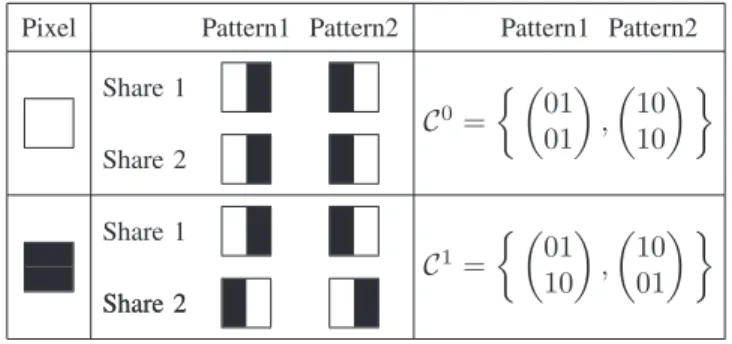
In the ordinary SS schemes, the secrets and shares are both numerical data, and their decryption is performed by computers. In contrast, in the VSS schemes, the secrets and shares are both visual, and their decryption can visually be performed by human eyes. 8 Each black-white pixel in a secret image is encrypted into a set of black-white subpixels in shares. Hence, the encryption of each pixel can be represented as a pair of matrices C b = ( c b ij ) with b ∈ {0 , 1}, where b = 0 for a white pixel in a secret image and b = 1 otherwise, and c b ij = 0 for a white j-th subpixel in the i-th share and c b ij = 1 otherwise.
For an illustrative purpose, let us consider a (2 , 2) -threshold VSS scheme. A secret image is encrypted into two shares.
Each share is indistinguishable from noise images, and so leaks no information about the secret. On the other hand, the secret image can be reconstructed when both of the shares are superposed. This can be constructed as follows. A pixel e in the secret image is encrypted into two subpixels in each of the two shares. If e is white (resp. black), then Pattern 1 or Pattern 2 in the upper (resp. lower) row of Table II is chosen at random. The superposition of the two shares has one black subpixel and one white subpixel (resp. two black subpixels) if e is white (resp. black). This construction can be represented by the sets C 0 and C 1 of matrices in Table II;
more precisely, the above encryption and decryption can be
8