熊本大学学術リポジトリ
Electronic properties of Cs2TCNQ3 crystals grown under magnetic field
journal or
publication title
Synthetic Metals
volume 133‑134
page range 535‑537
year 2003‑03‑13
URL http://hdl.handle.net/2298/10529
doi: 10.1016/S0379-6779(02)00423-X
Electronic properties of Cs
2TCNQ
3crystals grown under magnetic field
N. Kuroda
a,b,*, T. Sugimoto
c, M. Hagiwara
d, Hasanudin
a, K. Ueda
c, T. Tada
c, H. Uozaki
e, N. Toyota
e, I. Mogi
b,f, K. Watanabe
b,fand M. Motokawa
b,fa Department of Mechanical Engineering and Materials Science, Kumamoto University, Kumamoto 860-8555, Japan
b Core Research for Evolutional Science and Technology (CREST), Japan Science and Technology Corporation, Japan
c Research Institute for Advanced Science and Technology, Osaka Prefecture University, Sakai 599-8570, Japan
d Institute of Physical and Chemical Research (RIKEN), Wako 351-0198, Japan
e Department of Physics, Graduate School of Science, Tohoku University, Sendai 980-8578 Japan
f Institute for Materials Research, Tohoku University, Sendai 980-8577, Japan
* Tel; +81 96 342 3726; Fax: +81 96 342 3710; E-mail: [email protected]
___________________________________________________________________________
Abstract
The influence of magnetic field on the crystallization process has been examined in Cs2TCNQ3 (TCNQ = tetracyanoquinodimethane), a strongly Coulomb-correlated organic semiconductor. The crystal structure is unaffected by the magnetic field, while the electric, magnetic and optical properties change markedly if the magnetic field higher than a threshold (~ 4 T) is applied during the crystal growth. The high-field crystals exhibit a very weak but distinct spontaneous magnetization with the exceedingly high Curie temperature of ~420 K.
The infrared and visible spectroscopy data show that this novel ferromagnetism concurs with the renormalization of the π* state of TCNQ radical anions, TCNQ-s.
Keywords: TCNQ salt, magnetic-field-induced acceptors, organic ferromagnetism, infrared and visible spectroscopy
__________________________________________________________________________
1. Introduction
High magnetic field is useful for processing functional materials [1]. In this study we examine electronic properties of crystals grown under high magnetic field with respect to Cs2TCNQ3, an organic semiconductor with the lowest optical energy gap of 0.3 eV [2]. This substance has a columnar structure consisting of a periodic stack of the triad TCNQ0/TCNQ−/TCNQ− because of the strong Coulomb repulsion between π* electrons of TCNQ molecules. Every π* electron of the radical molecule TCNQ- carries a spin but most of the two spins of the triads are pairedantiparallel with one another by the kinetic, antiferromagnetic exchange interaction of the order of ~0.12 eV. Our concern is to see how the nature of the spins is altered when the crystals are grown under high magnetic field. This study aims also to obtain the information on the origin of the weak ferromagnetism observed by Ueda et al. [3],
1. Experiment
We prepare the nearly saturated acetonitrile solution of Cs2TCNQ3 in a glass bottle. The bottle is encapsulated into a larger bottle together with diethyl ether, while the inner bottle being kept open. This dual container system is settled on the central position of the magnetic field of a cryogen-free superconducting magnet, which can generate magnetic field up to 5 T. The temperature of the system is regulated at 20 ºC.
2. Results
The crystals of Cs2TCNQ3 precipitate as needles or thin plates. After 2-3 days a half amount of the dissolved material crystallizes but the precipitation rate tends to be suppressed by magnetic field. The habit of the crystals appears to be unaffected by the magnetic field up to 5 T. Accordingly the crystal structure and the lattice constants remain unchanged. Nevertheless the crystals grown under 0 T and 5.0 T (hereafter called 0 T crystals and 5 T crystals, respectively), show different temperature dependencies of the electric conductance: In the 0 T crystals the behavior agrees with the p-type conduction reported by Blakemore et al. [4] well, whereas in the 5 T crystals the overall electric conductivity is significantly elevated compared with that of 0 T crystals. The acceptor concentration in the 5 T crystals is likely to be
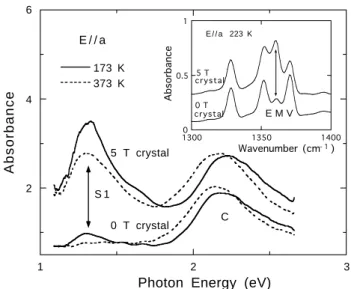
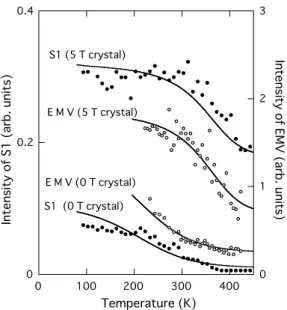
Figure 1 shows the optical absorption spectrum due to electronic transitions in the visible region at 173 K and 373 K for the E//a polarization, where E and a are the electric field of light and the a-axis of the crystal, respectively. The absorption band, S1, appearing at around 1.3 eV is enhanced noticeably in the 5 T crystals. The S1 band is attributed to the charge- transfer transition of the π* electron between the TCNQ- molecules. If we look at the temperature dependence of the spectrum we notice that the intensity of the S1 band varies in quite a different manner between 0 T and 5 T crystals, as shown in Fig. 2.
Fig. 1. Visible and infrared absorption spectra in 0 T and 5 T crystals of Cs2TCNQ3.
The inset of Fig. 1 shows the infrared absorption spectrum measured around an electron- molecular-vibration (EMV) coupled band [5] for E//a at 223 K. The EMV band at 1360 cm-1 originates from the totally symmetric Ag(ν4) vibration of the C-C double bonds of TCNQ- molecules. The intermolecular π*-π* S1 transition couples with the Ag(ν4) vibration, so that in the 5 T crystals the EMV band becomes as intense as the ordinary infrared-active bands. The temperature dependence of the intensity of the EMV band normalized by the intensity of an ordinary band is plotted in Fig. 2 along with the intensity of the S1 band.
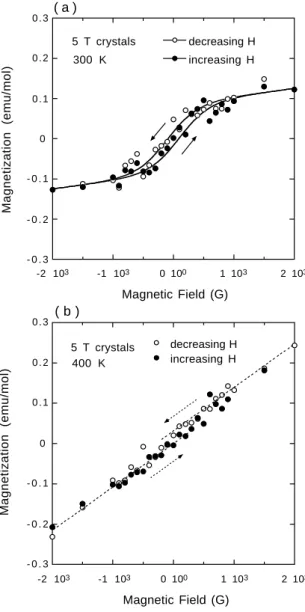
Figure 3 shows the magnetization versus magnetic field of the 5 T crystals at 300 K and 400 K, where the inherent diamagnetic moment of TCNQ molecules is subtracted from the original data. At 300 K there appears a weak but clear loop of ferromagnetic magnetization on
2 4 6
1 2 3
173 K 373 K
Absorbance
Photon Energy (eV)
5 T crystal
0 T crystal E / / a
C S 1
13000 1350 1400
0.5 1
Wavenumber (cm- 1) E M V 5 T
0 T E / / a 223 K
crystal
crystal
Absorbance
a small, paramagnetic background due to thermally excited triplet spin state. If temperature is raised to 400 K the ferromagnetic moment is reduced largely. Figure 4 shows the temperature dependence of the ferromagnetic moment deduced from the measurement of the susceptibility at 1×10³ G. In the 0 T crystals the moment tends to collapse around 320 K, whereas it perseveres up to about 420 K in the 5 T crystals, consistent with the magnetization curve shown in Fig. 3.
Fig. 2. Temperature dependence of the intensity of the S1 and EMV bands in 0 T and 5 T crystals of Cs2TCNQ3. The solid lines show the magnetization in respective crystals (see text).
4. Discussion
Spectroscopically, the magnetic-field effects appear to occur selectively upon the π* state of TCNQ_molecules. Furthermore, if we draw the same curves as the magnetization with their baselines and magnification factors adjusted, they fit the experimental data of the S1 and EMV bands very well, as shown by the solid lines in Fig. 2. These results show that the ferromagnetic order is linked with the renormalization of the π* state of TCNQ- molecules throughout a crystal. The magnetic-field-induced acceptors should be the important ingredient of this ferromagnetism. We suppose that the acceptors are associated with the deviation of the content of TCNQ0 from stoichiometry.
0 0.2 0.4
0 1 2 3
0 100 200 300 400
Intensity of S1 (arb. units) Intensity of EMV (arb. units)
Temperature (K) S1 (5 T crystal)
E M V (5 T crystal)
E M V (0 T crystal) S1 (0 T crystal)
To our knowledge, the highest Curie temperature of the organic ferromagnetism ever known is 36 K in p-NC·C6F4·CNSSN [6]. Compared with that case, the Curie temperatures, ~420 K in the 5 T crystals and ~320 K in the 0 T crystals, of Cs2TCNQ3 are quite high. In addition, the saturation moment, being (0.9-1.8)×10-5 µB/formula unit, is very small. In these respects Cs2TCNQ3 is reminiscent of the recently reported high-temperature ferromagnets Ca1-xLaxB6 [7] and CaC2B2 [8], in which the Curie temperature and saturation moment are ~600 K and
≤3.5×10⁻⁴µB/formula unit and 770 K and 3.8×10⁻⁴µB/formula unit, respectively.
Fig. 3. Magnetization in 5 T crystals of Cs2TCNQ3 at (a) 300 K and (b) 400 K.
- 0 . 3 - 0 . 2 - 0 . 1 0 0 . 1 0 . 2 0 . 3
-2 103 -1 103 0 100 1 103 2 103
decreasing H increasing H
Magnetization (emu/mol)
Magnetic Field (G) 5 T crystals
400 K ( b )
- 0 . 3 - 0 . 2 - 0 . 1 0 0 . 1 0 . 2 0 . 3
-2 103 -1 103 0 100 1 103 2 103
decreasing H increasing H
Magnetization (emu/mol)
Magnetic Field (G) 5 T crystals
300 K ( a )
Fig.4. Temperature dependence of magnetization in 0 T and 5 T crystals of Cs2TCNQ3.
References
[1] Y. Ma, K. Watanabe, S. Awaji, M. Motokawa, Appl. Phys. Lett. 77 (2000) 3633. See also the references therein.
[2] C. S. Jacobsen, in E. Conwell (Ed.), Semiconductors and Semimetals, vol.27, Academic Press, San Diego, 1988, pp. 293-384.
[3] K. Ueda, T. Sugimoto, S. Endo, N. Toyota, M. Kohama, K. Yamomoto, Y. Suenaga, H.
Morimoto, T. Yamaguchi, M. Munakata, N. Hosoito, N. Kanahisa, Y. Shibamoto, Y. Kai, Chem. Phys. Lett. 261 (1996) 295.
[4] J. S. Blakemore, J. E. Lane, D. A. Woodbury, Phys. Rev. B 18 (1978) 6797.
[5] A. Painelli, C. Pecile, A. Girlando, Mol. Cryst. Liq. Cryst. 134 (1986) 1.
[6] A . J. B anister, N . Bricklebank, T. Lavender, J. M . Raw son, C. I. G regory, B. K . Tanner, W . Clegg, M . R. J. Elsegood, F. Palacio, A ngew . Chem . Int. Ed. Engl. 35 (1996) 2533.
[7] D. P. Young, D. Hall, M. E. Torelli, Z. Fisk, J. L. Sarrao, J. D. Thompson, H._R. Ott, S. B.
Oseroff, R. G. Goodrich, R. Zysler, Nature 397 (1999) 412.
[8] J. Akimitsu, K. Takenawa, K. Suzuki, H. Harima, Y. Kuramoto, Science 293 (2001) 1127.
0 0 . 1
0 0 . 1
0 1 0 0 2 0 0 3 0 0 4 0 0
Magnetization (emu/mol) Magnetization (emu/mol)
Temperature (K)
5 T crystals
0 T crystals