Sustainable Agriculture in Zhangye Oasis, Middle Reaches of Heihe River Basin)
著者 Guo Xiaoxi
journal or
publication title
International Review for Spatial Planning and Sustainable Development
volume 5
number 4
page range 32‑41
year 2017‑10‑15
URL http://doi.org/10.24517/00053231
doi: 10.14246/irspsd.5.4_32
Creative Commons : 表示 ‑ 非営利 ‑ 改変禁止 http://creativecommons.org/licenses/by‑nc‑nd/3.0/deed.ja
32
International review for spatial planning and sustainable development, Vol.5 No.4 (2017), 32-41 ISSN: 2187-3666 (online)
DOI: http://dx.doi.org/10.14246/irspsd.5.4_32
Copyright@SPSD Press from 2010, SPSD Press, Kanazawa
Review o n Public Private Partnerships of Urban River Management in China: A Case Study of Chu River
Xiaoxi Guo
1*1 Graduate School of Global Environmental Studies, Sophia University
* Corresponding Author, Email: [email protected] Received: Dec 15, 2016; Accepted: Jan 15, 2017
Key words: Public Private Partnership, Urban River, Wuhan
Abstract: Urban river management is a critical factor in an urban planning blueprint.
However, such management includes various influences from political, financial and environmental aspects. This article tries to illustrate a solution through a case study of Chu River in Wuhan. Through the framework of a Public Private Partnership (PPP), the Wuhan government and Wanda Group establish a partnership that manages the Chu River collaboratively and achieves a sustainable win-win development outcome. By analyzing the achievements and mistakes of this case, we hope to present some experiences of urban river management that can be applied in similar cases.
1. INTRODUCTION
The Public Private Partnership (PPP) is a popular financial method in government infrastructure construction and providing public service. The Chinese government has wanted to increase the number of PPP programs since 2013. The Chu River program is one of the early PPP programs in China and stands as a good example for research. The article will begin with an introduction of PPP. After the introduction of PPP, an analysis of the Chu River program will reveal its positive outcomes and shortcomings. Based on the analysis, some problems from the bigger picture will emerge when comparing the Chu River program with a more current event. Finally, the article will give some suggestions based on the analysis.
2. WHAT IS PUBLIC-PRIVATE PARTNERSHIP?
Public Private Partnership (PPP) has become a relatively popular choice of the financial method when it comes to infrastructure construction.
However, the definition of PPP can be either wide or narrow. For the wider
definition, the Asian Development Bank (ADB) gives a broad definition of
public-private partnership as “a range of possible relationships between
public and private entities in the context of infrastructure and other services”
(ADB Public Private Partnership Handbook, 2015). However, that definition includes traditional financial methods such as “Build-Operate-Transfer (BOT)” or “Transfer-Operate-Transfer (TOT)”. Nevertheless, the ADB’s PPP handbook gives a narrower definition right after, containing three key points:
1) The PPP must form a framework. Inside such framework, all potentially interested parties can have a place. For example, nongovernment organizations (NGOs) and/or community-based organizations (CBOs) have their place under this framework, so it will not be a two-party agreement like a BOT or TOT.
2) Unlike Private Sector Participation which contracts transfer obligations to the private sector, the PPP is more about shared responsibility.
3 If the “framework” comes in the form of a company, then the private sector and public sector will each have part of the ownership of the company.
With all these unique characteristic, PPP has the potential to fit the construction needs of environment-related programs. Environmental programs usually require a long period from planning to completion. Klijn et al. (2008) indicate in their research that the PPP model fits well with multiple environment-related programs. In this case, a company under a PPP protocol is more likely to continue running over a number of years, and such a company will usually give more consideration to long term strategy and keeping the business running. On the other hand, for example, a government-owned program may be shut down during a budget cut. The framework’s characteristics also guarantee the full participation of each party at a certain level. The community-based organization has less chance to join a BOT program, even when the program is next to their community.
NGO’s usually play an advisory role and do not have a decision-making position. Zhang (2005) demonstrated in his research how to find a combination of suitable partners for a PPP program. Following the ideas of his research, PPP has a more flexible framework. At the same time, experts from different fields can join the framework, meaning an expert can be brought in from the public sector with the experience of running environmental programs and an expert in business from the private sector who knows how to run a company can also be involved. Osborne (2002) stated in his book that these types of cooperation help in fixing the shortcomings of both the public and private sector. Finally, PPP’s help to solve funding issues. As previously mentioned, government-owned programs rely heavily on government budgets and can be ceased due to lack of financial support. Therefore, in this case, a long-run self-profitable program has a better chance of survival. If people want to reach the goal of sustainable development, then a program must be not only environmentally sustainable but also economically sustainable.
Despite the advantage that a modern PPP framework has of being well-
suited to environmental programs, the disadvantages of a PPP framework
may cause some problems. The management of a PPP is complicated, due to
its complex framework (Akintoye, Beck, & Hardcastle, 2002). The
leadership of this framework needs to be clearly set at the beginning of a
project, otherwise, people from different parties will only follow the orders
of their previous superior. In addition, different parties within the framework
may have different interest. Sometimes, these interests could be against one
and another, especially when there are both financial and non-financial
interests (Mota & Moreira, 2015). Private sector parties join PPP programs
34 IRSPSD International, Vol.5 No.4 (2017), 32-41
in order to gain financial benefits, therefore private sector parties would request a certain amount of profit in return, and public sector parties may want to spend money elsewhere. Finally, not all programs fit the requirements of PPP framework. The private sector will not invest in a program that will not generate profit, and not all environmental programs do.
Therefore, a PPP is not always the best solution.
3. DEVELOPMENT OF CHU RIVER PROGRAM
After explaining the PPP framework, it is time to see how the Chu River program operates as a PPP. According to the evaluation report, “Big East Lake water network program”, the Chu River is a channel to connect the East Lake and Sand Lake (Water Conservancy Committee of Yangzi River, 2007). The “Big East Lake water network program” is an environmental program to connect major lakes in Wuhan through a man-made channel. Chu River is located geoFigureically at the center of Wuhan City. The area of the sites, called “Shuiguo Hu” (Fruit Lake), acts not only as the center of Wuchang district but also of Wuhan city. Fruit Lake is a 0.12 km
2sub-lake of the East Lake. A small bridge separates this lake and the main part of East Lake. This lake (or a pond to be precise) is also the connection between East Lake and Sand Lake. The East Lake has a water surface size of 32.5 km
2with several sub-lakes. The East Lake is also the biggest urban lake in China.
Sand Lake has a surface size of 3.2 km
2. The six major lakes have a total surface area of 62.6 km
2. In the past years, these lakes have faced serious pollution, with most of the lakes having water quality below the level 5 standard of National Environmental Quality Standards for Surface Water.
The water bodies of lakes exchange relatively slowly, so lakes are hard to clean up once they have been polluted. Thus, the Water Conservancy Committee and Wuhan government came out with a planned to connect these lakes through an artificial channel to accelerate the exchange of the water bodies. In addition, channels will be connected to the Yangzi River, so fresh water from the Yangzi River will flow in and out of the water network.
Only polluted water exchanging between polluted lakes is simply meaningless. After researching and evaluating the program, the Water Conservancy Committee and Wuhan government gave a green light to the program. This type of design has some obvious disadvantages, however.
According to Chen and Yang’s (2006) study on the building height and the distance from building to the river, the ratio of the height and the distance should be 1:1. The buildings in Han Street are too close to the river and do not follow the 1:1 rules. In addition, over commercialization issues cause the Chu River program to lose its own characteristics (Hu, Duan, & Zeng, 2013). The shopping street has a theme called “Han culture”, yet contains international brands such as Starbucks and McDonald’s. These shops do not match the theme of this program at all. However, the developers still put these famous brands into the shopping street to attract customers. This over commercialization issue will be further discussed in the Discussion section.
Once the program had been decided, the Wuhan government wanted to
build an organization to handle the financing and investment issues related to
the program. The Wuhan Water Resources Development Cast Time Group
established in May 2009 and Wuhan government gave the company the
authorization to be in charge of water resources related to investment
(Wuhan Water Resources Development Cast Time Group, 2010). According
to the company’s report, the Water Resources Development Group invested
a total amount of 8.9 billion RMB into four areas: pollution control (3.1 billion), ecosystem restoration (2.05 billion), water network connection (3.6 billion), and finally the water quality monitoring system (0.15 billion). The first subprogram of the water network connecting program is the “Chu River and Han street” program. This program contains two parts: the Chu River as a canal to connect East Lake and Sand Lake, and the Han Street as a commercial street to contain an entertainment function. Wuhan city is the capital city of Hubei province, and the provincial government’s building is located just a few blocks away from Han Street. Many other government agencies and their old staff dormitories are also built in this area. Therefore, the Chu River and Han Street program has also faced old town reconstruction issues. With that amount of construction work and the amount of money required, the Wuhan government felt the burden might be too heavy to take on by itself. Hence, the Water Resources Development Cast Time Group has outsourced the development and construction of Han Street to Wanda Group (Shao & Ji, 2012). In return, Wanda Group owns the property rights of Han street. The Wanda Group has invested 50 billion RMB into the Han street program. The street includes shops, restaurants, one cinema theme park, several commercial residents and one seven-star luxury hotel with a total area of 1.8 km
2. The construction was completed in eight months with Han Street being opened to the public in September 2011.
The Chu River program is a typical PPP program with a framework (i.e.
Water Resources Development Cast Time Group), sharing obligations and sharing ownership. Wanda Group hoped to gain profit from this program and the Wuhan government, on the other hand, wanted to gain environmental and community benefits.
The Chu River program is a relatively young and small program.
Therefore, the Chu River program has had limited influence on the improvement of water quality in East Lake. The final goal of this program expected to reach the national level 3 standard (Water Conservancy Committee of Yangzi River, 2007), however, research stated that people could still sense a nasty smell from East Lake and the water quality in Sand Lake was still lower than the national level 5 standard (Xiong, 2010). In fact, this 2010 article by Xiong may be too critical of the program’s longer term environmental benefits given the Chu River had just finished its construction in 2010. The water quality will not change in a short period. Although Xiong’s study might be too severe on the program, one fact is that the water quality had not had any obvious improvements at that time, due to the construction of Chu River.
In Table 1, below, data from the Wuhan Environmental Annual Report
from 2007 to 2014 has been compiled. The “5-” represents “lower than level
5 standard”. “5” and “4” represent their level standard accordingly. The 2010
data from Sand Lake has been excluded because the monitoring station was
dismantled to build the canal and then the station was rebuilt in 2010. The
data of East Lake did present a slight improvement. Meanwhile, the water
quality in Sand Lake and Shuiguo Lake (where a small sub-lake connects
Sand Lake and East Lake) improved in the first two years after the
construction of Chu River. Nonetheless, from 2013 the water quality in both
lakes began to worsen. Although detailed reasons remain unknown, Xiong’s
(2010) research mentioned that rain could sabotage the water quality very
quickly and mentioned Wuhan has a huge rainfall capacity. In general,
further study is required on the water quality issue to determine the reasons
for this pollution.
36 IRSPSD International, Vol.5 No.4 (2017), 32-41
Table 1. Water quality of East Lake, Sand Lake, and Shuiguo Lake.Source: Wuhan Environmental Protection Bureau, 2015
The riverbank design is a feature of this program. The planning and riverbank construction had its own advantages but also contained some shortcomings. Chu River has a modern, but practical water-accessible river bank design. People can reach the water with their hands. This design is different from hydrophilic terraces found in other similar rivers in China, like Suzhou River in Shanghai. The Chu River design gives people true access to the water, instead of seeing it from a terrace. The Chu River program has another advantage: Han Street. People can do something else, other than walk alongside the river. In fact, the concept of combining a shopping street and the river had already been developed years previously (Wang, Jianguo & Lu, 2001). This combination gives people an opportunity to combine water viewing with other activities, like enjoying afternoon tea.
In addition, the shopping street with a riverside walking corridor allows people to enjoy the river view in any weather condition. This feature also brings a unique experience to tourists. The Chu River fulfills its purpose as a place for local people to relax and enjoy life.
As for its economics, the Chu River program achieves a remarkable result by both earning a profit and providing opportunities. In fact, its PPP program related to real estate has a framework rarely used worldwide, with its PPP heavily involved in infrastructure construction (Singewar &
Deshmukh, 2016). Successful cases are even rarer. However, the Chu River program successfully proved itself as an economic booster. First, this program had a direct impact on local real estate prices. According to Figure 1, presented below, the Chu river area had average real estate prices lower than the Wuhan city’s average price in 2006 and 2007. Then, the price began to climb in 2008. The program conducted relocations of original residences and old town reconstruction in 2009 and 2010 (Wuchang District, 2013).
After the program finished in 2011, the real estate prices in that area rocketed. The price rose 214% from 2008 prices in the Chu River area. The average price of Wuhan real estate rose 33% from 2008 to 2011. Therefore, ignoring the 33% growth caused by the economic trend, this program still brought an additional 181% of growth to the developer over two years. The real estate price in the Chu River area stayed two times higher than the average price of Wuhan in the following years. This undeniable truth proved the economic success of this program. In addition, most of the business
Year East Lake Sand Lake Shuiguo Lake
2007 5- 5- 5
2008 5 5- 5
2009 5 5- 5
2010 5 X 5
2011 4 4 4
2012 4 4 4
2013 4 5- 5
2014 4 5- 5
activities on the new shopping street belong to tertiary industries. This means another source of tax income to the government. In addition, tertiary industry businesses incidentally provide job opportunities and help to solve unemployment issues without creating as much pollution as many of the heavy industries. Therefore, economically, the Chu River program achieved its original purpose and has developed a good business model.
Figure 1. Real Estate Price Comparison in Wuhan from 2006 to 2013, Source: Wuhan Licheng Real Estate Appraisal Co., LTD., 2014
Although the Chu River program has been economically successful, it somehow does not show the PPP program’s advantages of full participation of all relevant parties. Wang, Jin (2004) mentioned that public participation has many practical issues when it comes to enforcing such participation.
Even though years passed after Wang’s article, the situation in the Chu River program is still severe. According to the material from Wuchang district, the district in charge of Chu River, the district published the plan for a public inquiry (Wuchang District, 2013). What this material did not mention was that the public only obtained 10 days for any inquiry (Xiong, 2010). This short period did not give the public much chance to participate. Although the Chu River program set up a PPP framework, the participation of third party organizations/individuals is little to none at this point. The reason behind this is simple. It is easy to ask advice from third-parties, yet it is difficult to allow them to join the decision-making stage. If the framework is a company, the public sector and private sector each have their priority share of stock because they either provide land as capital or invest money.
4. POST-CHU RIVER PERIOD AND PPP PROGRAM IN CHINA
As one of the early PPP programs in China, the Chu River program
achieved some success and certainly gained some experience from mistakes.
38 IRSPSD International, Vol.5 No.4 (2017), 32-41
PPP programs in China reached a “new boom” phase, after phases of fluctuation from 2008 to 2013 (Cheng et al., 2016). Yet the success of the Chu River program cannot prevent or alter certain problems that are beyond a single program. People need to see the big picture and address these problems before they worsen.
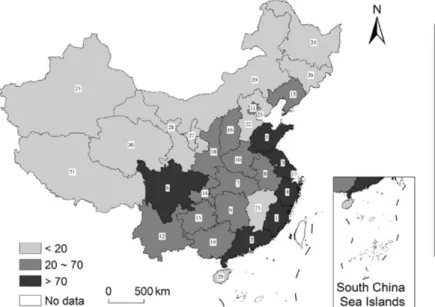
One conspicuous problem is the imbalance of PPP program distribution in China. Investment is concentrated in south-eastern China and ignored in poor areas. Investment focuses on high-profit PPP projects (i.e. sewerage systems, urban transportation, etc.). Figure 2, below, shows that south- eastern provinces, especially those located near the coastline, have more PPP programs than other provinces. On the other hand, north-western provinces do not have many. Ironically, compared to high-income provinces such as Guangdong or Zhejiang, the provinces in north-western China have less income to support environmental programs, and therefore need PPP programs more. However, investors tend to invest their money in well- developed instead of less-developed areas. Furthermore, the government in less-developed areas have difficulty attracting talented or seasoned experts to do planning or program design. Thus, these areas do not present programs attractive enough for investors. This issue will cause damage not only presently, but also extend damages into the future.
Figure 2. Number of PPP projects implemented in China by province. Source:
Cheng et al. (2016)
The government has little interest in introducing urban river restoration
projects. The Ministry of Finance of China announced its “Sample PPP
program list” for the first time in 2014. Among the 30 programs inside the
list, only two of them are related to water restoration. However, 10 programs
were sewer plants (Ministry of Finance, 2014). The Ministry of Finance
announced the second list in 2015. Out of 206 programs, only 13 of them
involved water environment protection/restoration. Even though programs
like the Chu River project have shown their potential for earning a profit, the
government seems to think programs like sewer plants need more
investment. Therefore, programs similar to the Chu River program do not
have the chance to enter the recommendation list. Ironically, sewer plants
can be run completely by the private sector. Public sector and investor
attitudes on PPP frameworks have shifted by many factors. For example, the
local government quickly lost their enthusiasm for the application of PPP
when the Chinese central government came out with a 4 trillion RMB stimulus package after the worldwide financial crisis in 2008 (Yang and Cai, 2016). The local government then did not need to work with the private sector because adequate financial support was being received from central government. The Chu River program started at the end of 2008, so its existence relied on a bit of luck. The Wuhan government did not kill the plan even after receiving the stimulus package. On the other hand, local government regained =interest in the PPP model after 2013, according to research (Cheng et al., 2016). The shift between different attitudes has made investors reconsider the stability of cooperation with the public sector.
Finally, PPP programs in China face unbalanced participation by different parties, with an extremely high requirement for market access. Multiple types of research (Ke et al., 2010; Cheung & Chan, 2011) indicate the high requirement for the private sector to join a PPP program in China. The requirements include the financial requirement (minimum invest amount, etc.), qualification requirement (requiring qualifications only top companies possess) and identity requirement (the company must be nationally owned).
Due to these extreme, even excessive requirements, several top companies monopolize access to PPP programs in China. The Chu River program operated by Wanda Group is an excellent example. Previously mentioned research also suggests some local PPP programs should lower the barrier to PPP entry since the high requirements can be unnecessary for small PPP programs.
As previously mentioned, the public-private partnership framework is not a cure for all problems, yet PPP programs still face stress from high expectations. Each party wants different things from a PPP program. Central government expect to increase private investment through PPP (Cheng et al., 2016), local government want to pay back previous debt and get rid of deficits, the Ministry of Finance of China has even released an order that local government should not use PPP programs as a cover for financing of previous debt (Ministry of Finance of China, 2016). Environmental departments hope to solve funding issues; high ranking officers from the Ministry of Environmental Protection have made several speeches in 2016 in support of environmental PPP programs. However, they do not lead any programs by themselves. Investors rely on a high rate of return from PPP programs and are driven by profit when selecting a program. And in addition, the local community, NGOs and other industries (construction, energy, etc.) also have their own agendas. Managing these differing agendas is a true art.
5. SUGGESTION AND CONCLUSION
With so many problems to address, the following provides a constructive
suggestion. People should set reasonable environmental goals for each
environmental PPP program. With the goals in mind, people should interpret
the program in detail by recruiting an environmental expert early in the
planning stage, to clarify the goals to every participant. In the execution
stage, the framework (usually a company) should increase the weight of the
environmental expert’s opinion in decision making. Finally, if full
40 IRSPSD International, Vol.5 No.4 (2017), 32-41
participation is not achievable in the current stage, third-party supervision should be included as a minimum, with a channel for addressing suggestions.
The boom of PPP programs has arrived in China and thousands of programs appear every year. The Chu River program sets an example of a partnership between public and private sector. Although the program is not perfect, other programs should learn from the Chu River experience. The market is promising, but also potentially risky. Leaders from the public and private sector may need to discuss the big picture issues before PPP programs take on a detrimental direction.
ACKNOWLEDGMENT
This study was supported by the Sophia University Graduate School of Global Environmental Studies, Tokyo. This study could not be accomplished without all the support I received. Great gratitude should be given to Professor Guangwei Huang, my supervisor, who gave me great support on my research. His advice is always the most helpful.
REFERENCES
Akintoye, A., Beck, M., & Hardcastle, C. (Eds.). (2002). Public-Private Partnerships:
Managing Risks and Opportunities: Blackwell science.
Chen, T., & Yang, K. (2006). "Discussion on the Influence Exerted by Riparian Land Use on Urban River Corridor: A Case Study of Suzhou Creek in Shanghai". World Regional Studies, 15(3).
Cheng, Z., Ke, Y., Lin, J., Yang, Z., & Cai, J. (2016). "Spatio-Temporal Dynamics of Public Private Partnership Projects in China". International Journal of Project Management, 34(7), 1242-1251.
Cheung, E., & Chan, A. P. (2011). "Risk Factors of Public-Private Partnership Projects in China: Comparison between the Water, Power, and Transportation Sectors". Journal of urban planning and development, 137(4), 409-415.
Hu, Z., Duan, D., & Zeng, J. (2013). "Research on Business Culture Street Construction Based on Space Production Theory: Take Chuhe & Han Street of Wuhan City as an Example". Urban Development Studies, 20(12).
Ke, Y., Wang, S., Chan, A. P., & Lam, P. T. (2010). "Preferred Risk Allocation in China’s Public–Private Partnership (Ppp) Projects". International Journal of Project Management, 28(5), 482-492.
Klijn, E.-H., Edelenbos, J., Kort, M., & van Twist, M. (2008). "Facing Management Choices:
An Analysis of Managerial Choices in 18 Complex Environmental Public—Private Partnership Projects". International Review of Administrative Sciences, 74(2), 251-282.
Mota, J., & Moreira, A. (2015). "The Importance of Non-Financial Determinants on Public–
Private Partnerships in Europe". International Journal of Project Management, 33(7), 1563-1575.
Osborne, S. (2002). Public-Private Partnerships: Theory and Practice in International Perspective. Routledge.
Shao, Q., & Ji, J. (2012). "Wuhan Central Culture Area - Chu River Han Street Planning and Design Research Report". Xiandai Horticulture, (10), 133.
Singewar, M., & Deshmukh, S. (2016). "Application of Public Private Partnership in Real Estate". Imperial Journal of Interdisciplinary Research, 2(7), 1431-1433.
Wang, J. (2004). "Study of Public Participation Issue in the Environmental Impact Assessment Progress - Discussion of Environmental Impact Assessment in China". Law Review, 22(2), 107-118.
Wang, J., & Lu, Z. (2001). "A Historic Review of World Urban Waterfront Development".
City Planning Review, 25(7).
Water Conservancy Committee of Yangzi River. (2007). "Verification Report of Wuchang
"Big East Lake" Eco Water Network Construction".
Xiong, Y. (2010). "How to Utilize the Ecological Resources of Big East Lake in Wuhan".
Brianpower Magazine, (5).
Zhang, X. (2005). "Criteria for Selecting the Private-Sector Partner in Public–Private Partnerships". Journal of construction engineering and management, 131(6), 631-644.