skills of children with hearing impairments by the Kanazawa Method
著者 外山 稔
著者別表示 Toyama Minoru journal or
publication title
博士論文本文Full 学位授与番号 13301甲第4997号
学位名 博士(保健学)
学位授与年月日 2019‑09‑26
URL http://hdl.handle.net/2297/00059272
doi: https://doi.org/10.24517/00055101
Original Article
Journal of Wellness and Health Care Vol.43 ⑴ 23〜34 2019An investigation into the syllable-extraction skills of children with hearing impairments by the Kanazawa Method
Minoru Toyama, Masako Notoya
1) *, Hiromi Harada
2), Ken Nakatani
3), Hisashi Sugimoto
4), Tadashi Ishimaru
5), Tomokazu Yoshizaki
4)Abstract
Objectives: To examine predictors of syllable extraction proficiency, a prerequisite for children with hearing impairments progressing from spoken to written language by the Kanazawa Method.
Background: The rates of delayed language acquisition in children with hearing impairments have remained unchanged despite increased use of cochlear implants. Children born with hearing deficiencies do not receive sufficient auditory inputs, which contributes to delayed acquisition of spoken language. As spoken language is the springboard to written language, such children are likely to experience delays in acquisition of syllable awareness and written language when taught in the same way as children without hearing impairments. However, most research on syllable awareness in children with hearing impairments in Japan is related to studies targeting school-age children and later. Therefore, it remains unclear how to manage syllable awareness problems in pre-school-age children.
Methods: This study was conducted on 68 children with hearing impairments, between 4 and 6 years of age, diagnosed by the Kanazawa University Hospital with congenital deafness before the age of 4 years and receiving outpatient language instruction. To examine the predictors of syllable extraction scores, we performed multiple-regression analysis with syllable extraction as the dependent variable and age, unaided hearing level, and scores for remaining language skills (auditory word comprehension, syllabification, syllable extraction, written language character recognition, and written language sentence comprehension) as independent variables.
Results: Stepwise regression analysis showed that written language character recognition score, age, and auditory word comprehension score contributed to the syllable extraction score.
Discussion: The relationship between syllable extraction proficiency and age was consistent with previous reports. Early intervention targeting character recognition and auditory word comprehension assisted the teaching of written language and improved syllable awareness in children with hearing impairments. The results of this study indicated that early-stage intervention in written language character recognition and auditory word comprehension is an effective method of teaching children with hearing impairments to facilitate acquisition of written language and the development of syllable awareness. The vocabulary and syllable awareness acquired by exposure to a combination of spoken language, Japanese sign language, and written language can be easily transferred to speechreading. Using the Kanazawa Method to facilitate understanding of the structure of Japanese language can help children with hearing impairments to acquire syllable extraction proficiency, regardless of their unaided hearing level.
KEY WORDS
Hearing impairment, Language ability, Syllble extraction, Written language charater recognition, Auditory word comprehension
Division of Health Sciences, Graduate School of Medical Sciences, Kanazawa University
1 ) Department of Speech and Hearing Sciences and Disorders, Kyoto University of Advanced Science 2 ) Department of Speech and Hearing Sciences, International University of Health and Welfare 3 ) Department of Rehabilitation Sciences, Kansai University of Welfare Sciences
4 ) Department of Otolaryngology-Head and Neck Surgery, Graduate School of Medical Science, Kanazawa University 5 ) Hyotan-machi ENT Clinic
* Corresponding author
Introduction
In children with hearing impairments, rates of delayed language acquisition reportedly remain unchanged, despite increased use of cochlear implants1- 3). Many children with cochlear implants exhibit clear speech, considered functional for daily conversation. However, there are more than a few cases of clear delays in language learning from school age onward, with particular difficulties in vocabulary and syntax4-6). Not only do these issues delay language acquisition in children with hearing impairments, they may also contribute to communication problems with family and friends, potentially interfering with the individual’s ability to engage in daily living activities, and limiting future career choices.
Children without hearing impairments start to receive spoken linguistic stimuli from the adults around them soon after birth. These inputs facilitate the generation of first words, generally by around one year of age, and initial disyllabic words at around two years. By the time Japanese children reach school age (at around six years old), they have already acquired basic Japanese.
Although reports vary regarding the number of words and sentence structures that children acquire by the time they start school, current reports estimate them as 3,000-10,000 words. By the time they start school, most children without hearing impairments have also developed the ability to comprehend and express tense, the passive voice, causative structures, sentence structures for giving and receiving, and compound sentences7).
Children without hearing impairments acquire the basics of spoken language in infancy, which serve as a springboard for the acquisition of written language.
Japanese characters have ideograms (kanji) and phonograms (kana), with one kana equivalent to one morae (sg. mora). In children without hearing impairments, the progression from spoken to written language often grows from an earlier interest in kana characters. For example, children often begin learning written language by picking out the phonogram “ka”
from kana character table, connecting it to the ka in ka- ra-su ‘crow’, then proceeding onward to the next kana.
Syllable awareness is an important prerequisite to the acquisition of written language, and is cultivated as a basic element of spoken language8).
In Japanese, syllable awareness is defined as the ability to extract syllables from words or deconstruct them into morae (sg. mora), and generally emerges around age 4 and develops from age 5 onward8). Morae (sg. mora) are the timing units by which syllables are counted in Japanese. The Japanese people perceive syllables differently than the Westerners;
therefore, the term “mora” is used to distinguish the units from syllables. For example, according to the phonology of Western languages, (a) hatsuon, the Japanese letter for “n” which is also written in one of the letters of kana and (b) sokuon, the gemination noted by a small “tsu” character, are not syllables by themselves, but the Japanese people perceive them as single timing units similar to the regular syllables.
Diphthongs and long vowels are also regarded as single syllables in Western languages, but Japanese people perceive them as having two timing units.
Children born with hearing deficiencies do not receive sufficient auditory inputs. This contributes to a delay in the acquisition of spoken language.
Since spoken language is the springboard to written language, such children are likely to experience delays in the acquisition of syllable awareness and written language when they are taught in the same way as children without hearing impairments. The technology of cochlear implants and hearing aids has evolved now, but the problem of syllable awareness of hearing impaired children has not improved9).
To solve this problem, we have spent over 40 years teaching written language to children with hearing impairments in parallel with spoken language, beginning at an early age10). Our written language teaching method involves introducing children to meaningful words, rather than single kana. Studies thus far have shown that the acquisition of written language in children with hearing impairments is significantly robust, compared to the acquisition of spoken language11, 12). While the very act of writing characters, which is necessary for the expression of written language, can be considered difficult for children, we use Japanese sign language in our teaching as a temporary substitute for writing before progressing to teaching actual written language.
It is well-known that children with hearing impairments find sign language the easiest to comprehend when simultaneously presented with sign language,
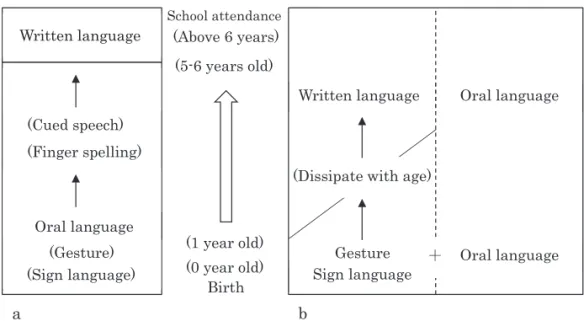
written language, and spoken language stimuli. Our instructional method is called the Kanazawa Method (written-oral language method) 13, 14). Figure 1 shows difference between general language instruction and Kanazawa Method. We found that by presenting pre- verbal children, younger than one year, with gestures paired to spoken language stimuli, the children begin to produce their first signed utterances. Examples of such utterances include mamma ‘mama’, choudai ‘give me’, and baibai ‘bye-bye’, produced using sign language at around one year, the same time as children without hearing impairments do (using spoken language).
Then, when the children develop the ability to use sign language to express words, we introduce written language and demonstrate the correspondences between signed and written words and between sign language and spoken language. This enables the children to understand the meaning of words, regardless of the linguistic mode—signed, written, or spoken15). For this reason, children with hearing impairments, taught by using the Kanazawa Method, reach a reading level of the average first-semester second grade student by the time they start school16).
Recently, the importance of literacy instruction in the problem of syllable awareness in children with hearing impairments has been focused17, 18). The problem of syllable awareness in children with hearing impairments is mainly reported in countries where Japanese is not their native language18-21). There are only few reports
on Japanese syllable awareness targeting children with hearing impairments before pre-school. Most of the research on syllable awareness in children with hearing impairment in Japan is related to studies targeting school-going children and later; hence, how to manage syllable awareness problems from the pre-school perspective remains unclear.
Similarly, the problem of syllable awareness has not been investigated for the children with hearing impairments, who have been trained by the Kanazawa Method. However, there is the fact that children with hearing impairments who have been trained by the Kanazawa Method have the ability to read at the level of first-semester of the second grader at the time of elementary school enrolment. This fact indicates the following hypothesis that "early introduction of gestures, sign language, and letter language may contribute to syllable recognition".
The objective of this study, conducted on children with hearing impairments who were taught by using the Kanazawa Method, was to identify predictors of syllable awareness, necessary for the acquisition of written language. With these predictors in mind, we examined effective strategies for instruction and interventions for children with hearing impairments who are prone to delays in the acquisition of written language.
Figure 1. Language instruction difference for the hearing-impaired children between auditory- oral language instruction and Kanazawa Method
The language instruction strategy by auditory-oral method (Figure 1a).
The language instruction strategy by written-oral language method (The Kanazawa Method) (Figure 1b).
Figure 1
a b
(5-6 years old)
(0 year old) (1 year old)
( y )
Birth (Above 6 years)
(Ab 6 )
School attendance Written language
Written languagge
Oral language (Cued speech) (Finger spelling)
(Sign language) (Gesture)
(Dissipate with age)
Oral language Written language Oral language
Sign language 㸩㸩㸩 Si l
Gesture
Methods 1. Participants
For this study, our participants were 68 children (32 boys, 36 girls) with hearing impairments, aged 4- 6 years, who were diagnosed by the Kanazawa University Hospital Department of Otorhinolaryngology with congenital deafness before the age of 4 years and were receiving outpatient language instruction there.
C h i l d r e n w i t h i n t e l l e c t u a l d i s a b i l i t i e s o r developmental disorders were not excluded from receiving Kanazawa Method instruction in the language outpatient therapy services at the Kanazawa University Hospital Department of Otorhinolaryngology. However, children with intellectual disabilities were excluded from consideration for this study, given the nature of such disabilities.
2. Study design
For more than 40 years, the Kanazawa University Hospital Department of Otorhinolaryngology has used the Kanazawa Method to teach language to children with hearing impairments. The Kanazawa Method facilitates linguistic development in children with hearing impairments by using Japanese sign language and written language, beginning at an early age.
Additionally, the method teaches spoken language through speechreading with the aid of hearing aids or cochlear implants. The Kanazawa Method differs from previous methods of language instruction in its emphasis on teaching children, beginning at an early age and language stage, to understand the structure of Japanese through multi-modal inputs including sign language and written language, in addition to spoken language (Figure 1).
We statistically examined the relationships between (a) syllable-extraction proficiency, considered crucial for the acquisition of spoken and written language, and (b) other linguistic aspects. We assessed basic skills required to acquire Japanese (auditory word comprehension, syllabification, syllable extraction, written language character recognition, and written language sentence comprehension) in children with hearing impairments, between 4- 6 years of age, who were taught language skills according to the Kanazawa Method.
3. Materials
In this study, a children’s reading test (Kanekoshobo,
Tokyo, Japan)22) was chosen as the method for measuring the target language skills. Test questions of reading subtest were presented to the participants in a one-on-one setting. The method of presentation was based on methods used with children without hearing impairments. We also used spoken language and speechreading to present the questions according to general testing procedures.
The children’s reading test in this study was designed to test the following language skills in children from ages 3 to 7 according to the following instructions.
Auditory word comprehension (the ability to hear a spoken word and understand its meaning): Given five pictures, listen to the meanings and categories of words for familiar everyday objects and select the corresponding picture.
Shape differentiation (the ability to perceive the distinguishing features of each character): Given four shapes, choose the one that matches the example.
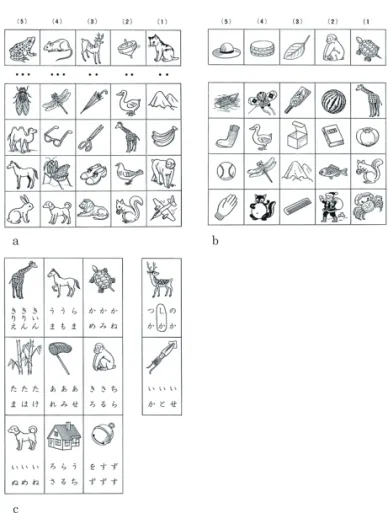
Syllabification (the ability to deconstruct a word into its component syllables): Given a picture of an object and its number of syllables (with each syllable written as •), choose the picture (among four) of the object whose name has the same number of syllables as the example.
Syllable extraction (the ability to extract certain syllables from a word): Given five pictures, choose the one with the object whose name starts with the same initial sound (syllable) as the example. In syllable extraction, in addition to syllabification, the ability to extract syllables from a word is required.
In general, syllabification and syllable extraction of words are known to be more difficult with syllable extraction8). In development of language, syllabification ability is positioned as a process of acquiring syllable extraction ability, so the syllable extraction score was used as an index of syllable recognition in this study.
Written language character recognition (the ability to realize and recognize differences between words that are both aurally and graphically similar): Given three words written in kana, choose the one that corresponds to the object in the picture.
Written language sentence comprehension (the ability to understand the content of a Japanese sentence):
Given a sentence written in hiragana, choose the corresponding picture among three pictures.
Figure 2 shows an example of the subtest (Syllabification, Syllable extraction and Written language character recognition). The subtests for each area consist of 7 of single-answer questions and 8 of multiple-answer questions for word auditory comprehension, 10 of single-answer questions for shape differentiation, 5 of multiple-answer questions for syllabification (Figure 2a), 5 of multiple-answer questions for syllable extraction (Figure 2b), 24 of single-answer questions for written language character
recognition (Figure 2c), and 18 of single-answer questions for written language sentence comprehension.
The maximum scores for each area were 23 for auditory word comprehension, 20 for shape differentiation, 20 for syllabification, 20 for syllable extraction, 24 for written language character recognition, and 18 for written language sentence comprehension.
Fifteen of the children ( 8 boys, 7 girls) were between 4 years and 4 years 11 months; 36 (17 boys, 19 girls) were between 5 years and 5 years 11 months;
and 17 (7 boys, 10 girls) were between 6 years and 6 years 11 months. The start of training was 0 years in 20, 2 years in 29, 3 years in 14, and 4 years in 5. Fifty of the children used hearing aids and 18 had cochlear implants. Table 1 shows participants’ average unaided hearing levels and aided hearing levels (both out of four levels).
4. Ethical considerations
This study was conducted with the approval of the Kyoto University of Advanced Science Research Ethics Committee (Approval No. 29-13). According to the procedure described in the approved document, the study objective and method of the study were fully explained to the board of “Parents and Children with the Hearing-Impaired—the Kanazawa Method Research Group, a Specified Nonprofit Corporation”. We obtained verbal and written consent from the chairman of the group on behalf of the participants.
5. Statistical Analysis
We performed Pearson variable tests to determine the relationships among age, unaided hearing level, and five of the language skills covered in the reading test (excluding shape differentiation): auditory word comprehension, syllabification, syllable extraction, written language character recognition, and written language sentence comprehension.
In addition, to identify predictors of syllable- extraction proficiency, we created a multiple-regression Table 1. Age and number of children with hearing impairments in this study
Tables Table 1
Unaided hearing level Aided hearing level
Age < 90 dB G% < 40 dB G% Total
4 year-4 year 11 months 6 9 8 7 15
5 year-5 year 11 months 13 23 13 23 36
6 year-6 year 11 months 5 12 8 9 17
Figure 2. Example of children’s reading test (Syllabification, Syllable extraction and Written language character recognition) Syllabification: Given a picture of an object and its number of syllables, choose the picture of the object whose name has the same number of syllables as the example (Figure 2a).
Syllable extraction: Given five pictures, choose the one with the object whose name starts with the same initial sound as the example (Figure 2b).
Written language character recognition: Given three words written in kana, choose the one that corresponds to the object in the picture (Figure 2c).
Figure 2
b
a
c
model with the syllable extraction score as the dependent variable and age, unaided hearing level, and the scores for the remaining language skills (auditory word comprehension, syllabification, written language character recognition, and written language sentence comprehension) as the independent variables. Stepwise regression was used as the method of fitting for a more detailed investigation. IBM SPSS Statistics 22.0 (IBM, Armonk, NY, USA) was used to perform the statistical analyses, with a significance level of p < 0.05.
Results
The median subtest scores of the 15 children between 4 years and 4 years 11 months of age were 13 for auditory word comprehension (range: 7-20), 14 for syllabification (range: 0-20), 6 for syllable extraction (range: 0-14), 15 for written language character recognition (range: 0-22), and 11 for written language sentence comprehension (range: 0-18). The median subtest scores of the 36 children between 5 years and 5 years 11 months of age were 13 for auditory word comprehension (range: 0-20), 14 for syllabification (range: 0-20), 14 for syllable extraction (range: 0-20), 18 for written language character recognition (range: 0-24), and 18 for written language sentence comprehension (range: 0-24). The median subtest scores of the 15 children between 6 years and 6 years 11 months of age were 17 for auditory word comprehension (range:
0-22), 18 for syllabification (range: 6-20), 18 for syllable extraction (range: 0-20), 22 for written language character recognition (range: 8-24), and 14 for written language sentence comprehension (range: 5-18).
When comparing the results of syllable extraction of
68 participants with standardized data obtained from infants (1,616 children without hearing impairments) / the reading test, there were 32 participants whose results were within one standard deviation (SD) of mean obtained from same-age children without hearing impairments. There were 29 participants who exceeded the mean + 1SD of the children without hearing impairments, and 7 participants who did not reach the mean - 1SD of the children without hearing impairments.
We performed a single-correlation test on age, unaided hearing level, and the five language skills (auditory word comprehension, syllabification, syllable extraction, written language character recognition, and written language sentence comprehension). Table 2 shows the scores for each item and the significant correlations among them. No significant correlations were found between age and unaided hearing level (p = 0.831), age and auditory word comprehension (p = 0.333), age and written language sentence comprehension (p = 0.113), unaided hearing level and syllabification (p = 0.268), or unaided hearing level and syllable extraction (p = 0.053).
To examine predictors of syllable extraction scores, we performed a multiple-regression analysis (forced- entry method) with syllable extraction as the dependent variable and age, unaided hearing level, and the scores of auditory word comprehension, syllabification, written language character recognition, and written language sentence comprehension as the independent variables.
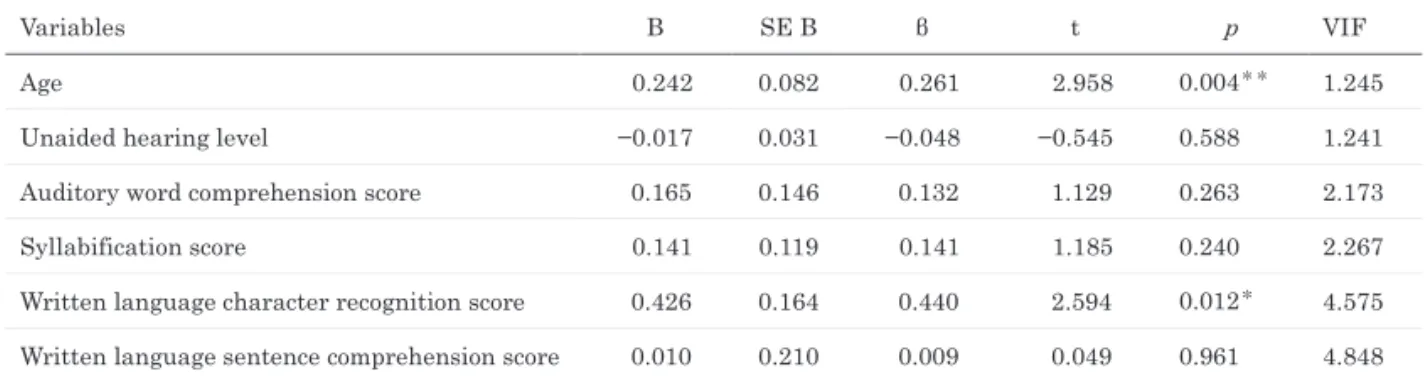
In the analysis, age (p = 0.004) and written language character recognition (p = 0.012) were found to be significant, with a contribution ratio of R2 = 0.617 (R*2 Table 2. Correlation of each variable
Table 2
Variables 1 2 3 4 5 6 7
1. Age ― 0.026 0.119 0.330** 0.472** 0.336* 0.194
2. Unaided hearing level ― −0.392** −0.136 −0.235 −0.275* −0.244*
3. Auditory word comprehension score ― 0.574** 0.534** 0.604** 0.676**
4. Syllabification score ― 0.619** 0.688** 0.689**
5. Syllable extraction score ― 0.725** 0.635**
6. Written language character recognition score ― 0.858**
7. Written language sentence comprehension score ―
*p < 0.05, **p < 0.01
= 0.579) (Table 3).
Additionally, to examine the multiple-correlation coefficient (variance inflation factor [VIF] for written language character recognition = 4.575) between the independent variables in the above analysis, we performed a stepwise regression with an enter/remove threshold of 0.15. The written language character recognition score (p < 0.001), age (p = 0.002), and auditory word comprehension score (p = 0.062) were chosen as contributing factors to the syllable extraction score, with a contribution ratio of R2 = 0.607 (R*2 = 0.588) (Table 4).
Discussion
In this study, we extracted predictors of syllable extraction scores in 68 children with hearing impairments, between 4-6 years of age. Based on the results, the written language character recognition score, age of the child, and auditory word comprehension (by speechreading) score were the variables chosen as factors influencing syllable extraction scores.
The first variable chosen as a predictor of syllable- extraction proficiency was written language character
recognition. The method of instruction we use in teaching children with hearing impairments is as described above. Rather than one kana at a time, we use individual written whole-words, which are visual linguistic symbols, as the stimulus unit. Many children with hearing impairments acquire written language in a more robust manner than spoken language, and that the number of words they understand through written language exceeds that of speechreading11, 12). The Japanese language contains many words with different meanings, produced with the same mouth-shaped (e.g., ame/kame ‘rain/turtle’), and many homophones (e.g., ame/ame ‘rain/candy’). This means that acquiring the ability to understand Japanese vocabulary through speechreading alone is likely to be extremely difficult for children with auditory disabilities. In addition to kana, the Japanese writing system also includes kanji (Chinese characters). Because kanji are ideographic, they assist children with understanding the different meanings of words. This makes written language a more readily-accessible modality by which children with hearing impairments can acquire the ability to understand words. This is consistent with the finding Table 3. Relationship between syllable extraction score and age, unaided hearing level, auditory word
comprehension score, syllabification score, written language character recognition score, and written language sentence comprehension scoreTable 3
Variables B SE B β t p VIF
Age 0.242 0.082 0.261 2.958 0.004** 1.245
Unaided hearing level −0.017 0.031 −0.048 −0.545 0.588 1.241
Auditory word comprehension score 0.165 0.146 0.132 1.129 0.263 2.173
Syllabification score 0.141 0.119 0.141 1.185 0.240 2.267
Written language character recognition score 0.426 0.164 0.440 2.594 0.012* 4.575 Written language sentence comprehension score 0.010 0.210 0.009 0.049 0.961 4.848 R2 = 0.617(R* 2 = 0.579), *p < 0.05, **p < 0.01
B, unstandardized coefficient; SE B, standard error of coefficients; β, standardized coefficient; t, t-statistic; p, p-value; VIF, variance inflation factor
Table 4. Result of Stepwise Multiple Regression for syllable extraction scoreTable 4
Variables B SE B β t p VIF
Written language character recognition score 0.503 0.101 0.519 4.973 <0.001 1.773
Age 0.255 0.078 0.275 3.286 0.002 1.142
Auditory word comprehension score 0.235 0.124 0.188 1.901 0.062 1.595 R2 = 0.607(R*2 = 0.588)
B, unstandardized coefficient; SE B, standard error of coefficients; β, standardized coefficient; t, t-statistic; p, p-value; VIF, variance inflation factor
that language acquisition, in children with hearing impairments who were taught by using the Kanazawa Method, is not influenced by the severity of hearing acuity23, 24). Written language acquired in this way ultimately becomes a positive influence on the size of the child’s spoken vocabulary as he or she transitions to speechreading-based instruction25). This is likely the reason written language character recognition was chosen as the primary predictor of syllable-extraction proficiency in children taught by using the Kanazawa Method.
The next variable chosen as a predictor of syllable- extraction proficiency was age. As is well known, syllable-extraction proficiency in non-hearing-impaired Japanese children improves with age8). The results of this study suggest that syllable-extraction proficiency likewise improves with age in children with hearing impairments. This also supports the idea that structural development of language acquisition is similar across both groups.
The third variable chosen as a predictor of syllable-extraction proficiency was auditory word comprehension—that is, the understanding of spoken language. It is recognized that from age 4½ onwards, children without hearing impairments realize that words are series of sounds and develop the ability to extract syllables26). For example, they realize that the Japanese word megane ‘eyeglasses’ is made up of ‘me’,
‘ga’, and ‘ne’ (morafication) and subsequently become able to answer questions like “What syllable does this word start with?” (syllable extraction). During the fourth year, they were already fully capable of daily conversation, which suggests that having a sufficiently large vocabulary is a prerequisite for morafication and syllable awareness. While the children in this study were hearing-impaired, the fact that some of them had been wearing hearing aids and receiving spoken language training before the age of age 1 year means that they likely had a sizable vocabulary that they understood through speechreading. This observation was consistent with the results of previous studies that the development of the understanding of spoken language and the ability to extract syllables are interrelated17, 18). The above findings suggest that syllable-extraction proficiency requires a certain minimum vocabulary. In the Kanazawa Method, written
language functions as a springboard for teaching spoken language (speechreading), so the number of written words that are understood assists speechreading ability.
This is likely the reason that written language character recognition and auditory word comprehension were two predictors of syllable extraction.
In Japan the term “ 9 years age wall” often has been used for children with hearing impairments.
This term refers to the inability to understand abstract expressions, which is important for language development of children around age 9. It is difficult for children with hearing impairments, who do not receive sufficient auditory inputs, to “catch up” to children without hearing impairments in the acquisition of spoken language, particularly when they are taught using the same conventional speech-first methods. Since such children also experience delays in the acquisition of written language, this undoubtedly contributes to their “ 9 years age wall”, which refers to feelings of inferiority caused by mistakes or by comparing oneself to others of a similar age.
In previous syllable awareness and syntax acquisition studies in children with hearing impairments, various initiatives and discussions arose that can still be seen today18, 27). There are reports that children with hearing impairments tend to be delayed in acquiring syllable consciousness, when compared to children without hearing impairments; however, their learning processes are similar to those of children without hearing impairments28). Therefore, studies using Cued Speech and Visual Phonics are being conducted in order to encourage spoken language learning as the basis of acquisition for character-based languages and to cross the “9 years age wall” 29, 30).
The new strategy of the Kanazawa Method is to introduce written language from infancy (1-year-old), and the results of this study proved the hypothesis
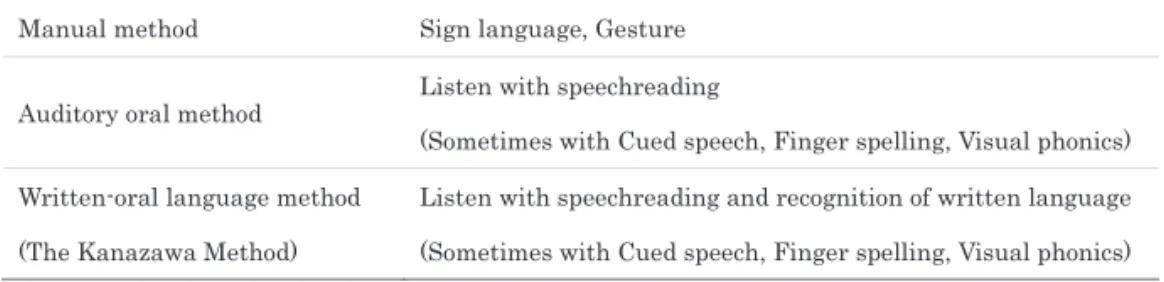
"early introduction of gestures, sign language, and letter language may contribute to syllable recognition". This method of introducing written language from infancy and improving syllable awareness is very novel. Our results suggest the need for a different approach for use with children with hearing impairments (Table 5).
The results of this study make it clear that early-stage and direct intervention in the areas of written language character recognition and auditory word comprehension
is an effective method of teaching children with hearing impairments so that they acquire written language and develop syllable awareness. The vocabulary and syllable awareness acquired by exposure to a combination of spoken language, Japanese sign language, and written language can transfer easily to speechreading. By using Kanazawa Method to facilitate understanding of the structure of Japanese language can help children with hearing impairments to acquire syllable-extraction proficiency, regardless of their unaided hearing level.
Limitations of current study
The most severe limitation of the current study was sample sizes. Although the number of samples for hearing impaired children was sufficient to reveal statistically significant effects, it was difficult to classify the children with cochlear implants by their starting age and duration of wearing the cochlear implant prosthesis, and the duration of receiving speech therapy services.
For these reasons, it was difficult to investigate in detail the differences between hearing aids and cochlear implants used by children with hearing impairments, and the differences in syllable awareness associated with them. The second limitation of this study was that the subtests for syllable extraction were performed only on phonetic characters (kana), and the evaluation was limited only to the initial sound. These problems are closely related to the fact that the tests used in this study are standardized for infants.
Longitudinal study design of participants in current study would enable more effective evaluation of syllable awareness, developmental process of verbal intelligence quotient and performance intelligence quotient, as well as clarify the process whether children with hearing impairments who were trained by using the Kanazawa
Method can be break through 9 years age wall.
Conclusions
We examined predictors of syllable-extraction proficiency, which, for children without hearing impairments, are prerequisites for transitioning from spoken to written language. Our participants were 68 children with hearing impairments between 4- 6 years of age who were taught by using the Kanazawa Method. Contributing factors to syllable extraction scores were the written language character recognition score, their age, and the auditory word comprehension score. This suggests that early-stage intervention in the areas of written language character recognition and auditory word comprehension can increase syllable awareness in children with hearing impairments.
Funding
This work was supported by Kyoto University of Advanced Science(2018-2019).
Declarations of Interest None.
Acknowledgments
We are grateful to “Parents and Children with the Hearing-Impaired—the Kanazawa Method Research Group, a Specified Nonprofit Corporation” for their cooperation. We would like to thank Prof. Dr. med.
Fujiko Someya (Kanazawa University) for a valuable guidance in thesis; and Mr. Katsumi Inoue (Kanazawa University) for a valuable advice in the statistical analysis. We also thank Prof. Makoto Kariyasu (Kyoto University of Advanced Science) for proof editing of the manuscript.
Table 5. Language program for children with hearing impairmentsTable 5
Manual method Sign language, Gesture
Auditory oral method Listen with speechreading
(Sometimes with Cued speech, Finger spelling, Visual phonics) Written-oral language method
(The Kanazawa Method)
Listen with speechreading and recognition of written language (Sometimes with Cued speech, Finger spelling, Visual phonics)
References
1 ) J.B. Tomblin, B.A. Barker, L.J. Spencer, et al.
(2005): The effect of age at cochlear implant initial stimulation on expressive language growth in infants and toddlers, J. Speech Lang. Hear. Res., 48, 853-867, doi: 10.1044/1092-4388(2005/059) 2 ) D.M. Houston, R.T. Miyamoto (2010): Effects of
early auditory experience on word learning and speech perception in deaf children with cochlear implants: implications for sensitive periods of language development, Otol. Neurotol., 31, 1248- 1253, doi: 10.1097/MAO.0b013e3181f1cc6a
3 ) Y. Lee, D. Yim, H. Sim (2012): Phonological processing skills and its relevance to receptive vocabulary development in children with early cochlear implantation, Int. J. Pediatr.
Otorhinolaryngol., 76, 1755-1760, doi: 10.1016/
j.ijporl.2012.08.016
4 ) T. Iwaki (2008): The reading ability of the children for the cochlear implant, Audiology Japan., 51, 521-522, doi: 10.4295/audiology.51.521
5 ) A. Tomizawa, A. Kawano, N. Nonami, et al. (2017):
Examination of the vocabulary before and after elementary school period in hearing-impaired children with cochlear implants, Audiology Japan., 60, 500-508, doi: 10.4295/audiology.60.500
6 ) K. Shirai, A. Kawano, Y. Saito, et al. (2018):
Academic abilities in the Japanese language of teenagers with cochlear implants, Audiology Japan., 61, 576-582, doi: 10.4295/audiology.61.576
7 ) H. Kobayashi (2001): Development of word meaning, E. Hatano (Ed.), Introduction to development of language, 56-81, Taishukan Publishing Co., Ltd.
8 ) K. Amano (1970): Formation of the act of analyzing phonemic structure of words and its relation to learning Japanese syllabic characters (kanamoji), Jpn J. Educ. Psychol., 18, 76-89, doi: 10.5926/
jjep1953.18.2_76
9 ) M. Harris, E. Terlektsi, F.E. Kyle (2017):
Concurrent and longitudinal predictors of reading for deaf and hearing children in primary school, J Deaf Stud Deaf Educ., 22, 233-242, doi: 10.1093/
deafed/enw101
10) M. Notoya, S. Suzuki, M. Nakajima (1979):
Learning processes of written and oral language in two children with deafness, Jpn. J. Logop.
Phoniatr., 20, 247-254, doi: 10.5112/jjlp.20.247 11) S. Suzuki, M. Notoya (1984): Teaching written
language to deaf infants and preschoolers, Top. Early Child Spec. Educ., 3, 10-16, doi:
10.1177/027112148400300405
12) M. Notoya, S. Suzuki, M. Furukawa (1994): Effect of early manual instruction on the oral-language
development of two deaf children, Am. Ann. Deaf., 139, 348-351, https://www.jstor.org/stable/44391970 13) M. Notoya, S. Suzuki, M. Furukawa, et al. (1986):
Academic achievement of hearing-impaired children trained by written language- auditory method and acquisition of sign language in profoundly deaf infants, Jpn. J. Logop. Phoniatr., 27, 235-243, doi:
10.5112/jjlp.27.235
14) M. Notoya, S. Suzuki, H. Tedoriya, et al. (1992):
The effects of early manual instruction on the oral language development of two deaf children, J. Otolaryngol. Jpn., 95, 1360-1365, doi: 10.1353/
aad.2012.0334
15) M. Notoya, T. Tateishi, S. Suzuki (1995):
Prelinguistic intervention program for profoundly hearing impaired infants, Jpn. J. Logop. Phoniatr., 36, 286-291, doi: 10.5112/jjlp.36.286
16) T. Kobayashi, M. Notoya, M. Furukawa (2003):
Long-term progress in reading abilities in hearing- impaired children trained by the Kanazawa Method, J. Logop. Phoniatr., 44, 298-303, doi:
10.5112/jjlp.44.298
17) A.R. Lederberg, E.M. Miller, S.R. Easterbrooks, et al. (2014): Foundations for literacy: An early literacy intervention for deaf and hard-of-hearing children, J Deaf Stud Deaf Educ., 19, 438-455, doi:
10.1093/deafed/enu022
18) S. Nittrouer, M. Muir, K. Tietgens, et al. (2018):
Development of Phonological, Lexical, and Syntactic Abilities in Children With Cochlear Implants Across the Elementary Grades, J. Speech Lang. Hear. Res., 61, 2561-2577, doi: 10.1044/2018_
JSLHR-H-18-0047
19) T.Y. Ching, L. Cupples (2015): Phonological Awareness at 5 years of age in Children who use Hearing Aids or Cochlear Implants, Perspect Hear Hear Disord Child., 25, 48-59, doi: 10.1044/
hhdc25.2.48
20) S. Nittrouer, J.H. Lowenstein, C. Holloman (2016): Early predictors of phonological and morphosyntactic skills in second graders with cochlear implants, Res Dev Disabil., 55, 143-160, doi: 10.1016/j.ridd.2016.03.020
21) B. Wachtlin, Y. Turinsky, F. Herrmann, et al. (2017):
Phonological awareness in German-speaking preschool children with cochlear implants - 3 case examples, Int. J. Pediatr. Otorhinolaryngol., 100, 198-203, doi: 10.1016/j.ijporl.2017.06.031
22) Childhood Institute of Education (1973): Children’s reading test, Kanekoshobo
23) S. Suzuki, M. Notoya (1993): Language instruction for hearing-impaired children: review of Kanazawa Method, J. Logop. Phoniatr., 34, 257-263, doi:
10.5112/jjlp.34.257
24) T. Kobayashi (2006): Verbal IQ scores of hearing- impaired subjects trained by the Kanazawa Method, J. Logop. Phoniatr., 47, 194-201, doi: 10.5112/
jjlp.47.194
25) M. Notoya, S. Suzuki (1984): The role of written language in language development of the hearing- impaired, J. Logop. Phoniatr., 25, 140-146, doi:
10.5112/jjlp.25.140
26) H. Dairoku (1995): Is awareness of morae a requisite for acquisition of Kana reading? Jpn. J.
Psychol., 66, 253-260, doi: 10.4992/jjpsy.66.253 27) D.C. Nielsen, B. Luetke-Stahlman (2002):
Phonological awareness: one key to the reading proficiency of deaf children, Am. Ann. Deaf., 147, 11-19, doi: 10.1353/aad.2012.0213
28) M.Y. Webb, A.R. Lederberg (2014): Measuring phonological awareness in deaf and hard-of-hearing children, J. Speech Lang. Hear. Res., 57, 131-142, doi: 10.1044/1092-4388(2013/12-0106)
29) S. Colin, A. Magnan, J. Ecalle, et al. (2007):
Relation between deaf children's phonological skills in kindergarten and word recognition performance in first grade, J. Child Psychol. Psychiatr., 48, 139- 146, doi: 10.1111/j.1469-7610.2006.01700.x
30) Y. Wang, B.J. Trezek, J.L. Luckner, et al. (2008):
The role of phonology and phonologically related skills in reading instruction for students who are deaf or hard of hearing, Am. Ann. Deaf., 153, 396- 407, doi: 10.1353/aad.0.0061
金沢方式による聴覚障害幼児の音韻抽出能力の検討
外山 稔,能登谷 晶子1)*,原田 浩美2),中谷 謙 3)
杉本 寿史4),石丸 正 5),吉崎 智一4)
要 旨
目的:本研究は,金沢方式による訓練を受けた聴覚障害幼児の音韻意識の習得に寄与する 因子を明らかにすることを目的とした。
背景:先天性聴覚障害児は,聴覚を経由した情報入力が不十分であるために,結果として 音声言語の習得に遅れをきたす。音声言語の習得の遅れは,音声言語を基盤として発達す る音韻意識と文字言語の習得に影響を与える。聴覚障害児の音韻意識に関する先行研究は,
学童期を対象としたものが多く,幼児期の音韻意識の習得とその背景要因は明らかにされ ていない。
方法:金沢大学附属病院において 0 〜 4 歳までに先天性聴覚障害と診断され,同音声言 語外来で継続的な指導を受けた 4 〜 6 歳児 68 名を対象とした。対象児の音韻意識と言語 能力を幼児・児童読書力テストによって評価し,音韻の抽出能力(音韻意識)と他の言語 能力との関係,月齢,聴力レベルとの関係を検討した。
結果:音韻の抽出の成績を従属変数,月齢,聴力レベル,語の理解(聴覚口話),音韻の分解,
文字の認知(文字言語),文の理解(文字言語)の各成績を独立変数とした重回帰分析では,
文字の認知の成績,月齢,語の理解の成績の 3 つの変数が選択された。
結論:聴覚障害幼児の音韻の抽出の成績には,文字の認知の成績,月齢,語の理解の成績 が影響していた。本研究では,聴覚障害幼児の音韻意識を高める方略の一つとして,文字 の認知および語の理解の側面への早期介入が効果的な指導に寄与することが示唆された。