2
Toward Reduction of Environmental Burden
Caused by Excessive Application of Nitrogen Fertilizer
— Reduction of Groundwater Pollution and Nitrate Contents in Agricultural Products —
HIROKAZU FUKUSHIMA Environment and Energy Research Unit
1 Introduction
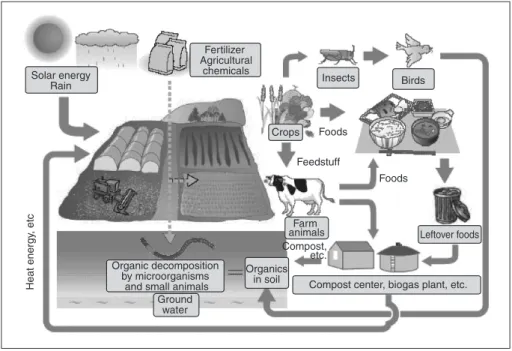
Agr iculture is i n herently equipped with various environmental protection functions (such as flood control, preparation for drought, prevention of soil erosion, and purification of water and air). Furthermore, agriculture is a series of sustainable production activities that make use of natural recycling of materials such as water, nitrogen, and carbon; thus, it is possible to maintain environmental harmony by implementing appropriate agricultural production techniques that make the most of these inherent environmental protection functions[1] (Figure 1).
However, poor or misguided farming practices can impose major burdens on the environment, potentially leading to adverse effects on the safety and security of foodstuffs. Therefore, agricultural chemicals are strictly regulated in Japan based on the Agricultural Chemicals Regulation Law[2]; however, there is no regulation of fertilizers.
In the Third Science and Technology Basic Plan, the issue of groundwater pollution caused by agricultural production activities is listed as an important research and development subject[3]
(Environmental Field: Research on Water and Materials Cycles and River Basin Sector Program 3 “Adequate Water Control Tech nolog y i n Agriculture and Forestry”).
Source: Reference[1]
Figure 1 : Relationship between agriculture and environment
������������
����
�����������
��������������
���������
������� �����
����� �����
�����
���������
�����
�������
��������
�����
��������������
�����������������������������������
�����������������
����������������������
������������������
�����������������
������
�����
��������
�������
Nitrogen fer ti l izers (i ncludi ng chem ical fertilizers and compost), which are essential tools in agricultural production, have been used to a greater extent than actually required.
This is probably due to the tendency of many farmers to apply more fertilizer than is needed in an effort to increase harvests. However, such excessive fertilization imposes a heavy burden on the environment. The excessive fertilizer components that are not utilized by agricultural products penetrate beneath the soil, raising the nitrate - nitrogen content in groundwater.
E xce s s i ve fe r t i l i z a t i o n a l s o c au s e s h i g h accumulation of nitrates in agricultural products (particularly vegetables).
The purpose of this repor t is to discuss m e a s u r e s f o r s o l v i n g t h e p r o b l e m o f environmental burden and high accumulation of nitrates in agricultural products due to excessive application of nitrogen fertilizers.
2 Groundwater pollution in Japan
2-1 Status of groundwater pollution in Japan
The annual consumption of daily life water, including drinking water, in Japan is 16.1 billion m3, of which 22.1% (nationwide average) is sourced from groundwater. Some regions depend on groundwater for over 50% of their daily life water supply[4] (Figure 2).
Accord i ng to a water qu a l it y su r vey of groundwater carried out in 2004, of the 26 items for which environmental criteria have been established relating to human health,
nitrate-nitrogen and nitrite-nitrogen most notably exceed the environmental criteria with a rate of 5.5%[5] (Table 1). Figure 3 shows that the degree of failure to meet nitrate-nitrogen and nitrite-nitrogen criteria has not lessened since FY1999, when the environmental criteria were established.
Nitrate-nitrogen ingested by humans is reduced to nitrous acid by bacteria living in the mouth cavity and digestive system. If the generated nitrous acid are absorbed and enter the blood, they react with hemoglobin in the red blood cells that transport oxygen, thereby converting the hemoglobin into methemoglobin, which cannot transport oxygen. The increase in nitrous acid concentration can cause methemoglobinemia, which turns the skin blue and cause vomiting, and may result in death in the worst case. It has been also pointed out that nitrate-nitrogen may generate carcinogenic nitroso compounds[6].
In order to promote proactive, planned and more systematic prevention of health hazards caused by water pollution, nitrate-nitrogen and nitrite - nitrogen were included among the 25 items designated in 1993 to be monitored. The guideline value for total nitrate - nitrogen and nitrite-nitrogen was set at 10 mg/L based on the results of epidemiologic investigation regarding the relationsh ip bet ween n itrate - n itrogen concentration and methemoglobinemia carried out by Walton*1 and, at the same time, taking the water quality standards for city water into consideration. Subsequently, it was found through water quality measurements that nitrate-nitrogen
��������������������
�������� ������ ������������ ������������� �������������� ����� �������� ������������ ������������� �������������� ��������������� ��������������� ���������������� ������� ��������������� ��������������� ��������������� ������� ����������������
Figure 2 : Dependency rates of daily life water on groundwater by regions in 2003 in Japan
Source: Reference[4]
and nitrite-nitrogen concentrations were high in water for public use, particularly in groundwater.
Based on these results, the environmental criteria were reviewed and, in 1999, nitrate-nitrogen and nitrite-nitrogen were added to the environmental criteria for pollution of groundwater[7].
2-2 Causes of groundwater pollution caused by nitrate-nitrogen
The Ministry of the Environment conducts an annual questionnaire survey asking local governments about the status of investigations into and measures against groundwater pollution.
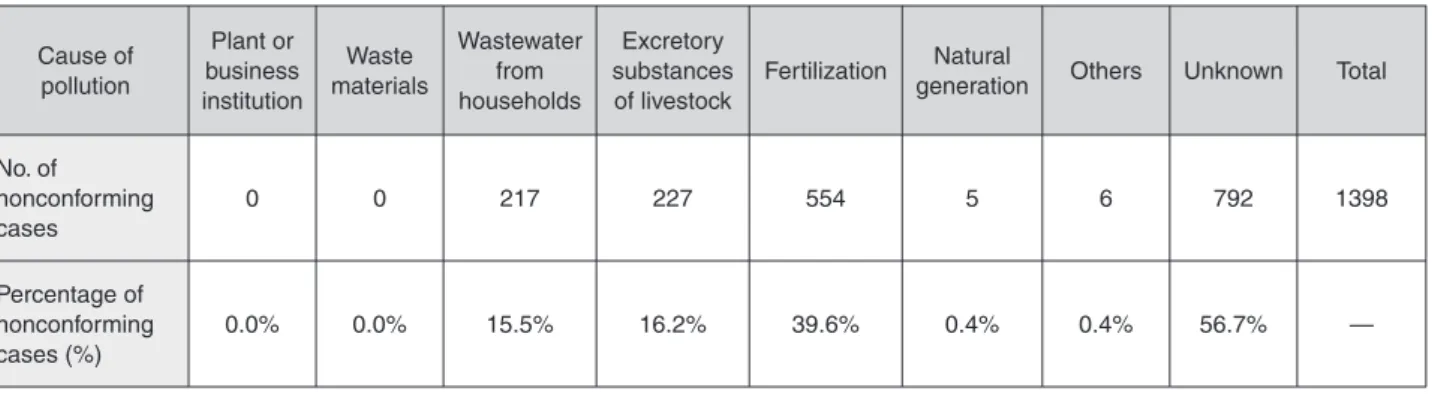
Results of the survey in 2004[8] indicated 1,398 wells that did not conform to the criteria for nitrate - nitrogen and nitrite - nitrogen. Table 2 s h o w s t h e n u m b e r o f n o n c o n f o r m i n g cases of grou ndwater pol lution caused by nitrate -nitrogen and nitrite -nitrogen, and the ratio of nonconforming cases. The number of nonconforming cases attributable to wastewater from households was 217 (15.5%), those resulting from excretory substances produced by farm
Item No. of measured
samples
No. of samples exceeding standard
Rate of Excess (%)
Environmental criteria Cadmium
Total cyanogen Lead
Hexavalent chromium Arsenic
3,247 2,723 3,566 3,420 3,666
0 0 14 0 74
0 0 0.4
0 2.0
0.01 mg/Lmax Not to be detected 0.01 mg/L max 0.05 mg/L max 0.01 mg/L max Total mercury
Alkyl mercury PCB
Dichloromethane Carbon tetrachloride
3,235 993 1,899 3,535 3,661
5 0 0 0 4
0.2 0 0 0 0.1
0.0005 mg/L max Not to be detected Not to be detected 0.02 mg/L max 0.002 mg/L max 1,2-dichloroethane
1,1-dichloroethylene Cis-1,2-dichloroethylene 1,1,1-trichloloethane 1,1,2-trichloloethane
3,267 3,744 3,743 3,990 3,259
0 2 5 0 1
0 0.1 0.1 0 0.0
0.004 mg/L max 0.02 mg/L max 0.04 mg/L max 1 mg/L max 0.006 mg/L max Trichloroethylene
Tetrachloroethylene 1,3-dichloropropene Thiuram
4,234 4,248 3,043 2,472
18 22 0 0
0.4 0.5 0 0
0.03 mg/L max 0.01 mg/L max 0.002 mg/L max 0.006 mg/L max Simazine
Thiobencarb Benzene Selenium
2,628 2,539 3,524 2,698
0 0 0 1
0 0 0 0.0
0.003 mg/L max 0.02 mg/L max 0.01 mg/L max 0.01 mg/L max
Nitrate-nitrogen and nitrite-nitrogen 4,260 235 5.5 10 mg/L max
Fluorine Boron
3,542 3,499
19 8
0.5 0.2
0.8 mg/L max 1 mg/L max
Total (number of wells) 4,955 387 7.8
Table 1 : Results of water quality measurement of groundwater in 2004 (general survey)
Source: Reference[5]
Rate of
excess Nitrate-nitrogen and nitrite-nitrogen Fluorine
Arsenic Trichloroethylene Tetrachloroethylene
1989 1990 1991 1992 1993 1994 1995 1996 1997 1998 1999 2000 2001 2002 2003 2004
(Year of survey) Figure 3 : Changes in the rate of excess above
environmental criteria
Note 1: Surveyed wells in the general survey differ by year of survey, which means that the same wells were not surveyed every year.
Note 2: The environmental criteria for groundwater pollution were established in 1997. Until then, the criteria were only used as the bases of evaluation. (The evaluation criterion for arsenic was changed from “0.05 mg/L max” to “0.01 mg/L max” in 1993.)
Note 3: Nitrate-nitrogen, nitrite-nitrogen, fluorine, and boron were added to the environmental criteria in 1999.
Source: Reference[5]
animals totaled 227 (16.2%), while fertilization was responsible for 554 cases (39.6%). While there are diverse causes of nitrate-nitrogen and nitrite-nitrogen pollution, fertilization is the most common identified cause. It is also found that the number of unknown causes in the same survey was 792 (56.7%). Some of the regions polluted due to unknown causes are urban districts and it appears that these areas may still be suffering from residual effects of the land’s agricultural past.
The treatment of wastewater from households is being promoted through improvement of wastewater treatment facilities including sewage systems, changeover from individual sewage treatment tanks to integrated sewage treatment tanks, and improvement of drainage systems;
consequently, the dissemination ratio of water
purification expressed by population is rising (Figure 4). For excretory substances from farm animals, measures such as the elimination of inadequate outdoor piling and unlined piling are being implemented. In November 2004, the
“Law on Livestock Excreta Management and Recycling (Livestock Excreta Law)[9]” came into full force, requiring operators of livestock farms over a specified size to adequately treat excretory substances from farm animals (in order to comply with control standards). Therefore, inadequate treatment such as outdoor piling has disappeared.
3 Effects of excessive fertilization in agriculture
3-1 Elements required for agricultural products
Agr icultural products grow by tak ing in carbon, hydrogen, oxygen, nitrogen, phosphorus, and potassium. Among these elements, carbon, hydrogen, and oxygen are derived from carbon dioxide in air and water.
Nit r o ge n i s a n ele me nt t h at i s a m ajor constituent of organic substances such as protein and nucleic acid; when nitrogen is lacking, the color of leaves fades and normal plant height is not attained. Phosphorus is a vital element for the synthesis of nucleic acid, which is a biochemical macromolecule existing in the cells of organisms and conveys genetic information, and substances involved in intracellular energy transfer such as ATP*2. Deficiency of phosphorus will adversely affect flowering, fructification, and the growth of leaves and stems. Potassium is necessary for the growth of roots and stems; deficiency of potassium disturbs the growth of roots. As Table 2 : Causes for pollution of groundwater by nitrate-nitrogen and nitrite-nitrogen
Cause of pollution
Plant or business institution
Waste materials
Wastewater from households
Excretory substances of livestock
Fertilization Natural
generation Others Unknown Total
No. of nonconforming cases
0 0 217 227 554 5 6 792 1398
Percentage of nonconforming cases (%)
0.0% 0.0% 15.5% 16.2% 39.6% 0.4% 0.4% 56.7% —
Prepared by the STFC based on Reference[8]
������������������
�������������������������������������
���������������
�����������������������
�������������������������������
���� ���� ���� ���� ���� ���� ���� ���� ����
������������
Figure 4 : Changes in the dissemination rate of water purification by population
Source: Reference[5]
has been described, nitrogen, phosphorus, and potassium, which are absorbed from the soil, are essential components in the growth of agricultural products. Harvesting of agricultural products depletes the nitrogen, phosphorus, and potassium contained in the soil, necessitating replenishment of the soil with the three major nutrients that have been consumed. Therefore, fer tilization is essential to the growing of agricultural products, and, in Japan, crop yields have been increased to a remarkable degree through ever-increasing application of chemical fertilizers.
3-2 Excessive fertilization and its effects
A lthough fer ti lization shou ld be car r ied out to the extent that agricultural products require, the reality is that excessive quantities of chemical fer ti lizers have been applied.
According to “Administrative Control Concerning E nv i ron ment a l Con ser vat ion Mea su res i n Agriculture,” published by the then Management and Coordination Agency in 1994, quantities of fertilizer in excess of the fertilization standard*3 were applied at 50% of the investigation sites (328 out of 656) in FY1990[10].
O n e o f t h e r e a s o n s fo r t h i s e xc e s s i ve fertilization is farmers’ belief that more fertilizer leads to bigger harvests.
However, fertilization in excess of adequate amounts can cause significant adverse effects on groundwater and agricultural products.
Figure 5 shows the effects of nitrogen fertilizers on groundwater and agricultural products.
The picture on the left shows a case where the
appropriate amount of fertilizer has been applied in the vicinity of the root; the picture on the right shows a case where excessive amounts of fertilizer have been applied more widely.
(1) Effects on groundwater
Because the clay minerals in soil and corrosive substances are negatively charged, components of fertilizers with a positive charge are electrically retained in the soil and will not be easily washed away by rain.
Phosphorus fertilizer is taken into plants i n t he for m of phosphor ic ion s. B ecau s e phosphoric ions are negatively charged, they are not retained by the soil particles that are negatively charged; phosphoric ions combine with aluminum, iron, and calcium in the soil to form compounds that are barely soluble and are retained in the soil. Thus, phosphorus is less likely to leach into groundwater. Potassium fertilizer is taken into plants as potassium ions. Potassium also is less likely to leach into groundwater because potassium ions are positively charged and are retained by the soil particles. However, nitrogen fertilizers tend to leach into groundwater. Nitrogen fertilizer is taken into plants as ammonium irons or nitrate ions. (While some agricultural products tend to absorb ammoniac nitrogen and others tend to absorb nitrate-nitrogen, more products are nitrate -philic.) Ammonium irons are retained by soil particles because they are positively charged. However, in fields where oxygen is in sufficient supply, nitrogen fertilizers and i nor ga n ic a m mon ia der ived f rom or ga n ic Agricultural
products
Adequate fertilization Nitrogen fertilizer
Localized
fertilization Remaining nitrogen Groundwater
High concentration of nitrates
Excessive fertilization
Nitrogen fertilizer Nitrate-nitrogen pollution
Groundwater
Leaching of
nitrate ions Remaining nitrogen
Figure 5 : Effects of nitrogen fertilizers
Prepared by the STFC
materials are oxidized by nitrification bacteria in the soil and converted into nitrate ions (NO3-) through nitrite ions (NO2-) (nitrification). By this process, particularly in fields, nitrogen fertilizers that are not absorbed by agricultural products are converted into negatively charged nitrate ions, which dissolve in rainwater and leach into groundwater, causing nitrate-nitrogen pollution.
(2) Effects on agricultural products
If excessive quantities of nitrogen fertilizer are applied, certain kinds of products, particularly vegetables, will absorb excessive amounts of nitrate ions, which accumulate in the leaves as nitrate.
Nitr ates contai ned i n vegetables do not immediately compromise human health when nor ma l qua ntities a re i ngested. However, it has been pointed out[11, 12] that, as in the case of nitrate - nitrogen and nitrite - nitrogen in groundwater, the nitrites, when reduced to n itr ites i n the hu man body, may cause methemoglobinemia and generation of the carcinogenic substances, nitroso compounds*4.
4 Technologies for reducing the environmental burden and increasing safety and security of foods
To ach ieve envi ron menta l ha r mony a nd safety and security of foods from agricultural production activities while maintaining high crop yields and high product quality it is essential to apply adequate amounts of fertilizers based on the nutrient absorption characteristics of agricultural products. That is, only the required amounts of fertilizers must be applied according
to the kinds of products and the stage of growth when and where the application is required.
Figure 6 shows the opti mal fer ti lization sequence. First, prior to the start of cultivation, the content of nitrogen in soil is measured and the amounts of fertilizers to be applied are decided. When deciding the quantity, it is necessary to consider two aspects: groundwater pol lut ion cau sed by n it r ate - n it rogen a nd n it r ite - n it r o ge n ; a nd pr e ve nt ion of h ig h accumulation of nitrates in agricultural products.
In the period between the start of cultivation and harvesting, localized fertilization should be conducted and fertilizers that cause less nitrate ion leaching into groundwater should be used. Multi- cultivation*5 is an effective means of preventing leaching of fertilizers. In the process of cultivation, it is desirable to conduct a nutritional diagnosis in order to determine the nutritional conditions of the products and to feed back the difference from optimum conditions to fertilization design. It is also necessary to develop a technology to recover nitrogen remaining in the soil after harvesting, so that leaching of nitrogen into groundwater is prevented.
The following are required technologies and subjects to be studied for each stage of cultivation.
4-1 Soil diagnosis and determination of fertilizer amounts
The amount of nitrogen remaining in the soil varies significantly according to the type of soil and the nature of previous cultivation. It also depends on the drainage of water, even within the same farm field. The amount of fertilizer to be applied in each section of a farm field must be decided by subtracting the amount of
(i) Soil diagnosis (ii) Determination of the quantities of
fertilizers Cultiva
-tion
Localized fertilization (iii) Fertilizers causing +
less nitrate ion leaching
(iv) Nutrient diagnosis
Harves -ting
(v) Prevention of leaching of remaining nitrogen
Fertilization standards
Figure 6 : Sequence of fertilization
Prepared by the STFC
remaining nitrogen from the amount that the product actually requires. To this end, each farmer should diagnose the remaining nitrogen (by simple soil diagnosis) prior to the start of cultivation, and determine the necessary amount of fertilizer based on the fertilization standards established for each agricultural product. To prepare a more precise fertilization plan, it is desirable to periodically conduct diagnoses (periodic soil diagnosis, at intervals of about five years) on items that are difficult to be measured by simple soil diagnosis, such as organic contents, mineralized ratio, base contents, and heavy metal contents, so that the amount of fertilizer can be decided taking into consideration the amount of nitrogen mineralized from the organic matter in the soil.
Currently, simple soil diagnosis is carried out by measuring the electrical conductivity (EC) of soil that is related to the nitrate - nitrogen concentration, or by directly measuring the nitrate ion concentration in the soil. However, the instruments used are not equipped with a function that directly calculates the amount of fertilizer from the measurement results. To make fertilization design based on simple diagnosis more practical, (a) software must be developed that enables calculation of the required amount of fertilizer in respect of different kinds of agricultural products and types of fertilizers; (b) simple measuring instruments equipped with a function to measure the remaining nitrogen and a function to calculate the necessary amount of fertilizer must be developed; and (c) the cost of simple measuring equipment must be reduced.
At present, periodic soil diagnosis is carried out by the National Federation of Agricultural C o o p e r a t i v e A s s o c i a t i o n s ( J A) a n d t h e Agricultural Improvement and Extension Center of each prefectural government. However, diagnosis facilities should be improved and increased in number so that periodic diagnosis becomes more widespread and more farmers can more easily use the facilities.
The National Agricultural Research Center of the National Agriculture and Food Research Organization is planning to develop a ver y useful simulation model that provides effective i n for mation for fer ti l i zation desig n. T h is
simulation model will predict and evaluate the amount of nitrate - nitrogen eluted from the applied fertilizers based on local conditions (meteorological and soil conditions), and will suggest the optimum fertilization design and combination of products for a specific area.
Or ig i n a l ly, fer t i l i z at ion st a nd a rd s were established with the aim of increasing crop yields; however, the “Code for Agricultural Practice in Harmony with the Environment (Agricultural Environment Code),”[13] established in 2005, provided a guideline for reviewing past fertilization standards[14] and prefectural gover n ments a re now i mplementi ng such reviews. The guideline adopts reduction of the environmental burden as an important perspective for the reviews. In the process of reviewing standards, it is desirable to investigate from the viewpoint of safety and security of foodstuffs, such as prevention of accumulation of nitrates in agricultural products.
4-2 Development of fertilizers that reduce environmental burden
(1) Chemical fertilizers
Most chemical fertilizers are water- soluble, wh ich prov ides a r apid fer ti l i zi ng ef fect.
Therefore, they are transferred to lower layers of the soil by rain and watering before the products grow sufficiently, with the result that nutrients are likely to be deficient at the height of growth.
To suppress leaching of chemical fertilizers into groundwater and prevent excessive enrichment and uneven distribution of soil nutrients, it is necessar y to increase the absorption factor (rate of utilization) of individual agricultural products. To this end, effect-controlled fertilizers as described below have been developed. In this type of fertilizer, elution of nutrients is controlled according to the amounts of nutrients required by the product. Since the nutrient absorption characteristics of vegetables vary significantly according to type, it is also necessary to develop enhanced databases for this purpose.
(i) Coated nitrogen fertilizer
T he su r faces of water - soluble fer ti l i zer particles (mainly urea fertilizer) are coated with low- permeability film to control the rate of
elution. Water vapor that has penetrated through the coating generates a saturated solution of fertilizer in the particle. Because the internal vapor pressure is lower than the external vapor pressure, water vapor continues to penetrate until the internal pressure reaches a certain value. Once the internal pressure exceeds the prescribed value, the fine holes of the coating expand and urea is pushed outward.
Currently, various types of coated nitrogen fer t i l i zer w it h d i f ferent elut ion pat ter n s are available on the market. By combining multiple types of coated nitrogen fertilizers, it is possible to match the elution pattern to the nutrition absorption characteristics of individual ag r icu ltu r al products. However, opti mu m combination ratios for individual agricultural pr o d u c t s h a ve n o t ye t b e e n s u f f i c i e nt l y established. In addition, coating films that do not remain in the soil must be developed in due course.
To reduce the time difference between elution of nutrients and absorption by the products, the National Agr icultural Research Center for Tohoku Region and other institutes are conducting research on root- sensitive coated fertilizer[15], which makes use of the fact that roots significantly change the pH of surrounding soil.
(ii) Chemically synthesized delayed release nitrogen fertilizer
Generally, fertilizers with low water solubility and speed of mineralization in the soil are selected as delayed - release fertilizers. Urea, which is relatively inexpensive and has a high
nitrogen content, is commonly used as the raw material.
(iii) Nitrogen fertilizer provided with nitrification inhibitor
Applied ammonium - nitrogen fertilizers are rapidly converted to nitrate -nitrogen through nitrous acid by nitrification reaction in the field. Nitrification inhibitors, which react with nitrification bacteria in the soil, are used to suppress the reaction. By suppressing oxidation, the nitrogen component is retained in the soil, which enables maintenance of the fertilization effect.
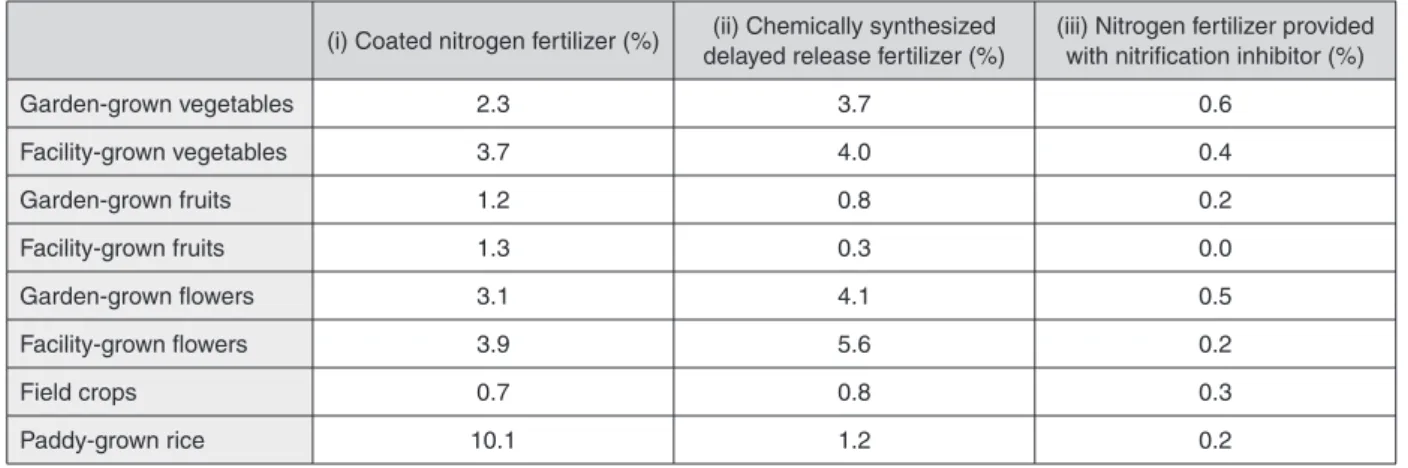
Table 3 shows t he st at u s of u s e of t he above -mentioned effect- controlled fertilizers.
It can be seen that the usage rate for these fertilizers is very low. The reason for this is that the price of effect- controlled fertilizers is about 1.6 times higher than that of normal chemical fertilizers. (The final cost is 1.3 times higher even though the amount of fertilizer to be applied is reduced by 20%.)[10] It is absolutely crucial to reduce the cost for dissemination of effect-controlled fertilizers.
(2) Organic fertilizers (organic matter fertilizers and manure compost)
Because organic matter such as oil cake and manure compost decomposes slowly in the soil, the components do not leach into groundwater in high volume in the year when the fertilizers are applied. However, when such fertilizers are applied successively, undecomposed organics accumulate in the soil and the amounts of Table 3 : Status of the use of effect-controlled fertilizers (as of 1998)
(i) Coated nitrogen fertilizer (%) (ii) Chemically synthesized delayed release fertilizer (%)
(iii) Nitrogen fertilizer provided with nitrification inhibitor (%)
Garden-grown vegetables 2.3 3.7 0.6
Facility-grown vegetables 3.7 4.0 0.4
Garden-grown fruits 1.2 0.8 0.2
Facility-grown fruits 1.3 0.3 0.0
Garden-grown flowers 3.1 4.1 0.5
Facility-grown flowers 3.9 5.6 0.2
Field crops 0.7 0.8 0.3
Paddy-grown rice 10.1 1.2 0.2
Prepared by the STFC based on Reference[10]
decomposed products increase year by year.
Therefore, it must be noted that elution will increase if application of the same amounts of fertilizer based on f lawed assessment is continued.
As a result of the rapid expansion of the scale of livestock farms, the total amount of manure derived from farm animals has reached about 90million tons/year[16], and it is important to effectively utilize (recycle to farmland) such manure, which contains a large amount of nitrogen. It is theoretically possible to recycle all livestock manure back into farmland because the total amount of nitrogen required by the agricultural production activities exceeds the total amount of nitrogen contained in livestock manure[17]. However, the balance between the volume of livestock manure generated and the volume of nitrogen that can be accommodated by farmland differs from region to region. In regions where the livestock industry flourishes, such as southern Kyushu, it is difficult for farmland to accommodate all the manure generated in the region. Therefore, the livestock manure generated in large volumes in regions where the livestock industry flourishes must be converted into compost that can be easily transported, so that it can be widely utilized in other regions.
Component- controlled compost is currently under development[18, 19].
The present form of livestock compost suffers from various problems such as f luctuations in quality, imbalance of nutrition ingredients, f luctuations in fertilization efficiency, and a s low d e co mp o s it io n r at e t h at l e a d s to stagnation of growth at the initial stage of cu ltivation. Issues to be addressed i n the future include: (a) development of a method of rapid fertilization effect assessment; (b) development of component-controlled composts with balanced nutrients matched to individual agr icu ltu ral products ; (c) development of component- controlled compost for each item with good handling performance; (d) cost reduction; and (e) establishment of stable supply and distribution systems.
(3) Utilization of nitrogen-fixing bacteria Leguminous plants, including soybeans, fix the
nitrogen in the air using microorganisms. This enables reduction of the application of nitrogen fertilizers. Nitrogen fixation by soybeans can be increased by controlling the moisture in the soil.
Furthermore, it has been clarified that nitrogen is fixed by bacteria living in plants such as sugarcane and sweet potato[20].
By proactively utilizing microorganisms, t he a mou nt of n it rogen fer t i l i zer ca n b e reduced. Research on effective uti lization of microorganisms is being carried out by the National Agricultural Research Center of the National Agriculture and Food Research Organization.
4-3 Nutritional diagnosis of agricultural products
Down through histor y, farmers skilled in cultivation have learned how to apply the necessary amount of nitrogen to agricultural p r o d u c t s a t t h e r e q u i r e d t i m e , t h r o u g h comprehensive obser vation of the color of leaves, thickness of stems, and conditions of growing points. This ability to judge appropriate quantities and timing means that non-productive fertilization can be avoided. Nutritional diagnosis based on scientific data replaces the judgment of skilled farmers. Currently, leaf color measurement and nitrate ion concentration measurement, which directly measures the nitrate - nitrogen concentration in the plant (using liquid squeezed from the product), are used for such diagnosis.
The problem is that instruments used for these measurements are not equipped with a function that readily calculates the amounts of fertilizer to be added by using the measured results of each product.
Issues to be addressed in the future include:
(a) development of sof t wa re that enables calculation of the amounts of required fertilizer based on the results of nutritional diagnosis of each product; (b) development of a simple measuring instrument that integrates a nutritional diagnosis function and a fertilization calculation function; and (c) cost reduction of the simple measuring equipment. It is also necessary to carry out research into the relationship between the nutritional conditions of products and their sensitivity to disease damage.
4-4 Technology to recover remaining nitrogen
After agricultural products are harvested, the remaining nitrogen in the soil that has not been absorbed by the products is carried by rain into groundwater as nitrate-nitrogen. A technology to recover the remaining nitrogen is being developed, in which cover crops*6 are grown during catch cropping, or the fallow period, to absorb the remaining nitrogen and recycle it to the next cultivation.
Research is being carried out[21] on a method to reduce elution, in which organic matter with a relatively high value of C/N ratio*7, such as residual tea, would be rotated in the fields following vegetable harvests in order to organize the inorganic nitrogen in the soil through the proliferation of microorganisms.
5 Regulation introduction policy of the EU and Japan’s Policy
S ome ove r s e a s cou nt r ie s h ave p ol ic ie s stipulating that fertilization should be regulated in order to overcome the problems caused by excessive nitrogen fertilization. This section describes the policies adopted by the EU and Japan. Ahead of all other countries, the EU adopted the regulation on fertilization, and established criteria for nitrate concentration in agricultural products.
5-1 Measures taken by EU
The EU has a high rate of dependency on groundwater as a source of drinking water.
Furthermore, the large number of transnational r ivers means that the problem of n itrates derived from agriculture is not simply one faced by individual countries, but rather a regional issue. For this reason, aiming at reduction and prevention of pollution and nutrient enrichment of surface water and groundwater due to nitrates derived from agriculture, the EU in 1991 issued
“Council Directive 91/676/EEC Concerning Protection of Waters Against Pollution Caused by Nitrates from Agricultural Resources (Nitrate Directive)[22],” and all member countries are taking measures to reduce such emissions.
Table 4 shows an outl i ne of the Nitr ate Directive. In the Directive, legal regulations on nitrogen fertilization are applied to regions where pollution is severe and Good Agricultural Practice, under which fertilization standards are established, is applied to other regions. To promote the prevention of excessive fertilization, an economic incentive provides subsidies to farmers who participate in projects aimed at reducing levels of environmental burden below the standards prescribed in Good Agricultural Practice.
Measures to prevent high accumulation of nitrates in vegetables due to excessive fertilization are also being implemented by the EU.
Table 4 : Outline of Nitrate Directive
(i) Member countries are required to establish domestic laws that put the Nitrate Directive into effect.
(ii) Monitoring of the estimation of nitrate concentration and nutrient enrichment across the country must be conducted and water areas with problems must be designated as Nitrate Vulnerable Zones.
(iii) To suppress nitrate emissions in the Vulnerable Zones, farmers must comply with the following items as obligations according to the action plans established by their governments:
a) Use of fertilizers and manure is prohibited during the winter season when crops are not cultivated.
b) Improvement of facilities to store livestock excreta during the winter season.
c) Use of fertilizers and manure is prohibited for soil on steep-sided lands and marshy areas.
d) Scientific fertilization standards must be observed based on the nitrogen required by crops and the natural nitrogen supply.
e) Soil shading period with crops must be maintained by crop rotation.
f) Rearing density must be controlled so that the nitrogen generated by livestock excreta is kept at 170 kg/ha or less (after December 21, 2002).
(iv) The results of implementation of the Nitrate Directive must be reported every four years.
(v) Farmers outside the Nitrate Vulnerable Zones are required to observe Good Agricultural Practice which is stipulated by the government, on a voluntary basis.
Prepared by the STFC based on Reference[10]
In 1995, the Joint FAO/WHO Expert Committee on Food Additives ( JECFA) set the acceptable daily intake (ADI) of nitrates (sodium nitrate) at 5 mg/kg weight[23]. Because vegetables are the major source of nitrates in the EU, nitrate contents in vegetables have been regulated since 1997 by the establishment of standards for vegetables. A standard value (200 mg NO3/kg) was also set for baby foods and cereals. Member countries are required to implement annual monitoring surveys and report the results to the EU Commission.
5-2 Measures taken in Japan
In Japan, as a result of the rapid economic g r o w t h t h a t s t a r t e d a r o u n d 19 6 0 , t h e environment deteriorated due to emissions from mining and manufacturing industries.
However, various environmental regulations were implemented around 1970 and environmental pollution was diminished. On the other hand, the issue of nitrate - nitrogen emerged due to i nadequate control of wastewater from households and livestock excreta, and excessive appl ication of n itrogen fer ti l izers to soi l.
Regarding wastewater from households, measures have been taken to improve wastewater treatment facilities, including sewage systems. As for livestock excreta, the “Law on Livestock Excreta Management and Recycling (Livestock Excreta Law)” came into full force in November 2004.
Although the legal regulations on excessive fertilization of nitrogen fertilizers such as EU Nitrate Directive have not been established in Japan, an economic incentive was introduced. In 1999, the “Law for Promoting the Introduction of Sustainable Agricultural Production Practices ( S u s t a i n a b l e A g r i c u l t u r a l L a w)[ 2 4 ]” w a s established. This legislation provides farmers (Ecofarmers) who make efforts to reduce their use of chemical fertilizers (soil preparation using compost and reduction of the use of synthesized agricultural chemicals) with special benefits in the areas of finance and taxation. In March 2005, the “Code for Agricultural Practice in Harmony with the Environment (Agricultural Environment
Code)” was established. This standard is designed to encourage farmers to voluntarily review their activities in relation to harmonization with the environment and to improve their activities where appropriate. Items to be checked include whether or not the fertilization standards, which are guidelines (with no legal strictures) prepared by each local government, are observed.
Guidance for reviewing the fertilization standards is also included. This requires that fertilization standards be reviewed based not only on past crop yield result but also on the objective of reducing the environmental burden. Subsidies provided by the Ministry of Agriculture, Forestry and Fisheries are awarded to farmers who practice the Agricultural Environmental Standard.
In October 2005, a framework of “Measures for Improving Agricultural Lands, Water, and Environmental Conservation[25]” was announced as part of the Outline of Measures for Stabilization of Business Income. According to this framework, when advanced projects, such as one aimed at reducing environmental burdens through significant quantitative reduction in use of chemical fertilizers and synthesized agricultural chemicals, are carried out collaboratively in a respectable size in the region, new types of subsidies will be provided from FY2007.
Regarding nitrates in vegetables, the National Institute of Vegetable and Tea Science, part of the National Agriculture and Food Research Organ ization, is car r yi ng out research on
“E lucidation of the Mecha n ism of Nitr ate Accumulation in Vegetables and Development of Reduction Technolog y[11]” as one of the projects aimed at developing more sophisticated agriculture, forestry, and fishery technologies.
H o w e v e r, d o m e s t i c c r i t e r i a f o r n i t r a t e concentration in vegetables have not yet been established because sufficient medical data are not available. (There are no data on how much of the nitrate in vegetables is taken in by humans).
Table 5 shows the comparison of nitrate contents in major domestic vegetables with EU standards (as of November 2005)[26].
6 Raising awareness of excessive fertilization
To promote reduction of excessive application of nitrogen fertilizers, it is important to raise farmers’ awareness of the issue.
According to the results of a questionnaire survey of local governments on groundwater pollution due to nitrate -nitrogen, carried out by the Ministry of the Environment in 2003[27], 180 areas administered by 62 local governments were thought to require some measures to solve groundwater pollution problems. However, as many as 80% of the 62 local governments are not engaged in educational activities for re sident s, wh ich me a n s t h at appropr i ate measures to promote awareness of environmental conservation are not being implemented. The first priority is to proactively publicize the facts about nitrate pollution so that the current situation is widely recognized. It would also be effective to proactively transmit information on practical methods of reducing fertilizer quantities while maintaining crop yields at present levels, together with data and figures on cost- saving
through reduction of fertilization.
Motivation to adopt adequate fertilization will be enhanced if actual effects on the reduction of the environmental burden are demonstrated to farmers using the simulation described in 4-1, which describes optimum fertilization methods and crop combination for individual areas.
Conveying information on nitrates in vegetables to farmers and consumers in a positive manner would also contribute to the promotion of awareness of adequate fertilization.
7 Conclusion
A mong the envi ron mental standards for groundwater, the least satisfactory achievement r a t e s a r e t h o s e fo r n it r a t e - n it r o ge n a n d nitrite-nitrogen, and there has been no sign of a trend toward improvement over the past several years. One of the major reasons for this situation is excessive application of nitrogen fertilizers in the agricultural production activities. The Third Science and Technology Basic Plan lists reduction of the environmental burden caused by excessive application of nitrogen fertilizers in the agricultural production activities as one Table 5 : Nitrate contents in major domestic vegetables and comparison with EU standards
Item Data of Ministry of Health, labour and Welfare
Reference
UK Data (1999 to 2000) EU standard
Spinach 3560 ± 552(6) November to December 2180 - 2560(2)
[Average 2370] October to March 3000 Salad spinach 189 ± 233(6) April to October 25 - 3910(21)
[Average 1487] April to September 2500
Head lettuce 634 ± 143(3)
Facility-grown
April to September 937 - 3740(18)
[Average 2247]
October to March 1040 - 4425(19)
[Average 3158]
Garden-grown
April 775 - 1461(2)
[Average 1118]
May to August 244 - 3073(26)
[Average 1045]
September 308 - 2119(17)
[Average 1090]
October to December 670 - 3000 [Average 1348]
Facility-grown
April to September 3500 October to March 4500 Garden-grown
April to September 2500 October to March 4000 Sunny lettuce 1230 ± 153(3)
Facility-grown 2500 Garden-grown 2000 Butter lettuce 5360 ± 571(3)
Garland
chrysanthemum 4410 ± 1450 — —
Tatuai 5670 ± 1270 — —
Ging-geng-cai 3150 ± 1760 — —
Note 1: Values in ( ) in the data column show the number of analyses.
Note 2: Facility-grown = cultivated in a greenhouse; Garden-grown = cultivated outdoors. Source: Reference[26]
of the important research and development subjects for adequate water control technology in the agricultural and forestr y production activities. Not only from the perspective of groundwater pollution but also from that of safety and security of agricultural products, excessive fertilization must be addressed because it causes accumulation of nitrates in agricultural products, particularly vegetables.
In order to ensure reduction of environmental burden and safety and security of food while maintaining high crop yields and high product quality, it is necessary to develop awareness of adequate fertilization among farmers and consumers, and to promote adequate fertilization practices that match the nutrient absorption characteristics of particular crops. Specifically, the following items must be implemented:
(i) Establishment of fertilization standards that take both environmental conservation and food safety into consideration
T h e fe r t i l i z a t i o n s t a n d a r d s , o r i g i n a l l y established with the primary aim of increasing the crop yields, contain no legal strictures.
They are currently being reviewed by local gover n ments with a view to reduci ng the e n v i r o n m e n t a l b u r d e n o n g r o u n d w a t e r.
However, another viewpoint must be taken into consideration, namely, ensuring the safety and security of food by preventing high accumulation of nitrates.
(ii) Development of simple measuring equipment for use in fertilization design based on soil and crop diagnoses
In order to implement adequate fertilization ba sed on fer ti l i zation st a nda rds a i med at environmental conser vation and safety and security of food, it is necessary to develop simple, low- cost measuring equipment that enables easy measurement of nitrogen remaining in the soil prior to the start of cultivation, so that adequate fertilization according to the crop and type of fertilizer is immediately known. It is also necessary to enhance the system for periodic diagnosis.
A further requirement is the research and development of a simple, low- cost measuring
instrument equipped with both a function to measure the nutrition conditions of a particular crop and a function to calculate the appropriate amount of fertilizer.
(iii) Development of fer ti l izers that enable reduction of environmental burden
Chemical fertilizers that allow control of elution speed according to the nutr itional requirements of crops are the most effective type for reducing environmental burden. Because the nutrient-absorbing characteristics of vegetables vary significantly by plant species, databases for this purpose must be enhanced and various types of effect-controlled fertilizers must be developed to suit di f ferent vegetables with di f ferent characteristics. A vital factor in realizing effective dissemination of environmental burden-reducing fertilizers is making them more affordable.
Re g a r d i n g o r g a n i c fe r t i l i z e r s (m a nu r e compost), it is important to establish a system for recycling farm-generated livestock excreta, which is high in nitrogen content, back onto farmland in the form of compost. Currently, methods for rapid fertilizer effect assessment and composition-controlled composts are under development. To promote utilization of manure composts, quality should be represented based on fertilizer effect assessment, while diversified types of composition- controlled composts that are easy to handle and meet the nutritional needs of a wide variety of agricultural products must be developed. Needless to say, such composts must be affordably priced.
Acknowledgments
T he aut hor w i shes to ack nowledge t he contributions of the following persons whose valuable comments and advice assisted greatly in the preparation of this report: Dr. Hiroshi Naga nom a, S en ior Resea rch Coord i n ator, National Agricultural Research Center, National Agriculture and Food Research Organization;
Dr. Yoshito Yuyama, Team Leader, Dr. Tomonori Fujikawa, and Mr. Masato Nakamura, Research Team for Biomass Recycling System, National I n st it ute for Ru r a l E ng i neer i ng, Nat ion a l Agriculture and Food Research Organization; Dr.
Shoji Matsumura, Field Science Center, Tokyo