Prosodic Instruction and Reading Comprehension
1 韻律スキル学習と読解Conrad McPhail
マックフェイル・コンラッド
Abstract: This project aims to contribute to pre-existing research into the links between expressive speech and reading comprehension, and investigate pedagogic approaches to the acquisition of prosodic skills within the context of an English as a Foreign Language learning environment. The study utilizes an authentic English text sourced from a news themed periodical, with the lesson being conducted using communicative language teaching (CLT) methodology, in such a way as to focus on the prosodic aspects of the text. Data were tabulated by way of an adapted Communicative Orientation of Language Teaching (COLT) observation scheme, optimized to highlight student interaction, expressive speech pedagogy and prosodic awareness. Student generated reading comprehension questions and answers were analyzed using data from the aforementioned observation scheme.
Keywords: Stress, intonation, rhythm, prosody, reading comprehension
要旨:このプロジェクトは、表現力豊かなスピーチと読解の間のリンクに関する既存の 研究に貢献し、また外国語としての英語環境で韻律スキルを習得するための教授法を調 査することを目的としています。この研究では、定期的に刊行されるニュース記事から 本物の英語文章を利用し、その韻律論的な側面に焦点を当てる方法で、コミュニカティ ブ・ランゲージ・ティーチング(CLT)方法論を使用してレッスンを実施します。データ は、言語教育のコミュニケーションオリエンテーション(COLT)観察スキームを使用し て表にされ、学生の相互作用、表現力豊かなスピーチ教授法、および韻律認識を強調す るように最適化されました。学生が発した読解の質問と回答は、前述の観察スキームを 使用して分析されました。
キーワード:強勢、イントネーション、リズム、韻律、読解
1. Introduction
The objective of this action research (AR) project is to build on pre-existing scholarship into the relationship between prosody and reading comprehension, through examining the impact of prosodic instruction in an English as a Foreign Language (EFL) intensive reading lesson. The underlying approach to AR used in this study is embodied by the following quotes:
“AR involves taking a self-reflective, critical, and systematic approach to exploring your
own teaching contexts.” (Burns, 2009, p.2)
“[AR is] a systematic inquiry into the issues and problems that teachers face with the goal of improving pedagogical practices” (McKay, 2006, p.1)
Proficiency in reading is generally assumed to be a prerequisite of reading comprehension, and is typically described as the ability to read accurately at speed (Berninger et al., 2010). However, research into the role of prosody as it pertains to reading fluency has gained significant currency (Kuhn et al, 2010). This is a particularly important concept within the field of EFL education in Japan, as prosodic instruction is often de-emphasized in favor of rote learning and grammar translation, leading to a deficit in prosodic awareness (Stephens, 2011).
The research question interrogated by this study is: What effect does prosodic instruction have on reading comprehension questions and answers constructed by students?
Prosodic awareness is a vitally important component of text reading fluency (Miller
& Schwanenflugel, 2006; Rasinski et al., 2009). Several studies have shown the causal link between text reading prosody and reading comprehension proficiency (Calet et al., 2015; Veenendaal et al., 2015). Moreover, a study conducted by Holliman et al. (2014) examining the perception of stress, rhythm and intonation in six and seven-year-old children, demonstrated a correlation with proficiency in reading comprehension, and an additional study carried out by Lochrin et al. (2015), analyzing production and perception of speech prosody in children aged seven to twelve, found that prosody is causally linked with both comprehension and text reading accuracy.
Studies into text reading prosody have suggested the development of automaticity as a prerequisite for improvement in prosodic awareness (Miller & Schwanenflugel, 2006; Schwanenflugel et al. ,2004). However, recent work by Groen et al (2019) into the effects of delayed development in speech prosody in poor readers suggests that there is in fact a causal relationship between prosodic proficiency in natural speech and awareness of implicit prosody in written text:
“Poor perception and production of speech prosody may hinder an internal representation of what a text should sound like, which is suggested to obstruct comprehension of written text.” (Groen et al, 2019, p.18).
Delayed development in the inference and production of speech prosody may also
negatively affect awareness of implicit prosody in written text. Fodor (1998) proposes an
implicit prosody hypothesis which argues that syntactic elements of written text are
decoded, through the use of an inferred prosodic contour. This theory has since been
supported by later studies, demonstrating a causal association between implicit prosody
and reading comprehension proficiency (Kentner, 2012; Rasinski et al., 2009). Failure to utilize a ‘default prosody contour’ when engaging with written text, may explain poor reading comprehension skills in students who experience delayed development in verbal prosody (Groen et al, 2019).
The incidence of weak semantic, syntactic and grammatical skills among students with poor reading comprehension has been well demonstrated by Nation et al (2004) and Nation & Snowling (2000), and connections between these reading skills deficits and delayed development in prosody have been suggested by other authors. For instance, Chafe (1988) hypothesizes that one of the functions of prosody is to signify syntactic roles in text, while Snedeker & Trueswell (2003) suggest that implicit prosody is utilized by skilled readers to break up text into semantic and syntactic segments. This highlights the need for more effective application of prosodic instruction and draws a clear causal link between the development of effective reading comprehension skills and expressive speech.
English language education in Japan often de-emphasizes communication skills acquisition in preference for lessons focusing on exam preparation (Garant, 2000). This shortfall in basic communicative proficiency shifts emphasis to extensive memorization of written text, in order to gain requisite semantic, lexical, syntactic and grammatical skills (Watanabe, 2002). Walter (2009), in her study into the links between L2 (second language) text comprehension and phonology, argues that text is decoded visually but stored phonologically, utilizing unconscious vocalization. If this is indeed the case, then L2 students who have not first acquired a functional mastery of English pronunciation will be hindered in their attempts at effectively decoding written text. Moreover, the unique mora duration and vowel stress of the Japanese language often leads to L1 (first language) interference in native Japanese speaking EFL learners, thus strengthening the case for pronunciation and prosody focused instruction (Koike, 2014). Mora in the Japanese language are of relatively uniform length, in contrast to English syllables, where duration is heavily dependent on stress. Moreover, reduced vowels in Japanese are relatively uncommon, and so reliably recognizing and utilizing reduced vowels can be particularly challenging for L2 students whose first language is Japanese (Nakamura, 2010).
Given that regular written English text does not explicitly convey prosodic elements
of pronunciation, effective instruction in expressive speech is necessary to enable L2
students to acquire mastery in rhythm, stress and intonation, and to facilitate proficiency
in the inference and production of prosodic elements of speech.
2. Method
The subjects who participated in this project were Japanese native speaking EFL students, with EIKEN Grade 2 or Pre-2 certification (CEFR B1-A2):
Student 1 (S1) - EIKEN Grade 2 certified Student 2 (S2) - EIKEN Grade 2 certified Student 3 (S3) - EIKEN Grade Pre-2 certified Student 4 (S4) - EIKEN Grade 2 certified Student 5 (S5) - EIKEN Grade 2 certified
The data used in this study were collected during an intensive reading skills lesson, as part of a course designed to improve authentic text reading proficiency in intermediate and upper intermediate readers. Materials utilized in this investigation were sourced from a bilingual news-based periodical, CNN English Express, which features real world news articles presented in a format conducive to English language learning. The news article selected for this study (see Appendix, Figure 6) has been divided into tone units, so as to facilitate prosodic skills acquisition, and makes use of a single slash/double slash format.
The intensive reading skills lesson, during which data were collected, was broken up into three sections: Pre-reading, While reading and Post-reading. The Pre-reading section started with some basic conversation, designed to orient the students to the topic of the lesson, which was then reinforced by an introduction to key terms from the news article and a preliminary discussion of the topic. This was carried out in a CLT manner, engaging the students’ interest and prompting them to predict what the article may be about.
Pre-reading stage of the lesson (see Appendix, Fig. 1).
During the subsequent While-reading segment of the lesson, the concept of
‘stressed sounds’ was introduced and explained using examples from the article. The
reasons for and functions of stressed sounds from the article were demonstrated using
CLT techniques, so as to explicate the relationship between stress and the ways in which
it can imbue meaning in text. During this part of the lesson care was taken to show the
interplay between stress, rhythm and intonation, once again using examples from the text
to demonstrate the manner in which implied meaning can be altered through manipulation
of elements of expressive speech. This was of particular importance given the mora-timed nature of the students’ L1 and the possibility of L1 interference in their understanding of English prosody.
The class then listened to the teacher read the news article aloud, with emphasis on prosodic elements of the text, and the students were required to underline stressed sounds.
The more challenging sections of the text were repeated by the teacher, with particular attention given to key expressive elements, and support was provided to enable consistent results among the less proficient members of the class. Next, the teacher read out each single slash tone unit from the text, which were then chorally repeated by the class.
Correction and repetition were provided as needed, with the goal of achieving reasonable accuracy in stress, rhythm and intonation.
Next, a pair-work activity was used to give the students an opportunity to practice expressive elements of the text, which they had just learnt as a class. The students took turns, alternately reading single slash sections of the text, monitored by the teacher for accurate use of intonation, rhythm and stress. Particular attention was paid to prominence (nuclear stress), as a consequence of its vital role in the intelligibility of meaning (Jenkins, 2000). The pairs were then rotated and the activity carried out again, with monitoring and correction provisioned as needed.
While-reading stage of the lesson (see Appendix, Fig. 1).
After the students completed the pair-work activity and returned to their original seats, they were asked simple reading comprehension questions based on the article, and encouraged to respond through the use of hints and prompts. This was conducted in such a way as to facilitate subsequent student-constructed reading comprehension questions and answers (see Appendix, Fig. 2 for transcript coding):
Teacher (T): Now we’re going to make some questions from the text. What is Finding Nemo about? What is Finding Nemo about? What do you think? Who can tell me?
S5: Fish (.) a fish.
S4: A clownfish.
T: Make a sentence, a full sentence. It’s about:::
S1: It’s about (.) a clownfish.
T: Good, good. Why is the clownfish in danger? What does danger mean (.) in danger?
S1: Abunai.
T: Yes, that’s right. Why is the clownfish in danger?
This process continued until the students were generally capable of answering a variety of comprehension questions pertaining to various parts of the text, to a degree that demonstrated a reasonably in-depth understanding of the content and ideas expressed in the article. The students were then required to independently construct five comprehension questions on their own, monitored by the teacher. Upon completing the questions, the students formed pairs and took turns providing answers, with the teacher taking note of the activity.
Post-reading stage of the lesson (see Appendix, Fig. 1).
Data were tabulated in this study using the Communicative Orientation of Language Teaching observation scheme (COLT), which is formulated to show pedagogically significant elements of communicative interaction. COLT was the product of a research initiative known as the Development of Bilingual Proficiency, carried out by the Ontario Institute for Studies in Education in Toronto, with the aim of interrogating the acquisition of language proficiency, the effect of sociological factors on L2 fluency, and the impact of language teaching methods (Allen et al, 1983). The development and implementation of COLT were motivated by three main themes:
1. The widespread introduction and acceptance of communicative approaches (Communicative Language Teaching or CLT) to L2 teaching.
2. The need for more and better research into the relationship between teaching and learning.
3. The need to develop psycholinguistically valid categories for classroom observation schemes.
(Spada & Frohlich, 1995, p.2)
COLT is typically presented in two parts, the first section documents various aspects of activities used throughout the lesson (see Appendix, Figure 3) and the second codifies communicative elements of the students’ and teacher’s speech (see Appendix, Figures 4 and 5). The COLT observation scheme as implemented in this project, has been optimized to better document prosodic elements of speech exhibited by both the teacher and students.
Communicative language teaching theory is, in part, predicated on the assumption that language learners’ ability to formulate semantically and grammatically accurate text does not reliably indicate their capacity for effective communication within the context of real-world interactions (Nunan, 1988). This highlights the applicability of the COLT observation scheme in this study, which seeks to examine the links between prosodic instruction and its impact on student constructed reading comprehension questions and answers.
3. Findings and Discussion
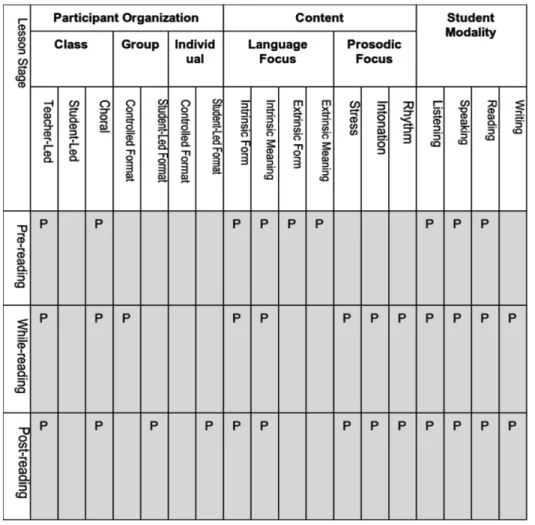
The data gleaned from the Pre-reading section of the lesson show that activities were mostly teacher-led and choral in nature (see Appendix, Fig.3). During this part of the lesson, introductory conversation was encouraged, definitions and examples of key terms and their proper usage were provided and students chorally repeated the key expressions.
Intrinsic form and meaning elements were present (see Appendix, Fig.3) during the
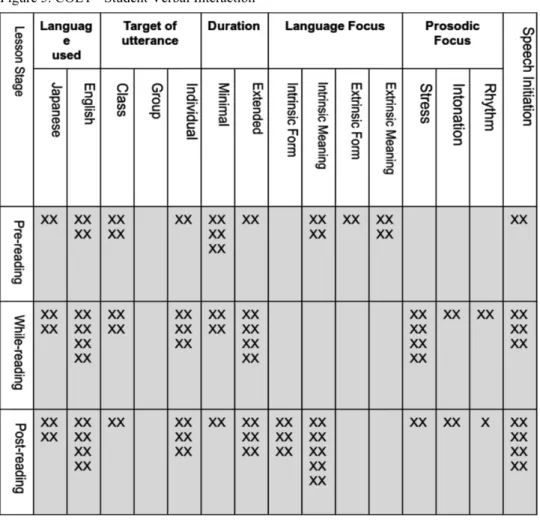
discussion of key words and grammar from the article. This explanation was expanded to include examples of how these key terms and grammar could be used beyond the context of the article (extrinsic meaning/form), which was mostly teacher-led and did not require much direct input from students (see Appendix, Fig. 5). This interaction was conducted mainly in English, with some Japanese used by both teacher and students (see Appendix, Fig. 4 and 5). Also, during the Pre-reading stage of the lesson speaking, listening and reading episodes were all utilized, however there was little writing performed by the students as instruction was provided verbally and on the whiteboard. Moreover, during this segment of the lesson, little deliberate prosodic instruction was given, aside from taking care to clearly pronounce the script (see Appendix, Fig. 3).
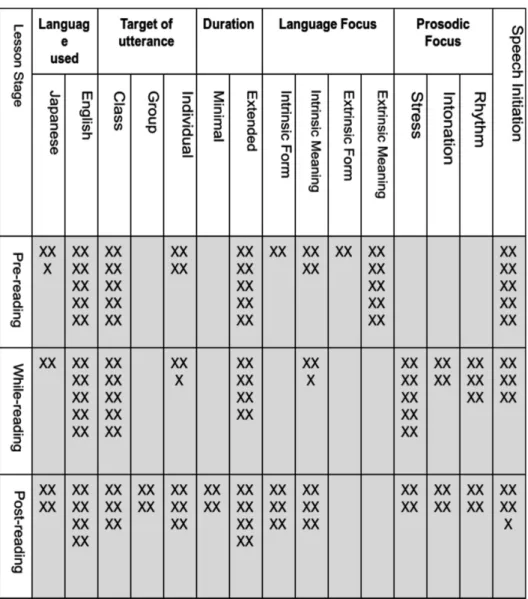
The While-reading segment of the lesson made use of teacher-led and choral class activities (see Appendix, Fig. 3), during which an explanation of prosody was given, and the class was encouraged to repeat single slash sections of the text after the teacher. A pair-work exercise was also utilized (see Appendix, Fig. 3), where students practiced expressive speech elements of the text by taking turns reading from the article and giving attention to stress, rhythm and intonation. This activity was conducted almost exclusively in English and required interaction of an extended duration, as it focused on text from the article itself (see Appendix, Fig. 5). The teacher devoted quite a lot of time to explaining and demonstrating the concept of stress (see Appendix, Fig. 4), and this focus on stress is particularly noteworthy due to the well-established causal links between nuclear stress, the acquisition of implicit prosody (Groen et al, 2019), intelligibility (Koike, 2014) and comprehension (Kuhn et al, 2010).
Lesson activities utilizing rhythm and intonation were present during this stage (see Appendix, Fig. 3), mostly stemming from teacher verbal interaction (see Appendix, Fig.
4) and produced while explaining and modelling the pronunciation of tone units. Student verbal interaction during this phase of the lesson demonstrates fewer occurrences of intonation and rhythm (see Appendix, Fig. 5), which would point to the students’ lack of proficiency in these elements of expressive speech and the need for more prosodic skills instruction.
During the choral repetition of tone units from the text, students articulated
relatively accurate stress, as a result of the teacher carefully vocalizing each tone unit,
with particular attention given to nuclear stress. More challenging segments of the text
were repeated by the teacher and the class, until relative mastery of the basic elements of
stress was achieved. During the subsequent pair-work exercise, several students exhibited
a return to using uniform rhythm and a flat tone, possibly due to L1 interference. The
teacher monitored the students’ progress and provided correction where needed, however many students reverted to L1 patterns of pronunciation and experienced difficulty in accurately producing prosodic speech on their own.
The While-reading stage of the lesson made use of all four student modalities (see Appendix, Fig. 3), although instances of writing performed by the students were mostly limited to underlining stressed sounds in the article. The remaining three student modalities (reading, speaking and listening) were extensively utilized: listening to the teacher demonstrate each tone unit from the text, to other students read the text during the pair-work activity and to the teacher’s guidance and corrections; reading the text chorally and with a partner; speaking during choral repetition and the pair-work activity.
During the Post-reading segment of the lesson the teacher modelled reading comprehension questions, based on the text, and encouraged the class to jointly construct answers. The teacher continued in this manner until the class was capable of asking and answering comprehension questions, both individually and chorally. This represented verbal interaction of extended duration, expressing both intrinsic meaning and form, carried out mostly in English and demonstrating many instances of prosodic speech (see Appendix, Fig. 4).
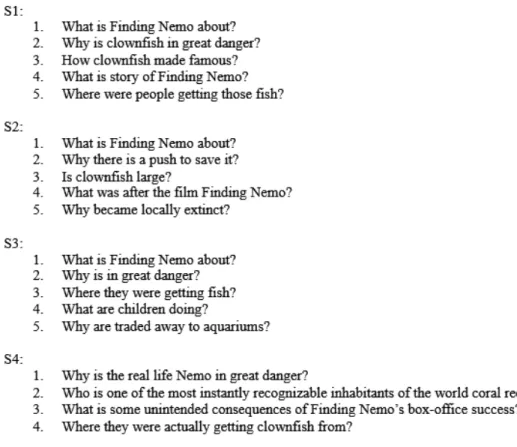
During the post-reading segment of the lesson, the class was asked to write comprehension questions based on information from the article (see Appendix, Fig. 7), these questions were then utilized in a pair-work exercise, where students took turns asking and answering each other’s questions. The manner and accuracy of student interaction during this activity was intended to demonstrate the students’ comprehension of key aspects of the article, and the impact of prosodic instruction. The students’ self- composed questions contained some syntactic and grammatical errors, but were semantically accurate:
S1: What is story of Finding Nemo?
S2: Why there is a push to save it?
S3: Where they were getting fish?
This correct representation of meaning suggests that the students were able to grasp
the key concepts and vocabulary from the news article, but that their knowledge of
grammar and syntax requires further refinement. As this study deals primarily with the
impact of expressive speech instruction on reading comprehension, grammatical and
syntactic accuracy fall outside its focus. Of more interest to this study are the semantic
elements of the student composed reading comprehension questions and answers.
Many of the students came up with the question: “What is Finding Nemo about?”
(see Appendix, Fig. 7). The teacher modelled this question during the lesson so it could reasonably be expected that several of the students would choose to reproduce it. In fact, S1, S2, and S3 wrote this as their first question, but the answers given by their partners varied markedly:
S1: A clownfish.
S2: It’s (.) about (.) a clownfish.
S4: About a clownfish (.) that was taken (.) and now:: there not enough of them.
From the above excerpt it can be seen that while S1 and S2 offered correct answers, only minimal information was given, and their answers closely followed previously modelled answers from the lesson. S4 on the other hand, gave an answer which brought together information from several segments of the article and showed a deeper understanding of the content. Furthermore, S4 composed a comprehension question which demonstrated further mastery of the semantic elements of the article, and which once again combined several points from the text to form a relatively complex sentence:
“Why are students at Belgian Garden primary school breeding fish?”. The answers given to this question varied among the students:
S5: So they can give fish (.) to people (.) who want fish.
S2: So they (.) don’t take them (.) out of the wild.
From the sample of student interaction above it appears that S5’s answer is the most accurate and complex. However, by comparing this answer to sections of the article it is clear that S5 has simply combined sections of the text to form a plausible sounding answer.
Even though this answer correctly uses the pronoun “they” to refer to “students at Belgian Garden primary school”, it obscures the central reason for breeding clownfish: to provide an alternative to taking clownfish from their wild habitat. On the other hand, S2’s answer correctly represents this concept, and even though the pronoun “they” is misused and does not refer to the subject from the question, the meaning communicated by the answer is a better match for the preferred answer and so demonstrates a more nuanced understanding of the semantic elements of the article.
4. Conclusions
Work done by other studies has demonstrated the link between prosodic instruction and
improvements in reading skills in poor comprehenders. Furthermore, a more accurate
understanding of the intended meaning of text can be facilitated by the development of
implicit prosodic skills, which enables the application of prosodic contours to written text.
Language classes conducted in Japan will often prioritize exam preparation over communicative skills lessons, and in doing so deny students the chance to improve their proficiency in expressive speech and knowledge of prosody. This investigation endeavored to interrogate the links between reading comprehension skills and prosodic instruction. In reference to the research question posited by this study: The reading comprehension questions and answers constructed by the students indicate that explicit instruction in expressive speech, when coupled with CLT methodology, can result in improved understanding of the meaning of authentic text.
There are, admittedly, factors which limit the applicability of this study. Firstly, this study is based on data derived from a single lesson, and as such there is no baseline with which to compare the results. Second, the data were gathered and interpreted by just one practitioner, and so raising possible concerns over reliability. Despite these seemingly large objections, past work on causal connections between prosodic skills, reading proficiency and intelligibility, coupled with the points raised by this investigation, would seem to merit further work into the effects of prosodic instruction on reading comprehension.
Notes
1 Elements of this work were originally submitted by the author to satisfy the requirements of Master of Education in TESOL, Wollongong University, 17/02/2019.
References
Allen, P., Frohlich, M., Spada, N. (1983). The Communicative Orientation of Language Teaching: An Observation Scheme. Retrieved from https://eric.ed.gov/?id=ED275155 Berninger, V.W., Abbott, R.D., Trivedi, P., Olson, E., Gould, L., Hiramatsu, S. et al. (2010).
Applying the multiple dimensions of reading fluency to assessment and instruction. Journal of Psychoeducational Assessment, 28(1), 3–18.
Brown, H. D. (2006). Principles of language learning and teaching. Pearson Education.
Burns, A. (2009). Doing action research in English language teaching: A guide for practitioners.
Routledge.
Calet, N., Defior, S. & Gutiérrez‐Palma, N. (2015). A cross‐sectional study of fluency and reading comprehension in Spanish primary school children. Journal of Research in Reading, 38(3), 272–285.
Chafe, W. (1988). Linking intonation units in spoken English. In Clause combining in grammar and discourse, (pp. 1–27). Amsterdam: John Benjamins B.V.
De Ley, L. (2017). Why Prosody Matters: The Importance of Reading Aloud with Expression.
Retrieved from https://www.scilearn.com/blog/why-prosody-matters-importance-reading- aloud-expression
Flyman-Mattsson, A. (2009). Students’ communicative behaviour in a foreign language classroom. Working Papers in Linguistics, 47, 39-57. Retrieved from
https://lucris.lub.lu.se/ws/files/6113315/624445.pdf
Fodor, J.D. (1998). Learning to parse. Journal of Psycholinguistic Research, 27(2), 285–319.
Garant, M. (2000). EFL testing and university admission in Finland and Japan. Asian Journal of English Language Teaching, 10, pp. 115-135.
Gibson, S. (2008). Reading aloud: a useful learning tool? ELT journal, 62(1), 29-36.
Groen, M. A., Veenendaal, N. J., and Verhoeven, L. (2019) The role of prosody in reading comprehension: evidence from poor comprehenders. Journal of Research in Reading, 42:
37–57.
Gunduz, M. (2004). Communicative orientation in the language class and the effect of activity types on interaction (Doctoral dissertation). The University of Leicester, School of Education.
Holliman, A.J., Williams, G.J., Mundy, I.R., Wood, C., Hart, L. & Waldron, S. (2014). Beginning to disentangle the prosody‐literacy relationship: A multi‐component measure of prosodic sensitivity. Reading and Writing, 27(2), 255–266.
Jenkins, J. (2000). The Phonology of English as an International Language. Oxford: Oxford University Press.
Johnston, V. (2015). The power of the read aloud in the age of the common core. The Open Communication Journal, 9(1).
Kentner, G. (2012). Linguistic rhythm guides parsing decisions in written sentence comprehension. Cognition, 123(1), 1–20.
Koike, Y. (2014). Explicit pronunciation instruction: Teaching suprasegmentals to Japanese learners of English. In N. Sonda & A. Krause (Eds.), JALT 2013 Conference Proceedings.
Tokyo: JALT.
Kuhn, M.R., Schwanenflugel, P.J. & Meisinger, E.B. (2010). Aligning theory and assessment of reading fluency: Automaticity, prosody, and definitions of fluency. Reading Research Quarterly, 45(2), 230–251.
Lochrin, M., Arciuli, J. & Sharma, M. (2015). Assessing the relationship between prosody and reading outcomes in children using the PEPS‐C. Scientific Studies of Reading, 19(1), 72–
85.
McKay, S. L. (2006). Researching second language classrooms. Retrieved from http://ebookcentral.proquest.com
Miller, J. & Schwanenflugel, P.J. (2006). Prosody of syntactically complex sentences in the speech reading of young children. Journal of Educational Psychology, 98(4), 839–853.
Nakamura, S. (2010). Analysis of relationship between duration characteristics and subjective evaluation of English speech by Japanese learners with regard to contrast of the stressed to the unstressed. Pan Pacific Association of Applied Linguistics, 14(1), 1-14.
Nation, K., Clarke, P., Marshall, C.M. & Durand, M. (2004). Hidden language impairments in children: Parallels between poor reading comprehension and specific language impairment? Journal of Speech, Language, and Hearing Research, 47(1), 199–211.
Nation, K. & Snowling, M.J. (2000). Factors influencing syntactic awareness skills in normal readers and poor comprehenders. Applied PsychoLinguistics, 21(02), 229–241.
Nunan, D. (1988). The Learner-Centred Curriculum. Cambridge, Cambridge University Press.
Rasinski, T., Rikli, A. & Johnston, S. (2009). Reading fluency: More than automaticity? More than a concern for the primary grades? Literacy Research and Instruction, 48(4), 350–361.
Richards, J. C. (2006). Communicative language teaching today. Cambridge University Press.
Retrieved from https://www.professorjackrichards.com/wp-content/uploads/Richards- Communicative-Language.pdf
Schwanenflugel, P.J., Hamilton, A.M., Kuhn, M.R., Wisenbaker, J.M. & Stahl, S.A. (2004).
Becoming a fluent reader: Reading skill and prosodic features in the speech reading of young readers. Journal of Educational Psychology, 96(1), 119–129.
Serious Solution Needed. (November, 2018). CNN English Express, November Edition. Asahi Publishing.
Snedeker, J. & Trueswell, J. (2003). Using prosody to avoid ambiguity: Effects of speaker awareness and referential context. Journal of Memory and Language, 48(1), 103–130.
Spada, N. & Frohlich, M. (1995). COLT Coding Conventions and Applications. Macquarie University, National Centre for English Language Teaching and Research (NCELTR).
Stephens, M. A. (2011). Why exposure to prosody should precede the teaching of reading. The Language Teacher, 35(4), 68-73.
Veenendaal, N.J., Groen, M.A. & Verhoeven, L. (2015). What speech text reading fluency can reveal about reading comprehension. Journal of Research in Reading, 38(3), 213–225.
Watanabe, T. (2002). English as a skill: A comprehensive skill building program. Toyama Prefectural University Kiyo 12, pp. 61-71.
Received on 2 February 2021
Appendix
Figure 1. Lesson plan
Figure 2. Transcription Coding (McKay, 2006, p.103)
Figure 3. Communicative Orientation of Language Teaching Observation Scheme (COLT) - Lesson Activities/Episodes. Adapted from Allen et al (1983).
(“P” indicates activity/episode present)
Figure 4. COLT - Teacher Verbal Interaction
(“X” indicates extent of verbal interaction)
Figure 5. COLT - Student Verbal Interaction
(“X” indicates extent of verbal interaction)
Figure 6. News article handout (Serious Solution Needed, November, 2018)
Figure 7. Student generated comprehension questions (spelling corrected)