Satawalese Society
journal or
publication title
Man and culture in Oceania
volume 1
page range 1‑26
year 1985‑01‑01
URL http://hdl.handle.net/10502/5263
Man and Culture in Oceania, 1: 1-26, 1985
Avoidance Behavior and Kin Category in Satawalese Society'
Ken-ichi Sudo2
Satawalese society is composed of eight ydyinang (matrilineal, exogamous, nonlocalized clans), segmented into 15 lineages. Satawalese kinship terminology is a variant of the Hawaiian type. Kin terms are used only in reference; personal names are used in address.
The Satawalese distinguish three categories of avoidance behavior: Ye- pin me wddn "it is taboo from above", pininmwdngeydng "taboo between
opposite-sex siblings", and kir-gig/se/4n "taboo word". The kin and affine categories affected by yepin me wddn differ among men and women. If ego is a man, he must observe taboos against the men of older gener- ations in his clan, their sons, older brothers, parallel siblings, the sons of his father's older brothers and his mother's older sisters, and his
"brother-in-law" , his wife's older sister's husband. If ego is a woman, she must observe pininmwdngeydng taboos against cross siblings, older sis- ters, and parallel siblings, the daughters of her father's older brothers and her mother's older sisters. Kkepasepin are taboos which men and women must mutually observe.
Key words: Hawaiian kinship terminology; matrilineal society; taboo;
honorific word; avoidance.
What attracts our interest among interpersonal relationships in Satawalese society is the complicated and exact regulations which govern behavioral patterns in people's daily lives. These behavioral patterns are
"manners" which a person must observe when having contact with some -
one with whom he/she has a specific relationship, and they dictate in
detail the precise expressions used, how contact is made, the posture assumed, and how another person's possessions may be borrowed.
The behavioral patterns between individuals are determined by their relative social status. In Micronesia many societies have a ranking sys-
tem and titles designating social status (Murdock, 1948; Mason, 1968).
However, in the Truk and Central Caroline Islands, the people are divided into "clans of chiefs" and "clans of commoners", but precise ranking of individuals with special titles does not exist. The determining factors for social status in Satawal, which has a relatively egalitarian social struc- ture, are genealogical status, sex, generation, and age. While social status is based upon these factors, complicated behavioral patterns are determined fundamentally by kin and affinal ties.
1This paper is an abbreviated and translated version of "Avoidance Behavior in Sate- walese Society, Micronesia," originally published in Japanese in Bulletin of the National Museum of Ethnology, 4(2): 1008-1046 (1980).
aNational Museum of Ethnology , Osaka 565, Japan.
In this paper I concentrate mainly on the behavior pattern known in social anthropology as "avoidance behavior". In interpersonal relation- ships in Satawalese society the manner in which two individuals interact is very formal since it is based on many taboos. The existence of social distance between two persons is a distinctive characteristic of kinship behavior in Satawal. The aim of this paper is to clarify the kinship system in Satawalese society through an analysis of human relationships, which are determined by complicated behavioral patterns.
Until now kinship studies in the Central Caroline Islands have dealt mainly with the theme of principles of kinship organization and landhold-
ing patterns (Alkire, 1965, 1971; Burrows and Spiro, 1951; Lessa, 1950, 1966; Rubinstein, 1979; Ushijima, 1982). However, kinship studies focus-
ing on behavioral patterns in interpersonal relationships have not been undertaken. According to my fieldwork findings, the behavioral patterns among interpersonal relationships in Satawalese society are quite similar, with some slight variations, to those of the people from the Central Caro- line to the Truk Islands. Before a comparative study with other societies
can be undertaken, concrete data about behavioral patterns in
Satawalese society must first be presented (Sudo, 1979, 1984a, 1984b).
Satawal is a small, raised reef island with a 6 km circumference, located in the Central Caroline Islands of Micronesia. It lies 1,000 km east
of Yap and 500 km west of Truk. Its population (1980) was 492 people comprising 86 household groups. Satawalese society is made up of 8 matrilineal descent groups known as ydyinang, and each person belongs to one of them. Each yayinang has a specific name, and yayinang genealogies can sometimes be traced back 8 generations. The 8 ytiyinang are segmented into 15 subgroups, each of which is a corporate landowing body. The subgroups are composed of members who can trace themselves back 3 or 4 generations. The place where the members reside is called its pwukos, and these are named after geographical places. The members of a pwukos abide by the uxorilocal residential rule; they include the female members, their husbands, children, unmarried males, and other adopted persons of another yavinang.
Members of a ydyinang do not necessarily live only on Satawal; they can also live on other islands. Of those who live on other islands, some can trace their ancestors, while others just know only the name of their yaginang. When it has been acknowledged that persons are from the same yriyinang, they are obliged to assist each other and are prohibited from committing incest or marrying. In this paper, the definition of yrlyinang is "clan", and the term "lineage" will be used in reference to the
15 subgroups which as a corporate group own property in Satawalese society.
The data in this paper are based on fieldwork collected in both
Satawalese and English. The fieldwork was conducted from June to Sep-
tember 1978 and from May 1979 to March 1980. Satawalese belongs to
Avoidance in Satawal Island 3
Table 1. Satawalese Vowels and Consonants
Vowel High
Mid Low Consonant
Stop Fricative Nasal Trill Resonant Semivowel
Front e
a Bilabial
p pw f
m mw
Central A
6 a
Alveolar t
n r
Back 0 6
Alveo-Palatal (Retroflex)
ch
rh
Palatal Velar
k ng
w
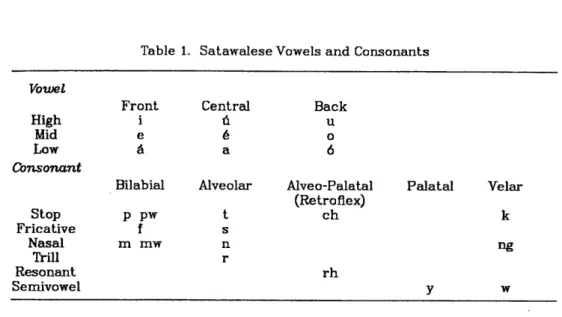
the Trukic group in the Micronesian devision; its phonetic sounds were transcribed according to the following rules and those rules given in Table
1: (1) The 9 vowels are i, e, é, a, u, o, 6, and the long vowels are ii, ee, AA, 66; and (2) the 15 consonants are ch, f, k, m, mw, n, ng, p, pw, r, rh, s, t, w, y, and the double consonants are fT, kk, cch, mmw, nng, ppw (Elbert, 1972; Goodenough and Sugita, 1980).
Relationship Terms Kinship Terms
In Satawalese society a person's first name is used when person is addressed in daily life. For instance, when a child speaks to his parents,
he willcall them by their first names: "Namoni, yito mtvongo" (Namoni, and nd eat), or "Ratomai, wopwe neyiya" (Ratomai, where are you going?). First names are also used when speaking to one's own siblings or grandparents. Kinsmen and those who are not immediate family membes are also called by their first names, which can be their given names.
Referential terms are used when speaking about the relationship between oneself and one's kinsman. For instance, ngang ndwinnuw (I am your child) and yiiy serndiy (He is my father) are two examples. Referen-
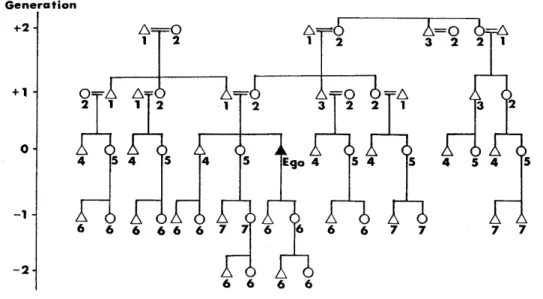
tial terms are used to identify the kinship ties between the speaker and another person to a third person or when two people are confirming or acknowledging their genealogical relationship. The referential terms in Satawalese society are listed in Table 2 and illustrated in Fig. 1.
While these kinship terms do not dintinguish relative age, they do dis- tinguish generation, sex, and matrilineal line.
(1) These following 7 words are used to distinguish generation, sex of
Table 2. Satawalese Kinship and Affinal Terms
Term
1. saam father
2. yiin mother
Gloss
3. tukufdyiy old man or big man (mwaanennap)(mother's brother) 4. pwii same-sex sibling
5. mtvengeyemg opposite-sex sibling
6. naay child
Referents
F, FB, FF, MF, FZH, MZH, MMZH, WF, WMF, WFF, WFB, WMB, WMZH, HF, HMB, HMZH
M, FZ, MZ, FM, MM, MMZ, FBW, MBW, MMBW, MMZD, WM, WMM, WFM, WMZ, HM, HMM, HMBW MB, MMB, MMZS
7. fatal() sister's son or daughter 8. kOwurh brother-in-law
9. leas sister-in-law 10. purfavecw wife or husband
(m.s.) B, FBS, FZS, MBS, MZS, MMZSS, MMZDD (w.s.) Z, FBD, FZD, MBD, MZD, MMZSD, MMZDD, HBW (
m.s.) Z, FBD, FZD, MBD, MZD, MMZSD, MMZDD
(w.s.) B, FBS, FZS, MBS, MZS, MMZSS, MMZDS C, BC, FBCC, FZCC, MBCC, CC, ZCC, WZC, WBC, HBC, HZC
ZC, MZDC, MMZDDC (m.s.) WB, WM Z S (
w.s.) HZ, HMZD
(m.s.) W, WZ, WMZD, BW ( w.s.) H, HB, HMZS, ZH (m.s.) = Man Speaking, (w.s.) = Woman Speaking.
Figure 1. Satawalese Kinship Terminology.
The numbers correspond to those in Table 2.
speaker and hearer, and line among kinsmen: saam,, yiin, tukufayiy (mwacinennap), pwii, rnwengeydng , naay, fatal).
(2) The speaker (ego) uses saam when speaking to a man of an older
Avoidance in Satawal Island 5
generation who is not a member of the same matrilineal line, regard- less of how old he is, and yiin when indicating a woman of an older
generation. Men of older generations in the same matrilineal line are
distinguished from other older men by use of the terms tukufayiy or mwdanenap, The relationships are as follows: F = FB = FF = MF = FZH, M = MZ = FZ = MM = FM = FBW = MBW, FB MB.
(3) When ego speaks to someone of his own generation, the choice of term is dependent on the sex of that person and not on matrilineal line.
Pwii is used when speaking to a person of the same sex and mwengeyang for the opposite sex. The relationships are as follows: B
= FBS = MBS, Z = FBD = MBD.
(4) When ego speaks to a person of a younger generation who is not the child of a female sibling in the same clan, nerdy is used without any
distinction as to generation or sex. A male speaker used fattlin when
speaking to a female sibling's child in the same clan. The relation-
ships are C = BC = MBDC, BC ZC.
This term classification system, as in the examples of B = FBS = MBS for cousins, has been classified as being a Hawaiian type and a kind of generation system (Murdock, 1949:123). An examination of the entire kinship term system in Satawal shows that it strongly distinguishes one generation above MB and the generation below ZC, a feature which dis- tinguishes it from other systems. Because within the matrilineal line MB
and ZC receive great emphasis, special kinship behavioral rules have most likely been established among the kinship categories derived from these terms.
The sphere in which the two sibling terms are applicable is limited to ego's second cousin of his generation, but this limitation does not apply to consanguine relatives in the matrilineal line. If members of a matrlineal descent group, ydyinang, mutually recognize each other's
genealogy, the two sibling terms are used regardless of who the female ancestor was. In a Satawal ydyinang the oldest female ancenstor in the matrilineal genealogy can be traced back B generations. Use of these kin- ship terms is not restricted to members of a ydyinang living on the same island, but also applies to members of the same ydyinang living on other islands. In summary, the kin category to which these kinship terms apply goes as far back only as the second cousin of ego's own generation when that person belongs to a non-matrilineal line, but is applicable toward all kinsmen who are members of the same matrilineal line as ego.
The 7 kinship terms in Table 2 are specific expressions as well as gen-
eral terms for father, mother, mother's opposite-sex siblings, same-sex
siblings, opposite-sex siblings, children of opposite-sex siblings, and chil-
dren. These terms are used in two ways. One is by telling the third per-
son directly what the relationship is between ego and another person, as
in "He is my father" or "That person is their mother." The second way is
for ego to state that the other person(s) is a relative, as in "We are
siblings" or "He and I are children".
In the first instance, a possessive suffix is affixed to the term's stem.
This suffix changes according to a given rule depending on who the second person is (Table 3). In the second instance, the term ending is duplicated when the relationship between two persons is explained. For example, the statement "We are siblings" would be said, "Kiirh si , dupli- cating pwii, and the statement "A and I are father and son" would be said,
"ngang yi, samesam. A nge A ye naaynay ngang", which literally means "I regard A as my father and A regards me as his son." When ego states to a third person his relationship with a second person, the various kinship terms like samesarn, yineylin, pwiipwi, and naaynay are duplicated.
Possessive suffixes are not affixed to these duplicated words.
Modifiers are affixed to the kinship term to differentiate whether the person is or is not a member of the same clan in Satawal. When the per- son is a member of the same clan as ego and also a sibling of the same sex, the word sipekin is used, as in sipekinin pwiiy; but when the person is from a different clan the word teten is used, as in tetenin pwiiy. The adjective sipekin means true or genuine, and the noun teten means line or rank. The classified category sipekin pwiiy not only includes siblings with the same mother but also same-sex siblings in the same clan. Thus siblings having the same mother are not distinguished from classificatory siblings in the same matrilineal line.
Since address terms do not occur in the Satawalese kinship term sys- tem but referential terms do, the system is similar to that of Hawaii.
However, because of the emphasis of line MB and ZC and the distinctive characteristic of MB KB, BC ZC, Satawalese kinship terminology differs from the Hawaiian type in that it does distinguish between certain lines.
Affinal Terms
Relationship terms in Satawalese sometimes do distinguish between kinship and affinity, as between F and MZH, FZH and M, or MBW and FBW.
The two types of kin terms discussed are those used by ego in stating his
relationship with aother person (1) because of marriage or (2) as a result
of adoption or remarriage by the father or mother. The relationship terms used by ego to identify those people to whom he is related can be used in two ways. One is using a kinship term which indicates that the second person is affined to ego by marriage. Another is using special terms other than kinship terms.
In the first instance, ego places himself in his spouse's position, and
then identifies himself with the second person by using the same kinship
terms as his spouse would. This is done when the second person is some-
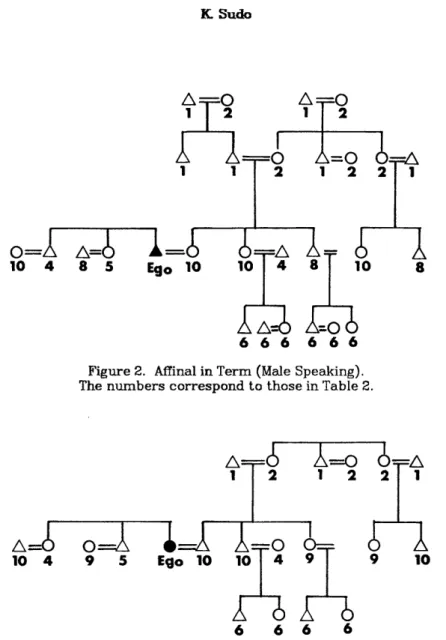
one who is of an older or younger generation than the spouse. Figures 1,
2, and 3 show how WF, WMF, WFB, WMB, MZH, and FZH are included in the
Table 3. Inflection of Kinship and Affin al Terms
Person
Term
1. sawn.
2. yiin 3. tuku.f6;giy 4. pwii 5. mwengeyerng 8. naay 7. fataw 8. kb/out 9. 1c66s 10. pure/nit/A,
1 sg.
Singular
2 sg. 3 sg. 1 inc.
semedy sembmw SO man semat
yinety yina 71VW yinan yinaf
tukufayiyddi tukufet.yiyOTnw tulcufilyiyart tukuferyiyaif
pwiiy pwiimw pwiin pwiit
mwengey mwengey6mw mwengeyan mwengeycct
nelyiy n6wumw naytsn ruxylcf
faticwily faticw6mw fat swan fcaliwat
kawutuy k6wul-umw kOwutun kOwutuf-
k6esety k66s6mw k66san ke6sat
purtznitig.wexy pw4nitil.w6mw pw6n-6.-6.wan pwfmfthwat
1 exc.
Plural
2 pl. 3 pl.
semetrrunvim stinted SO rneer yinarnmam yirutrni yine e r tukufewdiyeunnukm tutufeLyia.mi tukfdyieer
pwitirn6.m pwiimi pwiir
mwengeyfunmecm m,wengeyami m.we ngeye er
nayimecm nayimi naytcar
faticw6anmam fat4w6uni faMweer kOwulummeurt k6wuturni kaurutuur
k66sammdm k66seemi k66seer
Inutcnictiwamm6an pw6.n.fraw6rni pwanirthweer
5
1 sg.= first person singular. 1 inc.= first person plural inclusive.
1 exc.= first person plural exclusive. 2 pl.= second person plural.
Figure 2. Affinal in Term (Male Speaking).
The numbers correspond to those in Table 2.
Figure 3. Affinal Kin Term (Female Speaking).
The numbers correspond to those in Table 2.
scam category. The same is true of ylin, so all women included in the viin category are "mothers" to the ego. Children of spouses and relatives
of the same generation (pwii, mwengeyang) are of the narzy category to ego, as in WBC, WZC, WZDH, and WBSH.
In the second instance, the non-kinship terms used to indicate other kinds of relationships have the following three special features:
(1) Ego's spouse is referred to by the term punintlw, without any regard
to the speaker's sex. W, WZ and WMZD apply when ego is a male.
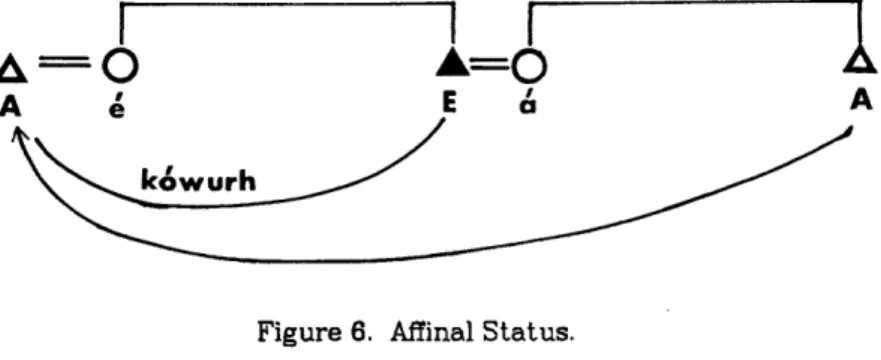
(2) If ego is male, male siblings of ego's wife are called kdwurh; examples
are WB and WMS.
Avoidance in Satawal Island 9
(3) If ego is female, female siblings of ego's husband are called kegs;
examples are HZ and HMZD.
The spouse's relatives are divided into two categories depending on the sex of the speaker when the spouse's relatives are not the same sex as the speaker. Not differentiating between ego's spouse and siblings of the same sex as the spouse means that a potential marriage between ego and the spouse's pwii has been recongized.
Yafakar
Yafakiir is a term which indicates the relationship between the individ- ual and his father's clan. It refers to a person born of a man of the clan.
If one's father was a member of the Neyaar ydiyinang, then one can say that he is a yafakzir of the Neyaar clan (ngang yafakdran Neyaar).
Yafalair is not used to indicate kinship ties between individuals but is a relationship term which shows that an individual is affiliated to his father's clan. Telling a person to which yafakdr of a clan one belongs is an important criterion in establishing one's kinship relationship with another person. If both persons are from the same clan's yafukzir and are also of the same sex and generation, they have a pwiipwi relationship.
There is also a marriage rule that prohibits people from the same yafuktir from marrying. The existence of specific terms which identify a person and his relationship to his father's clan means that there probably are special behavior patterns having to do with rights and obligations.
The Satawalese kinship term system beyond those of one's cousins is similar to the Hawaiian system. However, a distinctively differentfeature is the emphasis on MB and ZC. Also, among affinity terms, the kin term for one's spouse and for a same-sex sibling of one's spouse is the same, without any distinctions.
Kinds of Taboos and Their Sanctions
In Satawalese society a person must follow institutionally restricted norms of behavior regarding word choice, posture, and the handling of utensils when interacting with another person. These norms are yepin, meaning taboos; ye is the 3rd demonstarative pronoun, Yepin is a gen-
eric term for taboos in general, but the categories can be subdivided
according to what ego wishes to forbid, such as yepinu yengan (taboo on working), yepinutdta (taboo on climbing a tree near a deceased person's home during the mourning period) and kkepasepin (taboo on saying cer- tain words). The kinds of yepin which exist in Satawal and which affect
interactions between people, the theme of this paper, are as follows:
A. yepin me wddn
a. kkepaseyawaawa or yepin faits wddn
b. yepin yang eta wddn
c. ydppworo
B. pininmwengeydng (yepin mwengeydng)
a. yepin yildn b. yepin waisor
c. yepin sepao
d. yepin kielciy
e. yepin mangak
f. others C. kkepasepin
Ordinary Word
Table 4.
1. rnwongo (eat)
2. yfran (drink or smoke)
3. rongorong(hear) 4. piipi (see or look)
weri (understand)
5. kkepas (speak) 6. kAneey (know) 7. têngfl. (smell) 8. Vrata (stand) 9. kekkety (laugh) 10. tumwuri (lick)
11. rnayetr (sleep) 12. rrufuln6 (die)
Verb List of kkepaseyawaawa
Honorific Term
1. was
2. yeruiya (use)
3. ytinet.64k (distribute) 4. yatt66wur
5. teep 6. n.O.And 7. tac chuuk 8. patttrak (divide) 1. pwor66wus 2. pwoppworo
1. sak4r&fhw (the back of the body) 2. medott,npirey (the outside of the feet) 3. nfacfatiipwa (the outside of the foot's toes) 4. sarey
5. woori 1. y66nak 2. yen°
3. fdaniipwa (the under of the foot) 1. reepiya
1. ngtthri 1. nnangeta 2. yrissUtd.
1. faiwarh 2. riyadk 3. ffas
1. yelkina (try) 2. sOtoni (try) 3. nnetri.
4. woongi
1. setypar (shut the eyes) 2. yatên
3. kAnamw (doze) 1. wosant5
2. pitngUn6 (loose)
Avoidance in Satawal Island 11
Yepin me wddn literally means "taboo from above"; it places behavioral restrictions on a person which prevent him from placing him- self above another person of a higher status whom he respects.
Pininmwengeying means "taboo among opposite-sex siblings"; it res- tricts behavior between a person and members of the same generation in his clan and among his affines. Kkepasepin means "words forbidden to be spoken"; these basically are taboo words between men and women.
Recognized adult males (mwddn) and females (rhddpwut) must obey
these taboos. In this section the meaning of these taboos and the kin and affinity categories to which they are applicable will be examined.
A. Yepin me wddn
(a) Kkepaseyawaawa. Kkepaseyawaawa is a compound word whose two parts are kkepas, meaning "to talk" or "words", and yawaawa, meaning
"to speak honorably" or "words of respect"; hereafter
, kkepaseyawaawa will have the latter meaning. Yepin faits wddn means "it's a taboo to call an older person", which is another way of showing respect. Honorific words in Satawalese fall into two categories: nouns and verbs (Tables 4 and 5). The verbs mwongo, yuun, rongorong, piipi, kkepas,
krineey, tumwuri, and kekkdy have to do with the senses or perceptions, such as sight, hearing, taste, and smell. Also included are the verbs yadta, mayzir, and mar/no, having to do with human actions or death.
The nouns riimw, nuking, mans, seining, yaaw, and ytIttw refer to parts of the body, mostly the neck and above.
Examples of honorific words can be found in the table, but some ordi- nary words and the polite forms of these words have the same meanings, whereas in other instances the meanings are different. Examples of the latter are the honorific words for mwongo, which are yddyd, yinetatik, and pattilak, and the honorific words for piipi, which are sakilnlaw, nzikun pirey, and nfikilniipwa. Interestingly, the honorific words for "to look" are verbs which were formerly nouns meaning "the back of the body", "the outside of the feet", and "the outside of the foot's toes". The verbs have these meanings because when a Satawalese listens to a person of a higher status's speech, he is forbidden to look at the person. So he looks at the person's feet. Directly looking at the speaker's face is disrespectful; it means the listener will not do what he is being told. This example is a symbolic representation of respect behavior in Satawalese society.
Even honorific nouns are words whose meanings are different from their ordinary usage. For instance, the honorific word for head, riimw, is weyinang, which means heaven or sky. Weyindng is aslo the honorific word for the forehead and brow. The honorific word for eyebrow (fast) is ndngoitaylik, which is a compound of the words "to support" (ndng) and
"tumeric" (Myra) . The word tumeric is used because tumeric root
Table 5.
Ordinal Word
Noun List of kkepaseyawaawa
1. riimw (head) 2. mOOng (fore head) 3. winni riimw (hear) 4. neyetyinfatun (the brow) 5. maas (face)
6. fayann maas (eyes) 7. pwoot (nose) 8. yaaw (mouth) 9. y-tretw (neck) 10. fethn yAftw (throat) 11. seining (ear) 12. faat (eyebrow)
13. mAitetteren maas (eyelashes) 14. sdpwon maas (the tail of the eye) 15. raani maas (tear)
16. ykuusap (cheek)
17. meren pwoot (the top of the nose) 18. ngii (teeth)
19. chechanon maas (pupil) 20. rh.een kanew (tongue)
Honorific Term
weyinetn,g (sky or heaven) weyin/ing (sky or heaven) yttttn
yemni weyinang
weyinang (sky or heaven) sapweyun
fayay sapweyun y6fOng
ngeterrh sbrof y6s6rofan pworalvus
nengoi tetyak (the support of turmeric) mettetterey sapwOyem
stpway sapwêyart raani sapweyun wO6i saputhyun meren y6f6ng f6t6f6t (plant) faay (stone)
chechOnon sapweyun
rh,eeni ngetar (the leaf of the tongue)
(Curcuma sp.) powder is put on the forehead to ward off evil, and it
appears as if the eyebrows support the powder. In general, when the head, .forehead, or eyebrows of a person of higher authority are being referred to, the honorific words used mean "heaven" or "the upper parts".
However, not all honorific words have different meanings from their common usages. The honorific words for "to eat" are the polite words wiis, ydttdOwur, and teep, and the honorific words for "to see" are the
polite words sarey and woori. Honorific words for most nouns also do not have a different meaning from their common usage.
The use of some honorific words depends on the sex of the speaker.
The honorific words for "to eat" are ycIttOdwur and teep when spoken by
males, and yaciya, yineti111.1c, and tacchuuk when spoken by
females; wiis and pattl'alk can by used by both sexes. For "to stand", females would use the honorific word nnangeta whereas males would use the common word yttiata. Some honorific words can be used only in cer-
tain places. In the meeting and canoe house (wuutt) only the honorific words teep and ffas can be used for the words "to eat" and "to laugh".
Honorific words in Satawal have a peculiar characteristic of being
verbs relating to the human senses or perception or nouns referring to
body features from the neck up. Many honorific words have different
Avoidance in Satawal Island 13
meanings from their ordinary usage, and complicated rules govern the kind of word used depending on who the speaker is and on the cir- cumstances.
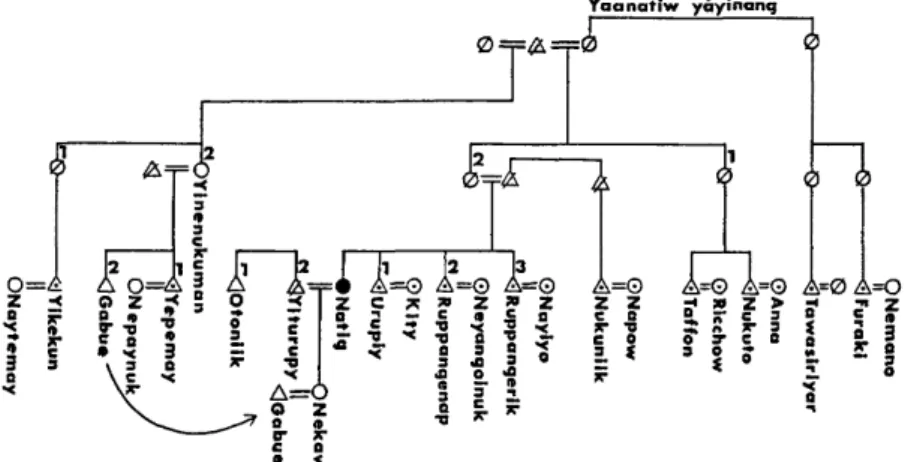
The following two examples illustrate honorific word usage in interper- sonal relationships with members of the kin and affine groups. Figure 4 is
the example of Rappow (a 30-year-old male) and Fig. 5 is that of Natig (a 68-year-old female).
In Rappow's situation, he is speaking to the following persons:
(1) The members of his ydyinang are the older males (Otoniik, Tokomey,
and Yepemay), Yepemay's adpoted son (Teppang), and his older brothers (Yipoinuk, Recho) of the same generation. Not all the
spouses of these males are included. Since Rappow's immediate older
brother's wife (Nasoniman) is related to Rappow through his father's
line, she belongs to the naay category. Neyangerik is also not included since he is a mwengeyang. Although Gabue can be included
because he is a member of the same ydyinang, he is excluded since
he is the stepfather of Rappow's wife (Nerak). Nesap and Nerak are
pwii, so Nesap is excluded.
(2) Yikefir and Yikima are included because Rappow is a yafakiir of their clan (Neyaar ydyiang).
(3) Among Rappow's wife's clan, his wife's brothers (Racche, Aisowin,
Mongonufar yOyinang Neyoar yayinang
4,0=dead person
,L,O=those odressed with honorific words 1,2,3= birth order