Temporal variation of HCl and HF observed at Tsukuba related to the change of the meridional circulation in the northern lower stratosphere
Isao Murata1, Yoshihiro Tomikawa2,3, Isamu Morino4, Hideaki Nakajima4, and Hideharu Akiyoshi4
1Graduate School of Environmental Studies, Tohoku University, Sendai, Miyagi, Japan
2National Institute of Polar Research, Tachikawa, Tokyo, Japan
3SOKENDAI (The Graduate University for Advanced Studies), Tachikawa, Tokyo, Japan
4National Institute for Environmental Studies, Tsukuba, Ibaraki, Japan
HCl is a main chlorine reservoir species in the stratosphere. The amount of HCl is a good indicator for a potential of ozone depletion. Observed total column of HCl was decreasing in 2000s after the CFCs regulation but showed increase from 2007 to 2011. Mahieu et al. [2014] investigated that this increase is due to interannual dynamical variability in the northern stratosphere from Fourier Transform Infrared spectrometer (FTIR) observations at 8 sites including Tsukuba and 3D-chemical transport model simulations.
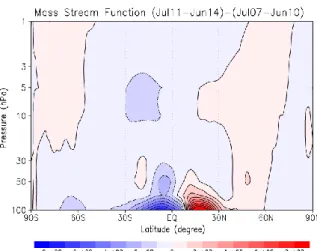
In this study we extended the analysis of HCl total column observed with FTIR at Tsukuba to 2018 and HF total column was also anlyzed. HF is a good tracer of atmospheric transport. The temporal variation of HCl and HF total columns showed decrease again from 2011 to 2014 then increase from 2015 to 2017 (Figure 1 for HCl). Mass stream function was calculated from ERA-Interim meteorological data to confirm that these temporal variations are also due to stratospheric circulation change. The difference of the mass stream function between the average of 2003 - 2006 and the average of 2007 - 2010 shows negative values in the northern lower stratosphere. This means the deceleration of circulation and it is consistent with the result of Mahieu et al. [2014]. The difference between the average of 2007 - 2010 and the average of 2011 - 2014 shows positive values in the northern lower stratosphere that means the acceleration of circulation (Figure 2). These changes correspond to the HCl and HF temporal variation. Thus we confirm that the temporal variation of HCl and HF is basically due to stratospheric circulation change.
The situation is somewhat different for the period after 2015. The difference of mass stream function between the average of 2011 - 2014 and the average of 2015 - 2017 shows negative values in the northern lower stratosphere again and this is also consistent with the increase of HCl and HF total columns after 2015. However, MIROC3.2 Chemistry-Climate Model (CCM) results show that the decrease rates of HCl and HF became lower but continue to decrease after 2015. This means that the circulation change after 2015 isn’t enough to explain the trend reversal and there are some possibility that the emission change in CFC-11 affects the increase of HCl and HF after 2015.
References
Mahieu, E., M. P. Chipperfield, J. Notholt, T. Reddmann, J. Anderson, P. F. Bernath, T. Blumenstock, M. T. Coffey, S.
Dhomse, W. Feng, B. Franco, L. Froidevaux, D. W. T. Griffith, J. Hannigan, F. Hase, R. Hossaini, N. B. Jones, I. Morino, I. Murata, H. Nakajima, M. Palm, C. Paton-Walsh, J. M. Russell III, M. Schneider, C. Servais, D. Smale, and K. A.
Walker, Recent Northern Hemisphere stratospheric HCl increase due to atmospheric circulation changes, Nature, Vol. 515, 104-107, doi:10.1038/nature13857, November, 2014.
Figure 1. Temporal variation in the total column of HCl
observed at Tsukuba from 2001 to 2018. Figure 2. Difference of the mass stream function (in kg/s) between 2007-2010 and 2011-2014.