Introduction
journal or
publication title
Senri Ethnological Reports
volume 133
page range 1‑7
year 2016‑01‑25
URL http://hdl.handle.net/10502/00009071
Introduction
Terada Yoshitaka
National Museum of Ethnology
This booklet is a report of the international symposium, An Audiovisual Exploration of Philippine Music: The Historical Contribution of Robert Garfi as, which was held at the National Museum of Ethnology (Minpaku) on May 19, 2014. Robert Garfi as is an eminent ethnomusicologist who has had global impact, and is one of the pioneers in the fi eld who recognized the importance of audiovisual documentation at an early stage of his career. He has shot the 64,000 feet of fi lm to this date and the list of his fi lms, included in this report, is remarkable by any standards (see Appendix 2). However, what is truly impressive is not the sheer number of the fi lms he produced, but the whole array of great musicians he documented and his ear for underestimated musical genres and styles that might have gone unnoticed. Furthermore, the list only contains edited programs: a substantial amount of unedited footage is equally, if not more, precious (see Appendix 3). The value of his documentation has increased, and no doubt will further increase, as time passes.
Garfi as went to the Philippines and Korea in 1966, almost half a century ago, with funding from the Rockefeller Foundation, and conducted his fi rst major fi lming project whose purpose was to document the music and dance tradition of each country as much as possible in a relatively short time. With a pioneering spirit, he volunteered to undertake the project when the opportunity presented itself although he had no prior experience with fi lming per se. Garfi as himself has described elsewhere the preparation for the trip and consultation on fi lm methods with various experts at that time (Garfi as 2011: 10–11). In subsequent years, many fi lms were produced through the University of Washington where he had established an ethnomusicology department, and they have been used for research and in classroom. Because the fi lming was done almost a half century ago, most of the artists documented are no longer alive and many of the genres and performance styles are no longer continued.
Koizumi Fumio Prize for Ethnomusicology
I conceived the idea of organizing this symposium when I learned that Garfi as would be visiting Japan to receive the Koizumi Fumio Prize for Ethnomusicology for 2013. While he has received many prestigious awards before, including the Kyokujitsu-sho (Order of the Rising Sun, Gold Rays) from the Japanese
Terada Y. (ed.) An Audiovisual Exploration of Philippine Music: The Historical Contribution of Robert Garfi as Senri Ethnological Reports 133: 1 7 (2016)
government in 2005 for his role in disseminating Japanese music abroad, the Koizumi Prize appears particularly pertinent and befi tting to him.
When Garfi as came to Japan in 1958 to study its court music (gagaku), Koizumi was in India conducting his fi rst extensive research outside of Japan.
After his return to Japan, they developed an immediate rapport with each other as they shared many common interests and perspectives on music and music studies.
They were both very active in academic studies and public arena alike, had a wide range of thematic and geographical interests, conducted fi eld research in multiple locations with vastly different historical and cultural backgrounds, had exceptional skills in discerning musical characteristics in analysis and on the spot and in communicating at ease in local languages. They both even hosted a radio program for a number of years through which people outside of the academia were exposed to the beauty of music from all corners of the world (Figure 1).
Koizumi was perhaps the very fi rst ethnomusicologist in Japan, as we understand the term today. As a professor of music at the Tokyo University of Arts, he spearheaded ethnomusicological research in Japan and trained many students who continued his legacy and later became established scholars in their own right.
His social impact was equally notable. Through his accessible writings, LP recordings and frequent appearances in mass media, he exposed the general public to music cultures of the world, showing them new ways of listening to and appreciating music. In fact, through his activities and media exposure, the term
Figure 1 Robert Garfi as (center) with Koizumi Fumio (right) in 1959. Photo courtesy by Robert Garfi as.
Terada Introduction
ethnomusicology, virtually unknown outside of the academic circle then, became part of common parlance. After his premature death in 1983 at age 56, a foundation was set up to perpetuate his memory and an award was established in 1989 to honor the individuals and organizations who made distinguished achievements in ethnomusicology. On May 15, 2014, Robert Garfi as was presented with the award for his life-long contribution.
Minpaku Symposium in Honor of Robert Garfi as
This symposium was organized to celebrate this felicitous occasion. As one of his former students, I take the greatest pleasure that his contribution to the fi eld and the infl uences of his activities on society at large have been offi cially recognized in Japan where he conducted his fi rst extended research in the late 1950s. That work served as a recurring point of reference for his subsequent research in many other parts of the world.
Minpaku seemed to be an appropriate venue to hold a symposium in honor of Garfi as, given his long and close association with the Museum. He served three times as a visiting professor, for the fi rst time for seven months in 2003, followed by two shorter stays in 2009 and 2013. During and between these appointments, he participated in multiple symposia and public forums as a speaker and commentator, including Performance and Culture, an international symposium sponsored by the National Institutes for the Humanities (NIHU) as a collaborative research project in 2009. His tangible academic output includes an important monograph on the theories and methodologies of ethnomusicology: Music, The Cultural Context (Garfi as 2004) published by Minpaku. More recently, he collaborated with Sasahara Ryoji and myself for two audiovisual documentation projects and produced ethnographic fi lms on music cultures of Spain, Portugal and Puerto Rico (2008–13; see Appendix 2). He also served as a primary advisor when our music gallery was renovated in 2010. His extraordinary enthusiasm for music and almost any other aspect of life is contagious and has left an indelible impression on myself and other Minpaku staff.
The symposium had two related objectives. The fi rst goal was to examine the
content and method of the Garfi as’ documentation in detail. We planned to discuss
the selection of traditions documented, the type of fi lming and editing techniques
applied, the effect of such methods on the fi nal product, and the logistical and
technical limitations. The second objective was to assess the historical
contributions and future applications of his documentation in relation to Philippine
music research, music education, preservation of traditional performing arts, and
impact on local communities. We can safely assume the value of the
documentation since it was made almost half a century ago at a time when it was
virtually impossible to obtain the necessary equipment and funds in the Philippines to prepare audiovisual records. Beyond this generalization, what aspects of the documentation are particularly valuable and on what account?
With these objectives mentioned above in mind, I invited three distinguished scholars of Philippine music: Professors Ramon Santos and Michiyo Yoneno-Reyes from the University of the Philippines and Dr. Usopay H. Cadar, ethnomusicologist and director of the performing ensemble of kulintang, one of the music genres documented by Garfi as. The biography of each participant is shown in the List of Contributors.
Three Sessions
The symposium consisted of three sessions. In the fi rst two, we focused on two particular regions of the Philippines, namely Luzon and Mindanao respectively.
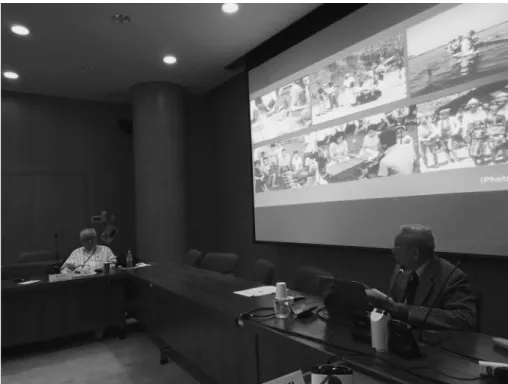
The selected 1966 footage was fi rst screened, followed by a paper presentation on the documentation in each area (Figure 2). In the fi rst session, after showing the fi lm footage from Luzon Island, Michiyo Yoneno-Reyes directed our attention to the selection of genres in Garfi as documentation. Particularly, the inclusion of Spanish traditions, such as an elderly Ilocano man dancing fandango to the guitar
Figure 2 Film screening prior to paper presentation. Photo by Terada Yoshitaka.
Terada Introduction
accompaniment, serves as a critical intervention, in her assessment, to the Filipino tendency to regard indigenous music as exclusively comprising and representing Filipino music, thus neglecting the Spanish and Mexican traditions transmitted in villages.
In the second session, we fi rst screened the footage of Maranao music and dance. Usopay H. Cadar then traced in his presentation the pivotal role that Garfi as has played in the transmission of kulintang music from the Philippines to North America and beyond, with the 1966 expedition as a starting point of this long and complex journey. He also stressed the increasing value of the Garfias documentation in relation to emerging “digital tribes,” in a new generation that relates to music in ways unthinkable at the time of documentation.
In the third session, Ramon Santos provided the contextual running commentary to the Garfi as documentation as he moved from region to region, genre to genre, and concluded that the footage collectively serves as a testimony for the existence of diverse locally-based musical systems that were based on different sensibilities of time, timbre, and kinetic movement. With this observation, he also questioned the relevance of the term “music” to describe the wide gamut of seemingly remote expressions (Figure 3).
Figure 3 Ramon Santos presenting his paper as Robert Garfi as looks on. Photo by Terada Yoshitaka.
I requested the authors to incorporate the comments and suggestions made during the symposium into their essays, which are included in this report (Chapters 2 to 4). During the symposium, Garfi as shared many illuminating anecdotes and stories regarding his 1966 expedition in interaction with the three presenters and the audience (Figure 4), and he kindly agreed to contribute an essay on the subject, a kind of travelogue that takes the readers to the fi lming sites chronologically (Chapter 1 of this report). Illustrated with many valuable fi eld photographs, the essay evokes a sense of the technical and logistical problems and other challenges faced, and the excitement of fi nding unexpected gems during the espedition.
The report also contains a concluding essay by Fukuoka Shota who led the NIHU research project, A Study on Visual Ethnography of Performing Arts as Human Cultural Resource (2010–2015), which funded this symposium. He notes the signifi cance of the symposium in the context of the project and two case studies from Japan with which he was directly engaged.
The appendices provide additional information about the fi lmmaking activities by Robert Garfi as, which can be consulted as readers go through the essays:
Appendix 1, the locations of documentation on the Philippine map; Appendix 2, the list of all fi lms released by Garfi as; Appendix 3, the list of individual footage at the University of Washington where original fi lms are stored and archived; Appendix 4, the list of audiovisual collection available for research at the University of the Philippines Center for Ethnomusicology (where Ramon Santos is currently director) and Appendix 5, sample pages from Garfi as’ fi lm log.
Finally, I would like to thank Robert Garfi as who himself attended the symposium, actively participated in discussion, and wrote an essay on the 1966 trip for this
Figure 4 General discussion (from left, Usopay Cadar, Michiyo Yoneno-Reyes and Robert Garfi as).
Photo by Terada Yoshitaka.
Terada Introduction