Bands in A ∼130 Region
Naotaka Yoshinaga1 and Koji Higashiyama2
1Department of Physics, Saitama University, Saitama City 338-8570, Japan
2Department of Physics, University of Tokyo, Hongo, Tokyo 113-0033, Japan E-mail: [email protected]
Abstract. The properties of the yrast and yrare states in the mass A∼130 region are studied by a full microscopic theoretical framework of the pair-truncated shell model. This approach for energy levels and electromagnetic transition rates in134La gives good agreement with experiment. The analysis of the wave functions reveals new band structure, which results from chopsticks configurations of two angular momenta of the unpaired neutron and the unpaired proton, weakly coupled with the quadrupole collective excitations of the even-even core.
PACS numbers: 21.60.Cs, 21.60.Ev, 27.60.+j
1. Introduction
The study of yrast and yrare states in doubly-odd nuclei has recently been one of the most interesting subjects in nuclear physics. A large number of experimental data [1, 2, 3, 4, 5, 6, 7, 8] have been accumulated in mass A ∼ 130 region, showing that the yrast and yrare states with the νh11/2 ⊗πh11/2 configuration form ∆I = 1 doublet bands which are nearly degenerate in energy. They are built on the single particle states of a valence neutron and a proton in the same unique-parity orbital 0h11/2. These
∆I = 1 doublet bands had been interpreted as a manifestation of “chirality” in the meaning of the angular momentum coupling, which was predicted by Frauendorf and Meng [9]. In their picture, the chiral mechanism is explained as follows. When three angular momenta of the even-even core, the unpaired neutron and the unpaired proton are perpendicular to each other, they can form either a left-handed or a right-handed geometrical configuration. These configurations are energetically equivalent, and two degenerate bands are constructed as linear combinations of these. The chiral structure of the ∆I = 1 doublet bands was investigated theoretically in the framework of the three- dimensional tilted axis cranking model [1, 2, 8, 9, 10], the particle-rotor model (PRM) [4, 11] and the phenomenological core-particle-hole coupling model [6, 7]. Despite a large number of theoretical studies, they are insufficient to obtain accurate quantitative results for both energy levels and electromagnetic properties of these bands, simultaneously.
In this paper, we present a new interpretation of the yrast and yrare states with the νh11/2⊗πh11/2 configuration for the A∼130 doubly-odd nuclei in the context of a pair-truncated shell model (PTSM) [12]. Through analysis of their structure, it turns out that the level scheme of ∆I = 2 E2 bands arises from different angular momentum configurations of an unpaired neutron and an unpaired proton, weakly coupled with the quadrupole collective excitations of the even-even core.
2. Theoretical Framework
In the simplest version of the PTSM, the shell model basis is restricted to the SD subspace where angular momenta zero (S) and two (D) collective pairs are used as the building blocks of the model. Thus the many-body wave function of the even- nucleon system is represented by the basis states |SnsDndIηi, where I is the total angular momentum and η is any other index needed to completely label the nuclear state. Here the angular momentum coupling is exactly carried out. Then the many- body wave function of the odd-nucleon system among like nucleons is expressed as
|jSnsDndIηi. A basis state of any doubly-odd nucleus with total spin I is written as a product of the above state in neutron space and that in proton space as |Φ(Iη)i = [|jνSν¯nsDnν¯dIνηνi ⊗ |jπSπnsDnπdIπηπi](I), where ¯Nν = 2¯ns+ 2¯nd+ 1 andNπ = 2ns+ 2nd+ 1 are numbers of valence neutron holes and proton particles, respectively. In this study, valence neutrons are treated as holes, and valence protons, as particles.
The effective Hamiltonian employed in the present calculation consists of the single particle energies, and the monopole and quadrupole pairing plus quadrupole-quadrupole interactions. The detailed prescriptions for the PTSM have been given in Refs. [13, 14]
in addition to the strengths of the interactions.
3. Numerical Results of Doubly-Odd Nuclei
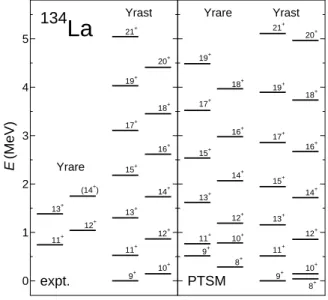
In Fig. 1, the experimental energy spectrum based on the νh11/2⊗πh11/2 configuration is compared with the PTSM calculation. For the yrast states, energy levels are almost perfectly reproduced, except that in our calculation the 8+1 state is predicted in between the 9+1 and 10+1 states. Also for the yrare states, our theoretical result provides a successful description of the energy levels, though only four levels are observed experimentally.
In Fig. 2(a), theoretical ratios B(M1;I → I −1)/B(E2;I → I −2) for the yrast states are compared with experiment. The effective charges and gyromagnetic ratios are taken as follows: eν = −1.2 e, eπ = 2.2 e, gℓν = 0.00, gℓπ = 1.00, gsν =−2.68 and gsπ = 3.91. The large-amplitude staggering of the B(M1)/B(E2) ratios is in excellent agreement with experimental data, except for the 16+1 state. In Fig. 2(b), the theoretical B(E2;I → I −2) values between yrast states and between yrare states are shown as functions of spin I. The behavior of E2 transitions is similar for both the even-spin yrast states (I ≥12) and the odd-spin yrast states (I ≥13). The strongE2 transitions
0 1 2 3 4 5
12+ (14+)
11+ 13+
10+ 12+ 14+ 16+ 18+
11+ 15+
9+
14+ 18+ 19+
16+
13+ 11+
15+ 13+
16+
12+ 15+
17+
11+
expt.
E(MeV)
21+
17+
14+
10+
PTSM
19+ 17+
19+ 20+
13+
12+
9+ 18+ 20+
10+ 9+
134La
8+ 21+
8+
Yrast Yrare
Yrast
Yrare
Figure 1. Comparison of energy spectrum in experiment (expt.) with those of the PTSM (PTSM). The experimental data are taken from Ref. [5].
10 12 14 16 18 20
0 5 10 15 20
10 12 14 16 18 20
0 0.1 0.2 0.3 0.4
8 10 12 14 16 18 20
0 1 2 3 4
I h( )
I h( ) I h( )
PTSM expt.
Yrast Yrast Yrare Yrare
Yrast Yrast Yrare Yrare Yrast Yrare
B E2( ) ( N )eb 2 B M1( )µ B M1( ;µ) ( N2 )I I 1
B E2( ;e2 b2) ( )I I 2
(a) (b) (c)
Figure 2. (a) Comparison of the calculatedB(M1)/B(E2) ratios for the yrast states with experiment. Experimental data are taken from Ref. [5]. (b) B(E2) values calculated in the PTSM. (c)B(M1) values calculated in the PTSM.
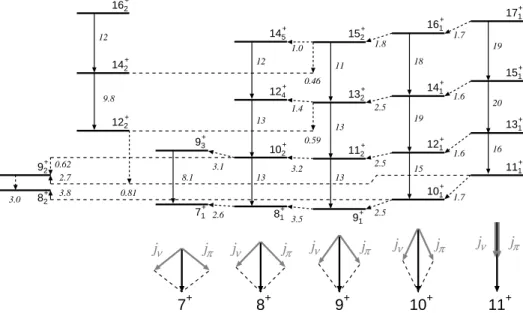
with spins greater than 12 indicate that the odd-spin and the even-spin yrast states respectively form two ∆I = 2 bands starting from the bandhead states of 11+1 and 10+1. The B(E2) values between the yrare ∆I = 2 states are smaller than those between the yrast ∆I = 2 states. Nevertheless, since the yrare states are linked by the strong E2 transitions between the ∆I = 2 states, quadrupole collectivity plays an important role in describing the even-spin and the odd-spin yrare states for I > 11. Concerning the interband transitions between the yrast and yrare states with spins greater than 11 (not shown in the figure), the calculated B(E2) values are smaller than the value 0.02 e2b2, except for the B(E2; 11+1 → 9+2) = 0.0266 e2b2 and B(E2; 11+2 → 9+1) = 0.131 e2b2 values. From analysis of the B(E2) values, we conclude that the following members form five ∆I = 2 E2 bands each starting from the first member as the bandhead state (see Fig. 3): (1) 11+1, 13+1, 15+1, 17+1, (2) 10+1, 12+1, 14+1, 16+1, (3) 9+1, 11+2, 13+2, 15+2, (4) 8+1, 10+2, 12+4, and (5) 12+2, 14+2, 16+2.
The calculated B(M1;I → I − 1) values of the yrast and the yrare states are
+ +
+ +
+ +
+ +
+ +
142 162
131 112
132
161
121 152
171
111+ 141
101
+
+
122
91 102
92
82
81
+ +
+ +
+ +
11+ 10+
9+ 8+
7+
jν jπ jν jπ jν jπ jν jπ jν jπ
151 124+
145+
71+ 93+
1.7 1.8
1.6 1.0
2.5 0.46
1.6 0.59
1.4
2.5
0.81 1.7
3.2
2.5 0.62
3.0
3.5 3.1
2.6
19 18
12
20 11
19 9.8
12
16 13
15 13
13 13
2.7 3.8
8.1
Figure 3. Partial level scheme of 134La suggested by the PTSM calculation. The arrows indicateE2 transitions (B(E2)≥0.02 e2b2), and the dotted arrows denoteM1 transitions (B(M1)≥0.40µ2N). The numerals on the right side of theE2 transitions denote theB(E2) values (in 10−2e2b2), and those beneath theM1 transitions denote theB(M1) values (inµ2N).
shown as functions of spin I in Fig. 2(c). Concerning the yrast states, the B(M1) values (I ≥ 11) are large for the transitions from odd spin to even spin, and small for the transitions from even spin to odd spin. On the contrary, for both casesB(M1) values are found to be small for the yrare states (I ≥12). This fact implies that the structure of the yrare band differs from that of the yrast band. The strong M1 transitions (I ≥11) connect the odd-spin yrast states (I) to the even-spin yrast states (I−1), and connect those states (I −1) to the odd spin states (I−2). These large B(M1) values indicate that the ∆I = 1M1 bands are composed of the following four level sequences: (a) 8+1, 9+1, 10+1, 11+1, (b) 10+2, 11+2, 12+1, 13+1, (c) 13+2, 14+1, 15+1, and (d) 15+2, 16+1, 17+1. The partial level scheme of134La constructed from the theoretical results of theM1 andE2 transition rates is shown in Fig. 3. Our model gives five ∆I = 2 E2 bands. The states within four ∆I = 2 E2 bands with the bandhead states of 8+1, 9+1, 10+1 and 11+2 are connected by the strongE2 transitions to the same members of the ∆I = 2 E2 bands, and by the strong M1 transitions to the states in the neighboring ∆I = 2 E2 bands.
The structure of the ∆I = 2 E2 band with the bandhead state of 12+2 is quite different from those of the other ∆I = 2 E2 bands, since these states in the former band are not connected by the strong M1 transitions to any member of the other ∆I = 2 E2 bands.
In search of the microscopic origin of the magnetic transitions, the reduced matrix elements ofM1 operators are analyzed. Figure 4 shows the comparison of three kinds of the absolute M1 reduced matrix elements. It is seen that the main contribution of the reduced matrix elements of M1 operators comes from the 0h11/2 orbitals. To pin down
0 4 8 12
T M1( )( N)I 1Iµ 91+ 81+ 101+ 91+ 111+ 101+ 131+ 121+ 151+ 141+ 171+ 161+ 121+ 112+ 141+ 132+ 161+ 152+ 112+ 102+
T ( )M1 T11/2 ( ) M1 Toth M1( )
Figure 4. Three kinds of absolute reduced matrix elements of M1 operators: the total reduced matrix elements [T(M1)], contributions only from the 0h11/2 orbitals [T11/2(M1)], and their absolute differences [Toth(M1)].
5+ 10+
8+
3+ 6+
7+ 7+
14+
2+
13+
11+ 13+
16+
12+ 15+
17+
11+ 5+
8+
14+
10+ 7+
6+
12+
9+ 10+ 9+ 11+
8+ 11+
6+ 4+
3+
9+
4+
11+ 10+ 9+ 8+ 7+ 6+ 5+ 4+ 3+ 2+ 1+ 0+
15+
10+ 9+
5+ 12+
4+
13+
1+ 0+
2+
7+ 8+
6+
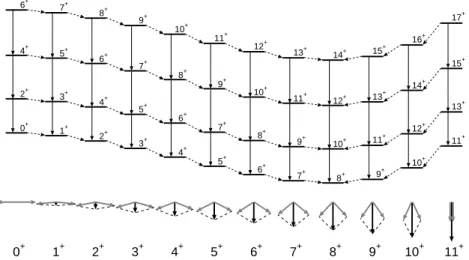
Figure 5. Band scheme predicted by the PTSM calculation in the weak coupling limit.
their detailed microscopic origin, we consider a two-nucleon system of one neutron and one proton both in the same 0h11/2 orbital. From simple geometrical considerations, the 8+ state of the two-nucleon system is built by perpendicular coupling of two angular momenta of the neutron and proton, while the 11+state is built by parallel coupling. By comparing the results for this two-nucleon system with those of actual134La calculations, the odd-spin yrast states (I) (I = 11,13,15,17), the even-spin yrast states (I−1) and the odd spin states (I−2) have the configurations of the unpaired nucleons with angular momentum 11, 10 and 9, respectively.
The configurations of two angular momenta of the unpaired nucleons with angular momentum 0 ∼ 11 are called chopsticks configurations hereafter. Since quadrupole collectivity plays an important role in describing the ∆I = 2 E2 bands, the main structure of these ∆I = 2 E2 bands is interpreted as arising from a weak coupling of the chopsticks configurations with the quadrupole collective motion of the even-even core. In Fig. 3, schematic illustrations of the chopsticks configuration are presented below each ∆I = 2 E2 band.
Our new interpretation leads to a schematic illustration of the band structure shown in Fig. 5, which is expected to occur in the weak coupling limit of the chopsticks configurations with the core excitations. The bandhead states of the ∆I = 2 E2 bands are built on the unpaired nucleons both in the 0h11/2 orbitals, coupled with the even- even core of angular momentum 0. The spin of the bandhead states corresponds to one of the possible chopsticks configurations with angular momentum 0 ∼ 11, whose schematic illustrations are shown below for each ∆I = 2 band in Fig. 5. In the actual calculations the PTSM provides four ∆I = 2 E2 bands with the bandhead states of 8+1, 9+1, 10+1 and 11+1.
4. Summary
To conclude, we have applied the PTSM to the structure study of the yrast and yrare states with the νh11/2 ⊗πh11/2 configuration in 134La. The calculation reproduces the experimental energy levels and electromagnetic transition rates, especially the staggering of the B(M1)/B(E2) ratios. Through analysis of their structure, it is found that the main structure of the yrast and yrare states is described in terms of a weak coupling of the chopsticks configurations, which represent two angular momenta of the unpaired neutron and the unpaired proton, to the multi-phonon excitations of the even-even core.
The detailed results are presented in Ref. [19] and a forthcoming paper [14].
References
[1] Starosta Ket al2001Phys. Rev. Lett.86971 [2] Hecht A A et al2001Phys. Rev.C63051302 [3] Koike T et al2001Phys. Rev.C63061304 [4] Hartley D J et al2001Phys. Rev.C64031304 [5] Bark R A et al2001Nucl. Phys.A691577 [6] Starosta Ket al2002Phys. Rev.C65044328 [7] Koike T et al2003Phys. Rev.C67044319 [8] Rainovski Get al2003Phys. Rev.C68024318 [9] Frauendorf S and Meng J 1997Nucl. Phys.A 617131
[10] Dimitrov V I Frauendorf S and Donau F 2000Phys. Rev. Lett.845732 [11] Peng J Meng J and Zhang S Q 2003Phys. Rev.C68044324
[12] Higashiyama K Yoshinaga N and Tanabe K 2003Phys. Rev.C67 044305 [13] Yoshinaga N and Higashiyama K 2004Phys. Rev.C69054309
[14] Higashiyama K Yoshinaga N and Tanabe K (Phys. Rev.C submitted) [15] Frauendorf S 1993Nucl. Phys. A557259c
[16] Petrache C Met al1996Nucl. Phys.A597106 [17] Petrache C Met al1996Nucl. Phys.A60350 [18] Petrache C Met al1998Nucl. Phys.A635361
[19] Higashiyama K and Yoshinaga N 2005Prog. Theor. Phys. 113?