Original Article
INTRODUCTION
Due to the rapid aging of Japanese society following World War II, Japan now has one of the highest percentages o f e l d e r l y c i t i z e n s a m o n g d e v e l o p e d c o u n t r i e s . Consequently, according to the data of Ministry of Health, Labour, and Welfare of Japan; 69% of cancer patients and 80% of patients who die of cancer are aged ≥ 65 years. As elderly individuals’ lifespans grow longer, their mental and physical functions decline, often causing them to fall into a pathologic state known as geriatric syndrome. In addition to
suffering from mental and physical impairment, many elderly people are socially and economically disenfranchised.
1Daily living, high medical expenses, and the absence of care typically raise barriers to cancer treatment. Thus, treatment of elderly individuals requires a comprehensive assessment of factors such as the background.
2The field of gerontology already employs the Com pre
hen sive Geriatric Assessment (CGA), a multifaceted assess
ment of aspects such as activities of daily living (ADL),
3mood
4and cognition.
5The results of the CGA are used as a basis for performing therapy and rehabilitation, which are used to improve survival rates and physical functioning.
6The use of the CGA has also been attempted in the treat
ment of elderly cancer patients. The National Com pre hen
sive Cancer Network guidelines, which are used worldwide, also recommend the use of the CGA as a tool for assessing benefits and the risk of adverse events in cancer treatment for elderly patients.
2In this study, we report on our retrospec
tive assessment of patient characteristics, performance status (PS), and CGA items in 93 patients with incipient malignant lymphoma; as well as our analysis of malignant lymphoma classification, stage, treatment content, and chemotherapy dose intensity.
Received: December 28, 2015 Revised : March 7, 2016 Accepted: April 3, 2016
1)Department of Medical Oncology, Hematology and Infectious Diseases, Fukuoka University, Fukuoka, Japan
2)Academia, Industry and Government Collaborative Research Institute of Translational Medicine for Life Innovation, Fukuoka University, Fukuoka, Japan
3)General Medical Research Center School of Medicine, Fukuoka University, Fukuoka, Japan
Corresponding author: Hidenori Sasaki, M.D., Division of Medical Oncology, Hematology and Infectious Diseases, Department of Medicine, Fukuoka University Hospital, 7-45-1 Nanakuma, Jonan-ku, Fukuoka 814-0180, Japan
Email: hsasaki@fukuokau.ac.jp
Retrospective Analysis of Treatment Outcomes and Geriatric Assessment in Elderly
Malignant Lymphoma Patients
Yoshiko Naito,
1)Hidenori Sasaki,
1)Yasushi Takamatsu,
1)Fumiaki Kiyomi,
2)and Kazuo Tamura
3)In recent years, the Comprehensive Geriatric Assessment (CGA), which is used in gerontology to assess functioning in elderly individuals, has been said to be useful in geriatric oncology. Therefore, we examined whether items in the CGA were associ
ated with survival time in elderly patients with non-Hodgkin lymphoma (NHL). We conducted the CGA for 93 patients aged ≥ 65 years who had undergone treatment for NHL retrospectively. The CGA includes activities of daily living, instrumental activities of daily living, mood, cognition, nutrition, and the Charlson comorbidity index. For each category, we divided sub
jects into a “good” group and a “poor” group. In regard to the Charlson comorbidity index, patients were divided into two groups using different cutoffs to divide the groups; the two groups were established according to the division with the largest significant difference in survival time. Multivariate analysis was then performed with the following prognostic factors affect
ing survival: all CGA items, NHL classification, stage, performance status, and doxorubicin use/non-use. We also performed similar analysis for 43 diffuse large B-cell lymphoma (DLBCL) patients who had undergone anthracycline treatment. Results are factors affecting survival in NHL cases included comorbidity score ≥ 6 (P < 0.0001), doxorubicin non-use (P = 0.005), and cognitive impairment (P = 0.0488). In cases of DLBCL, survival was affected by comorbidity score ≥ 5 (P = 0.0016). High comorbidity score was strongly associated with survival in both NHL and DLBCL. 〔J Clin Exp Hematop 56(1):43-49, 2016〕
Keywords: nonHodgkin lymphoma, overall survival, comprehensive geriatric assessment, Charlson comorbidity index
MATERIALS AND METHODS Patients and surveillance design
Patients aged 65 years or older who were admitted for the first time to the Department of Medical Oncology, Hematology, and Infectious Diseases, Fukuoka University Hospital for the treatment of non-Hodgkin lymphoma (NHL) were consecutively enrolled in this study during the period of January 2004 and December 2008. Their background char
acteristics were collected and CGA was conducted by reviewing the medical records at the time of initial examina
tion when they were hospitalized. Patient characteristics consisted of age, sex, histological classification, stage, PS, and international prognostic index (IPI).
7Items for the CGA consisted of ADL
3, instrumental activities of daily living (IADL),
8mood,
4cognition,
5nutrition,
9and comorbidities.
10CGA was performed using detailed daily review of medi
cal records by physicians, nurses, and pharmacists.
Assessment of ADL was based on the Barthel index;
3patients who required at least one item of assistance with feeding, bathing, walking, dressing, toilet use, or grooming were deemed to be impaired in their ADL. In assessing IADL, we referred to the ability to manage one’s own medication and go shopping by oneself, which are items on the IADL scale;
8patients who required at least one item of assistance in either of these were deemed to be impaired in their IADL. As for mood, although all patients naturally demonstrated some level of anxiety, those who were diagnosed as depressive or having depressive tendencies based on the Geriatric Depression Scale
4were considered to be impaired in their mood. In assessing cognition, patients were deemed to have cognitive impairment if described as such by their attending physician or a nurse. For patients in whom cognitive impair
ment was suspected, we administered the revised version of Hasegawa’s dementia scale.
5Nutrition was assessed based on the Mini Nutritional Assessment; patients with body mass index < 19 were deemed to suffer from undernutrition.
9Comorbidity was assessed using the Charlson comorbidity index.
10Comorbidities were scored as follows: myocardial infarc
tion, congestive heart failure, peripheral vascular disease, cerebrovascular disease, dementia, chronic pulmonary dis
ease, connective tissue disease, ulcer disease, mild liver dis
ease, and diabetes were each scored as one point; hemiplegia, moderate or severe renal disease, diabetes with end organ damage, any tumor, leukemia, and lymphoma were each scored as two points; moderate or severe liver disease was scored as three points; and metastatic solid tumor and acquired immune deficiency syndrome were scored as six points. All individual scores were added together to yield a total comorbidity score. We also examined the relationship between dose intensity and prognosis and safety profiles in
patients with diffuse large B-cell lymphoma (DLBCL), the most common type of lymphoma among our subjects, who had received a standard combination chemotherapy consist
ing of rituximab, cyclophosphamide (CPA), doxorubicin (ADR), vincristine (VCR), and prednisolone (R-CHOP) che
motherapy.
11We then analyzed these cases using patient characteristics, CGA, and dose intensity as variables.
Statistical analysis
We examined the association of CGA with using a simple and a multiple proportional hazard model. For the multivari
ate analysis, a variables selection was conducted by the step
wise method in order to determine the simplest model. For all cases of lymphoma, in addition to CGA items, we included PS, age, stage, lymphoma classification, and the use or nonuse of doxorubicin as explanatory variables. For cases of DLBCL, in addition to CGA items, we included PS, age, IPI, and average relative dose index (ARDI).
Of the CGA items analyzed in the proportional hazards model, ADL, IADL, cognition, mood, and nutrition were divided into a “good” group and a “poor” group. In regard to the Charlson comorbidity index, patients were divided into two groups using different cutoffs to divide the groups (for example, 1–2 points vs ≥ 3 points, 1–3 points vs ≥ 4 points, etc.), and cut off point was determined using the proportional hazard analysis: the two groups were established according to the division that demonstrated the largest significant differ
ence in survival time. As for PS, patients were divided into groups with relatively favorable (0–1) or poor statuses (2–4).
Depending on age, patients were divided into an earlyelderly group (65–74 years) and a late-elderly group (≥ 75 years).
Depending on the treatment, patients were divided into the group that used doxorubicin (the key drug in lymphoma treatment) and the group that did not. Depending on the dis
ease stage, patients were divided into an early-stage group (I–
II) and an advanced-stage (III–IV). Depending on the classi
fication, patients were divided into an “aggressive” group (moderate- or high-grade malignant lymphoma) and an
“indolent” group (low-grade malignant lymphoma). As for IPI, patients were divided into two groups: a low and low- intermediate group and a highintermediate and high group.
Next, we determined ARDI to examine the association between the intensity of R-CHOP chemotherapy and adverse events. The standard usages and doses of drugs in R-CHOP was as follows. For rituximab, 375 mg/m
2was infused intra
venously the day before beginning CHOP. CPA, ADR, and VCR were each injected intravenously on day 1 in respective doses of 750 mg/m
2, 50 mg/m
2, and 1.4 mg/m
2. Pred nis o- lone was administered for five days beginning on day 1 at a dose of 100 mg/day. These latter four drugs were adminis
tered every three weeks. Rituximab rarely results in serious
adverse events other than infusion reactions and has little
effect on the treatment schedule; therefore, it was excluded from examinations of dose intensity. Prednisolone was also excluded. The dose intensity of CPA, ADR, and VCR were determined in terms of dosage per week (mg/m
2/week), and the dosages actually administered were divided by the respective standard dosages to determine their respective rel
ative dose intensities. The relative dose intensity of these three drugs was then averaged to determine ARDI. To examine the association of ARDI with survival time, we examined survival time in 5% increments starting at 100%.
We then determined proportional hazards and used the ARDI with the largest significant difference as a cutoff point to divide ARDI into two groups. Survival curves were drawn by the KaplanMeier method.
Evaluation of adverse events
Chisquare tests were performed between each of the items in the CGA and ≥ grade 3 hematologic toxicity, as well as between CGA items and the manifestation of febrile neu
tropenia (FN). We similarly examined the development of constipation, stomatitis, and peripheral neuropathy, all of which are known to be frequent adverse events in CHOP chemotherapy.
11RESULTS Patient characteristics
Ninetynine elderly patients with NHL were enrolled in the study between January 2004 and December 2008. Since 6 patients were excluded because of being unable to obtain complete CGA data from their medical records, the present study were comprised of 93 patients whose characteristics were listed in Table 1. The median age was 77 (range, 65–90) years. Forty-three patients were male and 50 were female. Seventy-seven patients had aggressive lymphoma including 66 of DLBCL, while 16 patients had indolent lym
phoma including 9 with follicular lymphoma and 5 of MALT lymphoma. A total of 91 patients received anti-lymphoma treatment including chemotherapy in 82, radiation alone in 5 and surgery alone in 4, while 2 patients underwent best sup
portive care. R-CHOP therapy was given in 55 patients and CHOP in 9 (Table 1).
Since Charlson comorbidity index scores malignant lym
phoma as 2 points, all patients had a comorbidity score of ≥ 2. A total of 52 patients (56%) had a score of 2, while nine patients had a score of ≥ 5. Cognitive impairment was deemed present in four patients, three of whom had under
gone Hasegawa’s dementia scale and scored 27, 21, and 12 (Table 2).
Comprehensive geriatric assessment and overall survival We also analyzed the relationship between Charlson comorbidity index and survival rates. Chisquare tests dem
onstrated the greatest significant difference between scores of 2–5 and ≥ 6 in NHL and between scores of 2–4 and ≥ 5 in
Table 1. Baseline clinical features of 93 nonHodgkin lymphomapatients
Characteristics No. of patients (%)
Median age 65-74 75-90 Sex (male/female) Classifying of NHL Indolent type Follicular lymphoma MALT lymphoma
Lymphoplasmacytic lymphoma Nodal marginal zone lymphoma Aggressive type
Diffuse large Bcell lymphoma Angioimmunoblastic T-cell lymphoma Peripheral T-cell lymphoma
NK/T-cell lymphoma Mantle cell lymphoma Anaplastic large cell lymphoma Adult T-cell leukaemia/ lymphoma Burkitt lymphoma
Ann-Arbor stage III
III-IV
Performance status 01
24 Treatment Chemotherapy R-CHOP CHOP Methotrexate R-COP Others Radiation Surgery
Best supportive care Treatment of doxorubicin Including doxorubicin Without doxorubicin
77 53 (57) 40 (43) 43/50 16 (17) 9 (10) 5 (5) 1 (1) 1 (1) 77 (83) 66 (71) 2 (2) 2 (2) 2 (2) 2 (2) 1 (1) 1 (1) 1 (1) 41 (44) 52 (56) 73 (78) 20 (22) 82 (88) 55 (59) 9 (10) 4 (4) 3 (3) 11 (12)
5 (5) 4 (4) 2 (2) 66 (71) 27 (29) NHL, non-Hodgkin lymphoma; MALT, extranodal marginal zone lymphoma of mucosa-associated lymphoid tissue type; R-CHOP, rituximab, cyclophosphamide, doxorubicin, vincristine, predniso
lone; R-COP, rituximab, cyclophosphamide, vincristine, prednisolone
cases of DLBCL. These respective points were used to divide patients into two groups for use as variables in multi
variate analysis. In multivariate analysis of CGA and sur
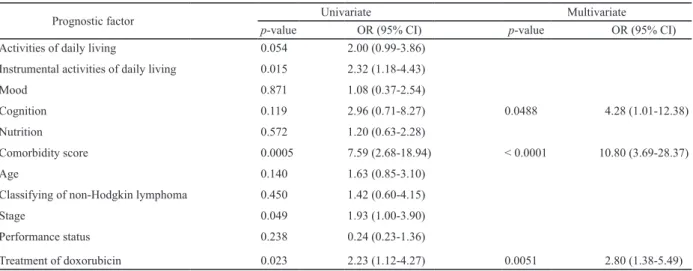
vival time among the 93 NHL patients, the largest significant difference was observed in the Charlson comorbidity index (P < 0.0001)(Table 3). The next largest significant differ
ences observed were in doxorubicin use/non-use (P = 0.005) and cognition (P = 0.049). In regard to the Charlson comor
bidity index which demonstrated the greatest significant dif
ference, we drew survival curves for scores of ≥ 6 and < 6 (Fig. 1).
For the 43 DLBCL patients who underwent R-CHOP chemotherapy, we analyzed the relationship between the ARDI of ADR/CPA/VCR and survival rate; we consequently
found the greatest significant difference in ARDI ≥ 75% (P = 0.028). Thus, patients were divided into an ARDI ≥ 75%
group and an ARDI < 75% group, which were included along with the variables analyzed for overall lymphoma. In multi
variate analysis related to survival rates for these 43 patients, leaving only the Charlson comorbidity index (P = 0.0016) as a significant variable (Table 4). Only comorbidity score was selected as a result of the stepwise method in the multivariate analysis, and therefore the results of univariate and multivari
ate analysis for comorbidity score are consistent.
Comprehensive geriatric assessment and adverse events Within the CGA, items associated with hematological toxicity were observed at a significantly higher frequency in patients with low ADL and in the development of anemia due to undernutrition. However, there were no risk factors related to leukocyte count, infection, or FN (Table 5). Also, there were no associations between CGA and the non-hema
tological toxicities of constipation, stomatitis, and peripheral neuropathy.
DISCUSSION
Japanese studies on lymphoma in elderly individuals have not produced data for examinations of indices other than PS. Although the present study is a retrospective study and therefore limited in terms of items examined, we were able to analyze the relationship between survival rates and CGA items.
In this study, we found that a Charlson comorbidity index score of ≥ 6 (P < 0.0001) was found to be a high risk factor for incipient NHL in individuals aged ≥ 65 years. The most common comorbidities in patients with scores ≥ 6 were meta
static solid tumors. Because malignant lymphomas are
Table 2. Comprehensive geriatric assessment of 93 nonHodgkin lymphoma patientsItem Group No. (%) Reference
Activities of daily living good/poor 67 (72%)/26 (28%) Barthel index3
Instrumental activities of daily living good/poor 64 (73%)/29 (27%) Instrumental activities of daily livings (Lawton & Brody)8
Mood good/poor 79 (85%)/14 (15%) Geriatric depression scale4
Cognition good/poor 89 (96%)/ 4 (4%) The revised version of Hasegawa's dementia scale5
Nutrition good/poor 55 (49%)/38 (51%) Mini nutritional assessment9
Comorbidity score
2 52 (56%)
Charlson comorbidity index10
3 22 (23%)
4 10 (12%)
5 3 (3%)
6 1 (1%)
7 1 (1%)
8 3 (3%)
9 1 (1%)
1.0 0.8 0.6 0.4
0.2
0.0
0 500 1000 1500 2000 2500 3000 3500 4000
Fig. 1. Overall survival curves of 93 nonHodgkin lymphoma patients by Charlson comorbidity index. A clear difference was observed between the comorbidity scores of ≥ 6 and < 6.
relatively easy to control with drug therapy and radiotherapy, it is understandable that metastatic solid cancers would be objects of focus as prognostic factors. But this fact that the Charlson comorbidity index score is a high risk factor for survival is very important for making decision of treatment.
General cancer treatment guidelines for elderly individu
als are as follows.
2First, the patient’s remaining life expec
tancy is compared with the survival time that would be yielded by treatment. If treatment would be able to suffi
ciently prolong the patient’s remaining life expectancy, treat
ment is proactively performed; otherwise, palliative or sup
portive therapy is considered. Our analysis strongly indicated that patients with a high Charlson comorbidity index score have extremely poor prognosis. So treatment for such cases should not strive for standard therapy to maintain
high ARDI, but rather should reduce dosages and discontinue doxorubicin (the key drug) with the goal of controlling the tumor. Moreover it is preferable we propose that such cases are discussed by cancer board, where multidisciplinary can
cer team meet together.
12From among the 93 NHL patients in this study, we abstracted 43 DLBCL patients who underwent R-CHOP che
motherapy. We analyzed for survival time not only CGA items, but also IPI and ARDI (which are prognostic factors for DLBCL); in univariate analysis, ARDI was significantly correlated with survival rates. However, in multivariate analysis, high comorbidity score emerged as a significant risk factor (P = 0.0016) as well as 93 NHL patients.
Studies on prognosis for malignant lymphoma have sel
dom considered the CGA. As retrospective analysis of 348
Table 4. Prognostic factors who received R-CHOP for 43 diffuse large B-cell lymphoma patients
Prognostic factor Univariate Multivariate
pvalue OR (95% CI) pvalue OR (95% CI)
Activities of daily living 0.284 0.48 (0.07-1.72)
Instrumental activities of daily living 0.712 0.81 (0.23-2.34)
Mood 0.830 0.85 (0.13-3.06)
Cognition 0.277 5.11 x 10⁹ (3.42-3.42)
Nutrition 0.802 1.14 (0.39-3.09)
Comorbidity score 0.0016 11.60 (2.80-45.32) 0.0016 11.60 (2.80-45.32)
Age 0.538 1.38 (0.48-3.81)
Performance status 0.090 0.24 (0.01-1.20)
International prognostic index 0.312 1.37 (0.60-4.55)
Average relative dose intensity 0.028 3.25 (1.13-11.65)
R-CHOP, rituximab, cyclophosphamide, doxorubicin, vincristine, prednisolone; OR, Odds’s ratio; CI, confidence interval Table 3. Prognostic factors affecting survival by univariate and multivariate analysis of 93 non-Hodgkin lymphoma patients
Prognostic factor Univariate Multivariate
pvalue OR (95% CI) pvalue OR (95% CI)
Activities of daily living 0.054 2.00 (0.99-3.86)
Instrumental activities of daily living 0.015 2.32 (1.18-4.43)
Mood 0.871 1.08 (0.37-2.54)
Cognition 0.119 2.96 (0.71-8.27) 0.0488 4.28 (1.01-12.38)
Nutrition 0.572 1.20 (0.63-2.28)
Comorbidity score 0.0005 7.59 (2.68-18.94) < 0.0001 10.80 (3.69-28.37)
Age 0.140 1.63 (0.85-3.10)
Classifying of nonHodgkin lymphoma 0.450 1.42 (0.60-4.15)
Stage 0.049 1.93 (1.00-3.90)
Performance status 0.238 0.24 (0.23-1.36)
Treatment of doxorubicin 0.023 2.23 (1.12-4.27) 0.0051 2.80 (1.38-5.49)
OR, Odds’s ratio; CI, confidence interval
DLBCL patients in 2008 who underwent a CHOP-like regi
men, Bosly et al.
13said ARDI, IPI, PS, and age as important prognostic factors, with particular emphasis of the impor
tance of ARDI. In Japan, in 1999, Mori et al.
14have con
ducted prospective trials to determine optimal CHOP doses for elderly patients. In a prospective study in which patients were administered a 1/2 dose, 7/12 dose, 5/6 dose, or a stan
dard dose, they reported that the optimal schedules for patients aged < 80 years and patients aged ≥ 80 years were 5/6 and 7/12 of the standard dose. Treatment was decided by patients’ age not CGA. In another study conducted by the same researchers with 57 elderly patients, patients aged 65–79 years and patients aged ≥ 80 years were administered 5/6 and 7/12, respectively, of the standard CHOP dose. The researchers reported respective threeyear survival rates of 58% and 30%.
15These results thus indicate that elderly lym
phoma patients who are at least healthy enough to participate in clinical trials demonstrate better outcomes with a higher ARDI in CHOP. These results show that ARDI is related to survival time.
As shown in Table 2, patients who Charlson comorbidity scores of ≥ 5 (which strongly affect prognosis) only accounted for approximately 10%. However, as Japanese society further ages, the number of patients with comorbidi
ties will increase; therefore, it becomes more important to consider high comorbidity score’s patients for providing appropriate treatment. In an examination of Charlson comor
bidity index and other prognostic factors in 154 DLBCL patients who had undergone R-CHOP chemotherapy, Wieringa et al.
16said Charlson comorbidity score ≥ 4 (P = 0.02) and IPI (P = 0.01) are prognostic factors; this report supports our results.
In addition to comorbidities, the use of doxorubicin also emerged as a factor favorably affecting survival times in the 93 malignant lymphoma patients in the present study (P = 0.005). In multivariate analysis of therapeutic outcomes for DLBCL and mantle cell lymphoma using CGA and the use/
nonuse of anthracyclinebased treatment as variables, Marchesi et al. similarly found doxorubicin to be an inde
pendent factor contributing to improved survival rates. This finding supports the idea that doxorubicin is the key drug for
aggressive lymphoma.
17Our study also suggested that cognitive impairment would affect survival in multivariate analysis (P = 0.0488).
Raji et al. reported older patients who had cognitive impair
ment were associated with high mortality than those of no mental problems in patients with breast, colon, and prostate cancer.
18This report supports our results.
In regard to CGA and adverse events among DLBCL patients, patients with impaired ADL and patients with under
nutrition demonstrated a significantly high frequency of ≥ grade 3 anemia (P = 0.045 and P = 0.007, respectively). In a prospective trial related to CGA and adverse events con
ducted among 500 patients with various cancers,
19,20not only low hemoglobin value, but also low leukocyte count and infection were noted significantly more frequently in patients with poor CGA outcomes. In this study, FN and infection yielded no differences in patients with poor CGA outcomes;
this lack of difference may have been due to proper adjust
ment of anticancer drug dosages.
In the present study, the Charlson comorbidity index was found to be a significant prognostic factor in NHL. There have been almost no attempts in the past to assess function
ing in elderly individuals, conduct a prospective study based on such an assessment, or to examine its association with prognosis like this. One possible reason is that no standard usage, dosage, or treatment has been established for malig
nant lymphoma among the elderly. Elderly individuals are frail compared to young individuals; therefore, they demon
strate greater diversity in host factors and require more indi
vidualized treatment. Consequently, stratification involves many factors, making prospective comparative studies diffi
cult to organize. Tucci et al. have reported among unfit patients who are problem in CGA, their outcomes did not dif
fer between curative treatment and palliative care.
21They suggests that the curability of DLBCL may not only depend on its biological characteristics, but also patientrelated fac
tors, which may be linked particularly to the parameters ana
lyzed by CGA.
In this study, comorbidity score and cognition were asso
ciated with prognosis. As the number of elderly malignant
Table 5. Association between comprehensive geriatric assessment and hematological toxicity and infection in diffuse large B-cell lymphoma 43 patients
White blood cell Absolute
neutrophil count Hemoglobin Platelet Febrile neutropenia/Infection
Activities of daily living 1.0 1.0 0.045 1.0 0.092
Instrumental activities of daily living 1.0 1.0 0.278 0.312 0.728
Mood 1.0 1.0 0.174 0.571 0.393
Cognition 1.0 1.0 0.372 1.0 1.0
Nutrition 0.458 0.451 0.007 0.161 0.219
Comorbidity score 0.188 0.226 0.372 0.372 0.465
lymphoma patients in Japan is expected to continue increas
ing, treatment guidelines for such patients need to be established.
ACKNOWLEDGMENTS
We thank project managers Y. Ito, N. Gushima, K.
Nakata, E. Kumakawa, N. Ikoma, and S. Nagamori, and the medical doctors N. Kunami, K. Tsutsumi, T. Tanaka, A.
Mogi, T. Goto, Y. Ikari, M. Masaki, Y. Nakashima, M. Ishizu, A. Shirahashi, E. Sato, Y. Kitai, T. Takata, A. Togawa, Y.
Obata, M. Yoshimura, H. Katsuya, K. Ishitsuka, C. Kawai, T.
Maeda and M. Fujita for valuable assistance in conducting the present study.
CONFLICT OF INTEREST STATEMENT Yasushi Takamatsu received honoraria for writing promo
tional material for Janssen and Celgene. Yoshiko Naito, Hidenori Sasaki, Fumiaki Kiyomi, and Kazuo Tamura have no conflict of interest.
REFERENCES
1 Jeffrey BH, Joseph GO, Mary ET, Stephanie S, Kevin PH, et al.: Hazzard’s Geriatric Medicine and Gerontology. 6th ed, New York, McGraw Hill, pp.621738, 2009
2 Hurria A: Management of elderly patients with cancer. J Natl Compr Canc Netw 11(5 Suppl):698-701, 2013
3 Mahoney FI, Barthel DW: Functional evaluation: The Barthel Index. Md State Med J 14:61-65, 1965
4 Yesavage JA, Brink TL, Rose TL, Lum O, Huang V, et al.:
Development and validation of a geriatric depression screening scale: a preliminary report. J Psychiatr Res 17:37-39, 19821983
5 Jeong JW, Kim KW, Lee DY, Lee SB, Park JH, et al.: A norma
tive study of the Revised Hasegawa Dementia Scale: compari
son of demographic influences between the Revised Hasegawa Dementia Scale and the Mini-Mental Status Examination.
Dement Geriatr Cogn Disord 24:288293, 2007
6 Applegate WB, Miller ST, Graney MJ, Elam JT, Burns R, et al.:
A randomized, controlled trial of a geriatric assessment unit in a community rehabilitation hospital. N Engl J Med 322:1572- 1578, 1990
7 No authors listed. A predictive model for aggressive non-Hodg
kin’s lymphoma. The International NonHodgkin’s Lymphoma Prognostic Factors Project. N Engl J Med 329:987-994, 1993 8 Lawton MP, Brody EM: Assessment of older people: self-main
taining and instrumental activities of daily living. Gerontologist 9:179186, 1969
9 Guigoz Y, Lauque S, Vellas BJ: Identifying the elderly at risk
for malnutrition. The Mini Nutritional Assessment. Clin Geriatr Med 18:737-757, 2002
10 Charlson ME, Pompei P, Ales KL, MacKenzie CR: A new method of classifying prognostic comorbidity in longitudinal studies: development and validation. J Chronic Dis 40:373383, 1987
11 Coiffier B, Lepage E, Briere J, Herbrecht R, Tilly H, et al.:
CHOP chemotherapy plus rituximab compared with CHOP alone in elderly patients with diffuse largeBcell lymphoma. N Engl J Med 346:235-242, 2002
12 Blazeby JM, Wilson L, Metcalfe C, Nicklin J, English R, et al.:
Analysis of clinical decision-making in multi-disciplinary can
cer teams. Ann Oncol 17:457-460, 2006
13 Bosly A, Bron D, Van Hoof A, De Bock R, Berrneman Z, et al.:
Achievement of optimal average relative dose intensity and cor
relation with survival in diffuse large Bcell lymphoma patients treated with CHOP. Ann Hematol 87:277-283, 2008
14 Mori M, Murai Y, Suzuki K, Nonaka Y, Sato H, et al.: Study of optimal CHOP dose ranges for elderly patients with non-Hodg
kin’s lymphoma. Rinsho Ketsueki 40:199-204, 1999 (in Japanese)
15 Mori M, Niitsu N, Takagi T, Tomiyama J, Matsue T, et al.:
Reduceddose chop therapy for elderly patients with nonHodg
kin’s lymphoma. Leuk Lymphoma 41:359-366, 2001
16 Wieringa A, Boslooper K, Hoogendoorn M, Joosten P, Beerden T, et al.: Comorbidity is an independent prognostic factor in patients with advancedstage diffuse large Bcell lymphoma treated with R-CHOP: a population-based cohort study. Br J Haematol 165:489-496, 2014
17 Marchesi F, Cenfra N, Altomare L, Dessanti ML, Mecarocci S, et al.: A retrospective study on 73 elderly patients (≥ 75 years) with aggressive B-cell non Hodgkin lymphoma: clinical signifi
cance of treatment intensity and comprehensive geriatric assess
ment. J Geriatr Oncol 4:242248, 2013
18 Raji MA, Kuo YF, Freeman JL, Goodwin JS: Effect of a dementia diagnosis on survival of older patients after a diagno
sis of breast, colon, or prostate cancer: implications for cancer care. Arch Intern Med 168:2033-2040, 2008
19 Hurria A, Togawa K, Mohile SG, Owusu C, Klepin HD, et al.:
Predicting chemotherapy toxicity in older adults with cancer: A prospective multicenter study. J Clin Oncol 29:3457-3465, 2011 20 Extermann M, Boler I, Reich RR, Lyman GH, Brown RH, et
al.: Predicting the risk of chemotherapy toxicity in older patients: the Chemotherapy Risk Assessment Scale for High- Age Patients (CRASH) score. Cancer 118:3377-3386, 2012 21 Tucci A, Ferrari S, Bottelli C, Borlenghi E, Drera M, et al.: A
comprehensive geriatric assessment is more effective than clini
cal judgment to identify elderly diffuse large cell lymphoma patients who benefit from aggressive therapy. Cancer 115:4547- 4553, 2009