福島県立医科大学 学術機関リポジトリ
This document is downloaded at: 2021-11-07T23:59:51Z
Title Interventions for body weight reduction in obese patients during short consultations: an open-label randomized controlled trial in the Japanese primary care setting( 本文 ) Author(s) 菅家, 智史
Citation
Issue Date 2014-03-25
URL http://ir.fmu.ac.jp/dspace/handle/123456789/606
Rights
© The Author(s). This is the pre-peer reviewed version.
Published version is "Asia Pac Fam Med. 2015 May 21;14(1):5. doi: 10.1186/s12930-015-0022-7", used under Creative Commons Attribution License.
DOI
Text Version ETD
Interventions for body weight reduction in obese patients during short consultations: an open-label randomized controlled trial in the Japanese primary care setting
Satoshi Kanke1), Takumi Kawai1), Naomi Takasawa1), Yukiko Mashiyama1), Atsushi Ishii2), and Ryuki Kassai1)
1) Department of Community and Family Medicine, Fukushima Medical University, Fukushima, Japan
2) Department of Internal Medicine, Kashima Hospital, Iwaki, Japan
Abstract Background
Family physicians should maintain regular contact with obese patients to ensure they effectively reduce their body weight. However, family physicians in Japan have on average only 6 min per consultation, and conventional interventions for body weight reduction require a longer consultation or additional manpower. A brief intervention within the limited consultation time available is therefore needed. Here we investigated the effectiveness of a brief weight reduction intervention for obese patients and the related factors for reducing body weight during routine consultations in the primary care setting.
Methods
We conducted an open-label randomized controlled trial at a family medicine clinic in Japan from January 2010 to June 2011. Patients aged 30 to 69 years with body mass index ≥25 who were diagnosed with hypertension, dyslipidemia, or type 2 diabetes mellitus were randomly assigned to the intervention or control group. At every consultation, body weight in the intervention group was measured by a family physician who provided weight reduction advice in addition to usual care. The primary outcome was body weight change at 1-year follow up. Analysis was done by intention to treat.
Results
We randomly assigned 29 participants to the intervention group and 21 to the
control group. Forty participants (80%) remained in the trial until the 1-year
follow up. At follow up, the median body weight change from baseline was not
significantly different between the groups (p=0.68), at −0.8 (interquartile range [IQR] −2.5 to 1.0) kg in the intervention group and 0.2 (IQR −2.4 to 0.8) kg in the control group.
Conclusion
The intervention method that physicians measured body weight and to advise for weight reduction at every consultation. In our setting, this method did not extend consultation length, but did not have significant additional effects on usual care for body weight reduction of moderately obese patients.
This trial is registered with the UMIN Clinical Trial Registry (UMIN
000002967).
Background
The number of patients with hypertension, dyslipidemia, or type 2 diabetes mellitus has increased in the last few decades in Japan [1]. From 2002 to 2011, the number of patients with hypertension increased from 7 million to 9 million, those with dyslipidemia from 1.4 million to 1.9 million, and those with type 2 diabetes from 2.3 million to 2.7 million [1]. All three of these diseases are related to obesity [2, 3]. In 2008, more than 10% of the world’s adult population was obese according to the World Health Organization’s definition of a body mass index (BMI) ≥30 kg/m
2[4], although only 3% of the Japanese population in 2011 conformed to this definition of obesity [5]. As the incidence rates of obesity-related diseases in Japan have been increasing, an international expert panel proposed a lower BMI cut-off for the Japanese population [6]. The current definition of obesity for Japanese is BMI ≥25 kg/m
2[7]. According to this definition, 30% of Japanese adult men and 21% of Japanese adult women were reported to be obese in 2011 [5]. Developing an effective intervention for reducing the body weight of obese Japanese patients has the potential to improve the management of obesity-related diseases.
Although the guidelines for managing overweight and obesity recommend
advising patients with obesity-related diseases to lose weight [8], the weight
reduction approach of healthcare providers remains inadequate [9]. Primary care
physicians meet many obese patients with obesity-related diseases [10] and
should maintain regular contact with these patients to ensure they reduce their
body weight as necessary. Epstein and Ogden showed there was a contradiction
between primary care physicians and obese patients. Obese patients think
obesity as a medical problem that should be managed by the physicians. In
contrast, physicians consider that obesity management is primarily the
responsibility of the patients. One of the reasons of the contradiction is lack of
effective patient interventions in the primary care setting[11]. In the primary care setting, physicians need a brief and easy-to-perform intervention method for encouraging obese patients to lose weight. Because physicians manage on average three problems during each short consultation [12], it is too difficult to provide the proven intervention methods established in other studies in a real- world clinical setting. In previous studies conducted in the primary care setting outside of Japan, patient body weight has been effectively reduced through lifestyle counseling provided by medical assistants, nurses, or dietitians [13-15], as well as by Internet-based intervention programs [16, 17]. In Japan, providing these interventions in the primary care setting is difficult because very few dietitians work for primary care clinics and clinic nurses do not have sufficient experience in lifestyle counseling. In fact, most lifestyle counseling is given by Japanese primary care physicians during regular patient visits [18]. In other studies, physicians have provided tailored intervention to obese patients during 15 to 20-min long consultations [19, 20]; however, in Japan, primary care consultations last for around 6 min [21], meaning that primary care physicians cannot practically provide any effective counseling-based interventions due to time constraints. In the Japanese primary care setting, physicians need simple and easy-to-perform methods of intervention that are suitable for use in routine brief consultations.
In our clinical experience, some of our obese patients, whose body weight was checked by the physician at every consultation, managed to reduce their body weight. Based on this success, we focused on body weight monitoring as an innovative method for promoting body weight reduction in the primary care setting.
In general, weight reduction strategies consist of the following five approaches:
dietary intervention, physical activity, behavioral treatment, pharmacotherapy,
and surgical therapy[3]. Many studies in the primary care setting have reported the effects of dietary intervention, physical activity, and pharmacotherapy on body weight reduction in obese patients [13-15]. However, weight monitoring is a component of behavioral treatment, and in the area of behavioral treatment, most studies on body weight reduction have applied an intensive approach in an academic setting; few studies have reported the effects of behavioral treatment on body weight reduction in the primary care setting [22].
Against this background, we hypothesized that if physicians involved in
outpatient care measure patient body weight and advised about weight reduction
at every consultation, this approach might reduce the body weight of obese
patients since it can be performed quickly and easily. There are important points
of the approach of this study. An obese patient monitored their weight with their
physician. Weight monitoring makes obese patients to recognize actual
condition of their weight. In this study, we planned weight monitoring with a
physician at every consultation that may provide a feeling of tension and
motivation of life-style change. Another point was the physician asked the
patient about life-style based on the measured body weight, and provided
specific advices of participant’s background that makes difficult to change life-
style. An intervention method for life-style change is needed to improve a
doctor-patient relationship[23, 24]. We planned to establish trust relationship by
physician’s advice in the intervention method. The objective of this study,
therefore, was to devise a brief and easy-to-perform intervention method for
body weight reduction in the Japanese primary care setting.
Methods
Design and participants
We planned an open-label randomized control study at a family medicine clinic (Date City, Fukushima Prefecture, Japan) attended by four family physicians.
When obesity-related disease diagnosed at this clinic, a patient is informed from physicians about needs of decreasing their caloric intake (25 kcal/kg of ideal body weight/day), eating well-balanced foods (protein is 10-15% of total caloric intake, fat is 20-25%, and carbohydrate is 60%), exercise 20-30 minutes more than three times per week, and losing 5% of his or her body weight[25-28].
These patients have regular consultation every month or two.
From January to June 2010, we checked the medical records of adult patients
aged 30-69 years who visited the family medicine department for routine
checkups for hypertension, dyslipidemia, or type 2 diabetes mellitus. A total of
180 patients were matched in January 2010. From the pool, we recruited 57
patients with a BMI ≥25 kg/m
2(moderately to severely obese) to participate in
this study. We excluded patients with a history of cancer or psychological
disease or those prescribed hormone therapy because these factors are known to
affect body weight [29-31]. We informed all participants of the aim and content
of the study and obtained their written consent to participate. After being
informed of this research project, 51 patients agreed to participate. One
participant with a history of cancer was excluded. At baseline measurement, 50
participants (18 women, 36%; 32 men, 64%) were enrolled. We randomized 29
participants to the intervention group and 21 participants to the control group. In
total, 44 participants (88%) were assessed for body weight changes at 6 months,
and 40 participants (80%) remained in the study until the 1-year follow up
(Figure 1).
Baseline data and measurement
After the participants agreed to participate, their physician collected the following baseline data: age, sex, history of hypertension (yes or no), history of dyslipidemia (yes or no), history of type 2 diabetes (yes or no), educational background (junior high school, high school, technical college, or university), history of smoking (never smoker, former smoker, or current smoker), history of alcohol consumption (never drinker, <once a week, <3 times per week, <6 times per week, or daily), and frequency of body weight self-monitoring (<once a month, <once a week, several times per week, or daily). The places of weight self-monitoring were not only the participants’ house but also other places.
Nurses, who were blinded to the group assignment of each patient, measured participant height, body weight, abdominal circumference, and blood pressure.
After defecation and micturition, participants removed their shoes and wore as light clothing as possible for height and body weight measurement on a digital scale. Abdominal circumference was measured at the umbilical level with a tape measure in the standing position and at end-expiratory pressure [32], and blood pressure was measured in the sitting position with an automated sphygmomanometer after a few minutes rest. We checked these data and the participants’ medical records to ensure the participants met the criteria for metabolic syndrome (Japanese criteria and the National Cholesterol Education Program-Adult Treatment Panel III criteria) [32, 33].
Randomization
Participants were assigned original identification numbers, which were sent to a
co-researcher (A.I.) working at another hospital who randomized these numbers
into two groups (intervention group and control group) by means of a random digits program. The randomization results were sent to the chief researcher (S.K.) who informed the participants. Figure 1 shows the participant flow throughout the study.
Intervention
In the intervention group, at the first consultation after the randomization, participants were informed about the participant’s ideal body weight, weight reduction target (5% of current weight), and positive effect of weight reduction for their present diseases by using information leaflet by a physician [25].
Participants were given notices that a physician would check his or her body weight and give specifically advice about weight reduction at every regular consultation. Since then, participants received care of their present diseases based on the Japanese guidelines of hypertension, dyslipidemia and type 2 diabetes[26-28] every month or two. A physician measured the body weight after defecation and micturition of the participant with an analogue scale within the every consultation, and to provide advices for the participant focused on weight reduction based on the measured body weight at every consultation. The physician was required to question at every consultation specifically about eating and exercise, to reconfirm the participants’ weight target, and to provide advice focused on each participant’s difficult points of life-style change. We commissioned the physicians this intervention even if the consultation length was longer than the time of appointment (Table 2).
In the control group, at the first consultation after the randomization,
participants were informed about the participant’s ideal body weight, weight
reduction target, and positive effect of weight reduction likewise the
intervention group. Since then, participants received care of their present
diseases based on the Japanese guidelines every month or two. However, a physician was not forced at all consultations to measure the body weight of the participants and to discuss body weight reduction.
Outcomes
The primary outcome of this study was change in body weight at 1-year follow up. Secondary outcomes were changes in body weight at 6-month follow up, and changes in abdominal circumference and blood pressure at the 6-month and 1-year follow ups. Nurses blinded to the group assignment of each patient measured body weight, abdominal circumference, and blood pressure at 6 months and 1 year. The nurses then asked the participants about their frequency of weight self-monitoring at the 1-year follow up using the same classification as that used at baseline. Physicians recorded the length (in minutes and seconds) of each consultation and calculated the mean length for each patient after all participants had completed the 1-year follow up.
Sample size calculation
We selected a mean weight difference of 2 kg after 1 year as clinically significant and assumed a standard deviation of weight change of 2 kg, in accordance with a previous study [34]. The present study was designed to have an 80% power to detect a weight change of 2 kg in both groups. For this purpose, at least 17 participants were needed in each group. We considered p<0.05 as statistically significant.
Blinding
We informed the participants and the physicians, but not the nurses, of the
randomization results at the first consultation after randomization. No
measurement data were given to the physicians. Analysis was performed after all data had been collected.
Statistical analysis
Analysis was based on the intention-to-treat principle. The categorical variables of baseline data were converted into binary categories, education background (<high school or ≥high school), history of smoking (non-smoker or currently smoker), history of drinking alcohol (<once a week or ≥once a week), and frequency of body weight self-monitoring (<once a week or ≥once a week). We analyzed baseline data between the two participant groups using the Mann- Whitney U test and χ
2test. The main outcome and secondary outcomes were analyzed using the Mann-Whitney U test. Statistical analysis was performed using SPSS Statistics (version 17.0; SPSS Inc, Chicago, IL).
Ancillary analysis
We performed ancillary analyses about effects of the intervention for morning fasting blood glucose (BS), triglyceride (TG), high-density lipoprotein cholesterol (HDL-C) and low-density lipoprotein cholesterol (LDL-C). These blood test data were collected from each participants’ medical record at baseline and 1-year follow up. The changes in these parameters at 1-year follow up were analyzed using the Mann-Whitney U test.
Another analyses was about the associations between body weight change and
consultation factors. Data of 40 participants, regardless of their randomization
group, who completed the 1-year follow up were used. We focused on the
consultation factors, which included the number of consultations over 1 year,
total length of consultations over the year, mean length of each consultation,
and number of physicians who saw participants in the clinic over the year, in order to calculate the total consultation length over the year and the mean length of each consultation. The number of physicians who saw participants was obtained from the medical records. The associations of these factors with the change in body weight over the 1-year period were analyzed using Spearman’s rank correlation coefficient.
This study was approved by the Ethics Board of Fukushima Medical University (No. 905) and is registered in the UMIN Clinical Trial Registry (UMIN 000002967).
Results
In all participants, the mean age (standard deviation [SD]) was 54.8 (6.7) years, mean body weight (SD) was 74.1 (9.6) kg, and mean BMI (SD) was 28.1 (2.1) kg/m
2. At baseline, no significant differences were evident between the groups (Table 1). The median number of consultations (interquartile range [IQR]) was 8 (7 to 10) in the intervention group and 10 (9 to 11) in the control group. The median consultation length (IQR) for each patient over the 1-year period was 59.1 (51.4 to 71.1) min in the intervention group and 79.7 (64.8 to 97.8) min in the control group. The median length (IQR) of each consultation was 7.0 (6.3 to 8) min in the intervention group and 8.0 (6.4 to 9.8) min in the control group.
The median number of doctors (IQR) who saw each participant over the 1-year
period was 2 (1 to 3) in the intervention group and 2 (1 to 3) in the control
group. The number of consultations (p=0.01) and the total consultation length
(p=0.002) were significantly different in both groups. The length of each
consultation was not significantly different (p=0.13) (Table 3).
Intention-to-treat analysis revealed that at 1 year, 15 participants in the intervention group (68% of the group) and 9 participants in control group (50%
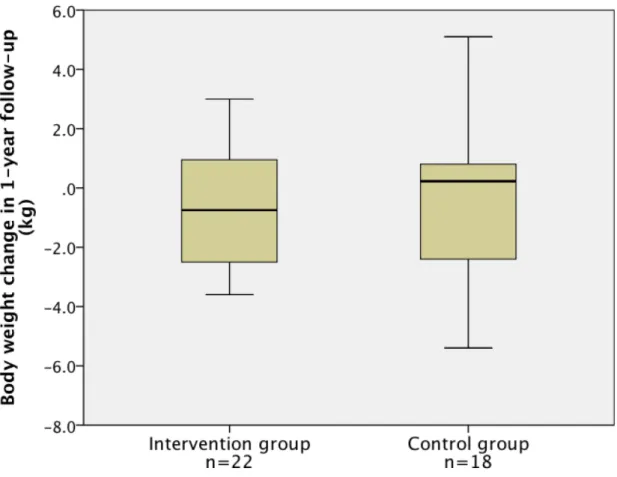
of the group) had decreased their body weight from baseline values. The median (IQR) change in body weight from baseline was −0.8 (−2.5 to 1.0) kg in the intervention group and 0.2 (−2.4 to 0.8) kg in the control group. There was no significant differences in this primary outcome (p = 0.68) observed between the groups (Figure 2).
No significant differences in secondary outcomes were noted between the groups; that is, the median (IQR) changes in the intervention and control groups at the 1-year follow up were 0.0 (−3.5 to 1.5) cm and −1.2 (−2.8 to 1.0) cm for abdominal circumference, 2 (−12 to 10) mmHg and −1 (−10 to 7) mmHg for systolic blood pressure, and −2 (−6 to 4) mmHg and −2 (−10 to 8) mmHg for diastolic blood pressure, respectively. The median (IQR) changes in the intervention and control groups at 6 months were −1.0 (−2.3 to 0.6) kg and −1.9 (−3.8 to 0.6) kg for body weight, −1.1 (−2.4 to 0.9) cm and −2.8 (−4.0 to −0.4) cm for abdominal circumference, 0 (−6 to 9) mmHg and 0 (−15 to 7) mmHg for systolic blood pressure, and −1 (−6 to 7) mmHg and −2 (−10 to 7) mmHg for diastolic blood pressure, respectively (Figure 3). Again, no significant differences were observed between the groups.
In ancillary analyses about effects of the intervention for morning fasting BS,
TG, HDL-C and LDL-C, the median (IQR) changes in the intervention and
control groups at the 1-year follow up were 2 (-8 to 10) mg/dl and 1 (-8 to 5)
mg/dl for BS, -14 (-32 to 19) mg/dl and 10 (-17 to 48) mg/dl for TG, 1 (-5 to 7)
mg/dl and 3 (0 to 6) mg/dl for HDL-C, and 1 (-24 to 12) mg/dl and 3 (-12 to 20)
mg/dl for LDL-C (Figure 4), there were no significant differences between the
groups.
In analyses of consultation factors, the mean number of consultations (SD) was 9.1 (2.1), mean total consultation length (SD) over 1 year was 70.6 (24.9) min, mean length of each consultation (SD) was 7.8 (2.2) min, and mean number of physicians who saw each participant (SD) was 2.1 (1.0). The correlation coefficient was 0.16 (p=0.31) for body weight change and the number of consultations, 0.32 (p=0.05) for body weight change and the total consultation length, 0.30 (p=0.06) for body weight change and length of each consultation, and −0.01 (p=0.93) for body weight change and the number of physicians who saw each participant. A weak positive correlation was seen between body weight change and total consultation length over the year.
It should be noted that the study area was affected by the Great East Japan
Earthquake in March 2011, which occurred during the study period. In the
aftermath, both water and gasoline were in short supply, which forced some
participants to evacuate to community halls for several days. The 1-year follow
up for 11 participants of the intervention group (50% of the group) and 9 in the
control group (50% of the group) (total 20; 50%) was done after the earthquake,
and we analyzed the effect of the earthquake on body weight change using the
Mann-Whitney U test (Table 4). No significant differences were observed in
body weight change between the participants who attended the 1-year follow up
before the earthquake and those who attended after it (p=0.95).
Discussion
We planned this study to reveal the effects of adding in a brief intervention for body weight reduction provided by physicians to obese Japanese patients at a family medicine clinic in the primary care setting. Given the lower incidence rate of severe obesity in Japan than in developed Western countries (1,4), we need an intervention method that not only addresses severe obesity, but also overweight and moderate obesity. In this study, only 8 participants (16%) were severely obese (BMI ≥30, Japanese criteria), and the average BMI was 28.1, which is classed as moderately obese.
Our results revealed no significant differences in consultation length between the intervention and control groups. This intervention method was performed briefly as planned and proved suitable for short routine consultations. It is important point in a real-world clinical setting that intervention method is feasible in a short routine consultation.
The total consultation length was unexpectedly longer in the control group than
in the intervention group. The consultation length for the control group might
have been longer because the control group had a higher ratio of participants
who gained body weight. A possible explanation for this finding is that
physicians may have extended the duration of each consultation for patients
who gained weight and may have kept consultations short for patients who kept
and lost weight. Alternatively, physicians may have extended the consultation
time in general to measure body weight and provide advice to patients in the
intervention group within the short consultation time allotted and in doing so
might have unintentionally overlooked other aspects of care while being
preoccupied with the measurement, keeping the consultation time shorter for the
intervention group overall.
Although we planned a brief and easy-to-perform intervention method for body weight reduction, no significant additional effects on usual care were observed.
On the other hand, physician’s brief advice has been shown to be effective for quitting smoking [35] in the primary care setting. Simple intervention methods to quit smoking for primary care physicians are established[36]. Weight reduction is more complex than smoking cessation in two points. First, cigarette smoking is not essential items to live. Physicians, therefore, can advice to stop smoking clearly. But patient cannot stop eating, because eating is essential behavior to live. Physicians can advise just how to eat. To quit behavior can be simpler than to find an appropriate way to adjust behavior. The second point is the nature of the medical conditions. Since smoking is one of behavioral risk factors for health, physicians’ advice can be focused on smoking behavior directly. On the other hand, obesity is a biomedical condition as a result of interactions of social, behavioral, cultural, physiological, metabolic and genetic factors[37]. For success of weight reduction, obese patients need to change eating, exercising, working, and other behaviors. Physicians need to intervene in multiple factors for weight reduction with obese patients.
The multiple categories of intervention for body weight reduction available. The intervention method used in this study was based on a behavioral approach, for which we attached high value to an easy-to-perform method. Previous studies have shown that intervention methods involving multiple approaches for weight reduction are more effective than those with a single approach [14, 38, 39].
Thus, to develop an effective intervention method for reducing body weight in
the short primary care consultation, it may be useful to encompass multiple
brief and easy-to-perform approaches suited to short consultations.
The situation of our clinic may affect for the outcome. Effective doctor-patient communication can improve patient health outcomes[24], family medicine trainees need to improve their skills of doctor-patient communication in residency training. The family medicine clinic, which was a teaching clinic of a family medicine residency program, had four family physicians. One of the physicians was a faculty and other three physicians were senior trainees of family medicine. More experienced family physicians could have made differences by the intervention method.
As another clue of devising a brief and easy-to-perform intervention method, we noted weight self-monitoring. In a previous study, Butryn and colleagues showed that more frequent body weight self-monitoring was related to body weight maintenance in patients who had lost weight [40]. Some researchers have proposed that weight self-monitoring increases obese patients’ awareness of their weight and results in them modifying their eating and exercise behavior[41]. We noted in supplemental data about the relationship between self-monitoring frequency at baseline and body weight reduction (Supplemental Figure 1), and between change of body weight self-monitoring frequency and body weight reduction (Supplemental Table 1, Figure 2). We think that this relationship should worth exploring further by conduction another prospective study.
This study has several limitations. First, it was conducted at a single family
medicine clinic. It was difficult to analyze in subgroup of sex, age and other
factors because of the number of eligible patients for this study in the clinic. In
addition, it was difficult to make this type of trial blinded. A cluster randomized
controlled design is a possible solution for assembling more participants and
acquiring more evidence with greater power. The second limitation is that this
study was conducted in the Japanese clinical setting, which differs from that in
Western countries in terms of shorter and more frequent consultations. The third limitation is that the intervention method was affected to doctor-patient communication. We did not strictly standardize the content of the weight reduction advice provided by the physicians. This might have caused inter- physician differences in the intervention, which were not measured. A final limitation is the effects of the Great East Japan Earthquake. In particular, we could not eliminate the effects of the earthquake because of the small study population.
Conclusions
We studied the intervention method that physicians measure body weight and to advise for weight reduction at every consultation. In our setting, this method did not extend consultation length but did not have significant additional effects on usual care for body weight reduction of moderately obese patients. More researches of simple and easy-to-perform intervention methods are needed. We found a potential research question about weight self-monitoring and body weight reduction in the primary care setting.
Acknowledgement
Part of this study was financially supported by the Jinsenkai Public Interest
Incorporated Foundation. We thank Kimie Iizuka, Tomoko Yoshida, and Emiko
Furukawa for their assistance in measuring patient parameters. We are also
grateful to all the participants in this study.
References
1. 2011 Patient Survey. Ministry of Health, Labour and Welfare, Japan; 2012:1–14.
2. Mokdad AH, Ford ES, Bowman BA, Dietz WH, Vinicor F, Bales VS, Marks JS:
Prevalence of obesity, diabetes, and obesity-related health risk factors, 2001. JAMA 2003, 289:76–79.
3. Xiao J, Yang W: Weight loss is still an essential intervention in obesity and its complications: A review. Journal of Obesity 2012, 2012:1–6.
4. World Health Organization: Obesity and Overweight WHO Fact Sheet No311. 2013.
5. 2011 National Health and Nutrition Survey Japan. Ministry of Health, Labour and Welfare; 2012.
6. Kanazawa M, Yoshiike N, Osaka T, Numba Y, Zimmet P, Inoue S: Criteria and
classification of obesity in Japan and Asia-Oceania. Asia Pac J Clin Nutr 2002, 11 Suppl 8:S732–7.
7. World Health Organization: Appropriate body-mass index for Asian populations and its implications for policy and intervention strategies. The Lancet 2004, 363:157.
8. Jensen MD, Ryan DH, Apovian CM, Ard JD, Comuzzie AG, Donato KA, Hu FB, Hubbard VS, Jakicic JM, Kushner RF, Loria CM, Millen BE, Nonas CA, Pi-Sunyer FX, Stevens J, Stevens VJ, Wadden TA, Wolfe BM, Yanovski SZ: 2013 AHA/ACC/TOS Guideline for the Management of Overweight and Obesity in Adults: A Report of the American College of Cardiology/American Heart Association Task Force on Practice Guidelines and The Obesity Society. Circulation 2013.
9. Galuska DA, Will JC, Serdula MK, Ford ES: Are health care professionals advising obese patients to lose weight? JAMA 1999, 282:1576–1578.
10. Stecker T, Sparks S: Prevalence of obese patients in a primary care setting. Obesity 2006, 14:373–376.
11. Epstein L, Ogden J: A qualitative study of GPs' views of treating obesity. Br J Gen Pract 2005, 55:750–754.
12. Beasley JW: How Many Problems Do Family Physicians Manage at Each Encounter? A WReN Study. The Annals of Family Medicine 2004, 2:405–410.
13. Wadden TA, Volger S, Sarwer DB, Vetter ML, Tsai AG, Berkowitz RI, Kumanyika S, Schmitz KH, Diewald LK, Barg R, Chittams J, Moore RH: A two-year randomized trial of obesity treatment in primary care practice. N Engl J Med 2011, 365:1969–1979.
14. Nanchahal K, Townsend J, Letley L, Haslam D, Wellings K, Haines A: Weight- management interventions in primary care: a pilot randomised controlled trial. Br J Gen Pract 2009, 59:157–166.
15. ter Bogt NCW, Bemelmans WJE, Beltman FW, Broer J, Smit AJ, van der Meer K:
Preventing weight gain by lifestyle intervention in a general practice setting: three-year results of a randomized controlled trial. Arch Intern Med 2011, 171:306–313.
16. Bennett GG, Herring SJ, Puleo E, Stein EK, Emmons KM, Gillman MW: Web-based weight loss in primary care: A randomized controlled trial. Obesity 2009, 18:308–313.
17. Appel LJ, Clark JM, Yeh H-C, Wang N-Y, Coughlin JW, Daumit G, Miller ER, Dalcin A, Jerome GJ, Geller S, Noronha G, Pozefsky T, Charleston J, Reynolds JB, Durkin N, Rubin RR, Louis TA, Brancati FL: Comparative effectiveness of weight-loss interventions in clinical practice. N Engl J Med 2011, 365:1959–1968.
18. Suzuka T: The needs assessment of nutrition counseling in primary internal medicine clinic. Kyoto igakukai zassi 2008, 55:173–176. [in Japanese]
19. Christian JG, Bessesen DH, Byers TE, Christian KK, Goldstein MG, Bock BC: Clinic- based support to help overweight patients with type 2 diabetes increase physical activity and lose weight. Arch Intern Med 2008, 168:141–146.
20. Martin PD, Dutton GR, Rhode PC, Horswell RL, Ryan DH, Brantley PJ: Weight loss maintenance following a primary care intervention for low-income minority women.
Obesity 2012, 16:2462–2467.
21. Wooldridge AN, Arató N, Sen A, Amenomori M, Fetters MD: Truth or fallacy? Three hour wait for threeminutes with the doctor: Findings from a privateclinic in rural Japan. Asia Pacific Family Medicine 2010, 9:11.
22. Butryn ML, Webb V, Wadden TA: Behavioral Treatment of Obesity. Psychiatric Clinics of North America 2011, 34:841–859.
23. German PS: Compliance and chronic disease. Hypertension 1988, 11:II56–II56.
24. Stewart MA: Effective physician-patient communication and health outcomes: a review. CMAJ 1995, 152:1423–1433.
25. Japan society for the Study of Obesity: Obesity disease treatment guideline 2006.
Himan Kenkyu 2006, 12(suppl.):1–91. [in Japanese]
26. Ogihara T, Kikuchi K, Matsuoka H, Fujita T, Higaki J, Horiuchi M, Imai Y, Imaizumi T, Ito S, Iwao H, Kario K, Kawano Y, Kim-Mitsuyama S, Kimura G, Matsubara H, Matsuura H, Naruse M, Saito I, Shimada K, Shimamoto K, Suzuki H, Takishita S, Tanahashi N,
Tsuchihashi T, Uchiyama M, Ueda S, Ueshima H, Umemura S, Ishimitsu T, Rakugi H, et al.:
The Japanese Society of Hypertension Guidelines for the Management of Hypertension (JSH 2009). Hypertens Res 2009:3–107.
27. Japan Atherosclerosis Society: Japan Atherosclerosis Society (JAS) Guidelines for Prevention of Atherosclerotic Cardiovascular Disease 2007. 2007 [in Japanese]
28. The Japan Diabetes Society: Evidence-Based Practice Guideline for the Treatment of Diabetes in Japan 2007. 2007. [in Japanese]
29. Serretti A, Mandelli L: Antidepressants and body weight. J Clin Psychiatry 2010, 71:1259–1272.
30. Vanina Y, Podolskaya A, Sedky K, Shahab H, Siddiqui A, Munshi F, Lippmann S: Body weight changes associated with psychopharmacology. Psychiatr Serv 2002, 53:842–847.
31. Espeland MA, Stefanick ML, Kritz-Silverstein D, Fineberg SE, Waclawiw MA, James MK, Greendale GA: Effect of postmenopausal hormone therapy on body weight and waist and hip girths. Postmenopausal Estrogen-Progestin Interventions Study Investigators. J Clin Endocrinol Metab 1997, 82:1549–1556.
32. [Definition and the diagnostic standard for metabolic syndrome--Committee to Evaluate Diagnostic Standards for Metabolic Syndrome]. Nippon Naika Gakkai Zasshi 2005, 94:794–809. [in Japanese]
33. Grundy SM: Diagnosis and Management of the Metabolic Syndrome: An American Heart Association/National Heart, Lung, and Blood Institute Scientific Statement.
Circulation 2005, 112:2735–2752.
34. Tsai AG, Wadden TA, Rogers MA, Day SC, Moore RH, Islam BJ: A primary care intervention for weight loss: results of a randomized controlled pilot study. Obesity 2009, 18:1614–1618.
35. Stead LF, Buitrago D, Preciado N, Sanchez G, Hartmann-Boyce J, Lancaster T:
Physician advice for smoking cessation. Cochrane Database Syst Rev 2013, 5:CD000165.
36. Use T, Panel DG: Treating tobacco use and dependence: 2008 update. 2008.
37. Initiative NOE: Clinical guidelines on the identification, evaluation, and treatment of overweight and obesity in adults. 1998.
38. Jakicic JM, Tate DF, Lang W, Davis KK, Polzien K, Rickman AD, Erickson K, Neiberg RH, Finkelstein EA: Effect of a stepped-care intervention approach on weight loss in adults: a randomized clinical trial. JAMA 2012, 307:2617–2626.
39. Wu T, Gao X, Chen M, van Dam RM: Long-term effectiveness of diet-plus-exercise interventions vs. diet-only interventions for weight loss: a meta-analysis. Obesity Reviews 2009, 10:313–323.
40. Butryn ML, Phelan S, Hill JO, Wing RR: Consistent self‐monitoring of weight: A key component of successful weight loss maintenance. Obesity 2007, 15:3091–3096.
41. Burke LE, Wang J, Sevick MA: Self-Monitoring in Weight Loss: A Systematic Review of the Literature. Journal of the American Dietetic Association 2011, 111:92–102.
Table 1: Baseline demographic and clinical characteristics of participants
We compared groups with Mann-Whitney U test or χ2 test.
*BMI=body mass index.
†Data were missing for one patient on intervention group and one patient on control group.
n(%) or
Median (interquartile range)
Intervention Control p
value
n=29 n=21
Age (years) 56 (38 to 65) 55 (42 to 63) 0.94
Sex 0.39
Female 9 (31) 9 (43)
Male 20 (69) 12 (57)
Weight (kg) 71.8 (67.3 to 82.4) 74.1 (68.1 to 77.4) 0.84
Height (cm) 164.5 (156.5 to 168.3) 162.5 (154.5 to 168.1) 0.79 BMI* (kg/m2) 27.6 (26.4 to 29.5) 27.6 (26.9 to 28.4) 0.78 Abdominal circumstance (cm) 94.0 (91.8 to 98.0) 95.0 (92.0 to 97.5) 0.93 Systolic blood pressure (mmHg) 130 (120 to 140) 132 (120 to 138) 0.85 Diastolic blood pressure (mmHg) 82 (72 to 86) 78 (71 to 86) 0.88
Medical history
Hypertension 25 (86) 17 (81) 0.71
Dyslipidemia 11 (38) 8 (38) 0.99
Type 2 diabetes mellitus 2 (7) 6 (29) 0.06
Metabolic syndrome criteria
Japanese criteria 15 (52) 6 (29) 0.10
NCEP-ATP III criteria 15 (52) 7 (33) 0.20
Educational background 0.48
Under high school 7 (24) 7 (33)
High school and above 22 (76) 14 (67)
Smoking 0.87
Non-smoker 24 (83) 17 (81)
Currently smoker 5 (17) 4 (19)
Alcohol drinking 0.53
Under once a week 14 (48) 12 (57)
once a week and over 15 (52) 9 (43)
Weight self monitoring frequency† 0.73
Under once a week 14 (48) 11 (52)
Once a week and over 14 (48) 9 (43)
Home blood pressure monitoring 0.19
Regularly 24 (83) 14 (67)
Not regularly 5 (17) 6 (33)
Table 2: Contents of consultations
Intervention group
At first consultation after randomization
Explained about ideal body weight (Body mass index = 22 kg/m2) and weight reduction target of each participant (5% of participant’s weight) and positive effect of weight reduction for the participant’s present diseases
Noticed that a physician check the participant’s body weight and give specifically advice about weight reduction at every regular consultation
At every regular consultation
Delivered regular consultation every month or two for care of the participant’s present diseases based on guidelines of the disease
Measured the body weight within the consultation
Asked about key life-style for weight reduction (eating, exercising, weight monitoring) Given information about standard of life-style change for obese people
Calorie intake (reduced calorie intake to 25 kcal/kg ideal body weight/day)
Well-balanced foods (protein is 10-15% of total caloric intake, fat is 20-25%, carbohydrate was 60%)
Exercise (20-30 minutes more than three times per week)
Provided advices focused on weight reduction adjusted to each participant’s circumstances and life-style
Control group
At first consultation after randomization
Explained about ideal body weight (Body mass index = 22 kg/m2) and weight reduction target of each participant (5% of participant’s weight) and positive effect of weight reduction for the participant’s present diseases
At every regular consultation
Delivered regular consultation every month or two for care of the participant’s present diseases based on guidelines of the diseases
Table 3: The consultation factors of intervention and control groups
We compared groups with Mann-Whitney U test.
† Significantly different (p < 0.05) between both groups.
Median (interquartile range)
Intervention Control p
value
n=22 n=18
The number of consultations in one year 8 (7 to 10) 10 (9 to 11) 0.01† Total consultation length in one year (min) 59.1 (51.4 to 71.1) 79.7 (64.8 to 97.8) 0.002† Average length per one consultation (min) 7.0 (6.3 to 8.0) 8.0 (6.3 to 9.9) 0.13
Table 4: Cross table of the timing of 1-year follow-up and The Great East Japan Earthquake
* Mean weight change between baseline and 1-year follow-up
Timing of 1-year follow-up Total Berore
the Earthquake
After the Earthquake
Intervention The number of participants 9 9 18
Weight change (kg)* -0.4kg -0.7kg -0.5kg
Control The number of participants 11 11 22
Weight change (kg)* -1.0kg -0.6kg -0.8kg
Total The number of participants 20 20 40
Weight change (kg)* -0.7kg -0.6kg -0.7kg
Figure 1 Participant flow chart of this study.
BMI of over 25 (n= 57)
Screened and baseline measuring (n= 51)
Exclusion criteria (n=4) Not agree participating
(n= 2)
Enrolled in randomization (n= 50)
Intervention group
(n= 29) Control group
(n= 21)
Follow-up at 6 months
(n= 25)
Follow-up at 6 months
(n= 19)
Follow-up at 1 year (n= 22)
Follow-up at 1 year (n= 18) Did not follow up
(n=3)
Exclusion criteria (n= 1)
Moving house (n=1) Did not follow up
(n= 2)
Did not follow up (n= 2)
Did not follow up (n= 1) 30-69 years old patient diagnosed as hypertension, dyslipidemia, or
type 2 diabetes mellitus. (n= 180)
BMI of fewer than 25 (n= 123)
Exclusion criteria (n=1)
Figure 2: Box plot of body weight change in 1-year follow-up
[Body weight]
[Abdominal circumference]
[Systolic blood pressure]
[Diastolic blood pressure]
Figure 3: Box plot of secondary outcomes
Figure 4: Box plot of fasting serum blood glucose, triglyceride, high-density lipoprotein cholesterol, and low-density lipoprotein cholesterol (LDL-C) change at 1-year follow-up
Supplemental figure 1: Box plot of body weight change at 1-year follow-up in groups of frequency of body weight self-monitoring at baseline.
Data of 40 participants regardless of randomized groups, who completed 1-year follow up were used for supplemental data.
At baseline, weight self-monitoring was performed less than once a month by 13 (33%) participants, less than once a week by 8 (20%) participants, several times per week by 11 (28%) participants, and daily by 8 (20%) participants.
The median (IQR) of body weight change at the 1-year follow up was −0.6
(−2.7 to 0.7) kg in participants self-monitoring less than once a month, −0.4
(−2.2 to 0.9) kg in those self-monitoring less than once a week, −1.7 (−2.9 to
1.1) kg in those self-monitoring several times per week, and −1.3 (−2.7 to 1.1)
kg in those self-monitoring daily. Analysis using the Kruskal-Wallis test showed
no significant differences (p=0.86).
Supplemental table 1: Cross table of body weight self-monitoring frequency at baseline and 1-year follow-up
We divided the participants into the following two groups based on change in weight self-monitoring frequency: those with a decreased frequency (decreased group), and those with an increased or unchanged frequency (non-decreased group). We calculated the change in the frequency of weight self-monitoring from baseline to the 1-year follow up. Eight participants (21%) had decreased their frequency of weight self-monitoring, 20 (54%) showed no change, and 9 (24%) had increased their frequency at the 1-year follow up. We analyzed body weight change over the 1-year period between the decreased group (n=8) and the non-decreased group (n=29).
The number of participants n(%)
Frequency of body weight self-monitoring at 1-year follow-up
<1 times
per month <1 times
per week A few times
per week Daily Total
Frequency at Baseline <1 times per month 6 (16) 3 (8) 1 (3) 1 (3) 11 (29)
<1 times per week 3 (8) 3 (8) 2 (5) 0 (0) 8 (22) A few times per week 2 (5) 2 (5) 5 (14) 2 (5) 11 (29)
Daily 0 (0) 1 (3) 0 (0) 6 (16) 7 (19)
Total 11 (30) 9 (24) 8 (22) 9 (24) 37 (100)
Supplemental figure 2: Box plot of body weight change in 1-year follow-up in groups of change of body weight self-monitoring frequency in 1-year follow-up