Sites of Japan
’
s Meiji Industrial Revolution
Conservation, Restoration, Presentation and Public Utilization Plan
Conservation, Restoration, Presentation and Public Utilization Plan for Kosuge Slip Dock (Abstract)··· 1
Conservation, Restoration, Presentation and Public Utilization Plan for Takashima Coal Mine(Abstract)··· 11
Conservation, Restoration, Presentation and Public Utilization Plan for Glover House and Office (Abstract) 19
1
Component Part No. 6-1of the
“Sites of Japan’s Meiji Industrial Revolution”
Conservation, Restoration, Presentation and Public Utilization Plan
for Kosuge Slip Dock
(Area 6 Nagasaki)(Abstract)
Nagasaki City and the Mitsubishi Heavy Industries Nagasaki Shipyard (MHI Nagasaki Shipyard) drew up a Conservation, Restoration, Presentation and Public Utilization Plan for Kosuge Slip Dock (hereinafter
referred to as “Plan”) in FY 2016 and 2017, which became a source of “Conservation Work Programme”
pursuant to Recommendation b) in Decision: 39 COM 8B. 14 as adopted by the World Heritage Committee at its 39th session in 2015. The Plan comprises detailed measures for the conservation, restoration, presentation and public utilization of the component part of the “Sites of Japan’s Meiji Industrial Revolution: Iron and Steel, Shipbuilding and Coal Mining” (hereinafter referred to as “Sites of Japan’s
Meiji Industrial Revolution”). This document provides an abstract of the Plan.
1. Vision
When Japan was establishing itself as an industrial power, the Kosuge Slip Dock contributed to this process in the shipbuilding field, merging traditional techniques with Western shipbuilding and repair technology. The buildings and remains characteristic of these accomplishments will be conserved and utilized, while taking considerations for the environment where they are located.
The eight component parts included in Area 6 Nagasaki of the Sites of Japan’s Meiji Industrial Revolution are industrial heritages representative of the shipbuilding and coal industries after the ban on building of large ships was lifted in 1853. They testify to the process of rapid industrialization in heavy industries in Japan. Their special importance is in helping to understand the connections of the two eras in the two industrial fields of shipbuilding and coal mining, namely, the period of directly introducing Western techniques and the period of establishing industrialization.
In the field of shipbuilding and repair, the Kosuge Slip Dock is a set of remains demonstrating how Japan’s
traditional techniques came to be merged with Western industrial technology, and in a very short time industrialization in this field progressed to completion. Central to the component part is the modern Western-type slip dock itself, the first in Japan to be driven by a steam engine, as Western technology was being introduced into Japan. It consists of a hauling hut building that is the oldest brick building remaining in Japan, stone masonry bank protections, and other remains characteristic of the Meiji Era when the dock was in operation. They will be passed down to the next generation in as good condition as possible, with a reciprocal cooperation between MHI Nagasaki Shipyard.
(1) Conservation and restoration based on the whole process of changes and developments of the Kosuge Slip Dock, its characteristics, and the present state
Since Kosuge Slip Dock represents the starting point of the shipbuilding industry history, Nagasaki City and MHI Nagasaki Shipyard will faithfully maintain the remains from the initial operation in the Meiji Era, as a component part contributing to the Outstanding Universal Value. At the same time, from the standpoint of the process of historical changes and developments relating to the Kosuge Slip Dock, remains not just from the Meiji Era but those from the Showa Era, during which operation was continued as a boat factory, to the present day, will be conserved based on their individual nature and the history of their transformation.
The first steps will be to determine the current issues and take measures to slow deterioration of each of the remains, for maintaining them in good condition to the extent possible. From the period when the facility was first established to the Meiji operating period, Showa operating period, and the time thereafter, many aspects have not yet been clarified, such as the characteristics in each period and the changes they
2
underwent. These aspects will therefore be investigated. In parallel with these studies, Nagasaki City and MHI Nagasaki Shipyard will start the work for conservation and restoration in cooperation, giving priority to those parts showing notable deterioration.
(2) Information provision based on the characteristics of Area 6 Nagasaki
At the Kosuge Slip Dock, under the cooperation with MHI Nagasaki Shipyard, Nagasaki City will provide information focusing on the constituent elements contributing to Outstanding Universal Value,
including Japan’s oldest surviving brick building, created by merging traditional Japanese techniques with
industrial technology imported from the West, and the modern Western-style slip dock itself, powered by
Japan’s first steam engine. The city will also provide information on operation of the facilities continuing into the Showa Era. These aspects will be provided with a close focus on actual objects. Explanations on the Component Part will therefore show the role of the Kosuge Slip Dock in the Outstanding Universal Value, as well as aiming for understanding of the roles played by the hauling hut, the hauling machinery, and the slip dock rails in the hauling process, and the roles of the foundation,1 stone masonry bank protections, and other remains, while showing the objects themselves.
2. Policy
The policy consisting of following six items have been set toward achieving the Vision.
(1) Conducting investigative studies
To confirm anew the contribution of the component part to Outstanding Universal Value of the World Heritage property, Nagasaki City will carry out excavation surveys and surveys of relevant historical documents to find out more details about the situation during the Meiji operating period and the functions of and changes to each of the elements of the Slip Dock.
In addition, using monitoring charts prepared for the purpose, Nagasaki City and MHI Nagasaki Shipyard will monitor the site and conduct surveys to determine the state of metal deterioration and look for looseness or swelling of the stone masonry. The visitor situation will also be reflected in measures for proper preservation and for presentation, public utilization and promotion.
(2) Preserving, reinforcing, and stabilizing the architectural elements and archaeological remains of the slip dock in terms of materials, substance, and structure
Nagasaki City and MHI Nagasaki Shipyard will maintain and conserve the remains of Kosuge Slip Dock, and improve their environment, with a reciprocal cooperation, to enable harmonious information
1 The base built under the slip dock for accommodating the rails
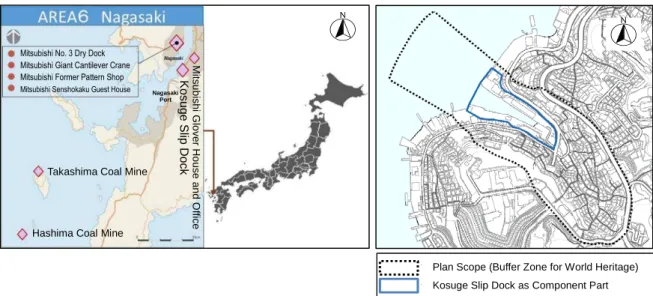
Figure 1: Location of the Component Part and scope of the Plan
計画地 世界遺産の緩衝地帯
世界遺産構成資産としての 小菅修船場跡
Takashima Coal Mine
Hashima Coal Mine
Nagasaki Port
M
itsu
b
ishi
Glo
ve
r Ho
u
se
a
n
d
O
ffice
K
o
s
u
g
e
S
lip
D
o
c
k
Mitsubishi No. 3 Dry Dock Mitsubishi Giant Cantilever Crane Mitsubishi Former Pattern Shop
Mitsubishi Senshokaku Guest House
Plan Scope (Buffer Zone for World Heritage)
3
provision of the nature of the architectural elements and archaeological remains, focusing on the Meiji operating period from the standpoint of Outstanding Universal Value, but with the attention to changes and developments of the elements and remains including the Showa operating period during which the component part was still in use. The hauling hut, in particular, will be maintained and conserved with due
attention paid to its being Japan’s oldest surviving brick building, and to the hauling machinery being the first in Japan to be driven by a steam engine, as Japan’s first modern Western-style slip dock. From a similar standpoint, the rails and stone masonry remains making up the slip dock from the Meiji operating period will be maintained and conserved. Specific steps will include reinforcement of the bricks, aseismic reinforcement of the brick building, rainwater drainage and groundwater measures, and rustproofing measures. The optimal combination of approaches for these steps will be chosen with due attention to the interworking between methods.
(3) Indicating and explaining industrial systems in the component part
To enable understanding of the hauling mechanism, Nagasaki City and MHI Nagasaki Shipyard will set up tour routes in the component part, and digital images will be employed showing the workings of the boiler and gears and how ships were hauled at the slip dock. The cherry trees, azalea, and other plantings around the hauling hut will be trimmed or removed to avoid adverse impact on the building and stone walls, and to improve the scenery, safety, and comfort.
(4) Arranging and improving the landscape from the standpoint of scenic view
The Kosuge Slip Dock is situated on an inlet going to Nagasaki Port. It was created by altering the river channel while making use of the delta topography impacted on both sides by hilly terrain. This surrounding terrain has been retained to this day as a unified part of the slip dock constituent elements, such as the rails and their foundation, the stone masonry bank protections, and the hauling hut; and because of the significance of making visitors aware of both as an integrated landscape, with a reciprocal cooperation, Nagasaki City and MHI Nagasaki Shipyard will improve elements that obstruct this landscape.
The entire Kosuge Slip Dock, situated on the delta terrain, can be seen from the sea inside Nagasaki Port in the buffer zone and from high vantage points in the background. Accordingly, the foreground landscape will be cleaned up to enable easy visibility from ships bound for tours of the Takashima Coal Mine (ComponentPart 6-6) and Hashima Coal Mine (Component Part 6-7).
(5) Utilizing as cultural resource and base for information dissemination in the Area
Since the Kosuge Slip Dock is one of the component part owned by the MHI Nagasaki Shipyard, use will be made of the Mitsubishi Nagasaki Shipyard Former Pattern Shop and Former Mitsubishi No. 2 Dock House as a base for information dissemination. The No.2 Dock House was relocated to inside the grounds of the Glover Garden (a tourism facility where the Glover House and Office (Component Part 6-8) is located).
At the Mitsubishi Nagasaki Shipyard Former Pattern Shop, MHI Nagasaki Shipyard2 will introduce its role in the Sites of Japan’s Meiji Industrial Revolution, and explain the relation of the Kosuge Slip Dock to other component parts, while also provide information about the position and role of the Kosuge Slip Dock in Area 6 Nagasaki.
At the Former Mitsubishi No. 2 Dock House, Nagasaki City will introduce the roles of the eight component parts making up Area 6 Nagasaki of the Sites of Japan’s Meiji Industrial Revolution, including the role of the Kosuge Slip Dock as a component part of the shipbuilding industry and the involvement of Thomas Blake Glover.
2 Previously known as Nagasaki Seitetsusho (Ironworks), completed in 1861 and sold to the Mitsubishi Company by the Meiji
4
(6) Implementing projects
The MHI Nagasaki Shipyard as owner of the component part, Nagasaki City, experts, and citizens will jointly establish a system for management and project implementation. Along with conservation and restoration of the building and remains, they will open the site to the public with a focus on the hauling mechanism, and will make use of the component
part as a base for disseminating information, including for the related cultural resources in the Area.
3. Methods
(1) Investigative studies (a) Excavation surveys
Excavation surveys of the Kosuge Slip Dock have not been carried out up to now. Such surveys will be necessary, however, in the case of constituent elements giving evidence that it was the first modern Western-style slip dock driven by a steam engine. These elements include the Lancashire boiler from the beginning of the Meiji operating period, the chimney base, and other underground remains. It will further be necessary to clarify the nature of the slip dock rail (one rail on each side) of Meiji Era, which are currently only partially exposed and the masonry work remains on both banks of the slip dock. The results of the studies will then be used to conserve, restore, and
reinforce these elements. These above surveys will be conducted by Nagasaki City under the cooperation with MHI Nagasaki Shipyard.
(b) Historical document surveys
Under the cooperation with MHI Nagasaki Shipyard, Nagasaki City will survey historical documents relevant to the remains to gather basic information necessary for clarifying the nature of each of the remains and methods for conservation, restoration, presentation and public utilization of the component part. The systematic collection of data can hardly be called adequate at this point, as only a few materials including old photographs have been confirmed. Accordingly, along with the existing study results, the collection of data will also cover not-yet-confirmed research results in related fields such as industrial history, architectural history, and industrial machinery.
(c) Detailed surveys of current state
While there are topographical maps of the current state, detailed drawings have not yet been made of the individual constituent elements, namely, the hauling hut, hauling machinery, slip dock, and masonry work remains. Records have therefore not been collected of the current state of deterioration and problem locations. Nagasaki City and MHI Nagasaki Shipyard will implement creating detailed drawings of current state of remains and recording of problems of the individual constituent elements.
(d) Monitoring
Nagasaki City and MHI Nagasaki Shipyard will create monitoring charts for comprehensively and systematically collecting information on constituent elements, and use them to keep track of the state
Figure 2: Constituent elements of Kosuge Slip Dock Hauling machinery and pit
Boiler, Steam engine Stack pedestal Stone stairway of administration
building
Land form
Stone masonry of the waterway
Stone masonry bank protections Hauling hut
Stone wall of administration building
Rail (one rail in the middle)
Rail (one rail on each side)
Slip Dock Land foundation
Land form
Water well
Land form
Stone masonry of the waterway (arch stone masonry)
5
of and changes to the component part. The results will be analyzed yearly based on monitoring indicators, and annual report will be made to the Nagasaki Conservation Council (for non-working properties) asking for its views. The results will also be reflected in the phased conservation, restoration, presentation and public utilization methods for each constituent element. The monitoring results from monitoring charts will be designed to be useful in particular when renovating the building and remains, with the instruction and advice of experts.
(2) Conservation and restoration (a) Scope
Under the cooperation with Nagasaki City, MHI Nagasaki Shipyard will implement conservation and restoration (maintenance, repair and renovation) focusing on constituent elements from the Meiji operating period that contribute to the Outstanding Universal Value. Methods for conservation and restoration of constituent elements from the Showa operating period will also be studied in detail based on survey results.
(b) Basic concept and methods
Hauling hut
The environmental conditions in the area around the hauling hut, where deterioration of the wall bricks is advanced, will be listed and measures will be taken especially to prevent water permeation and inflow from outside into the bricks and building. Bricks that have deteriorated due to water permeation will be repaired, drainage measures will be taken to collect and drain rainwater and groundwater seeping into the building, and aseismic reinforcement of the building itself will be implemented.
Hauling machinery
Machinery in the hauling hut remaining from the Meiji operating period, including the boiler, steam engine, gears, and chains, will be maintained and repaired. Particular attention will be paid to improving the situation whereby rainwater and groundwater collect in the pit and overflow in rainy weather.
Slip dock
In determining priorities in repairs, the following factors are to be considered: value classified as belonging to the Meiji or Showa operating periods; environmental conditions classified as belonging to non-inundation or inundation areas; the state of deterioration of steel objects due to rust (surface rusting, surface flaking or layer flaking, overall swelling). Having considered these factors, priority will be given to places belonging to the Meiji operating period, showing surface rust and/or surface flaking, and located in non-inundation areas.
Stone masonry
Focusing mainly on the stone masonry bank protections and stone stairs involved in both the Meiji and Showa operating periods, changes up to now will be clarified, and regular monitoring will be conducted to check for changes in the state of stone masonry (looking for swelling, loosening, stone cracks, missing stones, shifting of position, etc.). For cases requiring urgency,
Zone I
Zone II Non-inundated
Inundated
Figure 3: Zoning of component part and surrounding area
Zone I Land areas that can be toured by visitors
Zone II
6
a minimum extent will be defined and the stone structure will be restored with dismantling.
(3) Presentation and public utilization of the shipbuilding and repair systems in view
Dividing into the following two zones, under the reciprocal cooperation, MHI Nagasaki Shipyard and Nagasaki City will carry out presentation and public utilization for the purpose of indicating and explaining the Kosuge Slip Dock remains in the shipbuilding and repair systems.
Zone I is defined as the area where remains from the Meiji operating period are still to be found, and consisting of land areas that can be toured by visitors. Zone II is the area where remains are to be surveyed to clarify the full picture, and where special ingenuity will be needed for showing and explaining the remains to visitors.
(i) Flow lines
At this component part, part of a site where corporate activity is taking place will be opened to the public. Since crossing of visitor movement with this corporate activity cannot be avoided, flow lines will be designed that enable corporate actors to readily predict the movement of visitors. These visitor flow lines will be made clear to visitors by means of guidance signs, etc., and visitors will be able to tour, obtain explanations, and view the remains along the prescribed route (see Figure 4).
(ii) Terrain
modification/environment improvement
No new terrain modification will be carried out, as the existing terrain and
pavement will be used. However, paths will be set as visitor flow lines and fences showing deterioration will be removed.
(iii) Arranging and improving landscape and planting vegetation
The main focus of explanations to visitors will be the slip dock rails, stone masonry bank protections, and the hauling hut and hauling machinery itself. To prevent obstruction of the view of the slip dock and hauling hut, not only on the site but from ships in Nagasaki Port, cherry trees impacting the building will be delimbed and azaleas and other plantings will be trimmed back.
(iv) Guidance and explanatory facilities
Nagasaki City will continue to provide the guidance and explanations currently being provided with the cooperation of the local Kosuge community association. Along with installation of explanatory boards using illustrations and photographs, a Wi-Fi environment will be provided and mobile devices will be used to present content enabling visitors to compare the present-day landscape with that back when the dock was in operation.
(v) Administrative and utility facilities
Visitor surveys up to now have pointed to such issues as the relatively short time spent on the tour of the component part, and concerns about getting in the way of corporate activity inside the component part. According to the former issue, rest facilities etc. for visitors will not be provided for the time being.
Figure 4: Tour route
Explain mechanism of hauling machinery and slip dock while viewing actual objects
Hauling hut
Kosuge bus stop
Kosuge slip dock sign
Show tour route and rules Convey significance of
World Heritage listing, value, position and scope of slip dock, etc.
Kosuge bus stop
Return route Slip dock
7
(4) Arrangement and improvement for the buffer zone from the standpoint of scenic view
Buffer zone with radius of 500 meters has been set northwest of the component part, to prevent the erection of structures that might obstruct the view of the hauling hut from the sea. The land area of the buffer zone is protected by the Nagasaki City Landscape Plan (general area) formulated based on the Landscape Act, while the harbor area and sea portion are protected by the Ports and Harbor Act, as Nagasaki City and Nagasaki Prefecture are cooperating appropriately in conservation and restoration of the component part. Moreover, since the overall Kosuge Slip Dock terrain and the slip dock as part of the landscape can be visually recognized from the sea, MHI Nagasaki Shipyard will trim or remove trees and other plantings that might obstruct the view from ships headed for tours of Takashima Coal Mine and Hashima Coal Mine.
4. Project implementation
(1) Order of priorities
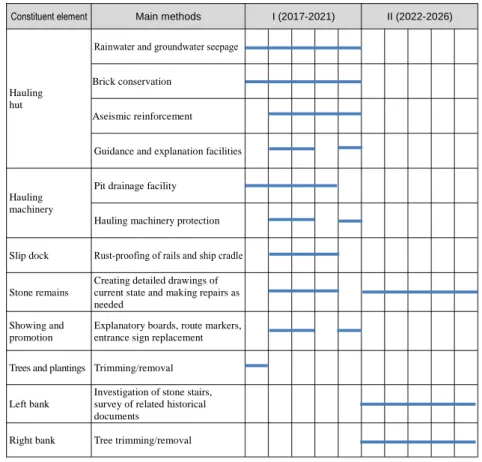
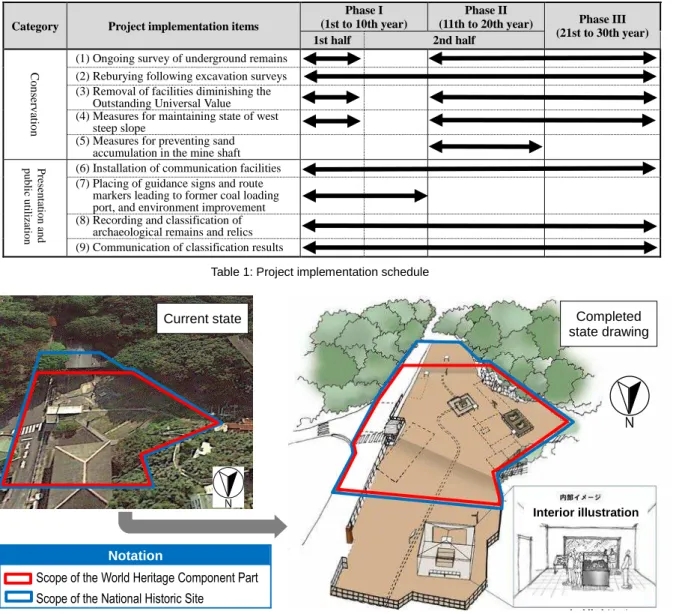
The projects implementation schedule is as shown in Table 1. Dividing the projects implementation period into a Short Term (first 5 years) and Medium to Long Term (6th to 10th years) periods, conservation, restoration, presentation and public utilization and promotion will take place in phases.
The following items will be given priority in the Short Term period.
Measures to conserve hauling hut from rainwater and
groundwater seepage; brick preservation measures
Aseismic reinforcement of hauling hut
Installation of pit drainage facility Hauling machinery conservation measures
Slip dock rail and ship cradle rust-prevention
treatment, etc.
Creating detailed drawings of current state of masonry work remains and making repairs as needed
Installing guidance and explanatory boards and route
markers, and replacing entrance signs
Trimming/removal of trees
8
(2) Review of implementation schedule
After around ten years, the implementation schedule will be reviewed based on project progress to date. If the need arises for new action, revisions will be considered without waiting for ten years to pass.
(3) Other
MHI Nagasaki Shipyard and Nagasaki city has carried out conservation and restoration work, etc. for the Kosuge Slip Dock by securing necessary funds* making use of various subsidy programs available in FY2016 and FY2017, the first two years following inscription of the property on the World Heritage List. To ensure the smooth implementation of the project, it plans to
continue such efforts to secure necessary funds in partnership with relevant institutions.
* Approximately 5 million yen was spent in FY2016 (including the amount spent for plan making) and 3 million yen has been budgeted for FY2017, both including the costs incurred or earmarked for the presentation and public utilization of the component part, but excluding the cost for day-to-day maintenance.
Table 1: Projects implementation schedule
Constituent element Main methods I (2017-2021) II (2022-2026)
Hauling hut
Brick conservation
Aseismic reinforcement
Guidance and explanation facilities
Hauling machinery
Pit drainage facility
Hauling machinery protection
Slip dock
Stone remains
Creating detailed drawings of current state and making repairs as needed
Showing and promotion
Explanatory boards, route markers, entrance sign replacement
Trees and plantings Trimming/removal
Left bank
Investigation of stone stairs, survey of related historical documents
Right bank Tree trimming/removal
9
5. Basic Plan
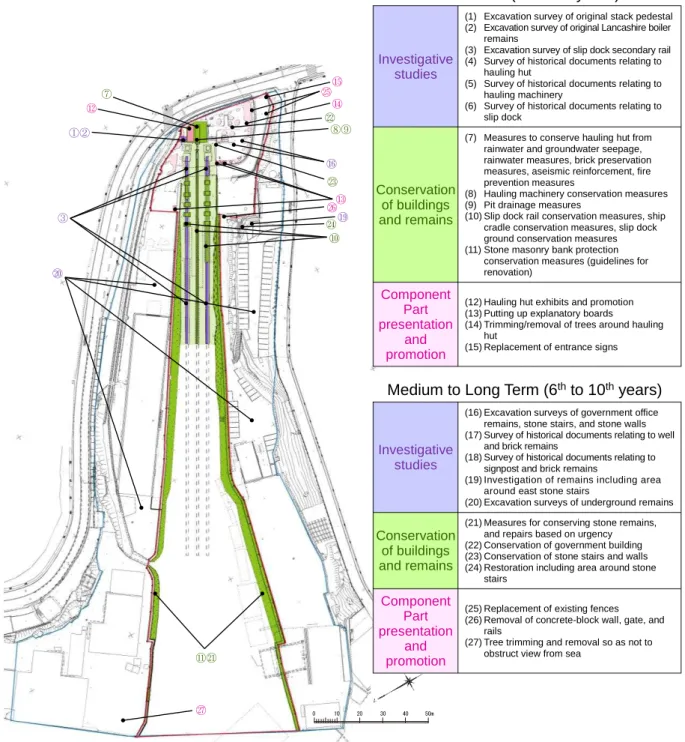
The basic plans for Kosuge Slip Dock project implementation items is as shown in Figure 5.
0 10 20 30 40 50m
ջद ब տ प վ ध ոչ շ ռ ձղ ր न फ ս փ ऩ պ ք ճ
Short Term (1st to 5th years)
Investigative studies
(1) Excavation survey of original stack pedestal (2) Excavation survey of original Lancashire boiler
remains
(3) Excavation survey of slip dock secondary rail (4) Survey of historical documents relating to
hauling hut
(5) Survey of historical documents relating to hauling machinery
(6) Survey of historical documents relating to slip dock
Conservation of buildings and remains
(7) Measures to conserve hauling hut from rainwater and groundwater seepage, rainwater measures, brick preservation measures, aseismic reinforcement, fire prevention measures
(8) Hauling machinery conservation measures (9) Pit drainage measures
(10) Slip dock rail conservation measures, ship cradle conservation measures, slip dock ground conservation measures (11) Stone masonry bank protection
conservation measures (guidelines for renovation) Component Part presentation and promotion
(12) Hauling hut exhibits and promotion (13) Putting up explanatory boards
(14) Trimming/removal of trees around hauling hut
(15) Replacement of entrance signs
Medium to Long Term (6th to 10th years)
Investigative studies
(16) Excavation surveys of government office remains, stone stairs, and stone walls (17) Survey of historical documents relating to well
and brick remains
(18) Survey of historical documents relating to signpost and brick remains
(19) Investigation of remains including area around east stone stairs
(20) Excavation surveys of underground remains
Conservation of buildings and remains
(21) Measures for conserving stone remains, and repairs based on urgency (22) Conservation of government building (23) Conservation of stone stairs and walls (24) Restoration including area around stone
stairs Component Part presentation and promotion
(25) Replacement of existing fences (26) Removal of concrete-block wall, gate, and
rails
(27) Tree trimming and removal so as not to obstruct view from sea
11
Component Part No. 6-6
of “Sites of Japan’s Meiji Industrial Revolution”
Conservation, Restoration, Presentation and Public Utilization Plan
for Takashima Coal Mine
(Area 6 Nagasaki)(Abstract)
Nagasaki City drew up a Conservation, Restoration, Presentation and Public Utilization Plan for Takashima Coal Mine (hereinafter referred to as “Plan”) in FY 2015 and 2017, which became a source of “Conservation
Work Programme” pursuant to Recommendation b) in Decision: 39 COM 8B. 14 as adopted by the World Heritage Committee at its 39th session in 2019. The Plan comprises detailed measures for the conservation, restoration, presentation and public utilization of the component part of the “Sites of Japan’s Meiji Industrial Revolution: Iron and Steel, Shipbuilding and Coal Mining”(hereinafter referred to as “Sites of Japan’s Meiji
Industrial Revolution”). This document provides an abstract of the Plan.
1. Vision
By investigating, conserving and restoring the mine shaft and other archaeological remains and arranging and improving the landscape that recall the past when the modern coal industry was born in this place, the component part will be utilized as a resource for learning, for community promotion, and for researching.
The Nagasaki Area where the Takashima Coal Mine is located is home to eight of the 23 component parts. It has a special role that sets it apart from other Areas, in helping to understand the two eras in the three industrial fields of iron and steel, shipbuilding, and coal mining, namely, the period of directly introducing Western techniques and the period of establishing industrialization, as well as the interrelationship of these three fields. The Takashima Coal Mine is the first mine in Japan to introduce modern coal extraction techniques. Along with the Hashima Coal Mine (Component Part 6-7) where the
techniques were carried on, it played an important role in providing fuel for steamships and coking coal for iron and steel making, and as the founding place for the modern coal industry. In Area 6 Nagasaki, the Takashima Coal Mine and Hashima Coal Mine can be regarded as an integrated site for experiencing the history of coal mining. Conservation, restoration, presentation, public utilization, and provision of information to visitors, will be carried out with consideration to the process of historical changes and developments of the component part in view, from the introduction of Western techniques in the early Meiji era to the period after the mines were closed, and focusing on the functions and links of the remains that enable understanding of the entire coal production system, including coal extraction and transport. The component part will also be
used as a unique resource for telling the story of the “island”
community that grew up during the period from when coal was being extracted to after the mine was closed.
(1) Conservation based on the characteristics of the remains and the current state
Most of the archaeological remains are buried under ground, and other than the mine shaft, many aspects have not yet been investigated. Excavation surveys will therefore be carried out
Conservation, Restoration, Presentation and Public Utilization Plan for Takashima Coal Mine (Abstract)
Figure 1: Location of the Site and Scope of Plans
Scope of Plan (Buffer Zone for the World Heritage Property)
Scope of World Heritage Component Part Scope of National Historic Site Takashima
Coal Mine
Hashima Coal Mine
G
lov
e
r
H
ou
s
e
a
nd
O
ff
ic
e
K
os
ug
e
S
li
p Do
c
k
Mitsubishi No. 3 Dock Giant Cantilever Crane Former Pattern Shop Senshokaku Nagasaki
12
regarding the underground archaeological remains other than the shaft, to the minimum necessary extent. To avoid adverse impacts on the remains, day-to-day maintenance will be conducted, including small repairs, basically to improve and stabilize the mine shaft and surrounding environment.
Fragile remains that would be difficult to expose above ground for viewing will be kept as they are under ground, and their locations and scales will be presented by flat displays on the ground using other materials.
(2) Public utilization by diverse methods
Given the lack of compelling communication regarding the contribution of the Takashima Coal Mine to the World Heritage Outstanding Universal Value, and of its role as the starting place of the modern coal industry, the component part will be exploited as a resource for learning and community promotion. For this purpose, old photographs showing the state in the past when the mine was operating and explanatory boards will be placed, and facilities will be installed to introduce the results of excavation surveys. Provision will further be made of a view between the Takashima Coal Mine and former coal loading port, and guidance signs and routes will be set up to the second house of Thomas Glover and the former coal loading port, distant from the component part. In such ways, visitors will be able to envision the entire coal production system including coal extracting and transport.
To improve access to the component part on the island, ship and bus schedules will be revised, rental cycles and the like will be made available, and integrated tours of the entirety of Takashima Island and Hashima Island will be made possible, in such ways aiming to increase the number of visitors.
2. Policy
The policy consisting of following six items have been set toward achieving the Vision.
(1) Conducting investigative studies
Nagasaki City will seek to further awareness of the Outstanding Universal Value by continuing with surveys, including (1) field investigations and excavation surveys of the remains, (2) historical document surveys for clarifying the coal production system including extraction and transport, (3) landscape surveys of the World Heritage and surrounding area, and (4) surveys of visitors and their impact on the component part. One purpose for surveys of underground archaeological remains and ongoing historical document surveys is to clarify the individual functions and interrelationship of the Takashima Coal Mine and other mines located on Takashima. In addition, the City of Nagasaki will conduct regular monitoring, using monitoring charts, to determine the state of the component part and its buffer zone, and will reflect the results in the annual report.
(2) Maintaining, strengthening, and stabilizing the remains in terms of the material, substance and structure
The city will conduct day-to-day maintenance, along with monitoring, mainly to improve the preservation environment so the remains can be kept in stable state. Phased reinforcement, stabilization and other conservation work will also be carried out, assigning priorities, based on an overall assessment of the role and deterioration state of each of the remains. Along with day-to-day maintenance of the mine shaft, future measures will be taken to prevent sand accumulation and to prevent collapse of the west steep slope.
(3) Showing and explaining the coal production system including extraction and transport
It will be necessary to foster understanding of not only the coal industry but also the interrelationship among three industries that are iron-making, steel-making and shipbuilding industries whose advances were made possible by coal. To this end, the city will convey to visitors the nature of the Takashima Coal Mine
13 of the former coal loading port.
(4) Arrangement and improvement of the buffer zone from the standpoint of scenic view
Visitors will need to be able to recognize visually the broad expanse of the land on which the coal mining facilities were located in the past, centering on the mine shaft. To aid visitors in picturing the coal production system at the time, from coal extraction to transport and loading on ships, while comparing the site with old photographs, the city will ensure a view of the area between the Takashima Coal Mine and the former coal loading port north of it. For this purpose, plantings around the remaining mine shaft will be trimmed, and in the future, the wastewater treatment facility serving residents adjacent to the component part will be removed.
In the buffer zone, appropriate guidance will be provided regarding the appearance of dwellings and protective fences, etc. in consideration of the Component Part landscape.
(5) Utilizing the Takashima Coal Mine as cultural resource and for information communication in the Area
The city will create a viewing plaza with explanatory boards in the vicinity of the mine shaft, so that visitors can view the component part in the same direction as old photographs were taken in. Further, while using the existing Takashima Coal Museum on the island as a base for information dissemination, the entire island will be treated as a field museum of the Takashima Coal Mine and used as a resource for learning, community promotion, and research. Information provision will also be made in tie-ups with mine remains throughout Kyushu.
Visitor management rules will be set for those coming to the Takashima Coal Mine, in consideration of local residents, and visitor numbers will be regulated by controlling ship operation.
Along with establishment of mechanisms for supporting volunteers and other groups and the local community, the necessary human resources development will be carried out for training guides and those involved in conservation and surveys, etc., to ensure the component part is preserved into the future.
(6) Implementing projects
The city will draw up a project implementation schedule for ensuring each of the projects is carried out in phases and on time. It will include such matters as project deadlines, methods for implementing the project in phases, items to be carried out in each fiscal year.
At appropriate times, the city will review the schedule, while ensuring communication with the owners and managers of the land involved in the project, and confirming the project progress each year. As the body with overall responsibility for managing and operating projects as a whole, the city will coordinate with parties and organizations concerned, including advertising, holding of events, and working with stakeholders.
3. Methods
Specific methods for conservation, restoration, presentation and public utilization are indicated below. The city has the main responsibility for each of these items.
(1) Investigative studies
(a) Excavation surveys and on-site investigations
Excavation surveys will be continued for coal mining facilities including the underground archaeological remains around the mine shaft and the coal loading rail remains. In the future, all or part of the wastewater treatment facility now in operation for the adjacent community will be removed, and the entire coal production system from extraction to transport and loading will be made clear.
(b) Historical document surveys
14
house organs of labor unions, and newspapers from the time. The historical document surveys will provide the role of the Takashima Coal Mine, covering such aspects as the significance of Takashima mines, including the Hashima Coal Mine, for the history of technology, the relation to steelmaking and other industries, and the relation to other coal mines in Japan.
(c) Surveys of visitor numbers and behavior
Surveys will be conducted to verify the effectiveness of the project and determine the impact of visitors on the state of the remains on and under the ground. The results will be reflected in better ways of utilizing the component part of the World Heritage property. Visitor numbers and behavior will be surveyed as part of this effort.
(d) Monitoring
Monitoring charts have been created for comprehensively and systematically collecting information on the constituent elements, and will be used to keep track of the state of the component part and the buffer zone. The results will be reported to the Nagasaki Conservation Council, in accordance with the World Heritage operational framework, asking for its views. If any negative effects are detected and verified, measures will be taken to remove the causes or lessen the impact. The effectiveness of the measures will then be verified by conducting inspections.
(2) Conservation and restoration of buildings and archaeological remains (a) Scope
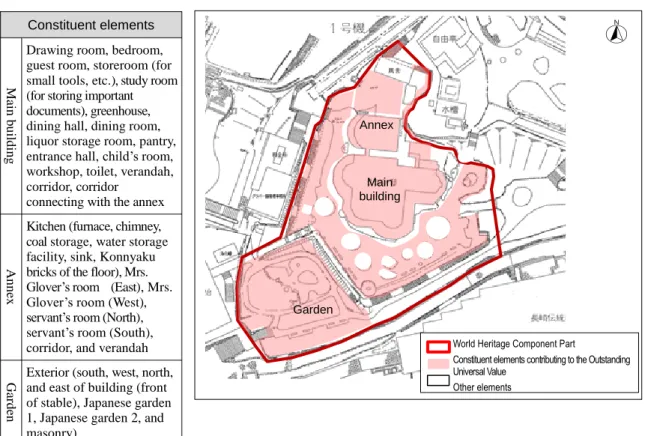
Conservation (maintenance, repair and restoration) applies to the constituent elements of the component part contributing to the Outstanding Universal Value (Figure 2).
Notation
Scope of the World Heritage Component Part
Scope of the National Historic Site
Constituent elements
contributing to the Outstanding Universal Value
Other elements (those contributing to the value National Historic Site and to its preservation and utilization)
Other elements (those not contributing to value or to its preservation and utilization)
Figure 2: Constituent elements subject to conservation and restoration Concrete post (Mitsubishi)
Fence Underground remains (entire historic site)
Local road Drainage system (manhole) Private homes Hut Stonework Concrete-block walls Path (Sign) Road (Guardrail) Road Road Concrete-block walls Stonework (Sign) Stonework Drainage system (manhole) Drainage system (manhole) Drainage system (gutter) Drainage system (gutter) Drainage system (gutter) Concrete (foundation, etc.) Concrete (foundation, etc.) Concrete (foundation, etc.) Greenery (Post box) (Public phone) Wi-Fi guidance (Mirror) Guidance sign Mine shaft Wooded area Water and sewage ducts East channel (Utility pole) Explanatory sign Greenery
15
(b) Basic concept and methods
Mine shaft
For the time being, day-to-day maintenance including minor repairs will be carried out to prevent deterioration and keep the remains in stable condition. After the mine was closed, the mine shaft came to be used as a well and alterations were made to the frame and other parts exposed above ground. Materials that were clearly added later and that diminish the value of the mine shaft remains will be removed. To prevent sand accumulation in the mine shaft, measures will be taken to stop the inflow of rainwater, etc.
West steep slope
The situation will be monitored regularly and records will be kept of the results. Day-to-day management of the steep slope will be carried out and trees affecting collapse will be trimmed, to ensure the remains are maintained in stable condition (Figure 5).
East water channel
This channel remains as a concrete underground drain. For the time being, records of the current state will be kept and monitoring will be continued. If investigations make clear the original state, restoration will be carried out at that point in time (Figure 5).
Underground remains (entire area of the component part)
The remains reburied after excavation surveys, such as the brick structures including chimney, the stone remains, and earthen remains, will be left in their buried state to prevent damage. The remains unearthed in excavation surveys of Takashima Coal Mine to be conducted hereafter will likewise be reburied, covered with protective earth layers of appropriate thickness, and preserved underground.
(3) Presentation of the entire coal production system in view, including extraction and transport
While expanding the scope for public utilization in phases, from Zone I to Zone III, utilization will be made as a resource contributing to school education and education of the public as well as for tourism.
(a) Visitors’ flow lines
Visitors’ flow lines will be set up in the component part linking learning points and other places where remains are displayed, etc., and it will guide visitors in stages to the former coal loading port in the north.
Visitors’ flow lines will also be set up connecting the Takashima Coal Mine to the former coal loading
port and Glover’s second house (Figure 6).
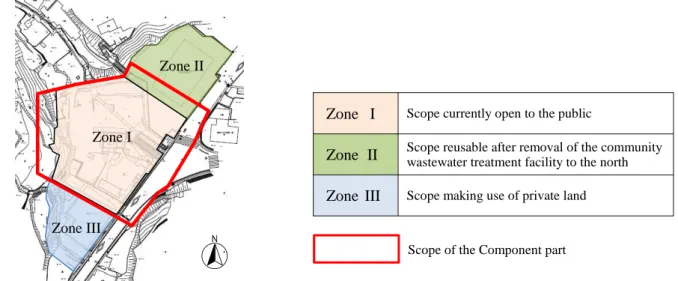
Figure 3: Zoning of the Component Part and surrounding area
Scope of the Component part
Zone I
Zone II
Zone III
Zone I Scope currently open to the public
Zone II Scope reusable after removal of the community wastewater treatment facility to the north
16
(b) Terrain modification/environment improvement
Outdoor paths will be paved with earthen material or other materials appropriate to the landscape. A slope will be installed at the entrance to the component part.
(c) Arranging the landscape and planting vegetation
Trees near the west steep slope (Figure 5) will be trimmed and the slope will be stabilized. The water supply and drain pipes on the surface of the concrete block walls bordering the private land on the south will be obscured by shrub plants or by board fencing with a design like that seen in old photographs. Trees that threaten the preservation of the remains will be trimmed as needed, and no new trees will be planted.
(d) Guidance and explanatory facilities
Guidance and explanatory boards will be placed inside the component part and in the surrounding areas. The boards will have a uniform design and size befitting the landscape, and will include support for disabled visitors and multiple languages. As the scope of public utilization is expanded in phases from Zone I to Zone III, guidance and explanatory boards and guide markers leading to surrounding facilities will be installed. Guide markers will show the flow lines on the surface of paved walkways.
(e) Administrative and utility facilities
As the scope of public utilization is expanded in stages, an observation space will be installed on the site where the community wastewater treatment facility is currently located, north of the component part. Diorama models, explanatory boards and other facilities with guidance functions will also be set up (Figure 5).
Rest facilities will be installed in the park near Glover’s second house, to the north of the Component Part, and visitor parking areas for cars and bicycles will be provided, as well as toilets and benches (Figure 6).
(4) Arrangement and improvement for the buffer zone from the standpoint of scenic view
In the buffer zone, electric wires, utility poles, protective fences, the community wastewater treatment facility, dwellings and other objects detrimental to the landscape will be arranged and improved, and a view will be provided between the Takashima Coal Mine and former coal loading port.
(5) Utilization of the component part as cultural resource and for information communication in the Area
(a) Providing information about the 23 component parts of the Sites of Japan’s Meiji Industrial Revolution focused in Area 6 Nagasaki
The Former Mitsubishi No.2 Dock House located inside Glover Garden (a tourism facility where the Glover House and Office (Component Part 6-8) is located) will be used as a base for explaining the interrelationship of the 23 component parts, mainly those in Area 6 Nagasaki, and the historical background.
(b) Utilization of the whole island as a field museum related to Takashima Coal Mine
A guide course will be set linking the Takashima Coal Mine and other mining remains on the island and the Nagasaki-city Takashima Coal Museum and other related facilities, treating the entire island as a field museum related to Takashima Coal Mine.
4. Projects implementation
(1) Order of priorities
The city will draw up a 30-year projects implementation schedule starting from the year 2018. The plan is divided into three phases of ten years each. The priorities and overall plan are subject to revision based on such factors as the results of investigations and monitoring and progress in purchasing up private land on the south side. Urgently needed conservation and restoration work will be carried out whenever necessary.
17
community wastewater treatment facility (Zone II), and (3) the scope of the land where the community wastewater treatment facility existed and of usable private land (Zone III). The following items will be given priority in Phase I.
Removal of unnecessary facilities harming the Outstanding Universal Value
Trimming of trees on the west steep slope that may lead to collapse of the slope, etc.
Setting up observation space and explanatory boards that convey value and promote proper understanding
(2) Review of implementation schedule
Around the time Phase I has completed (10 years), the implementation schedule will be reviewed based on project progress to date. If the need arises for new action, revisions will be considered without waiting for ten years to pass.
(3) Other
The city has carried out conservation and restoration work, etc. for the Takashima Coal Mine by securing necessary funds* making use of various subsidy programs available in FY2016 and FY2017, the first two years following inscription of the property on the World Heritage List. To ensure the smooth implementation of the project, it plans to continue such efforts to secure necessary funds in partnership with relevant institutions.
* Approximately 27 million yen was spent in FY2016 and 14 million yen has been budgeted for FY2017, both including the costs incurred or earmarked for the presentation and public utilization of the component part, but excluding the cost for day-to-day maintenance.
Category Project implementation items
Phase I (1st to 10th year)
Phase II
(11th to 20th year) Phase III (21st to 30th year)
1st half 2nd half
C
o
n
ser
v
at
io
n
(1) Ongoing survey of underground remains (2) Reburying following excavation surveys (3) Removal of facilities diminishing the
Outstanding Universal Value (4) Measures for maintaining state of west
steep slope
(5) Measures for preventing sand accumulation in the mine shaft
P
res
en
ta
tio
n
an
d
p
u
b
lic
u
til
iza
tio
n
(6) Installation of communication facilities (7) Placing of guidance signs and route
markers leading to former coal loading port, and environment improvement (8) Recording and classification of
archaeological remains and relics (9) Communication of classification results
Table 1: Project implementation schedule
Notation
Scope of the World Heritage Component Part Scope of the National Historic Site
Figure 4: Conceptional drawing of Takashima Coal Mine conservation, restoration, presentation and public utilization
Completed state drawing Current state
18
5. Basic Plans
The basic plan showing Takashima Coal Mine projects implementation is given in Figures 5 and 6.
(3) Removal of facilities harming the World Heritage Value
(4) Measures for maintaining state of west steep slope (tree trimming, slope consolidation)
(6) Provision of information
dissemination facilities
(7) Guidance signs and route provision (6) Communication by tiles
with actual-size photos
Haedomari Fishing Port
Figure 6: Takashima Coal Mine Periphery Plan (numbers correspond to Table 1) Figure 5: Takashima Coal Mine Plan (numbers correspond to Table 1)
(5) Measures for preventing sand accumulation in the mine shaft
Glover’s Second House
Takashima Park
Notation
Component site scope East water channel
(8) Recording and classification of relics and remains
Notation
Plan scope
Component site scope (7) Placing of guidance signs and
provision of route to former coal loading port, and environment improvement
(guidance signs and route provision)
(7) Placing of guidance signs and provision of route to former coal loading port, and beautification (provision of park, parking area, bicycle parking)
West steep slope (1) Ongoing survey of
underground remains (2) Reburying following
19
Component Part 6-8 of the
“Sites of Japan’s Meiji Industrial Revolution”
Conservation, Restoration, Presentation and Public Utilization Plan
for Glover House and Office
(Area 6 Nagasaki)(Abstract)
Nagasaki City drew up a Conservation, Restoration, Presentation and Public Utilization Plan for Glover House and Office (hereinafter referred to as “Plan”) in FY 2016 and 2017, which became a source of
“Conservation Work Programme” pursuant to Recommendation b) in Decision: 39 COM 8B. 14 as adopted by the World Heritage Committee at its 39th session in 2015. The Plan comprises detailed measures for the conservation, restoration, presentation and public utilization of the component part of the “Sites of Japan’s Meiji Industrial Revolution: Iron and Steel, Shipbuilding and Coal Mining” (hereinafter referred to as “Sites of Japan’s Meiji Industrial Revolution”). This document provides an abstract of the Plan.
1. Vision
Restore the deteriorated sections of the house in which Thomas B. Glover resided and did business to inherit them for future generations his role in the industrial revolution of Japan during the Meiji Era and the overall value of Nagasaki's foreign settlement, including this house, as a stage for introducing Western technology to the nation.
Area 6 Nagasaki of the "Sites of Japan’s Meiji Industrial Revolution" constitutes eight of the 23 component parts, including Glover House and Office. The Area is unique for encompassing the stages of the direct importation of Western technology and of the full-blown industrialization of Japan, and is uniquely positioned to provide an understanding of the mutual connections between the iron and steel, shipbuilding, and coal industries.
Thomas B. Glover, a Scottish merchant, brought Western technology to Japan and cultivated human resources by helping Japanese nationals to study abroad. He played a pivotal role in Japan's industrial revolution during a short period of about half a century of from the end of the Edo period through the Meiji Era. Glover House and Office was his residence and a place of commerce, on a top of hill overlooking Nagasaki shipyard within a foreign settlement created when the port opened to Western trade at the end of the Edo period. It is the oldest surviving Western-style wooden house in Japan. The townscape and views of Glover House and Office and the Nagasaki foreign settlement that ushered in Western technology are still intact. Nagasaki City will preserve the district for future generations as an important tourist destination in company with residents.
(1) Conservation and restoration of Glover House and Office based on its characteristics and current state
The house served as a residence and base for the trading and cultural activities of Glover, who shaped the development of Japan's coal and shipbuilding industries. Nagasaki City will improve the present state addressing the causes of deterioration, while the city will restore building to its original design during the Meiji Era. Another goal is to have the masonry, cliff, and other elements of the landscape look as they would have when Glover lived at the house.
(2) Promotion by diverse methods about Glover House and Office
As well as reviewing pamphlets, explanation boards, the website, and other content, the city will endeavor to provide a new information delivery measures through mobile devices so people can compare the contemporary landscape with how it looked in old photos. The city will disseminate information focusing on the architectural historical value of Glover House and Office and the relationship between component parts of the Sites of Japan’s Meiji Industrial Revolution and Glover
20
himself. In the Glover Garden, as well as this residence, there are national important cultural properties Ringer House and Alt House, and other Meiji Era historic buildings relocated to Glover Garden. The city will update information to clearly present differences in the historical backdrops and value of these buildings.
2. Policy
The policy of the conservation, restoration, presentation and public utilization are set based on the six items below.
(1) Conducting investigative studies
Nagasaki City will explore the historical documents to clarify the original usage of Glover House and Office and assess current rainwater drainage channels around the house. It will investigate visitor numbers and behavior to evaluate the current state of visitors and the impact on the component part. The city will also evaluate the conditions of the constituent elements of the component part and the buffer zone by periodically conducting follow-up observations through monitoring charts, reflecting the findings in the annual report.
(2) Preserving, reinforcing, and stabilizing the buildings and remains in terms of material, substance, and structure
Based on the results of aseismic assessment of Glover House and Office in FY 2016, Nagasaki City will undertake restore and earthquake resistance measures in FY 2018. Degradation of the walls, floors, wallpaper, and other parts of the building has progressed since the building became constantly open to the public as a tourism resource. After restoration, the city will endeavor to stabilize the building's stable condition through appropriate cleaning and other ongoing daily maintenance and mitigating the cause of the deterioration by installing air conditioners to enhance the indoor environment. It will also alleviate
the impact of visitors’ tread pressure on the facility by managing visitor flows in a given direction.
(3) Indicating and explaining contributions of the component part to the industrial revolution
Glover House and Office embodies two eras defined under the concept of the Outstanding Universal Value of the property. The first was that of the direct importation of Western science and technology and the second was that of the full-blown industrialization. To inform visitors properly the fact that Glover has direct ties with the coal and shipbuilding industries, notably through the development of the Takashima Coal Mine and construction of the Kosuge Ship Dock, and that he had great achievement toward Japan's industrialization, Nagasaki City will put up information boards and other installations, train guides, and enhance guide presentations.
(4) Arranging and improving the buffer zone from the standpoint of scenic view
The city aims to reproduce views of Nagasaki Port and the Nagasaki Shipyard of Mitsubishi Heavy Industries on the opposite site reminiscent of the time between the end of the Edo Period and the Meiji Era, when Glover flourished. It will recreate the garden below the northwest of the house at that time based on the results of studies of historical photos. While the construction dates of the barn and stable adjacent
Scope of the Plan (Buffer Zone) Scope of the World heritage Component Part scope
Takashima Coal Mine
Nagasaki Port
Hashima Coal Mine
No.3 Dry Dock Giant Cantilever Crane Former Pattern Shop Senshokaku Guest House
Glo
v
er
H
o
u
se
an
d
Of
fice
Ko
s
u
g
e
S
h
ip
Do
c
k
21
to the house are unknown, the city will repair degraded parts and open the interiors to the public. The city will endeavor to maintain the masonry, cliffs, and other elements of the settlement terrain, logging, removing, and pruning trees, and keeping the views tastefully integrating with buildings in the Glover Garden.
(5) Utilizing the Former Glover House and Office as a cultural resource and base of information dissemination in the Area
The city will display exhibits, including the history of Nagasaki city, inside buildings in Glover Garden through the designated administrator, and utilize the garden as a base for disseminating information
about the Sites of Japan’s Meiji Industrial Revolution. The city has positioned the Former Mitsubishi No. 2 Dock House in the Glover Garden as a guide facility for the Sites of Japan’s Meiji Industrial Revolution, and will explain other component parts in Area 6 Nagasaki and in other Areas.
(6) Implementing projects
The city will ensure a carefully phased implementation of this Plan by formulating a projects implementation schedule that encompasses the project term, staged projects implementation method, and annual project agenda. The city will confirm projects progress every year while communicating with relevant managers and stakeholders to the scope of the Plan, review the projects implementation schedule at the appropriate times. In its supervising role for operating the progress of the projects for the component part, including for public relations, events, and stakeholder coordination, the city will liaise with stakeholders and related organizations.
3. Methods
(1) Investigative studies
(a) Document surveys
Surveys comprise the items as follows: comprehending the process of historical changes and developments of the buildings and the compound of Glover House and Office, the determining the scope of the residential compound owned by Glover and the location of the main gate and approaching route to it at that time, identifying external facilities including the garden at that time based on old photographs, assessing the tree impacts on the masonry and other aspects of the environs for their pruning and cutting, identifying the course of rainwater drainage channels around Glover House and Office and their extents at that time, exploring the history of the furniture currently on display inside the buildings, determining the time when the barn and stable were constructed, and studying the activities in Japan of Glover himself, including in terms of the relationship between him and component parts of the Sites of Japan's Meiji Industrial Revolution.
(b) Surveys of visitor numbers and behavior
As well as assessing the effectiveness of the projects implemented, the city will study visitor numbers and behavior to identify the negative impact made by the visitors on the buildings and compound and reflect the findings in better utilization of this component part of the World Heritage property.
(c) Monitoring
The city will produce monitoring charts that comprehensively and systematically consolidate information on the state of constituent elements within the component part and regularly assess the condition of the component part and the buffer zone. The monitoring results will reflect in an annual report, submitting it to the Nagasaki Conservation Council based on the management structure of this World Heritage property and seek opinions from that body.
(2) Conservation and restoration
22
Scope for conservation and restoration work will focus on the constituent elements of the Glover House and Office that contribute to the Outstanding Universal Value of the World Heritage property.
(b) Basic concept and methods for conservation and restoration of Glover Garden as a whole
Maintenance and management will entail restoring ceiling paper, exterior wall plaster, and exterior paint, periodically cleaning the gutter and roof, and cutting and pruning trees that are not vital to the landscape. In line with aseismic reinforcement and restoration after FY 2018, the city will review and update the disaster preparedness equipment and revise indoor exhibits. The barn and stable will be opened after restoration. The city will assess and study old photographs of the Japanese garden around Glover House and Office and restore the garden to how it looked in the age set for restoring the main and attached buildings.
Constituent elements
M
ain
b
u
il
d
in
g
Drawing room, bedroom, guest room, storeroom (for small tools, etc.), study room (for storing important documents), greenhouse, dining hall, dining room, liquor storage room, pantry,
entrance hall, child’s room,
workshop, toilet, verandah, corridor, corridor
connecting with the annex
An
n
ex
Kitchen (furnace, chimney, coal storage, water storage facility, sink, Konnyaku bricks of the floor), Mrs.
Glover’s room (East), Mrs.
Glover’s room (West),
servant’s room (North),
servant’s room (South),
corridor, and verandah
Ga
rd
en
Exterior (south, west, north, and east of building (front of stable), Japanese garden 1, Japanese garden 2, and masonry)
Main building Annex
Garden
World Heritage Component Part
Constituent elements contributing to the Outstanding Universal Value
Other elements
23
(3) Public Utilization
(a) Zoning
The city will properly inform visitors of Glover's great contributions to Japan's industrialization as well as use Glover Garden overall to disseminate information about the Sites of Japan's Meiji Industrial Revolution by dividing Glover Garden into A, B, and C zones (see Figure 3) and improving the environment and arranging the views for each zone.
(b) Tour routes
Once inside Glover Garden, visitors will be guided to the Former Mitsubishi No. 2 Dock House at the top of the park to be informed about the Outstanding Universal Value of the World Heritage property consisting of 23 component parts and the positioning of the Glover House and Office in that. Visitors will thereafter be guided to Glover House and Office through viewpoints overlooking Nagasaki Port and the Nagasaki Shipyard of Mitsubishi Heavy Industries on the opposite side (Figure 3). Inside Glover House and Office, there will be a tour route guiding visitors from the entrance to private areas through the public space (Figure 4).
Note: Visitor management approach regarding site utilization
Nagasaki city will formulate the following visitor
management rules in opening the interior of Glover House and Office to the public while properly preserving structures.
(i) Entry and exit will be through one location each.
(ii) It will set up tour courses and post guidance signage indoors (Figure 4). (iii) It will install air-conditioning facilities in appropriate locations.
(iv) It will regularly close the house or certain rooms to the public in some periods for repairs and cleaning.
(c) Terrain correction and environmental improvements
It has been confirmed that some of the masonry on the east of Glover House and Office is swollen, and repairs and restoration will be made as determined necessary through ongoing monitoring. No masonry in B or C Zones currently require restoration.
(d) Arranging and improving landscape and planting vegetation
Figure 4: Tour route inside Glover House Exhibition room (tentative)
Exhibition room (installed)
=Accessible area
=Display area
=Closed area
=Tour routes
Figure 3: Glover Garden zoning
Scope of the Component Part
A Zone
B Zone
C Zone
Tour routes Component site
scope A Zone B Zone C Zone
B6. Set up administrative and convenience facilities B6. Set up administrative and convenience facilities
No.1 Moving walkway
No.2 Moving walkway