Introduction
Current dysphagia tests include videofluoroscopy (VF)1-14) and fiberoptic endoscopic evalu- ation of swallowing (FEES)1, 2, 15). VF is regarded as the gold standard in clinical practice1). Although VF is useful for the direct evaluation of the status of dysphagia, it is not easy to predict the outcome of swallowing rehabilitation on the basis of the results obtained using VF during the acute stage2, 3, 15) because various factors influence the eating / swallowing function, including the presence or absence of aspiration in the pharyngeal phase, cognition,
Predicting the Prognosis of Swallowing Function in Stroke Patients with Dysphagia Using
the Videofluoroscopic Dysphagia Scale
Shinsuke SATO1, 2), Akio TSUBAHARA2), Yoichiro AOYAGI2)
Kyota BUNNO1, 2) and Masazumi MIZUMA3)
Abstract: The aim of the present study was to evaluate the correlation between parameters of the videofluoroscopic dysphagia scale (VDS) and the outcome of dysphagia to determine the usefulness of the VDS in patients admitted to convalescent rehabilitation wards. Patients (n=23) with stroke- related dysphagia admitted to our rehabilitation hospital between April 2007 and March 2009. Medical records and videofluoroscopy findings on admission to hospital were reviewed retrospectively and the VDS score was calculated by adding individual VDS parameters. Subjects were divided into two groups : those who were able to ingest orally without tube feeding before discharge
(Group 1) and those who still needed tube feeding on discharge (Group 2). The VDS scores were compared between the two groups. There were no significant differences in any individual parameter on the VDS between the two groups. However, the total VDS score was significantly lower in Group 1 patients (p<0.05), as was the time from stroke onset to admission to our hospital (p<0.05). There were no significant differences in any other param- eters evaluated. The findings of the present study suggest that the total VDS score may be useful in predicting the prognosis of stroke-related dysphagia.
Key words: dysphagia, stroke, activities of daily living, videofluoroscopic dys- phagia scale, videofluoroscopy
Original
1) Department of Rehabilitation Medicine, Sato Memorial Hospital, 45, Kurotsuchi, Shouo-cho, Okayama, 709-4312, Japan.
2)Department of Rehabilitation Medicine, Kawasaki Medical School.
3)Department of Rehabilitation Medicine, Showa University School of Medicine.
masticatory function in the oral phase, taste, digestive function, and the ability to maintain a sitting position. In addition, the swallowing condition at the time of examination does not always reflect the state of typical nutritional intake in daily life4). However, recently, the importance of predicting the outcome of swallowing rehabilitation in clinical practice has been emphasized with the widespread application of early stroke rehabilitation5-7). This information is particularly important in convalescent rehabilitation wards that are not part of an acute-phase hospital because, in many cases, in these kinds of wards it is difficult to perform percutaneous endoscopic gastrostomy (PEG)16) after admission. On planning swallowing rehabilitation, it is particularly important to predict whether the ability to ingest substances orally is likely to return. Many studies have investigated various prog- nostic factors and reported that the outcome of swallowing rehabilitation is correlated with aspiration on VF2, 5, 7-9) reduced pharyngeal sensation8), motor function5, 10), activities of daily living (ADL)2, 17, 18), the presence of a bilateral lesion5, 10), and psychiatric symptoms19). In 2007, Han et al proposed the videofluoroscopic dysphagia scale (VDS)14), which facilitates the quantitative evaluation of VF findings, and demonstrated a correlation between the total VDS score and an ability / inability to ingest food 6 months after the onset of stroke. In the present study, we evaluated the correlation between the VDS and other parameters of stroke to determine the usefulness of the VDS in patients admitted to convalescent rehabili- tation wards in Japan.
Methods Subjects
The subjects of the present study consisted of 23 patients with stroke who had been admitted to the convalescent rehabilitation ward in our hospital between April 2007 and March 2009 (18 men and five women ; 15 with cerebral infarction and eight with cerebral hemorrhage). None of the patients was able to ingest food orally and thus they required tube feeding. Mean patient age was 77.1 8.6 years. The mean time from stroke onset to admission to the rehabilitation ward was 47.1 9.9 days and the mean duration of hospi- talization was 129.1 26.2 days. Of the 23 patients enrolled in the present study, 14 had undergone PEG prior to admission to the rehabilitation ward.
Procedures
After reviewing the subjectsʼ medical records and VF findings upon admission to the rehabilitation ward, we calculated a VDS score for each patient as outlined by Han et al14). In addition, we recorded information regarding patient age, gender, primary disease, days from onset to admission to the rehabilitation ward, the presence or absence of appetite upon admission, duration of hospitalization, and the functional independence measure
(FIM)20, 21) on admission / discharge. VF was performed within 2 days of admission to the rehabilitation ward. The maximum VDS score is 100 points, and the score increases with
the severity of dysphagia14). Furthermore, using a receiver operating characteristic (ROC)
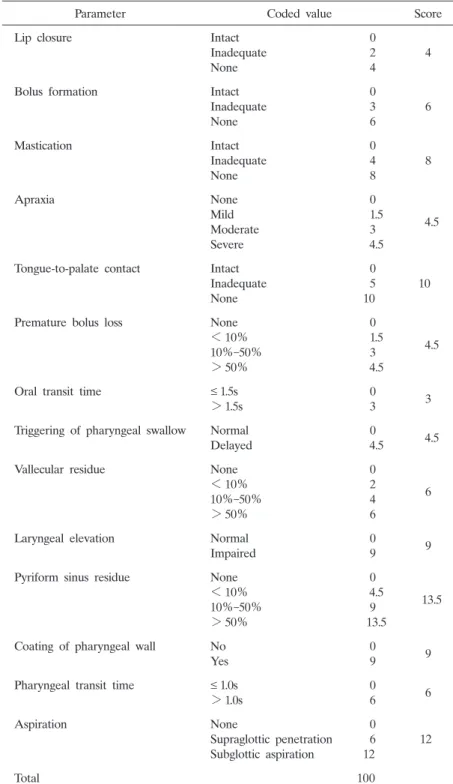
curve, Han et al14) established a cut-off of 47 points, above which more dysphagia patients could not ingest food orally 6 months after the onset of stroke. The parameters evaluated by VDS and their individual scores are listed in Table 1.
Statistical analysis
Subjects were divided into two groups, those who were able to ingest orally without tube feeding before discharge (Group 1) and the others who required tube feeding on discharge
(Group 2). The parameters listed in Table 1 were compared between the two groups. Han et al14) reported a difference in the prognosis of dysphagia for patients with a total VDS score of higher or lower than 47 points ; thus, in the present study, we also evaluated the usefulness of this cut-off point. Statistical analyses were performed using the Mann-Whitney U-test and Fisherʼs exact probability test, as appropriate.
Results
The results are given in Table 2. There were no significant differences in individual VDS parameters between the two groups. However, the total VDS score was significantly lower in Group 1 than in Group 2 (p<0.05). In addition, the time from stroke onset to admission to the rehabilitation ward was significantly shorter in Group 1 (p<0.05). Using a cut-off of 47 points for the total VDS score resulted in a significantly different prognosis for those with scores above and below this point (p<0.01). In patients with a total VDS score of ≤ 46 points, the odds ratio for achieving oral ingestion was 20-fold higher (95%
confidence interval 1.85-216) than that for patients with a total VDS score of ≥ 47 points.
There were no significant differences in any other parameters, including FIM scores, although there was a tendency for a higher FIM score on discharge in Group 1.
Discussion
The results of the present study indicate that the total VDS score may be useful in deter- mining the prognosis of dysphagia. Because the total VDS score represents comprehensive findings of dysphagia from the oral to pharyngeal phases, it could be a better predictor of the outcome of swallowing rehabilitation than the assessment of other local eating / swallowing functions, such as the presence or absence of aspiration. Furthermore, the cut- off (47 points) proposed by Han et al14) was found to be meaningful in the present study.
However, there are some differences between the present study and the study of Han et al14) that must be taken into consideration : the number of patients evaluated (n=83) was greater, mean patient age was lower (62 10 years), and the duration of hospitalization was shorter (40 19 days) in the study of Han et al14). Furthermore, the mean Barthel index21)
in the study of Han et al14) was 53 27, reflecting a high ADL, although this measure can- not be compared directly with the FIM used in the present study. In future studies, the
Table 1. Videofluoroscopic dysphagia scale
Parameter Coded value Score
Lip closure Intact
Inadequate None
0 2 4
4
Bolus formation Intact
Inadequate None
0 3 6
6
Mastication Intact
Inadequate None
0 4 8
8
Apraxia None
Mild Moderate Severe
0 1.5 3 4.5
4.5
Tongue-to-palate contact Intact Inadequate None
0 5 10
10
Premature bolus loss None
<10%
10%-50%
>50%
0 1.5 3 4.5
4.5
Oral transit time ≤ 1.5s
>1.5s
0
3 3
Triggering of pharyngeal swallow Normal Delayed
0
4.5 4.5
Vallecular residue None
<10%
10%-50%
>50%
0 2 4 6
6
Laryngeal elevation Normal
Impaired
0
9 9
Pyriform sinus residue None
<10%
10%-50%
>50%
0 4.5 9 13.5
13.5
Coating of pharyngeal wall No Yes
0
9 9
Pharyngeal transit time ≤ 1.0s
>1.0s
0
6 6
Aspiration None
Supraglottic penetration Subglottic aspiration
0 6 12
12
Total 100
The scoring system above is reproduced with permission from Han et al14).
cut-off of 47 points on the VDS should be confirmed in a larger number of patients.
In the present study, there was no significant difference in the FIM at discharge between Groups 1 and 2. Previous studies have reported a correlation between swallowing function and ADL2, 17, 18) and, although a similar tendency was noted in the present study, the dif- ference between Groups 1 and 2 did not reach statistical significance. This issue requires further investigation in a larger number of patients.
In the present study, VF was performed at the time of admission to the convalescent rehabilitation ward. The interval from stroke onset until VF varied and we could not control this. The mean interval between stroke and VF in the study of Han et al14) was 40 19 days and, if this interval can be standardized, an ideal study investigating the value of the procedure in the prognosis of dysphagia may be possible. However, because the course of stroke management varies in the Japanese medical system, this is unlikely. Thus, the present study evaluating the effects of timing of VF may be more practical, given the current system regarding convalescent rehabilitation wards in Japan. There was also significant variability in
Table 2. Results
Oral intake at time of discharge
Yes (Group 1 ; n=9) No (Group 2 ; n=14)
Age (years) 74.6 9.6 78.7 7.5
Gender (M / F) 6 / 3 12 / 2
Etiology
Cerebral infarction (n) 7 8
Cerebral hemorrhage (n) 2 6
Time from stroke onset to admission (days) 40.7 9.6 51.2 7.6* Appetite on admission
Present (n) 6 4
Absent (n) 3 10
Duration of hospitalization (days) 130.9 33.6 128.0 20.0
VDS on admission
Total score 34.3 9.6 47.7 14.1*
Cut-off of 47 points
≥ 47 points (n) 1 10
≤ 46 points (n) 8 4†
Functional independence measure on admission
Total score 55.8 30.8 43.1 31.2
Motor score 38.7 23.5 30.1 22.5
Cognitive score 17.1 8.0 13.0 9.1
*p<0.05 compared with Group 1 (Mann-Whitney U-test);
†p<0.01 compared with Group 1 (Fisherʼs exact probability test).
Note, there was no significant difference for any of the individual parameters on the videofluoroscopic dysphagia scale (VDS).
the time from stroke onset until admission to the rehabilitation ward. With the addition of this parameter to the evaluation process, the VDS may become a more sensitive predictor for the prognosis of dysphagia in the future. Further studies are warranted.
Conclusion
In the present study, we retrospectively reviewed medical records and VF findings in patients with stroke-related dysphagia who were admitted to the convalescent rehabilitation ward in our hospital. The findings suggest that the VDS is useful for predicting the prog- nosis of stroke-related dysphagia.
Acknowledgments
An abstract of this article was presented at the 5th World Congress of the International Society of Physical and Rehabilitation Medicine (ISPRM). The authors thank Drs T. R. Han, N. Paik, J. Park, and B. S. Kwon for their cooperation.
References
1) Tsubahara A and Abe H : Evaluation for patients with dysphagia. J Clin Exp Med 203:734-740(2002)(in Japanese)
2) Sato S, Sato M and Mizuma M : Prognoses of stroke with dysphagia. J Showa Med Assoc 66:392-397(2006)
(in Japanese)
3) Liu M : Problems in dysphagia rehabilitation. J Clin Rehabil 8:689-696(1999)(in Japanese)
4) Onogi K, Saitoh E, Baba M and Takeda S : Videofluoroscopic examination of swallowing. J Clin Rehabil 11:
797-803(2002)(in Japanese)
5) Teraoka F, Nishi M, Yoshizawa T, Momose M, Hirashima Y and Ichikawa T : Outcome of dysphagia in stroke patients : predictive factors for the resumption of a regular diet. Jpn J Rehabil Med 41:421-428(2004)(in Japanese)
6) Domen K : Prediction of stroke outcome. J Clin Rehabil 7:347-356(1998)(in Japanese)
7) Mann G, Hankey GJ and Cameron D : Swallowing function after stroke : prognosis and prognostic factors at 6 months. Stroke 30:744-748(1999)
8) Sato S, Fujishima I, Setsu K, Katagiri N, Inao R and Mizuma M : Evaluation for dysphagia by testing laryngeal sensation with a flexible laryngoscope. Jpn J Dysphagia Rehabil 6:44-52(2002)(in Japanese)
9) Holas MA, DePippo KL and Reding MJ : Aspiration and relative risk of medical complications following stroke. Arch Neurol 51:1051-1053(1994)
10) Horner J, Buoyer FG, Alberts MJ and Helms MJ : Dysphagia following brain-stem stroke. Arch Neurol 48:
1170-1173(1991)
11) Veis SL and Logemann JA : Swallowing disorders in persons with cerebrovascular accident. Arch Phys Med Rehabil 66:372-375(1985)
12) Teasell RW, Mcrae M, Marchuk Y and Finestone HM : Pneumonia associated with aspiration following stroke.
Arch Phys Med Rehabil 77:707-709(1996)
13) Smithard DG, OʼNeill PA, England RE, Park CL, Wyatt R, Martin DF and Morris J : The natural history of dysphagia following a stroke. Dysphagia 12:188-193(1997)
14) Han TR, Paik NJ, Park JW and Kwon BS : The prediction of persistent dysphagia beyond six months after stroke. Dysphagia 23:59-64(2007)
15) Langmore SE : Endoscopic Evaluation and Treatment of Swallowing Disorders, Thieme, New York, pp 73-155
(2001)
16) Makabe T, Masada T, Kunishio K and Matsumoto A : A retrospective study of timing of percutaneous endo-
scopic gastrostomy (PEG) for dysphagic stroke patients. Med J Kasawaki Hosp 1:17-20(2006)(in Japanese)
17) Langmore SE, Terpenning MS, Schork A, Chen Y, Murray JT, Lopatin D and Loesche WJ : Predictors of aspiration pneumonia : how important is dysphagia?. Dysphagia 13:69-81(1998)
18) Nakazawa T, Sekizawa K, Arai H, Kikuchi R, Manabe K and Sasaki H : High incidence of pneumonia in elderly patients with basal ganglia infarction. Arch Intern Med 157:321-324(1997)
19) Langmore SE, Skarupski KA, Park PS and Fries BE : Predictors of aspiration pneumonia in nursing home residents. Dysphagia 17:298-307(2002)
20) Cully AJ, Gfeller JD, Heise RA, Ross MJ, Teal CR and Kunik MA : Geriatric depression, medical diagnosis, and functional recovery during acute rehabilitation. Arch Phys Med Rehabil 86:2256-2260(2005)
21) Christiansen CH, Schwartz RK and Barnes KJ : Self-care ; evaluation and management. In : Rehabilitation Medicine : principles and practice. 2nd ed, DeLisa AJ, Gans BM (Eds), Lippincott, Philadelphia, pp 178-200
(1993)
[Received October 19, 2009 : Accepted December 11, 2009]