The Cybersecurity Policy for Critical Infrastructure Protection (4th Edition)
(Tentative Translation)
April 18, 2017
(Revised July 25, 2018) (Revised January 30, 2020) Cybersecurity Strategic Headquarters
Government of JAPAN
i
Table of Contents
I. Introduction ... 1
1. Direction for Establishing the Cybersecurity Policy ... 1
2. Structure of This Cybersecurity Policy ... 3
3. Assessment of the Third Policy ... 3
4. Outcome of the Review for the Revision of this Cybersecurity Policy ... 6
4.1 Purpose of CIP ... 6
4.2 Concept of Mission Assurance ... 7
4.3 Priorities in This Cybersecurity Policy ... 7
4.4 Policy Groups and Direction of Reinforcing and Refining the Components of the Cybersecurity Policy8 II. Executive Summary of This Cybersecurity Policy ... 10
III. Policies for CIP ... 12
1. Maintenance and Promotion of the Safety Principles ... 12
1.1 Continual improvement of the Guidelines for Safety Principles... 12
1.2 Continual improvement of the safety principles ... 13
1.3 Promotion of the safety principles ... 13
2. Enhancement of Information Sharing System ... 14
2.1 Information sharing system during the term of this Cybersecurity Policy ... 14
2.2 Further promotion of information sharing... 15
2.3 Promotion of CI operators' activities ... 16
3. Enhancement of Incident Response Capability ... 18
3.1 Improvement of cross-sectoral exercises ... 18
3.2 CEPTOAR communication training ... 19
4. Risk Management and Preparation of Incident Readiness ... 21
4.1 Basic view of risk management ... 21
4.2 Promotion of risk management ... 22
4.3 Establishment of a process of synergizing the relevant policies ... 25
5. Enhancement of the Basis for CIP ... 26
5.1 Review of the protection scope of CI ... 26
5.2 Promotion of public relations activities ... 27
5.3 Promotion of international cooperation ... 27
5.4 Promotion of security by design ... 28
5.5 Appeal to top management ... 28
5.6 Promotion of the development of human resources ... 29
5.7 Ensuring Security in relation to the My Number System ... 29
5.8 Maintenance of reference of standards and guides ... 29
IV. Activities Taken by Stakeholders ... 31
ii
1. Activities by the Cabinet Secretariat ... 31
2. Activities by Responsible Ministries for CI ... 33
3. Activities by Cybersecurity Related Ministries ... 35
4. Activities by Crisis Management Ministries and Disaster Prevention Related Ministries ... 35
5. Voluntary Activities by CI Operators ... 36
6. Voluntary Activities by CEPTOARs and the CEPTOAR Secretariat ... 37
7. Voluntary Activities by the CEPTOAR Council ... 38
8. Voluntary Activities by Cybersecurity Related Agencies ... 38
9. Voluntary Activities by Cyberspace-related Operators ... 39
V. Assessment and Verification ... 40
1. Assessment of This Cybersecurity Policy ... 40
1.1 Assessment ... 40
1.2 Envisaged future ... 40
1.3 Goals of this Cybersecurity Policy ... 42
1.4 Supplementary studies ... 43
2. Verification of This Cybersecurity Policy ... 44
2.1 Verification ... 44
2.2 Verification of measures taken by CI operators ... 44
2.3 Verification of policies by government organizations... 45
VI. Revision of This Cybersecurity Policy ... 47
ATTACHMENT: INFORMATION SHARING TO NISC AND INFORMATION SHARING FROM NISC ... 48
1. Information Related to System Failures ... 48
2. Information Sharing to NISC from CI Operators ... 50
2.1 Cases requiring information sharing to NISC ... 50
2.2 Framework for information sharing to NISC ... 50
2.3 Handling of information shared to NISC ... 51
3. Information Sharing from NISC ... 52
3.1 Cases requiring information sharing from NISC ... 52
3.2 Framework for information sharing from NISC ... 52
3.3 Cooperation for information sharing from NISC ... 53
ANNEX 1. SCOPE OF CI OPERATORS AND CRITICAL INFORMATION SYSTEM EXAMPLES ... 54
ANNEX 2. EXPLANATION OF CI SERVICES AND CI SERVICE OUTAGE EXAMPLES ... 55
ANNEX 3. CATEGORIES OF EVENTS AND CAUSES FOR INFORMATION SHARING TO NISC ... 61
ANNEX 4-1. INFORMATION SHARING SYSTEM ... 62
ANNEX 4-2. RESPONSIBILITIES OF EACH STAKEHOLDER IN INFORMATION SHARING SYSTEM ... 63
ANNEX 5. DEFINITIONS / GLOSSARIES ... 64
I. Introduction
1. Direction for Establishing the Cybersecurity Policy
1 I. Introduction
1. Direction for Establishing the Cybersecurity Policy
National life and socioeconomic activities fully depend on diverse social infrastructures, and information systems are being broadly utilized to enable infrastructures to properly fulfill their functions. Under such circumstances, there is a need for the public and private sectors to make all-out efforts to intensively protect critical infrastructure (CI) services, such as information and communication services, electric power supply services and financial services, whose suspension or deterioration is highly likely to have tremendous impact. The private sector should not completely count on the government, nor should the government leave everything to the private sector. Close public-private collaboration is indispensable. As safe and continuous provision of CI services is required due to their nature, Critical Infrastructure Services (CISs) outage risks due to cyberattacks on indispensable information systems must be reduced to the extent possible, and at the same time, efforts for early detection of and swift recovery from outages are of great importance in protecting them.
Therefore, the government established the Cybersecurity Policy for Critical Infrastructures Protection (the
"Cybersecurity Policy"), a shared policy between the government, which bears responsibility for protection, and CI operators, which independently carry out relevant protective measures, as a basic framework for CI protection, and has promoted this initiative.
This framework was originally formulated with the establishment of the "Special Action Plan on Cyber-terrorism Countermeasures for Critical Infrastructure" (concluded in the December 2000 Information Security Measure Promotion Meeting; the "Special Action Plan") and had served as the basis for the policy related to cybersecurity measures for Japan's critical infrastructure for over 16 years, up until the establishment of the preceding Basic Policy of Critical Information Infrastructure Protection (3rd Edition) (concluded by the Information Security Policy Council in May 2014 and revised by the Cybersecurity Strategic Headquarters in May 2015; the "Third Policy"). Certain achievements have been made, while reflecting the lessons learned from the experience of dealing with system outages and data loss during the Great East Japan Earthquake and appropriate responses having been made to an ever-changing social and technological environment and the increasingly sophisticated and complex cyberattacks in recent years, and through necessary reviews based on assessment of measures implemented under this framework.
Considering these backgrounds, the Cybersecurity Policy of Critical Infrastructure Protection (4th Edition) ("this Cybersecurity Policy") was established while maintaining the basic framework for CIP. Based on the basic concept of the Basic Act on Cybersecurity (Act No. 104 of 2014), assessment of the Third Policy described later, and the Cybersecurity Strategy (Cabinet resolution in September 2015), this Cybersecurity Policy maintains the basic structure consisting of the five key policies in the Third Policy which have become deeply rooted among stakeholders. In the meantime, changes in cyberattacks targeting CI and in the background social and technological environment are significant, and information technology (IT) has come to be increasingly incorporated in socioeconomic systems integrally with operational technology (OT)
1such as control systems. Additionally, IoT systems, which may be targeted
1
Hereinafter, operational technology for control systems using IT is simply indicated as OT.
I. Introduction
1. Direction for Establishing the Cybersecurity Policy
2
in cyberattacks, are also becoming more widely used. Ahead of the Olympic and Paralympic games to be held in Tokyo
in 2020 (the "Olympic and Paralympic games"), risks surrounding CI may be increasing. Therefore, this Cybersecurity
Policy specifies priorities and aims to enhance and improve measures in each key policy.
I. Introduction
2. Structure of This Cybersecurity Policy
3
2. Structure of This Cybersecurity Policy
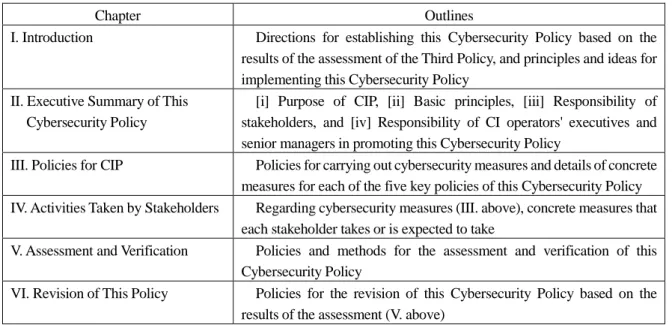
The structure of this Cybersecurity Policy and outlines of each Chapter are as indicated in Table 1.
For responsible entities for respective initiatives based on this Cybersecurity Policy, please refer to Chapter IV.
Table 1 Structure of This Cybersecurity Policy
Chapter Outlines
I. Introduction Directions for establishing this Cybersecurity Policy based on the results of the assessment of the Third Policy, and principles and ideas for implementing this Cybersecurity Policy
II. Executive Summary of This Cybersecurity Policy
[i] Purpose of CIP, [ii] Basic principles, [iii] Responsibility of stakeholders, and [iv] Responsibility of CI operators' executives and senior managers in promoting this Cybersecurity Policy
III. Policies for CIP Policies for carrying out cybersecurity measures and details of concrete measures for each of the five key policies of this Cybersecurity Policy IV. Activities Taken by Stakeholders Regarding cybersecurity measures (III. above), concrete measures that
each stakeholder takes or is expected to take
V. Assessment and Verification Policies and methods for the assessment and verification of this Cybersecurity Policy
VI. Revision of This Policy Policies for the revision of this Cybersecurity Policy based on the results of the assessment (V. above)
3. Assessment of the Third Policy
The Third Policy is composed of the following five key policies.
[1] Maintenance and promotion of the safety principles [2] Enhancement of information sharing system [3] Enhancement of incident response capability [4] Risk management
[5] Enhancement of the basis for CIP
After analytical assessment for each key policy (assessment of the results and clarification of issues), comprehensive assessment was conducted for the entirety of the Third Policy (assessment of the achievement and clarification of issues in light of the purpose (envisaged future) during the term).
The comprehensive assessment is outlined as follows.
< Envisaged Future >
Voluntary activities based on each stakeholder's awareness of their responsibilities are disseminated as their respective code of conduct and such behavior contributes to forming cybersecurity culture.
< Assessment >
The Third Policy clearly indicates the basic principle, stating that cybersecurity measures should be taken by CI
operators on their own responsibility, and then presents this envisaged future.
I. Introduction
3. Assessment of the Third Policy
4
With the aim of promoting voluntary efforts by CI operators, the Guidelines for Establishing Safety Principles for Ensuring CI Security and Attachment thereof (the "Guidelines for Safety Principles") were revised in line with the PDCA (Plan-Do-Check-Act) cycle. Each CI sector guideline and codes of conduct of respective CI operators such as internal policies are now being reviewed on a voluntary basis in response to the revision of the Guidelines for Safety Principles.
Given these, it is considered that the PDCA cycle itself, which allows CI operators to judge the necessity of review and make improvements independently, is prevailing as their code of conduct.
However, the activities of "Check" and "Act" in the PDCA cycle are not sufficiently established, nor can be recognized to have been disseminated to the degree that they are accepted as the code of conduct, as shown in the results of the survey concerning the dissemination of safety principles, which was conducted by the Cabinet Secretariat with the aim of ascertaining the current status of cybersecurity measures. The establishment of these activities is one of the remaining challenges.
In the future, it is hoped that such behavior based on the abovementioned code of conduct is disseminated among all stakeholders, encouraging them to continue efforts in line with this, and cybersecurity culture is thus formed among them.
< Envisaged Future >
Stakeholders communicate with each other on a regular basis with the aim of strengthening measures in preparation for any CISs outages and are making improvements to their measures constantly in order to reflect experience concerning incident responses in their future efforts.
< Assessment >
Active information sharing between the public sector and the private sector is steadily progressing, with an increasing number of reports being made from CI operators to responsible ministries and the National Center of Incident Readiness and Strategy for Cybersecurity (NISC).
Regarding information sharing in the private sector, the secretariat of the CEPTOAR council was transferred to the private sector, thereby enhancing their independence and positive attitude in information sharing among CEPTOARs.
Additionally, members of each CEPTOAR have increased and broader information exchanges have been contributing to enriching knowledge on cybersecurity and creating ties among responsible personnel. The development of a better environment for communication among stakeholders has thus been steadily advancing. Furthermore, ISACs
2have been organized in some sectors and information sharing and countermeasures against cyberattacks are progressing.
Cross-sectoral exercises and training by CEPTOARs are also being conducted continuously to enhance incident response capability. Participants are increasing significantly and response scenarios are made more and more sophisticated. These activities are found to have contributed to enhancing response capability in line with the needs of CI operators.
In the meantime, as threats are becoming increasingly serious, it is required to continue to improve communication methods qualitatively and quantitatively through their classification and specification in light of respective purposes in
2
ISAC: Information Sharing and Analysis Center
I. Introduction
3. Assessment of the Third Policy
5
order to further strengthen preventive measures against CISs outages. On the other hand, it should also be said that efforts to reflect experience of CISs outages in future measures in a cross-sectional manner are not necessarily sufficient although efforts have been made to enhance incident response capability through exercises and training. This needs to be addressed. Additionally, in order for CIP covering a broader area ("protection as plane"), constant improvements through analysis and sharing of case examples are indispensable and efforts therefor must be continued.
< Envisaged Future >
The fact that stakeholders are collaboratively making efforts for CIP is widely understood by the general public and this gives them peace of mind. Well-established communication among diverse stakeholders enables them to take calm responses in the event of CISs outage.
< Assessment >
Stakeholders have reliably come to have better communication as mentioned above. Additionally, the Third Policy and the achievement thereunder are publicized and videos of cross-sectoral exercises are publicly made available online.
In this manner, PR activities have been carried out with the aim of reassuring the general public by having them better understand diverse efforts being made based on the Third Policy.
On the other hand, public concern over CIP cannot be fully relieved partly due to increasing news reports on information leakage caused by targeted mail attacks. Such concern needs to be eliminated.
Efforts to enhance incident response capability have been made through constantly checking the current status of incident response through exercises and training as mentioned above. Collaboration with overseas organizations, etc., such as information sharing under various frameworks, has also been promoted.
In order to reassure the general public and ensure calm responses upon CISs outages, it is necessary to continue and strengthen these efforts in collaboration with diverse entities in and outside Japan, while sharing collected and analyzed information on new risks, sources of risks and the latest incidents among stakeholders, and actively providing information to the general public based on the concept of mission assurance.
< Envisaged Future >
These efforts are publicized as the Cybersecurity Policy and are assessed regularly and revised properly as needed.
< Assessment >
Cybersecurity measures have been compiled and publicized as the Cybersecurity Policy since 2000 and the progress of the activities thereunder in each fiscal year has been checked and verified from the perspective of measuring the output of individual activities. Activities during the Cybersecurity Policy term have also been assessed once every three to five years from the perspective of measuring the outcome, i.e., to what extent society has come closer to the envisaged future, and the Cybersecurity Policy has been reviewed based on the results of the assessment.
Through these efforts, CIP in Japan has been implemented steadily for 16 years since the establishment of the Special
Action Plan, or for 11 years under the current style of the First Policy to the Third Policy, and has been progressing
I. Introduction
4. Outcome of the Review for the Revision of this Cybersecurity Policy
6
steadily based on the five key policies. Therefore, it can be said that the Cybersecurity Policy and activities thereunder have been properly reviewed through regular assessments.
The basic framework for CIP should be maintained as the Cybersecurity Policy and efforts need to be continued into the future based thereon.
< Envisaged Future >
These efforts being made by stakeholders have become steadily rooted as measures contributing to the sustainable development of society.
< Assessment >
Efforts based on the Cybersecurity Policy are found to have been progressed steadily as mentioned above.
Therefore, the basic structure consisting of the five key policies in the Third Policy, which have deeply taken root among stakeholders, should be maintained and activities under each policy should be strengthened. In light of the status of cyberattacks targeting CI and background changes in the social and technological environment, and based on the concept of mission assurance, due consideration should be given to [i] further promotion of leading activities by some operators for protecting CI as a whole, [ii] enhancement of information sharing structure toward the Olympic and Paralympic games, and [iii] promotion of incident readiness based on risk management. These points should be positioned as policy priorities in this Cybersecurity Policy and concrete activities under each of the five key policies need to be enhanced and improved while keeping them in mind.
4. Outcome of the Review for the Revision of this Cybersecurity Policy
As explained above, the basic structure consisting of the five key policies in the Third Policy, which have taken deep root among stakeholders, are maintained in this Cybersecurity Policy, in light of the issues extracted through the assessment of the Third Policy and the Cybersecurity Strategy. It was decided to first clarify the purpose of CIP and decide policy priorities, in light of the status of cyberattacks targeting CI and background changes in the social and technological environment and also based on the concept of mission assurance, and then consider enhancement and improvement of activities under this Cybersecurity Policy.
4.1 Purpose of CIP
This Cybersecurity Policy maintains the purpose of CIP under the Third Policy but clearly states "ensuring safe and
continuous provision of CI services" as the top priority based on the concept of mission assurance.
I. Introduction
4. Outcome of the Review for the Revision of this Cybersecurity Policy
7
4.2 Concept of Mission Assurance
CI services are the very basis of national life and socioeconomic activities and suspension thereof may have a direct and serious negative effect on the safety and ease of the general public. Therefore, stakeholders are required to make efforts to ensure safe and continuous provision of CI services (mission assurance).
Mission assurance in this Cybersecurity Policy does not mean to oblige stakeholders to make a firm commitment to ensuring CIP or maintaining CI functions, but to have them assume their responsibilities in the process of protecting CI services and maintaining the functions thereof. This is the concept to require each stakeholder to properly make efforts for necessary cybersecurity measures.
(1) Efforts required for CI operators
The top management of CI operators must be actively involved in deciding business strategies incorporating preparedness for cybersecurity risks and taking measures to reduce such risks strategically based on the results of risk assessment. They need to put in place an appropriate incident readiness to continue CI services even in the case of receiving a cyberattack, etc., ensuring safety of their CI services and preventing suspension or quality loss unacceptable for themselves and other stakeholders to the extent possible. Top management should develop internal control systems concerning cybersecurity measures and must fulfill accountability to their own stakeholders concerning the fact that they are properly taking measures for mission assurance.
(2) Efforts required for government organizations
Government organizations are required to set or review the scopes of CI and CI services to be protected as the basis to support national life and socioeconomic activities, in collaboration with diverse stakeholders, and to offer necessary support to CI operators for their abovementioned efforts. Government organizations must also fulfill accountability to the general public concerning the fact that efforts are being made properly through the assessment of this Cybersecurity Policy and PR activities.
4.3 Priorities in This Cybersecurity Policy
The following three priorities are to be reflected in activities under each policy.
4.3.1 Promotion of leading activities by CI operators (classification of CI operators in light of interdependency)
The utilization of ICT is increasingly spreading among CI operators and interdependency among sectors has become
deeper. In some sectors that are highly depended upon by other CISs and may cause a big impact in the case of outages
even for a relatively short period of time (such as electric power supply services, information and communication
services, and financial services), CI operators have voluntarily promoted highly advanced cybersecurity measures,
centered on major operators belonging to the relevant sectors. In order to protect CI as a whole from increasingly
sophisticated cyberattacks, etc., such leading activities need to be further enhanced and promoted and should also be
I. Introduction
4. Outcome of the Review for the Revision of this Cybersecurity Policy
8
disseminated to other CI operators within these sectors and those in other CI sectors. Therefore, this point is reflected in activities under this Cybersecurity Policy.
4.3.2 Enhancement of information sharing structure toward the Olympic and Paralympic games
Looking ahead to big international events, such as the Olympic and Paralympic games, Japan is attracting the attention of the international community but at the same time may also be subject to malicious attacks, posing a possibility that risks of cyberattacks, etc. may increase. In order to surely protect these international events and CI from heightened threats of cyberattacks, stakeholders need to detect threats early and take prompt and appropriate countermeasures based on helpful and practical information. Therefore, this point is reflected in the activities for the enhancement of information sharing structure under this Cybersecurity Policy.
Assuming that these activities are to be handed down as a legacy after the Olympic and Paralympic games, modeling of know-how and other knowledge concerning the formulation of relevant systems will be discussed.
4.3.3. Promotion of incident readiness based on risk management
Considering the fact that cyberattacks targeting CI are becoming more and more serious and in light of background changes in the social and technological environment, CI operators are required to develop appropriate incident readiness against cyberattacks, etc. so that they can continue the provision of CI services while ensuring safety of their services and preventing suspension or quality loss unacceptable for themselves and other stakeholders to the extent possible.
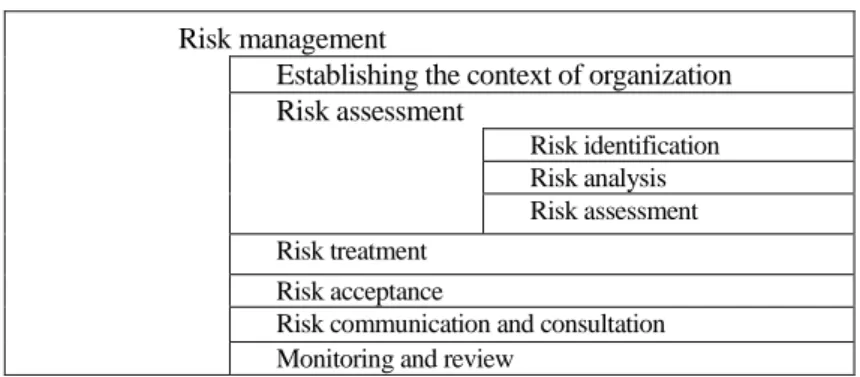
Additionally, it is necessary to enhance and promote efforts for risk assessment, risk communication and consultation, monitoring and review in the process of risk management in order to develop appropriate incident readiness from the viewpoint of mission assurance. Therefore, this point is reflected in the activities for the risk management and development of incident readiness under this Cybersecurity Policy.
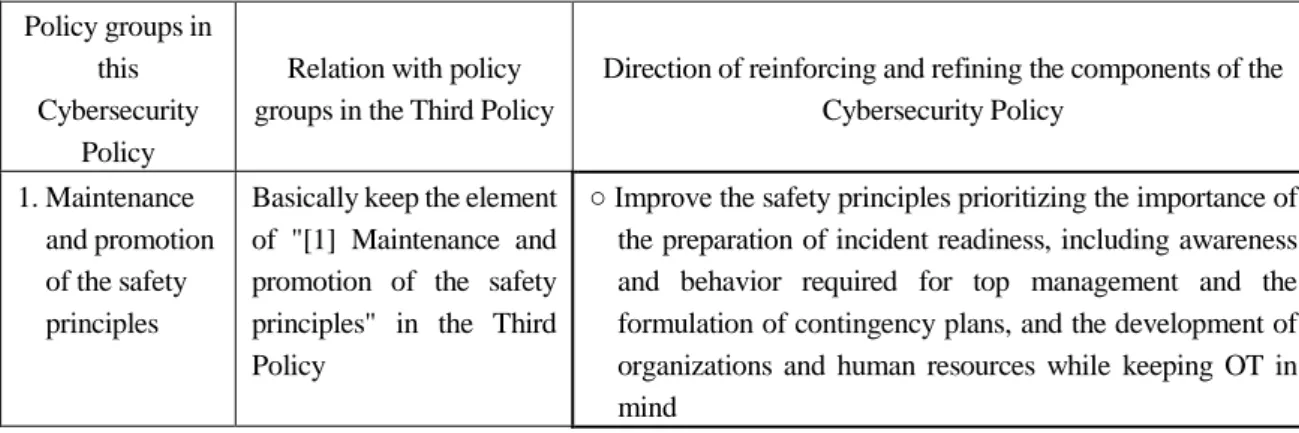
4.4 Policy Groups and Direction of Reinforcing and Refining the Components of the Cybersecurity Policy Policy groups and direction of reinforcing and refining the components of the Cybersecurity Policy are as shown in the following table.
Table 2 Policy Groups and Direction of Reinforcing and Refining the Components of the Cybersecurity Policy Policy groups in
this Cybersecurity
Policy
Relation with policy groups in the Third Policy
Direction of reinforcing and refining the components of the Cybersecurity Policy
1. Maintenance and promotion of the safety principles
Basically keep the element of "[1] Maintenance and promotion of the safety principles" in the Third Policy
○ Improve the safety principles prioritizing the importance of
the preparation of incident readiness, including awareness
and behavior required for top management and the
formulation of contingency plans, and the development of
organizations and human resources while keeping OT in
mind
I. Introduction
4. Outcome of the Review for the Revision of this Cybersecurity Policy
9
○ Continue efforts for appropriately improving institutional frameworks as necessary for maintaining safety, such as through positioning cybersecurity measures as safety regulations among relevant laws and embodying the service maintenance level in relevant laws from the viewpoint of mission assurance
○ Review items of the questionnaire survey so that the survey leads to further improvement and dissemination of the safety principles among CI operators
2. Enhancement of information sharing system
Basically keep the element of "[2] Enhancement of information sharing system" in the Third Policy
○ Further promote information sharing
・ Eliminate obstacles that hinder information sharing by diversifying the contact formation (addition of a new route for information provision via the CEPTOAR secretariat, which enables data anonymization)
・ Promote efficient and effective responses through information sharing based on severity schema on CISs outages
・Develop the information sharing system to allow opening of a hotline to achieve prompt and efficient sharing of information on cyberattacks, 24 hours a day, 365 days a year
・ Share awareness among stakeholders regarding the inclusion of OT and IoT in the scope of information sharing to and from NISC by clarifying the relevant scope
3. Enhancement of incident response capability
Basically keep the element of "[3] Enhancement of incident response capability" in the Third Policy
○ Continuously improve cross-sectoral exercises and CEPTOAR training that would be more practical for CI operators
○ Promote voluntary exercises by CI operators by broadly disseminating knowledge and know-how obtained through cross-sectoral exercises and providing a virtual exercise environment
4. Risk management and
development of incident readiness
Basically keep the element of "[4] Risk management"
in the Third Policy and develop the element as
"Risk management and preparation of incident readiness"
○ Expand the scope of measures and add those for assisting preparation of incident readiness based on the results of risk assessment from the viewpoint of mission assurance (including measures aimed at the Olympic and Paralympic games)
○ Promote "risk communication and consultation" and
"monitoring and review," which are significant from the viewpoint of mission assurance
5. Enhancement of the basis for CIP
Basically keep the element of "[5] Enhancement of the basis for CIP" in the Third Policy
○ Continue review of the scope of information sharing within and outside the CI sectors
○ Positively provide information obtained from international conferences, etc. to stakeholders
○ Promote security by design
○ Make appeals to the management layer of CI operators
○ Assist human resources development (cooperation among
government, industry and academia for specific human
resources development)
II. Executive Summary of This Cybersecurity Policy
10 II. Executive Summary of This Cybersecurity Policy
The key points for this Cybersecurity Policy ([i] Purpose of CIP, [ii] Basic principles, [iii] Responsibility of stakeholders, such as CI operators, government organizations, and cybersecurity related agencies, and in particular, [iv]
Responsibility of top management) are as follows.
[i] Purpose of CIP
The purpose of CIP is to maintain safe and continuous provision of CI services, based on the concept of mission assurance, by preventing serious impact on national life and socioeconomic activities caused by any CISs outages resulting from cyberattacks, natural disasters or other causes to the extent possible and ensuring prompt recovery from outages.
[ii] Basic concept
In the first place, CI operators should implement cybersecurity measures on their own responsibility, but collaborative efforts among stakeholders are indispensable on the basis of mission assurance for all CIs.
Therefore, the purpose of CIP should be achieved through all-out efforts by diverse stakeholders, thereby nurturing a sense of security among the general public, promoting social growth and resilience, and strengthening international competitiveness.
・ CI operators should respectively take measures and make efforts for continuous improvement of those measures as entities providing services and bearing social responsibilities.
・ Government organizations should provide necessary support for cybersecurity measures of CI operators.
・ Each CI operator should cooperate and coordinate with other stakeholders due to the limit of each operator's individual cybersecurity measures to address various threats.
[iii] Responsibility of stakeholders
・ All stakeholders should periodically check the progress of their own measures and policies as part of relevant efforts and accurately recognize the current circumstances, and proactively determine the goals of relevant activities. In addition, stakeholders should enhance their cooperation with each other, taking into account the status of other stakeholders' relevant activities.
・ All stakeholders should understand the 5W1H (when, where, who, why, what and how) of responses to CISs outages depending on the scale thereof and should be able to calmly address signs or occurrence of any CISs outages. They should also be capable to cooperate with other stakeholders and respond in a cooperative and concerted manner in addition to ensuring robust communication among various stakeholders and taking proactive measures.
[iv] Responsibility of top management
In addition to the above, top management should understand the necessity of the following matters and take relevant measures.
・Recognize their responsibility for ensuring cybersecurity and exert their leadership in cybersecurity measures from the viewpoint of mission assurance
・With the awareness that their individual efforts also contribute to the development of society as a whole, take cybersecurity measures while involving their supply chains (business partners, subsidiaries and affiliated companies, etc.)
・Develop incident readiness even in normal times and disclose information on responses properly in the event of an incident from the perspective of gaining trust and nurturing a sense of security among stakeholders
・Constantly secure management resources, such as budgets, structure and personnel, necessary for the
abovementioned measures and appropriately allocate them from a risk-based perspective
II. Executive Summary of This Cybersecurity Policy
11
Figure "Critical Infrastructure Operator Measure Examples" and "Government Activities"
P lan ( p rep ar at io n )/ p revent io n an d m it ig at io n Check (verify) + A ct ( revis e) / id ent ificat io n an d fixin g is su es
Do (act u al o p era tio n )/ d et ect io n an d r eco very
Internal rule (Cybersecurity policy, etc.) BCP, Contingency Plans Information handling Provision of resources (budget, human resources, infrastructure) Human resource development/assignment and accumulation of know-how Measures for outsourcingEstablishment and revision of roadmap for cybersecurity measures Establishment and revision of plan for cybersecurity measures Clarification and modification of cybersecurity requirements Design/implementation/maintenance related to technological cybersecurity measures Design/procedure manual creation/maintenance related to operational cybersecurity measures
Basis Operation of cybersecurity measures (Monitoring/control) Management review of operation of cybersecurity measures
Normal circumstances
Protection/recovery from CI services outage Public announcement of measures for critical infrastructure protection Outages Issue identification through internal/external audits
Normal circumstances
Issue identification through results of research/analysis of IT environmental change Issue identification through exercises and training Issue identification through CI services outage response Outages
Risk assessment based on identified issues Determination and revision of operator's basic policy Operation of cybersecurity measures (Recognizing the trend of attack, etc.) Public announcement of cybersecurity measures Issue identification through operation of cybersecurity measures
Resource management Establishment
Rulemaking Planning
Policy
Information sharing by stakeholders Execution of BCP, Contingency plans, etc.
Government activities Critical infrastructure operator
measure examples
Ma in ten an ce an d p ro mot io n o f th e sa fet y p rin ci p les Con tin u al im p ro vem ent o f th e safet y p rin cip les
( Secretariat/responsible ministries for critical infrastructure)S u rvey o n act ivit ies u n d er safet y p rin cip les
(Cabinet Secretariat)R is k m an ag em ent an d p rep ar at io n o f in cid ent r ead in ess R is k co m m u n ica tio n an d co n su lt at io n
(Cabinet Secretariat/responsible ministries for critical infrastructure) Enhancement of basis for critical infrastructure protection Review of the protection scope / Public relations / International cooperation / Promotion of security by design / Appeal to top management / Promotion of the developing human resources / maintenance of regulations (Cabinet Secretariat/responsible ministries for critical infrastructure)Dissemination of risk assessment (Cabinet Secretariat/responsible ministries for critical infrastructure) Promotion of incident readiness (Cabinet Secretariat/responsible ministries for critical infrastructure)
Continual improvement of guides for safety principles (Cabinet Secretariat/responsible ministries for critical infrastructure)
In for m at io n s h ar in g
Information sharing between public- private stakeholders (Cabinet Secretariat/responsible ministries for critical infrastructure)Incident response Cross-sectoral exercises (Cabinet Secretariat/responsible ministries for critical infrastructure) CEPTOAR communication training (Cabinet Secretariat/responsible ministries for critical infrastructure) Training by responsible ministries for critical infrastructure (Responsible ministries for critical infrastructure) Investigation and analysis of new risk sources and risks, etc. (Responsible ministries for critical infrastructure)
Promotion of monitoring and review (Responsible ministries for critical infrastructure)
III. Policies for CIP
1. Maintenance and Promotion of the Safety Principles
12 III. Policies for CIP
1. Maintenance and Promotion of the Safety Principles
Cybersecurity measures commonly required in all sectors were compiled as the Guidelines for Safety Principles for Ensuring CI Security and revisions have been made as necessary. In line with the Guidelines, all CI sector guidelines and internal policies, etc. of respective CI operators are now being reviewed, and the safety principles as a whole are being developed in this manner.
The safety principles have been disseminating among CI operators as the rules on cybersecurity measures, which further encourages efforts necessary for ensuring safe and continuous provision of CI services.
During the term of this Cybersecurity Policy, the Cabinet Secretariat carries out the review of the Guidelines and continual improvement of the safety principles, and surveys their promotion status in order to maintain and enhance CIP capability.
Also, CI operators continuously and steadily work on cybersecurity measures in accordance with their PDCA cycle, in view of the importance thereof.
1.1 Continual improvement of the Guidelines for Safety Principles
The Cabinet Secretariat carries out the review of the main section and measures section of the Guidelines for safety principles as well as the manual (the "Manual for Prioritization of Information Security Measures") with the aim of maintaining and enhancing CIP capability, especially measures related to top management, development of incident readiness including formulation of contingency plans, and measures integrating not only IT but also OT.
Specifically, responsibility of top management is clarified to require them to take the initiative in the formation of cybersecurity culture and the implementation of the PDCA cycle in carrying out cybersecurity measures by the use of the "Cybersecurity Management Guidelines," etc. The reviewed Guidelines additionally describe the necessity of preparation of incident readiness through the establishment of BCPs and contingency plans based on the concept of mission assurance and efforts for ensuring cybersecurity, which is indispensable for properly responding to IT, as a basic factor for internal control (such as internal audits and penetration tests).
The significance of developing a cross-sectoral organization consisting of a unit responsible for IT and a unit responsible for OT and nurturing personnel required therefor is also emphasized for the purpose of promptly responding to threats of cyberattacks to control systems of plants and factories, in addition to the need to formulate a Computer Security Incident Response Team (CSIRT
3).
Furthermore, as a part of the efforts for information sharing, the implementation of case studies concerning past incident responses is presented as a recommendation so that respective CI operators surely reflect other operators' experience of response to CISs outages in their future cybersecurity measures.
3
Computer Security Incident Response Team: A mechanism to monitor information systems for information security problems, and
analyze the causes and investigate affected areas, etc. if any problem is detected
III. Policies for CIP
1. Maintenance and Promotion of the Safety Principles
13
The main section, measures section, and manual are to be reviewed once every three years in principle, but this does not apply when any significant changes beyond expectations occur in social trends, etc. In particular, looking toward the Olympic and Paralympic games in 2020, reviews are to be conducted on a timely basis.
1.2 Continual improvement of the safety principles
CI operators and responsible ministries for CI continually improve the safety principles based on knowledge learned from experiences of each CI operators' incident responses in order to maintain and enhance the protective capability of CI as a whole.
In detail, they make continual improvement of the safety principles through risk assessment, by identifying issues from operation of cybersecurity measures, internal/external audits, results of studies and analyses of environmental changes concerning IT, exercises, training and CISs incident responses. When verifying the safety principles, the Guidelines as well as social trend changes and new knowledge released by the Cabinet Secretariat are to be used.
Additionally, the Cabinet Secretariat and responsible ministries for CI continue efforts for appropriately improving institutional frameworks as necessary for maintaining safety, by means such as through positioning cybersecurity measures as safety regulations among relevant laws and embodying the service maintenance level in relevant laws so that appropriate cybersecurity measures are surely taken from the viewpoint of mission assurance.
The Cabinet Secretariat carries out survey on the improvement of the safety principles by the responsible ministries for CI each fiscal year and releases the results thereof.
1.3 Promotion of the safety principles
The Cabinet Secretariat conducts a questionnaire survey and visits to CI operators every year for the purpose of examining their concrete measures and further accurately ascertaining how the safety principles have been promoted among CI operators. Survey items are to be reviewed as needed to better promote the safety principles and improve CI operators' activities.
Specifically, survey items that enable more detailed and accurate understanding of the current status and survey items for ascertaining the level of reaching the envisaged future are to be added. Furthermore, questionnaires are designed to enable CI operators to conduct a self-check and ascertain their own achievement levels, issues and solutions through responding to questions.
Visits to CI operators are also conducted with the aim of verifying hypotheses formed on the results of the questionnaire survey and collecting best practices.
Results of these questionnaire survey and visits are released every fiscal year, in principle, and are utilized for the
improvements of measures under this Cybersecurity Policy.
III. Policies for CIP
2. Enhancement of Information Sharing System
14
2. Enhancement of Information Sharing System
While the social and technological environments surrounding CI and trends of cybersecurity are changing from moment to moment, individual CI operators' independent activities have limits in maintaining high security levels.
Cross-sectoral efforts for information sharing in collaboration between the public and private sectors are indispensable.
Broadly sharing information on attackers and resulting prompt countermeasures by a larger number of CI operators contribute not only to minimizing damage caused by the relevant attack but also to deterring further cyberattacks.
Given such backdrop, efforts for smoother information sharing have been made under former Cybersecurity Policies and a certain outcome is observed in activated information sharing in some sectors, but information sharing among the entirety of the CI is not necessarily sufficient yet. Therefore, it is important to deepen understanding of the significance and necessity of such efforts and promote measures for activating information sharing continuously under this Cybersecurity Policy.
The Japanese government basically considers that CI operators should assume the primary responsibility for cybersecurity measures and should mutually cooperate with other stakeholders voluntarily. Accordingly, the Cabinet Secretariat preferentially makes efforts to develop an environment to enable the public and private sectors to easily share information in a cross-sectoral manner.
2.1 Information sharing system during the term of this Cybersecurity Policy
As many big international events, such as the Olympic and Paralympic games, are scheduled to be held in Japan, cyberattacks against CI are expected to be increased qualitatively and quantitatively and it is urgently necessary to develop an information sharing system among relevant entities promptly. The information sharing system built under the Third Policy has become fully rooted among stakeholders and therefore should be further developed and disseminated. The Cabinet Secretariat will consider means for improving the information sharing system and formulating new schemes as follows to enable CI operators to positively utilize shared information in their risk management and incident responses.
Under the former information sharing system, CI operators were supposed to submit information to the Cabinet Secretariat via responsible ministries and this partially hindered activation of information sharing as CI operators were afraid of being subject to disciplinary guidance by government organizations as a result of reporting signs of incidents, Hiyari-Hatto events or system failures, for which reporting is not required under relevant laws. Therefore, this
information sharing system is to be revised to newly introduce, in addition to the conventional means to have CI operators directly make reports to responsible ministries, a new route for information sharing via the CEPTOAR secretariat, which enables data anonymization, regarding events for which reporting is not required under relevant laws.
CI operators will be able to select the means for reporting on their own, depending on the content, and this is expected
to break down psychological barriers and prompt information sharing not legally required. Additionally, information
will come to be gathered in each CEPTOAR secretariat and functions of CEPTOARs will be strengthened as each
CEPTOAR will become able to spread gathered information promptly within each sector as necessary.
III. Policies for CIP
2. Enhancement of Information Sharing System
15
Furthermore, the information sharing system will be developed to allow the opening of a hotline between the Cabinet Secretariat and CI operators in an emergency to achieve prompt and efficient information sharing on cyberattacks, 24 hours a day, 365 days a year.
Cybersecurity related agencies offer support for the collection and analysis of information on domestic and foreign incidents and incident responses from a neutral standpoint apart from individual companies, and therefore, it is effective and preferable that the Cabinet Secretariat, CI operators and cybersecurity related agencies, which have abundant knowledge on cybersecurity, closely collaborate with each other. Cybersecurity related agencies are expected to play a major role in Japan's information sharing system through anonymizing information based on consent of data sources and sharing such anonymized information positively with stakeholders.
In the event of a CISs crisis due to a disaster or terror attack, etc., stakeholders should closely collaborate with each other in accordance with "Regarding the Government Initial Response System for Emergencies" (November 21, 2003, Cabinet resolution), while properly sharing information based on this Cybersecurity Policy.
Given these, the information sharing system during the term of this Cybersecurity Policy is represented in "ANNEX 4-1. INFORMATION SHARING SYSTEM" and the roles of individual stakeholders are in "ANNEX 4-2.
RESPONSIBILITIES OF EACH STAKEHOLDER". Diversification of reporting routes will be promoted on a trial basis even before the introduction of the new information sharing system. Examples of critical information systems and CISs outages are indicated in "ANNEX 1. SCOPE OF CI OPERATORS AND CRITICAL INFORMATION SYSTEM EXAMPLES" and "ANNEX 2. EXPLANATION OF CI SERVICES AND CI SERVICE OUTAGE EXAMPLES."
The abovementioned measures are steadily promoted and construction of a system to share information with stakeholders will be developed while CISs outages and threat information is aggregated in the Cabinet Secretariat in a cross-sectoral manner and analyzed using the information sharing system mentioned above, in order to make it possible to promptly and properly respond to any threat to cybersecurity covering multiple sectors, such as IoT.
2.2 Further promotion of information sharing
The Cabinet Secretariat continuously reviews the protection scope of CI (including the expansion of the scope of information sharing) in light of changes in the social and technological environment and interdependency among CI sectors, while clarifying information to be shared among CI operators, in order to further activate information sharing during the term of this Cybersecurity Policy.
Information to be shared is defined, as in the Third Policy, to be "information concerning system failures, including CISs outages, signs and Hiyari-Hatto events (hereinafter, referred to as "information on system failures")" based on the idea indicated in "ATTACHMENT: INFORMATION SHARING TO NISC AND INFORMATION SHARING FROM NISC" and "ANNEX 3. CATEGORIES OF EVENTS AND CAUSES FOR INFORMATION SHARING TO NISC".
However, as affected areas and concrete actions differ depending on the seriousness of CISs outages and the significance
of related information, this Cybersecurity Policy cites examples of the severity schema on CISs outages in the
ATTACHMENT and the Cabinet Secretariat considers materialization of such criteria for the purpose of promoting
III. Policies for CIP
2. Enhancement of Information Sharing System
16
awareness sharing among stakeholders and ensuring prompt and effective information sharing. Through these efforts, the Cabinet Secretariat works on promoting effective information sharing among stakeholders based on concrete criteria with regard to information on cyberattacks, etc. that are highly likely to have an expansive influence within and outside the relevant sector. In addition, considering the recent trend that cyberattacks have come to target control systems, which used to be considered closed and safe, this Cybersecurity Policy clearly states that attacks to control systems, including IoT systems that are expected to be further disseminated in the future, are also included in the information to be shared.
During the term of this Cybersecurity Policy, stakeholders are requested to conduct information sharing to and from NISC and thus promote information sharing in line with the ATTACHMENT under the reviewed information sharing system. When any change occurs in the environment, the system is to be reviewed as needed.
Review of the protection scope of CI is also continued in order to achieve "protection as plane" covering a broader area for the purpose of ensuring safe and continuous provision of CI services (refer to 5.1(1) below for details).
2.3 Promotion of CI operators' activities
Enrichment of information sharing within and between CEPTOARs is expected for further activating activities of CI operators, in addition to individual efforts by CI operators themselves.
In particular, CI operators should proactively work towards their own information sharing activities, in addition to constructing and enhancing CISs outage response structure, such as CSIRT. CEPTOARs are also expected to continue sharing information provided by the Cabinet Secretariat as during the term of the Third Policy, while applying rules decided upon by constituent members regarding agreements on the handling of such provided information, maintenance of confidentiality and provision of information to parties outside the constituent members, under a situation where a PoC
4is established to allow contact between constituent members and with non-members in case of emergency.
It is also expected that efforts for further activating sharing activities are made such as through appointing coordinators who will carry out information collection and decision making within CEPTOARs, sharing predictive information and CISs outage examples during ordinary situations, and enhancing functions required for information sharing between CEPTOARs and with the CEPTOAR council. ISACs have already been organized in some sectors that are carrying out leading activities, and sharing, examination and analysis of information within respective ISACs and information sharing with foreign ISACs are now being promoted. Promoting participation in ISACs and information sharing among different ISACs will contribute to further activating information sharing among CI operators and their further positive activities for cybersecurity measures.
Additionally, expansion of internal and external information sharing should be maintained through the expansion of constituent members of respective CEPTOARs and establishment of new CEPTOARs. Qualitative and quantitative improvements are expected for sharing information handled by CI operators, covering not only IT but also OT, for the purpose of ensuring collaboration with domestic and foreign diverse entities, and safe and continuous provision of CI services.
4
PoC: Point of Contact
III. Policies for CIP
2. Enhancement of Information Sharing System
17
The CEPTOAR council is an independent body, not positioned below other agencies, including government organizations, so information is to be mutually shared based on independent determinations by each CEPTOAR.
5In this sense, it is expected that CI operators' activities, such as further enhancement of information sharing between CEPTOARs, are further vitalized through autonomous and wide ranging activities which contribute to the enhancement of service maintenance and recovery capacity at CI operators through the proactive involvement of each CEPTOAR.
5