海洋温度差発電システムの性能評価手法の検討
安永 健
*1,森崎 敬史
*1,池上 康之
*1Performance Evaluation Method of Ocean Thermal Energy Conversion System Takeshi YASUNAGA
*1, Takafumi MORISAKI
*1and Yasuyuki IKEGAMI
*1*1 Institute of Ocean Energy, Saga University 1-honjo, Saga-shi, Saga, 840-8502, Country
Abstract
Ocean thermal energy conversion (OTEC) utilizes a temperature gradient in the ocean between surface and depth to generate electricity. The condition for maximized work output from the heat engine in the OTEC system is determined by the balance of the donated heat duty from the heat source and the thermal efficiency of the heat engine. Since the thermal efficiency mainly depends on the available temperature difference of the heat engine, the thermal efficiency itself does not show the performance of the energy conversion system.
Therefore, an alternative definition of thermal efficiency for the performance evaluation of systems is inevitably required. Firstly, this research clarifies the potential energy of the heat sources using the dead state as the thermal equilibrium state of the finite heat sources instead of the infinite quantity of the environmental temperature. Secondly, the normalized thermal efficiency of energy conversion, which is defined as the ratio of the work over the potential energy, is proposed. The normalized thermal efficiency coincides with a change in the work from the heat engine. Finally, the exergy and exergy efficiency are proposed based on the dead state as the thermal equilibrium state applying the ideal reversible heat engine. The normalization method of the efficiency is verified that the same manner with the maximum power and entropy generation minimization.
Key words : OTEC, Normalizaed thermal efficiency, Exergy, Finite-time thermodynamics, Entropy generation
1. 緒 言
持続可能な社会の構築のため,再生可能エネルギーを中心とした発電システムの多様化が求められている.海 洋エネルギーは未利用の再生可能エネルギーの一つであり,日本は世界第6位の排他的経済水域を誇ることから,
その活用が期待されている.海洋エネルギーの一つである,海洋温度差発電(Ocean Thermal Energy Conversion, OTEC)は海洋エネルギーの中でも資源量が豊富であり,安定的に発電できることから,発電に利用した後の海水 が保有する熱エネルギーや海洋深層水を資源として複合利用することで,海水を取水・排水する設備を他事業と 共有でき,海水取水設備の設置コスト低減に繋がる可能性がある.ここで,発電後の海水が保有する熱エネルギ ーは,蒸発式海水淡水化の駆動エネルギーや農業,水産業の低熱利用として活用される.資源としての海洋深層 水は,その清浄性,富栄養性から主に水産業への適用が行われている(Takahashi, 2000).この海水の多目的利用は,
沖縄県海洋深層水研究所を中心として検討・実施されており,海洋温度差発電とその海洋深層水に関連する事業 を組み合わせた「久米島モデル」として提案されている(沖縄県久米島町,2011).
海洋温度差発電は,30℃程度の表層海水と 5~10℃程度の海洋深層水の有限な温度差(20℃程度)の熱エネルギ ーを仕事に変換する発電システムであり(上原, 1982, Avery and Wu, 1994),熱を仕事に変換する熱機関が利用する 有効な温度差が非常に小さいことから,理想的に熱エネルギーを仕事に変換可能な理論的な熱効率が数%と原理 的に低い.そのため,熱交換過程における不可逆損失を低減させる一つの手法として,エネルギー変換時の不可 逆損失の低減を目的に,非共沸混合媒体(上原他,1998)や多段熱機関(Morisaki and Ikegami, 2014a, 2015b)の適用が 提案されている.
原稿受付 2017年 8月 4日
*1佐賀大学海洋エネルギー研究センター(〒840-8502 佐賀県佐賀市本庄町一番地)
E-mail of corresponding author: [email protected]
Bejan (1998)は,有限温度,有限流量の熱源を利用する発電システムが変換可能な仕事については,理想的熱機 関であるカルノー熱機関を用いた仕事Wの最大値Wmおよびその時の熱効率th,CAが次式で理論的に示されるこ とを示している(Curzon and Ahlborn, 1975),
ܹൌ൫ඥ்ೈିඥ்൯మ
ೈషభାషభ (1)
ߟ௧ǡൌ ͳ െ ට்்
ೈ (2)
ここで,T,Cはそれぞれ温度[K]および熱容量流量[W/K](比熱と質量流量の積)を示し,添え字のw,c,mはそれ ぞれ表層海水,深層海水,最大値を示す.
熱効率の最大値は熱源温度を用いたカルノー熱効率であるが,式(1),(2)から,熱機関の仕事が最大となる条件 は熱効率が最大となる条件とは異なる.そのため,従来の熱効率では,有限温度,流量の熱源を用いる発電シス テムの適切な性能評価ができず,熱効率の向上が必ずしも発電出力の向上に直結しないことが明らかである.
Johnson (1983)はOTECの熱源のエクセルギーおよび複数の熱機関についてのエクセルギー評価を行い,熱機関
の理論的性能評価を行っているが,定義されているエクセルギーの物理的意味が十分に明らかになっていない.
Ikegami and Bejan (1998)は,カルノー熱機関を用いたOTECについて,必要な海水取水のポンプ動力を考慮した
場合の熱効率を理論的に示している.安永ら(2008)は,非共沸混合媒体を用いた30kWのOTEC実験装置を用い て,発電システムの性能評価を行い,その特性を明らかにするとともに,性能評価指標として,正味出力を用い た熱効率を採用している.Ohman (2012a, 2013b)は,低温度差発電について,カルノー熱機関の熱効率を基準にし た発電システムの性能評価指標を提案している.これらの研究は,発電システムの性能評価手法として従来の熱 効率が用いられている.Morisaki and Ikegami (2014a, 2015b)は,カルノー熱機関を用いた最大仕事と,熱機関から 得られる仕事の比を最大仕事率として定義し,多段のカルノーやランキンサイクルに対する性能評価を行ってい る.しかし,この熱機関の最大仕事とエクセルギーの差異は十分明らかにされていない.
OTECの評価は,未だ従来の熱効率を踏襲する場合が多く(Sinama et al, 2015, Yoon et al, 2017),従来の熱効率に 代わり,熱エネルギーを仕事に変換する割合を正しく表現した熱効率の定義が必要である.そのため,本研究で は,従来から広く用いられている熱効率を基準に,熱効率の標準化を提案するとともに,熱源が保有する海洋熱 エネルギーから理想的熱機関を用いて仕事に変換し得る有効エネルギーであるエクセルギーを新たに定義し,そ のエクセルギーを用いたエクセルギー効率を提案することで,OTECの発電システムに適切な評価手法を提案す る.
2. 熱効率の標準化 2・1 海洋が保有する熱エネルギー
熱効率を正しく表現するためには,海洋が保有する熱エネルギーを適切に把握する必要がある.図1にシステ ム内に有限な表層海水,海洋深層水を送り,断熱された系の熱機関にて熱を仕事に変換する概念図を示す.ここ で,熱源から利用可能な海洋が保有する熱エネルギーQHSは,表層海水と深層海水の温度差がなくなり熱移動し なくなる状態,即ち熱平衡となる温度T0まで熱交換した場合の熱源の熱量であり,
ܳுௌൌ ܥௐሺܶௐെܶሻ ܥሺܶെܶሻ (3)
T0はその定義から,表層海水と海洋深層水の平衡温度であるため,与式は,
ܳுௌൌ ʹݎሺͳ െ ݎሻܥுௌሺܶௐെ ܶሻ (4)
ܶൌ ݎܶௐ ሺͳ െ ݎሻܶ (5)
ここで,熱源である表層および深層の海水の総熱容量流量をCHS(=CW+CC)とし,総熱容量流量に対する表層海水 の熱容量をr(=CW/CHS)とする.
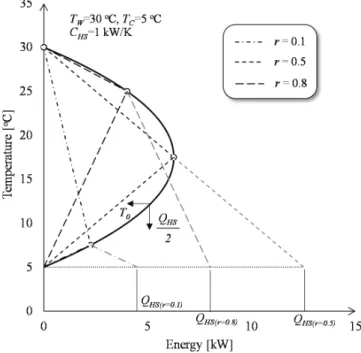
図2に式(4)で示される海洋熱エネルギーのT-E線図を示す.実線はT0をrを変化させて描いた曲線である.
T0の温度で表層海水および深層海水の温度は平衡となり,その際の海洋熱エネルギーは1/2QHSである.例 として,r = 0.1,0.5,0.8の場合のT – E 線図を破線で示す.式(4)から,QHSはr=1/2で最大となる.
2・2 熱効率の標準化
発電システムの特性を明らかにするため,図3に示すカルノー熱機関について検討する.本カルノー熱機関で は,理想的な熱交換器を行うと仮定し,モデルを単純化している.即ち,熱機関の動作温度と熱源である表層・
深層の海水の熱出口温度が一致すると仮定するため,
Fig. 1 Concept of reversible heat engine driven by high and low temperature streams.
Reversible heat engine W
QW
CW,TW TW,O
CC,TC TC,O
TH
TL QC
Surface
seawater Deep
seawater Adiabatic system
Fig. 2 Dead state temperature as function of ocean thermal energy in various ratio of the heat capacity of warm seawater.
��� ���������� � ������� (6) 断熱された系内では,熱力学第一法則から,熱機関が行う仕事Wは,
� � ��� ��� ������ ����� � �������� ��� (7) カルノー熱機関は可逆であるため,
∮ �� ����
� ����
� � � (8)
よって,式(7)は表層海水,海洋深層水の熱容量と表層海水または海洋深層水の熱交換器出口温度の3変数の関数 となる.この熱機関の熱効率は,
���� � ����
�=� �����
���� (9)
となり,式(6)~(9)から,熱機関の仕事はTW,OまたはTC,Oの関数となることから,任意の熱源流量において,
�� ��⁄ ���� �または�� ��⁄ ���� �の場合に熱機関の仕事は最大となり,その最大仕事Wmおよび熱効率th,CAは それぞれ式(1)および(2)で示される.この時の表層海水および深層海水の最適な出口温度差TW,O,opt,TC,O,optは,
��������� ������� �� � ���������� (10)
��������� ���������� �� � ������� (11)
図4に熱機関の仕事,および熱機関の熱効率と表層海水の交換熱量の関係を示す.図4から,熱機関の熱効率 は,熱源の出入口温度差の増加による交換熱量の増加と共に単調に低下する.これは,熱効率は熱交換時の温度 変化量が増加することにより,熱機関が利用可能な温度差(TH-TL)が低下するためである.一方、熱機関の仕事は 熱効率と熱量の積であるため,放物曲線を描き,式(2)の熱効率の際に仕事が最大となる.図4から,従来の熱効
Fig.3 Conceptual T - s diagram using ideal heat exchangers for energy transfer.
T
WT
CT
s T
W,OReversible heat engine
T
C,OT
HT
LFig.4 Concept of relationship between the temperature change of hot heat stream and thermal efficiency th, heat flow rate QH and power output W.
QH[kW]
th [%], W [kW]
Temperature change of surface seawater TW[K]
W Wm(Eq.(1))
th,CA (Eq.(2))
th
QW
率を用いる場合,熱効率と熱機関の仕事の傾向が異なり,熱効率と仕事の最大となる条件は一致しない.ここで,
OTECの発電システムにおいて,任意の熱源流量からより多くの仕事を得ることができれば,海洋熱エネルギー をより効率よく仕事に変換したことになる.エネルギー変換システムの性能は,熱機関の仕事が最大となる条件 で最大の効率となるべきであり,熱効率を標準化することで,熱効率と仕事が適切に対応した関係にする.
熱効率の標準化手法として,海水が保有する熱エネルギーから熱機関に集める熱エネルギーの割合である集熱 効率を考慮した、標準熱効率th,Norを下記の通り定義する,
ߟ௧ǡேൌொௐ
ೈ߰ௐൌொௐ
ಹೄ (12)
ここで,wは海洋熱エネルギーの中で熱機関に投入された熱量であり,
߰ௐൌொொೈ
ಹೄ (13)
式(12)、(13)を用いて,図3のカルノーサイクルの熱効率を標準化すると,
ߟ௧ǡேൌ ൬ͳ െ்்ǡೀ
ೈǡೀ൰ଶሺଵିሻಹೄ൫்ೈି்ೈǡೀ൯
ಹೄሺ்ೈି்ሻ (14)
ここで,式(1)の熱機関の最大仕事の場合のエネルギー変換の標準熱効率は,
ߟ௧ǡேǡൌଵଶඥ்ඥ்ೈିඥ்
ೈାඥ் (15)
図5に従来の熱効率,標準熱効率および熱機関の仕事の関係を示す.図5から,標準熱効率を用いることで,
熱機関の仕事と熱効率の傾向が一致し,標準熱効率の最大条件が熱機関の仕事の最大条件と一致している.標準 熱効率を発電システムの性能評価に導入することで,適切な熱機関の性能評価および性能比較が可能となる.
Fig.5 The trend of conventional thermal efficiency, normalized thermal efficiency and work output from the heat engine. In case TW=30 oC, TC=5 oC, CHS=1 kW/K, r=0.5.
3. エクセルギー効率
エネルギー変換の熱効率は熱源が保有する熱エネルギーを仕事に変換する割合を示すが,熱効率の大きさは熱 源の温度に依存するため,熱源が保有する熱エネルギーから仕事として変換し得るエネルギーについて,システ ム内でどの程度有効に利用できているかを表すためにはエクセルギーを用いた評価が有効である.これまで,
OTEC のエクセルギーについては,Jonson (1983)によって熱機関別に議論されているが,本検討では本来熱源が 保有するエクセルギーに着目し,検討を行う.即ち,熱源は,熱機関に熱を集約され,その温度が低下する際の 不可逆損失Sgenは(Bejan, 1996 and Salamon et al., 2001),
����� ������� ������� ������� ������
����������� �������
���� ���������
� � ������� ������
����������� ���������
���� �� � �����������
� � ������� ������ (16)
ここで,Sは熱交換時のエントロピー生成量,添字のTは温度変化に起因するもの,Pは圧力損失に起因する ものを示す.熱源の圧力損失によるエントロピー生成は熱交換器の仕様,海水の取水,配水にシステムによって 異なり,設置条件により大きく異なる.本検討では,理想的な熱機関によるエクセルギーを議論するため,ここ では,熱源の圧力損失によるエントロピー生成は無視する.
� ����⁄���� �により得られる仕事の最大値Wrev,mは,
�������������� � �� � ������
�������
������ (17)
��������� ��������� ������
����� (18)
ここで,TW,O,opt,TC,O,optはそれぞれ最大仕事Wrev,mとなる時の出口温度を示し,式(18)から両者は一致する.式(17)
はJohnson (1983)によって海洋熱エネルギーのポテンシャルとして提案されている.OTECで利用できる熱源の温
度範囲は,0℃~40℃程度であり,TC/TWは0.87程度で,一般的に表層海水と深層海水の熱容量流量比rは自由に 設計できることから,式(17)の仕事Wrev,mを最大とするrは約0.5となる. Wrev,mは理想的な可逆熱機関を利用し た場合にOTECでの熱源から得られる最大の仕事,即ちエクセルギーを以下として定義する,
������ ������������������������
������� �������� ����� ����� (19) よって,エクセルギー効率EXは以下で定義できる,
�������
������ �
� ������������ (20)
4. 考 察 4・1 標準熱効率の検証
図6に図1のモデルでのT-E線図を示す.T-E線図には,熱源から伝達された熱量と熱源の温度,熱機関の仕 事の関係が示される(Bejan, 1997).熱源が保有する熱エネルギーの一部は,熱機関により仕事Wに変換され,仕 事に変換されなかった熱エネルギーは熱機関外に排出される.仕事に変換されず,仮想的に系外に排出された熱 エネルギーをQHS,lossとすると,
ܳுௌǡ௦௦ൌ ܳுௌെ ሺܳௐെ ܳሻ ൌ ܳுௌെ ܹ (21) 排出された両熱源は,混合された熱平衡状態では温度T0'になる,
ܶᇱൌ ݎܶௐǡைሺଵିሻ் మ்்ೈǡೀ
ೈǡೀି்ೈ ൌ ܶௐݎ்்ೈǡೀ
ೈ ்்
ೈ
ሺଵିሻమೈǡೀೈ
ೈǡೀೈି ൩ (22)
OTECで利用する熱源の出入口温度変化量は小さく(TW,O/TW)≒1であるため,式(22)は式(15)と一致することか ら,
ܵ ൌொಹೄǡೞೞ்
బ (23)
図7に熱機関の温度差とエネルギー変換の熱効率,エントロピー生成量の関係を示す.図6から,エントロピ ー生成量が最小になる時に熱機関の仕事および標準熱効率が最大となることが分かる.図6から,エネルギー変 換の熱効率を用いる事で,温海水,冷海水の両熱源から熱機関が変換する仕事を適切に評価できていることがわ かる.また,熱機関の最大仕事とは,特定の熱機関で,外部への熱損失を最小にした状態を示すことがわかる.
これまで,最大仕事とエントロピ―生成量の最小値は Bejan (1996)を代表として多くの研究者が検討を行ってい る.しかし,最大仕事とエントロピー生成量の最小化が必ずしも一致しないという考察もあった.本検討では,
エントロピー生成量の最小化は,各エネルギーが保有するエネルギーの特性およびエクセルギーを適切に表現す ることで,仕事の最大化と一致する一例が示された.
Fig.6 Schematic model of power generation system and schematic T-E diagram shown the hypothetical energy loss TW
TC TC,O
TW,O
T0’ Reversible heat engine
Fig.1
TW
TC
E T
QW Wrev TC,O
TW,O
0 QC
T0’
1/2QHS,loss
1/2QHS
Collected thermal energy into heat engine
Unavailable thermal energy
Hypothetical energy loss
1/2QHS,loss
1/2QHS,loss
4・2 エクセルギーの検証
理想的な可逆熱機関の仕事Wrev,mは,無限段数の多段カルノーサイクルの最大条件と考えることが出来る.図8に 多段カルノー熱機関のT-s線図およびT-E線図の概念図を示す.N段のカルノーサイクルの最大仕事Wm,N、その 時の蒸発器交換熱量QW,opt,Nおよび凝縮器の交換熱量QC,opt,Nはそれぞれ,
ܹǡேൌ ܳௐǡ௧ǡேെ ܳǡ௧ǡே (24)
ܳௐǡ௧ǡேൌ ݎܥுௌቈܶௐെ ൜ݎܶௐಿభ ሺͳ െ ݎሻܶௐಿሺಿశభሻభ ܶಿశభభ ൠே (25)
ܳǡ௧ǡேൌ ሺͳ െ ݎሻܥுௌቈ൜ሺͳ െ ݎሻܶಿభ ݎܶಿሺಿశభሻభ ܶௐಿశభభ ൠேെ ܶ (26)
ܶௐǡ௧ǡேൌ ൜ݎܶௐಿభ ሺͳ െ ݎሻܶௐಿሺಿశభሻభ ܶಿశభభ ൠே (27)
ܶǡ௧ǡேൌ ൜ݎܶௐಿశభభ ܶಿሺಿశభሻభ ሺͳ െ ݎሻܶಿభൠே (28)
図9に多段カルノー熱機関のエクセルギー効率を示す.図9から,段数の増加とともに熱機関のエクセルギー 効率は増加し,2段の時67%,3段の時75%,約20段の時に95%となる.
図 10 に多段カルノー熱機関の熱源出口温度(式(27),(28))と式(18)に示す理想的熱機関の熱源出口温度を示す.
図10から,多段カルノー熱機関で熱交換した熱源の出口温度は,理想的熱機関の出口温度に漸近する.このこと から,式(17)の理想的熱機関の最大仕事は熱源の熱エネルギーを仕事に変換しうる最大の仕事,即ちエクセルギ ーであることが示される.このエクセルギーを基準としたエクセルギー効率は,熱源の保有するエクセルギーを 有効に仕事に変換した割合を示す指標となる.
5. 結言
本研究では,従来から広く用いられている熱効率を基準に,熱効率の標準化を提案するとともに,熱源が保有 する海洋熱エネルギーから理想的熱機関を用いて仕事に変換し得る有効エネルギーであるエクセルギーを新たに
Fig.7 Relationship between the normalized thermal efficiency and the temperature change in case TH =353.15 K, TL =300.15 K, CHS =1 kW/K and r = 0.5.
定義し,そのエクセルギーを用いたエクセルギー効率を提案することで,OTECの発電システムに適切な評価手 法を提案した.
・本検討では、温海水と冷海水の両熱源の平衡温度を基準とし,熱源が保有する熱エネルギーおよびその熱エネ ルギーを仕事に変換する場合のエネルギー変換熱効率を提案し,この評価指標の有効性を示した.
・一方,このエネルギー変換熱効率を最大化することは,任意の熱源流量で熱機関の仕事を最大化することであ り,エントロピー生成量を最小化することと等価であることを示した.
・熱源の温度差が保有するエネルギー量およびエクセルギー量を明確にし,熱機関の最大仕事とエクセルギーの 関係を明確にした.
・本提案によるエネルギー変換熱効率およびエクセルギー効率を用いる事で,OTEC 発電システムの適切な評価 や最適な設計につながる.
Fig.8 N-stage Carnot cycle heat engine, (a) schematic T-s diagram and (b) schematic T - E diagram.
TW
TC
E T
QW WN,max
0 QC
T0’=TW,O=TC,O TW
TC
T
s TW,O
TC,O
TH
TL
N-stage Reversible heat engine
Fig.9 Exergy of staging Carnot Cycle.
0.50 0.55 0.60 0.65 0.70 0.75 0.80 0.85 0.90 0.95 1.00
1 10 100 1000
Exergy Efficiency
Number of Stage
Fig.10 Heat source discharge temperature on staging Carnot cycle
Study on Pendulor Wave Power Converter for Coastal Operation of Sri Lanka
−Design of the Piston Pump for the HST (Hydro-Static Transmission) of the Pendulor−
Tomiji WATABE*1 and S.d.g.s.p. GUNAWARDANE*2 T-Wave Consultant*1, 5-23-3, Misono, Noboribetsu, 059-0036, Japan*1 Faculty of Engineering, University of Peradeniya*2,Peradeniya, 20400, Sri Lanka*2 Abstract
Pendulor is a moving body type Wave Power Converter. It can do an efficient power conversion though; its survivability hasn’t been enough in the stormy sea operation. The authors invented a new Pendulor which can treat the shock load safely by different way at the storm. The new Pendulor uses a hybrid piston pump as a component of the HST (Hydro-Static Transmission) for the conversion. This study is a case of 50kW Pendulor for Sri Lanka Coastal use. Since the cause of the trouble, begins from action of the restrictor which keeps the Pendulum stroke within a limit at the emergency. It is a stopper of huge moving mass. The new idea of exchanging the pump from a reciprocal type to a rotary type one, it also suggested a new technology. By the hint, we invented the hybrid piston pump. After that, the Pendulor is able to get the free stroke motion with the simpler system of the pendulum. The system also brought the sockless conversion toward the stormy condition. It can, not only contribute to the greater survivability, but also save cost of the electricity generated.
Key words: Pendulor, survivability, hybrid piston pump, slow speed high torque operation, E.H.L.
lubrication, speed up gear. 1. Introduction
The Pendulor device, it belongs to the moving body type conversion which is based on resonation and impedance match operation for the efficient power conversion(1). One of the problems is insufficient of the survivability against the storms. For this situation, we invented another Pendulor which is definitely safe by taking away the weak parts of the Pendulor by exchanging the motion style of the pump, from reciprocal motion to a rotary motion(2). Since the new Pendulor doesn’t use the stopper, there is no shock caused by the stopper. Therefore, the new wave power conversion can do no shock operation. The survivability shall be improved by applied with the piston pump invented for this purpose (Japanese Patent pending).We studied the pump as a Hybrid one suited to the Pendulor first, then the pump should work on the slow speed and high torque condition of more severe lubrication. In order to overcome the condition, we tried on the two new ideas on the pump parts; they are a piston and a shoe. A case of swash plate type axial piston pump designed for the HST of the 50kW Pendulor model of Sri Lanka Coast use was reported.
___________________________________________
Date of Manuscript Acceptance: 2017. 8.4
*1: Retired professor of Muroran Institute of Technology Japan, E mail: [email protected]
*2: Head of mechanical engineering, University of Peradeniya Sri Lanka, E mail: [email protected] 文 献
Takahashi, M., DOW: Deep Ocean Water as Our Next Natural Resources, Terra Scientific Publishing Company (2000) 沖縄県久米島町, 緑の分権改革推進事業久米島海洋深層水複合利用基本調査 調査報告書, (2011)
上原春男, 海洋温度差発電読本, オーム社, (1983)
Avery, H. W. and Wu, C., Renewable Energy from the Ocean, Oxford University Press, (1994), pp.401-413
上原春男, 池上康之, 西田哲也, 吸収と抽気作用を伴うサイクルを用いた海洋温度差発電システムの性能解析, 日 本機械学会論文集, B編, Vol.64, No.624, (1998), pp.384-389
Morisaki, T. and Ikegami, Y., Maximum power of a multistage Rankine cycle in low-grade thermal energy conversion, Applied Thermal Eng., Vol.69, (2014), pp.78-85
Morisaki, T. and Ikegami, Y., Evaluation of performance characteristics of multi-stage Rankine cycle based on maximum power, Proc. Int. Conf. on Power Engineering, Vol.15, (2015), 1154
Bejan, A., Advanced Engineering Thermodynamics, Wiley, New York, (1998)
Curzon, F. L. and Ahlborn, B., Efficiency of a Carnot engine at maximum power output, American Journal of Physics, Vol.
43, (1975), pp.22-24
Johnson, D. H., The Exergy of the Ocean Thermal Resource and Analysis of Second-low Efficiencies of Idealized Ocean Thermal Energy Conversion Power Cycles, Energy, Vol.8, (1983), pp.927-946
Ikegami Y., and Bejan, A., On the thermodynamic optimization of power plants with heat transfer and fluid flow irreversibilities, Transaction of ASME Journal of Solar Energy Engineering, Vol.120, (1998), pp.139-144
安永健, 池上康之, 門出政則, アンモニア/水を作動流体としてシェル&プレート式熱交換器を用いた海洋温度差 発電の性能評価(熱源の温度および流量の影響), 日本機械学会論文集, B編, Vol.74, No.738, (2008), pp.445-452 Ohman, H., and Lundqvist,P., Theory and method for analysis of low temperature driven power cycles, Applied Thermal
Engineering, Vol.37, (2012), pp.44-50
Ohman, H., and Lundqvist, P., Comparison and analysis of performance using Low Temperature Power Cycles, Applied Thermal Engineering, Vol.52 (2013), pp.160-169
Sinama, F., Martins, M., Journoud, A., Marc, O. and Lucas, F., Thermodynamic analysis and optimization of a 10 MW OTEC Rankine cycle in Reunion Island with the equivalent Gibbs system method and generic optimization program GenOpt, Applied Ocean Research, Vol.53, (2015), pp.54-66
Yoon, J., Seol, S., Son, C., Jung, S., Kim, Y., Lee, H., Kim, H., Moon, J., Analysis of the high-efficiency EP-OTEC cycle using R152a, Renewable Energy, Vol.105, (2017), pp. 366-373
Bejan, A., Models of power plants that generate minimum entropy while operating at maximum power, American Journal of Physics, Vol. 64, No. 8, (1996), pp.1054-1059
Salamon, P., Hoffmann, K. H., Schubert, S., Berry, R. S. and Anderson, B., What conditions make minimum entropy production equivalent to maximum power production, Journal of Non-Equilibrium Thermodynamics, Vol. 26, (2001), pp.73-83
Bejan, A., Graphic Techniques for Teaching Engineering Thermodynamics, Mechanical Engineering News, (1997), pp.26-28 Bejan, A., Entropy generation minimization, (CRC, Boca Raton, FL, 1996)